Aloe Vera Fertilizer Guide: Low-NPK Feeding & Schedule
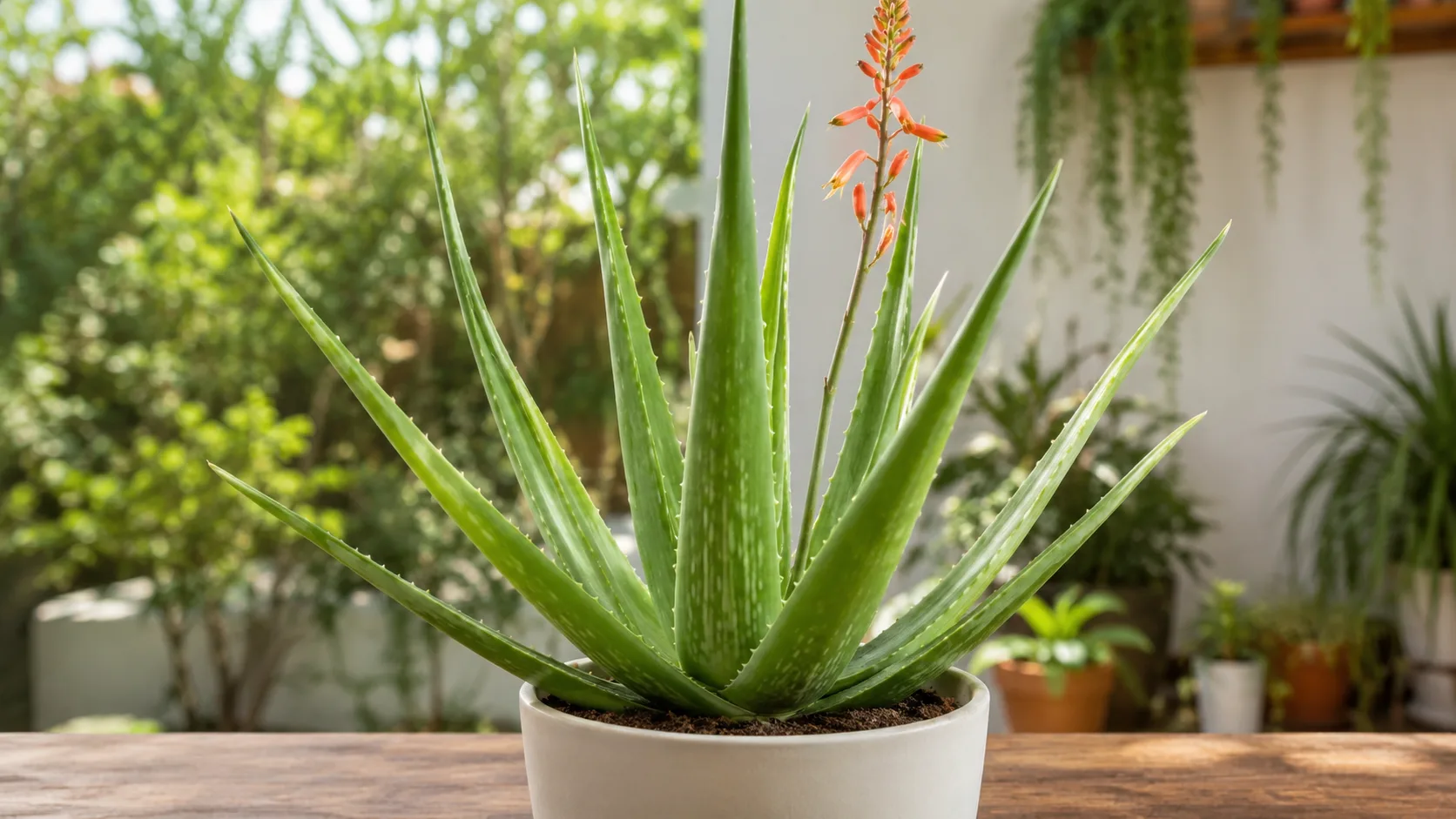
Aloe Vera Fertilizer Guide: Low-NPK Feeding & Schedule
Aloe Vera Fertilizer Guide: Low-NPK Feeding & Schedule
Aloe vera stores water and nutrients inside its thick leaves, evolved for lean desert soils where heavy feeding is rare and monsoon rains flush salts away. Indoors, that same plant sits in a small pot where every synthetic granule concentrates over months. Feed it like a hungry foliage plant and you get soft, weak growth, white salt crust on the soil, and crispy brown leaf tips that take a full season to grow out. The mismatch between how aloe lives in nature and how most houseplant fertilizers are formulated is the entire reason this guide exists.
Aloe vera fertilizer success is not about finding a magic bottle. It is about low-nitrogen NPK ratios, half- or quarter-strength dilution, and feeding only during active growth - typically once in early spring for most indoor pots, or two to three times across spring and summer for large outdoor specimens. Water onto moist soil only. Watch for the combination of dry brown tips and white crust on the mix surface - that pair is fertilizer burn, not thirst.
Reviewed by LeafyPixels Review Board · Author: sai-ananth
This page covers NPK ratios, fertilizer types, seasonal timing, application steps, and recovery from overfeeding. For the full care picture - light, soil, watering rhythm, and repotting - start at the Aloe Vera care overview.
Why Aloe Vera Barely Needs Fertilizer
Aloe vera - also sold as Aloe barbadensis on some labels - stores water and a fair amount of nutrients inside its fleshy leaves. In its native range across the Arabian Peninsula and dry parts of North Africa, soil is shallow, gritty, and mineral-rich but low in organic nitrogen. The plant grows slowly, holds resources internally, and pushes new leaves and pups only when light and temperature signal safety. South Dakota State University Extension states plainly that “no fertilizer is usually required to keep the plant healthy” for aloe houseplants.
The practical upshot: an aloe in reasonable cactus and succulent mix, repotted every two to three years, often needs no supplemental feeding at all. Penn State Extension covers propagation, light, and watering for aloe without listing a fertilizer recommendation - consistent with the plant’s low demand. The Royal Horticultural Society advises to “fertilise sparingly, using a general-purpose liquid food diluted to half the recommended strength” and to feed “once in the spring and again in late summer, avoiding over-fertilisation.”
Three honest reasons to fertilize anyway:
- Container mix depletes over time. Every watering leaches a little nitrogen and potassium through the drainage hole. After 12–18 months, the mix is genuinely lean.
- You want faster growth or more pups. A light spring feeding can push a slow, neglected aloe into producing offsets.
- You want a flower stalk. Mature outdoor aloes bloom in response to stress and age, not food alone - but a moderate spring feed helps a plant build reserves to try.
If none of those apply, skip fertilizer without guilt. That baseline is the safest place to start, especially for beginners.
What “Low-NPK” Actually Means for Aloe
“Low-NPK” in succulent care almost always means low first number - nitrogen (N) - relative to phosphorus (P) and potassium (K). That is the part that actually matters for aloe. High nitrogen pushes soft, watery leaf growth the plant cannot structurally support, and rapid cell division makes mealybug pressure and rot more likely.
Reading the NPK Label
Every fertilizer bottle in the U.S. lists three numbers in order: nitrogen, phosphorus (as P₂O₅), potassium (as K₂O). A “10-40-10” label means 10% nitrogen, 40% phosphorus, 10% potassium by weight. For aloe, you want the first number lower than or equal to the second and third. Clemson HGIC explains the same N-P-K labeling convention for indoor gardens.
- High-nitrogen products to avoid: “For foliage,” “all-purpose 20-20-20,” Miracle-Gro All Purpose (24-8-16), or any balanced formula where N ≥ P and N ≥ K.
- Low-nitrogen products to prefer: Cactus and succulent blends (typically 2-7-7, 1-3-3, or 0-5-5), African violet formulas with low N, or bloom-booster blends like 10-40-10 used at half strength or weaker.
Scan the ingredient list and avoid products that rely on urea or ammonium nitrate as the primary nitrogen source. Aloe roots are sensitive to those specific salts. Lower-nitrogen succulent formulas almost always use milder nitrogen forms, but checking the label is worth the ten seconds.
Best NPK Ratios for Aloe Vera (Comparison Table)
| NPK ratio | Typical dilution | Frequency (indoor default) | Best for |
|---|---|---|---|
| 2-7-7 or 2-4-8 | Half label strength | Once in early spring, or 2× season for large pots | Safest default; low N, strong P and K for roots |
| 1-3-3 or 0-5-5 | Half to quarter strength | Once in spring | Organic-leaning blends; near-zero N |
| 10-40-10 or 15-30-15 | Quarter to half strength | Once in spring only | Bloom-booster formulas; dilution non-negotiable |
| 10-10-10 (fallback) | Quarter strength | Once in spring, no more | Only if it is all you have on hand |
| 0.5-1-1 (succulent liquids) | Half to quarter strength | 1–3× per growing season | Miracle-Gro Succulent Plant Food and similar |
Gardener’s Path cites 2-4-8 as an ideal water-soluble ratio for aloe and recommends diluting any liquid feed to half strength. Clemson HGIC notes that water-soluble fertilizers are often preferred indoors because dilute solutions reduce burn potential - the same logic that makes quarter strength the safer choice when you are unsure.
The Best Fertilizer Types for Aloe Vera
The NPK ratio matters more than the delivery format, but the format changes how often you apply and how easy it is to overdo.
Liquid Succulent and Cactus Fertilizers
Liquid concentrates are the safest and most controllable option. You measure, dilute with water, and pour. The trade-off is remembering to do it. Look for cactus and succulent formulas with NPK where the first number is 2 or less - Miracle-Gro Succulent Plant Food at 0.5-1-1 is gentle by design. Balanced houseplant liquids work only when diluted aggressively.
The big advantage of liquids: you can adjust strength at the margin. Pale new growth after a lean year? One more feeding at half strength. Leaf-tip burn? Drop to quarter strength or skip the rest of the season. Foliar feeding is unnecessary for aloe - nutrients absorb through roots in moist soil; spraying fertilizer on leaves adds burn risk without benefit.
Slow-Release Granules and Spikes
Slow-release products - Osmocote Plus, generic succulent granules, Jobe’s spikes - release nutrients over one to three months. For aloe, apply half the label dose and break spikes in half before pushing them into the pot. Gardener’s Path recommends half the recommended dosage for aloes because full doses are calibrated for hungry foliage plants.
Granules work better for outdoor aloes in the ground, where rain leaches salts gradually. They are riskier for indoor plants in small pots because salt concentration rises in a confined volume with limited leaching.
Organic Options: Worm Castings, Compost, and Kelp
Organic options are the gentlest path and the hardest to overdo. The trade-off is lower nutrient density, so they work best as soil conditioners during repotting rather than as the primary feed.
- Worm castings (vermicompost): Roughly 1-0-0 with micronutrients and beneficial microbes. Mix one to two tablespoons into the top inch of soil in early spring, or work into fresh mix at repotting.
- Compost: Mature, fully broken-down compost is roughly 1-1-1. Top-dress with a half-inch layer in spring. Avoid fresh compost, hot manure, or unfinished compost - they hold too much moisture against the crown and invite rot.
- Compost tea or worm tea: Brewed castings steeped in water, applied as a soil drench at very low concentration.
- Kelp meal or liquid kelp: Very low NPK (often 1-0-2), rich in potassium and trace minerals. Excellent stress reducer after heat or a move. Sprinkle a teaspoon into the top inch of soil, or use liquid kelp at label strength once in spring.
- Fish emulsion: Usually 5-1-1 or 2-3-3 - high in nitrogen for aloe preferences. Dilute to quarter or half strength if you use it at all; most growers prefer kelp or worm castings instead.
- Powdered banana peel: A home gardener’s trick for phosphorus and potassium. Dry peels, grind to powder, sprinkle a teaspoon on soil in spring. Real effect is small; symbolic value is large. Gardener’s Path suggests mixing a teaspoon of dried banana peel or powdered seaweed into worm castings for a small P-K boost - one mention is enough; you do not need to layer multiple organic boosters.
Wear gloves when handling fertilizer and broken aloe leaves together - sap plus chemical residue can irritate sensitive skin.
When to Fertilize Aloe Vera (Seasonal Table)
The active growing season runs spring through late summer. The disagreement in the literature is how many feedings to pack into that window, not whether to feed in winter.
| Season | Aloe’s state | Fertilizer action |
|---|---|---|
| Late winter (Feb–Mar) | Waking up, light rising | Skip - wait for first signs of new growth |
| Early spring (Mar–Apr) | Active growth begins | First feeding of the year (any schedule) |
| Late spring / early summer (May–Jun) | Peak growth | Optional second feeding (multi-feeding schedules only) |
| Mid to late summer (Jul–Aug) | Growth tapering in heat | Optional third feeding only if plant is clearly still pushing new leaves |
| Early fall (Sep–Oct) | Slowing down | Stop. No more fertilizer. |
| Winter (Nov–Feb) | Dormant | Do not fertilize, period |
Clemson HGIC is clear that during short winter days, “many indoor plants that receive little or no artificial light enter a ‘resting stage.’ If plants go into a winter rest period, do not give them fertilizer.”
Grow-light exception: An aloe under strong supplemental grow lights that keeps producing new leaves through winter may take one light feeding every six to eight weeks at half strength - watch closely for salt crust. Skipping winter feeds is still safer than forcing growth with nutrients the roots cannot process.
The One-Annual Spring Feeding Approach
The conservative, lowest-risk approach - and the default this guide recommends for typical indoor aloes - is to feed once a year in early spring, just as the plant wakes up. Half-strength liquid succulent fertilizer in March or April tops off what the previous year’s watering leached out and carries the plant through the growing season. Missouri Botanical Garden describes aloe as low-maintenance with minimal winter watering needs, consistent with a single light spring feed rather than a monthly calendar.
Pick this schedule if:
- Your aloe is in a 6-inch or smaller pot with average light.
- You repotted within the last 12 months.
- The plant is a mature, slow-growing specimen that needs maintenance only.
The 2–3 Times Per Growing Season Approach
The more aggressive approach - used by many commercial growers and cited by Gardener’s Path - is to feed two to three times spread across spring and summer at half strength. That source advises limiting water-soluble applications to once a month during the growing season and slow-release granules to two applications: early spring and early summer.
Pick this schedule if:
- Your aloe is in a large container (10 inches or more) with depleted mix.
- It is an outdoor plant in USDA zones 10–12 in the ground or a big patio pot (NC State Extension lists zones 10a–12b for outdoor culture).
- You want faster growth, more pups, or a bloom attempt.
- The plant looks actively hungry - pale new growth, slow summer push, light green color.
Space feedings at least six to eight weeks apart. More often than that and salt accumulates faster than the plant can use it.
How to Apply Fertilizer Without Burning the Roots
Even the perfect NPK ratio burns aloe roots if applied wrong. Two rules prevent most damage: dilute harder than you think, and water first.
Dilution Ratios and “Half Strength” Explained
“Half strength” means mixing at 50% of the dose printed on the label. “Quarter strength” means 25%. Most aloe-care guidance recommends half strength as a starting point and quarter strength for any fertilizer whose first NPK number is above 5.
Worked example: if the bottle says 1 teaspoon per gallon for full strength, mix ½ teaspoon per gallon for half-strength aloe feeding. If the bottle says 1 tablespoon per gallon and the formula is 10-40-10, mix 1 teaspoon per gallon - roughly quarter strength.
A useful rule: if you are not sure whether to use half or quarter strength, use quarter. The cost of underfeeding aloe is zero visible damage. The cost of overfeeding is leaf burn that takes a full season to grow out.
The Water-First, Then-Feed Rule
Never pour fertilizer onto dry soil. Dry soil concentrates salts at the root zone where they cause the most damage. Clemson HGIC warns that soils with white film on the surface or white crust on the pot rim may indicate overfertilizing, and that salt buildup can lead to root damage with symptoms including reduced growth, brown leaf tips, and wilting.
Standard procedure:
- Water the plant normally the day before, or at least several hours before, with plain water. Let it drain.
- Mix the fertilizer at half or quarter strength in a separate watering can.
- Pour the solution slowly over moist soil, distributing it around the entire surface - not in one spot.
- Do not water again until the soil dries to its normal soak-and-dry cycle - usually two to three weeks depending on pot size and light.
Additional habits that reduce risk:
- Avoid the crown. Do not pour fertilizer into the rosette center where it pools against emerging leaves.
- Apply in the morning so splashes on leaves dry before evening.
- Skip feeding in extreme weather. No fertilizer on heat-stressed plants above 95°F or cold-stressed plants below 55°F.
- Do not feed a freshly repotted plant. Wait at least four to six weeks after repotting for roots to recover.
Signs of Over-Fertilization in Aloe Vera
Over-fertilization is the single most common avoidable problem with indoor aloe. Symptoms are distinctive and appear before the plant dies - but they are often misdiagnosed as underwatering on Aloe Vera (the plant looks thirsty) or sunburn (brown patches).
The underlying mechanism: when salt concentration in soil rises above the concentration inside root cells, osmosis reverses - water moves out of the roots and into the soil. The plant dehydrates from the inside while sitting in moist soil. University of Maryland Extension links excessive fertilizer to brown leaf tips and margins, reduced growth, lower leaf drop, and white crust on potting media. South Dakota State University Extension lists “excessive salt build-up on soil, which may look like a white, crusty layer” and “browning leaf tips and margins” as textbook signs of too much fertilizer.
Leaf Symptoms vs. Soil Symptoms
The cleanest diagnosis looks at leaves and soil together.
Leaf symptoms (in order of appearance):
- Crispy, dry brown leaf tips and margins - always dry, never mushy. The signature symptom.
- Yellowing of older, lower leaves while newer leaves stay green.
- Sudden leaf droop or shrinkage even when soil is moist - roots cannot take up water.
- Elongated, soft, weak new growth without the firm upright shape aloe should have.
- Leaf drop in severe cases.
Soil and pot symptoms:
- White, crusty mineral deposit on the soil surface, pot rim, or outside of terracotta pots.
- Hard, compacted soil surface that repels water.
- A sour or chemical smell in severe cases, often with soggy soil.
Differentiating from other problems:
- overwatering on Aloe Vera causes mushy brown leaves starting at the base; soil stays wet for weeks. Fertilizer burn starts at tips; leaves stay dry.
- Sunburn causes bleached, papery patches on the sun-facing side - not the tip-and-margin pattern.
- Underwatering causes shriveled, thin leaves with inward-curling tips - not outward-browning brittle tips.
How to Fix an Over-Fertilized Aloe Vera
Recovery is possible in most cases. Steps differ by severity.
Mild cases (a few crispy tips, light salt crust):
- Stop fertilizing for the rest of the growing season and the entire next one.
- Leach the pot by watering slowly with distilled, rainwater, or filtered water at twice the pot’s volume. Let it drain completely, repeat once more after 10 minutes. University of Maryland Extension recommends flushing with clear water at a volume at least equal to the pot size, repeated several times.
- Scrape off the salt crust and replace with fresh top-dressing of plain cactus mix.
- Wait. New growth normalizes within one to two months. Trim brown tips cosmetically - damaged tissue will not recover.
Moderate cases (multiple browned leaves, persistent crust, drooping despite moist soil):
- Unpot and shake or rinse old soil off roots.
- Inspect roots. Healthy aloe roots are pale, firm, and slightly fuzzy. Salt-burned roots are dark, soft, or papery.
- Trim damaged roots with clean scissors back to healthy white tissue.
- Rinse the root mass in room-temperature water to wash residual salts.
- Repot in fresh, fast-draining cactus mix with a drainage hole. Wait five to seven days before watering.
- Do not fertilize for at least three to six months.
Severe cases (mushy crown, fully rotted center):
Severe fertilizer burn combined with rot is often fatal. If the crown is still firm, follow moderate-case steps. If the crown is mushy, propagation from healthy offsets is the realistic path. Discard leaves intended for topical or internal use - salt-stressed gel is not safe.
Going forward: stick to once-a-year or twice-a-year feeding at half or quarter strength, leach the pot with plain water every four to six months if you use synthetic fertilizer, and switch to organic amendments if the problem recurs.
Special Cases: Low Light, Recently Repotted, and Stressed Plants
A few situations break the standard schedule:
- Low light. An aloe in a north-facing window or dim corner grows slowly and uses very little nitrogen. Skip fertilizer entirely. South Dakota State Extension notes that insufficient light makes the plant leggy with weak leaves - adding fertilizer makes it worse, not better.
- Recently repotted (within six weeks). Fresh cactus mix carries enough nutrients for months. Wait for active new growth before feeding.
- Stressed or recovering plants. Skip fertilizer until the plant pushes new leaves - including recovery from over-fertilization, root rot on Aloe Vera, sunburn, cold damage, or pests.
- Outdoor aloes in active growth. In zones 10–12, the multi-feeding two-to-three-times-per-season schedule at half strength is appropriate. Outdoor soil volume dilutes salts faster than a small indoor pot.
- Aloes you are trying to bloom. Stop fertilizing in late summer. Mature outdoor aloes (four or more years) bloom in response to cooler nights and reduced water in fall - not from heavy feeding.
- Aloe pups. Do not fertilize offsets separately in tiny pots. Feed the mother plant lightly at repotting time when pups share the root zone, or wait until pups are in their own pots with established roots.
Aloe Gel Safety After Fertilizer Stress
Aloe gel from healthy leaves is widely used topically, but salt-stressed or fertilizer-burned tissue is not safe for skin or ingestion. The yellow latex (aloin) just under the leaf skin is an anthraquinone glycoside that causes contact dermatitis in some people and gastrointestinal distress if swallowed. NC State Extension lists abdominal cramping, diarrhea, and skin irritation from latex as poisoning symptoms. The ASPCA classifies aloe as toxic to cats and dogs through ingestion.
Do not consume aloe gel from a plant showing fertilizer burn, salt crust, or stress symptoms. If aloe gel or latex is ingested - especially by a child or pet - contact a physician or veterinarian promptly. Fertilizer salts in stressed tissue are not filtered out by rinsing the cut surface. Keep fertilized aloe out of reach of pets; ingesting fertilized soil can compound toxicity.
Conclusion
Aloe vera is a low-demand plant, and the safest feeding strategy respects that. A low-nitrogen, phosphorus-and-potassium-leaning NPK ratio - 2-7-7, 1-3-3, or 10-40-10 at quarter to half strength - applied once in early spring for typical indoor pots (or two to three times across the growing season for large outdoor specimens), stopped completely in fall and winter, is the entire rulebook. Pair that with water-first application, a watch for dry brown tips plus white soil crust, and a willingness to skip feeding when the plant is dormant, freshly repotted, or sitting in low light. A lightly fed aloe in bright light and fast-draining mix will outlast a heavily fed one in the same window by years.
When to use this page vs other Aloe Vera guides
- Aloe Vera overview - Start here for whole-plant context before deep-diving this topic.
- Aloe Vera problems hub - Jump to symptom-specific fix guides when this care topic does not resolve the issue.