Calathea Care Guide: Light, Water, Soil and Humidity Tips
Keep Calathea leaves healthy with practical advice on indirect light, watering, humidity, soil and common leaf problems.
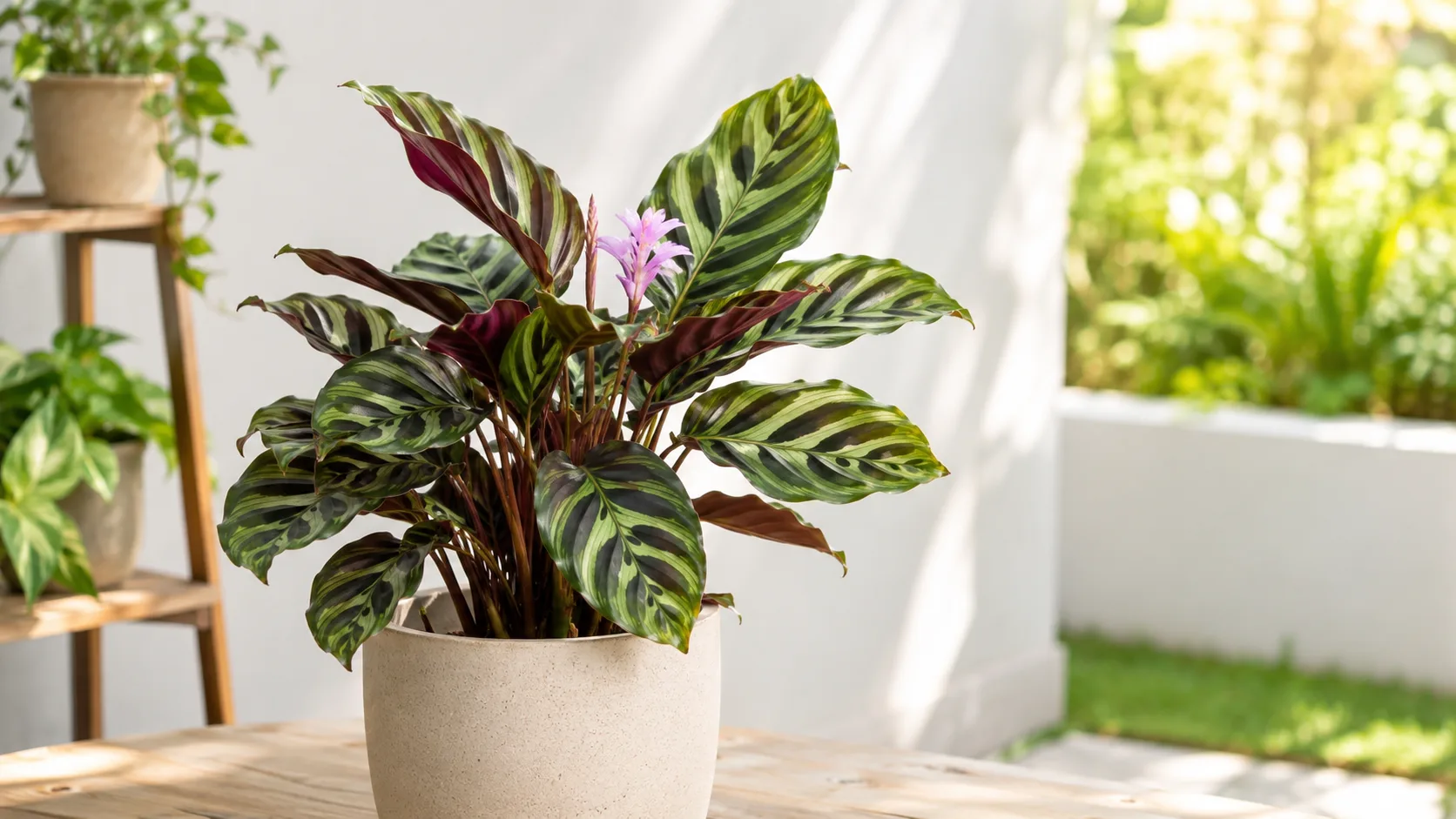
Calathea Care at a Glance
Calathea care succeeds when the room stays stable. These tropical understory plants want bright indirect light, evenly moist but never soggy soil, humidity closer to 50–60% or higher, warm steady temperatures, and protection from harsh sun, cold drafts, and mineral-heavy water. They are not impossible indoors, but they are not relaxed either. A calathea usually complains quickly when one variable swings: brown edges, curled leaves, faded patterns, yellowing foliage, or stalled growth.
Most houseplants forgive a missed watering or a dry weekend. Calatheas are less forgiving because they evolved under filtered rainforest light with steady moisture and humid air. North Carolina Extension describes several commonly grown Goeppertia types - still sold as calatheas - as plants that prefer bright indirect light or partial shade, moist well-drained mix, warm temperatures, and high humidity. (NC State Extension)
The practical rule: do not let calathea swing between extremes. Do not bake it in a sunny window, then drown it because the leaves curled. Do not let the pot sit in water, then compensate by letting the mix go bone dry. Boring consistency beats heroic rescue.
| Care factor | Best range or method | What to avoid |
|---|---|---|
| Light | Bright indirect or partial shade | Strong direct afternoon sun |
| Water | Water when top inch begins to dry | Soggy soil or hard drought cycles |
| Humidity | About 50–60% RH or higher | Dry heating-season air, AC drafts |
| Temperature | Steady 65–80°F (18–27°C) | Cold windows, sudden swings |
| Soil | Moisture-retentive, well-draining mix | Dense, compacted potting soil |
| Feeding | Monthly at half strength in active growth | Heavy winter feeding |
| Propagation | Division of mature clumps | Leaf cuttings in water |
Many plants still labeled Calathea are botanically Goeppertia after a 2012 molecular phylogeny split the old genus. (BioOne - Systematic Botany) For everyday care, the rename changes nothing: same warmth, humidity, filtered light, and careful watering.
How This Guide Relates to Our Calathea Hub
Use this page as an environment setup checklist - the four variables that must be right before symptom guides make sense. For phylogeny depth, Marantaceae comparisons, fertilizing schedules, and 16 dedicated problem pages, start at the canonical Calathea care hub.
This guide consolidates light, water, soil, and humidity in one read. The hub delegates when you already know something is wrong:
- Calathea watering - seasonal rhythm and dry-down triggers
- Calathea light - window placement and grow-light distances
- Calathea soil - mix ratios, pH, and repot timing
- Calathea propagation - division steps and recovery
- Problem guides such as brown tips, low humidity, root rot, and yellow leaves
If general watering logic is new to you, pair this guide with how to water indoor plants the right way and houseplant humidity basics.
What Calatheas Need Indoors
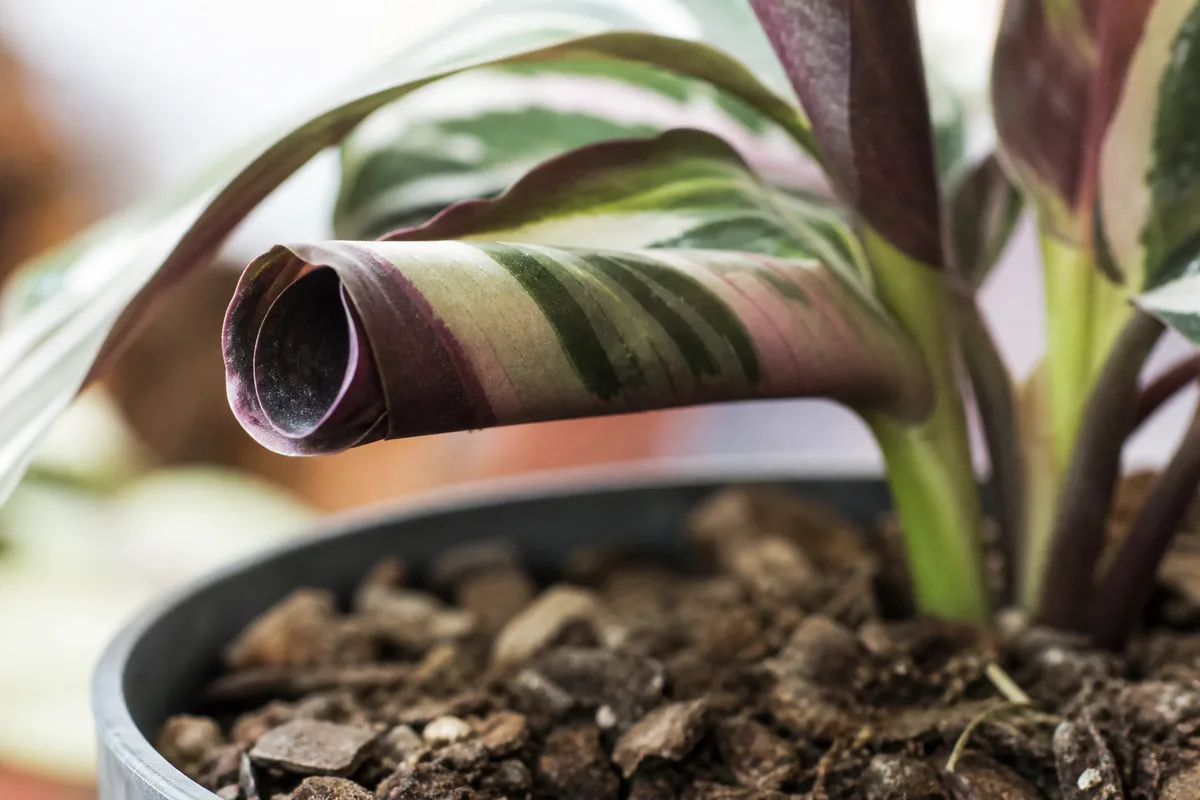
A healthy calathea looks alert: firm patterned leaves with slight daily movement. Many types fold or lift leaves at night and reopen with daylight - nyctinasty tied to light and temperature cues. NC State Extension notes this behavior in Goeppertia insignis (rattlesnake plant) and Goeppertia makoyana (peacock plant). (Goeppertia makoyana profile)
Gentle nightly lift differs from stress curl: tight rolling through the day, dry-feeling margins, or collapse. Diagnose in order: light, soil moisture, humidity, temperature, water quality, roots, pests.
Light
Calatheas want bright indirect light, not darkness and not full sun. “Low light plant” is one of the most misleading nursery labels. They tolerate dim corners better than sun lovers, but tolerance is not thriving. In deep shade, growth slows, patterns fade, and soil stays wet longer - raising overwatering risk.
Safest placement: near an east-facing window, a few feet from a bright south or west window, or behind a sheer curtain. Early morning sun is usually fine; harsh afternoon rays scorch thin leaves. The RHS recommends a bright spot out of direct sunlight. NC State notes rattlesnake plant tolerates early morning or diffused sun but not full sun. (Goeppertia insignis profile)
Bleached patches or crispy sun-facing zones mean pull back. Lean, smaller pale leaves mean more brightness - but move gradually. A stressed plant does not need a jump from a dark shelf to a blazing sill.
Grow lights help in dark apartments. Keep full-spectrum LEDs 12 to 18 inches above the canopy for 10 to 12 hours daily, and maintain a consistent day-night rhythm.
Water
Calathea soil should stay evenly moist, not wet. “Moist” does not mean “water often.” Roots need oxygen and moisture at once - a damp sponge, not mud.
The RHS advises keeping compost evenly moist in active growth, allowing the surface to dry before rewetting in autumn and winter, and never letting compost dry out completely - while warning that roots standing in collected water can rot. (RHS Calathea growing guide)
Check before watering: press one inch into the mix. If wet, wait. If slightly dry at the top but cool below, water thoroughly until excess drains, then empty the saucer. Pot weight and leaf behavior matter as much as a calendar. Winter’s lower light slows water use; a summer schedule can become overwatering by November.
Humidity
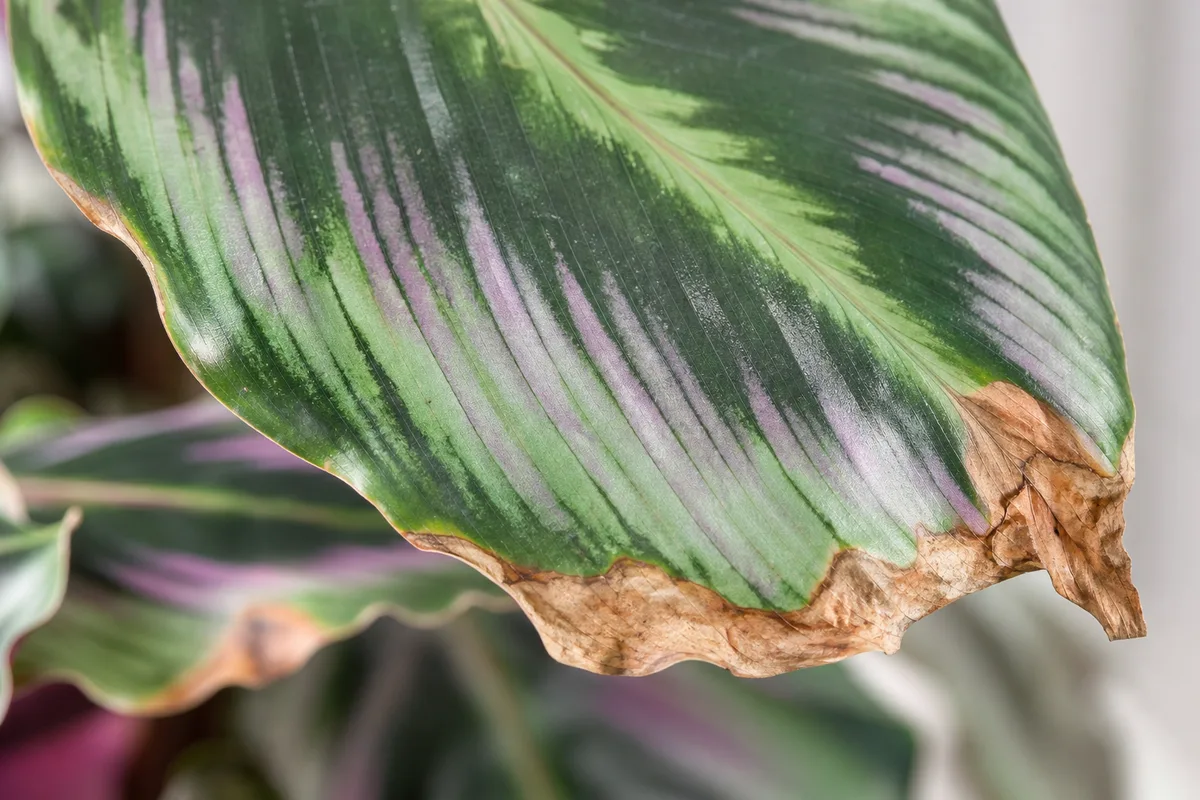
Many calathea problems blamed on “bad watering” are dry-air problems. Brown edges, crispy tips, curling margins, and spider mite pressure worsen when humidity stays low.
NC State profiles cite 50 to 60% humidity for Goeppertia fasciata and about 60% for Goeppertia makoyana and pinstripe types. (Goeppertia fasciata profile) A humidifier is the most dependable fix. Pebble trays and plant grouping add modest local moisture; they rarely replace a humidifier in a dry heated room. Misting wets leaves briefly, not the air - overrated as a primary strategy, and wet foliage overnight in stagnant air can invite spotting.
Bright bathrooms and kitchens can work when light is adequate. A dark bathroom is still a poor location. Measure with a cheap hygrometer: if readings sit below 40% for weeks, expect edge damage on thin-leaved types eventually.
Temperature
Calatheas are warm-room plants. NC State gives roughly 65–75°F for rattlesnake and peacock types; Goeppertia fasciata prefers 70–85°F. (Goeppertia insignis profile)
Stability beats the exact number. Avoid exterior doors, leaky winter windows, radiators, fireplaces, and AC vents blasting across leaves. If you feel a draft on your skin, the plant feels it too.
Best Soil and Pot Setup
Wrong soil turns every watering into a gamble. Dense mix suffocates roots. Pots without drainage trap water. Oversized pots keep a large volume of mix wet around a small rootball - a classic path to yellow leaves and fungus gnats.
Potting mix
Target a mix that holds moisture yet drains freely. NC State describes peacock plant as preferring moist, well-drained potting mix with high organic matter and perlite; African violet-style mix works for some Goeppertia types. (Goeppertia makoyana profile)
Practical home recipe:
- 2 parts quality indoor potting mix or coco-coir base
- 1 part perlite or pumice
- 1 part fine orchid bark or chunky coco chips
Adjust to your room: slightly less aeration in very dry warm homes; more perlite in humid, dim, or cool rooms so the pot dries at a safe pace. Avoid heavy garden soil indoors. Very chunky aroid mixes may dry faster than calathea roots prefer.
Pot choice and drainage
Drainage holes are non-negotiable. Cachepots are fine only if the inner pot drains fully and you dump excess water. The RHS specifically warns to tip away water collected in cover pots because standing roots rot. (RHS Calathea growing guide)
Plastic nursery pots hold moisture longer than terracotta - useful in dry rooms. Do not overpot: move up one size unless the rootball is truly crowded. See Calathea repotting for timing and step-by-step depth.
Calathea Watering Routine
A strong routine is a repeatable decision process: water before drought stress but after the top layer has dried enough for oxygen to return.
Calatheas usually need more water in bright warm months and less in darker cooler months. The RHS recommends monthly feeding during growth and avoiding autumn and winter feeding - the same seasonal slowdown affects watering frequency. (RHS Calathea growing guide)
How to check moisture
Start with your finger one inch deep. Wet - wait. Slightly dry at that depth with a lighter pot - water until excess drains, then empty the saucer.
Moisture meters can help as a second opinion; cheap probes misread chunky mixes. Pot weight, leaf curl, and recent room conditions all matter.
Bottom watering helps a very dry rootball rehydrate evenly: sit the nursery pot in shallow water 15–30 minutes, drain fully, do not soak for hours. Still flush from the top occasionally if salts accumulate.
Best water types
Calatheas are sensitive to water quality. Mineral-heavy tap water can contribute to brown tips over time. NC State notes some Goeppertia species react to fluoride in tap water and recommends distilled or rainwater. (Goeppertia fasciata profile)
The RHS gives a moderate view: houseplants generally prefer rainwater; calatheas may tolerate tap water left standing 24 hours for chlorine. (RHS Calathea growing guide)
University of Maryland Extension adds that mineral buildup from tap water and fertilizer salts can affect calatheas; repotting or reducing fertilizer can reset the root zone. (University of Maryland Extension)
If your plant is healthy on tap water, do not create a problem that does not exist. If brown tips persist despite good humidity and timing, switch to rainwater, filtered, or distilled water for several months and reduce feeding.
Common Calathea Problems
Most failures trace to a short list: dry air, inconsistent watering, mineral buildup, direct sun, cold drafts, poor drainage, pests, or overfertilizing. Different problems look similar - diagnose before reacting. Do not treat every symptom with more water.
For step-by-step symptom depth, use the hub problem guides linked below rather than guessing from leaf color alone.
Brown edges
Brown calathea edges are a stress record. Damaged tissue will not turn green again; fix the environment so new leaves stay clean.
Common causes: low humidity, inconsistent watering, mineral or fertilizer salts, direct sun, drafts, and fluoride in tap water. NC State notes browning or curling edges from low humidity, sun burn, and fluoride sensitivity in peacock plant. (Goeppertia makoyana profile)
Use this checklist:
- Humidity - below 40% for weeks? Raise with a humidifier; see low humidity on Calathea.
- Watering rhythm - alternating soggy and bone dry? Stabilize checks; see underwatering and overwatering.
- Water and fertilizer - hard tap or heavy feeding? Flush or switch water source.
- Light and drafts - scorch or desiccation from sun or HVAC?
- Pests - fine stippling on undersides? Inspect for spider mites.
Trim brown edges with clean scissors following the leaf shape. Partly damaged leaves still photosynthesize.
Curling and yellow leaves
Curling often means the plant is reducing moisture loss: dry soil, low humidity, sun, cold, or pests. Some nightly movement is normal; tight daytime rolling needs attention.
Check soil first. Dry and light - water thoroughly and raise humidity. Wet with curl or yellow - do not add water; inspect drainage and roots.
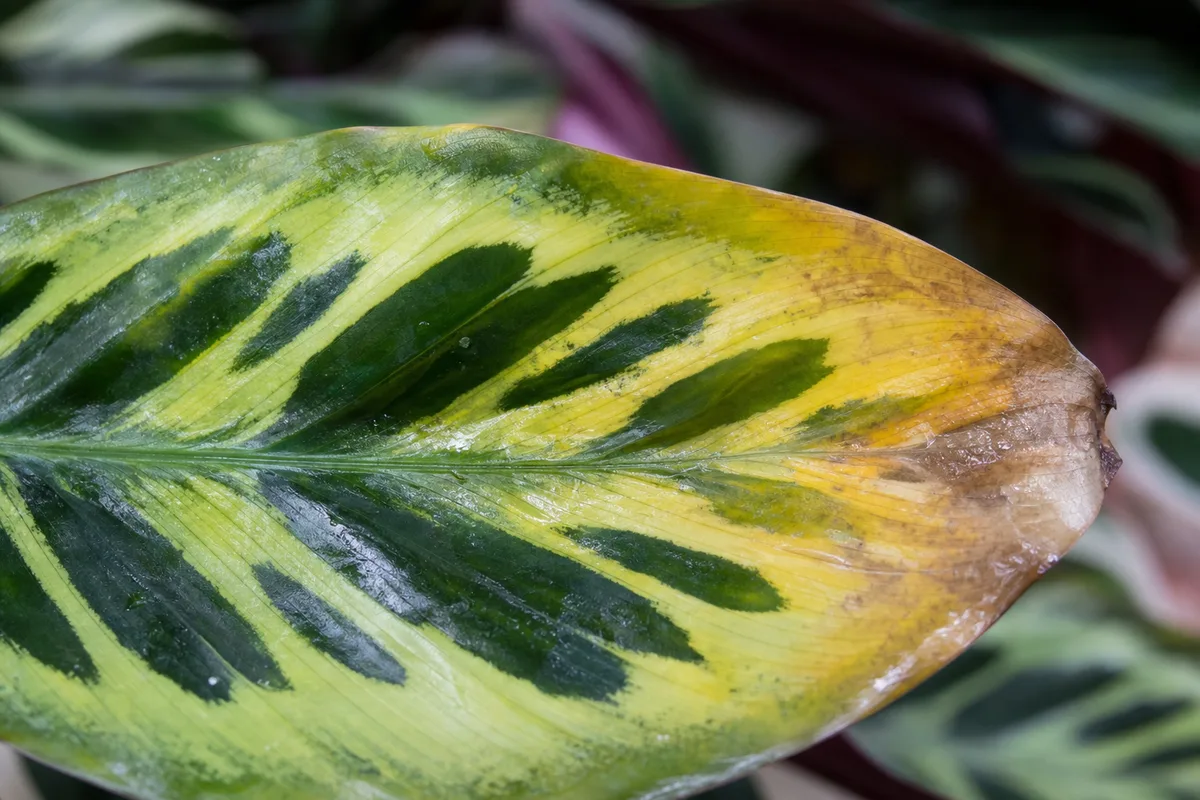
Yellow leaves need context. One older lower leaf occasionally yellows naturally. Several at once with constantly wet soil suggest overwatering or poor drainage. Dry crispy curl suggests underwatering or dry air. Dim corners slow growth and keep soil wet longer. NC State notes yellowing from both under- and overwatering, with overwatering leading to root rot. (Goeppertia insignis profile) See yellow leaves on Calathea and drooping leaves.
Pests and root rot
Spider mites thrive in dry indoor air. University of Maryland Extension notes spider mites as common indoor pests in lower humidity. (University of Maryland Extension) Inspect leaf undersides for speckling, webbing, sticky residue, or distorted new growth. Treat early; test sprays on one leaf because calatheas can be sensitive to some products.
Root rot starts when soil stays wet too long: yellowing, limp growth, sour smell, fungus gnats, wilt despite wet mix. Confirm by inspecting roots - firm and pale versus mushy and dark. Trim rot with sterilized scissors, repot into fresh airy mix, reduce watering, withhold fertilizer until stable. Full protocol: root rot on Calathea.
Propagation, Repotting, and Seasonal Care
Calatheas propagate by division, not leaf cuttings. A leaf in water will not grow without rhizome and roots. The RHS recommends dividing clumps in spring into sections with several leaves, keeping divisions warm, humid, and moist until growth resumes. (RHS Calathea growing guide)
Best timing: spring or early summer. Water the day before, separate natural clumps with roots attached, and avoid splitting a weak plant into tiny pieces. After potting, maintain bright indirect light and upper-range humidity.
Repot when rootbound, mix has broken down, water runs straight through, or salt buildup is suspected - often every one to two years. University of Maryland Extension notes periodic repotting helps reset salt levels. (University of Maryland Extension)
Feed lightly: monthly balanced liquid fertilizer at half strength during active growth; pause in autumn and winter per RHS guidance.
Dust broad leaves gently with a damp soft cloth - NC State notes dust slows photosynthesis. (Goeppertia insignis profile)
Winter care: reduce watering frequency, stop feeding, protect from cold glass, and run a humidifier through heating season. Lower light means slower water use - the biggest seasonal trap is summer watering on a winter schedule.
Pet Safety and Best Varieties
The ASPCA lists Calathea spp. as non-toxic to dogs, cats, and horses. (ASPCA Calathea listing) Non-toxic does not mean edible - chewing leaves can upset a pet’s stomach and damage the plant. Contact your veterinarian if a pet ingests a large amount or shows persistent vomiting, drooling, or distress.
Not every calathea is equally forgiving indoors:
| Variety | Beginner rank | Humidity need | Leaf sensitivity | LeafyPixels guide |
|---|---|---|---|---|
| Rattlesnake plant (G. lancifolia) | Easier | Moderate | Narrow leaves, more forgiving | Overview |
| Peacock plant (G. makoyana) | Moderate | High (~60%) | Thin, shows water stress fast | Overview |
| Pinstripe (G. ornata) | Moderate–hard | High (~60%) | Brown edges with dry air or hard water | Calathea hub |
| Medallion (G. veitchiana) | Moderate | High | Round leaves, draft-sensitive | Overview |
| Orbifolia | Moderate | High | Large round leaves need bright indirect light | Overview |
| Rose-painted (G. roseopicta) | Moderate–hard | High | Variegation fades with stress | Overview |
For beginners, choose a healthy rattlesnake or zebrina-type plant over a rare high-variegation cultivar. Look for firm leaves, active new growth, no webbing, no sour soil smell. If your home stays dry and you will not run a humidifier, calathea may survive but rarely look pristine - pick tolerance over pattern ambition.
Next Steps: Deeper Calathea Guides
Once your environment checklist is in place, use the hub for ongoing care:
- Calathea care hub - overview, taxonomy, and cluster navigation
- Calathea watering - seasonal rhythm and soak-and-drain technique
- Calathea light - window placement and grow-light setup
- Calathea soil - mix recipes and repot signals
- Calathea propagation - division timing and recovery
Related guides
- How to water indoor plants the right way - general dry-soil logic that applies to calatheas
- Houseplant humidity guide - humidifier sizing and measurement
- Why houseplants struggle in winter - seasonal dryness and watering traps
- Do pebble trays really increase humidity? - realistic expectations vs. humidifiers
Conclusion
Calathea care becomes manageable when you treat the plant as sensitive to swings, not mysterious. Build the environment first: filtered light, steady moisture, 50–60% humidity where possible, drainage, and gentle feeding. Most failures come from extremes - too much sun, too much water, too little humidity, cold drafts, hard water buildup, or dense soil.
If you remember one rule: check soil before watering, drain fully after watering, and use the Calathea hub when symptoms outgrow a setup checklist. A calathea will rarely be as carefree as a pothos. In return, you get foliage with movement, pattern, and character few houseplants match - when the room stays stable.