Low Humidity on Calathea: Causes, Checks & Fixes
Quick answer
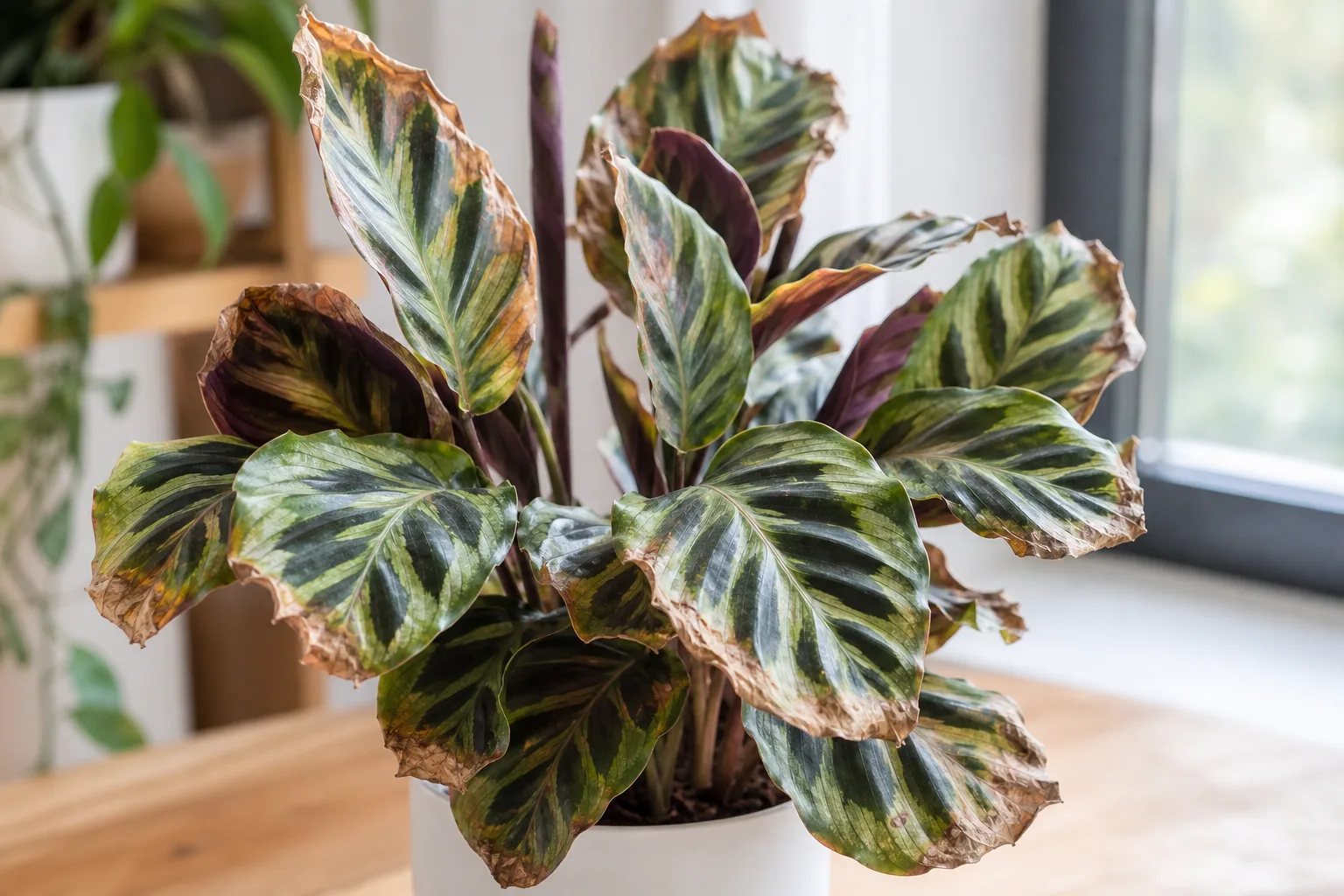
Low humidity on Calathea shows as crispy leaf margins, brown tips, slow unfurling, and daytime curl while soil moisture is adequate. Target 50–70% RH at canopy level. First step: place a hygrometer beside the pot and run a humidifier within 3–5 feet until readings hold in range.
Low Humidity on Calathea: Causes, Checks & Fixes
This guide covers low humidity on Calathea. See also the general Low Humidity guide, watering, and light pages for this plant.
Low Humidity on Calathea: Causes, Checks & Fixes
Quick answer
Low humidity on Calathea (Calathea / Goeppertia prayer plants) shows up as crispy leaf margins, brown tips, slow or stuck leaf unfurling, and daytime leaf curl even when soil moisture is technically adequate. These are thin-leaved Marantaceae plants from humid rainforest understories-they lose water through transpiration faster than succulents or snake plants when room air stays dry.
First step: place a hygrometer at canopy height beside the pot and read relative humidity for 24 hours. If readings stay below 50%, run a humidifier within 3 to 5 feet (1 to 1.5 m) until the plant zone holds 50–70% RH. Do not repot, fertilize, or change watering on the same day you add humidity-make one environmental correction and judge the next one or two new leaves.
For genus-wide humidity targets, winter heating context, and misting limits, see Calathea overview. For sun-facing bleaching that mimics crisp edges, see Calathea light. For fluoride-driven tip burn that overlaps dry air, see brown tips.
What low humidity looks like on Calathea
Healthy Calathea leaves feel supple, unfurl cleanly from rolled spears, and hold sharp pattern contrast. Dry-air stress usually appears on new and outer leaves first because thin margins lose water fastest.
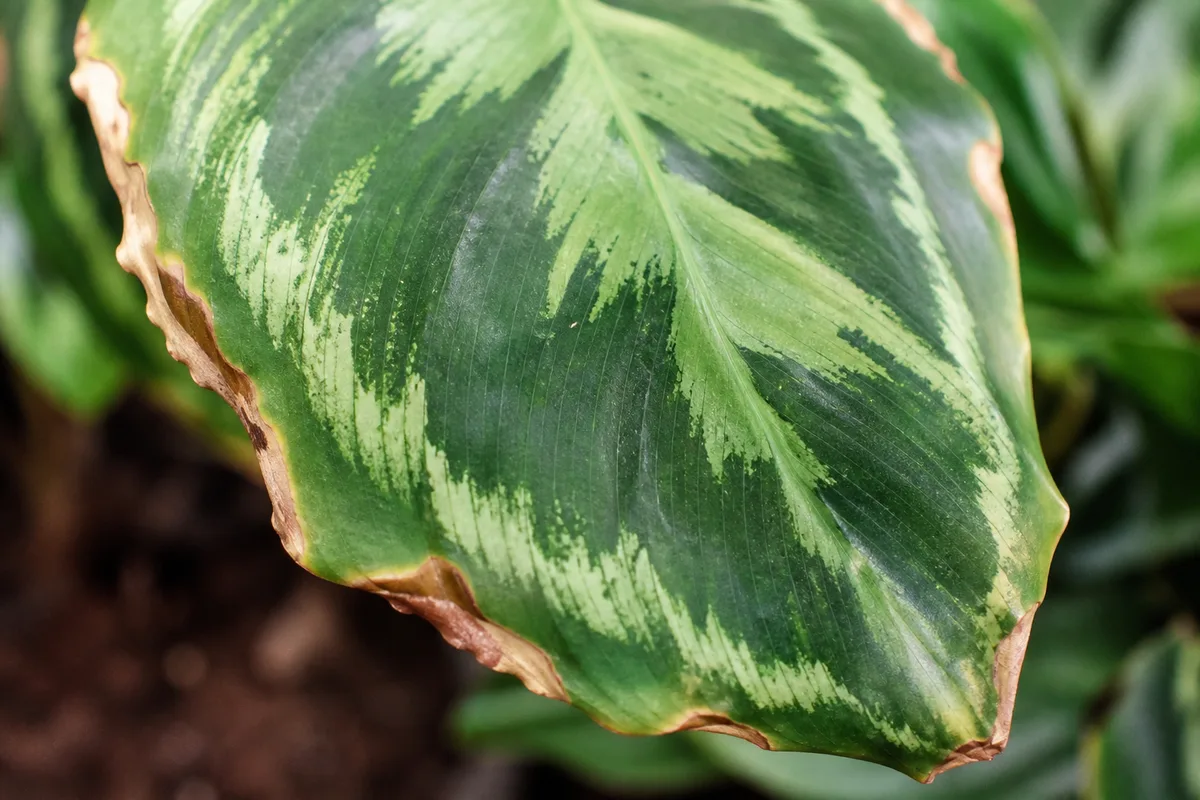
Low Humidity symptoms on Calathea - compare with healthy tissue on the same plant.
Common low-humidity signatures:
- Crispy brown edges on multiple leaves-not confined to one sun-facing side; RHS lists browning of leaf tips and edges as a usual result of low humidity on calatheas
- Brown tips that spread inward along the margin while the midrib tissue stays green longer
- New leaves stuck partially rolled or opening with torn, brittle edges
- Daytime curl or droop with firm roots and moist (not soggy) soil-different from underwatering collapse
- Faded or dull patterning on the newest blade as desiccation stress mounts
- Worsening symptoms in winter when heating runs, even though watering rhythm did not change
Normal nyctinasty vs. humidity curl: Calathea folds leaves upward at night and lowers them by morning-that predictable rhythm is healthy. Chronic daytime curl on multiple leaves, especially with crisp margins, points to desiccation, drafts, or heater blast-not normal prayer-plant movement.
Highly variegated cultivars like White Fusion (Goeppertia hybrids) often show damage at higher humidity thresholds than rattlesnake or zebrina types. Treat them as advanced humidity targets near the top of the 50–70% band.
Why Calathea is sensitive to dry air
Calathea evolved as a warm, humid rainforest understory plant. Large thin leaf blades maximize light capture in filtered shade but transpire heavily when air is dry. NC State Extension notes high humidity as a core requirement for Goeppertia species indoors-along with warm stable temperatures and filtered light.
Ranked causes of low effective humidity around Calathea:
Winter heating and HVAC. Forced-air heat can drop whole-room RH from the 40s to the mid-20s. A thermostat set to 70°F feels comfortable to you while leaf margins desiccate.
Air conditioning and dehumidified summer air. Cooling removes moisture. Plants near return vents or desktop AC units see localized dryness even when outdoor humidity is high.
Heater vents, fireplaces, and fans. Direct dry airflow strips moisture from leaf edges faster than a humidifier on the other side of the room can replace it-sometimes called air-movement desiccation.
Open windows in dry climates. Winter cold drafts and summer desert breezes both crash local humidity.
Recent move from greenhouse to home. Shop humidity often exceeds 60%; apartment air may sit near 30% the first week-expect transitional crisping unless you add humidity immediately.
Grouping too far apart. Clustering helps modestly, but five small pots on a large shelf rarely raise RH enough alone in a dry room.
Lookalike symptoms to rule out
Several Calathea problems produce brown or crisp foliage. Fix order matters because watering wet soil or moving to direct sun can worsen the plant while humidity looks like the culprit.
| What you see | More likely cause | Check next |
|---|---|---|
| Even brown margins on many leaves; moist soil; RH below 50% | Low humidity | Hygrometer + humidifier |
| Bleached or crispy patches only on window-facing side | Too much direct sun | Calathea light |
| Brown tips with otherwise green margins; tap water user | Fluoride / water quality | Brown tips |
| Dry soil, light pot, limp collapse | Underwatering | Soak and drain |
| Yellow lower leaves, wet heavy soil, sour smell | Overwatering / root rot | Pause water, inspect roots |
| Midday wilt with moist soil but RH below 40% | Dry-air transpiration loss | Humidifier (this page) |
| Fine webbing on undersides | Spider mites | Rinse + treat; mites thrive in dry air |
If multiple factors apply-common in winter-you still fix one variable first. Humidity is the right first move when the hygrometer confirms dry air, soil moisture is appropriate, and damage is evenly distributed rather than one-sided sun burn.
How to confirm low humidity
Work through these checks before buying accessories or moving the plant:
- Hygrometer at canopy level. Place the sensor beside the tallest leaves-not on the opposite wall. Read morning and evening for two days. Below 50% sustained at the plant is stressful for most calatheas; 40% or lower strongly confirms dry air as a primary driver.
- Seasonal context. Did crisping start when heat or AC began? Compare readings now to last summer in the same spot.
- Vent and draft audit. Feel for hot or cold moving air on leaves from registers, space heaters, fireplaces, or frequently opened doors.
- Soil moisture cross-check. Stick a finger 2 cm deep. Moist soil + crisp margins + low RH = humidity problem. Dry soil + curl = water first.
- Damage pattern. All-around marginal browning supports humidity. One-sided bleaching supports light.
- Water quality history. Chronic tip burn on an otherwise humid setup may be tap water-trial filtered water for four weeks while holding RH steady.
- New growth test. Roll back any humidifier or tray change for a week only if you are running an A/B test; otherwise add humidity and watch the next rolled leaf for clean unfurling.
Confirmation threshold: When RH at the plant holds 50–70% for several days and the next new leaf opens without fresh crisp edges, low humidity was at least a major contributor.
First fix for Calathea
Run a clean humidifier within 3 to 5 feet (1 to 1.5 m) of the pot until hygrometer readings at canopy level hold 50–60% (up to 70% for finicky variegated cultivars).
That single step addresses the most common fixable cause without stacking stress. NC State Extension recommends a humidifier or wet pebble tray when room air is too dry for pinstripe calathea. Empty and clean the humidifier regularly; use distilled or filtered water if your tap is hard.
After the humidifier runs:
- Move the pot off heater vents and at least 12 inches (30 cm) from cold window glass in winter.
- Keep one watering variable stable for the first week-do not interpret temporary perk-up as a signal to water more.
- Do not mist heavily at night on stagnant air; see ranked alternatives below if a humidifier is not available yet.
Ranked humidity fixes (after the humidifier)
If you cannot add a humidifier immediately, use this effectiveness ladder:
- Humidifier at the plant - most reliable sustained RH increase for Calathea.
- Plant grouping - place several houseplants together so shared transpiration raises local moisture; modest effect, best combined with a humidifier.
- Pebble / gravel tray - RHS calathea guidance recommends a wide tray of gravel or clay granules with water just below the pot base. Top up as water evaporates; do not let roots touch standing water.
- Bathroom or kitchen placement - only if bright filtered light and stable warmth are also met; many bathrooms are too dim for long-term Calathea health.
- Morning misting - brief surface wetting only; supplement, not substitute. Wet leaves overnight invite spotting when air is still.
Grouping and trays rarely lift a dry winter living room from 28% to 60% alone. Use them to support a humidifier, not replace it, when hygrometer readings stay low.
Recovery timeline
Damaged leaf tissue does not fully green up again-judge recovery by new growth.
| Milestone | What to expect |
|---|---|
| 24–72 hours | Daytime curl may ease if RH was critically low; old crisp edges remain. |
| 1–2 weeks | Active rolled spears should unfurl with fewer torn edges once RH stabilizes. |
| 3–4 weeks | Next one or two leaves should open with cleaner margins if humidity was the main limiter. |
| 6–8 weeks | You can trim fully brown tips or margins for appearance once new growth looks stable. |
| One season | Severe winter damage on many leaves may require gradual removal of worst leaves after several clean new blades confirm the fix. |
If new leaves still crisp while RH reads 55% at the canopy, audit drafts, water quality, and light before buying a second humidifier. UF/IFAS notes Calathea maintains appearance best between 40–60% RH in interior settings-your target band should stay in that range or slightly higher for sensitive cultivars.
What not to do
- Do not overwater because leaves look crisp-soggy soil plus dry air mimics two problems at once and invites root rot.
- Do not move to direct sun to “help” a struggling plant-sun scorch adds bleaching on top of humidity damage.
- Do not mist heavily overnight on crowded shelves with poor airflow-fungal spotting risk rises on thin leaves.
- Do not submerge the pot bottom in pebble-tray water-roots need oxygen.
- Do not fertilize a desiccated plant before humidity stabilizes-salts on stressed roots worsen tip burn.
- Do not stack Calathea repotting guide, pruning, and humidifier setup on the same day-Calathea reacts badly to combined insults.
How to prevent low humidity next time
Prevention is easier than reversing crispy margins on patterned foliage.
- Run a humidifier all heating season in rooms where Calathea lives-not only after damage appears.
- Keep a hygrometer at canopy height year-round; room-center readings lie.
- Place pots away from vents and fireplaces; redirect floor registers with deflectors if needed.
- Group humidity-sensitive Marantaceae (Calathea, Maranta, Stromanthe) in one zone you can humidify efficiently.
- Acclimate new purchases with immediate humidity support the first week home from a greenhouse.
- Use filtered water if tips brown even at good RH-see brown tips for the water-quality branch.
Full genus humidity context, temperature pairing, and misting caveats live on Calathea overview.
When to worry
Low humidity alone is rarely fatal, but combined stress escalates fast.
Act within days if:
- New rolled leaves abort or tear repeatedly despite corrected watering
- Multiple leaves yellow while soil stays wet-rule out overwatering before blaming air alone
- Fine webbing appears on undersides-spider mites exploit dry-canopy conditions
- The crown softens or stems collapse-humidity was not the only problem; inspect roots
Lower urgency: Older outer leaves with fixed brown tips while new growth opens clean-you are winning; trim cosmetic damage when stable.
Related Calathea problems
- Brown tips - tap-water fluoride and dry-air overlap
- Wilting - dry-air midday collapse with moist soil
- Drooping leaves - gradual limpness vs. acute humidity wilt
- Calathea light - sun scorch vs. all-around crisping
- Calathea watering - moisture band without confusing dry air for drought
- Calathea overview - full humidity and temperature targets
When to use this page vs other Calathea guides
- Calathea watering guide - Use for routine moisture checks before assuming low humidity is the main issue.
- Calathea problems hub - Browse all 16 common issues on this species.
- Brown Tips on Calathea - Different entry point when symptoms overlap with low humidity.