Rootbound Monstera: Signs, Fixes and When to Repot
Learn how to tell if your Monstera is rootbound, when to repot, what pot size to choose and mistakes to avoid.
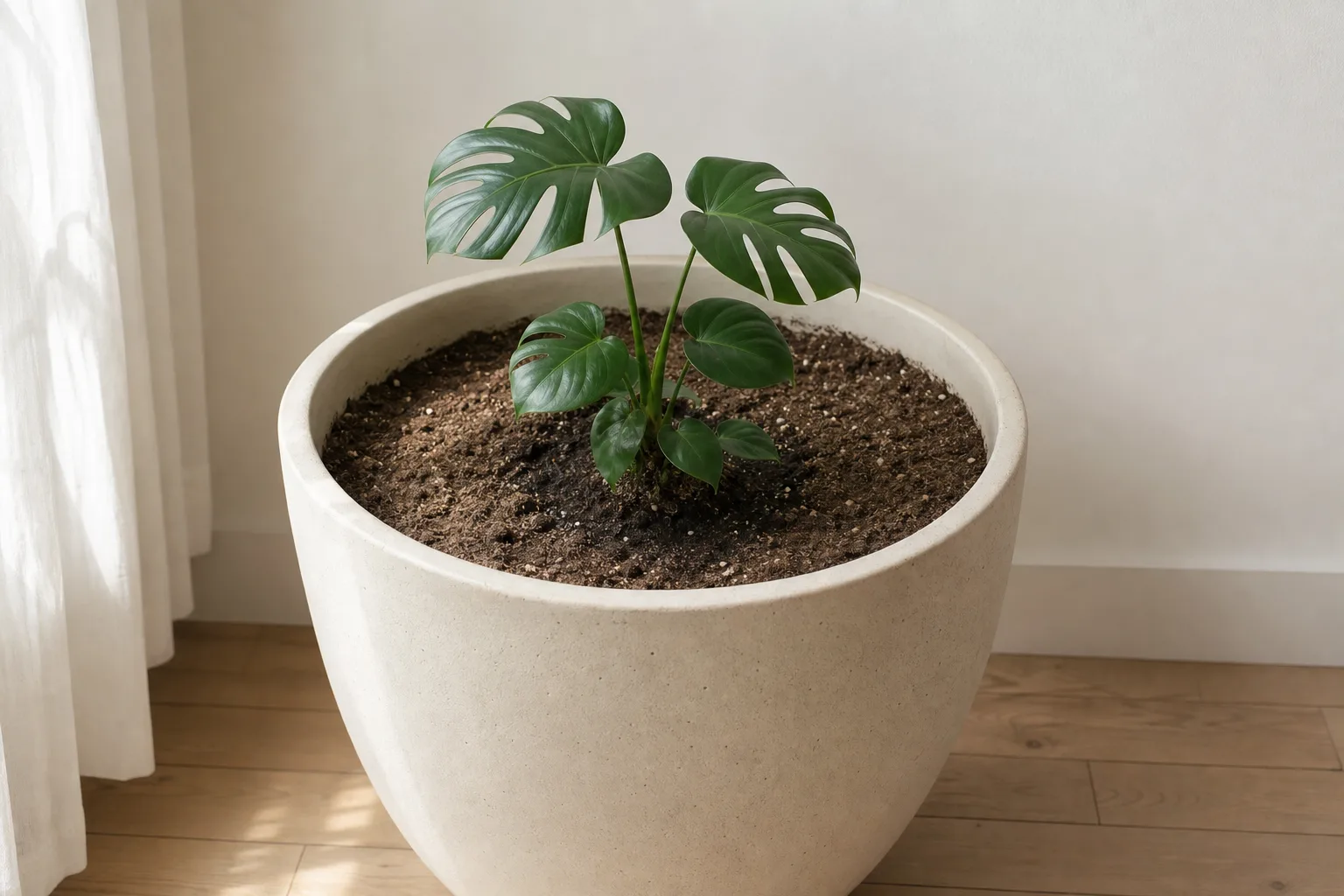
The short answer: how to tell quickly
If you want the fastest useful answer, here it is: your Monstera is probably rootbound if the plant dries out much faster than it used to, roots are pushing through the drainage holes or surfacing above the soil, the plant lifts out as a tight pot-shaped root mass, or growth has stalled even though light and watering are otherwise decent. The most reliable confirmation is simple: slide the plant partly out of the pot and look at the root ball. If you see dense circling roots with very little soil left, you are not guessing anymore. (Illinois Extension)
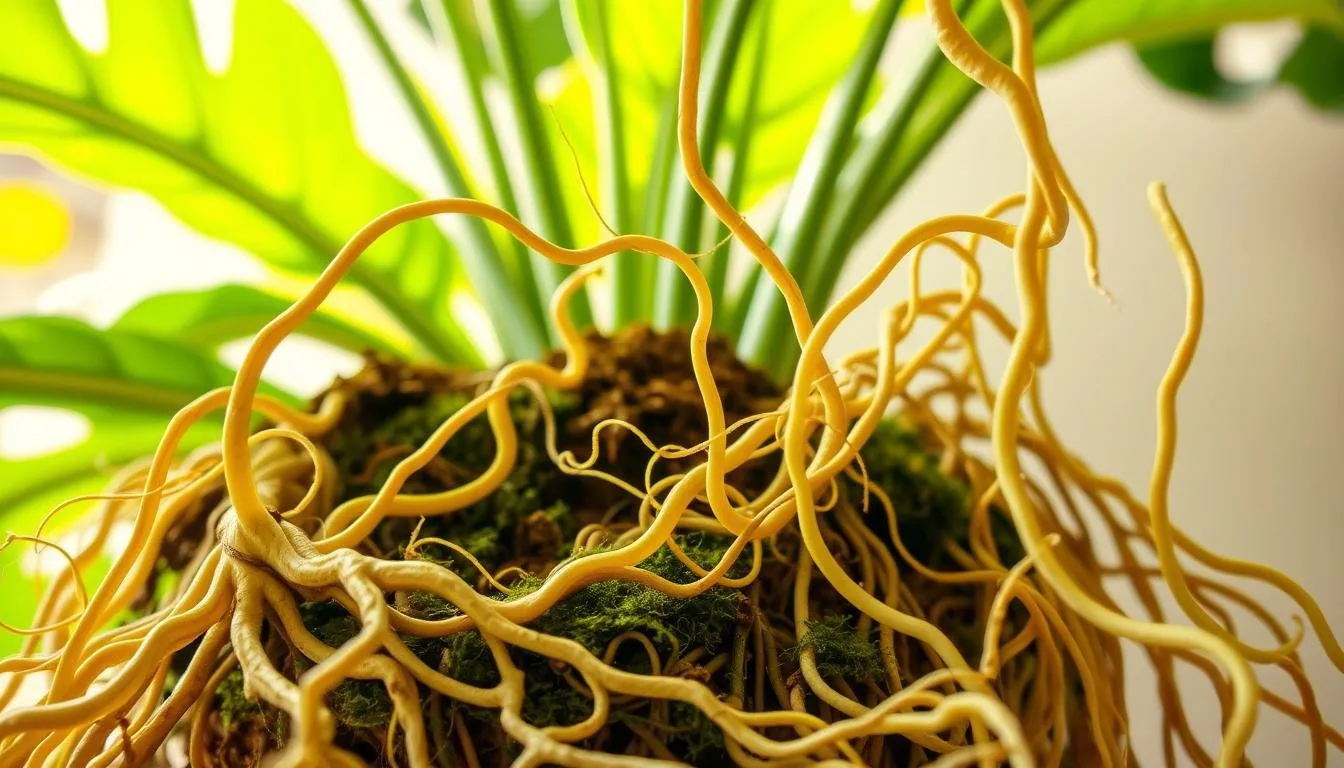
That said, do not make the classic mistake of treating one sign as proof. A few roots at the bottom can happen before a plant is truly cramped, and fast-drying soil can also come from hydrophobic mix, stronger light, heat, or a bigger plant simply using more water. Good diagnosis is pattern-based, not panic-based. When two or three signs show up together, especially combined with a dense root ball, the case gets much stronger. (University of Maryland Extension)
What “rootbound” means for Monsteras
A plant becomes rootbound when its roots have filled most of the available space in the container and begin circling the pot perimeter instead of expanding through fresh growing medium. In plain English, the roots have run out of room. That matters because roots are not just anchors. They handle water uptake, nutrient access, oxygen exchange, and the foundation for new top growth. When the root zone becomes congested, the plant’s above-ground performance starts paying the price. (University of Maryland Extension)
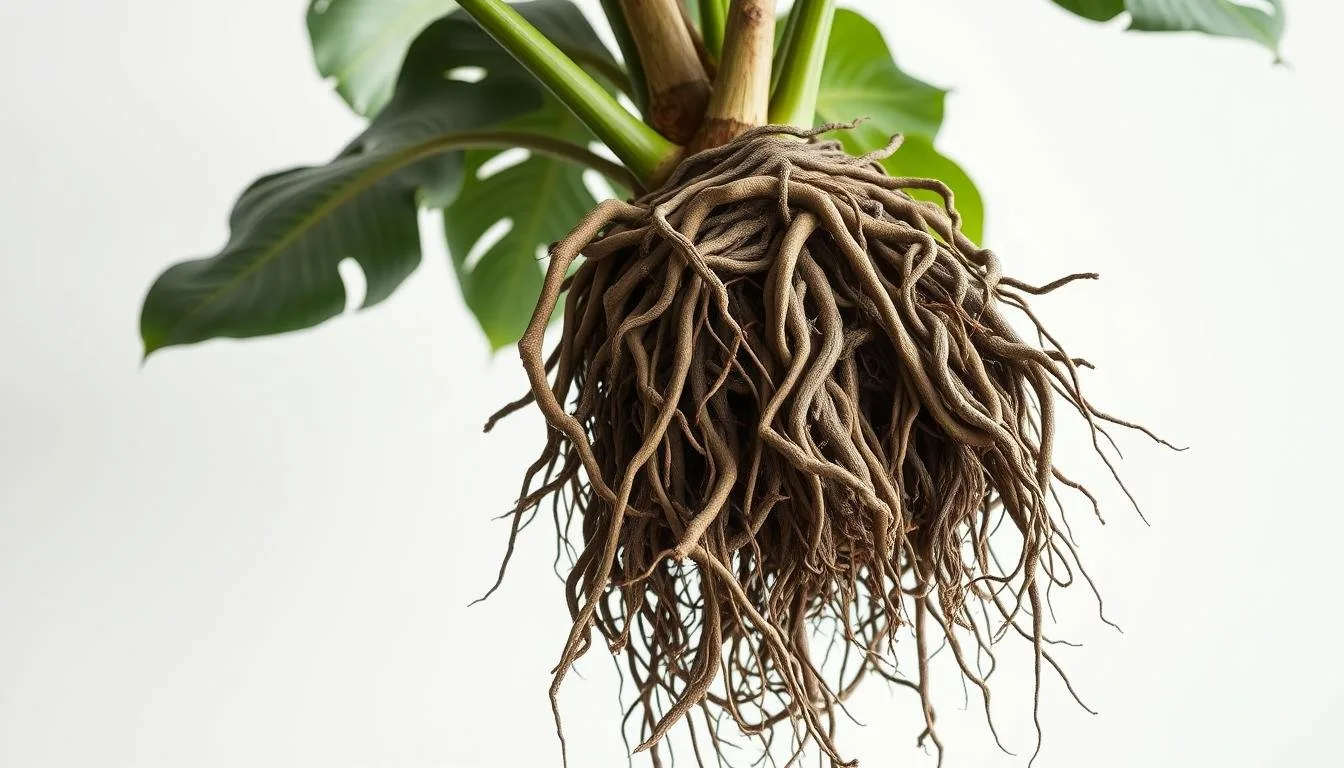
For a Monstera, the problem is rarely sudden. The potting mix breaks down over time, air spaces shrink, drainage changes, and the roots increasingly occupy the space that used to hold water and nutrients. The Royal Horticultural Society notes that crowded roots limit top growth and that aging compost also loses drainage, aeration, and nutrient-holding performance. That combination is exactly why a Monstera that looked fine six months ago can start acting thirsty, dull, and sluggish now. (RHS)
As an epiphytic aroid, Monstera deliciosa naturally produces both substrate roots in the pot and aerial roots along the stem. Healthy substrate roots should spread through mix; when they cannot, they circle. Aerial roots are a separate story - covered below - and confusing the two is one of the most common diagnosis errors. (Missouri Botanical Garden)
Do Monsteras like being slightly rootbound?
This is where a lot of bad advice starts. Monsteras can tolerate being slightly snug in a pot, but that is not the same as “Monsteras love being rootbound.” The New York Botanical Garden Monstera libguide notes they can stay in the same pot for years and move up only one size when roots come through the drain hole, which supports the idea that they do not need constant upsizing. Illinois Extension also notes that some plants do fine pot-bound while others do not. The practical takeaway is simple: slight crowding is normal; severe crowding is limiting. (libguides.nybg.org)
That nuance matters because overreacting causes its own damage. A Monstera in a pot that is only a little full may still be healthy, stable, and actively growing. Repotting too early into a pot that is much too big can leave too much damp mix around the roots, raising the odds of overwatering stress - the same risk covered in our pot too large guide for Monstera deliciosa. Monsteras want enough room, not a giant empty bucket of wet soil. Think of it like shoes: a snug fit can work; shoes three sizes too big just make you trip. (RHS)
The clearest visual signs your Monstera is rootbound
The strongest signs are the ones you can actually see. Not guess. See. Extension and botanical sources consistently point to visible roots, a packed root mass, and a plant that physically behaves like it has outgrown its container. Use the sections below as a checklist - then confirm with a root inspection. (RHS)
Roots coming out of drainage holes
This is the sign most people notice first, and it matters for a reason. Roots head toward moisture, and when they have explored the container thoroughly, drainage holes become the escape route. Illinois Extension lists roots through drainage holes as a repotting indicator, and the University of Minnesota includes the same point in its Monstera transplant guidance. If you flip the nursery pot and see a web of roots sticking out, your plant is at least close to full. (Illinois Extension)
Still, do not let that single sign bully you into repotting on the spot. A few roots peeking out do not automatically mean the entire root ball is a compacted brick. Some roots naturally chase water downward, especially if you bottom-water or if moisture lingers in a saucer. The better move is to use this sign as a prompt to inspect, not as a verdict by itself. That extra minute saves you from unnecessary repotting and from missing the real issue if the plant is struggling for another reason. (University of Minnesota Extension)
Roots pushing up at the soil surface
Roots at the top of the pot can mean the plant is crowded, but context matters. If actual soil roots are surfacing and circling around the rim, that often points to limited space. Illinois Extension lists roots appearing on the soil surface as another repotting indicator. In a truly cramped pot, the roots may have nowhere left to go, so they start showing themselves where they should not. (Illinois Extension)
But here is the catch: Monsteras also make aerial roots, and people confuse them with rootbound symptoms all the time. Aerial roots growing from the stem are normal. Missouri Botanical Garden notes Monstera’s long cord-like aerial roots and explains they can be rooted into soil, attached to a support, or removed on upper sections. So if the “root” you are seeing is attached to the stem and reaching outward like a brown tentacle, that is classic Monstera behavior, not proof your pot is too small. See the dedicated section below and our Monstera aerial roots guide for handling them. (Missouri Botanical Garden)
When the root ball lifts out as one solid mass
This is one of the clearest signs because it removes ambiguity. The University of Minnesota says a Monstera is potbound when you can easily lift the plant and the whole root ball out of the container. If the pot comes off and you are holding a dense pot-shaped cylinder of roots with barely any loose mix left, your Monstera has used up the real estate. (University of Minnesota Extension)
What you are looking for is not just “many roots.” Healthy plants have lots of roots. You are looking for density plus pattern: roots circling the outer wall, wrapping the bottom, and displacing much of the potting mix. University of Maryland describes pot-bound plants as having tight masses of roots that fill the pot and may even come over the edge. That is the difference between a vigorous plant and a constricted one. (University of Maryland Extension)
Aerial roots vs. soil roots - do not confuse them
Monstera deliciosa is a climbing aroid. Along the stem you will see aerial roots - brown, cord-like structures that reach for support and humidity. In the pot you will see soil roots - usually paler, finer, and embedded in mix. Rootbound diagnosis applies to soil roots filling the container, not to a mature plant simply producing aerial roots because it wants to climb.
Missouri Botanical Garden describes aerial roots as characteristic of the species and notes they can be directed into soil, trained onto a moss pole, or trimmed on upper sections when they become unwieldy. If your Monstera has plenty of aerial roots but the soil root ball still has open mix and no circling wall, the pot may be fine. If soil roots are surfacing, circling the rim, and the mix is mostly roots, that is a different picture. Our aerial roots guide covers training and trimming; this guide covers when the container is the limit. (Missouri Botanical Garden)
Watering and growth clues most owners notice first
Most people do not discover rootbound issues because they randomly inspect roots on a Saturday afternoon. They discover it because the plant starts acting different. The watering rhythm changes. New leaves shrink. The plant looks tired. Those are useful clues because they reflect what a crowded root zone does to the plant’s day-to-day function. (University of Maryland Extension)
Soil drying out unusually fast
When a Monstera becomes rootbound, there is less potting mix left to hold moisture around the roots. University of Maryland notes that watering often passes through pot-bound plants too quickly and may not get absorbed adequately, leaving the center of the root ball dry. The University of Minnesota lists soil drying within 24 hours as a strong repotting sign specifically for Monstera. This is one of the best real-life indicators because it shows up in your routine before you ever inspect the pot. (University of Maryland Extension)
That said, fast-drying soil is not exclusive to rootbound plants. A chunky aroid mix, stronger summer light, low humidity, warm rooms, or a sudden growth spurt can also shorten the watering interval. This is why smart diagnosis asks a second question: Did the watering pattern change because the environment changed, or because the root zone changed? If the plant now needs water far more often and the root ball is dense, rootbound is likely. If the room just got hotter and brighter, watering habits may need adjusting instead. (University of Minnesota Extension)
Smaller leaves and stalled growth
Illinois Extension lists smaller-than-normal new leaves as a repotting clue, and Minnesota Extension says a Monstera that seems dull and has stopped growing may need a larger container. That makes sense. Root crowding limits the plant’s ability to support fresh top growth. If your Monstera used to throw out satisfying new leaves and now produces smaller ones or pauses for a long stretch during active growing season, space may be part of the problem. (Illinois Extension)
Still, stalled growth is one of the easiest symptoms to misread. Monsteras also slow down in poor light, in cool conditions, or when nutrition is weak. Missouri Botanical Garden recommends bright indoor light without strong direct sun and notes reduced watering from fall to late winter, which reflects a seasonal slowdown in growth. So do not use stalled growth alone as a rootbound diagnosis. Use it as supporting evidence - and check whether you are in winter dormancy before assuming the pot is the bottleneck. (Missouri Botanical Garden)
Leaning, tipping, or becoming top-heavy
A Monstera that suddenly feels unstable can be telling you the pot is no longer a good match. Minnesota Extension specifically notes that overgrown Monsteras can tip over easily and should then move to a larger pot. This is especially common with mature plants on moss poles or with broad leaves that create a lot of top weight. Once the roots dominate the pot, there may not be enough stable mix left to anchor the plant well. (University of Minnesota Extension)
When tipping is the main symptom, also check moss-pole stability and whether the nursery pot is dwarfed by a heavy decorative cache pot. Sometimes the fix is support and a modest pot upgrade together - not a dramatic upsize. Minnesota’s propagation guidance also mentions choosing heavier containers for top-heavy Monstera cuttings, which supports the broader point that plant stability matters. (University of Minnesota Extension)
Symptoms that look like rootbound but are not
A lot of Monstera problems look similar from the top of the pot. Wilting can mean thirst, root crowding, or root rot. Yellowing can mean stress, poor drainage, aging leaves, or nutrition issues. Slow growth can mean winter. This is why diagnosis based on leaves alone is weak. You need symptoms plus root evidence. (University of Maryland Extension)
Overwatering and root rot
This is the big one. A Monstera with soggy soil, yellowing leaves, and droop can look “unhappy” in the same way a rootbound plant does, but the solution is different. University of Minnesota says healthy roots should be creamy white and firm, while brown and soft roots point to overwatering or poor drainage. The University of Arizona likewise describes dark, squishy, smelly roots as signs of root disease caused by overwatering or poor drainage. (University of Minnesota Extension)
Here is the practical rule: if the root ball is dense but the roots are still pale and firm, you are probably dealing with crowding, not rot. If the roots are mushy, dark, and smell bad, space is not the core issue. Drainage and moisture management are. Repotting a rotten plant into an oversized pot without fixing the root health problem is the wrong fix. (UA Cooperative Extension)
Low light, poor nutrition, or compacted mix
A Monstera in weak light can stall even when the roots have room. A plant in exhausted potting mix can look dull because the medium has broken down, not just because the pot is full. The RHS explicitly notes that compost slumps over time and loses drainage, aeration, nutrient retention, and water retention, which can limit healthy growth. That means your plant can need attention even before it is severely rootbound. Sometimes the real issue is stale, compacted mix. (RHS)
That distinction matters because your next move changes. If the roots are not excessively crowded but the mix is degraded, a refresh or modest repot can solve the problem. If the plant is in low light, repotting alone will not magically restart growth. Good Monstera care is always a stack: light, drainage, substrate, watering, and root space all work together. Ignore that, and you will keep treating symptoms instead of causes. (Missouri Botanical Garden)
How to check your Monstera without stressing it
You do not need to yank your Monstera around every month. A gentle check is enough. Water the plant lightly a day before inspection so the root ball is not bone-dry and brittle, then support the base, tilt the pot, and slide the nursery pot off or ease the root ball out slightly. Illinois Extension recommends gently knocking the plant from its container and looking at the roots. If the plant is huge, you may only need to lift it an inch or two to inspect the sides and bottom. (Illinois Extension)
What you want to assess is simple: how much of the outer wall is roots, whether they are circling densely, whether the bottom is matted, and whether there is still meaningful soil volume left. Check color and texture too. Creamy white to light-colored, firm roots are healthy. Brown, soft, smelly roots are not. You are not trying to perform surgery here. You are trying to answer one useful question: Is this plant constrained enough that more space or fresh mix will materially help? (University of Minnesota Extension)
If your Monstera is on a moss pole, support the pole and any aerial roots attached to it while you tilt - the same handling advice extension sources give for repotting large climbers. A partial lift beats a full extraction when you only need confirmation. (Illinois Extension)
What a healthy root ball vs. a rootbound root ball looks like
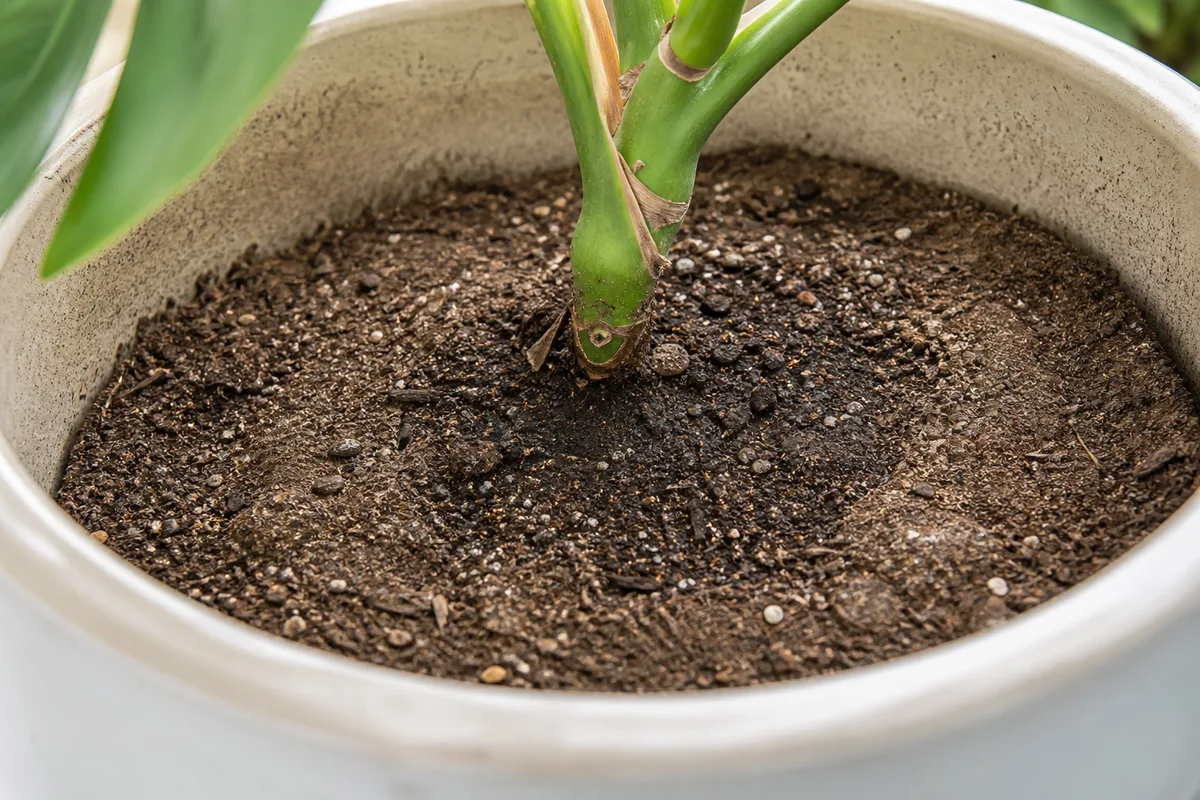
A healthy, not-yet-rootbound Monstera will have visible roots, but you will still see a fair amount of potting mix between them. The roots may trace the outer edge lightly, and the root ball will hold together, but it will not look like a woven basket. You can usually tease the roots apart without much resistance, and the potting mix has not been completely displaced. (University of Minnesota Extension)
**
A rootbound Monstera looks different. The root mass often mirrors the exact shape of the container. The outer layer is densely packed with roots, the bottom may be wrapped in a circular mat, and there is much less visible soil than you would expect. In more advanced cases, the roots are doing laps around the pot wall. That is the version that leads to fast drying, poor water penetration, and stalled vigor. University of Maryland’s description of tight, impenetrable root masses and Illinois Extension’s “soil mass is filled with roots” language fit this picture closely. (University of Maryland Extension)
Quick comparison:
| Trait | Healthy / slightly snug | Rootbound |
|---|---|---|
| Mix visible between roots | Yes - plenty of open mix | Little to none |
| Outer root pattern | Light tracing, easy to tease | Dense circling, pot-shaped |
| Lift test | Root ball stays in pot or slides with resistance | Whole mass lifts as one cylinder |
| Root color and feel | Creamy white, firm | Still firm if healthy; mushy if rot |
| Watering interval | Stable for the season | Suddenly much shorter |
Decision table: should you repot now or wait?
Use this table after your visual check and partial root inspection. It is a decision aid, not a substitute for looking at the roots.
| Sign or situation | Likely rootbound? | Confirm how | If not rootbound, check instead |
|---|---|---|---|
| 1–2 roots at drainage holes only | Maybe | Partial root lift | Normal growth; inspect again in 4–6 weeks |
| Roots circling soil surface + fast dry | Likely | Full root ball inspection | Hydrophobic or compacted mix |
| Pot-shaped dense root mass on lift | Yes | Already confirmed | Root rot if roots are mushy |
| Stalled growth in bright active season | Possible | Root lift + light check | Low light, nutrition |
| Stalled growth in late fall/winter | Unlikely alone | Wait for spring unless urgent | Winter care slowdown |
| Yellow leaves + soggy soil | No - think rot first | Smell and squeeze roots | Drainage, overwatering |
| Aerial roots on stem, open mix in pot | No | Root lift | Aerial root training |
| Tipping + dense bottom roots | Likely | Lift + stability check | Undersized cache pot, weak pole |
| Slightly snug but still growing well | No - wait | Re-check in one season | Refresh mix only if degraded |
Timing note: The best repotting window for Monstera is usually late winter through spring into early summer, when the plant is entering or already in active growth. Minnesota Extension recommends repotting Monstera in late winter or early spring every one to two years as it grows, and the RHS says spring to early midsummer is the best general repotting period. If your plant is severely rootbound, tipping, or impossible to water properly, do not wait months purely because the calendar says winter - but do repot carefully. (University of Minnesota Extension)
What to do next
This guide stops at diagnosis. If you confirmed rootbound - or strongly suspect it after inspection - your next step is repotting, not more guessing.
For step-by-step repot instructions, use our dedicated resources:
- Monstera deliciosa repotting - species-specific timing, pot size, mix, and aftercare on the plant-care hub
- When and how to repot Monstera - full walkthrough for indoor growers, including large plants and moss poles
If the root check showed room left but the mix is tired, a partial refresh may be enough - see the repotting pages above for refresh-vs-upsizing guidance.
If roots were mushy and dark, treat rot first. More pot volume will not fix saturated, diseased roots. Start with the overwatering and root health section on drainage, then the Monstera problems hub if decline continues.
If the plant is only slightly snug and still growing well, waiting is reasonable. Re-check at the start of the next active season. Moving up one pot size - about 1 to 2 inches wider - is the standard when you do repot; going much larger raises overpotting risk. (RHS)
For whole-plant context - light, watering, soil, and propagation - start at the Monstera deliciosa care hub.
Related Monstera Guides
- Monstera deliciosa overview - whole-plant care hub
- Monstera deliciosa repotting - when and how to repot after you confirm rootbound
- When and how to repot Monstera - detailed indoor repot walkthrough
- Monstera aerial roots guide - tell aerial roots apart from crowded soil roots
- How to do Monstera soil mix - mix refresh when roots still have room
- Monstera light requirements - rule out low light before blaming the pot
- Watering Monstera deliciosa - separate thirst rhythm changes from root crowding
Conclusion
If you are asking “Is my Monstera rootbound?”, the smartest answer is observational, not emotional. Look for the cluster of signs that actually matter: roots at drainage holes or soil surface, a root ball that slides out as a dense pot-shaped mass, soil that dries much faster than it used to, smaller new leaves, stalled growth in season, and a plant getting unstable in its container. Then confirm with a root check. That is the difference between guessing and knowing. (Illinois Extension)
Keep the nuance: Monsteras can tolerate being a little snug, but they do not benefit from being severely cramped. If the roots are healthy and the plant is still performing well, you can often wait. If the plant is drying out too fast, tipping over, or growing as a solid root cylinder with barely any medium left, it is time to act - and the repotting guides linked above are where to go next. (libguides.nybg.org)