Why Are My Monstera Leaves Yellow? Causes and Fixes
Diagnose yellow Monstera leaves caused by watering, light, nutrients, pests, root stress or natural aging.

Quick diagnosis: read the leaf and the root zone together
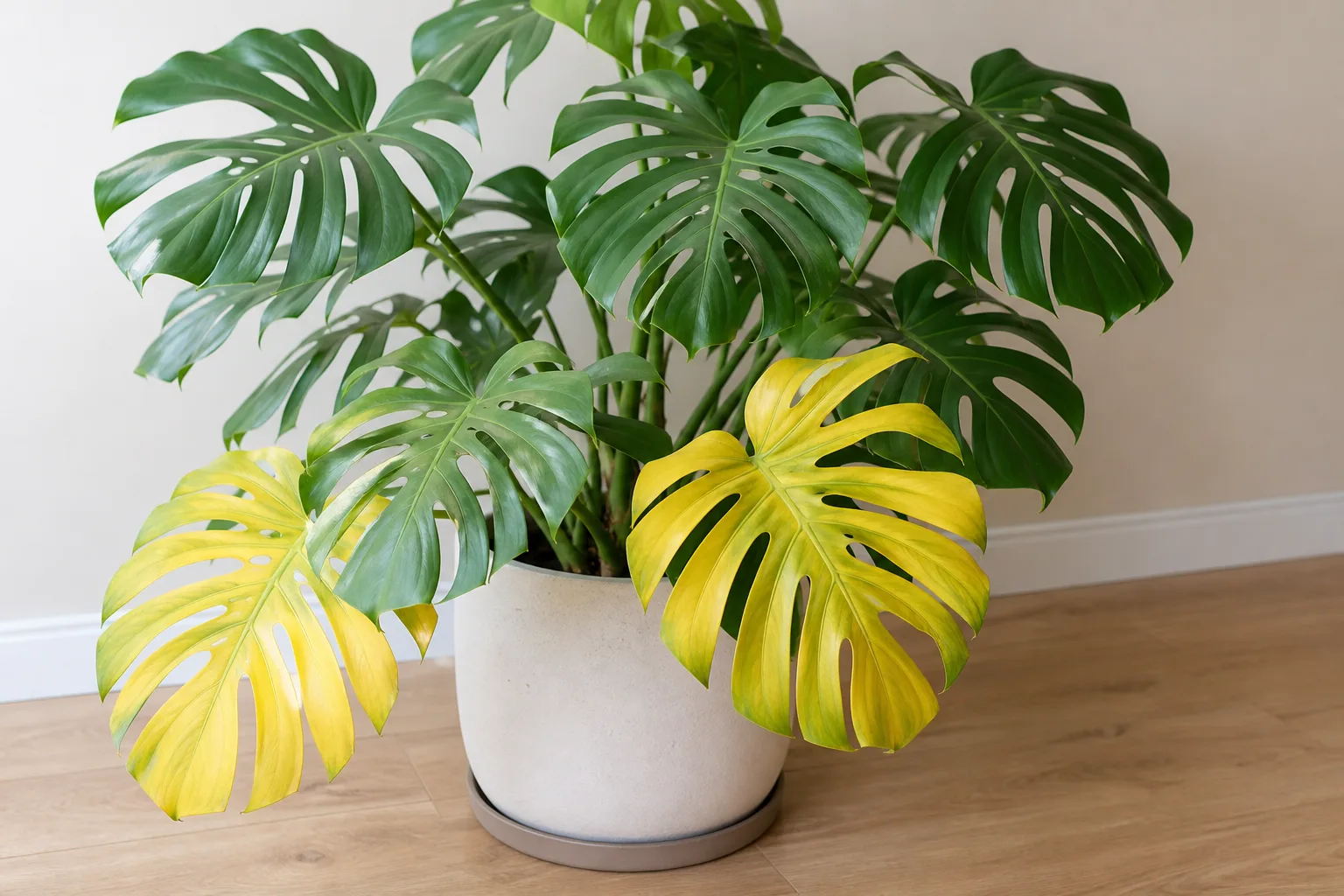
Yellow Monstera leaves are a symptom, not a diagnosis. Start by checking moisture below the surface and lifting the pot: wet, heavy mix with soft yellow foliage points toward overwatering or root trouble, while a light pot with dry mix and crisp margins points toward underwatering. Clemson Extension notes that whole-plant yellowing is most often associated with overwatering, but also lists low light, pests, mites, and nutrient problems as possible causes. (Clemson HGIC)
Do not respond to yellowing by watering, feeding, moving, and repotting all at once. Change one confirmed cause at a time, then judge recovery by stable green tissue and healthy new growth-not by expecting a fully yellow leaf to become green again.
| What you see | Check next | Most likely direction |
|---|---|---|
| One oldest lower leaf fades slowly; new growth stays green | Confirm moisture is normal | Natural senescence |
| Several soft yellow leaves; pot stays heavy | Probe the root zone and inspect roots if spreading | Overwatering or root rot |
| Yellowing with crisp brown edges; pot is light | Check whether the root ball is dry or water-repellent | Underwatering |
| Pale plant with stretched petioles or long internodes | Review window distance and seasonal light | Too little light |
| Bleached tan-yellow patches on the window side | Check direct-sun exposure | Sun scorch |
| Yellow or bronze stippling and fine webbing | Inspect leaf undersides with a hand lens | Spider mites |
| Yellow between green veins | Check which leaves are affected and review roots, pH, and feeding | Chlorosis or nutrient-uptake trouble |
Which Monstera do you have?
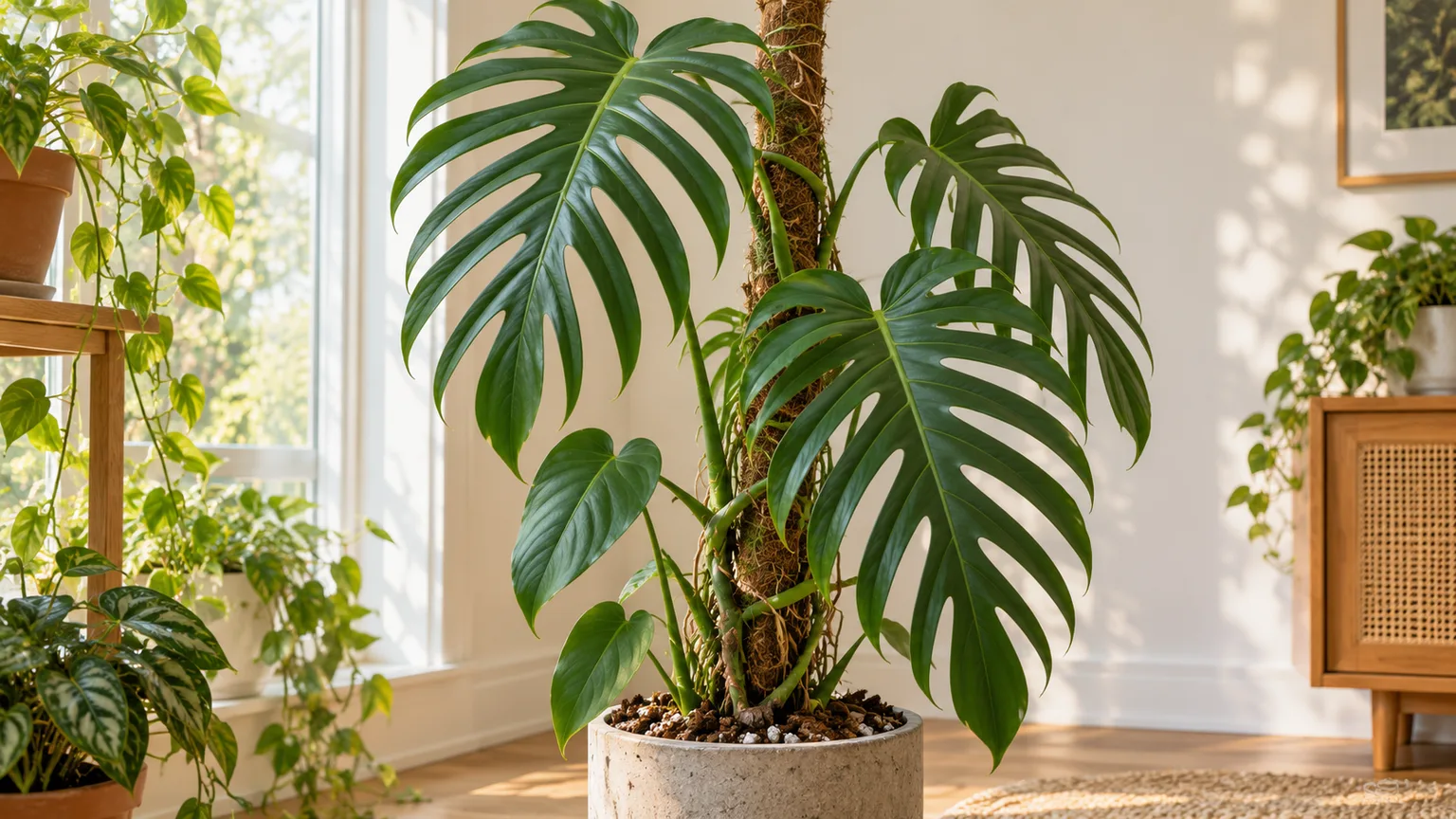
“Monstera” covers more than one houseplant. If yours has large, thick blades and develops edge splits as it climbs, use the dedicated Monstera deliciosa yellow-leaf guide for species-specific checks such as moss-pole senescence and large-pot moisture. The Monstera deliciosa hub covers the rest of its care system.

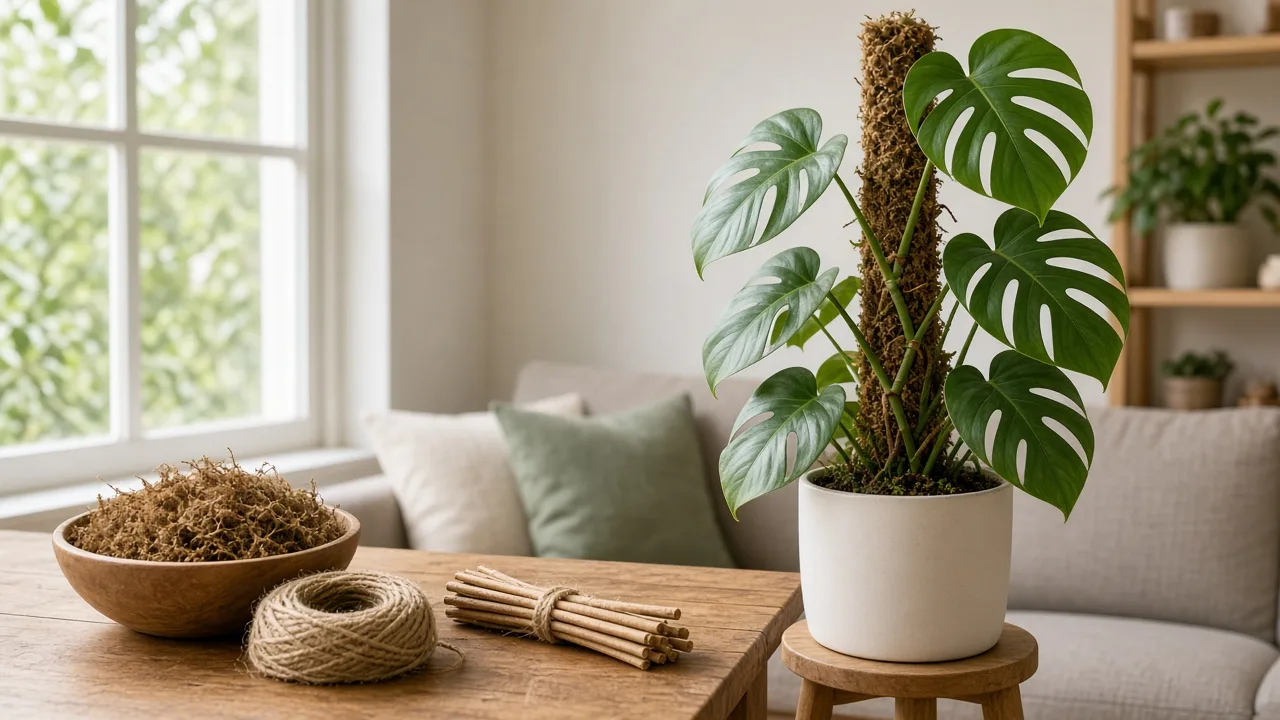
If yours has smaller, thinner leaves with many enclosed holes along a trailing or climbing vine, route to the Monstera adansonii yellow-leaf guide and Monstera adansonii hub. Kew recognizes Monstera adansonii as an accepted climbing species native across tropical America, so it should not be treated as a miniature M. deliciosa. (Kew Plants of the World Online) This page is the cross-species entry point; the two plant pages carry the narrower diagnosis.
When one yellow leaf is normal-and when it is not
The occasional oldest lower leaf can yellow and fall as a plant reallocates resources. The RHS specifically notes that the odd lower leaf on a mature houseplant may yellow normally, while multiple yellow leaves can result from moisture extremes, low light, cold, drafts, or overpotting. (RHS leaf damage guidance)
Look at the pattern rather than the most dramatic leaf. One slow-fading lower leaf with a firm stem, balanced moisture, and a green growing tip is usually low urgency. Several leaves yellowing in days, new leaves opening pale, a soft stem base, sour-smelling mix, or wilting on wet soil justifies same-day inspection.
Watering problems are the first place to look
Monstera roots need both moisture and air. NC State recommends watering M. deliciosa thoroughly and then allowing roughly the top quarter to one-third of the medium to dry, while Penn State advises letting the top 1–2 inches dry between waterings. (NC State Extension) (Penn State Extension) These are checkpoints, not calendar schedules; pot size, mix, light, temperature, and season change the drying rate.
Check depth, not just the crust on top. Push a clean wooden skewer or finger about 3–5 cm into the mix, then lift the pot. A skewer that comes out dark and damp plus a heavy pot means wait. A clean, dry skewer plus a light pot means the root zone may be ready for water.
Signs of overwatering
Overwatering usually means the root zone remains saturated too long, not that one watering was generous. Waterlogged media loses air space; Missouri Botanical Garden explains that roots in overly wet soil can die from oxygen deprivation, producing weak growth and yellow foliage. (Missouri Botanical Garden)
Look for broad yellowing on lower leaves, limp texture, a pot that remains heavy for many days, fungus gnats, a sour smell, or wilt despite wet mix. If yellowing spreads while the center stays wet, slide the root ball out. Dark, soft roots and a mushy stem base fit root-rot symptoms described by University of Maryland Extension. (University of Maryland Extension root rot)
Signs of underwatering
Underwatered plants usually pair yellowing with a light pot, dry mix, curling, loss of firmness, or crisp brown margins. The mix may shrink from the pot wall and repel water, allowing a quick pour to escape without wetting the root ball.
Water slowly until the entire root mass is moist and runoff exits the drainage holes, then empty the saucer. If the mix repels water, soak the nursery pot briefly and drain it fully. Do not keep a stressed plant permanently wet to compensate for one dry spell.
Light problems: too dim, too harsh, or changed too fast
Swiss cheese plants favor bright, indirect light. The RHS warns that direct summer sun can scorch foliage and says these plants prefer indirect light with warmth and humidity. (RHS Swiss cheese plant guide) Light also changes water use: a Monstera in a dim winter position dries more slowly, so a watering routine that worked in summer can become excessive.
What low-light yellowing looks like
Low-light decline is often gradual: foliage becomes pale, stems stretch, internodes lengthen, and newer leaves may stay smaller. Before blaming nutrition, compare the plant’s current window distance with its healthier period and note whether daylight has shortened. The Monstera light guide explains how to improve exposure without a sudden jump.
Move the plant toward brighter filtered light in stages. Then recheck soil more often because brighter conditions may shorten the interval between waterings. Old stretched growth will not compact; evaluate the next one or two leaves.
What sun scorch looks like
Sun stress is more localized than overwatering. Expect pale, bleached, tan-yellow, or crisp patches on the side facing a hot window, especially after an abrupt move. Filter harsh midday or afternoon rays with a sheer curtain or increase distance from the glass.
Do not confuse stable cream variegation with injury. Variegated sectors follow consistent boundaries, while scorch usually appears as damaged patches on the exposed side and progresses to dry brown tissue.
Root and pot problems below the surface
When a Monstera yellows despite sensible watering, inspect the system holding the roots. Dense mix, a blocked drainage hole, a cachepot holding runoff, or a container far larger than the root ball can keep the lower half wet even when the top looks dry.
Root rot versus root-bound stress
Root rot and root-bound stress can both produce yellow leaves, but the roots look different. Root-rot roots are brown to black, soft or mushy, and may shed their outer tissue; University of Maryland documents yellowing and wilt even when moisture is adequate. (University of Maryland Extension root rot) Root-bound roots are firm but densely circle the pot, leaving little mix to hold water.
For rot, remove affected roots with clean tools and repot in fresh, well-drained medium in an appropriately sized pot. For a firm, crowded root ball that dries unusually fast, move up only one modest pot size. The Monstera repotting guide covers the safer sequence.
Pot size, drainage, and soil structure
A good setup drains freely but retains enough moisture for the roots to use. Penn State recommends a well-draining soilless mix enriched with organic matter and notes that bark or perlite can improve structure. (Penn State Extension) Keep the plant in a drainage pot inside a decorative cachepot if the outer container has no hole, and remove collected runoff after watering.
Avoid automatically moving a stressed plant into a much larger container. The RHS lists overpotting among causes of widespread yellowing because excess medium around a small root system can remain wet too long. (RHS leaf damage guidance)
Nutrient patterns and fertilizer mistakes
Nutrient-related yellowing is possible, but it should come after moisture, roots, light, and pests in the diagnosis. The RHS defines chlorosis as leaf yellowing with many possible causes and explains that iron deficiency typically affects young leaves first, whereas nitrogen deficiency generally begins on older leaves. (RHS chlorosis guidance) Interveinal yellowing is a clue, not proof of one missing nutrient.
Do not fertilize a waterlogged or recently root-pruned plant. Excess soluble salts can cause leaf-edge dieback, lower-leaf drop, root injury, and sometimes yellowing; University of Maryland recommends correcting fertilizer use and leaching or replacing affected medium according to pot size. (University of Maryland fertilizer guidance) Resume a label-rate balanced feed only after roots and new growth are stable.
Pests and environmental stress
Pests, cold, drafts, and abrupt changes can mimic care problems. Inspect before treating: pest damage is usually patterned on the leaf surface, while temperature or repotting stress is better explained by a recent event and the absence of insects.
Spider mites and other sap-feeding pests
Spider mites create tiny yellow or white stipples that can merge into a bleached or bronze cast. University of Minnesota Extension advises checking undersides for mottling, moving specks, and fine webbing; feeding can yellow leaves and cause leaf drop. (University of Minnesota Extension) Thrips, scale, aphids, and mealybugs may cause other patchy discoloration, distortion, sticky residue, or visible insects.
Isolate an infested plant, rinse foliage where appropriate, and identify the pest before applying a labeled houseplant treatment. Do not treat uniform whole-leaf yellowing as mites without finding stippling, webbing, or the pests themselves.
Temperature, drafts, humidity, and repotting shock
Cold windows, air-conditioning vents, heaters, and sudden room changes can cause yellowing or leaf drop. The RHS includes cold temperatures, sudden temperature drops, and drafts among yellow-leaf triggers. (RHS leaf damage guidance) Keep conditions stable and avoid stacking more changes while the plant adjusts.
Dry air more commonly shows as brown margins than uniform yellowing. Penn State suggests humidity above 50% for Monstera and recommends a nearby humidifier in very dry spaces. (Penn State Extension) Misting is not a substitute for correcting root moisture, light, or an active pest problem.
Repotting can temporarily cost a leaf when fine roots are disturbed, but spreading yellow on a wet oversized pot is not “just shock.” Confirm drainage and root-zone moisture before deciding to wait.
A six-step diagnosis checklist
- Count affected leaves. One oldest lower leaf is different from multiple leaves or yellow new growth.
- Probe 3–5 cm deep and lift the pot. Record wet/heavy, evenly moist, or dry/light before acting.
- Read texture and pattern. Soft uniform yellow, crisp margins, bleached patches, green veins, and stippling point in different directions.
- Review light and recent changes. Note window exposure, seasonal change, repotting, feeding, drafts, and room moves.
- Inspect pests and roots. Use a hand lens under leaves; unpot only when wet soil, odor, spreading yellow, or abnormal drying justifies it.
- Make one matched correction. Track whether yellowing stops and whether the next leaf opens healthy before adding another intervention.
This order prevents the most damaging error: responding to wilt and yellowing with more water when roots are already saturated. If you have M. deliciosa, compare the result with the detailed watering guide before setting a new rhythm.
How to fix yellow leaves and prevent a repeat
For wet, heavy mix, pause watering, empty standing runoff, improve filtered light, and inspect roots if yellowing continues. For dry, light mix, rehydrate the root ball thoroughly and let it drain. For low light, increase filtered exposure gradually; for scorch, filter direct sun. For pests, isolate and treat the identified organism rather than spraying blindly.
Remove a leaf once it is fully yellow or clearly dying, using clean pruners near the petiole base without cutting the main stem. A partly green leaf still has functioning tissue, so removal can wait unless disease or pest management requires it. The yellow tissue itself usually will not regain normal green color; successful treatment is a halt in spread and healthy subsequent growth.
Prevention is a repeatable system: check depth and pot weight instead of watering by weekday, use a drainage pot and an airy mix, match watering to light and season, inspect leaf undersides, and avoid oversized pots. For broader maintenance after the symptom is stable, use Monstera care 101 rather than turning this diagnosis page into a complete care encyclopedia.
Related guides
- Use How to water indoor plants to improve the check-water-drain routine across your collection.
- Read Monstera humidity needs when brown margins and persistently dry room air accompany yellowing.
- Compare Monstera brown tips when the damage starts at the margins instead of fading the whole blade.
- Use Monstera light deficiency when pale leaves appear with stretched stems and smaller new growth.
Conclusion
Start with evidence: leaf position, pattern, texture, root-zone moisture, pot weight, and recent changes. Wet and heavy points toward excess moisture or root failure; dry and light points toward thirst; localized bleaching suggests sun; stippling suggests pests; one old lower leaf with healthy new growth may simply be senescence.
Once the cause is confirmed, make the smallest matching correction and watch new growth. If you need species-level detail, continue with the dedicated Monstera deliciosa or Monstera adansonii yellow-leaf page instead of applying generic advice past its limits.