Monstera Adansonii Care Guide: Swiss Cheese Vine
Monstera adansonii
Monstera Adansonii needs bright indirect light for fenestrations, watering every 7–10 days when top 3–5 cm is dry, 50%+ humidity, and a moss pole for climbing support.
Monstera Adansonii Care Guide: Swiss Cheese Vine, Fenestrations, and Climbing Support
Start with wateringThe most common care mistake for Monstera AdansoniiWatering guide →Monstera Adansonii care essentials
Light
bright indirect light, medium indirect light
Water
Every 7–10 days - allow top 3–5 cm to dry. Water thoroughly until drainage from holes. Reduce to every 10–14 days in winter.
Soil
Standard potting mix + 20–25 % perlite + 10–15 % orchid bark. Well-draining aroid mix. pH 5.5–7.0.
Humidity
50–60%
Temperature
18–27°C (65–80°F)
Fertilizer
Feed lightly during active growth. Use monthly in spring and summer.
About Monstera Adansonii
Monstera Adansonii has a upright growth habit.
| Detail | Information |
|---|---|
| Growth habit | Upright |
| Scientific name | Monstera adansonii |
Monstera Adansonii Care Guide: Swiss Cheese Vine, Fenestrations, and Climbing Support
What Monstera Adansonii Is and Why the Swiss Cheese Vine Name Fits
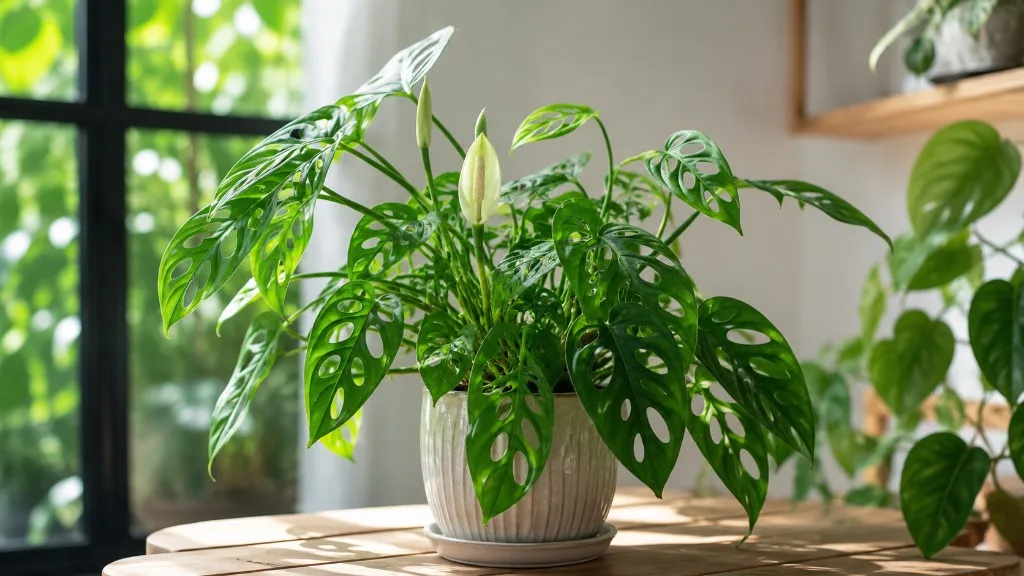
Monstera adansonii is the vining cousin of the split-leaf Monstera most people picture when they hear “Swiss cheese plant.” Its common names - Swiss cheese vine, Adanson’s monstera, and five holes plant - all refer to the same species: a fast-growing tropical climber with heart-shaped leaves punched through with oval holes. In a well-lit home with stable moisture and something to climb, it produces a steady flush of fenestrated foliage that reads as unmistakably Monstera even though the leaves stay smaller and thinner than Monstera deliciosa.
The plant is not difficult, but it is not forgiving of the same mistakes as a pothos or a snake plant. Its leaves are thinner, its roots want more air in the mix, and its response to low humidity or inconsistent watering shows up quickly as brown edges, stalled unfurling, or yellowing lower leaves. Treat it as a rainforest aroid that climbs toward light rather than as a generic trailing shelf filler, and the care becomes much more predictable.
Botanical identity, family, and native range
Monstera adansonii belongs to the Araceae family - the aroid family that also includes pothos, philodendrons, peace lilies, and elephant ears. The North Carolina Extension Gardener Plant Toolbox describes it as a tender, evergreen, herbaceous perennial climber native to the tropical rainforests of Mexico, Central America, and South America, with a native distribution stretching from southern Mexico through Belize, Costa Rica, Panama, and much of northern South America. In the wild it starts on the forest floor, then uses aerial roots to attach to tree trunks and climb toward brighter, filtered light in the canopy.
That origin is the single most important fact about its indoor care. A plant from a humid, warm, shaded understory that climbs toward dappled light wants Monstera Adansonii light guide, stable warmth, moderate to high humidity, and a well-draining but moisture-retentive mix - not desert dryness, not boggy soil, and not a dark corner unless you accept smaller, slower growth. The Extension listing also notes a rapid growth rate indoors and recommends providing a stake, trellis, or moss pole so the plant has structure to climb, which mirrors how it behaves in habitat.
Indoor size with support is typically 3 to 8 feet tall and 1 to 3 feet wide, according to NC Extension, though individual results depend on light, pot size, and whether the plant trails or climbs. Outdoors in frost-free climates (USDA zones 10a through 12b), plants can reach much larger dimensions. Leaves on mature wild specimens can exceed 18 inches wide; indoors, expect smaller but still clearly fenestrated foliage, especially on climbing stems.
How it differs from Monstera deliciosa and lookalikes
The name confusion is real. Both Monstera adansonii and Monstera deliciosa are sold as “Swiss cheese plant,” but they are different species with different habits. Monstera deliciosa is a much larger plant with thick, leathery leaves that develop splits and holes at the leaf margin as they mature. Monstera adansonii is a thinner-leaved vine with closed oval holes that stay fully within the leaf blade, and it stays compact enough for hanging baskets, moss poles, and shelf trailing in ordinary rooms.
NC Extension explicitly warns not to confuse the two and notes that adansonii has a faster growth rate and smaller overall size than deliciosa. At the garden center, check the tag for Monstera adansonii if you want the vining form. If the leaves are already large, thick, and developing edge splits on a short upright stem, you are likely looking at deliciosa or a hybrid sold under a Monstera name.
Philodendron hastatum and silvery philodendron cultivars sometimes sit on the same shelf and share the vining habit, but they do not produce the same hole pattern. Monstera obliqua is the rare lookalike with extremely thin leaves and more hole than leaf; almost every “obliqua” in trade is adansonii. If your plant is common, affordable, and growing fast, assume adansonii until proven otherwise. Variegated forms such as ‘Archipelago’ exist and follow the same care rules with the added caveat that variegated tissue burns more easily in direct sun.
Fenestrations: Why the Leaves Have Holes and How to Get More
The holes in Monstera adansonii leaves are called fenestrations, and they are one of the main reasons people buy the plant. In habitat, perforations are thought to help filter light down to lower leaves on the same vine and to reduce wind damage on large canopy leaves - the leaf keeps photosynthetic area while letting gusts pass through the gaps. Indoors, fenestrations are mostly a sign of maturity, adequate light, and often vertical growth.
A healthy adansonii in good conditions produces new leaves on a steady rhythm during the warm months. Each new leaf emerges from a cataphyll (a protective sheath) at a node, then unfurls over several days. The hole pattern is genetically set for the species, but how bold the fenestrations look depends on how mature that particular stem is and how much energy the plant can put into leaf size. Climbing stems that attach to a moss pole and receive bright indirect light typically produce larger leaves with more numerous holes than stems left to trail from a high shelf, where leaves often stay smaller.
When young plants have fewer holes
If your new Swiss cheese vine has solid juvenile leaves or only a few small holes, that is not necessarily a care failure. Younger leaves and juvenile growth often show reduced fenestration even on healthy plants. As the vine ages and especially as it begins climbing, subsequent leaves usually become more perforated. Impatience is a common grower mistake here: the plant may need a full growing season in good light with support before the hole pattern matches the photos you saw online.
You cannot force holes on a leaf that has already unfurled. What you can do is improve the conditions for the next leaves: increase bright indirect light gradually, add a moss pole, keep humidity at or above roughly 50%, and maintain a steady Monstera Adansonii watering guide so new growth does not stall mid-unfurl. Leaves that stick half-open with brown, crispy edges often trace back to low humidity or inconsistent moisture during unfurling rather than to a permanent lack of fenestration potential.
Light Requirements for Healthy Fenestrated Growth
Monstera adansonii wants bright, indirect light for most of the day and tolerates medium indirect light at the cost of slower growth, smaller leaves, and fewer fenestrations. NC Extension lists partial shade - direct sun for only part of the day - as the outdoor equivalent, and warns that direct sun scorches leaves. Indoors, the practical placement is near an east-facing window, a few feet back from a west-facing window, or behind a sheer curtain on a south-facing window. North light can work if the room is bright, but growth will be thinner and the internodes longer.
The plant tells you quickly when light is wrong. Leggy stems, small leaves, long gaps between nodes, and pale green color mean the vine is reaching for more light. Move it closer to the window or supplement with a full-spectrum grow light for 10–12 hours daily, keeping the fixture roughly 12–18 inches above the foliage. Bleached patches, brown scorched spots, or curled leaves mean too much direct sun - filter the light or move the pot back.
Light and watering are linked more tightly on adansonii than on many houseplants because the leaves are thin and transpire quickly in bright conditions. A plant in strong appropriate light dries its pot faster and uses water predictably; the same plant in dim light stays wet longer and is more vulnerable to root rot on Monstera Adansonii if you keep watering on a summer schedule through winter. When you move a plant to brighter light, do it over one to two weeks so existing leaves do not shock, and check the mix more often until you learn the new dry-down speed.
Watering: Allowing the Mix to Dry Without Stressing the Vine
The general rule for Monstera adansonii is to water when the top 3–5 cm (about 1–2 inches) of mix is dry, then water thoroughly until water runs from the drainage holes. In many homes that works out to roughly every 7–10 days during active growth and every 10–14 days in winter, but the calendar is a starting point, not a contract. Pot size, mix chunkiness, humidity, light, and whether the plant hangs in dry air all change the interval.
Use your finger, a wooden chopstick, or a moisture meter to check the root zone before every major watering. If the deeper mix still feels cool and damp, wait. If the top is dry and the pot feels noticeably lighter, soak the mix evenly and empty the saucer within 30 minutes so the pot never sits in runoff. Adansonii does not want to stay bone dry for long periods - chronic drought produces crispy leaf edges, drooping stems, and leaves that fail to unfurl - but it suffers more often from overwatering, which leads to yellow leaves, mushy stems, and root rot.
Water quality matters on thin-leaved aroids. Hard tap water with high fluoride or chloride can build salts in the mix over time and show up as brown tips even when humidity is acceptable. Room-temperature water is the safe default; filtered, rain, or distilled water helps in hard-water areas. Flushing the pot with plain water every month or two during the growing season washes accumulated salts through the drainage holes.
Seasonal adjustment is non-optional. When light drops and growth slows in late fall and winter, the same pot that dried in seven days in July may take two weeks in January. Stretch the interval, verify moisture physically, and pause fertilizer until new growth resumes. Resume the summer rhythm only when you see active leaves pushing and the pot drying on a predictable schedule again.
Humidity and Temperature in a Typical Home
Monstera adansonii is a tropical plant that prefers humid air and stable warmth. NC Extension recommends high humidity and suggests a humidifier or pebble tray. Most grower guides and the LeafyPixels plant profile target 50–60% relative humidity as a practical minimum, with 60–80% producing the lushest foliage in dry-climate homes. Average household humidity of 30–40% is tolerable for survival but often produces brown leaf edges, stuck leaf unfurling, and increased spider mite pressure.
Raising humidity effectively means changing the air around the plant, not misting leaves once a day. A small humidifier near the plant is the most reliable fix. Grouping tropical plants raises local humidity a few points through shared transpiration. A pebble tray - pebbles in a shallow dish with water kept below the pot base - helps marginally. Misting produces a brief humidity bump and wet foliage that can invite fungal spotting; if you mist, do it in the morning and avoid soaking new unfurling leaves for long periods.
Temperature comfort aligns with normal indoor living: roughly 65–80°F (18–27°C) is ideal. NC Extension warns against cold drafts and temperatures below 50°F (10°C), below which growth stalls and cold damage appears. Watch placement above radiators, directly under AC vents, and on window ledges that frost overnight in winter. Adansonii leaves are thin and show temperature stress faster than thick-leaved Monstera deliciosa.
Good air circulation matters alongside humidity. Stagnant, damp air around crowded foliage encourages fungal leaf spots; a gentle fan in the room or spacing plants slightly apart reduces that risk without drying the plant out excessively.
Soil and Drainage for Aroid Roots
Monstera adansonii roots are aroid roots: they need oxygen, moisture, and stability at the same time. A dense, peat-heavy bagged mix that compacts after a few months is one of the fastest paths to root problems. The workable recipe used across LeafyPixels plant data and most aroid growers is standard potting mix plus 20–25% perlite and 10–15% orchid bark, producing a chunky, well-draining aroid mix with a target pH of roughly 5.5–7.0. NC Extension recommends moist, well-drained soil with slightly acidic to neutral pH and good drainage - the same principle in extension language.
The mix should drain freely when you water heavily but still hold enough moisture that the root ball does not go hydrophobic and repel water after a few days. Orchid bark creates air pockets; perlite improves drainage; the potting base retains some water. Some growers add a small amount of charcoal or coco coir; the exact recipe matters less than the structure. If water runs straight through and the mix never wicks, the pot is too dry or the mix has gone peat-exhausted. If the pot stays heavy for a week after watering, the mix is too dense or the pot is too large for the root system.
Pot choice follows the same logic as for most houseplants: drainage holes are mandatory. Nursery plastic is fine; terracotta dries faster and suits heavy-handed waterers; hanging baskets work but dry quickly and need more frequent checks. Go up only one pot size at Monstera Adansonii repotting guide. An oversized pot holds water the roots cannot use and is the most common post-repot root rot trigger.
Climbing Support: Moss Poles, Trellises, and Trailing Displays
In the wild, Monstera adansonii climbs tree trunks using aerial roots. Indoors, giving it something to climb is the difference between a nice trailing plant and a specimen with larger, more fenestrated leaves. NC Extension explicitly recommends a stake, trellis, or moss pole in the center of the container. A moss pole or coir totem kept slightly moist gives aerial roots a surface to attach to; as the vine climbs, leaf size often increases compared with the same genetics left to hang.
Training is straightforward. Insert the pole at repotting if possible so you do not stab through established roots later. Tie stems loosely to the pole with soft plant ties or velcro strips, positioning nodes against the moss. As new growth appears, guide it upward rather than letting it cascade immediately. Keep the pole lightly moist by misting the moss or pouring a little water down the pole during regular watering so aerial roots stay engaged.
Trailing from a hanging basket or high shelf is a valid display choice and fits the vining habit aesthetically. Expect smaller leaves and sometimes fewer holes on long trailing stems compared with climbing stems on the same plant. Many growers combine both: let side stems trail while the main leader climbs. Pruning back leggy trailers encourages branching and a fuller pot; cut just above a node with clean snips, and the plant usually produces a new shoot from the axil.
Fertilizer During Active Growth
Monstera adansonii is a moderate feeder, not a hungry one. During active growth - typically spring through early fall - a balanced liquid houseplant fertilizer diluted to half the label strength, applied monthly to already-moist soil, is enough to support steady leaf production. The plant does not need heavy doses, and fertilizer cannot fix poor light, compacted mix, or chronic overwatering.
Always water first, then feed. Pouring fertilizer into dry mix concentrates salts around the roots and burns fine aroid roots, which shows up weeks later as brown tips or stalled growth. Pause feeding after repotting, during winter dormancy, and while the plant recovers from root rot, pests, or a major move. Fresh potting mix often contains a starter charge; skip supplemental feeding for the first month after repotting if the label indicates slow-release nutrients are included.
If white crust builds on the soil surface or pot rim, flush the pot with plain water and skip the next feeding. Adansonii responds quickly when environmental basics are correct; feeding a stressed plant mostly adds salt.
Repotting and Root Health
Repot Monstera adansonii roughly every one to two years, or when roots circle the drainage holes, water runs straight through without soaking in, or the plant dries out within a day or two of watering. The best timing is early in the active growing season - spring into early summer - so the vine has months of bright conditions to fill the new pot with roots.
Water the plant the day before repotting so the root ball holds together. Move up one pot size, refresh with chunky aroid mix, and install a moss pole at the same time if you plan to climb the plant. Water lightly after repotting and keep the plant in bright indirect light without direct sun stress for the first week. Hold fertilizer until new growth appears.
During repotting, inspect roots. Healthy aroid roots are firm and white or tan; black, mushy, or sour-smelling roots indicate rot and should be trimmed with sterile snips before replanting in fresh mix. If a large portion of the root system is lost, reduce foliage burden by trimming some stems so the remaining roots can support the plant, and expect a few weeks of recovery before vigorous growth resumes.
Propagation from Stem Cuttings
Monstera adansonii is easy to propagate from stem cuttings, which is the method NC Extension lists as the recommended propagation strategy. Take a cutting from a healthy, well-watered parent plant using clean, sharp snips. Each cutting needs at least one node - the swollen joint where leaves and aerial roots emerge - because roots form from nodes, not from leaf tissue alone. Include one or two leaves if possible, but single-node cuttings can work.
Water propagation is the most visible method: remove the bottom leaf if it would sit submerged, place the node in a clear glass with room-temperature water, and keep the glass in bright indirect light. Change the water every few days. Roots typically appear in three to six weeks, depending on warmth and light. Pot into moist aroid mix when roots are an inch or two long.
Sphagnum moss or moist aroid mix propagation works well for faster transition to soil roots. Wrap moist sphagnum around the node inside a clear container or bag with airflow holes, keep humidity high, and transplant when roots are established. Whichever method you use, avoid propagating stressed, pest-infested, or recently overwatered plants - cuttings inherit the parent’s problems and fail at higher rates when the source vine is weak.
Common Problems: Yellow Leaves, Brown Tips, and Leggy Growth
Most Monstera adansonii problems are environmental and show up as a small set of repeating symptoms. The diagnostic order is the same every time: check soil moisture, then light, then pests, then humidity and water quality.
Yellow leaves usually mean overwatering, underwatering, natural lower-leaf senescence, or a sudden environmental change. If the soil stays wet and the base of the stem feels soft, suspect root rot and unpot immediately to inspect roots. If the pot is very dry and leaves are crispy, increase watering consistency. A single yellow lower leaf on an otherwise healthy climbing vine is often normal aging - remove it and watch the next new leaves.
Brown tips and edges point to low humidity, dry soil, salt buildup, or fluoride/chloride in tap water. Raise humidity, flush the pot, consider filtered water, and trim damaged edges for appearance if you want; new leaves will tell you whether the fix worked. Leggy growth with small leaves is a light problem - move the plant closer to a bright window or add a grow light, and consider climbing support so new growth allocates energy into leaf size.
Stuck or damaged unfurling leaves are often humidity or watering issues during the week the leaf opens. Supplement humidity around the plant and keep soil moisture steady, not swinging from saturated to desert dry. Do not manually tear open stuck cataphylls; support the conditions and let the leaf open on its own.
Pests and Disease Prevention
NC Extension lists spider mites, mealybugs, aphids, whiteflies, and scale as common insect problems on Monstera adansonii. Spider mites are the most frequent indoor issue, especially when humidity drops in winter. Look for fine webbing, stippled yellow leaves, and dusty-looking leaf undersides. Mealybugs appear as cottony white clusters in leaf axils; scale as immobile brown bumps on stems.
Catch pests early with a weekly check of leaf undersides and stem joints. A strong shower dislodges mites; insecticidal soap or horticultural oil applied per label handles most outbreaks if you start before populations explode. Quarantine new plants and any infested vine away from your collection.
Root rot from overwatering is the main disease concern indoors. Leaf spot fungi can appear when foliage stays wet in poor air circulation; avoid overhead watering and improve spacing. Do not splash water on leaves habitually, as NC Extension notes this can contribute to leaf spot issues.
Buying a Healthy Swiss Cheese Vine
At the shop, choose a plant with firm, glossy leaves, clean leaf undersides, and active new growth at the tips. Avoid pots with widespread yellowing, sticky residue on stems, collapsed wet soil in dim display light, or soil that smells sour. Cosmetic older-leaf damage is less concerning than soft stems or visible pests.
Check the label for Monstera adansonii if you specifically want the vining Swiss cheese vine. Mixed Monstera displays sometimes contain deliciosa seedlings or mislabeled plants. Variegated ‘Archipelago’ forms cost more and need brighter light without direct sun on white sections.
Size is a preference, not a quality marker. A small pot with one long vine roots quickly and trains easily onto a new pole; a full basket gives instant impact but hides soil and root conditions - inspect carefully before buying.
First Month After Bringing It Home
Do not repot Monstera adansonii on day one unless the mix is clearly failing or pests are obvious. Quarantine new plants away from your collection for two weeks, learn how fast the pot dries in your light, and keep care boring while the plant acclimates from greenhouse humidity to home conditions. Many vines drop a leaf or pause growth during the first month even when care is correct.
Watch for yellow leaves, brown tips, and early root rot signals - wet mix that never dries, musty soil smell, or wilting on a heavy pot. If problems appear, fix the environmental cause first rather than stacking repotting, fertilizer, and pruning on the same week. Once the plant pushes new fenestrated leaves on a steady rhythm, you can repot, add a moss pole, or take cuttings from a position of strength.
Pet Safety: ASPCA Toxicity and Safe Placement
Monstera adansonii is toxic to cats and dogs, and NC Extension also flags it as poisonous to humans with low severity - contact dermatitis from sap and oral and GI irritation if ingested. The toxic principle is insoluble calcium oxalate crystals (raphides), the same mechanism shared across many Araceae houseplants. The ASPCA lists Monstera species (Swiss Cheese Plant) as toxic to dogs and toxic to cats, with clinical signs including oral irritation, intense burning of the mouth, tongue and lips, excessive drooling, vomiting, and difficulty swallowing. University of Florida IFAS notes that all Monstera species and plant parts contain these needle-like crystals that penetrate mucous membranes on contact.
Severity is generally mild to moderate rather than lethal in typical nibbling exposures, but the mouth pain is real and pets often paw at their faces or refuse food afterward. The ASPCA Poison Control line is (888) 426-4435; contact your veterinarian if you suspect ingestion, especially if swelling or breathing difficulty appears. Do not induce vomiting unless a veterinary professional directs you to.
The practical placement rule is simple: treat Monstera adansonii as an inaccessible display plant in pet households. Hanging baskets are not automatically safe - cats reach trailing vines. High shelves without climb paths, closed rooms, or pet-safe alternatives at floor level are better choices. Wear gloves if sap contact irritates your skin when pruning or repotting, and wash hands after handling cut stems.
Conclusion
Monstera adansonii rewards growers who respect its rainforest climbing habit rather than treating it like an indestructible trailer. Give it bright indirect light, water when the top 3–5 cm of mix is dry, target 50–60% humidity or higher, plant it in a chunky aroid mix, and offer a moss pole if you want the largest, most fenestrated leaves. The Swiss cheese vine grows fast when those basics align, propagates easily from stem cuttings, and looks striking whether trained upward or allowed to cascade - with the tradeoff that climbing stems usually outproduce hanging ones for leaf size and hole development.
The complications sit mostly outside the pot: the plant is ASPCA-toxic to cats and dogs because of calcium oxalate crystals, it shows stress quickly on thin leaves when humidity or watering swings, and it is easily confused with Monstera deliciosa at the tag level. Get the identity, placement, support, and moisture rhythm right first; fertilizer, propagation, and cosmetic pruning are easy once the vine is settled. If you cannot keep an aroid out of a pet’s reach, a non-toxic alternative is the more honest choice - but if you can, adansonii is one of the most satisfying aroids to watch climb.
When to use this page vs other Monstera Adansonii guides
- Monstera Adansonii overview - Canonical hub for this species - care topics and problems branch from here.
- Monstera Adansonii problems - Symptom-first path when you already know something is wrong.
Related Monstera Adansonii guides
- Monstera Adansonii watering
- Monstera Adansonii light
- Monstera Adansonii soil
- Monstera Adansonii propagation
- Monstera Adansonii fertilizer
- Monstera Adansonii repotting
- Monstera Adansonii pruning
- Ants on Plant on Monstera Adansonii
- Brown Tips on Monstera Adansonii
- Curling Leaves on Monstera Adansonii
- Crispy Leaves on Monstera Adansonii
- Drooping Leaves on Monstera Adansonii
How to care for Monstera Adansonii?
How much light does Monstera Adansonii need?
bright indirect light, medium indirect light
- bright indirect light, medium indirect light - bright indirect light, medium indirect light.
When should you water Monstera Adansonii?
Every 7–10 days - allow top 3–5 cm to dry. Water thoroughly until drainage from holes. Reduce to every 10–14 days in winter.
- Check top 2 inches - Every 7–10 days - allow top 3–5 cm to dry.
- Drain excess water - Water thoroughly until drainage from holes.
What soil works best for Monstera Adansonii?
Standard potting mix + 20–25 % perlite + 10–15 % orchid bark. Well-draining aroid mix. pH 5.5–7.0.
- Well-draining mix - Well-draining aroid mix.
Grower notes for Monstera Adansonii
Adansonii identity note
Monstera Adansonii is the smaller, thinner-leaved vine with many oval holes. It can trail from a shelf, but it develops larger and cleaner leaves when allowed to climb. The leaves dry faster and mark more easily than Monstera deliciosa, so humidity and watering swings show quickly. Use a pole or frequent pruning depending on whether you want a climbing display or a fuller hanging pot.
What makes Adansonii different
Monstera adansonii is a thinner vining Monstera with many small fenestrated leaves. It needs support or pruning sooner than Monstera deliciosa, and it dries faster in small hanging pots.
What matters most with Monstera Adansonii
Monstera Adansonii is easiest to grow when you judge the whole plant: new growth, root-zone moisture, light exposure, and how quickly the pot dries after watering. In practice, the care checkpoint is simple: bright indirect light, medium indirect light. Pair that with standard potting mix + 20–25 % perlite + 10–15 % orchid bark. Well-draining aroid mix; pH 5.5–7.0, and avoid changing water, pot size, and placement all at once.
Best placement in a real home
Monstera Adansonii belongs where bright indirect light, medium indirect light is realistic for most of the day, not only where the pot looks good. Every 7–10 days - allow top 3–5 cm to dry. Water thoroughly until drainage from holes. Reduce to every 10–14 days in winter. If the pot stays wet longer than expected, move the plant into better light or reassess the mix before watering again. Humidity target: 50–60%. Temperature comfort zone: 18–27°C (65–80°F).
Before you buy this plant
Choose Monstera Adansonii with firm new growth, clean leaf undersides, and soil that does not smell sour or feel compacted. Be cautious if you see yellow-leaves, sticky residue, collapsed crowns, or a pot that is wet in poor light. Cosmetic old-leaf damage is less worrying than weak roots or active pests.
First month after bringing it home
Do not repot Monstera Adansonii on day one unless the mix is failing or pests are obvious. Quarantine it, learn how fast the pot dries, and keep care boring while it adjusts. Watch especially for yellow-leaves, brown-tips, and root-rot. If problems appear, correct the condition first rather than stacking fertilizer, repotting, and pruning together.
Safety note for Monstera Adansonii
Monstera Adansonii is not a plant to keep within reach of pets or children. Treat it as an inaccessible display plant. Use gloves if sap or plant tissue is irritating, and pick a pet-safe alternative for floor pots or low shelves.
How to tell Monstera Adansonii is settling in
If you plan to multiply it later, common methods include Stem cuttings in water and Stem cuttings in sphagnum moss. If brown-tips shows up early, inspect light, watering, and roots before assuming the plant is permanently weak.
Is it pet safe?
Monstera Adansonii is toxic to cats and dogs.
Contains insoluble calcium oxalate crystals-causes oral irritation, excessive drooling, and vomiting in pets.
Watering Monstera Adansonii
Every 7–10 days - allow top 3–5 cm to dry. Water thoroughly until drainage from holes. Reduce to every 10–14 days in winter.
Soil & potting for Monstera Adansonii
Standard potting mix + 20–25 % perlite + 10–15 % orchid bark. Well-draining aroid mix. pH 5.5–7.0.
Humidity & temperature for Monstera Adansonii
Monstera Adansonii prefers 50–60%, though normal home humidity is usually fine. Keep temperatures around 18–27°C (65–80°F).
| Detail | Information |
|---|---|
| Humidity | 50–60% - normal home humidity is fine. |
| Ideal temperature | 18–27°C (65–80°F) |
Fertilizer & pruning for Monstera Adansonii
Use feed lightly during active growth. Use monthly in spring and summer. for Monstera Adansonii.
| Detail | Information |
|---|---|
| Fertilizer type | Feed lightly during active growth. Use monthly in spring and summer. |
Common problems on Monstera Adansonii
Likely cause: Monstera adansonii Monsteras are widely cultivated as ornamental houseplants around the world for their large, decorative foliage …
Quick fix: Confirm diagnosis on your Monstera Adansonii, then address the most likely care or pest factor described in current extension guidance.
Full fix guide →Brown Tips
MediumLikely cause: Low humidity
Quick fix: Increase humidity to 50%+
Full fix guide →Curling Leaves
MediumLikely cause: Mar 13, 2025 · Monstera deliciosa: The most popular variety, Monstera deliciosa, is known for its large, dark green leaves that can reach 2 feet or more across and are decorated with fenestrations, says …
Quick fix: Confirm diagnosis on your Monstera Adansonii, then address the most likely care or pest factor described in current extension guidance.
Full fix guide →Crispy Leaves
MediumLikely cause: Mar 13, 2025 · Monstera deliciosa: The most popular variety, Monstera deliciosa, is known for its large, dark green leaves that can reach 2 feet or more across and are decorated with fenestrations, says …
Quick fix: Confirm diagnosis on your Monstera Adansonii, then address the most likely care or pest factor described in current extension guidance.
Full fix guide →Drooping Leaves
MediumLikely cause: Mar 13, 2025 · Monstera deliciosa: The most popular variety, Monstera deliciosa, is known for its large, dark green leaves that can reach 2 feet or more across and are decorated with fenestrations, says …
Quick fix: Confirm diagnosis on your Monstera Adansonii, then address the most likely care or pest factor described in current extension guidance.
Full fix guide →Distorted Leaves
MediumLikely cause: Mar 13, 2025 · Monstera deliciosa: The most popular variety, Monstera deliciosa, is known for its large, dark green leaves that can reach 2 feet or more across and are decorated with fenestrations, says …
Quick fix: Confirm diagnosis on your Monstera Adansonii, then address the most likely care or pest factor described in current extension guidance.
Full fix guide →Holes in Leaves
MediumLikely cause: Mar 13, 2025 · Monstera deliciosa: The most popular variety, Monstera deliciosa, is known for its large, dark green leaves that can reach 2 feet or more across and are decorated with fenestrations, says …
Quick fix: Confirm diagnosis on your Monstera Adansonii, then address the most likely care or pest factor described in current extension guidance.
Full fix guide →Leaf Drop
MediumLikely cause: Feb 9, 2026 · The split-leaf philodendron (Monstera deliciosa) is a stunning climbing evergreen for indoors and out. Here's a care guide for your full-grown monstera.
Quick fix: Follow extension or botanical guidance for Monstera Adansonii leaf drop; adjust care before applying broad treatments.
Full fix guide →Leaf Spot Disease
MediumLikely cause: Feb 9, 2026 · The split-leaf philodendron (Monstera deliciosa) is a stunning climbing evergreen for indoors and out. Here's a care guide for your full-grown monstera.
Quick fix: Follow extension or botanical guidance for Monstera Adansonii leaf spot disease; adjust care before applying broad treatments.
Full fix guide →Leggy Growth
MediumLikely cause: Insufficient light or no climbing support
Quick fix: Move to brighter light; provide moss pole
Full fix guide →Leaf Miners
MediumLikely cause: Feb 9, 2026 · The split-leaf philodendron (Monstera deliciosa) is a stunning climbing evergreen for indoors and out. Here's a care guide for your full-grown monstera.
Quick fix: Follow extension or botanical guidance for Monstera Adansonii leaf miners; adjust care before applying broad treatments.
Full fix guide →Not Enough Light
MediumLikely cause: Dec 23, 2025 · Learn how to grow monstera as a houseplant, including care needs such as amount of light, water, soil type, and the best fertilizer. Plus find out how to propagate and prune a monstera.
Quick fix: Confirm diagnosis on your Monstera Adansonii, then address the most likely care or pest factor described in current extension guidance.
Full fix guide →Pale Leaves
MediumLikely cause: Mar 13, 2025 · Monstera deliciosa: The most popular variety, Monstera deliciosa, is known for its large, dark green leaves that can reach 2 feet or more across and are decorated with fenestrations, says …
Quick fix: Confirm diagnosis on your Monstera Adansonii, then address the most likely care or pest factor described in current extension guidance.
Full fix guide →Plant Leaning
MediumLikely cause: Monstera adansonii Monsteras are widely cultivated as ornamental houseplants around the world for their large, decorative foliage and tolerance of indoor conditions.
Quick fix: Confirm diagnosis on your Monstera Adansonii, then address the most likely care or pest factor described in current extension guidance.
Full fix guide →Purple Leaves
MediumLikely cause: Mar 13, 2025 · Monstera deliciosa: The most popular variety, Monstera deliciosa, is known for its large, dark green leaves that can reach 2 feet or more across and are decorated with fenestrations, says …
Quick fix: Confirm diagnosis on your Monstera Adansonii, then address the most likely care or pest factor described in current extension guidance.
Full fix guide →Pot Too Large
MediumLikely cause: Monstera adansonii Monsteras are widely cultivated as ornamental houseplants around the world for their large, decorative foliage and tolerance of indoor conditions.
Quick fix: Confirm diagnosis on your Monstera Adansonii, then address the most likely care or pest factor described in current extension guidance.
Full fix guide →Root Rot
MediumLikely cause: Consistently wet soil
Quick fix: Repot in fresh draining mix; correct watering interval
Full fix guide →Nutrient Lockout
MediumLikely cause: Aug 7, 2025 · The Monstera Adansonii, a popular houseplant, relies on specific nutrients for robust growth and vibrant appearance. Deficiencies can impact its health and aesthetic appeal. This article …
Quick fix: Confirm diagnosis on your Monstera Adansonii, then address the most likely care or pest factor described in current extension guidance.
Full fix guide →Sticky Leaves
MediumLikely cause: Mar 13, 2025 · Monstera deliciosa: The most popular variety, Monstera deliciosa, is known for its large, dark green leaves that can reach 2 feet or more across and are decorated with fenestrations, says …
Quick fix: Confirm diagnosis on your Monstera Adansonii, then address the most likely care or pest factor described in current extension guidance.
Full fix guide →Transparent Leaves
MediumLikely cause: Mar 13, 2025 · Monstera deliciosa: The most popular variety, Monstera deliciosa, is known for its large, dark green leaves that can reach 2 feet or more across and are decorated with fenestrations, says …
Quick fix: Confirm diagnosis on your Monstera Adansonii, then address the most likely care or pest factor described in current extension guidance.
Full fix guide →Likely cause: Mar 13, 2025 · Monstera deliciosa: The most popular variety, Monstera deliciosa, is known for its large, dark green leaves that can reach 2 feet or more across and are decorated with fenestrations, says …
Quick fix: Confirm diagnosis on your Monstera Adansonii, then address the most likely care or pest factor described in current extension guidance.
Full fix guide →Yellow Leaves
MediumLikely cause: Overwatering - too frequent
Quick fix: Allow top 3–5 cm to dry before watering
Full fix guide →Aphids
MediumLikely cause: Aphids on Monstera Adansonii cluster on soft unfurling leaves at vine tips, moss-pole crowns, and tight nodes along thin trailing stems. First step: isolate the pot, inspect the newest perforated grow
Quick fix: See plant-specific guide for step-by-step fixes.
Full fix guide →Fungus Gnats
MediumLikely cause: Fungus gnats on Monstera adansonii are small dark flies breeding in the top layer of constantly moist potting mix-not on the fenestrated leaves. First step: let the top 3–5 cm of mix dry completely an
Quick fix: See plant-specific guide for step-by-step fixes.
Full fix guide →Low Humidity
MediumLikely cause: Low humidity on Monstera Adansonii shows first at leaf edges and unfurling leaves. First step: measure humidity at the canopy and run a humidifier until you reach at least 50% relative humidity near t
Quick fix: See plant-specific guide for step-by-step fixes.
Full fix guide →Mealybugs
MediumLikely cause: Mealybugs on Monstera Adansonii hide in leaf axils along vining stems, moss-pole wraps, and unfenestrated juvenile tips. First step: isolate the plant and dab every visible cluster with a cotton swab
Quick fix: See plant-specific guide for step-by-step fixes.
Full fix guide →Mold on Soil
MediumLikely cause: White or gray fuzz on Monstera adansonii soil is usually harmless saprophytic mold on a damp surface-not a leaf disease. First step: scrape the top 1–2 cm, then let the top 3–5 cm of aroid mix dry bef
Quick fix: See plant-specific guide for step-by-step fixes.
Full fix guide →Overwatering
MediumLikely cause: Overwatering on Monstera adansonii shows as limp thin fenestrated leaves while the top 3–5 cm of mix stays wet, a heavy pot, and sometimes soft stems at nodes. First step: stop watering until the top
Quick fix: See plant-specific guide for step-by-step fixes.
Full fix guide →Slow Growth
MediumLikely cause: Slow growth on Monstera Adansonii usually means light is too weak, roots are crowded, or the plant is in winter rest-not that it needs more fertilizer. First step: move it to brighter indirect light a
Quick fix: See plant-specific guide for step-by-step fixes.
Full fix guide →Spider Mites
MediumLikely cause: Spider mites on Monstera Adansonii cause fine stippling and silk on thin fenestrated leaves, especially in dry winter air near heaters. First step: isolate the plant and shower-rinse every leaf unders
Quick fix: See plant-specific guide for step-by-step fixes.
Full fix guide →Underwatering
MediumLikely cause: Underwatering on Monstera Adansonii shows as a very light pot, limp fenestrated leaves, and dry mix 3–5 cm down. Bottom-soak until the root ball rewets, drain fully, then water when the top 3–5 cm dry
Quick fix: See plant-specific guide for step-by-step fixes.
Full fix guide →Wilting
MediumLikely cause: Wilting on Monstera adansonii starts with one check-soil moisture at 3–5 cm depth plus pot weight. Dry, light soil means thirst; wet, heavy soil with limp fenestrated leaves often means damaged roots,
Quick fix: See plant-specific guide for step-by-step fixes.
Full fix guide →Brown Leaves
MediumLikely cause: Common brown leaves pattern on Monstera Adansonii under indoor care stress.
Quick fix: Inspect roots, watering, light, and pests; adjust one variable and monitor new growth.
Full fix guide →Black Spots
MediumLikely cause: Common black spots pattern on Monstera Adansonii under indoor care stress.
Quick fix: Inspect roots, watering, light, and pests; adjust one variable and monitor new growth.
Full fix guide →Scale Insects
MediumLikely cause: Common scale insects pattern on Monstera Adansonii under indoor care stress.
Quick fix: Inspect roots, watering, light, and pests; adjust one variable and monitor new growth.
Full fix guide →Thrips
MediumLikely cause: Common thrips pattern on Monstera Adansonii under indoor care stress.
Quick fix: Inspect roots, watering, light, and pests; adjust one variable and monitor new growth.
Full fix guide →Whiteflies
MediumLikely cause: Common whiteflies pattern on Monstera Adansonii under indoor care stress.
Quick fix: Inspect roots, watering, light, and pests; adjust one variable and monitor new growth.
Full fix guide →Caterpillars
MediumLikely cause: Common caterpillars pattern on Monstera Adansonii under indoor care stress.
Quick fix: Inspect roots, watering, light, and pests; adjust one variable and monitor new growth.
Full fix guide →Nitrogen Deficiency
MediumLikely cause: Common nitrogen deficiency pattern on Monstera Adansonii under indoor care stress.
Quick fix: Inspect roots, watering, light, and pests; adjust one variable and monitor new growth.
Full fix guide →Iron Deficiency
MediumLikely cause: Common iron deficiency pattern on Monstera Adansonii under indoor care stress.
Quick fix: Inspect roots, watering, light, and pests; adjust one variable and monitor new growth.
Full fix guide →Magnesium Deficiency
MediumLikely cause: Common magnesium deficiency pattern on Monstera Adansonii under indoor care stress.
Quick fix: Inspect roots, watering, light, and pests; adjust one variable and monitor new growth.
Full fix guide →Potassium Deficiency
MediumLikely cause: Common potassium deficiency pattern on Monstera Adansonii under indoor care stress.
Quick fix: Inspect roots, watering, light, and pests; adjust one variable and monitor new growth.
Full fix guide →Calcium Deficiency
MediumLikely cause: Common calcium deficiency pattern on Monstera Adansonii under indoor care stress.
Quick fix: Inspect roots, watering, light, and pests; adjust one variable and monitor new growth.
Full fix guide →