Leggy Growth on Monstera Adansonii: Causes, Checks & Fixes
Quick answer
Leggy growth on Monstera Adansonii means long gaps between leaves on thin stretching stems-etiolation from too little light, often worsened when a vining aroid has nothing to climb. First step: move the vine to bright indirect light within a few feet of an east or filtered south/west window, install a moss pole, then wait two weeks before pruning the worst bare sections above a node.
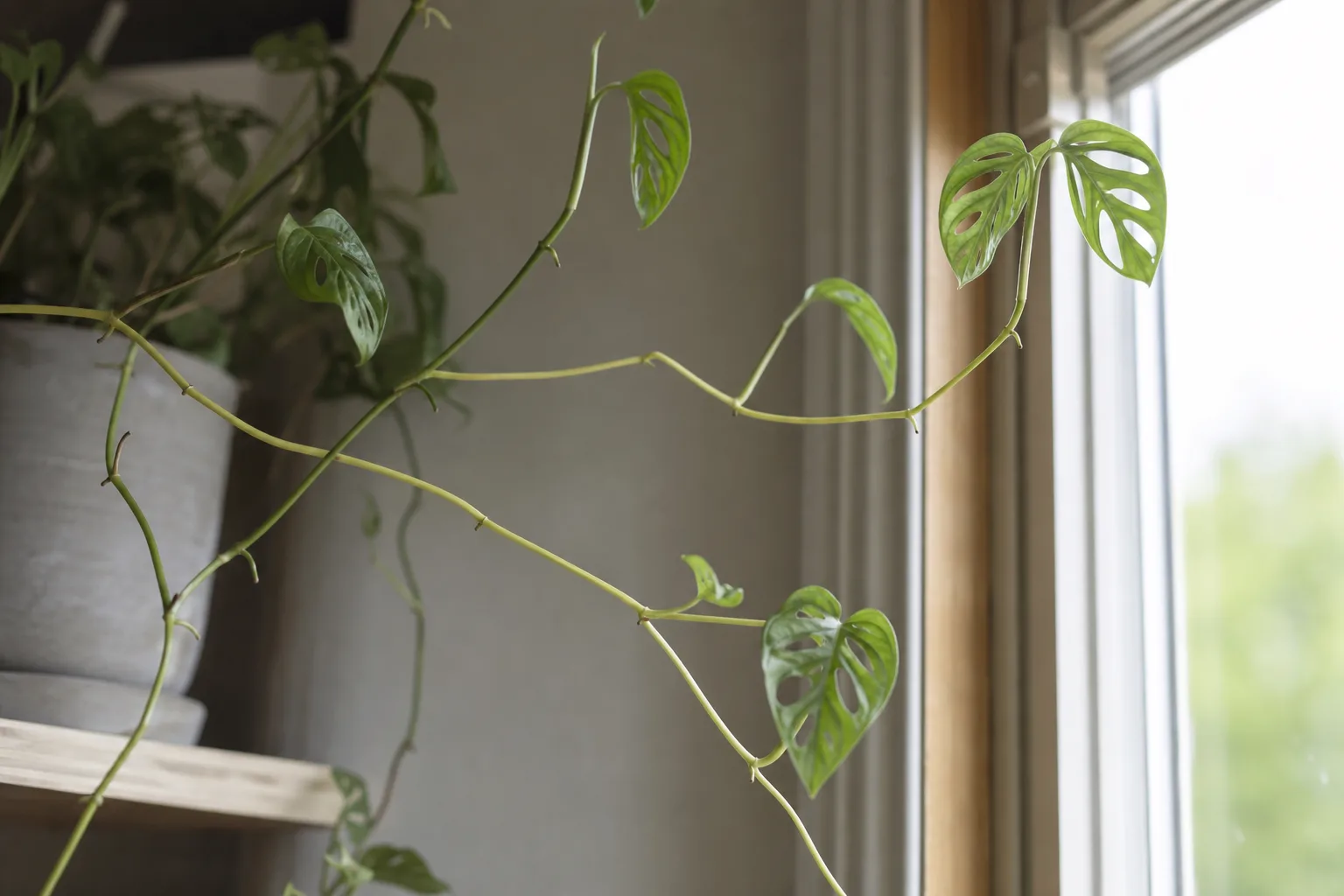
Leggy Growth on Monstera Adansonii: Causes, Checks & Fixes
This guide covers leggy growth on Monstera Adansonii. See also the general Leggy Growth guide, watering, and light pages for this plant.
Leggy Growth on Monstera Adansonii: Causes, Checks & Fixes
Quick answer
Leggy growth on Monstera Adansonii (Monstera adansonii, Swiss cheese vine) is etiolation-the vine stretches toward light when light is weak, producing long internodes, small leaves, and bare stem sections between nodes. On this fast-growing tropical climber, stretch shows up within one or two growth flushes because thin perforated leaves reach for light faster than thick Monstera deliciosa foliage.
First step: move the plant to bright indirect light and give it something vertical to climb. Unsupported trailers in dim corners stretch horizontally; a moss pole or trellis lets aerial roots attach so new growth can develop larger, more compact leaves once brightness improves. Do not fertilize or repot until you confirm the new spot is working.
This page focuses on recognizing stretch, adding support, and pruning bare vines. If your main worry is solid new leaves with shrinking holes, start with not enough light-fenestration loss and legginess often share the same root cause, but recovery here emphasizes internode spacing, moss-pole training, and cut-back reshaping.
What leggy growth (etiolation) looks like on Monstera Adansonii
Leggy Adansonii does not just look “tall.” It shows a pattern on the newest vine sections:
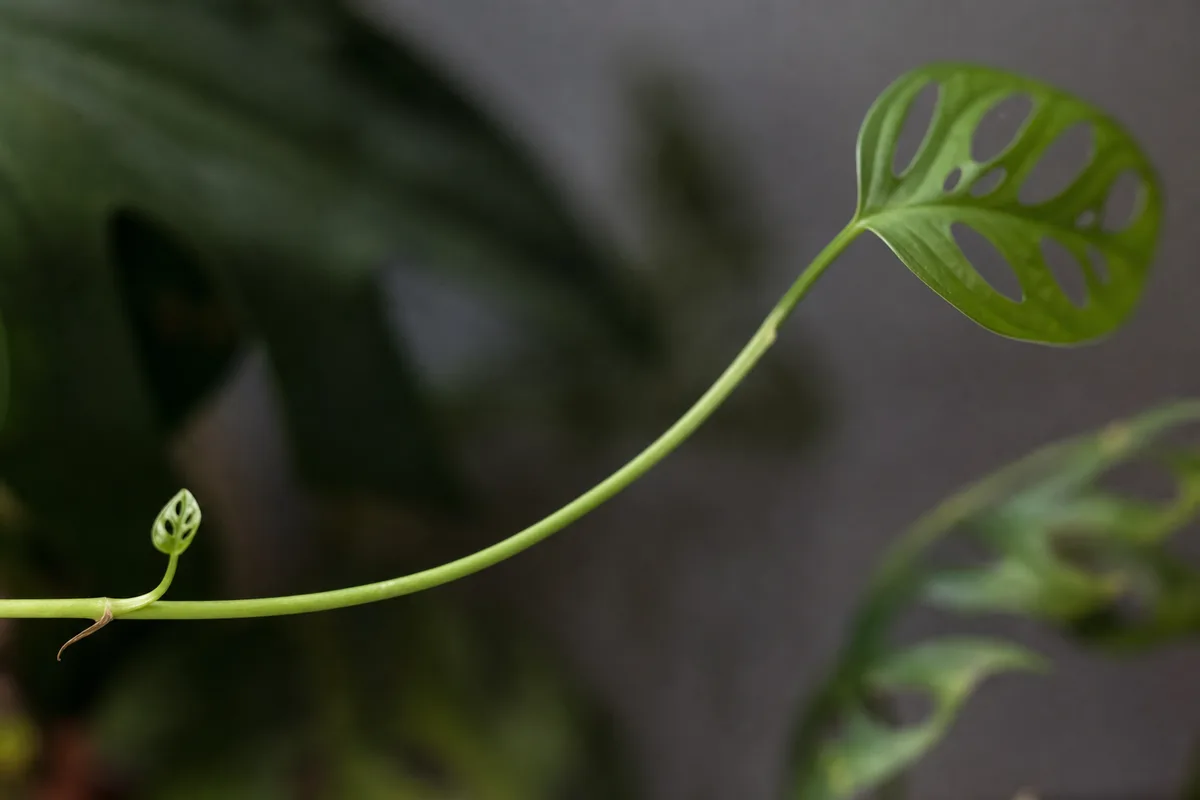
Leggy Growth symptoms on Monstera Adansonii - compare with healthy tissue on the same plant.
- Long gaps between leaves (internodes)-often noticeably longer than older compact growth lower on the same stem
- Smaller leaf blades on new growth compared with holed foliage produced in brighter conditions
- Thin, reaching petioles angled toward the brightest window or lamp
- Bare stem runs with no leaves for several centimetres between nodes
- Aerial roots along trailing sections searching for a surface to anchor-common when a climber has no moss pole
- Reduced fenestration on successive new leaves-Monsteras will not develop leaf perforations if light is too low, so holes shrink or disappear as the plant prioritizes photosynthetic area over mature perforated form
- One-sided growth in hanging baskets when the growth tip sits far from the window while older leaves near the rim still look acceptable
Trailing vs. climbing display: An unsupported basket vine often stretches along a shelf edge with long horizontal internodes. A staked vine in the same window may still etiolate if light is marginal, but once brightness improves, climbing stems typically produce larger, more fenestrated leaves than trailers at the same exposure-matching how Adansonii uses aerial roots to climb toward filtered canopy light in habitat.
What leggy growth is not: firm leaves that wilt and droop despite wet or dry soil-that pattern points to drooping leaves and a water or root problem first. Crisp bleached patches on the sun-facing side after a sudden bright move suggest sunburn, not etiolation.
Why Monstera Adansonii stretches - light, support, and growth habit
Monstera adansonii is a rapid-growing vining aroid and tropical climber that attaches to tree trunks with aerial roots in Mexican and Central American rainforests. Indoors, that biology means two separate drivers can make a vine look leggy:
Too little usable light
When photon intensity drops-deep in a room, on a north window alone through winter, or with a growth tip several feet from glass-the plant allocates stem length to reach brighter zones. Internodes lengthen, leaves stay small, and the whole vine leans toward the window. Adansonii’s fast growth rate makes this visible within weeks, not months.
No climbing support in marginal light
Even at borderline brightness, an unsupported trailing vine often produces smaller leaves and longer internodes than a moss-pole-trained stem at the same window. The growth tip on a high hanging basket sits farther from the glass; horizontal reach replaces upward climbing toward better-lit upper canopy positions. Aerial roots along bare sections signal the plant is searching for structure-not a disease.
Secondary contributors (after you rule out light)
- Root-bound slowdown in an undersized pot can produce weak, sparse new growth that mimics stretch-check whether roots circle heavily before blaming light alone
- Over-fertilizing in dim conditions pushes weak, soft elongation without fixing the photon deficit
- Normal lower-leaf drop on long trailers exposes bare stem that looks “leggy” even when the active growth tip is healthy-distinguish old senescent sections from active etiolation on the newest nodes
Light remains the primary fix for true etiolation. Support and pruning reshape the vine once brightness is adequate.
How to confirm leggy growth vs. other problems
Work through this checklist before repotting, feeding, or heavy pruning:
- Internode measurement - Pinch or mark the stem at the base of the last two leaves. A gap longer than about 5 cm (2 in) on the newest section with smaller blades strongly suggests etiolation.
- Window distance - Stand where the growth tip sits. Is it more than 1.5–2 m (5–6 ft) from the glass, or on a north exposure without supplemental light? Light intensity decreases rapidly with distance from the pane.
- Shadow sharpness test - At midday, hold your hand between the plant and the window. A faint, fuzzy shadow suggests marginal intensity; a sharper shadow suggests brighter usable light.
- Growth direction - Are newest petioles oriented toward one light source? Active phototropism confirms the plant is still seeking light.
- Support audit - Is the vine trailing with no moss pole, trellis, or stake? Long bare sections with aerial roots often improve once you add vertical support and light.
- Fenestration trend - Compare the last three new leaves to older holed foliage on the same stem. Shrinking holes plus long internodes fit leggy etiolation; see not enough light for full fenestration diagnostics.
- Soil and stem check - Insert a finger 3–5 cm into the mix. If soil stays wet for a week while stems soften at the base, investigate overwatering alongside light correction-dim corners slow uptake and keep mix soggy.
Two-week relocation test: Move the vine to your brightest safe indirect spot (or add a grow light), keep watering when the top 3–5 cm dries, and watch the next leaf pair. If the new internode is shorter and the leaf larger, light was the limiter. No change after four to six weeks in warm weather may mean the upgrade is still too dim or roots need inspection.
First fix: improve light and add climbing support
Move the vine to bright indirect light-then install or extend a moss pole before you prune.
Practical light targets:
- East window: Often ideal; gentle morning sun when acclimated
- South or west window: Place the pot 60–120 cm (2–4 ft) back or behind a sheer curtain so hot afternoon rays do not scorch thin leaves
- North window or interior shelf: Usually insufficient alone-plan a full-spectrum grow light rather than expecting compact regrowth from stretch alone
Grow-light supplementation: When natural light is weak, set a full-spectrum LED 15–30 cm (6–12 in) above the canopy for 12–14 hours daily-supplement for no more than 16 hours total light per day. Full placement and acclimation detail lives on the Adansonii light guide.
Moss pole setup:
- Insert a stake, trellis, or moss pole behind the main stem, deep enough in the pot to stay stable as the vine climbs.
- Gently tie the vine with soft plant ties-do not crush petioles.
- Aim aerial roots toward moist moss or coir; attachment encourages upward growth and larger subsequent leaves once light is adequate.
- Extend the pole as the tip outgrows it so the plant always has structure above the highest node.
Make one light move and one support change, then wait two weeks. Rotate the pot a quarter turn weekly so lean does not freeze in place. Expect the watering interval to change in brighter light-recheck the watering guide rather than keeping a dim-corner schedule.
Prune and reshape elongated vines
After light and support improve-and only after you see at least one promising new leaf pair-prune the worst bare sections to force branching.
Where and how to cut
- Identify a node (the swollen joint where a leaf petiole or aerial root attaches)-cut 5–10 mm above the node, not through it.
- Use clean, sharp scissors or pruners; sterilize blades between plants if you trim multiple specimens.
- Remove the most elongated bare runs first; leave at least a few healthy leaves on the main vine so the plant can photosynthesize while side shoots emerge.
- Optionally propagate tip cuttings with one or two nodes in water or moist aroid mix-leggy trimmings root readily when nodes stay firm.
What pruning cannot do
Existing long internodes do not shorten. Old stretched petioles and small solid leaves remain unless you cut them away. Judge success on new growth spacing and leaf size, not on stems that formed in the dark.
For species-specific pruning rhythm and tool hygiene, see the Adansonii pruning guide and propagation guide if you want to root trimmings instead of discarding them.
Recovery timeline - old stems vs. new growth
Within two to three weeks of a meaningful light increase during active growth, the next leaf pair should sit closer to the previous one and open larger if the upgrade was sufficient. Partial fenestration on those new blades confirms the vine is recovering mature form-not just surviving.
Old etiolated sections stay long indefinitely. Many keepers live with a few stretched lower stems while new compact growth covers the moss pole above-cosmetic, not fatal.
Full silhouette recovery-a bushy, holed Swiss cheese habit-often takes several months of consistent bright indirect light, weekly rotation, and selective pruning once replacement shoots prove the new setup works.
Worsening signs: continued collapse with wet soil, soft stems at the soil line, or no new nodes after six weeks in a clearly brighter spot during warm weather-escalate to root inspection or pest checks rather than more pruning.
Leggy stretch vs. not enough light vs. drooping - quick comparison
| What you see | Most likely issue | First move |
|---|---|---|
| Long internodes, small leaves, bare stem sections, lean | Leggy etiolation (this page) | Bright indirect light + moss pole; prune after new compact leaves |
| Solid new leaves, shrinking holes, dull green, slow growth | Not enough light | Relocate or add grow light; fenestration returns on new leaves only |
| Limp soft leaves, pot heavy or light vs. moisture | Drooping leaves | Probe soil 3–5 cm deep; fix watering before changing light |
| Yellow lower leaves, wet soil a week+, soft base | Overwatering / rot risk | Stop watering; inspect roots; improve light and drainage together |
| Brown crispy sun-side patches after bright move | Sunburn | Filter light; acclimate gradually |
Leggy growth and insufficient light overlap heavily on Adansonii-the difference is intent: this URL helps you measure stretch, train on a pole, and cut back bare vines; the not-enough-light URL helps you audit windows, fenestrations, and grow-light specs when light placement is the primary question.
Mistakes to avoid
Do not fertilize heavily to bulk up a stretched vine in a dim corner-salts accumulate while photosynthesis stays weak. Do not prune the entire plant before light improves; you remove stored energy and slow recovery.
Avoid jumping from deep shade to hot direct south-window sun in one step-direct sun can scorch Adansonii leaves. Do not install a moss pole alone in a dark room and expect large holed leaves; support does not replace brightness.
Do not confuse bare lower stem from old dropped leaves with active etiolation on the growth tip-trim only sections that are still producing small stretched new leaves.
Do not water on a fixed calendar after moving brighter without checking dry-down speed-see watering for the species rule (top 3–5 cm dry before a thorough soak).
How to prevent leggy growth next time
Place Adansonii where bright indirect light is realistic every season, not only where a hanging basket looks best in the room. East exposures, filtered south or west windows, or a dedicated grow shelf all support compact internodes.
Train the main stem on a moss pole even if you let side shoots trail-vertical climbing mimics wild habit and typically yields larger fenestrated foliage. Rotate weekly for even growth. Clean windows seasonally; grime cuts intensity more than people expect.
In autumn, move plants closer to glass or add artificial light before multiple nodes stretch rather than after a long bare run forms. When buying, avoid specimens already etiolated in a shop with poor lighting-starting with compact new growth is easier than rehabbing a long-stemmed basket.
Match watering to how the pot dries in that light level-faster growth in summer and brighter windows means more frequent checks; winter dim spells mean longer dry-down even with less water per drink.
Related tool
Use the Plant Problem Diagnosis Tool to narrow causes for leggy growth on this plant before changing multiple variables at once.