Monstera Adansonii Light Needs: Best Window & Signs
Monstera Adansonii Light Needs: Best Window & Signs
Monstera Adansonii Light Needs: Best Window & Signs
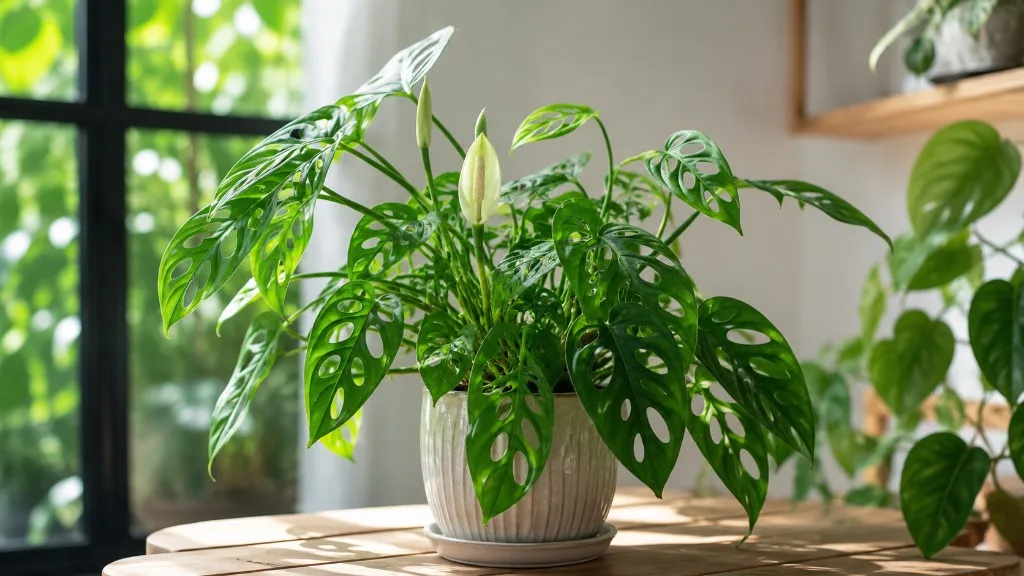
Monstera adansonii - the Swiss cheese vine - tells you whether its light is working on every new leaf it opens. When placement is right, fresh foliage arrives with clean oval holes, firm texture, and shorter gaps between nodes on a climbing stem. When light is wrong, the same vine pushes out smaller, solid leaves, stretches toward the glass with long bare internodes, or scorches within days of a careless window move. That feedback loop is why Adansonii owners search light advice differently from people growing thick-leaf Monstera deliciosa: you are not only preventing burn - you are managing fenestration, vining speed, and thin-leaf scorch risk at the same time.
The most common mistake is judging by how bright the room feels instead of how the leaf surface responds. A south-facing living room with the pot on a distant shelf is not the same as a filtered east exposure one to two meters from glass. Light intensity drops fast with distance, and Adansonii’s thinner leaves both dry faster in bright air near windows and mark more easily under direct sun than deliciosa’s thicker blades. The practical goal is strong plant-facing brightness without harsh beams on unacclimated tissue - then read the answer on the newest leaf, not on older foliage from a previous location.
This guide is the dedicated light hub for the Monstera Adansonii care cluster. It covers window direction, fenestration diagnostics, moss pole vs hanging basket geometry, grow-light hours and distance, acclimation steps, seasonal shifts, warning signs, and how light couples to watering when a fast vining aroid starts drinking faster.
Quick Answer: Best Light for Monstera Adansonii
Monstera adansonii grows best in bright, indirect light for most of the day - strong ambient daylight at the leaf without prolonged hot direct sun on unacclimated tissue. NC State Extension lists cultural preference as partial shade (direct sunlight only part of the day, 2–6 hours), which indoors usually means filtered east exposure, bright north in a well-lit room, or south/west windows with sheer curtain or several feet of setback - not bare afternoon sun on thin leaves.
In most homes the safest defaults are:
- Best default: filtered east-facing window, or west/south with sheer fabric or 1–2 meters (3–6 feet) of setback from glass
- Acceptable: bright north window if new leaves stay firm and fenestrated; supplement in winter if leaves shrink
- Avoid: unfiltered midday or afternoon sun on a shop-grown plant straight from lower light - Adansonii scorches faster than deliciosa
- Grow lights: full-spectrum LED 12–14 hours daily on a timer, foliage houseplants typically 30–60 cm (12–24 inches) from the lamp per University of Minnesota Extension
Success metric: the newest leaf on the active vine shows expected hole development for that stem’s age, firm texture, and reasonable internode length - not whether a legacy leaf from a dim shelf still looks green.
Why Swiss Cheese Vine Light Needs Differ From M. deliciosa
Both species share the Swiss cheese plant nickname and the same broad aroid preference for bright filtered light, but they are not interchangeable on a windowsill. Monstera deliciosa is a large-floor aroid with thick, leathery leaves that tolerate repositioning more slowly and scorch less readily once acclimated. Monstera adansonii is a fast, dense vine with smaller, thinner heart-shaped leaves perforated by closed oval holes that do not open to the margin the way deliciosa splits do. Penn State Extension notes Adansonii is much denser and quite vigorous as a houseplant, reaching 3 to 8 feet tall and 1 to 3 feet wide with leaves far smaller than deliciosa - which changes how quickly light stress appears and how fast the plant responds when you fix placement.
| Factor | Monstera adansonii (Swiss cheese vine) | Monstera deliciosa (split-leaf) |
|---|---|---|
| Leaf thickness | Thin; dries and marks quickly | Thick; more heat and scorch tolerance |
| Growth habit | Fast vining; leggy internodes in low light | Slower floor vine; architectural scale |
| Fenestration pattern | Closed oval holes in leaf blade | Splits and holes reaching leaf margin with age |
| Light stress speed | Shows on next 1–2 leaves within weeks | Often slower to display on thick tissue |
| Display geometry | Moss pole, shelf trail, or basket - angles vary | Usually upright on pole near large window |
The table is a decision tool, not a competition. Many homes grow both - but copying deliciosa’s south-sill placement for a trailing Adansonii in a small hanging pot often ends in crisp sun-facing patches and rapid soil drying because the thin leaf canopy sits closer to hot glass with less thermal mass.
Thinner Leaves and Faster Scorch Risk
Adansonii leaves lose water and heat up faster than deliciosa’s. In bright, dry window air - especially on a small hanging basket - you may see brown crisp edges or bleached zones while a deliciosa on the same sill still looks fine. That is biology, not failure. NC State Extension warns that direct sun can cause scorched leaves on Monstera Adansonii overview, and the partial-shade label still allows some direct sun in the right season and acclimation state. The reconciliation is simple indoors: treat hot afternoon glass as the danger zone, and treat gentle morning or filtered direct as optional once the plant proves it on new growth.
Best Light Level: Bright Indirect and What That Looks Like
Bright indirect light means the plant receives strong daylight while direct sunbeams do not strike leaves for long stretches - especially harsh afternoon rays. Penn State Extension advises placing Monstera near a sunny window where it receives bright light but not direct sun, and notes the plant gets leggy in lower light - stretched stems with wider gaps between leaves as it reaches for photons.
Adansonii’s native range spans tropical rainforests from Mexico through Central America into South America, where seedlings climb tree trunks toward dappled canopy light rather than full desert sun. NC State Extension describes it using aerial roots to climb for access to more sunlight - the same reason a moss pole indoors often produces larger, cleaner leaves than a vine left to trail in marginal brightness.
Reading Light at the Leaf Surface
Translate “bright indirect” with a field test at leaf height, not eye height. On a clear day, hold your hand between the plant and the window. A soft, readable shadow with defined edges usually indicates bright indirect range. A faint or absent shadow means low light - survivable short term, poor for fenestration long term. If the leaf surface feels hot to touch within an hour of sun hitting it, you are in direct exposure that may need filtering or distance.
Duration matters as much as a moment of sunbeams. Adansonii benefits from roughly 8 to 10 hours of useful ambient brightness across the day. A spot with one hour of gentle morning sun plus bright ambient light often outperforms two hours of baking west exposure alone. Re-check placement in late winter when sun angle and day length drop - vines that fenestrated well in summer may push smaller leaves by February unless you add a grow light or move closer to glass.
Fenestration as Your Light Success Metric
For Adansonii owners, light quality shows up first in hole formation on new leaves, not in a generic “looks green” check. NC State Extension notes the holes in the leaves help sunlight filter to the plant - a functional link between perforation and light capture in the wild. Indoors, inadequate light does not always kill the vine quickly; it often suppresses fenestration while the plant stays alive on stored energy, which is why solid new leaves are the earliest reliable signal that brightness is now limiting growth.
Wisconsin Horticulture Extension states that Monstera grown under fluorescent light will not develop leaf perforations when light is inadequate - a principle that applies to Adansonii fenestration as well: without enough intensity, the plant prioritizes survival foliage over perforated blades. Climbing support matters too. Stems trained up a moss pole or trellis mimic wild vertical growth toward brighter zones; a vine trailing downward from a high shelf may receive less light at the growing tip even when lower leaves look fine.
Judge fenestration on the active growing tip, not on juvenile basal leaves. Young or recently propagated vines often produce fewer holes until the stem matures - improve light and support, then read the next two leaves before declaring failure. Existing leaves will not gain holes retroactively.
Hole-Less New Leaves as a Low-Light Signal
When light is insufficient, Adansonii commonly shows:
- Smaller new blades compared with recent leaves on the same stem
- Solid or nearly solid leaves where the prior node had perforations
- Longer internodes - visible bare stem between nodes as the vine reaches toward the window
- Slower unfurling and softer texture on the newest leaf
These patterns overlap with other stresses, so change one variable at a time. If you move to brighter filtered light, wait two to three weeks before also Monstera Adansonii repotting guide or increasing fertilizer. Persistent solid small leaves after a light fix may point to not enough light or leggy growth rather than age alone.
Best Window Placement by Exposure
Window direction is a starting point. Overhangs, trees outside, tinted glass, and pot distance all change the light that reaches the leaf. Still, compass orientation gives a reliable first guess in the northern hemisphere.
Place Adansonii where it receives strong plant-facing light for most of the day, not where the room looks bright. Rotate the pot a quarter turn every two to three weeks if growth leans toward the glass - normal directional growth, not an emergency.
East, North, and Filtered South or West
An east-facing window is the default sweet spot for many Adansonii setups. Morning sun tends to be bright but cooler than late-day sun, followed by strong indirect light the rest of the day. 1–2 meters (3–6 feet) from an unobstructed east pane often delivers steady growth without constant scorch management - especially for moss-pole climbers where the top of the vine needs light as much as the base.
A north-facing window provides gentle indirect light all day. Adansonii can maintain in bright north rooms, but fast vining and strong fenestration may slow in winter. If new leaves shrink from late fall through early spring, add a grow light for 12–14 hours or shift to a brighter filtered east or west exposure rather than accepting permanent small foliage.
South- and west-facing windows deliver the highest total daily light - valuable in winter at mid and high latitudes when filtered. Use sheer curtains or place the pot 1.5–2 meters (5–6 feet) back from unobstructed south glass. Watch the top leaves on a moss pole; they can scorch while lower trailing stems look fine. In summer, move hanging baskets slightly farther from west glass - thin leaves in small pots heat quickly.
Moss Pole vs Hanging Basket: Angle and Distance Matter
Display form changes which tissue receives light. On a moss pole, the apical growing tip sits highest and often closest to the window - usually good for fenestration, but risky if that tip touches hot glass. On a hanging basket, the growing tip may trail downward into dimmer air below the window line while upper leaves intercept most light. Many growers climb the main stem on a pole and let side shoots trail for aesthetics, which balances light at the active meristem with a fuller silhouette.
Fast vining on a pole also increases light demand indirectly: more leaf area transpires more water, and brighter exposure drives faster growth. After mounting a pole or moving a basket closer to glass, re-check watering within the first week - light and water move together on Adansonii more visibly than on slow-growing floor plants.
Small hanging pots near windows dry faster in bright placement. That is not a reason to dim light automatically; it is a reason to pair brighter exposure with moisture checks rather than keeping the vine dim to preserve a calendar schedule.
Can Monstera Adansonii Take Direct Sun?
Yes - conditionally. NC State Extension lists partial shade with 2–6 hours of direct sun, which aligns with gentle morning exposure or filtered direct through sheer fabric - not necessarily with unfiltered south or west afternoon indoors. Leaves formed in lower light need gradual acclimation before stronger exposure. Sudden jumps produce bleached patches, crisp sun-facing tissue, or curling during brightest hours - see sunburn and scorched leaves when damage is fresh on new tissue.
Variegated ‘Archipelago’ cultivars carry less chlorophyll per leaf area and generally need brighter filtered light than solid-green Adansonii to maintain variegation - but they are more sensitive to scorch. Give variegated forms softer exposure and longer acclimation; judge variegation stability on new leaves after each move.
Morning Sun vs Afternoon Heat on Thin Leaves
Morning direct sun differs from afternoon direct sun in heat load. East exposure gives a manageable direct period followed by bright indirect day length. Afternoon sun through west or south glass can exceed what thin Adansonii leaves tolerate, especially in small pots on sills. If you want direct sun benefits - slightly tighter internodes on some vines - east morning sun is the safest entry. Never assume toughness equals burn immunity; sunburn tissue does not green up again.
Low-Light Limits: Small Leaves, Missing Holes, Leggy Vines
Low light is a poor long-term setup for Adansonii. The vine may survive for months on stored reserves while losing vigor - the same pattern Penn State Extension describes when Monstera gets leggy in lower light. University of Minnesota Extension notes that insufficient light produces long spaces between leaf nodes as stems stretch toward the source, along with paler or smaller new growth.
For Adansonii specifically, the defining low-light signals are:
- Hole-less or minimally perforated new leaves on stems that previously fenestrated
- Smaller blade size on successive nodes
- Long bare internodes on trailing vines reaching toward the brightest corner
- Soil staying wet longer as metabolism slows - raising root stress if watering does not adjust
Low light is not a moral failure - it is a geometry problem you can fix with a grow light, a closer filtered window, or a moss pole that lifts the growing tip into brighter air. Do not stack fertilizer to compensate for dim placement; that path leads to salt buildup while leaves stay small.
Grow Lights for Swiss Cheese Vine
When natural light is weak - north rooms, winter months, office desks - a full-spectrum LED grow light can sustain fenestration and shorten internodes. Wisconsin Horticulture Extension confirms Monstera can grow under fluorescent light but will not develop perforations without adequate intensity - treat that as a minimum intensity bar for Adansonii holes, not as permission to use a dim desk lamp.
University of Minnesota Extension recommends 12 to 14 hours daily for foliage houseplants on a timer, with 12 to 24 inches (30 to 60 cm) distance for typical LEDs - and warns that too much light bleaches or scorches leaves. Start at the farther end of that range for thin-leaf Adansonii, then move 5–10 cm (2–4 inches) closer only if new growth stays small and internodes stretch.
Duration, Distance, and Full-Spectrum Setup
Practical starting setup for a single Adansonii on a pole or shelf:
- Fixture: full-spectrum white LED labeled for foliage or general houseplants
- Height: 30–45 cm (12–18 inches) above the top leaves for moderate-output bars; 45–60 cm (18–24 inches) for strong panels
- Duration: 12–14 hours on a timer; do not run 24 hours - plants need a dark period for normal metabolism
- Placement: overhead or slightly offset so the growing tip is lit, not just the trailing skirt
- Check weekly: leaves curling, bleaching, or feeling warm mean raise the lamp or reduce hours
If the plant already receives several hours of good window light, 8–10 hours of supplemental LED may suffice. Windowless rooms need the full 12–14 hour schedule.
How to Move or Acclimate Without Leaf Drop
Sudden light jumps cause leaf drop, curl, scorch, or stalled growth on fast aroids. Increase exposure in small steps every three to four days - about 30 cm (one foot) closer to the window, one layer less of sheer, or one hour more grow-light time - over 7 to 14 days. Do not repot, fertilize heavily, or rotate the moss pole daily during acclimation; let the newest leaf report success or stress.
If the youngest leaf bleaches or crisps at midday, pause for a week at the last safe position before stepping brighter again. Old scars from a previous location are not acclimation data - only post-move new growth counts.
Light Changes and Watering Adjustments
Every light change changes water use. Brighter placement pulls moisture through thin leaves faster, especially near glass or under LEDs that add warmth. After moving Adansonii brighter, check the watering guide rhythm - the top 3–5 cm of mix may dry a day or two sooner. After moving dimmer, extend the dry-down before soaking to avoid soggy mix in slow metabolism.
Light and water fixes should not happen as a single shock event. Move light first, stabilize new growth, then adjust watering to match the new dry-down speed - not the calendar you used in the old corner.
Warning Signs Checklist: Too Much vs Too Little Light
Use the newest leaf on the active vine as your diagnostic sample.
Too little light
- Successively smaller new leaves
- Missing or reduced fenestrations on stems that previously perforated
- Long internodes and vines leaning toward the brightest corner - leggy growth
- Slow unfurling and softer new texture
- Mix staying wet too long without root rot on Monstera Adansonii yet present
Too much light or heat
- Bleached white-yellow patches on sun-facing tissue
- Crisp brown edges appearing within days of a window move
- Curling or wilting during brightest hours despite moist mix
- Leaf drop on Monstera Adansonii on upper canopy while lower leaves remain - often heat plus light shock
When symptoms overlap, fix light first - it is the lever most Adansonii owners under-adjust.
Know Your Plant: Native Habitat and Indoor Biology
Monstera adansonii is a tender evergreen vining aroid in the Araceae family, native to tropical rainforests of Mexico, Central America, and South America. In habitat it climbs tree trunks with aerial roots toward filtered canopy light. Indoors with support it commonly reaches 3 to 8 feet tall and 1 to 3 feet wide, with rapid growth when warmth, humidity, and light align. NC State Extension recommends a stake, trellis, or moss pole so the plant has structure to climb - matching both wild habit and better-lit upper-canopy leaf development.
The species is toxic to pets and humans if ingested, with calcium oxalate crystals causing oral irritation - relevant if you place vines within reach on low shelves. See the overview guide for toxicity detail and pet-safe display choices.
Avoid temperatures below 50°F (10°C) and cold drafts near windows in winter - light placement fails if the leaf is physiologically shut down from chill.
When to use this page vs other Monstera Adansonii guides
- Monstera Adansonii overview - Start here for whole-plant context before deep-diving this topic.
- Monstera Adansonii problems hub - Jump to symptom-specific fix guides when this care topic does not resolve the issue.
- Not Enough Light on Monstera Adansonii - Escalate here when light adjustments are not enough.
- Leggy Growth on Monstera Adansonii - Escalate here when light adjustments are not enough.
- Sunburn / Scorched Leaves on Monstera Adansonii - Escalate here when light adjustments are not enough.
Related Monstera Adansonii guides
- Monstera Adansonii overview
- Monstera Adansonii watering
- Monstera Adansonii soil
- Monstera Adansonii propagation
- Monstera Adansonii fertilizer
- Monstera Adansonii repotting
- Not Enough Light on Monstera Adansonii
- Leggy Growth on Monstera Adansonii
- Sunburn / Scorched Leaves on Monstera Adansonii
- Leaf Drop on Monstera Adansonii
- Monstera Adansonii problems
Conclusion
Monstera adansonii light success comes down to filtered brightness at the leaf, not room décor: place the vine where the newest leaf gets a soft hand shadow, protect thin tissue from hot afternoon glass, and use fenestration as your primary feedback loop. Move in small steps over 7 to 14 days, re-check watering after every shift, and read results only on new growth.
Choose east or filtered south/west for most homes, give climbing stems a moss pole so the active tip sits in light, and run grow lights 12–14 hours when windows fall short - especially in winter. When leaves stay small and solid, link to not enough light; when fresh tissue bleaches after a move, link to sunburn. Get placement right and Adansonii repays you in firm, holey new leaves - the whole reason this vine earns wall and shelf space.