Not Enough Light on Monstera Adansonii: Causes, Checks &
Quick answer
Monstera Adansonii in dim rooms loses fenestrations, grows smaller solid leaves on long petioles, and leans toward windows. First step: move the vine to bright indirect light within a few feet of an east or filtered south/west window-or add a full-spectrum grow light-before changing water or fertilizer.
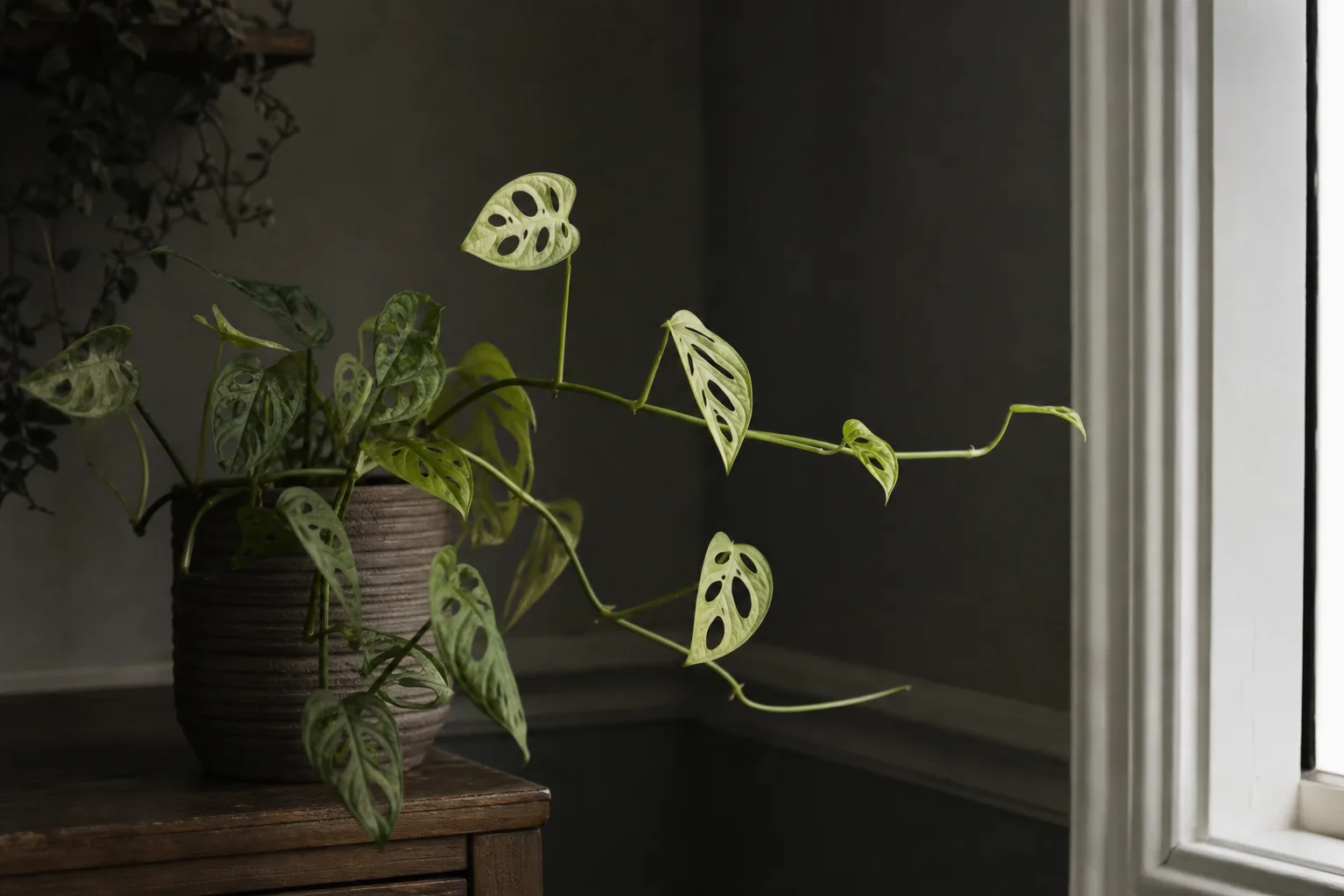
Not Enough Light on Monstera Adansonii: Causes, Checks & Fixes
This guide covers not enough light on Monstera Adansonii. See also the general Not Enough Light guide, watering, and light pages for this plant.
Not Enough Light on Monstera Adansonii: Causes, Checks & Fixes
Quick answer
Monstera Adansonii (Monstera adansonii, Swiss cheese vine) is a rapid-growing vining aroid that prefers bright, indirect sunlight indoors-not a dim hallway, distant bookshelf, or north-facing room alone. When light is too weak, the defining Adansonii signal is not generic “legginess” alone: new leaves arrive smaller, often solid, with fewer or no oval holes-Monsteras will not develop leaf perforations if light is too low-while petioles stretch and the whole vine leans toward the brightest direction.
First step: move the plant to your brightest safe indirect window-or add a full-spectrum grow light-and leave it there for two weeks. Do not repot, fertilize, or increase watering until you read how the next leaves respond. Brighter light changes how fast a small hanging pot dries; extra water in a dim corner is a common way healthy roots turn sour.
This page focuses on insufficient light as the root cause. If your main worry is long bare stems without fenestration context, also read leggy growth-but fenestration loss plus lean almost always starts here.
What not enough light looks like on Monstera Adansonii
Low light on Adansonii shows up as a pattern over weeks on new growth, not a single pale leaf.
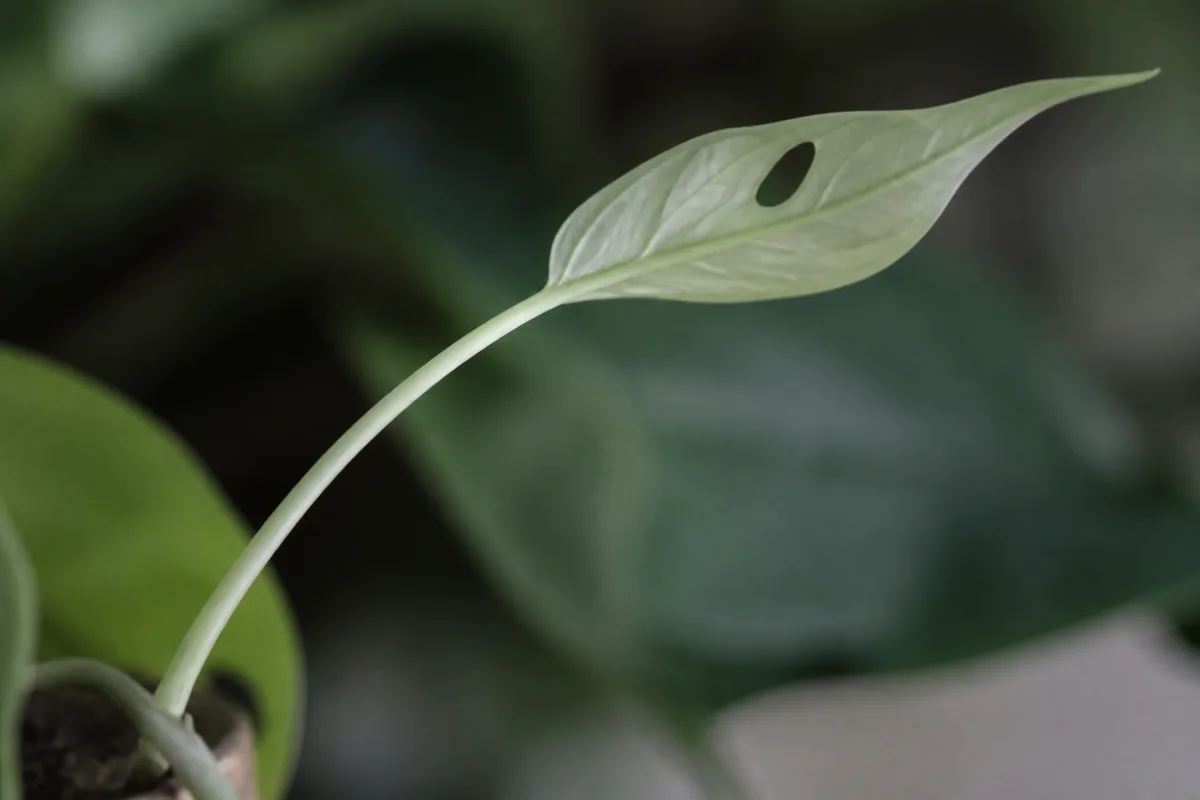
Not Enough Light symptoms on Monstera Adansonii - compare with healthy tissue on the same plant.
Typical signs:
- Solid or nearly solid new leaves on a vine that previously produced holed foliage-fenestrations shrink or disappear as light drops
- Smaller leaf blades compared with older perforated leaves lower on the same stem
- Longer gaps between leaves (etiolation) as petioles reach for photons
- One-sided lean or all new growth pointing toward a window or lamp-plants not receiving enough light stretch or lean toward the light
- Slow or stalled growth during warm months when Adansonii should be pushing nodes quickly
- Dull, dark green color that looks flat rather than the glossy perforated foliage of a well-lit specimen
- Aerial roots searching along a moss pole or shelf edge without firm new leaves following-energy is going to reach, not to mature foliage
Adansonii leaves are thin, glossy, and perforated-not velvety like some Ficus species. In good light they feel firm and show clean oval holes. In chronic shade they may stay attached but look undersized, and the Swiss cheese pattern fades on successive leaves.
What low light is not: crisp bleached or brown patches on the sun-facing side of a leaf-that pattern points to sunburn after a sudden bright move. A brand-new cutting’s first one or two leaves are often naturally solid; chronic hole loss on an established vine in the same dim spot fits insufficient light better.
Trailing vs. climbing context: Adansonii can trail from a basket, but it develops larger, more fenestrated leaves when allowed to climb a stake or moss pole toward brighter upper canopy light-mimicking how it uses aerial roots to ascend trees in tropical rainforests. A hanging vine in marginal light may show smaller solid leaves than a supported vine at the same window because the growth tip stays farther from the glass.
Why Monstera Adansonii gets not enough light
In the wild, Monstera adansonii is a climbing understory plant from Mexico, Central America, and South America. It attaches to tree trunks with aerial roots and grows toward brighter filtered light above the forest floor. Indoors, that biology means distance from the window matters more than how bright the room looks to your eyes.
Common situations that starve Adansonii:
Interior placement. Light intensity decreases rapidly with distance from the glass. A spot more than 1.5–2 m (5–6 ft) into the room may fall into low or medium-bright ranges-often 25–500 foot-candles depending on direction-while Adansonii performs best with sustained bright indirect exposure closer to the source.
North-facing windows alone. In the Northern Hemisphere, north panes provide the lowest natural intensity-often classified as low light. Adansonii may limp along there in summer but commonly loses fenestrations and vigor through winter unless you supplement.
Winter daylight. Shorter days and weaker sun reduce effective hours even if you never moved the pot. Many owners see solid new leaves and stretch every November through February in the same corner that worked in July.
Hanging baskets high in a dim room. Trailing display looks great, but the growth tip can sit far from the window while older holed leaves near the rim still look “fine”-masking that the newest tissue is light-starved.
Light-water coupling in small pots. In low light, Adansonii uses water slowly. If you keep watering on a summer schedule, soil stays wet longer, roots lose oxygen, and lower leaves yellow-mimicking overwatering when light was the root cause. Yellowing of lower leaves can be caused by too little light or overwatering-so read soil moisture before you add more water. Wet soil plus dim corners is a dangerous pairing for this aroid; overwatering can result in root rot.
Marketing confusion. Because Adansonii tolerates brief adjustment better than some finicky tropicals, it is easy to park it in the same dark corners reserved for snake plants. NC State lists partial shade for outdoor culture, but as a houseplant it still needs meaningful bright indirect exposure-not perpetual deep shade.
How to confirm the cause
Work through these checks before treating pests, repotting, or feeding:
- Window direction and distance - Stand where the pot sits. Can the newest growth tip see sky through the window, or is the plant several feet back? Is the only exposure north-facing without supplemental light?
- Fenestration trend - Compare the last three new leaves to holed foliage six months ago on the same vine. Shrinking holes or solid blades on an established plant confirm light limitation-not a normal juvenile phase.
- Growth direction - Are newest petioles and leaves oriented toward one light source? That lean confirms active phototropism-the plant is seeking more light.
- Internode length - Measure the gap between the last two leaves. Lengthening gaps with smaller blades is classic etiolation from insufficient intensity.
- Season - Did symptoms begin or worsen as days shortened? Seasonal light drop alone can push a borderline placement into deficiency.
- Soil moisture rhythm - Insert a finger 3–5 cm into the mix. If it stays damp for a week or more while growth is weak, low light may be slowing uptake. Note the pattern; do not water on autopilot until you understand both light and moisture together.
Optional: shadow sharpness test. At midday, hold your hand between the plant and the window. A sharp, dark shadow suggests brighter usable light; a faint, fuzzy shadow suggests marginal intensity-useful when you lack a meter.
If solid new leaves, stretch, and lean align with a dim placement-and roots are not mushy when you spot-check-not enough light is confirmed. If soil is sour-smelling and roots are brown and soft, investigate root trouble alongside light correction.
First fix for Monstera Adansonii
Move the vine to the brightest location that still avoids harsh unfiltered midday sun on thin leaves.
Practical targets:
- East window: Often ideal. Adansonii can sit closer to the glass and receive gentle direct morning sun when acclimated.
- South or west window: Brightest exposure; place the pot 60–120 cm (2–4 ft) back or behind a sheer curtain so hot afternoon rays do not scorch thin foliage.
- North window or interior shelf: Usually insufficient alone-plan on a grow light rather than expecting fenestrations to return without supplementation.
- No usable window: Set a full-spectrum LED grow light 15–30 cm (6–12 in) above the canopy for 12–14 hours daily-supplement for no more than 16 hours total light per day.
Make one move, then wait. Keep watering when the top 3–5 cm of mix dries-the same rule as normal Adansonii care-but expect the interval to shorten in brighter light. Check soil every few days for the first two weeks rather than assuming the old calendar still applies.
Do not jump straight to a blazing south window sill if the plant has lived in deep shade for months. A moderate step brighter now beats sunburn tomorrow; inch closer after new growth looks stable. Full safe-move workflow lives on the Adansonii light guide.
Step-by-step recovery
Once the plant is in better light:
- Hold fertilizer until you see fresh leaves opening with normal color and at least partial fenestration. Feeding a light-starved vine does not replace photons.
- Rotate the pot a quarter turn weekly so all sides receive similar exposure and the lean does not freeze in place.
- Add or extend a moss pole if you want larger holed leaves-the vine must climb toward light, not just trail farther into shade.
- Dust glossy leaves with a damp cloth. Blocked surfaces photosynthesize less efficiently on thin Adansonii foliage.
- Adjust watering to the new dry-down speed. Lighter pots mean drink sooner; heavy pots after a week mean wait longer-see watering guide for the species dry-down rule.
- Prune only after new growth proves the spot works. Cutting stretched stems before light improves removes stored energy and slows recovery.
If winter light remains marginal even at the best window, add a grow light rather than accepting solid leaves until spring.
Recovery timeline
Expect visible improvement in new growth within two to three weeks after a meaningful light increase during the active season. The first new leaf should sit closer to the previous one, grow larger, and show at least partial hole development if the upgrade was sufficient.
Older stretched petioles and small solid leaves will not compact. They remain long even when conditions improve-existing etiolated tissue does not shrink back. Evaluate success on the next two flushes of leaves, not on branches that formed in the dark.
Full vine silhouette recovery-a fuller, holed Swiss cheese habit-can take several months of consistent bright indirect light and may require selective pruning of the worst etiolated shoots once replacement growth is established.
If nothing new appears after four to six weeks in a clearly brighter spot during warm weather, reassess: roots may be damaged, pests may be present, or the “upgrade” may still be too dim (common with north windows in winter).
Lookalike symptoms
| What you see | Often confused with | How to tell them apart |
|---|---|---|
| Solid small new leaves, long petioles, lean | Normal juvenile leaves on a new cutting | Juvenile: first 1–2 leaves on a fresh propagate; chronic low light: hole loss on mature vines in the same dim spot for months |
| Long stems, small leaves, lean | Leggy growth from any cause | Leggy growth is the stretch symptom; this page traces the light root cause-confirm window distance and fenestration trend |
| Yellow lower leaves, wet soil | Overwatering / root rot | Overwatering: soil wet throughout, possible sour smell, soft roots. Low light: stretch and lean present; soil may stay wet because growth is slow |
| Uniform pale green leaves | Pale leaves from nutrient or light stress | Pale leaves: washed-out color across blades; low light: often darker dull green with small solid form and directional lean |
| Brown crispy patches on sun side | Sunburn | Sunburn: damage on the leaf facing the window after a sudden bright move. Low light: no scorch patch pattern |
| All growth pointing one way | Plant leaning alone | Leaning overlaps with low light; fenestration loss and small new leaves confirm insufficient intensity, not just pot orientation |
Mistakes to avoid
Do not water more because leaves look limp in a dark corner-roots in soggy mix cannot fix a light problem. Do not fertilize heavily to “green up” a stretched vine; salts build up while photosynthesis stays weak.
Avoid moving Adansonii into direct hot afternoon sun in one step after months of shade. Thin perforated leaves scorch quickly. Do not assume a north window is enough without watching new leaves for hole development.
Do not prune the entire vine before light improves; you remove stored energy and slow recovery. And do not ignore dry-down changes after a move-overwatering in brighter light is less common, but underwatering can happen if you forget to recheck the pot.
Do not confuse trailing culture with low light tolerance-a basket in shade still starves the growth tip even when older leaves look acceptable.
How to prevent not enough light next time
Place Adansonii where bright indirect light is realistic every month, not only where the hanging basket looks best in the room layout. East exposures, filtered south or west windows, or a dedicated grow shelf all work.
Rotate weekly for even growth. Clean windows and leaves seasonally-grime cuts intensity more than people expect. In autumn, move plants closer to glass or add artificial light before solid-leaf stretch begins rather than after multiple nodes fail to fenestrate.
When buying, avoid specimens already etiolated in a shop with poor lighting; starting with compact holed new growth is easier than rehabbing a long-stemmed basket.
Match watering to how the pot actually dries in that light level. Faster growth in summer and brighter windows means more frequent checks; winter dim spells mean longer dry-down even with less water volume per drink.
When to worry
Escalate if many leaves yellow while soil stays wet in a dark location-inspect roots for rot and improve light and drainage together. Worry if new growth stops entirely for more than a month in warm conditions despite a light move; the new spot may still be insufficient or another stressor (pests, cold drafts below 50°F (10°C)) is involved.
A few smaller leaves after a large light improvement can happen as the plant rebalances; widespread collapse with soft stems is not a normal low-light pattern-check roots.
Conclusion
Not enough light on Monstera Adansonii is a placement problem before it is a mystery disease. Solid new leaves, shrinking fenestrations, long petioles, and a lean toward the window tell you the vine needs more usable brightness-not more fertilizer or a bigger pot.
Move it to bright indirect exposure, recheck watering as the pot dries faster, and judge recovery on new holed foliage. Old stretched growth may stay long, but a well-lit Adansonii regains the perforated, vining habit that makes this species worth keeping out of the dim corners reserved for true low-light plants.
For proactive placement and grow-light specs, see the Monstera Adansonii light guide. For the full care picture, see the Monstera Adansonii overview.
Related tool
Use the Plant Problem Diagnosis Tool to narrow causes for not enough light on this plant before changing multiple variables at once.