Pale Leaves on Monstera Adansonii: Causes, Checks & Fixes
Quick answer
Pale leaves on Monstera Adansonii usually mean washed-out light green or yellowish foliage-not the normal lime tone on a leaf that is still opening. Low light and overwatering are the top causes. First step: compare newest leaves to older ones, check soil moisture at 3–5 cm depth, and move to bright indirect light if the whole vine looks faded.
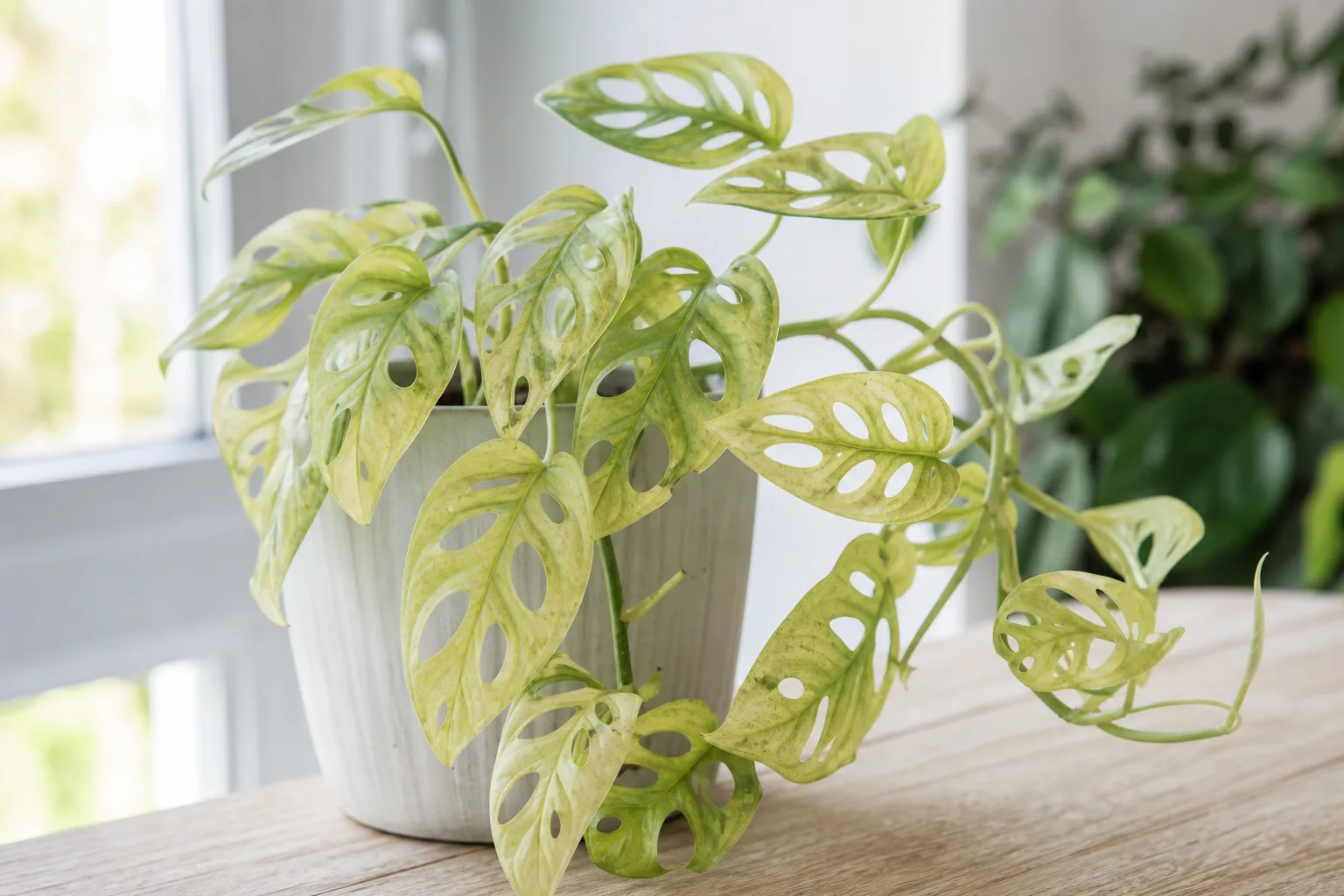
Pale Leaves on Monstera Adansonii: Causes, Checks & Fixes
This guide covers pale leaves on Monstera Adansonii. See also the general Pale Leaves guide, watering, and light pages for this plant.
Pale Leaves on Monstera Adansonii: Causes, Checks & Fixes
Quick answer
Pale leaves on Monstera Adansonii mean the foliage looks washed out, light green, or uniformly yellowish-not the brief lime flush on a leaf that is still unfurling. This fast-growing vining aroid normally carries medium to dark green, glossy, heart-shaped leaves with oval fenestrations. In dim rooms or chronically wet soil, new leaves stay pale, fenestrations shrink or disappear, and the vine stretches between nodes.
First step: look at the newest leaf, not the oldest. If the whole blade looks flat and pale and fenestrations are weak on recent growth, move the plant to Monstera Adansonii light guide and confirm the top 3–5 cm of mix is dry before watering again. Do not fertilize on day one.
What pale leaves look like on Monstera Adansonii
Before diagnosing a problem, separate normal Adansonii color change from unhealthy paleness.
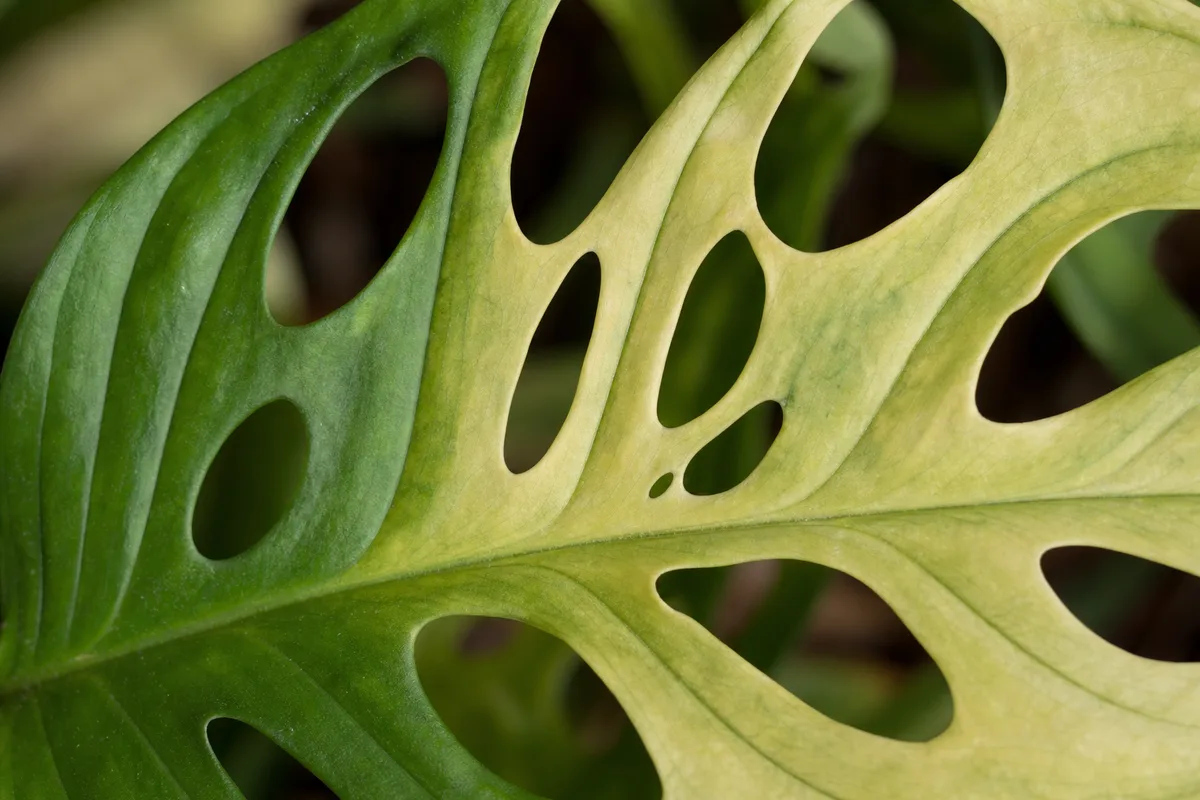
Pale Leaves symptoms on Monstera Adansonii - compare with healthy tissue on the same plant.
Healthy Adansonii leaves are glossy and heart-shaped with distinctive oval holes. Medium to dark green is the typical mature color on a well-lit plant. New leaves often open lime or chartreuse, then deepen as they harden-that opening tone is expected, not chlorosis.
Problem pale leaves on Adansonii show a different pattern:
- Uniform light green or yellow-green wash across the whole leaf, not a temporary lime stage on one unfurling leaf
- Smaller new leaves with fewer or missing fenestrations while older leaves still show holes
- Long internodes and thin stems on the same pale shoot-leggy growth paired with fade
- Lower leaves turning pale yellow while soil stays wet for days
- Bleached patches with brown crispy edges after sudden direct sun on thin foliage-too much light, not too little
- Fine yellow speckling with webbing on undersides-spider mite damage mimicking pale foliage
Unlike Monstera deliciosa, Adansonii has thinner leaves that mark and fade quickly when light or watering swings. A trailing pot in a back corner often looks uniformly pale along the whole vine, not just on one aging lower leaf.
Why Monstera Adansonii gets pale leaves
Most cases trace to light, water, or the combination-not a mysterious disease.
Insufficient light
Adansonii prefers bright, indirect sunlight indoors. Without enough photons, chlorophyll production drops and leaves lose their deep green. Not enough light can cause slow, spindly growth and the development of small pale leaves on many houseplants, including climbing aroids. On Adansonii this reads as washed-out vines, weak fenestrations, and stems reaching toward the brightest window.
Overwatering and poor root function
When roots sit in wet mix, oxygen drops and nutrient uptake falters. Overwatering can result in root rot on Monsteras. Pale or yellow lower leaves with soil that stays heavy 10–14 days after watering fit this pattern. Low light compounds the problem: transpiration slows in dim corners, so the same Monstera Adansonii watering guide keeps roots damp longer-especially in small hanging pots that dry slowly when shaded.
Too much direct sun on thin leaves
Adansonii wants bright filtered light, not hot midday rays on a south window. Direct sun can cause scorched leaves on Monstera Adansonii overview. Bleached or papery pale sections with brown margins are sun stress, not a nutrient shortage.
Nutrient deficiency (less common, after ruling out light and water)
If light is adequate, soil dries normally, and new growth stays uniformly pale, nitrogen deficiency is possible. Uniform chlorosis on older foliage is an early nitrogen deficiency symptom. On Adansonii this shows as older lower leaves fading before new ones, with weak overall vigor-not the typical vine-wide fade from shade. Do not feed a stressed, wet, or newly repotted Adansonii until basics stabilize.
Pests
Monitor for spider mites, mealybugs, and aphids on Adansonii. Spider mites cause stippling that makes leaves look speckled and pale, often with fine webbing on undersides-especially in dry winter air near heat vents.
How to confirm the cause
Work through these checks in order:
- Newest leaf quality - Compare the last two or three leaves to older fenestrated ones. Uniform pale wash with weak holes on new growth points to light stress. Pale or yellow lower leaves with wet soil points to water stress.
- Soil moisture at 3–5 cm depth - Dry mix with limp, pale leaves may mean underwatering. Wet mix with pale or yellow lower leaves confirms overwatering risk.
- Light at leaf level - Hold your hand between the window and foliage. A faint shadow means too dim for a fenestrated climber. Harsh direct sun on thin leaves suggests bleaching.
- Leaf undersides - Webbing, tiny moving dots, or sticky film mean pests-not cultural pale leaves.
- Recent changes - Monstera Adansonii repotting guide, fertilizer spikes, or a sudden window move can trigger temporary fade. Note timing before stacking fixes.
- Stem and soil smell - Sour odor or soft base tissue with pale/yellow leaves warrants unpotting to inspect roots.
If new leaves emerge medium green with clear fenestrations and the pot dries on a normal rhythm, Adansonii is healthy-a brief lime stage on one opening leaf is normal, not a problem.
First fix for Monstera Adansonii
Move the plant to bright indirect light and pause watering until the top 3–5 cm of mix is dry.
East-facing windows or filtered south/west exposure match Adansonii’s needs. If soil is soggy, skip the next scheduled drink and let dry-down catch up before watering deeply through the drainage holes. Remove fully yellow or papery sun-scorched leaves only after conditions improve.
Do not fertilize, repot, or prune heavily on day one. Photons and stable root moisture fix most pale-leaf cases on this fast-growing vine.
Step-by-step recovery
After the first light-and-water correction:
- Acclimate if coming from deep shade - Increase light over 7–10 days to avoid bleaching thin leaves with sudden intense sun.
- Adjust watering to new dry-down speed - Brighter rooms dry pots faster; dim rooms need longer intervals. Check the top layer before every drink.
- Provide climbing support - A moss pole or trellis lets upper leaves receive more light than trailing stems pressed against a shelf.
- Raise humidity if air is very dry - Adansonii prefers warm, humid conditions; grouping plants or a humidifier helps leaf quality without replacing adequate light.
- Treat pests if confirmed - Isolate, rinse leaf undersides, and use insecticidal soap on active infestations before expecting color recovery.
- Feed only after two good new leaves - If light and water are correct and older leaves still fade uniformly, apply diluted balanced fertilizer at half strength during active growth. Hold fertilizer on stressed indoor plants until basics are right.
Recovery timeline
Expect deeper green color and stronger fenestrations on the next one or two leaves within two to four weeks after adequate light and corrected watering. Tighter node spacing and glossier texture confirm the vine is recovering.
Old pale or faded leaves do not darken again. Judge success by new growth quality, not by old blades regaining deep green.
Worsening signs: every new leaf stays uniformly pale after four weeks in brighter light; yellowing spreads with sour soil smell; stippling increases despite care fixes. Those warrant root inspection or pest treatment beyond light adjustment.
Lookalike symptoms
- Not enough light - Fading color and weak fenestrations are the same light-stress spectrum; brighter indirect exposure fixes both.
- Yellow leaves - Often overlap when lower leaves pale-yellow with wet soil; dry-down and light matter more than fertilizer.
- Leggy growth - Long gaps between nodes accompany pale fade in dim rooms.
- Nutrient lockout - Pale new leaves after heavy feeding with white crust on soil point to salt buildup, not simple hunger.
- Transparent leaves - Usually severe underwatering or cold damage; tissue looks thin and see-through, not just light green.
- Normal new-leaf lime color - One unfurling leaf looking chartreuse then maturing to green is healthy Adansonii growth, not chlorosis.
Mistakes to avoid
Do not mistake a lime unfurling leaf for sick pale leaves-one opening leaf that darkens as it matures is normal.
Do not fertilize a pale, wet, or recently repotted Adansonii hoping for instant green-up; nutrient problems mimic environmental stress and feeding stressed roots can burn tissue.
Do not move from a dark corner straight into direct south-window sun without acclimation; thin Adansonii leaves bleach easily.
Do not keep a summer watering calendar in a dim winter room-slow dry-down keeps roots damp and leaves pale.
Do not ignore spider mites because the plant still has some green-stippling spreads and makes the whole vine look uniformly dull.
How to prevent pale leaves next time
Place Adansonii where bright indirect sunlight reaches the leaves most of the day. Water when the top 3–5 cm is dry, not on a fixed weekly schedule from a brighter season.
Rotate the pot weekly, clean dusty leaves so tissue absorbs light efficiently, and supplement with a grow lamp in dark winter rooms before fade starts. Give climbing shoots a moss pole so upper foliage gets stronger light than stems trailing on a shelf.
When buying, choose specimens with medium green color and clear fenestrations on the newest leaf-not only on older lower foliage that may have formed under stronger nursery light.
Conclusion
Pale leaves on Monstera Adansonii are usually the plant losing chlorophyll because light is too weak, roots are too wet, or both. Separate normal lime new-leaf color from unhealthy washed-out foliage, move to bright indirect light, match watering to dry-down, and read recovery on the next fenestrated leaves-not on tissue that already faded. With stable care, Adansonii can hold the deep green, holey look that makes this vine worth growing.
When to use this page vs other Monstera Adansonii guides
- Monstera Adansonii watering guide - Use for routine moisture checks before assuming pale leaves is the main issue.
- Monstera Adansonii problems hub - Browse all 22 common issues on this species.