Monstera Fertilizer Guide: Feeding Schedule for Bigger Leaves
Learn when and how to fertilize Monstera deliciosa, what formula to use, and how to avoid leaf burn or weak growth.
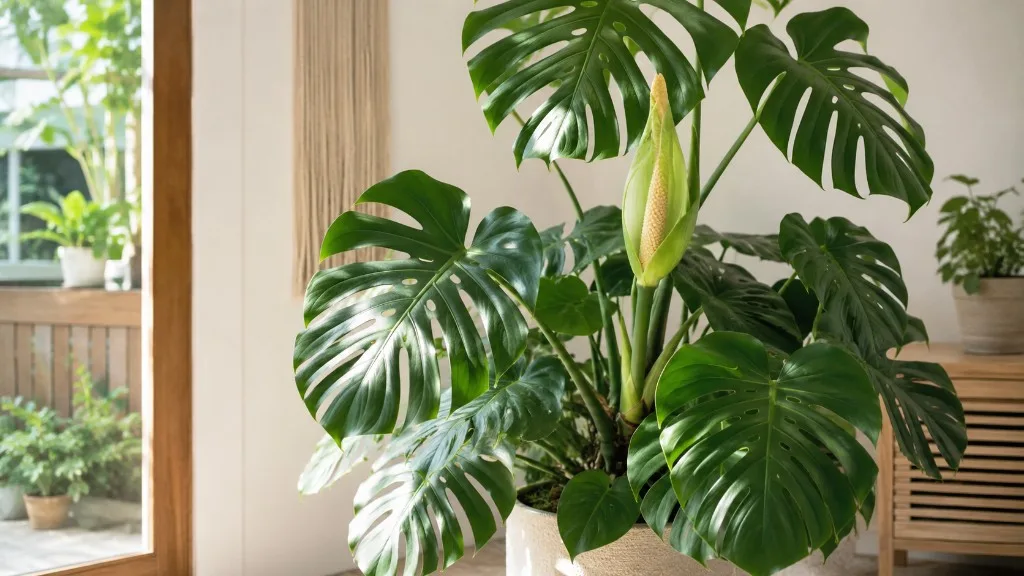
Why Fertilizer Matters for a Climbing Aroid
A Monstera deliciosa can survive for months in fresh potting mix without supplemental fertilizer. Indoors it usually will not thrive that way for long. Container mix holds a finite nutrient supply, and thorough watering leaches minerals faster than most growers expect. North Carolina Cooperative Extension is direct on this point: container plants depend on you to replace what watering removes and what vigorous leaf production consumes.
This guide focuses on practical feeding decisions for deliciosa owners - schedule, dilution, format, organic versus synthetic choice, and troubleshooting - and is part of the Monstera deliciosa care cluster. For month-by-month calendars, Penn State reconciliation tables, and the species-depth fertilizer page, start with the Monstera deliciosa fertilizer topic page. This article adds a setup-based schedule table, an organic-vs-synthetic subsection, and salt-flush recovery steps aimed at the grower who landed on the guides URL first.
Fertilizer is not magic. The same North Carolina source reminds readers that fertilizer does not “feed” a plant the way people imagine; it supplies raw materials the plant uses when light, water, and roots already support growth. Missouri Extension is blunter: poor light and watering - not nutrient shortage - cause most stalled houseplants. A weak Monstera in a dim corner does not need more fertilizer. It needs a better setup. Check light and watering before escalating feed.
Hemiepiphytic Habit and Leaf Nutrient Demand
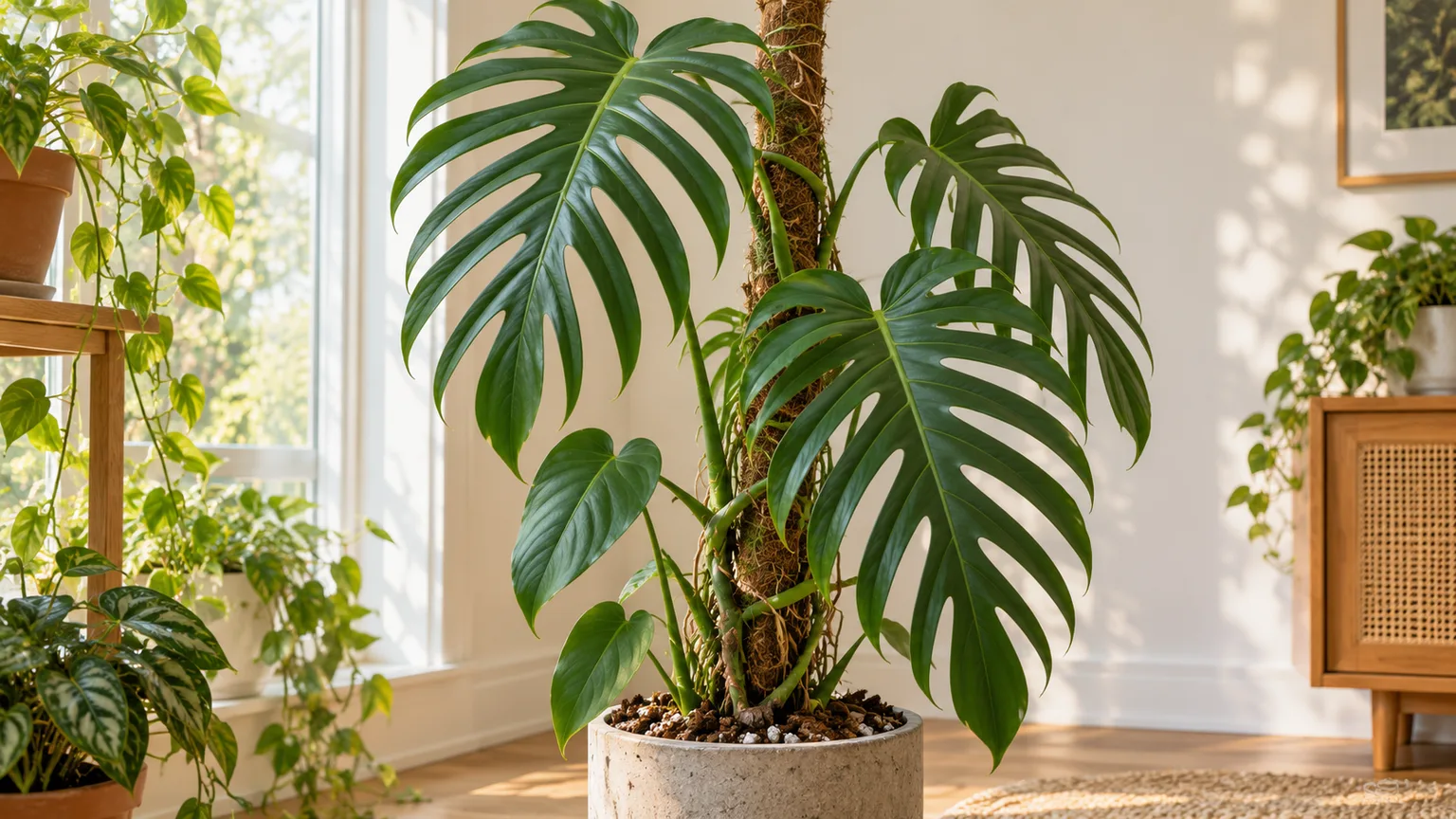
Monstera deliciosa is a large climbing aroid native from Mexico to Panama. In nature it starts terrestrial, then becomes hemiepiphytic, drawing moisture and nutrients through aerial roots as it climbs tree trunks. Indoors, that biology explains why a floor specimen on a moss pole in bright indirect light can use nutrients faster than a juvenile tabletop plant in moderate shade.
Penn State Extension describes deliciosa as a vigorous foliage plant that benefits from regular feeding during active growth. Wisconsin Horticulture Extension recommends fertilizing regularly from spring through fall while the plant is growing. Each new fenestrated leaf pulls nitrogen for green tissue; each new stem segment pulls potassium and phosphorus. Splits and holes still track age, light, and climbing support - not a high-nitrogen shortcut.
Quick-Reference Feeding Card
Extension sources disagree on frequency because they describe different setups. Reconcile them before copying a schedule from social media.
| Setting | LeafyPixels home default | Penn State extension schedule |
|---|---|---|
| Spring–summer active growth | Balanced liquid at half strength, every 4–6 weeks (every 2–3 weeks only if bright light + moss pole + steady new leaves) | Every 2 weeks with balanced houseplant fertilizer (Penn State) |
| Fall taper | Last half-strength feed when growth slows; pause by late fall | Growth naturally slows |
| Winter | No fertilizer for typical indoor setups | Monthly balanced fertilizer (Penn State) |
| Application rule | Moist soil only - never dry roots | Water thoroughly between feedings |
| Salt management | Flush with plain water once mid-season if feeding monthly or more | Not specified |
| Skip feeding when | Dry soil, stress, pests, or 0–6 weeks after repot | Same practical exclusions |
Half-Strength Dilution Example
If the label says 1 teaspoon per gallon for houseplants, mix ½ teaspoon per gallon (about 2.5 ml per 3.8 liters). Water normally the day before, then pour solution until a little drains and empty the saucer. Full dilution walkthroughs and month-by-month calendars live on the species fertilizer page.
What Monstera Needs From Fertilizer
The best Monstera fertilizer is not a bottle with “Monstera” on the label. It is a complete product you can dilute accurately and apply consistently during active growth. University and botanical sources converge on balanced or foliage-weighted formulas used at reduced strength - and they repeatedly warn that too much fertilizer is more dangerous than too little for container plants (Illinois Extension).
Macronutrients: N, P, and K
Label numbers refer to nitrogen (N), phosphorus (P), and potassium (K). Illinois Extension and Clemson HGIC recommend balanced complete fertilizers for indoor foliage plants. Monstera growers often lean slightly nitrogen-forward because the goal is leaf size, not indoor flowering - so 10-10-10, 20-20-20, or foliage ratios like 9-3-6 at half label strength all work when applied to moist soil.
Nitrogen drives green leafy growth. Phosphorus supports roots and energy transfer. Potassium supports overall vigor and stress tolerance. In real homes, light, watering, root health, and consistency matter more than hunting a perfect NPK decimal. A good product used correctly beats an “ideal” product used badly.
Micronutrients, Calcium, and Magnesium
University of Maryland Extension notes that micronutrients can become deficient in container plants and recommends commercial fertilizers that include them. Magnesium leaches with heavy watering; calcium supports cell wall structure. Large Monstera leaves expose deficiencies fast - pale new growth and washed-out foliage are often not just an NPK problem.
If you grow in a chunky aroid mix, water heavily, or use purified or softened water, confirm your fertilizer includes micronutrients or that your routine does not chronically omit magnesium and calcium. You do not need a separate cal-mag bottle for every deliciosa, but blind spots here show up on big leaves first.
Liquid vs. Slow-Release Fertilizer
The real decision is usually liquid vs. slow-release, not brand marketing. Iowa State Yard and Garden lists liquid, granular, spike, and tablet forms with intervals from every two weeks to several months. Clemson HGIC notes slow-release products can last 3 to 4 months or longer depending on temperature and watering.
Liquid fertilizer is the safe default for most Monstera owners. It is easy to dilute, easy to reduce when growth slows, and easy to skip after repotting stress. That flexibility matters because nutrient demand in bright summer light is not the same as demand in a dim corner in January. Liquid feed suits airy aroid mixes with bark and perlite - those mixes drain fast and hold fewer nutrients, so smaller, more frequent doses at half strength often work better than occasional heavy blasts.
When Slow-Release Works (and When It Does Not)
Slow-release pellets trade control for convenience. They work for larger Monsteras in stable bright conditions if you do not want to remember liquid feed every few weeks (Clemson HGIC). The trade-off is you cannot easily undo an application. Warmth and frequent watering accelerate release, which can surprise growers who also liquid-feed on schedule. Avoid stacking slow-release and regular liquid feed in small pots unless you pause liquid for two to three months - stacking concentrates salts unpredictably.
Organic vs. Synthetic Fertilizer
Both organic and synthetic products feed a Monstera deliciosa. The difference is delivery speed, salt load, and how forgiving the routine is if you miss a feed.
Synthetic water-soluble fertilizers give precise NPK numbers and predictable response. They are the easiest way to hit “half strength at every feeding” because the math is exact. The trade-off is salt buildup over months if you never flush the pot (Penn State Extension).
Organic fertilizers - fish emulsion, kelp meal, worm castings, compost teas - release nutrients more slowly as soil microbes break them down. They are gentler on roots, lower in soluble salts, and improve the long-term biological activity of an aroid mix. The trade-off is slower visible response and variable NPK by batch. Most organic liquid feeds are still applied at half strength because indoor pots cannot buffer a heavy dose.
Organic Options That Work Indoors
A few choices that are easy to source and behave well indoors:
- Worm castings. Top-dress with 1–2 tablespoons per 6-inch pot every 2–3 months, or mix up to 10% by volume into the potting medium at repotting. Slow-release nitrogen with low burn risk.
- Fish emulsion. A 5-1-1 style emulsion diluted to half label strength works as a monthly feed during active growth. The odor fades within hours; ventilate the room if it bothers you.
- Kelp meal. A micronutrient booster rather than a primary nitrogen source; use as a complement at half label rate.
- Compost tea. Brewed from mature, pathogen-free compost, applied at the same dilution as a synthetic houseplant feed. Quality varies; do not substitute fresh compost directly into the pot.
If you prefer to stay organic end-to-end, plan on a monthly half-strength fish emulsion plus a quarterly worm-casting top-dress, then flush with plain water once mid-season to keep salt buildup in check.
When to Fertilize: Active Growth and Winter
Feed when deliciosa is actively producing new leaves and extending stems. Stop when growth slows sharply. Indoors in temperate climates, that window usually runs mid-spring through late summer. Never feed dry soil, a newly repotted plant, or any plant recovering from root rot or severe yellow leaves until the underlying care issue is fixed.
Fresh bagged mix often includes a starter fertilizer charge lasting weeks to months. A new deliciosa may look fine without supplemental feeding at first, then slow when that charge depletes - especially in a small pot you water frequently.
Spring and Summer Active Growth
Start feeding when you see firm new leaves, aerial roots attaching to support, and the pot drying on a normal rhythm between waterings. Wisconsin Horticulture Extension recommends regular feeding from spring through fall during active growth. During peak summer, half-strength balanced liquid every four to six weeks suits most homes. A large moss-pole specimen in bright filtered light may sit at the four-week end - or move toward Penn State’s biweekly interval only if leaves stay deep green, no salt crust appears, and you flush salts mid-season.
Do not feed by calendar alone. Feed by growth behavior. A Monstera pushing leaves in April under grow lights may want fertilizer; the same genetics in a gloomy room in June may barely use it.
Winter Pause and the Grow-Light Exception
University of Maryland Extension advises that many indoor plants need much less fertilizer during short winter days when growth slows. That is the safe default: reduce sharply or pause when new leaves stop.
The exception is strong year-round growth. If your Monstera lives under effective grow lights, stays warm, and keeps producing leaves, optional half-strength feed every 6–8 weeks can continue - watch for white salt crust on the soil surface. Overfeeding a slow winter plant in low light is one of the fastest paths to root stress indoors.
How Often to Fertilize by Setup
Authoritative sources give ranges from every two weeks to once a month for active growth. Penn State recommends biweekly feeding through the growing season and monthly in winter; Missouri Extension says once a month is adequate for most growing houseplants. Iowa State emphasizes product label timing and reduced strength. Those recommendations describe different delivery systems and plant setups, not a contradiction. Match frequency to growth rate and fertilizer strength:
| Setup | Good starting schedule |
|---|---|
| Bright light + liquid fertilizer | Half-strength every 2–4 weeks |
| Very active growth + airy mix | Weak feed more often, such as every other watering |
| Average indoor light | Monthly at label-safe half dilution |
| Winter with little growth | Reduce sharply or pause |
| Slow-release pellets | Follow product timing, often every 3–4 months |
Watch the plant. Growth, color, and leaf quality tell the truth faster than any generic schedule copied from a forum.
How to Apply Safely: Dilution and Steps
Most Monstera fertilizer problems come from too much, wrong timing, or dry-soil application - not from choosing the wrong bottle. Kentucky Extension and North Carolina Extension stress following label rates, diluting appropriately, and never fertilizing wilted or stressed plants.
Worked dilution example: Label recommends 1 teaspoon (5 ml) per gallon for indoor plants. For half strength, use ½ teaspoon per gallon. If your watering can holds 2 gallons, that is 1 teaspoon total for the full batch - not 1 teaspoon per gallon twice.
A simple safe process:
- Water first if the potting mix is dry - roots should be hydrated, not soggy or bone dry.
- Mix fertilizer at half label strength with a measuring spoon.
- Apply to moist soil, pouring slowly across the surface.
- Let excess drain freely; discard saucer runoff.
- Mark the date and watch the next one to two new leaves for tip burn or healthy color.
- Flush the pot with plain water mid-season if you feed monthly or more.
Penn State Extension on over-fertilization recommends enough leaching that liquid runs from the bottom of the container. Indoors, where rain does not flush pots, salt management is part of fertilizing correctly.
Post-Repot Wait Guidance
Wait four to six weeks after repotting before resuming feed. Fresh mix often carries starter nutrients, and repot stress makes roots sensitive to salts. Resume at half strength only when the plant pushes stable new growth - not on a calendar date alone. The same four-to-six-week pause applies after heavy pruning that reduces the root-to-shoot ratio.
Moss Pole, Light, Soil, and Pot Size
Fertilizer only works when the plant can use it. A Monstera in bright indirect light on a climbing support can grow aggressively; one in dim light with compact soil may stall for months. Giving both the same dose does not make sense. Missouri Extension explicitly warns that poor growth often traces to light or watering, not nutrient shortage.
Light drives demand. More usable light means more photosynthesis and more nutrient use. Watering style changes how quickly nutrients move through the pot. Pot size changes how long fertilizer remains available before salts accumulate. Serious growers stop asking “What’s the best Monstera fertilizer?” and start asking “What does my setup require?”
Moss-Pole Feeding Frequency Tiers
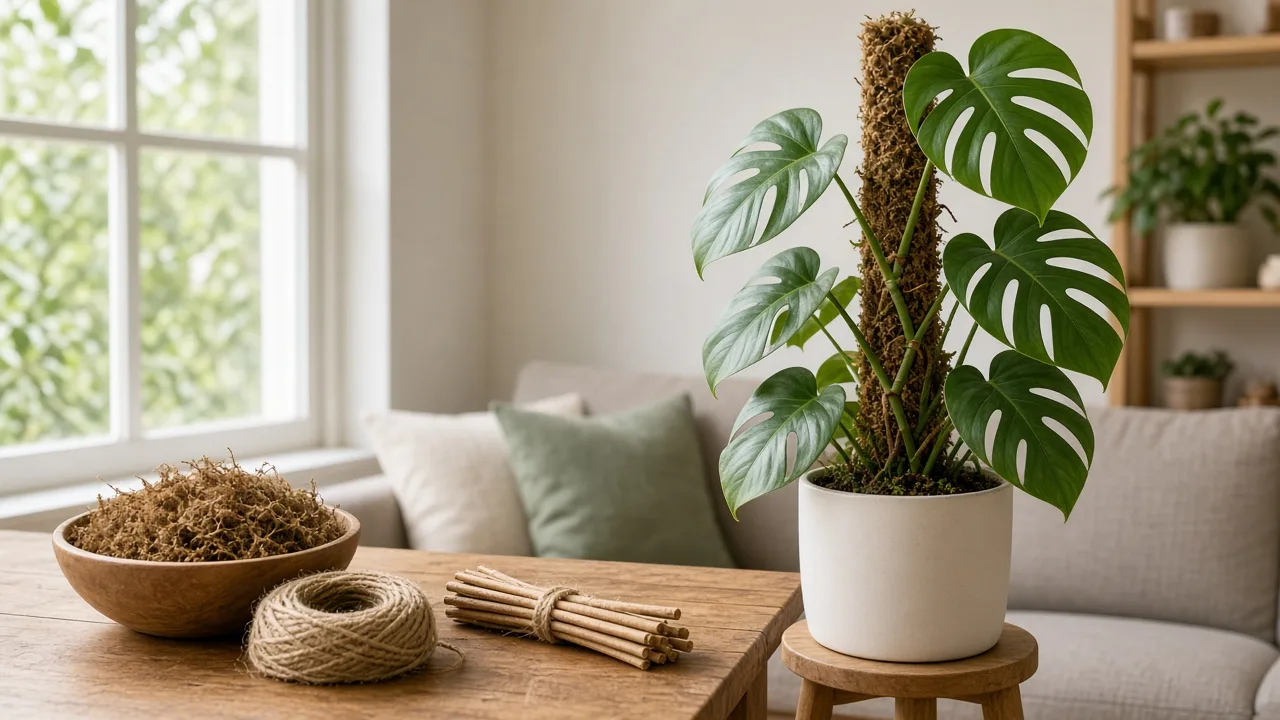
A moss pole lets aerial roots stay active and supports faster vertical growth in bright light - both increase nutrient use compared with a juvenile unsupported plant.
| Scenario | Suggested interval (half strength) | Notes |
|---|---|---|
| Juvenile, moderate light, small pot | Every 6–8 weeks spring–summer | Small volume salts quickly; lean is safer |
| Mature plant, bright light, moss pole | Every 4 weeks; up to 2–3 weeks if growth is rapid and no salt crust | Closest to Penn State biweekly intent |
| Large floor specimen, moderate light | Every 4–6 weeks spring–summer | Larger volume buffers salts slightly; still flush mid-season |
| Dim corner, slow or no new leaves | Do not feed until light improves | Fertilizer cannot replace photons |
Keep dose at half label strength; shorten the interval only when new fenestrated leaves keep appearing and the soil surface stays free of heavy white crust. For moss pole setup detail, see the Monstera deliciosa overview and the repotting page for post-repot timing.
Soil-Grown vs. LECA Monstera
A soil-grown Monstera in a chunky aroid mix usually does best with restrained liquid feeding or carefully used slow-release. The more porous the mix, the more sense smaller, regular doses make versus occasional heavy blasts. If mix stays wet too long or roots are stressed, stop feeding and fix drainage first.
A Monstera in LECA or semi-hydroponics depends on the nutrient solution you provide - the medium is structural, not nutritional. Precision matters more: use a complete liquid fertilizer at low to moderate strength, mixed accurately. Semi-hydro roots encounter dissolved nutrients directly, so strong solutions fail fast. Resist compensating with hotter mixes; measured consistency beats aggressive feeding indoors. A TDS (total dissolved solids) meter helps confirm reservoir concentration stays in the 300–600 ppm range for active growth.
Signs You Are Overfeeding or Underfeeding
Underfeeding and overfeeding both show weak growth, which is why owners misread the problem. South Dakota State Extension notes pale leaves can indicate nutrient need; Missouri Extension flags weak growth and yellow-green color - but both caution that light, watering, and root stress cause similar symptoms.
Signs you may need more nutrition include slow new growth during active season, smaller-than-expected leaves, or pale foliage despite good light, proper watering, and healthy roots. The key phrase is “despite good light.” If conditions are poor, fertilizer adds pressure, not progress.
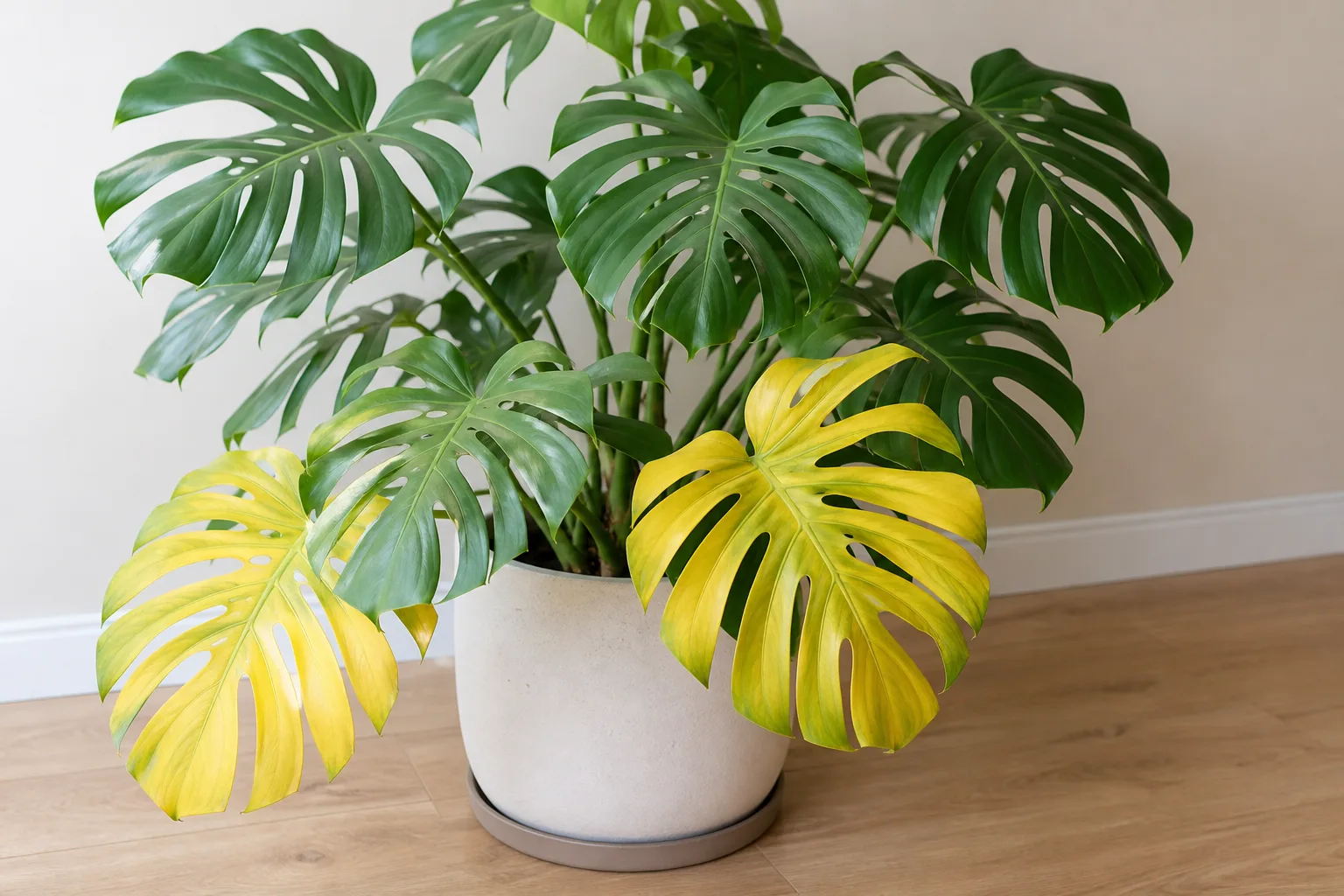
Signs of too much fertilizer include brown tips, yellow or brown leaf margins, white crust on soil, wilting despite moist mix, and decline within one to two weeks of feeding. University of Maryland Extension on fertilizer toxicity lists excessive or frequent fertilizer as a primary cause of high soluble salts, with tip browning and marginal dieback as typical symptoms.
Salt Flush Recovery
If you suspect burn, follow this sequence:
- Pause all fertilizer immediately. Do not resume until you see clean new growth.
- Move the pot to a sink or tub. Catch the runoff; do not let concentrated flush water reach houseplants or drains that feed a planted aquarium.
- Pour plain room-temperature water slowly across the surface. Use a volume equal to roughly two to three times the pot’s volume.
- Let it drain fully. Repeat once after a 15–20 minute pause.
- Top-dress replacement. If the soil surface shows heavy white crust, scrape off the top inch and replace with fresh aroid mix.
- Mark the calendar. Wait four to six weeks before resuming at half strength on a healthy new leaf.
Burned leaf tissue will not heal. Judge recovery by clean new growth, not by whether old damaged blades green up.
Common Fertilizing Mistakes
The biggest mistake is using fertilizer as a substitute for good care. Poor light, chronically wet roots, compacted soil, or pest pressure will not resolve with a premium bottle. Missouri Extension says not to fertilize to stimulate growth on plants in poor conditions.
Feeding dry soil is the second classic error. Kentucky Extension and Missouri guidance warn against applying fertilizer to dry potting mix because roots damage more easily. Water first; fertilize when the root zone is safely moist.
Copying someone else’s schedule without matching their light, mix, and pot size causes salt buildup in setups that cannot handle biweekly feeding. Equating more growth with better growth matters for Monstera too - soft, overpushed tissue in marginal light is not the goal. Ignoring salt buildup in closed indoor pots eventually catches up; periodic plain-water flushing is maintenance, not optional luxury. If persistent decline continues despite corrected care, contact your local cooperative extension service for soil and tissue testing.
How This Guide Fits the Monstera Cluster
This guide sits inside the wider Monstera deliciosa care cluster. The species hub page at Monstera deliciosa care is the right starting point for whole-plant context - light, watering, soil, propagation, repotting, pruning, and the problems hub all branch from there.
The topic page at Monstera deliciosa fertilizer goes deeper on species-specific biology, month-by-month calendars, and the Penn State reconciliation table. If you want only one URL to bookmark, that one is it. The page you are reading now is the practical schedule + setup-tier + organic-vs-synthetic guide - useful for growers who already know what a moss pole is and want to pick a starting dose today.
For specific symptoms - brown tips, yellow leaves, drooping - the problems hub routes you to the matching fix guide.
Related Monstera Deliciosa Guides
- Monstera deliciosa overview - start here for whole-plant context.
- Monstera deliciosa fertilizer - species-depth feeding page with month calendar and Penn State reconciliation.
- Monstera deliciosa light - light drives nutrient demand more than any bottle label.
- Monstera deliciosa watering - moisture rhythm before you add nutrients.
- Monstera deliciosa soil - drainage and mix porosity change how often you should feed.
- Monstera deliciosa repotting - post-repot wait before resuming fertilizer.
- Monstera deliciosa problems - symptom-first fix guides when feeding does not resolve the issue.
Conclusion
Fertilizing Monstera deliciosa is conditional, not complicated. Use a complete fertilizer, feed during active growth at half label strength, reduce or pause when the plant barely grows, and protect roots by avoiding heavy doses, dry-soil applications, and unchecked salt buildup. For month-by-month calendars and climbing-aroid depth, start with the species fertilizer page and the Monstera deliciosa hub. This guide’s setup table, organic-vs-synthetic guidance, and salt-flush recovery list are here to help you choose a starting schedule - then let your plant’s new leaves tell you whether to feed more often or back off.
Liquid fertilizer gives most growers the most control. Slow-release works when conditions are stable. Organic options work when you accept slower response and lower salt load. None of them rescue a plant fighting poor light, bad drainage, or damaged roots. Get the environment right first. Then use fertilizer as a support tool, not a cure-all.