Pot Too Large on Monstera Deliciosa: Causes, Checks & Fixes
Quick answer
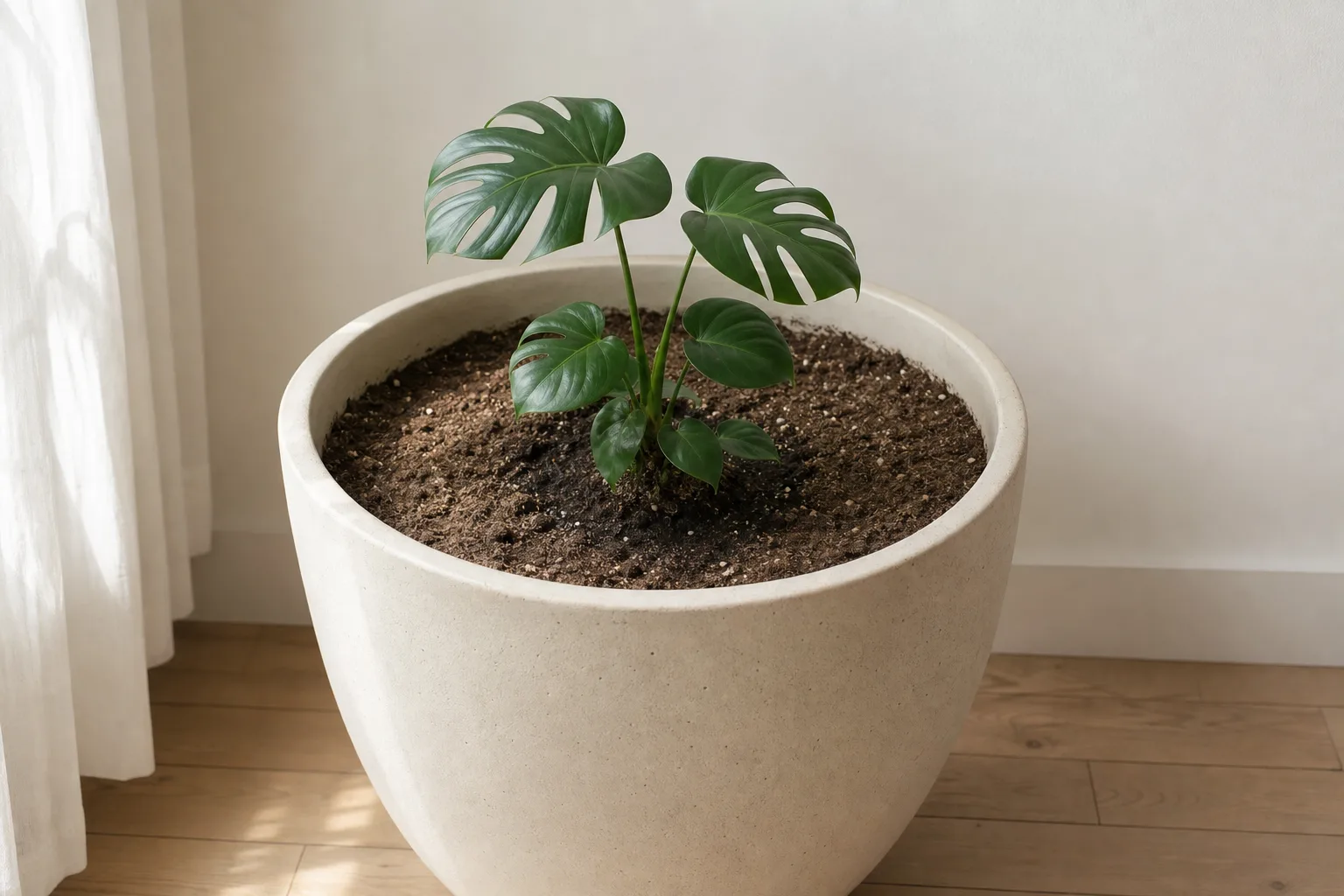
A pot too large on Monstera Deliciosa keeps excess soil wet beyond the root zone, mimicking chronic overwatering. First step: stop watering, slide the plant out, and compare root ball width to pot diameter before downsizing.
Pot Too Large on Monstera Deliciosa: Causes, Checks & Fixes
This guide covers pot too large on Monstera Deliciosa. See also the general Pot Too Large guide, watering, and light pages for this plant.
Pot Too Large on Monstera Deliciosa: Causes, Checks & Fixes
Quick answer
A pot too large on Monstera Deliciosa keeps excess soil wet beyond the root zone, mimicking chronic overwatering even when you water carefully. First step: stop watering, slide the plant out, and compare root ball width to pot diameter before downsizing.
Monstera Deliciosa is a large climbing aroid that needs a sturdy moss pole and a heavy pot for stability - but extra soil volume beyond what roots can use still creates a permanently wet zone. When the container outpaces the root ball, outer compost stays saturated long after the plant could use a drink, and broad split leaves show stress quickly.
Why Monstera Deliciosa gets a pot too large
Enthusiastic Monstera Deliciosa repotting guide is the most common trigger. Owners often upsize dramatically after purchase, move a young plant into a deep floor planter so it “has room to grow,” or repot on day one into a decorative cache pot without drainage. University of Maine Extension warns that too large of a pot may retain too much moisture and lead to root rot. On Monstera Deliciosa, that extra wet volume sits outside the active root ball while the vine keeps producing foliage the roots cannot yet support.
The floor-plant illusion drives oversizing. A tall Deliciosa with large split leaves looks like it needs a wide, deep container - but NC State notes the species stays between 6 to 8 feet in most home environments while the root mass may still occupy only the upper third of a deep pot. The lower half of the mix never dries at the pace Deliciosa expects when you wait for the top 3–5 cm to dry.
Day-one repotting into a show pot repeats the mistake. Missouri Extension notes that plants just brought home seldom need immediate repotting and that repotting adds strain while the plant is still acclimating. Deliciosa is slower to reposition than smaller Monsteras, so a bad first container choice can stall fenestrations for months.
Heavy stability pots compound the problem. A ceramic floor planter chosen to stop tipping can hold far more mix than roots need. Penn State Extension describes Monstera as a great floor plant for large spaces that still needs a well-draining mix - not a permanently saturated root zone in unused soil below the ball.
Winter and low light compound oversizing. In cooler rooms with shorter days, evaporation drops. A pot that dried in a week during summer may stay heavy for three weeks in winter, yellowing lower leaves and inviting fungus gnats over the wide wet surface. NC State recommends allowing the top quarter to one-third of the soil to dry between watering - an oversized pot makes that dry-down window unpredictable.
What an oversized pot looks like on Monstera Deliciosa
Common patterns when the container outpaces the roots:
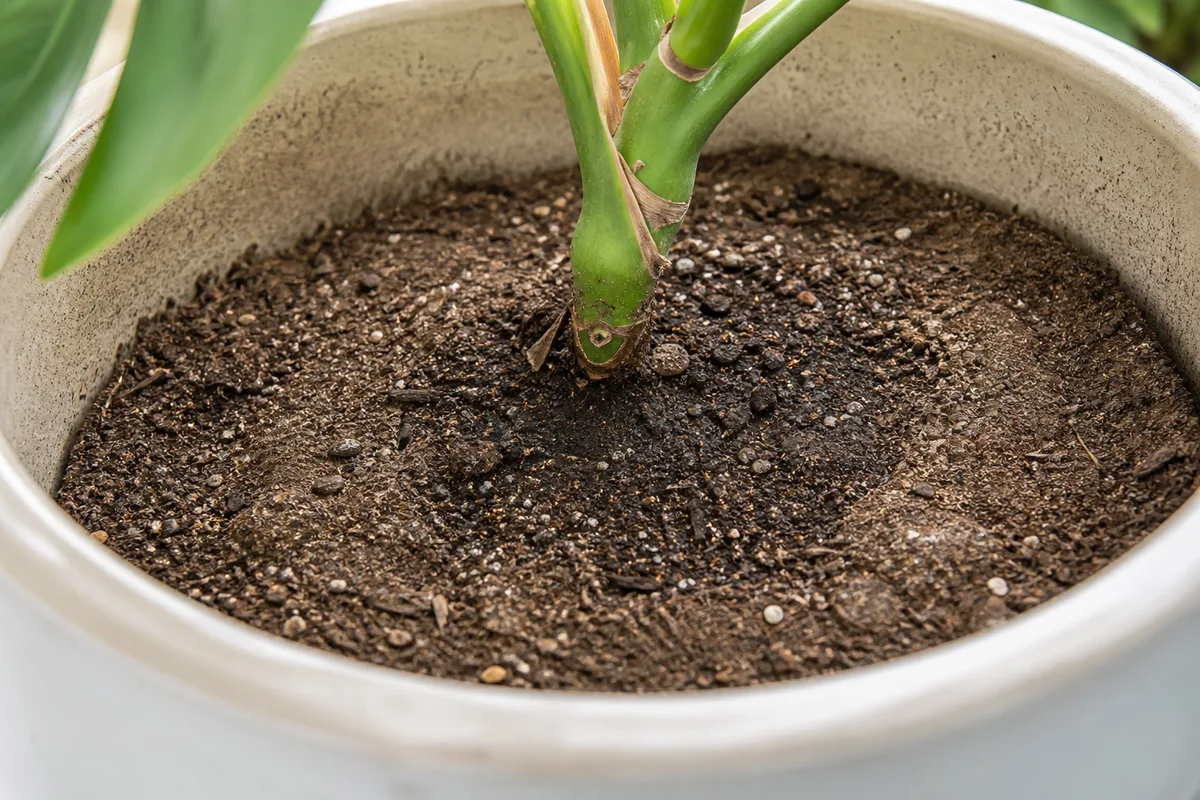
Pot Too Large symptoms on Monstera Deliciosa - compare with healthy tissue on the same plant.
- Root ball sits in the upper half of a tall or wide pot with inches of unused mix below
- Outer soil stays dark and cool while you wait for the top 3–5 cm to dry
- Pot stays heavy for weeks; fungus gnats hover over the wide wet surface
- Lower leaves yellow first while newer leaves stay small or lack mature splits
- Long stems trail or lean despite a moss pole - weak anchoring in loose wet mix
- Stems feel limp despite moist soil - a sign wet roots may already be failing
- No roots visible near drainage holes months after the last upsize
Unlike a root-bound Deliciosa that dries out within a few days of watering, an overpotted plant often stays wet too long - opposite symptom, same root-zone stress.
How to confirm the cause
- Measure root ball vs pot - Slide the plant out gently. If roots and rhizome width fill less than half the pot diameter, the container is likely too large.
- Moisture profile - After watering, compare outer edge soil to the center over the next seven to ten days. A persistent wet outer ring with a small root mass confirms oversizing.
- Repot history - Did the last repot jump more than 2 inches in diameter? Did you repot on day one into a decorative planter without drainage?
- Root health - Mushy outer roots with a firm center suggest rot in the wet perimeter soil. Penn State Extension notes that overwatering can result in root rot on Monstera.
- Growth pattern - Tall stems with stalled new leaves and damp outer mix point to environment before nutrient deficiency.
Lookalike symptoms to rule out
Pure overwatering on a correctly sized pot can yellow lower leaves - fix the schedule, not only the diameter. Root-bound plants dry fast and may push roots from holes; overpotted plants stay heavy. Heavy peat mix without enough perlite or bark retains water even in a snug pot. Confirm whether the problem is excess volume, excess retention, or both before repotting.
First fix for Monstera Deliciosa
Stop watering and unpot the plant to compare root ball size to container width. If the roots occupy far less volume than the pot holds, plan to downsize within the week - do not keep watering on your old calendar while outer soil stays saturated.
Avoid stacking fertilizer, heavy pruning, and a new room placement on the same day as the repot.
Step-by-step recovery
- Downsize the container - Choose a pot only 2–5 cm wider than the root ball with open drainage holes. UMN Extension advises choosing a container about two inches wider than the current container when repotting Monstera deliciosa.
- Refresh the mix - Use standard potting mix with 20–25% perlite and 10–15% orchid bark. Penn State recommends a well-draining soilless potting mix amended with charcoal, bark, or perlite.
- Trim bad roots - Cut mushy brown roots back to firm white tissue; shake off wet outer soil from the unused volume.
- Repot at the same depth - Firm mix gently around the root ball without burying nodes that should stay above the line. Reattach the moss pole so stems are supported immediately.
- Hold water briefly - Wait until the top 3–5 cm is fully dry before the first thorough drink unless leaves are visibly limp and the new mix is bone dry.
- Support recovery conditions - Monstera Deliciosa light guide and 50–70% humidity help new roots without forcing growth in a dark corner.
Recovery timeline
Right-sizing before rot often shows a lighter, more predictable pot weight within two to three weeks. Lower yellowing may stop spreading within a month. New leaves with mature splits can appear in four to eight weeks during spring and summer; winter recovery is slower. Cosmetic damage on old leaves persists - judge progress by firm stems and healthy new growth, not by saving every yellowed leaf.
What not to do
- Do not upsize again “so you won’t have to repot soon” - Deliciosa tolerates slight crowding better than excess wet soil.
- Do not keep a large decorative cache pot as the primary container without drainage; use a nursery pot inside it and empty runoff within 30 minutes.
- Do not water on your old schedule - a smaller, chunkier pot dries faster and needs a recalibrated rhythm tied to the top 3–5 cm drying.
- Do not fertilize until new growth resumes.
- Do not add a gravel layer at the bottom instead of fixing pot size - University of Maine Extension notes this can create a perched water table that keeps roots wet longer.
How to prevent an oversized pot next time
Follow species-appropriate repot timing and sizing:
- Repot only when roots circle the bottom or exit drainage holes - typically every one to two years in late winter or early spring, not because the vine looks tall.
- Increase pot diameter by only 2–5 cm each time. NC Cooperative Extension recommends a container no more than 2 inches larger in diameter than the current pot.
- Use chunky aroid mix; avoid deep pots with large unused soil mass below the root ball.
- Quarantine new plants and learn dry-down speed before any upsize.
- Match watering to pot weight after repotting - Missouri Extension notes that soil kept too moist invites root rots.
When to worry
Escalate if stems soften at the soil line, soil smells sour, or leaves collapse despite wet mix - oversizing has likely progressed to root rot. Immediate unpotting, root pruning, and dry repot into the smallest appropriate container are needed.
Lower urgency when leaves are firm, smell is neutral, and the issue is slow architectural growth in a large pot - downsize proactively before softness appears.
Conclusion
A pot too large on Monstera Deliciosa traps fine roots in permanently moist outer compost, mimicking overwatering even with careful habits. Confirm by comparing root ball size to pot volume and checking for a persistent wet outer ring; fix by repotting into a container only 2–5 cm wider with fresh chunky mix and a dry-down check before the next drink. Prevent by sizing up modestly only when roots fill the current pot - not when the split leaves simply look ready for a bigger home.
When to use this page vs other Monstera Deliciosa guides
- Monstera Deliciosa watering guide - Use for routine moisture checks before assuming pot too large is the main issue.
- Monstera Deliciosa problems hub - Browse all 18 common issues on this species.