Calathea Rattlesnake Care: Light, Water, Humidity, Soil
Goeppertia insignis
Calathea Rattlesnake needs filtered water, 60–80% humidity (humidifier essential), medium indirect light (no direct sun), and watering every 5–7 days when the top 2 cm is beginning to dry.
Calathea Rattlesnake Care: Light, Water, Humidity, Soil
Start with wateringThe most common care mistake for Calathea RattlesnakeWatering guide →Calathea Rattlesnake care essentials
Light
medium indirect light, low indirect light
Water
Every 5–7 days growing season (top 2 cm beginning to dry). 7–10 days winter. Filtered water or rainwater only.
Soil
Moisture-retentive but well-draining potting mix. pH 6.0–7.5.
Humidity
High humidity (60%+)
Temperature
18°C to 27°C (65–80°F)
Fertilizer
Feed lightly during active growth. Use monthly in spring and summer at half strength..
About Calathea Rattlesnake
Calathea Rattlesnake has a upright growth habit.
| Detail | Information |
|---|---|
| Growth habit | Upright |
| Scientific name | Goeppertia insignis |
Calathea Rattlesnake Care: Light, Water, Humidity, Soil
What Calathea Rattlesnake Actually Is
Calathea Rattlesnake is a tropical evergreen perennial grown almost exclusively for its foliage. The accepted botanical name is Goeppertia insignis, though you will still see the older names Calathea lancifolia and Calathea insignis on nursery tags, care apps, and even the ASPCA’s plant database. All refer to the same species per NC State Extension. It belongs to the Marantaceae family, the prayer-plant family, alongside Maranta, Ctenanthe, and other Goeppertia species.
Native to the humid forests of southeastern Brazil, G. insignis grows as an understory plant in dappled shade on the rainforest floor. That single biogeographic fact explains nearly every indoor care requirement: it wants filtered light, steady root-zone moisture, warm stable temperatures, and air humidity far above what a heated winter living room typically provides. Treat it like a sun-loving succulent and it will fail. Treat it like the forest-floor plant it is, and it becomes one of the more manageable members of a genus that has a reputation for drama.
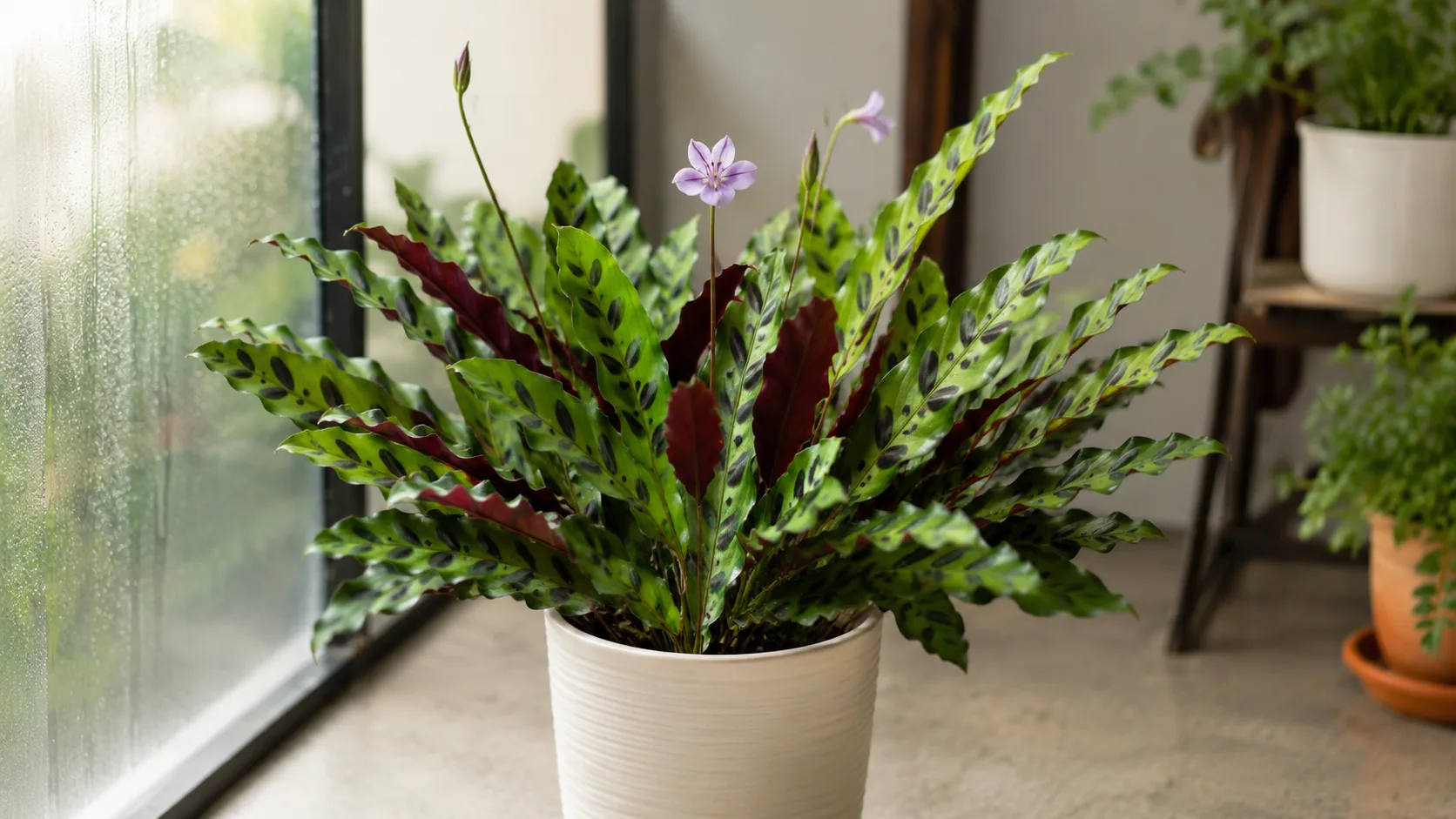
The common name comes from the leaf pattern. Long, lance-shaped blades carry wavy edges and an alternating pattern of dark green ovals on a bright green background, resembling the scales of a rattlesnake. Flip a leaf and you get a flash of purplish-red on the underside - one of the visual rewards that makes Calathea Rattlesnake overview worth the extra attention. Mature plants typically reach 9 to 20 inches (23–50 cm) tall and 9 to 18 inches (23–45 cm) wide in a container per NC State Extension, with a moderate growth rate in typical indoor conditions.
Taxonomists moved many former Calathea species into Goeppertia based on molecular and morphological evidence. For your purposes as a grower, the care has not changed: if a guide says “Calathea” or “Goeppertia,” the light, water, and humidity needs are the same. What matters is matching the species’ tolerances, not the label on the pot.
Calathea Rattlesnake at a Glance
A quick reference card before the deep sections:
- Botanical name: Goeppertia insignis (syn. Calathea lancifolia, Calathea insignis)
- Family: Marantaceae (prayer-plant family)
- Type: Evergreen herbaceous perennial; rhizomatous; grown as a houseplant in temperate climates
- Mature size: Roughly 9–20 in. tall × 9–18 in. wide indoors
- Light: Medium to bright indirect light; no harsh direct sun
- Water: Every 5–7 days in active growth when the top 2 cm of mix is beginning to dry; 7–10 days in winter; filtered water or rainwater strongly preferred
- Humidity: 60% or higher ideal; 50% is a practical minimum if other factors are right
- Temperature: 65–75 °F (18–24 °C) indoors; avoid drafts and sudden temperature swings
- Soil: Moisture-retentive but well-draining potting mix; pH 6.0–7.5
- Fertilizer: Balanced liquid fertilizer at half strength, roughly monthly in spring and summer
- Propagation: Division of rhizome clumps at Calathea Rattlesnake repotting guide
- Toxicity: Non-toxic to dogs, cats, and horses per the ASPCA prayer-plant listing (Calathea insignis)
- Hardiness outdoors: USDA zones 11a–12b; indoor plant in all cooler climates
- Difficulty: Medium - more forgiving than many Calatheas, but not a set-and-forget plant
Light - Bright Indirect, Never Harsh Direct Sun
Calathea Rattlesnake needs medium to Calathea Rattlesnake light guide - enough brightness to keep the snake-skin pattern sharp, but not so much that leaves bleach, curl, or scorch. In its native habitat, direct sun never reaches the forest floor; the canopy filters everything into soft, shifting light. Indoors, that translates to an east-facing window, a bright north exposure, or a west- or south-facing window diffused by a sheer curtain or placed several feet back from the glass.
Too little light produces a different set of problems. Growth slows, internodes stretch, new leaves may be smaller or paler, and the distinctive markings can fade even when the plant otherwise looks healthy. A dim plant also dries more slowly, which raises the risk of overwatering on Calathea Rattlesnake if you keep the same summer Calathea Rattlesnake watering guide through a dark winter. Too much direct sun - especially hot afternoon sun through glass - bleaches the pattern, scorches leaf tissue, and triggers tight curling during the brightest hours.
The practical test is always new growth. A well-lit rattlesnake produces firm, correctly patterned leaves from the center of the rosette. Old sun damage will not heal, but the newest leaf tells you whether the current placement is working.
Best Windows and Grow-Light Placement
An east window is often the sweet spot: gentle morning sun, bright ambient light the rest of the day. A north window works in many homes if the plant sits close enough to receive real light, not just room brightness. West and south windows can work when the plant is set back from the glass or behind diffusion; never place it in unfiltered afternoon sun.
If natural light is weak - interior rooms, north-facing apartments in winter, office cubicles - a full-spectrum grow light on a 10–12 hour timer fills the gap. Position the fixture 12–18 inches above the canopy and watch leaf temperature; LEDs should provide light without heat stress. Rotate the pot every week or two so growth stays even rather than leaning hard toward the window.
When you move the plant, do it gradually. A rattlesnake that has been growing in a shaded corner will burn if you jump it straight to a bright sill. Increase exposure over one to two weeks and read the newest leaves before making another change.
Watering - Steady Moisture, Not a Swamp
Watering is the skill that separates a thriving rattlesnake from a chronically stressed one. This plant wants consistently moist root-zone soil, not alternating drought and flood, and not a permanently soggy pot. The starting rhythm most growers land on is every 5–7 days during active growth when the top 2 cm (roughly the top inch) of mix is beginning to dry, and every 7–10 days in winter when growth slows and the pot dries more slowly.
That interval is a starting point, not a calendar command. Pot size, soil composition, room temperature, and light all change how fast the mix dries. A plant in a bright, warm room may need water twice a week in summer; the same plant in a cool, dim corner may go ten days between drinks in January. Check the pot before you water - finger, wooden skewer, or pot weight - every single time.
When you do water, water thoroughly. Run room-temperature water through the mix until a small amount drains from the bottom, let the pot sit for 10–15 minutes, then empty the saucer or cachepot so the roots are not standing in runoff. Shallow daily sips keep the surface wet while the center stays dry or, worse, create a wet zone around the roots that never fully aerates. One full drink followed by a proper dry-down is the rhythm this plant evolved with in rainforest litter - frequent light rain, excellent drainage below.
Signs you are overwatering include yellowing lower leaves, soft stems at the soil line, a sour or stagnant smell from the mix, and fungus gnats hovering at the surface. Signs you have underwatering on Calathea Rattlesnake include limp or tightly curled leaves, dry compacted mix, and a pot that feels dramatically light. A single dry episode usually recovers with a thorough soak; repeated drought damages fine roots and makes the plant hypersensitive when water finally returns.
Water Quality and Why Tap Water Bruises Leaves
Calathea Rattlesnake is sensitive to the fluoride, chlorine, and dissolved minerals in many municipal tap-water supplies. Over months, those salts accumulate at the leaf margins and produce brown, crispy tips and edges even when humidity and watering rhythm are otherwise reasonable. This is one of the most common complaints about the genus, and it is one of the easiest to prevent.
Filtered water, reverse-osmosis water, or rainwater are the best choices. If you must use tap water, letting it sit overnight removes some chlorine (though not fluoride), and occasional flushing - running plain water through the pot until it drains freely - helps wash accumulated salts from the mix. Avoid watering with cold water from the tap; room-temperature water reduces root shock.
The same mineral sensitivity applies to fertilizer. Use half the label strength and apply only to already-moist soil so concentrated salts do not burn fine roots.
Humidity and Temperature in Real Homes
Humidity is the second pillar of rattlesnake care after water quality. In Brazilian forest understory, relative humidity routinely exceeds 80%. Indoors, central heating can drop winter air to 30% or lower, which pulls moisture from the thin leaf edges faster than roots can replace it. Aim for 60% or higher around the plant; 50% can work if light, watering, and water quality are already dialed in, but below that you will almost certainly see brown tips.
Effective humidity boosts, ranked by reliability:
- Humidifier near the plant (most consistent method)
- Grouping plants to create a shared microclimate
- Pebble tray filled with water below the pot (modest effect; pot must sit above the water line)
- Bathroom or kitchen placement if light is adequate
Misting raises humidity for minutes, not hours, and wet leaf surfaces can invite fungal spotting on some prayer plants. Use misting as a cosmetic refresh, not as your primary humidity strategy.
Temperature comfort range is 65–75 °F (18–24 °C) per NC State Extension. The plant does not tolerate drafts or sudden temperature changes. Watch the problem spots in real homes: air-conditioning vents, radiators, drafty winter window sills, and single-pane glass that heats up in afternoon sun. Each can damage leaves within hours even when the thermostat reads a comfortable number.
Soil, Pot Choice, and Drainage
Calathea Rattlesnake needs a moisture-retentive but well-draining potting mix - the oxymoron that defines tropical houseplant soil. The mix should hold water long enough that roots do not dry out between waterings, yet drain freely enough that the root zone does not stagnate. Target pH 6.0–7.5; most quality peat- or coco-based houseplant mixes land in this range without adjustment.
A workable home blend:
- 2 parts peat-free or peat-based houseplant mix
- 1 part perlite or pumice for aeration
- 1 part orchid bark or coco chips for structure and drainage
Commercial “tropical” or “indoor plant” mixes also work if you add 20–30% perlite by volume. Avoid straight cactus mix (too dry) and avoid heavy, compaction-prone outdoor garden soil.
Drainage holes are non-negotiable for long-term indoor care. A decorative cachepot is fine only if you lift the inner pot to drain after every watering. Oversized pots are a common post-purchase mistake: extra soil holds extra water around a small root system, which is the fastest route to root rot on Calathea Rattlesnake after repotting. Choose a pot only one size larger than the root ball when upgrading.
Refresh the mix every one to two years, or sooner if it compacts, smells sour, or water runs straight down the sides without soaking in.
Fertilizing During Active Growth
Calathea Rattlesnake is not a heavy feeder. A balanced liquid fertilizer (such as 10-10-10 or 20-20-20) at half the label strength, applied roughly once a month during spring and summer, is enough to support healthy new leaves without salt buildup. Always fertilize after a normal watering so the solution distributes through moist soil rather than concentrating on dry roots.
Pause feeding during fall and winter dormancy, immediately after repotting, and while the plant is recovering from pest damage, root rot, or severe leaf loss. Feeding a plant that cannot use the nutrients only adds salts to an already sensitive system. Resume when you see stable new growth and the pot is drying on a normal active-season rhythm.
If leaf tips brown despite good humidity and water quality, flush the pot with plain water before increasing fertilizer - the problem is often accumulated salts, not deficiency.
Repotting Without Setting Back the Roots
Repot every one to two years, or when roots circle the drainage holes, the mix breaks down, water runs through without absorbing, or the plant dries out unusually fast. The best timing is early in the active growing season - late winter through spring in the Northern Hemisphere - so the plant has months of warmth and light to recover.
Steps that keep stress low:
- Water the plant lightly the day before so the root ball is workable but not soggy.
- Choose a pot one size up with a drainage hole.
- Gently loosen the outer roots; trim only mushy or clearly dead tissue.
- Set the plant at the same depth it grew before; burying the crown too deep invites rot.
- Water lightly, keep humidity high, and hold fertilizer for four to six weeks.
Repotting during a heat wave, mid-winter under weak grow lights, or while the plant is already declining from overwatering stacks stress on stress. Fix the underlying problem first, then repot into fresh mix if the root zone is the bottleneck.
Propagation by Division
The reliable home propagation method for Calathea Rattlesnake is division - separating the rhizome clump into two or more pieces, each with its own stems, leaves, and root system. Stem cuttings and leaf cuttings do not work for this species; the growing points live at the rhizome, not on detached leaves.
Best practice:
- Repot an established, healthy plant in spring.
- Gently tease the root ball apart or cut through the rhizome with a clean, sharp knife.
- Ensure each division has at least one growth point (a visible shoot or rolled new leaf) and a healthy root mass.
- Pot divisions into the same moist, well-draining mix you use for the parent.
- Keep humidity high (a clear bag or humidity dome for the first week helps), light bright but indirect, and watering careful - evenly moist, never waterlogged.
Do not divide a stressed, pest-infested, or recently purchased plant still acclimating to your home. Weak divisions fail at a much higher rate than healthy ones, and a small rattlesnake that is already struggling does not need its root system cut in half.
The Prayer-Plant Habit - Why Leaves Move
One of the reasons people buy Goeppertia species is nyctinasty - the daily rhythm where leaves fold in half in the evening and reopen at sunrise, as if in prayer. Calathea Rattlesnake follows this pattern. You may hear a faint rustle in the evening as blades shift position. Healthy movement is a sign that the plant’s turgor and light cues are functioning.
If leaves stay rolled tight all day, look at water stress, low humidity, or heat before assuming a pest issue. If movement stops entirely on an otherwise healthy plant, a sudden light or temperature change may have disrupted the rhythm; stabilize conditions and watch for a week. Nyctinasty is normal behavior, not a gimmick - and it is one of the traits that separates this plant from lookalikes that happen to have patterned leaves but no daily movement.
Common Problems and What They Mean
Most rattlesnake problems are environmental, not mysterious diseases. They develop over days or weeks from a mismatch in light, water, humidity, or water quality, and they resolve slowly once conditions improve. The hardest part is patience: damaged leaf tissue does not regenerate, so you judge recovery by new growth, not by old leaves greening up again.
When something looks wrong, check in this order: soil moisture → water quality → humidity → light → pests. Changing fertilizer or repotting before those five factors usually makes things worse.
Brown Tips and Crispy Edges
Brown tips are the signature complaint for this genus. The most common causes, in order of frequency indoors:
- Tap-water minerals and fluoride - switch to filtered or rainwater; flush the pot.
- Low humidity - especially winter heating; add a humidifier.
- Inconsistent watering - alternating bone-dry and soggy stresses leaf margins.
- Fertilizer salt buildup - flush the mix; reduce feeding strength.
- Heat stress or direct sun - move to softer light.
Trim brown tips with clean scissors if they bother you aesthetically; cut following the natural leaf contour so the edge does not look squared off. The damage is cosmetic unless it is spreading rapidly on new leaves, which points to an active ongoing stressor rather than old scarring.
Yellow Leaves and Leaf Drop
Yellow leaves demand a more careful diagnosis because several unrelated causes look similar:
- Overwatering - yellow lower leaves, soft base, sour soil; reduce watering and inspect roots.
- Natural senescence - one or two older outer leaves yellow and die as new center growth continues; normal if the rate is slow.
- Underwatering - yellowing with dry mix and limp texture; rehydrate thoroughly.
- Low light - general pale yellowing and weak new growth; increase brightness gradually.
- Cold draft or chill - sudden yellowing after a window or AC exposure; move to stable warmth.
A rattlesnake that yellows several leaves at once after a care change is usually protesting that change, not developing a random disease. Roll back the most recent variable - usually watering frequency or a new window - and stabilize for two weeks before trying again.
Pests That Target Stressed Calatheas
Healthy, humid rattlesnakes are not pest magnets, but stressed plants attract the usual houseplant pests. Inspect leaf undersides and stem joints weekly.
- Spider mites on Calathea Rattlesnake thrive in dry air; look for stippling, fine webbing, and dull gray leaves. Increase humidity, shower the foliage, and use insecticidal soap if populations persist.
- Mealybugs on Calathea Rattlesnake appear as white cottony clusters in leaf axils; remove with a cotton swab dipped in 70% isopropyl alcohol, then monitor weekly.
- Scale forms hard brown bumps along stems; scrape off manually and treat with soap or horticultural oil.
- Aphids on Calathea Rattlesnake occasionally appear on new growth; a strong rinse or soap spray usually clears them.
- Fungus gnats signal persistently wet surface soil; let the top layer dry slightly more between waterings and consider a sand or gravel top-dress.
Catch infestations early. A rattlesnake with a full mite webbing coat has already lost significant leaf function, and recovery takes months even after the pests are gone.
Pet Safety - Non-Toxic but Not a Snack
Good news for pet owners: the ASPCA lists Calathea species, including prayer plants sold under names like Calathea insignis, as non-toxic to dogs, cats, and horses. Calathea Rattlesnake is widely grown as a pet-safe foliage plant for that reason. Do not confuse it with snake plant (Dracaena trifasciata / Sansevieria), which is a completely different species and is toxic to pets.
Non-toxic does not mean harmless. Chewing any plant material can cause mild gastrointestinal upset in pets, and damaged leaves are unsightly. Place the pot where curious cats cannot use it as a litter-box alternative or batting toy. If your pet ingests a large amount of any plant and shows vomiting, lethargy, or loss of appetite, contact your veterinarian or the ASPCA Animal Poison Control Center regardless of the plant’s listed toxicity status.
Buying, Placement, and the First Month Home
Is Calathea Rattlesnake good for beginners? It is a fair medium-difficulty plant - often described as one of the more forgiving Calatheas because its narrower leaves show edge damage less dramatically than broad-leaved species like Goeppertia ornata (Roseopicta). That forgiveness has limits. If your home runs on hard tap water, dry winter air, and dark corners, a pothos or spider plant will be a kinder first plant. If you already own a humidifier and an east window, rattlesnake is a realistic step into prayer-plant care.
At the nursery, choose a plant with upright patterned leaves and visible new rolls emerging from the center. Pass on specimens with many brown-tipped leaves, collapsed outer foliage, mushy stems, sour-smelling soil, or visible pest webbing. A few cosmetic marks on older leaves are normal; widespread edge burn usually means inconsistent care at the grower or garden center.
First month at home: do not repot immediately unless the soil is clearly waterlogged or root-bound. Place the plant in medium indirect light, keep humidity as high as your setup allows, and water with filtered water on a check-the-pot rhythm. Avoid fertilizer, avoid moving it between rooms every few days, and avoid panic-pruning yellow leaves until you know whether new growth is firm and patterned. Rattlesnake works well on a plant shelf where leaves can arch sideways - do not flatten it against a wall where blades get creased.
Compared to Roseopicta, rattlesnake tolerates a slightly busier spot and handles shelf life better because each damaged leaf is less visually dominant. Compared to snake plant, it needs more humidity, softer light, and more attentive watering - they share a name pattern, not care requirements.
Conclusion
Calathea Rattlesnake (Goeppertia insignis) rewards growers who respect its rainforest origins: bright indirect light, steady moisture checked by pot weight rather than calendar, filtered water, 60%+ humidity, and a well-draining but moisture-retentive mix in the pH 6.0–7.5 range. It is non-toxic to pets, propagates easily by division, and moves its leaves on a daily rhythm that reminds you the plant is alive and responding to its environment.
Most failures come from treating it like a generic houseplant - tap water on a rigid weekly schedule, dry winter air, or a sudden move into direct sun. Fix those three factors and the rattlesnake often stabilizes on its own. When something looks wrong, read new growth first, check roots and moisture second, and change one variable at a time. That is slower than buying a replacement, but it is how you learn a plant well enough to keep it for years.
When to use this page vs other Calathea Rattlesnake guides
- Calathea Rattlesnake overview - Canonical hub for this species - care topics and problems branch from here.
- Calathea Rattlesnake problems - Symptom-first path when you already know something is wrong.
Related Calathea Rattlesnake guides
- Calathea Rattlesnake watering
- Calathea Rattlesnake light
- Calathea Rattlesnake soil
- Calathea Rattlesnake propagation
- Calathea Rattlesnake fertilizer
- Calathea Rattlesnake repotting
- Calathea Rattlesnake pruning
- Brown Tips on Calathea Rattlesnake
- Yellow Leaves on Calathea Rattlesnake
- Root Rot on Calathea Rattlesnake
- Overwatering on Calathea Rattlesnake
- Underwatering on Calathea Rattlesnake
How to care for Calathea Rattlesnake?
How much light does Calathea Rattlesnake need?
medium indirect light, low indirect light
- medium indirect light, low indirect light - medium indirect light, low indirect light.
When should you water Calathea Rattlesnake?
Every 5–7 days growing season (top 2 cm beginning to dry). 7–10 days winter. Filtered water or rainwater only.
- Check top 2 inches - Every 5–7 days growing season (top 2 cm beginning to dry).
- Drain excess water - Filtered water or rainwater only.
What soil works best for Calathea Rattlesnake?
Moisture-retentive but well-draining potting mix. pH 6.0–7.5.
- Well-draining mix - Moisture-retentive but well-draining potting mix.
Grower notes for Calathea Rattlesnake
Rattlesnake cultivar field note
Calathea Rattlesnake is the narrow-leaf prayer plant with long rippled blades and dark oval markings. It handles shelf life better than broad round Calatheas because each damaged leaf is less visually dominant, but it still hates dry air and mineral-heavy water. Give it room for the leaves to arch sideways instead of pressing it flat against a wall. If the pattern fades while the plant stays otherwise healthy, the light is probably too weak; if the leaves curl tightly during the day, check water stress and heat first.
How Rattlesnake differs from Roseopicta
Rattlesnake is usually more architectural and forgiving than Roseopicta because the leaves are narrower and less prone to obvious edge burn. Roseopicta sells on color and rounder leaf markings, while Rattlesnake sells on movement and pattern. That changes placement: Rattlesnake can take a slightly busier plant shelf, while Roseopicta deserves a calmer spot where its leaf surfaces stay clean. Do not judge them by the same cosmetic standard.
Placement note for Rattlesnake
Rattlesnake works better than larger Calatheas in tighter spaces, but it still needs filtered light and steady moisture. Keep it away from heat vents, fan blast, and sunny glass that can dry the narrow leaves unevenly.
Buying check for Rattlesnake
Choose a Rattlesnake plant with upright patterned leaves and visible new rolls from the center. Avoid plants with collapsed outer leaves and many brown tips along the wavy edge, because those signs often follow inconsistent watering or low humidity.
What makes Rattlesnake different
Calathea Rattlesnake has long, narrow, wavy leaves rather than broad round leaves. That shape makes it a little easier to fit on shelves, but the thin leaf edges still show dry air quickly. Watch curling and edge texture more than overall height.
What matters most with Calathea Rattlesnake
Calathea Rattlesnake is part of the fussy foliage group where leaf movement, crisping, and humidity stress can look dramatic before the plant is truly lost. Judge the newest rolled leaves and root moisture before reacting to every old edge mark. In practice, the care checkpoint is simple: medium indirect light, low indirect light. Pair that with moisture-retentive but well-draining potting mix; pH 6.0–7.5, and avoid changing water, pot size, and placement all at once.
Best placement in a real home
Calathea Rattlesnake belongs where medium indirect light, low indirect light is realistic for most of the day, not only where the pot looks good. Every 5–7 days growing season (top 2 cm beginning to dry). 7–10 days winter. Filtered water or rainwater only. If the pot stays wet longer than expected, move the plant into better light or reassess the mix before watering again. Humidity target: High humidity (60%+).. Temperature comfort zone: 18°C to 27°C (65–80°F).
Before you buy this plant
Choose Calathea Rattlesnake with firm new growth, clean leaf undersides, and soil that does not smell sour or feel compacted. Be cautious if you see brown-tips, sticky residue, collapsed crowns, or a pot that is wet in poor light. Cosmetic old-leaf damage is less worrying than weak roots or active pests.
First month after bringing it home
Do not repot Calathea Rattlesnake on day one unless the mix is failing or pests are obvious. Quarantine it, learn how fast the pot dries, and keep care boring while it adjusts. Watch especially for brown-tips and yellow-leaves. If problems appear, correct the condition first rather than stacking fertilizer, repotting, and pruning together.
Safety note for Calathea Rattlesnake
Calathea Rattlesnake is not a plant to keep within reach of pets or children. Treat it as an inaccessible display plant. Use gloves if sap or plant tissue is irritating, and pick a pet-safe alternative for floor pots or low shelves.
How to tell Calathea Rattlesnake is settling in
If you plan to multiply it later, common methods include Division. If yellow-leaves shows up early, inspect light, watering, and roots before assuming the plant is permanently weak.
Is it pet safe?
Calathea Rattlesnake is generally considered pet safe.
Watering Calathea Rattlesnake
Every 5–7 days growing season (top 2 cm beginning to dry). 7–10 days winter. Filtered water or rainwater only.
Soil & potting for Calathea Rattlesnake
Moisture-retentive but well-draining potting mix. pH 6.0–7.5.
Humidity & temperature for Calathea Rattlesnake
Calathea Rattlesnake prefers high humidity (60%+), though normal home humidity is usually fine. Keep temperatures around 18°C to 27°C (65–80°F).
| Detail | Information |
|---|---|
| Humidity | High humidity (60%+) - normal home humidity is fine. |
| Ideal temperature | 18°C to 27°C (65–80°F) |
Fertilizer & pruning for Calathea Rattlesnake
Use feed lightly during active growth. Use monthly in spring and summer at half strength.. for Calathea Rattlesnake.
| Detail | Information |
|---|---|
| Fertilizer type | Feed lightly during active growth. Use monthly in spring and summer at half strength.. |
Common problems on Calathea Rattlesnake
Brown Tips
MediumLikely cause: Tap water fluoride/chlorine or low humidity below 50%.
Quick fix: Filtered or rainwater. Humidifier 60–80% RH.
Full fix guide →Yellow Leaves
MediumLikely cause: Overwatering in low light or natural leaf ageing.
Quick fix: Allow top 2 cm to dry. Improve light.
Full fix guide →Root Rot
MediumLikely cause: Common on this plant type; confirm with recent watering, light, and root checks.
Quick fix: Inspect the plant and correct the most likely care stressor before stacking treatments.
Full fix guide →Overwatering
MediumLikely cause: Common on this plant type; confirm with recent watering, light, and root checks.
Quick fix: Inspect the plant and correct the most likely care stressor before stacking treatments.
Full fix guide →Underwatering
MediumLikely cause: Common on this plant type; confirm with recent watering, light, and root checks.
Quick fix: Inspect the plant and correct the most likely care stressor before stacking treatments.
Full fix guide →Spider Mites
MediumLikely cause: Common on this plant type; confirm with recent watering, light, and root checks.
Quick fix: Inspect the plant and correct the most likely care stressor before stacking treatments.
Full fix guide →Mealybugs
MediumLikely cause: Common on this plant type; confirm with recent watering, light, and root checks.
Quick fix: Inspect the plant and correct the most likely care stressor before stacking treatments.
Full fix guide →Aphids
MediumLikely cause: Common on this plant type; confirm with recent watering, light, and root checks.
Quick fix: Inspect the plant and correct the most likely care stressor before stacking treatments.
Full fix guide →Leggy Growth
MediumLikely cause: Common on this plant type; confirm with recent watering, light, and root checks.
Quick fix: Inspect the plant and correct the most likely care stressor before stacking treatments.
Full fix guide →Slow Growth
MediumLikely cause: Common on this plant type; confirm with recent watering, light, and root checks.
Quick fix: Inspect the plant and correct the most likely care stressor before stacking treatments.
Full fix guide →Wilting
MediumLikely cause: Common on this plant type; confirm with recent watering, light, and root checks.
Quick fix: Inspect the plant and correct the most likely care stressor before stacking treatments.
Full fix guide →Drooping Leaves
MediumLikely cause: Common on this plant type; confirm with recent watering, light, and root checks.
Quick fix: Inspect the plant and correct the most likely care stressor before stacking treatments.
Full fix guide →Low Humidity
MediumLikely cause: Common on this plant type; confirm with recent watering, light, and root checks.
Quick fix: Inspect the plant and correct the most likely care stressor before stacking treatments.
Full fix guide →Not Enough Light
MediumLikely cause: Common on this plant type; confirm with recent watering, light, and root checks.
Quick fix: Inspect the plant and correct the most likely care stressor before stacking treatments.
Full fix guide →Fungus Gnats
MediumLikely cause: Common on this plant type; confirm with recent watering, light, and root checks.
Quick fix: Inspect the plant and correct the most likely care stressor before stacking treatments.
Full fix guide →Mold on Soil
MediumLikely cause: Common on this plant type; confirm with recent watering, light, and root checks.
Quick fix: Inspect the plant and correct the most likely care stressor before stacking treatments.
Full fix guide →