Spider Mites on Calathea Rattlesnake: Causes, Checks & Fixes
Quick answer
Spider mites on Calathea Rattlesnake cause pale stippling across the oval pattern when winter heating drops humidity below what this 60%-humidity Marantaceae needs. First step: isolate the plant and rinse every leaf underside with lukewarm water before applying any spray.
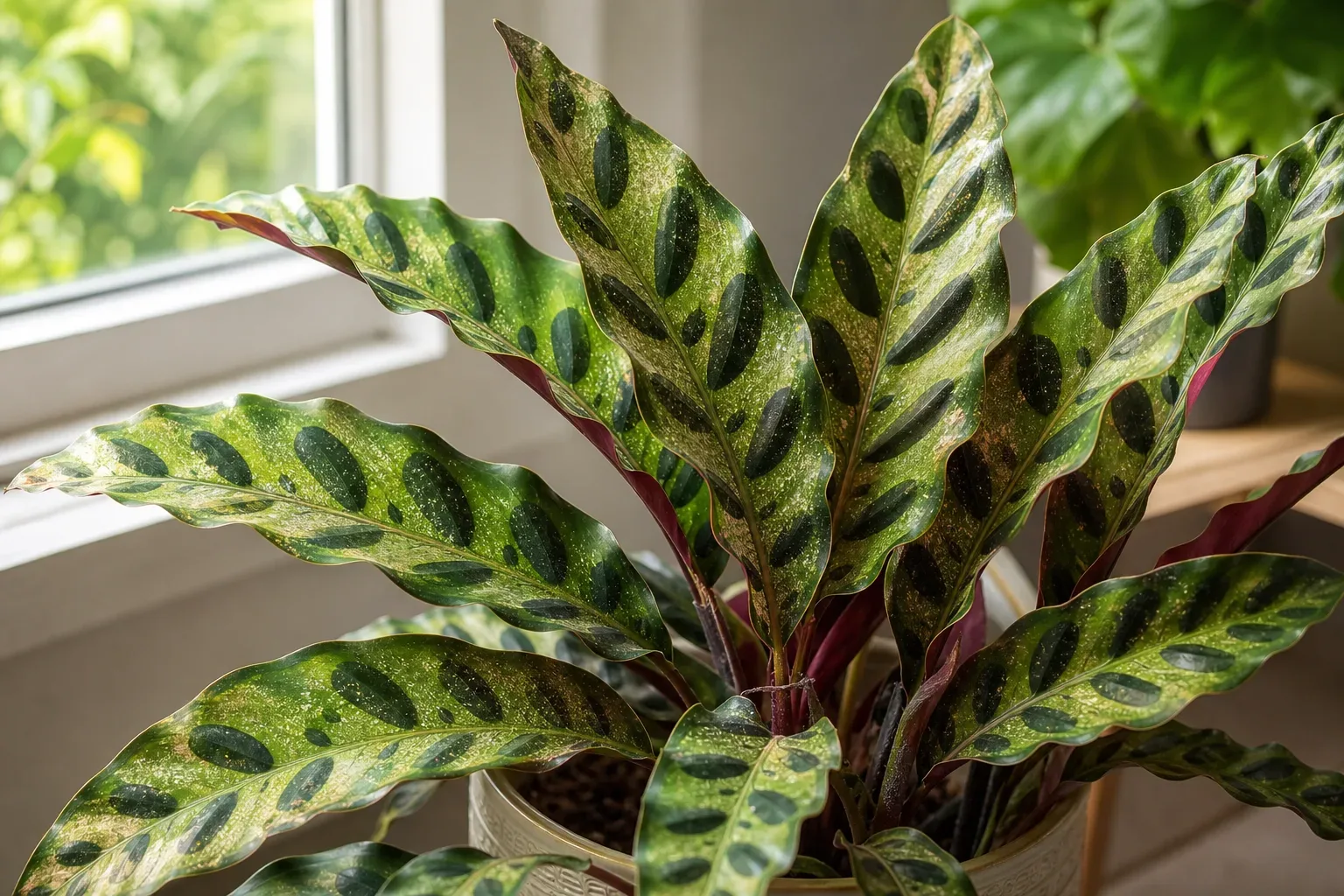
Spider Mites on Calathea Rattlesnake: Causes, Checks & Fixes
This guide covers spider mites on Calathea Rattlesnake. See also the general Spider Mites guide, watering, and light pages for this plant.
Spider Mites on Calathea Rattlesnake: Causes, Checks & Fixes
Quick answer
Spider mites on Calathea Rattlesnake (Goeppertia insignis) almost always trace to dry, warm indoor air-not random bad luck. The two-spotted spider mite thrives in the same winter conditions that stress this humidity-demanding Marantaceae: heating vents, low relative humidity, and lance leaves that dry on the edges while the purple-red undersides stay hidden from casual inspection.
On rattlesnakes, feeding shows up as pale stippling across the bright-green bands between dark oval markings, dull bronzed patches, and eventually fine silk webbing at petiole joints. The mites themselves are barely visible until populations build-and the patterned foliage can mask early damage until stippling spreads.
First step: isolate the plant and rinse every leaf underside with lukewarm water. Knock down live mites and webbing before reaching for soap or oil. One rinse is not a cure-eggs hatch in cycles-but isolation plus a thorough wash is the correct opening move. For species care context, see the Calathea Rattlesnake overview.
What spider mites look like on Calathea Rattlesnake
Rattlesnake leaves are long, lance-shaped, and thin compared with thick succulents-so mite damage becomes visible once you know where to look. The alternating dark-green ovals on a bright green background make stippling easy to miss at first because pale dots can blend into the lighter bands.
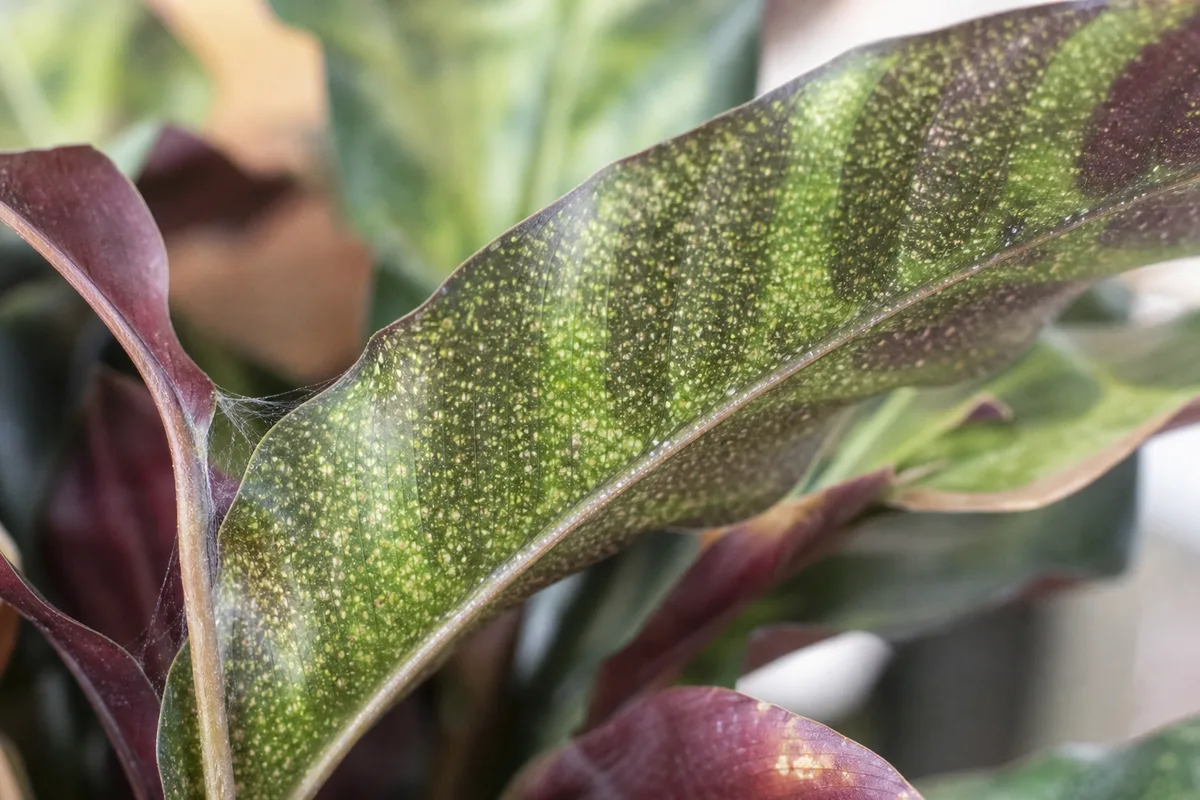
Spider Mites symptoms on Calathea Rattlesnake - compare with healthy tissue on the same plant.
Early signs:
- Tiny yellow or white dots scattered across green leaf surfaces, breaking up the rattlesnake scale pattern
- Leaves looking dusty, dull, or slightly bronzed even after wiping the patterned top
- Slight curling at margins when feeding is heavy, sometimes mistaken for low humidity alone
Established infestation:
- Fine silk threads between petioles, at leaf bases, or along the rhizome crown
- Amber-colored eggs, whitish cast skins, or black fecal specks on purple undersides
- Newest rolled center leaves opening with stippling already present
- Webbing visible without magnification when you tilt a blade to inspect the underside
The paper-tap test: Hold white paper under a lance leaf and tap the surface firmly. Moving specks that smear red-brown when crushed are spider mites. Mites are eight-legged arachnids, not insects-oval bodies, often greenish-yellow or reddish.
Damaged patterned tissue does not fully green up again. Judge recovery by clean new rolled leaves from the crown, not by old stippled blades reverting.
Why Calathea Rattlesnake gets spider mites
Rattlesnake plant evolved in humid Brazilian forest understory. Indoors it wants bright filtered light, consistently moist soil, and 60% humidity or higher-far above what most heated winter rooms provide. When central heating drops room RH below 40%, two problems stack:
- The plant is stressed - leaf edges crisp, growth slows, and thin lance foliage is less resilient to piercing pests.
- Mites reproduce faster - warm, dry air shortens their life cycle and lets populations double within days.
NC State Extension lists spider mites among common pests on Goeppertia insignis, alongside aphids, scale, and mealybugs. Rattlesnakes grow as upright fountain clumps with overlapping lance blades. Mites colonize undersides first, hidden beneath the patterned surface you admire from above. Crowded shelves of Marantaceae-calathea, stromanthe, ctenanthe, maranta-let mites walk or drift on silk threads from pot to pot.
Other triggers that make rattlesnakes vulnerable:
- Placement near radiators, forced-air vents, or winter sun through glass that dries leaf edges faster
- Letting soil go dry while air stays hot and dry (drought stress plus mite-favorable air)
- Bringing home an infested plant without quarantine
- Skipping underside checks because the plant looks fine from the patterned top
Spider mites are not a sign you failed at watering alone. They are an environmental pest that exploits the gap between what rattlesnakes need (humid, stable air) and what many homes provide in January.
Lookalike symptoms to rule out
| What you see | Likely cause | How to tell apart |
|---|---|---|
| Pale stippling with fine webbing | Spider mites | Paper-tap test shows moving specks; worse in dry winter air |
| Crisp brown tips or edges only, no dots | Low humidity or tap-water minerals | Even margin damage, no stipple pattern; mites absent on purple undersides |
| Silver streaks or scuffed patches | Thrips | No webbing; scrape test on leaf surface |
| White cottony clusters in axils | Mealybugs | Waxy blobs, sticky honeydew; see mealybugs |
| Yellow leaves, wet soil, no stippling | overwatering on Calathea Rattlesnake / root stress | Crown soft or soil sour; pest checks negative |
| Uniform dull pattern loss, no dots | Too much direct sun | Bleached markings, not speckled; mites absent |
Low humidity and spider mites often occur together on rattlesnakes. Raising humidity helps prevention and supports recovery, but confirmed stippling plus webbing still needs direct mite treatment-not just a humidifier. For dry-air damage without pests, see low humidity and brown tips.
How to confirm the cause
Work through these checks before spraying anything:
- Stippling pattern - Uniform tiny dots across multiple lance leaves, worse on older foliage first, points to mites. Single yellow leaves with wet soil suggest overwatering instead.
- Purple-underside inspection - Tilt each blade and check with a hand lens. Early colonies often show on the purplish-red surface before stippling is obvious on the patterned top.
- Paper-tap test - Confirms live mites versus dust or mineral deposits from hard water.
- Humidity reading - A hygrometer near the pot below 40% RH in winter strongly supports mite-friendly conditions on a plant that wants 60%+.
- Webbing location - Fine silk at petiole joints is mite-specific. Sticky shiny residue without webbing may be aphids or mealybugs instead.
- Neighbor plants - Check other prayer plants and calatheas on the same shelf. Mites rarely stay on one pot once webbing appears.
- Soil moisture - Press a finger into the top 2 cm of mix per your normal watering rhythm. Bone-dry soil with crisp edges can be drought; wet soil with stippling still fits mites if air is dry.
If stippling is absent, webbing is absent, and the paper-tap test shows nothing moving, rule out thrips, mealybugs, and environmental crisping before treating for mites.
First fix for Calathea Rattlesnake
Isolate the plant and rinse all leaf undersides with lukewarm water.
Move the rattlesnake away from healthy Marantaceae immediately. Mites spread on hands, tools, and breeze-caught silk. Carry the pot to a sink or shower and spray undersides with moderate pressure-enough to dislodge mites and webbing, not so hard that you tear thin lance blades.
Important rattlesnake-specific cautions during rinsing:
- Keep water off the rhizome crown - Overwatering and wet crowns cause root rot on prayer plants; do not let water pool where lance leaves meet the soil line.
- Let foliage dry the same day - wet leaves in cool, stagnant air invite fungal spotting on an already stressed plant.
- Wash the pot exterior and tray - mites can shelter on container rims.
Do not apply neem, soap, or oil on day one if you have not confirmed mites. Do not repot, fertilize, or prune heavily before the rinse-those add stress without removing pests.
After the rinse, set the plant in a humidified spot away from the collection and inspect again in 48 hours.
Step-by-step recovery
Once isolation and the first rinse are done, follow this sequence based on severity:
- Repeat water rinses every two to three days for two weeks if mites are still visible on inspection. Focus on purple undersides and new growth tips.
- Raise ambient humidity to 60% or higher with a humidifier-not occasional misting alone, which dries in minutes and can worsen crown problems if water sits at the leaf base. A pebble tray helps marginally; a humidifier is more reliable in winter.
- Apply insecticidal soap or horticultural oil if rinsing alone does not reduce populations after several attempts. Coat undersides completely; these products kill on contact and have little residual effect, so missed mites survive.
- Repeat soap or oil every five to seven days for at least three cycles to catch newly hatched mites. Most miticides miss eggs, so one application rarely ends an infestation.
- Inspect all Marantaceae nearby and rinse or treat any with early stippling, even before webbing appears.
- Prune only heavily webbed or defoliated leaves after sprays begin-removal lowers pest load but open wounds on stressed plants are secondary to knockdown.
- Hold fertilizer until new growth looks clean for two weeks. Feeding stressed rattlesnakes does not speed recovery and can push soft tissue mites prefer.
For severe infestations where most leaves are webbed and new center rolls have stopped, discarding the plant in a sealed bag may protect the rest of the collection-especially in a small apartment with many tropicals.
Recovery timeline
A thorough first rinse should reduce visible mites within two to three days on a moderate infestation. Full control with repeated soap or oil typically takes two to three weeks with label-interval applications.
Old stippled lance blades remain cosmetically marked. Expect cleaner new rolled leaves within three to four weeks once mites are gone and humidity stabilizes. The rattlesnake’s moderate growth rate means recovery is measured by unstippled center rolls, not by old blades greening up.
Escalate if webbing spreads after two full treatment cycles, or if neighboring plants develop stippling despite isolation.
What not to do
- Stopping after one rinse or one spray - eggs hatch continuously; schedule repeats before you declare victory.
- Spraying only the patterned leaf tops - mites live on purple undersides; top-only treatment leaves colonies intact.
- Misting instead of humidifying - brief leaf wetness does not fix dry air and can rot rattlesnake crowns if water pools at the base.
- Using dish soap - homemade detergents burn thin Marantaceae foliage; use labeled insecticidal soap.
- Applying oil in hot direct sun - phytotoxicity shows as bleached or spotted leaves on an already damaged plant.
- Assuming insecticides labeled for insects will kill mites - mites need miticides, horticultural oil, or insecticidal soap directed at undersides.
- Ignoring neighboring pots - mites on one rattlesnake usually mean checks are due on the whole shelf.
- Calathea Rattlesnake repotting guide mid-infestation - unnecessary stress; mites do not live in soil as a primary habitat.
Calathea Rattlesnake care cross-check
While treating mites, keep baseline care steady-wild swings in water or light make recovery harder.
- Light: Bright indirect; no harsh direct sun that dries lance blades faster.
- Water: Keep soil consistently moist at the top 2 cm per your watering guide; do not let the pot go bone dry during mite recovery.
- Humidity: Target 60%+ where possible-the same fix that discourages mites supports rattlesnake health.
- Temperature: Maintain 65–75°F (18–24°C); avoid cold drafts below 60°F.
- Water quality: Use filtered or rainwater when possible to avoid brown tips that mimic pest stress.
Spider mites are a pest problem layered on care environment. Raising humidity helps both the plant and your prevention plan, but confirmed infestations still need direct knockdown.
How to prevent spider mites next time
- Run a humidifier through winter heating season near rattlesnake and other prayer plant groupings.
- Quarantine new calatheas for two weeks; inspect purple undersides before placing with the collection.
- Tap-check lance leaves over white paper monthly, weekly in dry spells.
- Keep plants slightly spaced so you can tilt blades and see undersides.
- Rinse foliage with lukewarm water periodically in winter-same technique as treatment, used preventively.
- Avoid placing rattlesnakes directly above or beside heating vents.
Rattlesnakes that stay in stable 60%+ humidity rarely see explosive mite outbreaks. The goal is catching the first stippled leaf, not waiting for webbing across the oval pattern.
When to worry
Treat as urgent when:
- Webbing spans multiple stems and new center rolls stay damaged
- Mites appear on several plants in the same room
- The plant loses more than a third of its foliage despite two treatment rounds
- Stippling returns within a week after you stopped sprays
The plant is likely saveable if the rhizome crown is firm, roots are healthy, and at least some unstippled growth points remain-but a heavily webbed rattlesnake in a dense Marantaceae collection may be safer to discard than to risk spreading mites to every calathea on the shelf.
Goeppertia insignis is non-toxic to dogs, cats, and horses per the ASPCA prayer-plant listing. That does not make pesticide residues safe for pets to ingest-keep treated plants out of reach until sprays have dried, and follow product label precautions in homes with curious animals.
Conclusion
Spider mites on Calathea Rattlesnake mean dry winter air met a humidity-loving Marantaceae with thin, patterned lance leaves. Isolate, rinse purple undersides thoroughly, raise humidity to 60%+, and repeat contact treatments on a five-to-seven-day schedule until inspections stay clean. Old stippled blades will not look perfect again-watch for unstippled new center rolls instead.
When to use this page vs other Calathea Rattlesnake guides
- Calathea Rattlesnake watering guide - Use for routine moisture checks before assuming spider mites is the main issue.
- Calathea Rattlesnake problems hub - Browse all 16 common issues on this species.
- Low Humidity on Calathea Rattlesnake - Different entry point when symptoms overlap with spider mites.
- Slow Growth on Calathea Rattlesnake - Different entry point when symptoms overlap with spider mites.