Brown Tips on Calathea Rattlesnake: Causes, Checks & Fixes
Quick answer
Brown tips on Calathea Rattlesnake usually trace to tap-water fluoride and minerals or air below 50% RH at leaf height. First step: switch to filtered or rainwater, flush the pot until it drains freely, and place a hygrometer beside the canopy.
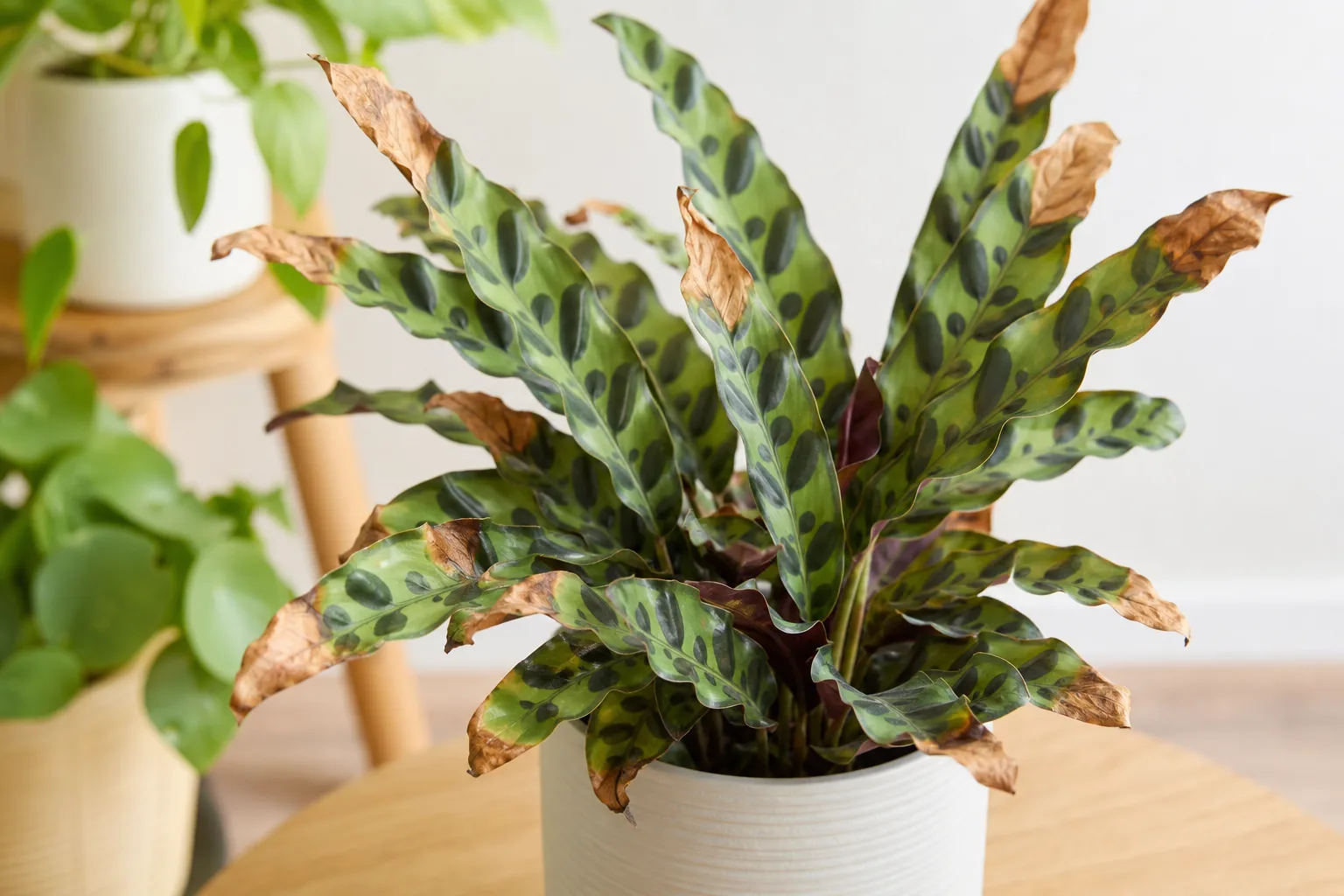
Brown Tips on Calathea Rattlesnake: Causes, Checks & Fixes
This guide covers brown tips on Calathea Rattlesnake. See also the general Brown Tips guide, watering, and light pages for this plant.
Brown Tips on Calathea Rattlesnake: Causes, Checks & Fixes
Quick answer
Brown tips on Calathea Rattlesnake (Goeppertia insignis) are margin necrosis on the thin, wavy edges of its lance-shaped blades-the first tissue to lose moisture when water chemistry, air humidity, or root-zone moisture goes wrong. This Brazilian understory prayer plant reacts fast because narrow margins transpire quickly and Marantaceae species accumulate fluoride and mineral salts at leaf edges.
First step: switch to room-temperature filtered or rainwater, flush the pot until water runs clear from the drainage holes, and place a hygrometer at leaf height beside the canopy. If readings stay below 50% RH while wavy edges crisp on moist soil, run a humidifier targeting 55–65% before you change watering frequency or repot. Do not stack fertilizer, pruning, and a water switch on the same day-make one care correction at a time so you can read the plant’s response.
For baseline humidity and water-quality setup, see the Calathea Rattlesnake overview and watering guide. This page is the multi-cause brown-tip diagnostic hub; see low humidity when dry air on moist soil is the confirmed primary issue.
What brown tips look like on Calathea Rattlesnake
Rattlesnake Calathea has long, narrow blades with undulating margins, alternating dark-green oval markings, and purple undersides. Brown tips here are tan-to-dark-brown necrosis along those wavy edges-sometimes tip-only, sometimes a continuous crispy band following the margin contour.
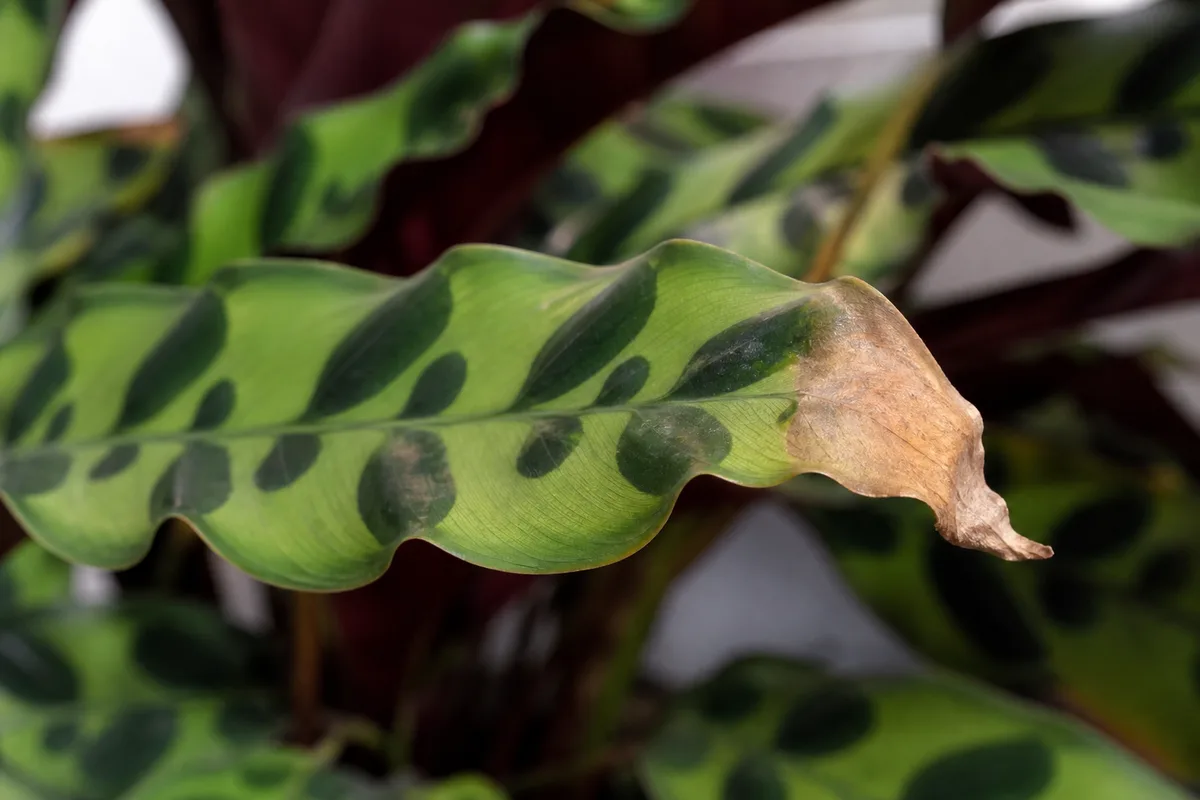
Brown Tips symptoms on Calathea Rattlesnake - compare with healthy tissue on the same plant.
Typical brown-tip patterns by cause:
- Tap-water and salt burn - Brown or tan crispy tips on older outer leaves; white or grey crust on the pot rim or soil surface; damage builds slowly over weeks to months of hard tap water or heavy feeding
- Low humidity on Calathea Rattlesnake - Crisping on the newest unfurling narrow rolls while soil feels cool and moist at 2 cm depth; worsens near heating vents or in heated winter rooms
- underwatering on Calathea Rattlesnake - Whole-blade inward curling through the afternoon plus crisp wavy edges; pot feels light and mix is dusty dry several centimeters down
- overwatering on Calathea Rattlesnake stress - Yellow lower leaves, soggy mix, and limp foliage with occasional margin crisp when roots struggle-see overwatering
- Cold drafts - Sudden margin browning on leaves touching cold window glass or sitting in an AC blast; often appears overnight after a placement change
- Direct sun scorch - Bleached or browned tissue on the side facing harsh glass; pattern may be uneven across the blade
Damaged brown tissue on existing leaves will not revert to green. Recovery shows up in the next leaves that open after conditions stabilize.
Reading oldest vs. newest leaves
The distribution across your rattlesnake clump is one of the fastest diagnostic clues:
- Oldest outer blades only - Often legacy tap-water damage or past drought; check whether new center rolls are clean before treating aggressively
- Newest patterned roll crisping first - Active ongoing stress-usually low humidity, cold drafts, or recent tap-water feeding on a sensitive unfurling leaf
- All leaves, all at once after a care change - Environmental shock (moved to a hot sill, repotted, or heat season started); roll back the most recent variable
Case example: A grower watered with city tap for eight months. Oldest rattlesnake blades showed isolated tip burn with white rim crust; the newest roll looked clean until winter heat dropped canopy RH to 38%. After switching to filtered water, flushing the pot once, and running a humidifier on a 60% humidistat, the next unfurling leaf opened with intact wavy margins in about eighteen days-old brown tips remained cosmetic only.
Why Calathea Rattlesnake gets brown tips
Goeppertia insignis evolved in the humid forests of southeastern Brazil as an understory perennial with fine feeder roots in organic litter that drains freely after rain. Indoors, three structural traits make margin burn common:
Thin wavy margins. The undulate leaf edge has less tissue volume than the midrib. When transpiration outpaces moisture replacement-from dry air, drought, or salt accumulation at the margin-the wavy edge browns before the green center yellows.
Tap-water sensitivity. Many Calatheas accumulate fluoride and mineral salts at leaf margins from municipal water and fertilizer. UF/IFAS notes fluoride toxicity produces dead spots near leaf margins on Calathea, and leaf marginal necrosis can follow excess fertilizer salts-especially when pH or soluble salts drift out of range.
Low indoor humidity. NC State Extension notes browning or curling of leaf edges and tips can result from low humidity on rattlesnake plant. Central heating can drop winter air well below the 60% or higher ideal described on the overview. Rattlesnake is often more forgiving than broad-leaf Calatheas, but sustained readings below roughly 50% at canopy height commonly produce margin crisping.
Other rattlesnake-specific triggers include inconsistent watering (alternating bone-dry and soggy peat stresses margins), cold drafts and sudden temperature changes below the 65–75 °F comfort range, and harsh direct sun on narrow blades that scorch unevenly.
Lookalike symptoms to rule out
| Signal | Tap-water / salt burn | Low humidity | Underwatering | Overwatering |
|---|---|---|---|---|
| Pot weight | Normal to heavy | Normal to heavy | Noticeably light | Heavy, stays wet |
| Soil at 2 cm | Moist on schedule | Cool, moist | Dusty dry | Soggy, sour smell |
| Leaf pattern | Older-leaf tip burn; rim crust | New-roll edge crisp; flat center | Whole-blade curl | Yellow lower leaves, limp |
| Timing | Builds over months | Worsens when heat runs | After skipped watering | Chronic wet mix |
| First fix | Filtered water + flush | Humidifier 55–65% RH | Bottom-water once | Dry back; inspect roots |
If soil is moist and the pot feels heavy but wavy edges keep crisping near a radiator, treat humidity-not drought. See underwatering and low humidity when the table points away from water chemistry.
Spider mites - Fine stippling with webbing on undersides; dry air invites mites but raising humidity alone will not eliminate an active colony. See spider mites.
Normal nyctinasty - Rattlesnake leaves rise at night and lower by day without tight inward rolling or crispy margins.
How to confirm the cause
Work through these checks in order before Calathea Rattlesnake repotting guide, fertilizing, or changing light:
- Newest vs. oldest leaf pattern - Note which blades show active crisping. New-roll damage with moist soil points to humidity or drafts; older-leaf-only burn with rim crust points to salts.
- Water source history - Have you used straight tap for months? Do you fertilize with hard water? White crust on the pot rim supports salt buildup per Clemson HGIC brown-tip guidance.
- Hygrometer at leaf height - Desk-level readings can run 10–15 points higher than canopy air. Below 45% RH with crisp new margins strongly suggests dry air.
- Pot weight and soil moisture - Lift the container and check the top 2 cm. A light pot with dry mix rules out humidity as the sole issue; a heavy pot with cool damp soil rules out simple thirst.
- Placement audit - Measure distance from radiators, HVAC vents, cold window glass, and direct afternoon sun. Clemson HGIC lists exposure to hot, dry air among causes of brown leaf tips and edges.
- Pest check - Tap a suspect leaf over white paper; look for moving specks or fine webbing before assuming environmental burn only.
If tap water is your only source, rim crust is visible, and oldest leaves show tip burn while you water on schedule, filtered water plus a flush is the likely fix. If soil is moist, humidity reads low, and new wavy edges crisp near a vent, treat air moisture first.
First fix for Calathea Rattlesnake
Switch to room-temperature filtered or rainwater, then flush the pot once-run plain water through the mix until it drains freely from the bottom and empty the saucer.
This single step addresses the most common indoor cause (tap-water minerals and fluoride) without stacking repotting, fertilizer, or humidity gear on the same day. Hold your normal watering rhythm-water when the top 2 cm begins to dry-and judge the next one or two center rolls before adding more interventions.
If a hygrometer at canopy height reads below 50% while new margins crisp on moist soil, add a humidifier targeting 55–65% RH as the second step after forty-eight hours of stable filtered watering-not instead of fixing water chemistry when rim crust is present.
Do not fertilize a stressed rattlesnake during this correction. Salts on already-burned margins worsen the problem.
Step-by-step recovery by confirmed cause
Tap-water and salt buildup
- Switch to filtered, reverse-osmosis, or rainwater for every drink.
- Flush the pot monthly until runoff is clear-Clemson HGIC recommends periodic drenching to leach salts.
- Scrape white crust from the soil surface if present; avoid heavy feeding until new growth is clean.
- Hold fertilizer at half strength only after two clean new leaves open.
Low humidity
- Move the pot away from heating vents and cold drafts.
- Run a humidifier beside the canopy until readings hold 55–65% at leaf height.
- Do not compensate with extra watering-see the low humidity guide for full dry-air recovery steps.
Underwatering
- Bottom-water once with filtered water until the surface feels evenly moist; drain fully.
- Resume checking the top 2 cm before the next drink-see underwatering.
Overwatering and root stress
- Let the top 2 cm dry before watering again; confirm drainage holes are open.
- If lower leaves yellow on soggy mix, inspect roots before repotting-see overwatering and root rot.
Cold drafts and heat scorch
- Move off cold window sills and away from AC blasts; keep day-to-day temperatures in the 65–75 °F range NC State recommends.
- Pull back from harsh direct sun; rattlesnake wants bright indirect light per the light guide.
Cosmetic trimming
Trim fully brown sections with clean scissors, following the natural wavy contour. Leave green tissue intact.
Recovery timeline
Tap-water correction - Expect cleaner margins on the next one or two unfurling leaves within two to four weeks of filtered water and one flush. Old tips stay brown permanently.
Humidity correction - New narrow rolls should open with intact wavy edges within two to four weeks of sustained 55–65% RH at the canopy.
Underwatering bounce - Leaves often uncurl within hours after a proper soak; edge crisp on old blades remains.
Improvement signs: firm new patterned rolls from the center, unfurling speeds up, stem bases stay firm, brown spread stops on new growth.
Worsening signs: successive new leaves emerge mostly brown, soft stems with sour soil, mite webbing despite corrections, or yellowing spreading up the plant-see yellow leaves.
What not to do
Do not fertilize a stressed rattlesnake before confirming roots, water quality, and humidity. Salt burn and fertilizer overlap on the same margins.
Do not stack repotting, heavy pruning, pesticide, and a water switch on the same day. One variable at a time.
Do not keep soil wet to fix dry air-that invites root rot on an already stressed prayer plant.
Do not mist once daily as a humidity substitute. Brief misting does not sustain Marantaceae moisture needs near heating vents.
Do not assume every brown edge is tap water. Run the confirmation checklist before buying a second humidifier or repotting.
Do not trim aggressively while active stress continues-each cut loses moisture through wounded tissue.
Calathea Rattlesnake care cross-check
Brown tips rarely exist in isolation. Confirm these basics while you correct water and air:
| Factor | Rattlesnake target | Quick check |
|---|---|---|
| Water quality | Filtered or rainwater | Rim crust? Switch source |
| Humidity | 60%+ ideal; 50% floor | Hygrometer at canopy |
| Watering | Top 2 cm dry before drink | Pot weight + finger test |
| Light | Bright indirect; no harsh sun | New growth pattern vivid? |
| Temperature | 65–75 °F; no drafts | Away from vents/glass |
| Soil | Moisture-retentive, well-drained | Drainage hole open |
Because Calathea Rattlesnake is non-toxic to pets per the ASPCA prayer-plant listing, toxicity is not a crisis concern here-but keep humidifiers on stable surfaces away from curious pets.
How to prevent brown tips next time
Use filtered or rainwater from day one if your municipal supply is hard or fluoridated. Flush the pot every few months during active growth to prevent salt accumulation.
Run a humidifier from early fall through heating season rather than waiting for crisp edges. Log canopy RH weekly when furnaces cycle.
Water when the top 2 cm begins to dry-never let the root ball go bone dry for weeks, and never leave the pot standing in runoff.
Keep rattlesnake in bright indirect light away from hot afternoon glass. Rotate gradually when moving to a brighter spot.
Inspect new center rolls weekly while problems are still small. One clean patterned leaf is worth more than trimming ten old crispy blades.
When to worry
Treat as urgent when every new leaf emerges mostly brown despite filtered water and corrected humidity, growth stops for more than a month in warm weather, stems soften at the soil line, or spider mites spread webbing across multiple petioles.
You do not need to discard a plant over old cosmetic tips if stems are firm and new growth is improving. Rapid spread on successive new leaves means an active stressor is still present-revisit the confirmation checklist before waiting for seasonal recovery.
Conclusion
Brown tips on Calathea Rattlesnake are a margin-stress signal, not a random blemish. Read the pattern on oldest vs. newest wavy blades, switch to filtered water with a flush, measure humidity at the canopy, and fix one variable at a time. Old crispy edges will not re-green, but clean new rattlesnake rolls from the center tell you the fix worked-usually within two to four weeks once water chemistry and air moisture align.
Related Calathea Rattlesnake problems
- Low humidity - dry-air crisping on moist soil
- Underwatering - drought curl when mix is bone dry
- Overwatering - soggy mix and yellow lower leaves
- Yellow leaves - progression beyond margin burn
- Calathea Rattlesnake overview - ranked brown-tip causes and baseline care
- Watering - fluoride protocol and flush steps
When to use this page vs other Calathea Rattlesnake guides
- Calathea Rattlesnake watering guide - Use for routine moisture checks before assuming brown tips is the main issue.
- Calathea Rattlesnake problems hub - Browse all 16 common issues on this species.
- Low Humidity on Calathea Rattlesnake - Different entry point when symptoms overlap with brown tips.
- Underwatering on Calathea Rattlesnake - Different entry point when symptoms overlap with brown tips.
- Overwatering on Calathea Rattlesnake - Different entry point when symptoms overlap with brown tips.