Yellow Leaves on Calathea Rattlesnake: Causes, Checks &
Quick answer
Yellow leaves on Calathea Rattlesnake often trace to overwatering, underwatering, low light, or normal lower-leaf aging. First step: check soil moisture at 1–2 inches and note whether only the oldest bottom leaves are affected before you fertilize or repot.
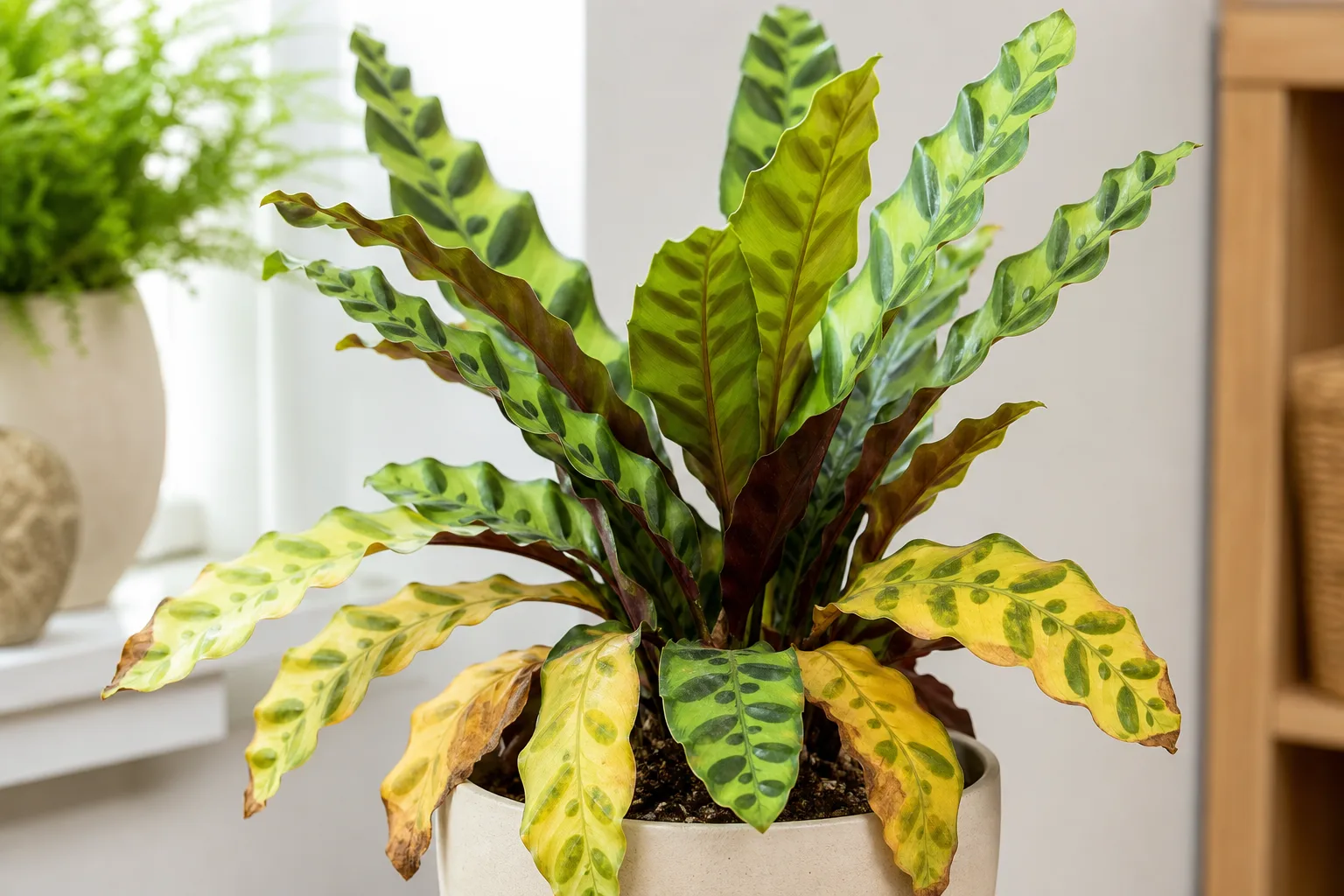
Yellow Leaves on Calathea Rattlesnake: Causes, Checks & Fixes
This guide covers yellow leaves on Calathea Rattlesnake. See also the general Yellow Leaves guide, watering, and light pages for this plant.
Yellow Leaves on Calathea Rattlesnake: Causes, Checks & Fixes
Quick answer
Yellow leaves on Calathea Rattlesnake (Goeppertia insignis, formerly Calathea lancifolia) are a symptom, not a diagnosis. On this narrow, patterned prayer plant, yellowing can mean normal lower-leaf aging, overwatering on Calathea Rattlesnake, underwatering on Calathea Rattlesnake, low light, or water-quality stress. The most useful clue is which leaves yellow first and whether the pot is wet or dry at depth.
First step: check moisture at 1–2 inches and leaf position before changing anything. One old bottom leaf fading slowly is often normal senescence. Several leaves yellowing together on heavy wet soil points to root stress, not a nutrient shortage.
Why Calathea Rattlesnake gets yellow leaves
Rattlesnake Plant does best in uniformly moist, well-drained soil with bright, indirect light. Indoors, yellowing usually comes from one of five cause groups:
Normal lower-leaf senescence. Older outer leaves yellow and drop as new center growth develops. Lower leaf yellowing is often normal aging when it is gradual and limited to one or two oldest leaves.
Overwatering and root stress. Overwatering can cause root rot and yellowing, especially when the pot stays heavy and wet for days.
Underwatering. Repeated dry-down can yellow older leaves, with curl and crisping when the mix runs too dry between waterings.
Insufficient light. In very dim rooms, foliage can fade and yellow while stems stretch toward light. Low indoor light reduces plant vigor and foliage quality.
Tap-water minerals and salts. Calatheas can react to hard or highly treated water; the RHS advises rainwater for calatheas, which often reduces edge yellowing and browning.
What yellow leaves look like on Calathea Rattlesnake
Normal aging: One older outer leaf turns evenly yellow over time; crown stays firm; new center leaves keep normal pattern and shape.
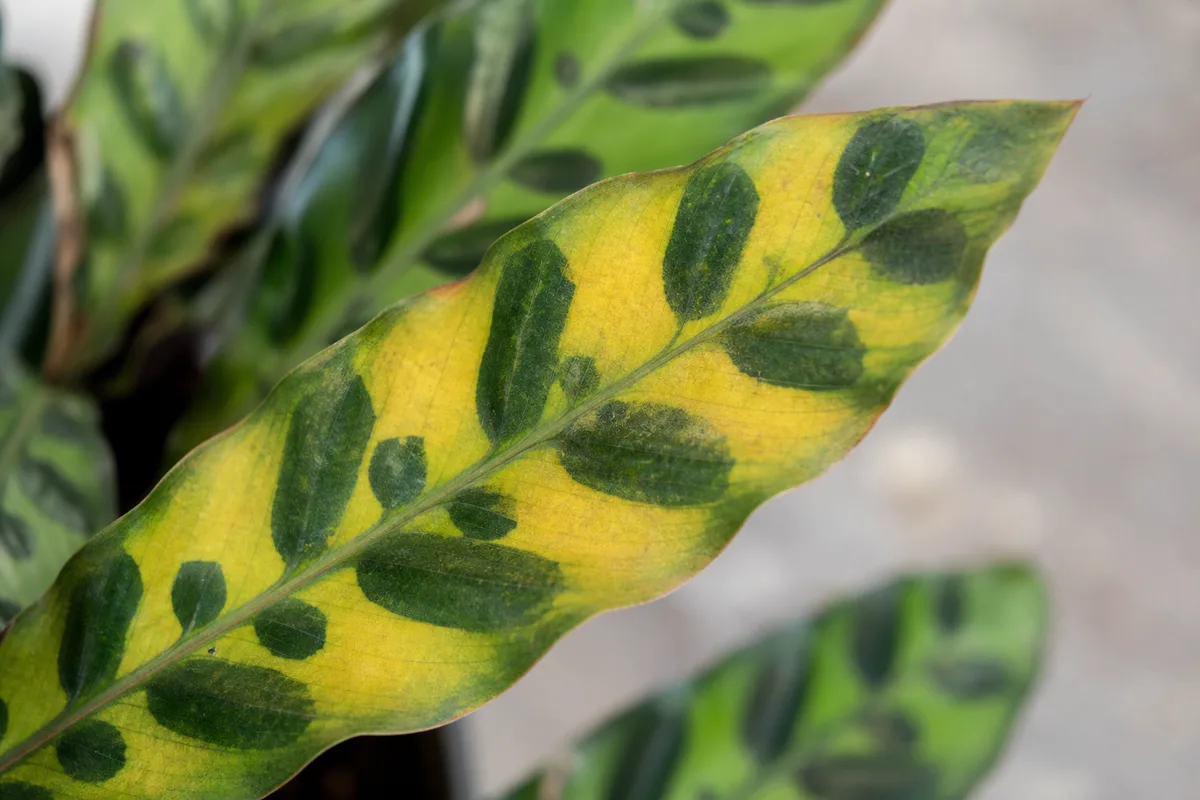
Yellow Leaves symptoms on Calathea Rattlesnake - compare with healthy tissue on the same plant.
Overwatering yellow: Multiple leaves yellow close together; pot stays wet/heavy; foliage looks limp despite damp mix; fungus gnats or sour odor may appear.
Underwatering yellow: Older leaves yellow from margins first, with a light dry pot and daytime curl; mix may pull from pot edges.
Low-light yellow: Pale, washed upper leaves with weaker pattern contrast and stretched petioles; moisture may still be normal.
Lookalike symptoms to rule out
| Pattern | Likely cause | First direction |
|---|---|---|
| One old bottom leaf, slow fade | Normal aging | Remove leaf; no care change |
| Several lower leaves, wet soil | Overwatering / root stress | Stop watering; inspect roots |
| Curl + light pot + dry soil | Underwatering | Thorough soak; fix rhythm |
| Pale upper leaves, dim spot | Not enough light | Move to bright indirect |
| Crisp tips, moist soil | Tap water / humidity | Switch water; check RH |
| Yellow + webbing | Spider mites | Rinse; treat pests |
How to confirm the cause
Work through these checks in order:
- Leaf position - Only bottom outer leaves, or spreading up the rosette?
- Soil moisture at 1–2 inches - Wet and clinging, or dry and crumbly?
- Pot weight - Heavy days after watering vs light and dry?
- Center spear - Firm green new growth, or stalled/browning?
- Light level - Bright indirect vs dim interior hallway?
- Water source - Tap vs rainwater/filtered?
Inspect roots if wet soil pairs with rapid yellowing. If only one bottom leaf fades over weeks to months with stable growth, aging is more likely than disease.
Nutrient deficiency vs root stress on Rattlesnake Plant
Yellow leaves from root stress and yellow from nutrient problems look similar at first glance, but the pot tells them apart. Root stress from overwatering shows several lower leaves yellowing together, a heavy wet pot days after you thought it dried, and often limp texture or fungus gnats. Nutrient-related yellowing more often appears as pale new growth or yellowing between veins on fresh leaves while older foliage stays greener-and the mix may feel appropriately moist, not sour.
Threshold checks before you fertilize:
| Signal | Root stress (overwatering) | Nutrient issue |
|---|---|---|
| Soil at 1–2 inches | Wet, clinging, cool | Normal dry-down rhythm |
| Pot weight | Heavy 4+ days after watering | Matches your usual cycle |
| Leaf pattern | Multiple lower leaves, limp | New leaves pale; veins may stay green |
| Center spear | Stalls or browns on wet soil | Opens but washed-out |
| Smell at drain holes | Sour or rotten | Earthy only |
Do not reach for fertilizer when the pot is heavy and wet-that pushes salts into stressed roots. Fix moisture first; only consider feeding after yellowing stops spreading and new center leaves stay green for two full weeks.
Observed case (indoor grower, March–April): A 6-inch rattlesnake in unamended peat mix yellowed three lower leaves in ten days while the top 2 cm stayed dark and wet. Pot weight barely changed between waterings. After pausing water until the top 2 inches dried and switching to a chunkier mix at repot, the next center leaf opened green in about three weeks-old yellow leaves did not re-green.
First fix for Calathea Rattlesnake
Match the fix to the confirmed cause-one change at a time:
- Aging: Snip the fully yellow leaf at the base. No watering or fertilizer change needed.
- Overwatering: Stop watering until the top 1–2 inches dry. Empty saucers. Inspect roots if decline continues.
- Underwatering: Water thoroughly until drainage runs; resume check-based rhythm per the watering guide.
- Low light: Move to Calathea Rattlesnake light guide-no direct sun on Rattlesnake leaves.
- Water quality: Switch to rainwater or filtered water for two weeks; watch new unfurling leaves.
Do not fertilize until yellowing stops spreading and new growth stays green.
Step-by-step recovery
- Stabilize conditions first. Keep temperatures steady and avoid moving the plant between very different light spots while diagnosing.
- Correct only the confirmed cause. Do not stack Calathea Rattlesnake repotting guide, fertilizing, and heavy pruning on day one.
- Remove fully yellow leaves. Yellow tissue does not re-green and can be trimmed at the base once fully spent.
- Track new growth, not old leaves. Improvement means fresh center leaves open with normal pattern and shape.
- Recheck after one full watering cycle. If symptoms continue after correct moisture rhythm, inspect roots and escalate to root rot.
Recovery timeline
Old yellow leaves usually decline over one to three weeks and will not re-green. Judge success by healthy new growth rather than old damaged leaves.
Overwatering-related yellowing may take four to six weeks if roots were damaged. Low-light recovery is slower-expect improved pattern on new leaves after four to eight weeks in brighter placement.
What not to do
Do not assume every yellow leaf needs fertilizer-salt buildup from overfeeding also yellows foliage. Do not increase watering on a wet pot. Do not repot immediately without confirming whether roots, light, or water quality is the driver.
When to worry
Treat this as urgent if yellowing spreads rapidly up the rosette while soil remains wet, the center spear browns, or tissue at the crown softens. A persistent sour smell with continuing decline suggests root damage and possible pathogen pressure.
If more than half the root mass is mushy when inspected, recovery may be limited and a healthy division may be the best salvage path.
How to prevent yellow leaves next time
Keep a consistent watering check, provide appropriate light for indoor plants, use filtered or rainwater when possible, and remove spent lower leaves promptly. Reduce watering frequency in winter when growth slows per RHS calathea guidance.
Related Calathea Rattlesnake problems
- Calathea Rattlesnake overview - species care hub
- Watering - moisture rhythm and seasonal checks
- Overwatering - wet-soil collapse patterns
- Root rot - escalation path for mushy roots
- Underwatering - dry-soil yellowing lookalike
- Low humidity - edge stress with moist soil
- Wilting - acute collapse patterns
When to use this page vs other Calathea Rattlesnake guides
- Calathea Rattlesnake watering guide - Use for routine moisture checks before assuming yellow leaves is the main issue.
- Calathea Rattlesnake problems hub - Browse all 16 common issues on this species.
- Overwatering on Calathea Rattlesnake - Different entry point when symptoms overlap with yellow leaves.
- Underwatering on Calathea Rattlesnake - Different entry point when symptoms overlap with yellow leaves.
- Not Enough Light on Calathea Rattlesnake - Different entry point when symptoms overlap with yellow leaves.