Calathea Rattlesnake Fertilizer: When, How, and Mistakes
Calathea Rattlesnake Fertilizer: When, How, and Mistakes
Calathea Rattlesnake Fertilizer: When, How, and Mistakes
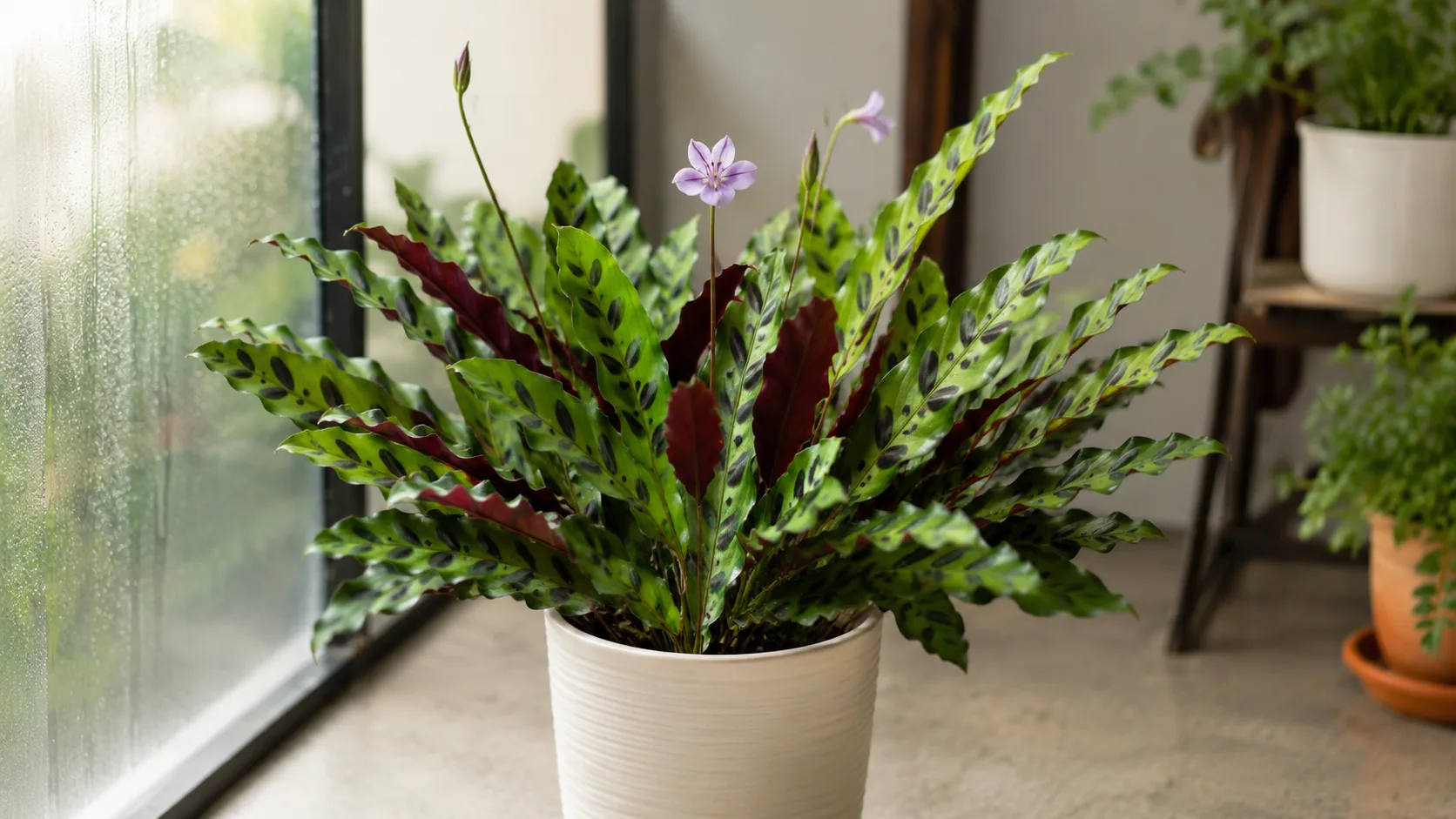
Calathea Rattlesnake - botanically Goeppertia insignis, still widely sold as Calathea lancifolia - is one of the more forgiving Calatheas, but it is not forgiving about fertilizer. The plant pushes out wavy, patterned leaves with burgundy undersides when light, humidity, and watering are stable. Nutrients support that foliage, yet the same fine roots that absorb water also absorb dissolved salts quickly. In a small indoor pot, fertilizer that would be harmless on a pothos can leave brown leaf margins on a Rattlesnake Plant within a week.
The goal is not to feed aggressively. It is to replace what the plant uses during visible growth without letting salts accumulate in the potting mix or compounding the mineral load from hard tap water. Most failures come from treating Rattlesnake Calathea like a heavy feeder: full label strength, every watering, through winter, on dry soil. This guide gives you a seasonal schedule, a safe dilution range, product choices that make sense indoors, and a clear way to spot trouble before the newest leaves show the damage.
Why Rattlesnake Calathea Needs a Light Feeding Hand
In its native range in southeastern Brazil, Rattlesnake Plant grows on the rainforest floor under filtered light, in consistently moist, organic-rich soil. The North Carolina Extension Gardener Plant Toolbox notes that during the growing season you should water regularly to keep soils moist and apply a balanced fertilizer monthly, then reduce watering and fertilization in winter when growth slows. That monthly guidance is a useful ceiling for home culture, not a minimum you must hit regardless of conditions.
Compared with many other Calatheas, Rattlesnake is often described as moderately fast-growing when humidity and light are adequate. New leaves may appear every two to three weeks in ideal conditions, which means the plant does use nitrogen, phosphorus, potassium, and micronutrients to build tissue. It is not a plant you can ignore for years in the same leached potting mix and expect crisp patterning forever. At the same time, it belongs to the Marantaceae family - the prayer plant group - and shares their reputation for reacting badly to excess soluble salts.
Container life changes the equation. Every watering carries a little nutrition through the drainage hole, and evaporation leaves salts behind at the soil surface and along the pot walls. Rattlesnake Calathea also transpires through large leaf surfaces, so marginal burn shows up early when the root zone becomes too salty. Fertilizer is support for growth you can already see, not a rescue tool for a plant struggling with dry air, cold drafts, or chronic overwatering on Calathea Rattlesnake.
Two details keep the feeding conversation honest. First, fertilizer cannot replace light or humidity. A Rattlesnake Plant in a dim corner with brown tips from 30% relative humidity will not recover because you switched to a “Calathea-specific” bottle. Fix the environment, then feed modestly when new growth resumes. Second, water quality matters as much as fertilizer strength. Tap water with fluoride, chlorine, and dissolved minerals adds its own salt load. Many growers who feed at half strength on hard water see the same tip burn as those who feed at full strength on distilled water. Treat water and fertilizer as one system.
What NPK Means for Goeppertia insignis Foliage
Fertilizer labels show three numbers: N-P-K, the percentages of nitrogen, available phosphate, and soluble potash. Nitrogen supports chlorophyll production and leaf expansion. Phosphorus participates in energy transfer and root function. Potassium contributes to water regulation, enzyme activity, and overall stress tolerance. Rattlesnake Calathea is grown almost entirely for foliage, not flowers indoors, so the feeding goal is steady leaf production with strong green patterning - not bloom promotion.
Balanced vs Foliage-Leaning Formulas
For routine indoor care, a complete balanced fertilizer is the safest default. Many growers use 10-10-10 or 20-20-20 liquid houseplant products diluted well below the label rate. The numbers describe relative proportions, not interchangeable doses - 20-20-20 contains twice the nutrient percentage of 10-10-10 at the same volume, so always follow the specific product label before reducing.
Commercial Calathea production guidance from University of Florida IFAS recommends water-soluble fertilizers with an N-P2O5-K2O ratio around 3-1-2, such as 24-8-16 or 18-6-12 with micronutrients, for fertigated greenhouse crops. That slightly nitrogen-leaning profile reflects leafy tropical production. At home, a balanced 10-10-10 or a foliage-oriented 3-1-2 product both work when applied conservatively.
| Goal | Typical NPK direction | When it makes sense |
|---|---|---|
| Routine indoor foliage | Balanced 10-10-10 or 20-20-20 | Default for most homes |
| Active leaf production in bright light | Slightly nitrogen-leaning 3-1-2 | Visible new leaves every few weeks |
| Recovery after salt flush | Skip feeding 4–6 weeks, then resume balanced | After burn symptoms or heavy leaching |
Do not chase high-phosphorus “bloom boosters” for Calathea Rattlesnake overview indoors. Rattlesnake Calathea may produce small yellow flowers in perfect greenhouse conditions, but indoor specimens are grown for leaves. Extra phosphorus without corresponding demand simply adds to the salt budget.
Why Salt Sensitivity Changes the Math
Calathea roots are fine and fibrous, adapted to rainforest soils that are moist but constantly flushed by rain through porous organic matter. Indoor peat- or coco-based mixes hold nutrients differently. When you apply fertilizer, soluble salts increase electrical conductivity (EC) in the root zone. UF IFAS notes that for commercial Calathea production, media EC below about 1.0 dS/m may indicate under-feeding, while readings above 3.0 dS/m suggest reducing fertilizer. Home growers rarely measure EC, but the principle still applies: salts accumulate in closed containers unless you leach them.
Because Rattlesnake Calathea is sensitive to marginal salt injury, many experienced growers dilute synthetic fertilizers to one-quarter of label strength rather than half - especially when tap water is hard or when feeding has been frequent. Half strength is a common starting point in published care guides; quarter strength is the safer end of the range when you see early tip browning or white crust on the soil. Neither number is magic. The correct dose is the one that produces healthy new leaves without progressive marginal burn.
Micronutrients matter too. Choose a product labeled complete with iron, manganese, zinc, and other trace elements listed. Iron-related chlorosis can appear as yellowing between veins on newer leaves, but adding iron without fixing root health, cold soil, or chronic wetness will not solve the problem. A complete fertilizer used sparingly prevents long-term micronutrient gaps in soilless mix.
The Best Fertilizer Types for Calathea Rattlesnake
The best product is one that is complete, easy to measure, and unlikely to be doubled accidentally. Brand matters less than nutrient analysis, dilution control, and compatibility with your watering routine. Oklahoma State University Extension emphasizes that houseplant fertilizer frequency should change with season, light, temperature, species, and medium - advice that fits Rattlesnake Calathea especially well because its growth rate swings with indoor conditions.
| Fertilizer form | Main advantage | Main limitation | Best fit |
|---|---|---|---|
| Liquid or water-soluble | Precise, adjustable, immediate | Easy to overapply | Growers who inspect plants regularly |
| Controlled-release | Convenient, gradual supply | Hard to remove or adjust; continues in winter | Stable warm rooms with bright light |
| Organic liquid | Gentler perceived release | Analysis may be low or variable | Growers comfortable measuring and monitoring |
| Foliar sprays | Direct leaf contact | Not a substitute for root feeding; can spot leaves | Generally skip for Rattlesnake Calathea |
Liquid Water-Soluble Fertilizers
Liquid concentrates and soluble powders give you the most control. You can reduce concentration for a low-light plant, skip a month during a heatwave or vacation, and stop immediately if the plant shows stress. Mix fertilizer in a measured volume of water using a spoon, syringe, or cap marked to the line - not by estimating drops into a partly filled watering can.
“Weakly, weekly” feeding is sometimes recommended for houseplants, but it is risky for Calathea. A quarter-dose every week can exceed a monthly half-dose depending on how often you water, and Rattlesnake Plant should not be watered on a fertilizer schedule alone. A three-to-four-week interval during active growth is simpler because ordinary watering stays tied to soil moisture, with plain-water applications in between to limit salt buildup.
Never pour undiluted concentrate into the pot. Never combine two different fertilizers unless you understand their combined nutrient load. If you use distilled or rainwater for the plant, mix fertilizer into that same water source so you are not surprised by shifting mineral content.
Slow-Release, Organic, and What to Skip
Controlled-release prills release nutrients gradually as moisture and temperature activate them. They can work for an established Rattlesnake Calathea in a warm, bright room with stable watering, but they are harder to remove if you overapply. Warm, wet soil releases faster; a plant recovering from root trouble cannot use the load efficiently. If your newly purchased plant already has prills mixed into the commercial potting medium, do not automatically add liquid fertilizer on top for the first several weeks.
Organic liquids such as fish emulsion or seaweed-based products can be used, but organic does not mean salt-free or impossible to overapply. Check the guaranteed analysis and directions. Some seaweed products supply mostly potassium and trace compounds rather than a complete N-P-K profile. Odor and gnat attraction are practical indoor drawbacks. If you choose organic, apply at the low end of the label range and monitor leaf margins closely.
Skip slow-release pellets in small pots unless you understand the release curve and plan to leach regularly. Skip foliar feeding as a routine - Rattlesnake leaves are textured and sensitive, and foliar sprays do not replace root-zone nutrition for a plant in soilless mix. Skip fertilizer combined with pesticides unless a specific labeled product and problem justify it. Skip kitchen shortcuts - banana water, coffee grounds on the soil surface, and eggshell water do not provide a reliably complete or measurable nutrient profile for container culture.
When to Fertilize Rattlesnake Plant by Season
Build the schedule around visible growth, not a calendar date in isolation. In many Northern Hemisphere homes, longer spring and summer days produce the strongest Rattlesnake Calathea growth. In tropical climates, air-conditioned offices, or rooms with grow lights, the pattern may differ. Watch for new leaves unfurling, faster water use, and the plant’s characteristic nightly leaf movement - signs that the pulvinus and vascular system are active.
Spring and Summer Feeding Windows
Begin or increase feeding after growth clearly resumes, usually from late March through early April in temperate climates, though your local timing should follow the plant. If the Rattlesnake Plant was repotted into fresh mix containing starter fertilizer, wait until that charge declines - often several weeks - before adding liquid feed. If the mix has no added nutrients and roots are healthy, a reduced liquid dose can begin once new leaves appear and soil dries at the usual rate.
During active growth, a practical baseline is every three to four weeks with a balanced liquid fertilizer at one-quarter to one-half label strength. Some guides suggest every two to four weeks; the lower end of frequency is safer for salt-sensitive plants. A plant in Calathea Rattlesnake light guide with stable 50%+ humidity and consistent moisture may tolerate the shorter interval. The same cultivar in moderate light and dry winter air may need only monthly feeding - or less.
NC State Extension’s monthly recommendation during the growing season aligns with this range when you interpret “monthly” as an upper bound for moderate feeders, not a requirement to feed on the first of every month regardless of growth. Feed the growth you see. If the plant has produced no new leaves in six weeks despite good care, investigate light, roots, and humidity before increasing fertilizer.
High humidity supports nutrient uptake indirectly by reducing transpiration stress, but it does not replace conservative dosing. A bathroom-grown Rattlesnake Calathea may grow faster and use slightly more food than a desk plant in dry air, yet both still burn from concentrated salts. Adjust frequency upward only after multiple successful feed cycles with no tip progression.
Autumn and Winter Pause
Reduce feeding as day length shortens and visible growth slows, typically from late September through February in many homes. During this period, pause fertilizer entirely unless your plant continues producing full-sized new leaves under supplemental grow lights in a consistently warm room. For most indoor growers, winter feeding does more harm than good because reduced water use means salts linger in the root zone without being diluted by frequent irrigation.
NC State Extension explicitly recommends reducing watering and fertilization in winter when Rattlesnake Plant growth slows. Oklahoma State University Extension similarly advises cutting back fertilizer frequency in winter for houseplants generally. Resume only when spring growth is unmistakable - new spears emerging, faster drying of the top inch of mix, and improved leaf movement at night.
Avoid fertilizing a cold plant. Rattlesnake Calathea prefers roughly 65–75°F (18–24°C) per NC State Extension and tolerates neither drafts nor sudden temperature drops. Cold roots absorb water and nutrients less efficiently, which increases burn risk even at doses that were safe in summer.
How Much Fertilizer to Use
Dose is a function of concentration, volume applied, and interval - not NPK numbers alone. A half-strength 10-10-10 application every three weeks is not equivalent to a quarter-strength 20-20-20 application every two weeks until you do the math against the label’s houseplant rate.
| Season | Typical frequency | Dilution | Notes |
|---|---|---|---|
| Spring–summer active growth | Every 3–4 weeks | ¼–½ label strength | Feed only when soil moisture is appropriate |
| Late summer taper | Every 4–6 weeks or skip | ¼ label strength | Growth often slows before day length drops |
| Autumn–winter | Pause | None | Resume when new spring growth appears |
| After Calathea Rattlesnake repotting guide | Wait 4–6 weeks | None initially | Unless mix is known to be nutrient-free and plant is actively growing |
Dilution Ratios: Quarter vs Half Strength
Half strength means half the product quantity in the same final volume of water specified on the label for houseplants - not half the water. Quarter strength means one-quarter of that label rate. If the label says one teaspoon per gallon for indoor plants, half strength is half a teaspoon per gallon and quarter strength is one-quarter teaspoon per gallon.
Start at quarter strength if any of the following apply: hard tap water, previous tip burn, a small pot under six inches, low to moderate light, or uncertainty about whether slow-release prills are already in the mix. Move toward half strength only after two or three successful applications with crisp new leaves and no salt crust. Full label strength is rarely appropriate for Rattlesnake Calathea indoors.
Write the calculation down if the label rate is given per gallon and your watering can holds two liters. Do not compare products by NPK alone - one teaspoon of 2-2-2 and one teaspoon of 20-20-20 do not deliver equivalent nutrients. Follow each formulation’s label, then reduce proportionally.
Matching Dose to Light, Humidity, and Pot Size
Light drives photosynthesis and therefore nutrient demand. A Rattlesnake Plant one to two feet from an east window or several feet from a sheer-curtained south window may grow steadily and use a modest feed every three to four weeks at half strength. The same plant moved into a dim hallway may need no fertilizer for an entire season because it is not building much new tissue.
Pot size and root density matter. A young plant in a four-inch pot has a small root zone where salts concentrate quickly - favor quarter strength and longer intervals. A root-bound plant in a six-inch pot with excellent drainage and frequent plain-water flushes may tolerate slightly more frequent feeding, but root-bound does not mean hungry; it often means watch water and salts more carefully.
Humidity below about 50% increases marginal desiccation, which makes brown tips from salts and hard water look worse. Increasing humidity helps the plant display health more accurately; it does not justify stronger fertilizer. If tips brown despite conservative feeding, test whether the problem is fertilizer, water minerals, or air dryness before changing the dose again.
Step-by-Step: How to Feed Without Burning Roots
Safe application is mostly about concentration, timing, and drainage. Use these steps every feeding cycle during active growth.
First, check the pre-feed conditions. Soil should be moist but not waterlogged. If the top inch is dry and the pot feels light, water with plain water first and wait until the root ball is evenly moist - usually a few hours to overnight - before applying fertilizer solution. Do not feed a wilted plant, a plant that just arrived from shipping, or one that was repotted within the last four to six weeks unless you know the mix has no starter charge and growth has resumed.
Second, mix the fertilizer at your chosen dilution in a known volume of water. Use the same water source you normally use for the plant so you are not introducing a new mineral profile on feeding day. Stir thoroughly. If you use distilled or rainwater, remember it lacks buffering minerals; that is fine for Calathea but makes accurate dilution even more important because there is no background EC masking small errors.
Third, apply evenly across the soil surface, not in a single stream against one stem. Water until a modest amount drains from the bottom, then discard runoff - never let the pot sit in the saucer of fertilizer solution. Salts reabsorb from standing water.
Fourth, record the date and concentration on a note or calendar. Memory fails when multiple plants share a watering day. If you are unsure whether you fed last week or three weeks ago, wait. Skipping is safer than doubling.
Fifth, schedule plain-water leaching every two to three months during active feeding. Water thoroughly several times in succession, allowing full drainage between passes, to wash accumulated salts toward the bottom and out. This is more effective than a token splash. If the mix has become hydrophobic and water runs down the pot wall, rewet gradually with plain water before any fertilizer is considered.
Signs Your Rattlesnake Calathea Is Under- or Over-Fed
Nutrient problems rarely exist in isolation. Rule out watering, humidity, light, and water quality first, because Rattlesnake Calathea shows similar leaf symptoms when roots are too wet, too dry, or exposed to fluoride and chlorine.
Under-fertilization signs include pale new leaves compared to older foliage, slow leaf expansion despite good light and humidity, and an overall muted pattern on a plant that has not been fed in more than a year in old, frequently leached mix. These symptoms are subtle. Rattlesnake Plant can look acceptable for a long time on residual pot nutrition, then stall. If the plant is in the same pot for two or more years, has bright indirect light, stable humidity, and new leaves are smaller or lighter green, a modest balanced feed at quarter strength is reasonable.
Over-fertilization signs are sharper and often appear within days to two weeks of a heavy application:
- Brown or scorched leaf margins and tips, sometimes progressing inward from the edge
- White or yellowish crust on soil surface, pot rim, or drainage hole
- Sudden leaf curling, drooping, or drop after a recent feed
- Wilting despite moist soil when root tips have been salt-damaged
- Dark, soft new growth that lacks the firm texture of healthy spears
- Reduced nyctinastic movement when the plant is otherwise unstressed - a secondary clue that vascular function is struggling
If you suspect overfeeding, stop fertilizer immediately. Flush the pot thoroughly with plain water - distilled, rainwater, or filtered if that is your normal practice - allowing generous drainage, and repeat over two weeks. Remove any visible surface crust gently without damaging roots. Wait for the next healthy, fully expanded leaf before resuming at quarter strength and a longer interval. Badly burned old leaves will not green up again; judge recovery by new growth.
Common Calathea Rattlesnake Fertilizer Mistakes
Most failures come from good intentions applied on autopilot. These are the repeats worth avoiding on Rattlesnake Plant.
Feeding Dry Soil and Stressed Plants
Applying fertilizer to dry soil concentrates salts at the root interface when water suddenly carries them into thirsty tissue. The same rule applies after repotting, division, pest treatment, or a cold draft event. Roots are repairing; salts add injury. Houseplant guides consistently recommend moistening soil before feeding for salt-sensitive species.
Another common error is feeding to “fix” non-nutrient problems. Crispy edges from 25% humidity will not heal because of 20-20-20. Yellowing from chronic overwatering is not a nitrogen deficiency. Pattern fading from low light is not solved by doubling the dose. Fertilizer supports a plant that is already functioning; it does not substitute for environmental correction.
Feeding every watering - even at low concentration - builds salts faster than many growers expect, especially in small pots with limited leaching. Rattlesnake Calathea does better with a clear feeding interval and plain water between feeds.
Doubling the dose after missing a month is another trap. Resume the normal schedule at normal strength - or slightly lower - rather than compensating. Extra fertilizer does not accelerate the next leaf and may delay it while roots recover.
Ignoring Salt Buildup and Water Quality
Even careful quarter-strength feeding leaves residues when water evaporates from the soil surface. Growers who feed regularly but never flush often see progressive brown tipping that reducing frequency alone does not fix. The plant is not necessarily being overfed now; it is living in accumulated salts from earlier applications and possibly from hard tap water.
Switching to distilled, reverse-osmosis, or rainwater for both watering and feeding reduces the background mineral load and makes fertilizer effects easier to interpret. You do not have to use purified water exclusively, but if tips persist despite conservative feeding, water quality is a prime suspect alongside dose.
Slow-release pellets in small indoor pots continue releasing through cooler months when the plant cannot use nutrients efficiently. Liquid feeding with seasonal pauses gives you control.
Using urea-heavy or high-salt cheap fertilizers without reading the label can spike ammonia and burn fine roots. Choose products labeled for houseplants with micronutrients, and avoid anything that does not list an indoor dilution rate.
Confusing fertilizer burn with fluoride or chlorine injury leads to repeated dosing when the fix is water source change. Both show brown tips; fertilizer burn often follows a recent feed and may include soil crust, while water injury develops more gradually across all leaves regardless of feeding date. When uncertain, flush, pause feeding for a month, and switch water source before experimenting with new products.
Conclusion
Calathea Rattlesnake fertilizer is straightforward once you accept that less control beats more product. Treat feeding as seasonal support for visible growth: a complete balanced liquid fertilizer at one-quarter to one-half label strength every three to four weeks from spring through late summer, a full pause in autumn and winter, and a plain-water flush every two to three months while you are actively feeding. Choose balanced NPK or a foliage-oriented 3-1-2 formula with micronutrients; skip bloom boosters, routine foliar sprays, and slow-release prills in small pots unless you have a specific reason to use them.
Always feed moist soil, never feed stressed or newly repotted plants, and read brown tips plus white crust as salt problems - not invitations to feed more. Match water quality to a sensitive Marantaceae root system, and let new leaf quality guide your next dose. Get light, humidity, and watering right first. Then fertilizer helps Rattlesnake Calathea keep the wavy, patterned foliage that makes the plant worth the extra attention.
When to use this page vs other Calathea Rattlesnake guides
- Calathea Rattlesnake overview - Start here for whole-plant context before deep-diving this topic.
- Calathea Rattlesnake problems hub - Jump to symptom-specific fix guides when this care topic does not resolve the issue.
Related Calathea Rattlesnake guides
- Calathea Rattlesnake overview
- Calathea Rattlesnake watering
- Calathea Rattlesnake light
- Calathea Rattlesnake soil
- Calathea Rattlesnake propagation
- Calathea Rattlesnake repotting
- Calathea Rattlesnake problems
Related tool
Try the Fertilizer Dilution Calculator with calathea-rattlesnake pre-selected to estimate needs for your setup.