Calathea Orbifolia Care: Light, Water, Humidity
Calathea orbifolia
Calathea Orbifolia needs filtered water, 60–80% humidity (humidifier essential), medium indirect light (no direct sun), and watering every 5–7 days when the top 2 cm is beginning to dry.
Calathea Orbifolia Care: Light, Water, Humidity, and Problems
Start with wateringThe most common care mistake for Calathea OrbifoliaWatering guide →Calathea Orbifolia care essentials
Light
medium indirect light, low indirect light, bright indirect (not harsh)
Water
Every 5–7 days growing season (top 2 cm beginning to dry). 7–10 days winter. Filtered water or rainwater only.
Soil
Moisture-retentive but well-draining potting mix. pH 6.0–7.5.
Humidity
High humidity (60%+); extremely sensitive to dry air
Temperature
18°C to 27°C (65–80°F)
Fertilizer
Feed lightly during active growth. Use monthly during spring and summer at half or quarter strength..
About Calathea Orbifolia
Calathea Orbifolia has a upright growth habit.
| Detail | Information |
|---|---|
| Growth habit | Upright |
| Scientific name | Calathea orbifolia |
Calathea Orbifolia Care: Light, Water, Humidity, and Problems
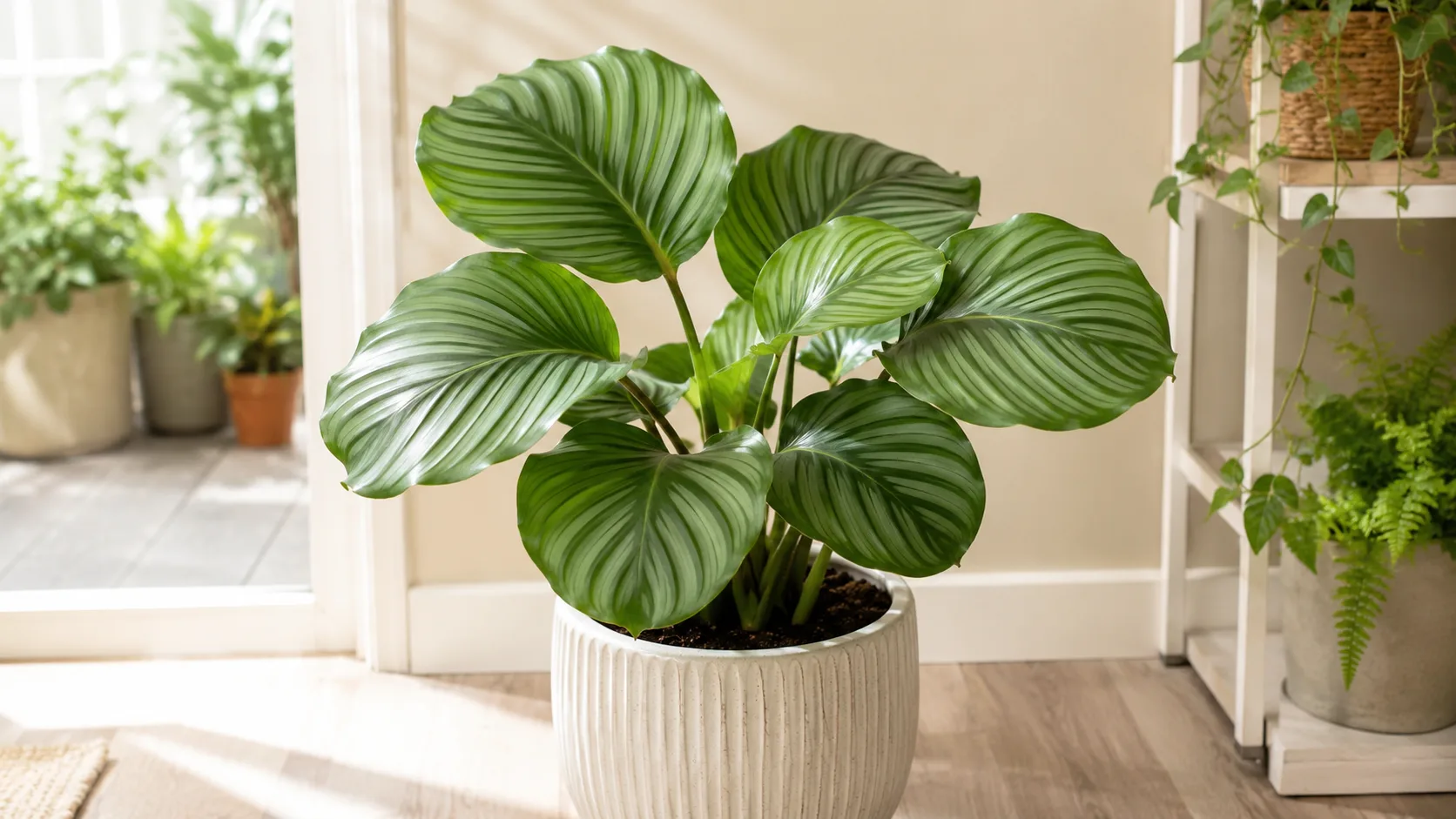
Calathea Orbifolia is the houseplant people buy for one reason: those oversized, round leaves striped in silver and green. It is also the plant that punishes small mistakes faster than almost any other foliage plant in the shop. A dry afternoon, a week of tap water, or a winter without a humidifier, and the leaf edges go crispy while the rest of the leaf still looks perfect. That contrast - stunning when healthy, visibly damaged when stressed - is the whole story of growing Calathea Orbifolia overview indoors.
This guide covers everything you need to keep Goeppertia orbifolia (the current botanical name, though “Calathea orbifolia” remains the name on most tags) looking like the plant in the photos. You will get the real light, water, humidity, and soil numbers; the filtered-water rule and why it matters; how to propagate by division; a clear pet-safety answer backed by the ASPCA; and a practical troubleshooting path for yellow leaves, brown tips, pests, and root rot on Calathea Orbifolia. By the end, you should know what to check first when something goes wrong - and what not to change.
Why Calathea Orbifolia Has Two Names (and What That Means for Care)
If you search for care advice and see both Calathea orbifolia and Goeppertia orbifolia, you are not looking at two different plants. You are looking at one species caught in a botanical reclassification. Genetic studies moved many plants formerly grouped under Calathea into the genus Goeppertia. The RHS growing guide and NC State Extension now list Calathea orbifolia as Goeppertia orbifolia, though nurseries, retailers, and most houseplant communities still use “Calathea” because that is what buyers recognize.
For your purposes as a grower, the name change changes nothing about care. The plant is still a Marantaceae (prayer plant family) species from tropical forest understory, with the same sensitivity to dry air, harsh sun, and mineral-heavy tap water. What the reclassification does clarify is that Orbifolia shares its core biology with other prayer plants - Maranta, Stromanthe, Ctenanthe - rather than with unrelated “calatheas” sold under confusing trade names. Treat it as a humidity-loving, rhizome-spreading understory plant and you are thinking about it correctly.
The native range is consistently described as Bolivian rainforest understory, though NC State Extension lists Eastern Brazil in its plant toolbox entry. Understory origin is the care fact that matters: this plant evolved under a canopy that filters direct sun, holds ambient moisture, and keeps temperatures stable. Your job indoors is to approximate that environment, not to replicate a desert succulent routine or a bright-window ficus routine.
Calathea Orbifolia at a Glance
Foliage, Size, and Growth Habit
Orbifolia is grown almost entirely for foliage. Individual leaves are large, round, and held on long petioles, with bold silver-green banding across the blade surface. Mature leaves can reach roughly 12 inches (30 cm) across indoors, and a well-grown specimen typically reaches 2 to 3 feet (60–90 cm) tall and wide over several years. The plant grows from a clumping rhizome at or just below the soil surface, sending up new leaves in flushes during the warm, bright months.
Growth rate is moderate - faster than a snake plant, slower than a pothos - and the plant stays upright and bushy rather than vining or tree-like. That large leaf size changes the care stakes in a way smaller prayer plant cultivars do not: one damaged leaf is a visible percentage of the whole plant, and mechanical scuffs from walls, curtains, or neighboring pots do not heal. Give Orbifolia physical space. Crowding looks fine for a week and then you have permanent blemishes on leaves that may stay on the plant for months.
Flowering indoors is possible but uncommon. When it happens, blooms are small, white, and cone-like - interesting to a botanist, irrelevant to most growers. Nobody buys this plant for flowers, and you should not judge your care by whether it blooms.
Nyctinasty and What That Daily Leaf Movement Tells You
One of the most distinctive behaviors of Calathea Orbifolia is nyctinasty - the daily rhythm where leaves droop or angle downward during the day and rise or fold upward in the evening, following a circadian pattern tied to light. If you watch the same plant at breakfast and again after dinner, the leaf orientation can look noticeably different. This is normal. It is not a distress signal by itself.
Nyctinasty becomes useful diagnostically when you learn to separate it from drought droop. Nyctinasty follows a predictable daily cycle and the leaves recover their evening position even if the plant is slightly dry. Drought droop is persistent - leaves stay limp through the day and night, often with dry soil and a light pot. overwatering on Calathea Orbifolia droop looks similar to drought droop (limp leaves) but the soil is wet and may smell sour. Always check moisture at root depth before reacting to drooping leaves. The prayer-plant movement is one of Orbifolia’s charms; misreading it as a watering emergency is one of the most common beginner mistakes.
Light: Bright Indirect, Never Scorching Sun
Calathea Orbifolia wants bright, indirect light - the kind of light you get deep in a bright room or near a window with filtered exposure, not the kind that casts a hard shadow at noon. NC State Extension lists partial shade (2–6 hours of direct sun at most) as the outdoor cultural condition; indoors, that translates to no harsh direct sun on the leaves for extended periods.
Placements that work well:
- An east-facing window with gentle morning sun, ideally softened by a sheer curtain.
- A north-facing window in a bright room - Orbifolia tolerates lower light better than many tropicals, though growth slows and banding may fade.
- 2 to 4 feet back from a south- or west-facing window behind a curtain that diffuses afternoon intensity.
Direct, hot sun scorches the large, thin leaves quickly. You will see bleached patches, papery brown spots on the sun-facing side, or leaves that curl tightly during the brightest hours. Low light produces a different set of problems: pale new growth, longer petioles, slower leaf production, and a plant that stays wet too long because it is not using water at the same rate. The practical test is always new growth: compact, well-banded leaves mean the light is working; stretched, pale, or slow-to-unfurl leaves mean the plant wants more light without a sudden move into direct sun.
If natural light is weak - common in winter at northern latitudes - a full-spectrum grow light on a 12- to 14-hour timer is a legitimate fix. Keep the fixture far enough that leaves do not heat up, and acclimate gradually if you are moving the plant from a dim corner to a brighter spot. Orbifolia leaves formed in low light burn easily if exposed to strong sun without a one- to two-week transition.
Watering Without Swinging Between Dry and Soggy
Watering is the second place people lose this plant, after humidity. Calathea Orbifolia evolved in soil that stays consistently moist but never waterlogged. The roots need access to moisture to keep those large leaves turgid, but they rot fast in anaerobic, soggy mix. The goal is even moisture - not a cycle of bone-dry soil followed by a flood, and not permanently damp soil that never dries.
A workable rule for most indoor conditions: water when the top 2 cm (roughly the top inch) of soil is beginning to dry, then water thoroughly until excess runs from the drainage hole. In active growth with bright light and warm temperatures, that often means roughly every 5 to 7 days. In cooler, dimmer winter conditions, stretch to 7 to 10 days or longer, always checking the actual pot rather than the calendar. Pot size, soil composition, room temperature, and light all change the interval, so a fixed weekly schedule is a reminder to check, not a command to pour.
Water quality matters as much as timing for Orbifolia. The species is notoriously sensitive to fluoride, chlorine, and heavy minerals in municipal tap water. NC State Extension explicitly recommends distilled or rainwater because fluoride in tap water causes brown leaf tips and edges. If you must use tap water, let it sit out overnight to off-gas some chlorine, run it through a filter rated for chemical reduction, or alternate with rainwater when you can. Brown tips that appear shortly after you switch water sources are often chemical burn, not a humidity problem - and no amount of misting will fix water the plant cannot process.
Watering habits that keep the plant healthy:
- Check root-zone moisture, not just the surface color of the mix. A finger, wooden skewer, or pot-weight check all work if you use them consistently.
- Water the whole soil surface evenly until water exits the drainage hole, then empty the saucer. Standing runoff is a root-rot invitation.
- Use room-temperature water to avoid shocking roots.
- Reduce frequency in winter when growth slows and the pot dries more slowly.
- Never water on a schedule alone. Limp leaves with wet soil mean pause; limp leaves with a light, dry pot mean water.
Splashing water on the foliage during watering can contribute to leaf spot in some conditions. Water the soil directly when possible, especially if your home has poor air circulation around the plant.
Humidity: The Non-Negotiable for Clean Leaf Edges
If light and water are the foundation, humidity is the difference between a good Orbifolia and a great one. This is a rainforest understory plant adapted to ambient moisture well above typical indoor levels. NC State Extension recommends at least 60% humidity for this species to thrive. Most guides place the practical range at 50% minimum, with 60–70% ideal for clean leaf margins and reliable unfurling of new leaves.
Indoor reality in winter often drops to 20–30% in heated homes. That gap is why the same plant that looked perfect in September develops crispy brown edges by February and attracts spider mites by March. The large leaf surface area transpires heavily; when the air is dry, the plant loses moisture through leaf edges faster than roots can replace it, and the tissue dies at the margins first.
Methods ranked by reliability:
- A room humidifier running near the plant is the most effective solution. It raises ambient humidity steadily rather than in brief spikes.
- Grouping Orbifolia with other tropical plants creates a shared humid microclimate through combined transpiration.
- A pebble tray - a shallow tray of water and stones with the pot sitting on the stones, not in the water - adds localized evaporation. It helps, but it is weaker than a humidifier in a dry room.
- A bright bathroom or kitchen can work if light is adequate, since those rooms tend to hold more moisture.
Misting is the least reliable option. It raises humidity for minutes, not hours, and wet leaf surfaces in stagnant air can invite fungal issues. If you mist, do it in the morning in a well-ventilated spot - but treat misting as a supplement, not a substitute for a humidifier in a dry climate or heated winter home.
Signs of insufficient humidity: brown, crispy leaf edges and tips, leaves that struggle to unfurl (new leaves stick or tear as they open), persistent curling unrelated to the daily nyctinasty cycle, and spider mite outbreaks on the undersides of leaves.
Temperature, Drafts, and Airflow
Calathea Orbifolia wants the same temperature band most people find comfortable indoors: 65–75°F (18–24°C) during active growth, per NC State Extension and consistent with RHS guidance for Marantaceae. Do not let the plant sit below 60°F (15°C) for extended periods. Cold slows growth, increases rot risk in wet soil, and can cause leaf damage that does not reverse.
Temperature stability matters as much as the number on a thermostat. Orbifolia hates sudden swings - the kind caused by:
- A pot sitting on a windowsill where glass gets cold at night in winter.
- Placement directly under an air-conditioning vent or heat register.
- A spot beside a frequently opened exterior door in winter.
- Hot radiators or appliances that cycle on and off near the plant.
Each of these can push leaf tissue out of its comfort zone within hours, and the damage shows as curling, browning, or yellowing that does not match a watering problem. If your plant declines after a move, check environmental stability before changing water or fertilizer.
Airflow should be gentle, not blasting. Stagnant air encourages fungal leaf spot when foliage stays wet; hurricane-force vents desiccate leaf edges. A ceiling fan on low in the same room often provides enough movement without drying the plant out.
Soil Mix, Drainage, and Pot Choice
Orbifolia needs a moisture-retentive but well-draining potting mix - soil that holds water evenly through the root zone without compacting into a brick or staying swampy for days. NC State Extension lists loam texture, good drainage, and slightly acidic to neutral pH (below 6.0 to 8.0, with acid preferred) as cultural conditions. For indoor growers, a target pH around 6.0–7.5 in a standard peat- or coco-based houseplant mix is close enough without laboratory adjustment.
A practical mix recipe:
- 40% high-quality potting soil or coco coir
- 30% perlite or pumice for aeration
- 20% orchid bark or coarse coco chips to prevent compaction
- 10% worm castings or compost for mild organic nutrition
The exact ratios matter less than the outcome: after watering, the mix should accept water evenly, drain freely within minutes, and dry on a predictable rhythm at root depth - not overnight on the surface while the core stays wet for a week. A mix that dries hard and pulls away from the pot sides causes hydrophobic dry pockets that are difficult to re-wet without soaking, and those dry pockets stress roots even when the surface looks damp.
Pot choice should match root mass, not leaf size. Orbifolia has a relatively modest root system for its foliage display. Go up only one pot size at Calathea Orbifolia repotting guide - typically 1 to 2 inches (2.5–5 cm) wider in diameter. An oversized pot holds excess wet mix around roots that cannot use it, which is the most common post-repotting cause of rot. A drainage hole is non-negotiable for long-term indoor care. Decorative cachepots are fine if you lift the inner pot to drain after every watering.
Refresh the mix every one to two years, or sooner if it compacts, smells sour, or water runs straight down the sides without soaking in. Old, broken-down peat loses structure and air space; roots suffocate even when you water correctly.
Fertilizing: Light, Monthly, and Only When Growing
Calathea Orbifolia is not a heavy feeder. It needs modest nutrition during active growth to support new leaf production, but excess fertilizer burns roots and accumulates salts that show up as brown leaf tips - easily confused with tap-water burn or low humidity.
During spring and summer, when the plant is visibly pushing new leaves, feed with a balanced liquid houseplant fertilizer (such as 10-10-10 or 20-20-20) at quarter to half the label strength, roughly once per month. NC State Extension recommends monthly feeding during the growing season. Apply to already-moist soil so the solution distributes through the root zone without concentrating and burning dry roots.
Pause feeding entirely from late autumn through early spring when growth slows, after repotting for at least four to six weeks, and any time the plant is stressed - pest infestation, root rot recovery, severe dehydration, or recent shipping shock. Feeding a plant that cannot use nutrients adds salt to the mix without producing growth.
If you see white crust on the soil surface, sudden leaf tip burn after feeding, or multiple leaves yellowing after a fertilizer application, flush the pot with plain water (filtered if possible) until runoff is clear, empty the saucer, and hold fertilizer for at least a month. Orbifolia responds to lean feeding better than to aggressive schedules copied from fast-growing tropicals.
Repotting When the Root Ball Outgrows the Pot
Repot Calathea Orbifolia when roots circle the drainage holes, water runs straight through without soaking, the pot dries unusually fast despite correct watering technique, or the mix has broken down and smells earthy-sour rather than fresh. The best timing is early in the active growing season - spring into early summer - so the plant has months of warmth and light to re-establish roots.
Steps that reduce stress:
- Choose a pot one size up with a drainage hole.
- Use fresh, well-draining mix rather than reusing old compacted soil.
- Loosen the outer root ball gently if roots are circling, but do not bare-root a healthy plant unnecessarily.
- Plant at the same depth as before; burying the rhizome too deep invites rot.
- Water lightly after repotting and keep humidity high while roots heal.
- Hold fertilizer for four to six weeks.
Do not repot a actively declining plant unless root-bound soil is clearly the problem. Repotting is stress; if the issue is overwatering, low humidity, or pests, fix that first. If you repot during winter dormancy, expect slow recovery - the plant may sit unchanged for weeks before new growth appears.
Propagation by Division
The reliable home propagation method for Calathea Orbifolia is division, not stem cuttings or leaf cuttings. The plant spreads by rhizome; each division needs roots, a growth point, and several leaves to stand alone. NC State Extension lists division in spring as the recommended propagation method.
How to divide:
- Water the parent a day before so the root ball is hydrated and flexible.
- Unpot and brush away loose mix to expose the rhizome structure.
- Identify natural separation points - clumps connected by rhizome that can be split with minimal tearing.
- Use a clean, sharp knife or shears to separate sections, ensuring each division has healthy roots and at least one active growth eye.
- Pot each division in fresh mix, at the same planting depth as the parent.
- Place in Calathea Orbifolia light guide with high humidity (a clear bag or humidity dome for the first week helps).
- Keep soil evenly moist but not soggy; avoid fertilizer until new growth confirms roots are working.
Do not propagate a stressed, pest-infested, or rot-affected plant. Weak divisions fail at high rates and inherit the parent’s problems. Wait until the plant is healthy, then divide during active growth for best results. Orbifolia is not a plant you propagate to save a dying specimen - it is one you divide to share a healthy clump or manage size.
Pet and Human Safety
Calathea Orbifolia is non-toxic to cats, dogs, and horses according to the ASPCA, which lists the entire Calathea genus as non-toxic. That makes Orbifolia one of the stronger choices for pet-owning households that want dramatic foliage without calcium oxalate risk. Unlike Epipremnum, Monstera, Philodendron, or Dieffenbachia, Orbifolia does not contain insoluble calcium oxalate crystals that cause immediate oral pain and swelling when chewed.
Non-toxic does not mean edible. Large quantities of any fibrous plant material can cause mild gastrointestinal upset - vomiting or soft stool - simply from bulk and fiber, especially in dogs that ingest more than a nibble. Keep the plant out of reach if you have a chronic chewer, both to protect the plant’s display value and to avoid unnecessary vet visits for stomach upset. The ASPCA Animal Poison Control Center (888-426-4435, fee may apply) is the resource to call if you are unsure about an exposure.
For humans, Orbifolia is generally safe, though sap may irritate sensitive skin on contact. Wash hands after handling if you are prone to dermatitis. The plant is a good option for homes with children and pets when placed where it will not be pulled over or shredded daily.
Common Problems and How to Read Them
Most Calathea Orbifolia problems are environmental, not mysterious diseases. The large leaves act like a dashboard: specific symptoms map to specific causes if you read them in order - moisture first, then humidity and water quality, then light, then pests.
Yellow Leaves
Yellow leaves are the most common complaint. Causes include:
- Overwatering - multiple leaves yellowing, soft stems, sour-smelling soil, wet mix at root depth.
- underwatering on Calathea Orbifolia - yellowing with dry, compacted soil and persistent limp leaves outside the normal nyctinasty cycle.
- Low light - gradual yellowing on older leaves with pale, slow new growth.
- Cold drafts or temperature shock - yellowing after a move near a vent, door, or cold window.
- Natural aging - a single older leaf yellowing at the base while new growth is healthy; remove it and move on.
- Pests - yellow stippling or mottling with visible insects on undersides.
Check soil moisture at root depth before changing anything. If the mix is wet and the plant is yellowing, reduce watering and inspect roots for brown, mushy sections. If the mix is dry and light, water thoroughly and increase humidity while the plant recovers. Changing light and fertilizer before diagnosing water creates weeks of confusion.
Brown Tips and Crispy Edges
Brown tips usually trace to one of three causes, and the order of likelihood matters:
- Tap water minerals and fluoride - edges and tips brown while humidity seems adequate; problem worsens with straight municipal water. Switch to filtered, distilled, or rainwater and flush the pot.
- Low humidity - uniform crisping along margins, often worse in winter; new leaves tear or stick while unfurling. Add a humidifier.
- Inconsistent watering - swinging between too dry and too wet stresses leaf margins even when average moisture seems fine.
Less commonly, salt buildup from over-fertilizing causes tip burn. Flush the pot and pause feeding. Direct sun scorch produces bleached or papery patches on the exposed side rather than uniform edge crisping - move the plant to softer light.
Pests: Spider Mites, Mealybugs, and Scale
NC State Extension notes no serious disease problems but lists mealybugs, spider mites, aphids, and scale as insects to monitor. Orbifolia’s broad leaves and love of humidity create conditions where spider mites thrive when humidity drops - inspect undersides weekly in winter.
Spider mites show as fine stippling, webbing, and dull leaf color. Rinse foliage with lukewarm water, increase humidity, and apply insecticidal soap or neem oil every four to five days until clear. Repeat treatments are essential; one application rarely eliminates an established population.
Mealybugs appear as white cottony clusters in leaf axils and stem joints. Remove with a cotton swab dipped in isopropyl alcohol, then treat with insecticidal soap. Scale looks like brown bumps on stems and leaf undersides; scrape gently and treat similarly. Fungus gnats indicate overwet surface soil; let the top layer dry slightly between waterings and consider a sticky trap while correcting the Calathea Orbifolia watering guide.
Catch infestations early. Orbifolia’s large leaves hide pests until populations are large enough to cause visible damage.
Root Rot
Root rot follows persistent overwatering, poor drainage, oversized pots, or compact, airless mix. Signs include yellowing leaves, wilting despite wet soil, mushy stems at the base, and a sour smell from the mix. If you suspect rot, unpot immediately, trim brown or mushy roots with clean tools, repot into fresh, airy mix in a appropriately sized pot, and reduce watering while keeping humidity high. Recovery is slow and not guaranteed if most of the root system is gone - but Orbifolia can bounce back from partial root loss if conditions improve quickly.
Prevent rot by never letting the pot sit in runoff, using a drainage hole, matching pot size to roots, and watering on moisture checks rather than autopilot schedules.
Conclusion
Calathea Orbifolia - Goeppertia orbifolia if you are reading current taxonomy - rewards growers who treat it as a rainforest understory plant, not a generic hardy houseplant. Give it bright indirect light without scorching sun, even moisture checked at the root zone rather than on a calendar, filtered or rainwater to protect those sensitive leaf edges, and 60% or higher humidity through a humidifier when your home air is dry. Use a moisture-retentive, well-draining mix in a pot with a drainage hole, feed lightly during active growth, and propagate by spring division when you want more plants.
When something looks wrong, read the leaves in order: water and soil first, then humidity and water quality, then light and temperature, then pests. One yellow lower leaf on an otherwise healthy plant is normal aging; multiple yellow leaves with wet soil is an emergency. Brown tips after months of tap water are a water-quality fix, not a repotting fix. The silver banding on those round leaves is the whole point - keep the environment stable enough that new growth arrives clean, and Orbifolia becomes one of the most striking non-toxic foliage plants you can grow indoors.
When to use this page vs other Calathea Orbifolia guides
- Calathea Orbifolia overview - Canonical hub for this species - care topics and problems branch from here.
- Calathea Orbifolia problems - Symptom-first path when you already know something is wrong.
Related Calathea Orbifolia guides
- Calathea Orbifolia watering
- Calathea Orbifolia light
- Calathea Orbifolia soil
- Calathea Orbifolia propagation
- Calathea Orbifolia fertilizer
- Calathea Orbifolia repotting
- Calathea Orbifolia pruning
- Brown Tips on Calathea Orbifolia
- Yellow Leaves on Calathea Orbifolia
- Root Rot on Calathea Orbifolia
- Overwatering on Calathea Orbifolia
- Underwatering on Calathea Orbifolia
How to care for Calathea Orbifolia?
How much light does Calathea Orbifolia need?
medium indirect light, low indirect light, bright indirect (not harsh)
- medium indirect light, low indirect light, bright indirect (not harsh) - medium indirect light, low indirect light, bright indirect (not harsh).
When should you water Calathea Orbifolia?
Every 5–7 days growing season (top 2 cm beginning to dry). 7–10 days winter. Filtered water or rainwater only.
- Check top 2 inches - Every 5–7 days growing season (top 2 cm beginning to dry).
- Drain excess water - Filtered water or rainwater only.
What soil works best for Calathea Orbifolia?
Moisture-retentive but well-draining potting mix. pH 6.0–7.5.
- Well-draining mix - Moisture-retentive but well-draining potting mix.
Grower notes for Calathea Orbifolia
Placement note for Orbifolia
Give Orbifolia room so leaves do not rub against walls, curtains, or neighboring pots. Mechanical damage becomes permanent on the broad blades, and crowded placement also reduces airflow around the crown.
Buying check for Orbifolia
Do not buy Orbifolia if the largest leaves are folded, torn, or crispy around most of the rim. Minor shipping marks are fine, but widespread edge burn usually means the plant has already been through dry air or irregular watering. Choose the plant with the cleanest newest leaf, not the largest old leaf.
What makes Orbifolia different
Calathea Orbifolia is grown for oversized round leaves with silver-green banding, and that leaf size changes the care stakes. One damaged leaf affects the whole look of the plant. It needs more physical space, gentler airflow, and steadier moisture than compact prayer plant cultivars.
What matters most with Calathea Orbifolia
Calathea Orbifolia is part of the fussy foliage group where leaf movement, crisping, and humidity stress can look dramatic before the plant is truly lost. Judge the newest rolled leaves and root moisture before reacting to every old edge mark. In practice, the care checkpoint is simple: medium indirect light, low indirect light, bright indirect (not harsh). Pair that with moisture-retentive but well-draining potting mix; pH 6.0–7.5, and avoid changing water, pot size, and placement all at once.
Best placement in a real home
Calathea Orbifolia belongs where medium indirect light, low indirect light, bright indirect (not harsh) is realistic for most of the day, not only where the pot looks good. Every 5–7 days growing season (top 2 cm beginning to dry). 7–10 days winter. Filtered water or rainwater only. If the pot stays wet longer than expected, move the plant into better light or reassess the mix before watering again. Humidity target: High humidity (60%+); extremely sensitive to dry air.. Temperature comfort zone: 18°C to 27°C (65–80°F).
Before you buy this plant
Choose Calathea Orbifolia with firm new growth, clean leaf undersides, and soil that does not smell sour or feel compacted. Be cautious if you see brown-tips, sticky residue, collapsed crowns, or a pot that is wet in poor light. Cosmetic old-leaf damage is less worrying than weak roots or active pests.
First month after bringing it home
Do not repot Calathea Orbifolia on day one unless the mix is failing or pests are obvious. Quarantine it, learn how fast the pot dries, and keep care boring while it adjusts. Watch especially for brown-tips and yellow-leaves. If problems appear, correct the condition first rather than stacking fertilizer, repotting, and pruning together.
Safety note for Calathea Orbifolia
Calathea Orbifolia is not a plant to keep within reach of pets or children. Treat it as an inaccessible display plant. Use gloves if sap or plant tissue is irritating, and pick a pet-safe alternative for floor pots or low shelves.
How to tell Calathea Orbifolia is settling in
If you plan to multiply it later, common methods include Division. If yellow-leaves shows up early, inspect light, watering, and roots before assuming the plant is permanently weak.
Is it pet safe?
Calathea Orbifolia is generally considered pet safe.
Watering Calathea Orbifolia
Every 5–7 days growing season (top 2 cm beginning to dry). 7–10 days winter. Filtered water or rainwater only.
Soil & potting for Calathea Orbifolia
Moisture-retentive but well-draining potting mix. pH 6.0–7.5.
Humidity & temperature for Calathea Orbifolia
Calathea Orbifolia prefers high humidity (60%+); extremely sensitive to dry air, though normal home humidity is usually fine. Keep temperatures around 18°C to 27°C (65–80°F).
| Detail | Information |
|---|---|
| Humidity | High humidity (60%+); extremely sensitive to dry air - normal home humidity is fine. |
| Ideal temperature | 18°C to 27°C (65–80°F) |
Fertilizer & pruning for Calathea Orbifolia
Use feed lightly during active growth. Use monthly during spring and summer at half or quarter strength.. for Calathea Orbifolia.
| Detail | Information |
|---|---|
| Fertilizer type | Feed lightly during active growth. Use monthly during spring and summer at half or quarter strength.. |
Common problems on Calathea Orbifolia
Brown Tips
MediumLikely cause: Tap water fluoride/chlorine or low humidity below 50%.
Quick fix: Filtered or rainwater. Humidifier 60–80% RH.
Full fix guide →Yellow Leaves
MediumLikely cause: Overwatering in low light or natural leaf ageing.
Quick fix: Allow top 2 cm to dry. Improve light.
Full fix guide →Root Rot
MediumLikely cause: Common on this plant type; confirm with recent watering, light, and root checks.
Quick fix: Inspect the plant and correct the most likely care stressor before stacking treatments.
Full fix guide →Overwatering
MediumLikely cause: Common on this plant type; confirm with recent watering, light, and root checks.
Quick fix: Inspect the plant and correct the most likely care stressor before stacking treatments.
Full fix guide →Underwatering
MediumLikely cause: Common on this plant type; confirm with recent watering, light, and root checks.
Quick fix: Inspect the plant and correct the most likely care stressor before stacking treatments.
Full fix guide →Spider Mites
MediumLikely cause: Common on this plant type; confirm with recent watering, light, and root checks.
Quick fix: Inspect the plant and correct the most likely care stressor before stacking treatments.
Full fix guide →Mealybugs
MediumLikely cause: Common on this plant type; confirm with recent watering, light, and root checks.
Quick fix: Inspect the plant and correct the most likely care stressor before stacking treatments.
Full fix guide →Aphids
MediumLikely cause: Common on this plant type; confirm with recent watering, light, and root checks.
Quick fix: Inspect the plant and correct the most likely care stressor before stacking treatments.
Full fix guide →Leggy Growth
MediumLikely cause: Common on this plant type; confirm with recent watering, light, and root checks.
Quick fix: Inspect the plant and correct the most likely care stressor before stacking treatments.
Full fix guide →Slow Growth
MediumLikely cause: Common on this plant type; confirm with recent watering, light, and root checks.
Quick fix: Inspect the plant and correct the most likely care stressor before stacking treatments.
Full fix guide →Wilting
MediumLikely cause: Common on this plant type; confirm with recent watering, light, and root checks.
Quick fix: Inspect the plant and correct the most likely care stressor before stacking treatments.
Full fix guide →Drooping Leaves
MediumLikely cause: Common on this plant type; confirm with recent watering, light, and root checks.
Quick fix: Inspect the plant and correct the most likely care stressor before stacking treatments.
Full fix guide →Low Humidity
MediumLikely cause: Common on this plant type; confirm with recent watering, light, and root checks.
Quick fix: Inspect the plant and correct the most likely care stressor before stacking treatments.
Full fix guide →Not Enough Light
MediumLikely cause: Common on this plant type; confirm with recent watering, light, and root checks.
Quick fix: Inspect the plant and correct the most likely care stressor before stacking treatments.
Full fix guide →Fungus Gnats
MediumLikely cause: Common on this plant type; confirm with recent watering, light, and root checks.
Quick fix: Inspect the plant and correct the most likely care stressor before stacking treatments.
Full fix guide →Mold on Soil
MediumLikely cause: Common on this plant type; confirm with recent watering, light, and root checks.
Quick fix: Inspect the plant and correct the most likely care stressor before stacking treatments.
Full fix guide →