Calathea Orbifolia Fertilizer: When, How, and Mistakes
Calathea Orbifolia Fertilizer: When, How, and Mistakes to Avoid
Calathea Orbifolia Fertilizer: When, How, and Mistakes to Avoid
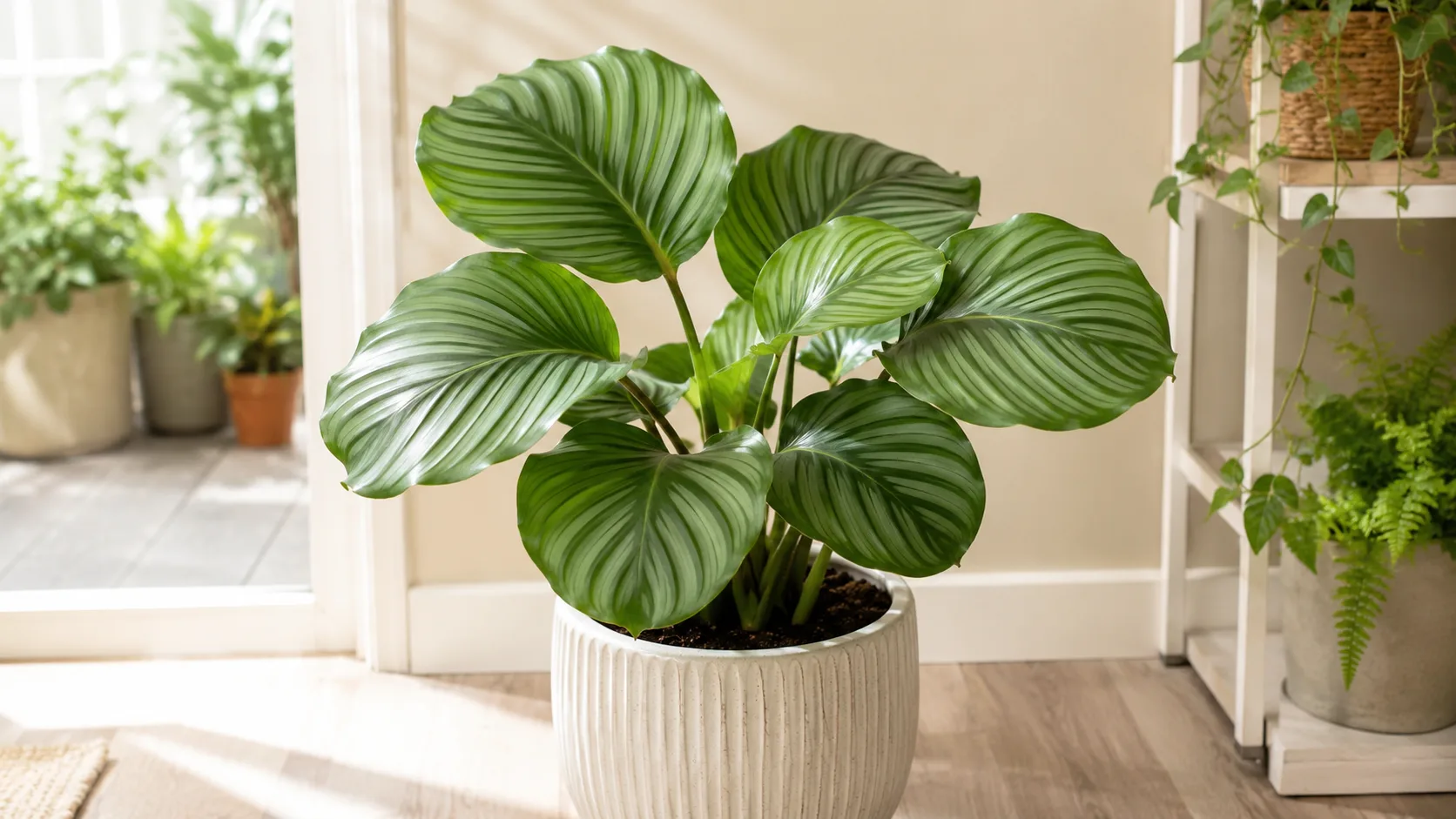
Calathea Orbifolia - now classified botanically as Goeppertia orbifolia - is one of the most striking prayer plants in the trade, with broad, round leaves striped in silver and green. It is also one of the most unforgiving when fertilizer salts accumulate in the root zone. Orbifolia does not need heavy feeding to produce those dramatic leaves. It needs consistent, gentle nutrition during active growth, paired with the humidity, filtered water, and Calathea Orbifolia light guide that let the roots actually use what you apply.
Most Orbifolia problems that get blamed on fertilizer are really care-stack problems: feeding a dry plant, feeding in winter when growth has stopped, or feeding at full label strength in a small pot that cannot dilute salts. This guide covers when to feed, what to use, how much to dilute, how to apply without burn, and the mistakes that turn striped foliage crispy at the edges.
The Quick Answer: How to Fertilize Calathea Orbifolia
For most established indoor Calathea Orbifolia plants, use a complete balanced liquid houseplant fertilizer - such as 10-10-10 or 20-20-20 - diluted to one-quarter to one-half of the label’s houseplant rate, applied once every four to six weeks during active growth (roughly spring through early autumn). Apply the solution to already-moist potting mix, water until a little drains from the bottom, and discard runoff. Pause feeding from late autumn through early spring when visible growth slows. Every two to three months during the growing season, flush the pot with plain water to leach accumulated salts.
Orbifolia is a light feeder. The Royal Horticultural Society recommends feeding calatheas once a month during the growing season (April to September) with a general-purpose or balanced houseplant liquid fertilizer, and avoiding feeding from October to March. That monthly rhythm works when the dose is reduced. Full-strength monthly feeding in a 6-inch pot is a common path to brown leaf margins and white crust on the soil surface.
If your plant is newly purchased, recently repotted into fresh mix with added fertilizer, stressed by underwatering on Calathea Orbifolia, or sitting in a dim corner with no new leaves, do not feed until conditions improve. Fertilizer replaces nutrients the plant is actively using. It does not fix wilt, low humidity, or root damage.
Why Calathea Orbifolia Is a Light Feeder
Orbifolia evolved as an understory plant in the humid forests of Eastern Brazil, where nutrients arrive slowly through leaf litter and decomposing organic matter rather than concentrated synthetic salts. Its roots are fine, moisture-sensitive, and adapted to a steady but modest nutrient supply. In a container, every fertilizer application adds dissolved minerals to a closed system. Water evaporates from the surface and is taken up by roots, but salts remain, concentrating over time.
That biology explains why Orbifolia owners often see damage before they see dramatic growth from feeding. The plant can produce large, beautiful leaves on relatively little fertilizer when light, humidity, and watering are correct. Push nutrients faster than the roots can absorb them, and osmotic stress shows up as tip burn, edge browning, and sudden leaf drop - symptoms that overlap with low humidity, so misdiagnosis is common.
What N-P-K Does for Orbifolia’s Large Leaves
Fertilizer labels display three numbers for nitrogen (N), phosphorus (P), and potassium (K). Nitrogen drives chlorophyll, proteins, and leafy vegetative growth - the main demand for a plant grown purely for foliage. Phosphorus supports energy transfer and root function. Potassium helps regulate water movement and general plant metabolism. Orbifolia does not need a specialty bloom formula; it needs a complete product that supplies all three macronutrients plus micronutrients such as iron, manganese, and magnesium.
A balanced 10-10-10 or 20-20-20 liquid fertilizer works well when diluted. The numbers describe proportions, not interchangeable doses: 20-20-20 contains twice the nutrient percentage of 10-10-10, so you cannot swap them volume for volume without recalculating. Some foliage-oriented formulas use ratios like 3-1-2, reflecting slightly higher nitrogen use in leafy plants. Either a balanced product or a foliage-leaning complete formula is acceptable if you apply it conservatively.
High-nitrogen feeding without adequate light produces soft, pale, stretched leaves that look bigger but less crisp. High-phosphorus “bloom boosters” are unnecessary for routine Orbifolia care and can add phosphorus the plant does not need. Micronutrients matter because iron-related chlorosis - yellowing between veins on newer leaves - can appear when uptake is blocked by cold roots, soggy soil, or pH issues, not because the bottle lacked iron. A complete houseplant fertilizer is the right baseline.
How Fertilizer Salts Damage Sensitive Prayer Plant Roots
When fertilizer dissolves in water, it becomes ions the roots absorb along with moisture. If the concentration at the root surface exceeds what the plant can regulate, water actually moves out of root cells toward the salty zone - the same osmotic mechanism that makes over-fertilized lawns turn brown. Orbifolia’s fine roots feel that stress quickly.
Salts also accumulate visually. A white or pale crust on the soil surface or pot rim is often a mix of fertilizer residues and minerals from tap water, especially in hard-water areas. That crust is a warning sign, not proof of deficiency. In many cases it means reduce feeding, flush the mix, and review both water and fertilizer before the next application.
Because Orbifolia is sensitive, many experienced growers prefer quarter-strength dilution rather than half-strength for Calathea Orbifolia overview specifically. Half-strength on a monthly schedule is a reasonable starting point for a healthy plant in bright indirect light. Quarter-strength is safer if you have burned the plant before, use hard tap water, or keep the pot in moderate rather than strong light. You can always increase slightly after several uneventful applications; reversing burn is slower than preventing it.
When Calathea Orbifolia Needs Fertilizer
Feed Calathea Orbifolia when three conditions align: the plant is producing visible new growth, the root zone is healthy (not rotting, not bone dry), and environmental conditions support uptake (warm enough roots, adequate light, stable humidity). Fertilizer schedules should follow growth, not a calendar divorced from what the plant is doing.
In most Northern Hemisphere homes without grow lights, active growth runs from mid-spring through late summer, when longer days and warmer rooms coincide with new leaf unfurling. In consistently warm, humid, brightly lit setups - or in tropical climates - the growing window may be longer. In an air-conditioned office with low light, the plant may barely grow enough to justify more than two or three feedings all year.
Active Growing Season vs. Winter Rest
The practical feeding window for indoor Orbifolia aligns with the RHS calathea guidance: feed during the growing season, pause in autumn and winter. The table below translates that into a home-grower schedule you can adjust based on what you see.
| Season | Typical months (N. Hemisphere) | Feeding approach | What to watch |
|---|---|---|---|
| Spring | March–May | Resume or increase to once every 4–6 weeks at quarter- to half-strength once new growth appears | Fresh unfurling leaves; do not feed immediately after Calathea Orbifolia repotting guide if mix contains fertilizer |
| Summer | June–August | Maintain monthly or 4–6 week interval if growth is steady | Flush with plain water every 2–3 months to leach salts |
| Autumn | September–October | Taper: skip feed if growth slows or days shorten sharply | Last feeding only if plant is still pushing leaves |
| Winter | November–February | Pause feeding; plain water only | Cold windowsills and dry heating air reduce nutrient demand |
Orbifolia in a warm room under a grow light may continue modest growth through winter. In that case, extend the interval to every six to eight weeks at quarter-strength rather than following a summer schedule. The decision criterion remains the same: if no new leaves are developing, do not feed.
Situations When You Should Skip Feeding
Certain conditions make fertilizer actively harmful. Skip feeding when the soil is completely dry - rehydrate with plain water and wait until the plant recovers before considering nutrients. Skip when the plant is wilting, dropping leaves, or showing sudden widespread browning; diagnose water, roots, pests, and humidity first. Skip for four to six weeks after repotting into mix that already contains slow-release fertilizer or a starter charge, unless you know that mix is inert and the plant is growing strongly.
Also skip feeding when pests or root rot on Calathea Orbifolia are present. Stressed roots cannot absorb nutrients efficiently, and adding salts worsens damage. Skip when temperatures drop below about 60°F (16°C) for extended periods; cold roots take up water and nutrients poorly, and the RHS calathea guide recommends keeping calatheas at 16–21°C (61–70°F) for best performance. A plant shivering on a cold windowsill does not need a nitrogen boost - it needs warmer placement.
Finally, skip feeding if you fed within the last two weeks and see tip burn or crust forming. Doubling down is the most common escalation mistake. Pause, flush, and observe.
Choosing the Best Fertilizer for Calathea Orbifolia
The best fertilizer for Calathea Orbifolia is one you can measure accurately, dilute heavily, and pause instantly if the plant reacts badly. Brand matters less than form, complete nutrient profile, and your ability to avoid accidental full-strength doses.
Liquid, Slow-Release, and Organic Options Compared
| Form | Advantage for Orbifolia | Main risk | Best use case |
|---|---|---|---|
| Liquid / water-soluble | Precise dilution; easy to stop | Easy to overapply if undiluted | Most indoor Orbifolia owners |
| Controlled-release prills | Convenient; gradual release | Hard to remove; can overfeed in warm wet soil | Stable bright conditions; large pots |
| Worm castings (top-dress) | Very gentle; low burn risk | Can hold moisture; gnats if overapplied | Growers wanting organic, forgiving input |
| Fish emulsion / organic liquids | Complete organic option when labeled | Odor; variable analysis; still salt-bearing | Diluted use in active growth |
Liquid balanced fertilizer is the default recommendation. Choose a product labeled for houseplants or foliage plants with micronutrients listed. Mix with a measured volume of water - a syringe or measuring spoon plus a marked watering can - rather than estimating “a splash” in a half-filled container.
Slow-release fertilizer mixed into potting compost at repotting can supply nutrients for months. The RHS notes that mixing slow-release fertilizer into compost at repotting can mean you should not need regular liquid feeding for the first year. If you repot with enriched mix, count that as feeding and avoid stacking a full liquid schedule on top.
Worm castings applied as a thin top-dressing in spring give Orbifolia a mild organic boost without a sharp salt spike. Use a small amount on the surface and water it in lightly. Do not bury a thick layer that stays wet against the crown; that invites fungus gnats and reduces airflow.
Avoid foliar feeding as a primary method for Orbifolia. These large leaves are decorative, not efficient nutrient sponges, and fertilizer on foliage in low humidity can spot or burn tissue. Root drenching is the reliable route.
Avoid fertilizer combined with pesticides unless you deliberately need both and have verified safety for indoor use. You lose the ability to separate causes if the plant reacts.
How Much and How Often to Feed
A workable baseline for a healthy established Calathea Orbifolia in bright indirect light: one-quarter to one-half label strength every four to six weeks from spring through early autumn. Many growers translate the RHS monthly guidance into half-strength once per month during active growth. Others prefer quarter-strength every four weeks for extra margin on a sensitive plant.
If Orbifolia sits in moderate or lower indirect light, stretch the interval to every six to eight weeks or reduce to quarter-strength only. A plant that adds one leaf every few months does not need monthly feeding. If it sits under a quality grow light and pushes leaves steadily through winter, maintain a reduced winter interval rather than a full summer schedule.
Do not feed every time you water. Constant micro-doses can accumulate salts faster than you notice, especially in pots under 8 inches wide. Plain water between feedings gives the root zone time to equilibrate and lets you monitor moisture and leaf response without adding variables every session.
Dilution Rates That Prevent Root Burn
“Half strength” means half the fertilizer volume in the same total water volume the label specifies - not half the water. If the label says 1 teaspoon per gallon for houseplants, half strength is half a teaspoon per gallon. Quarter strength is one-quarter teaspoon per gallon. If your watering can holds two liters and the label rate is per gallon, convert rather than eyeballing.
Products differ in concentration. A 2-2-2 organic liquid and a 20-20-20 synthetic powder are not interchangeable teaspoon for teaspoon. Follow each product’s label, then reduce proportionally. Never pour undiluted concentrate into the pot.
Start conservative. After three successful applications over a growing season with no tip burn, white crust, or sudden leaf drop, you may hold at that dose rather than increasing. Orbifolia rewards consistency, not escalation. More fertilizer cannot substitute for insufficient light; it only adds salts while leaves stay small.
Step-by-Step: Applying Fertilizer Safely
Safe feeding is mostly about sequence and concentration. Follow this order every time:
- Check the plant and environment. Confirm new growth, stable humidity, and temperatures roughly in the 61–70°F range. If the plant is stressed, stop here.
- Check soil moisture. The mix should be evenly moist, not soggy and not dust-dry. If the top is dry but the root ball is acceptable, water lightly with plain water first and wait an hour if the plant was severely dry.
- Mix fertilizer at quarter- to half-strength in your watering can. Write the date and dose if you tend multiple plants.
- Apply evenly across the soil surface, not dumped on one side of the stem. Water until a small amount drains from the bottom.
- Discard drainage and do not let the pot sit in runoff. Return the plant to its usual spot and observe new leaves over the next two weeks.
If you use cachepots or decorative outer pots without drainage, remove the nursery pot for feeding, allow full drainage in the sink, then return it. Fertilizer trapped at the bottom concentrates dangerously.
Every two to three months during active care, perform a plain-water flush: water slowly and thoroughly several times, letting excess drain fully each time, to leach salts from the mix. This is more effective than a quick splash. If water runs down the inside wall of a pot without wetting the root ball - common in peat mixes that dried too far - rewet gradually with plain water over a day before resuming any feeding schedule.
Signs Your Feeding Routine Is Working
Healthy Calathea Orbifolia on an appropriate fertilizer routine shows steady, unforced growth rather than sudden spurts. New leaves unfurl at a size consistent with recent ones, with clear silver striping and no widespread crisping at the margins. Stems stay upright, and the plant maintains the prayer-plant habit of lifting leaves at night and lowering them by day (nyctinasty), which indicates general vigor.
The soil surface should stay free of heavy white crust, and the pot should not smell sour or ammonia-like. Older lower leaves will still yellow and die eventually - that is normal senescence, not proof of deficiency. Judge feeding by new growth quality, not by chasing perfectly evergreen lower leaves.
If growth is modest but leaves look structurally sound, your routine may already be sufficient. Resist increasing fertilizer when the real limit is light or humidity.
Over-Fertilizing and Nutrient Deficiency Symptoms
Over-fertilizing is the more common and more damaging problem for Orbifolia. Watch for:
- Brown, crispy leaf tips and edges, often appearing soon after feeding
- White or yellowish mineral crust on soil or pot rim
- Sudden leaf curling, wilting, or drop despite moist soil
- Stunted new leaves that emerge small or deformed after a heavy dose
- Sour or musty root-zone smell combined with dark, mushy roots (advanced salt + overwatering on Calathea Orbifolia damage)
Under-fertilizing or true deficiency is harder to diagnose because low light, cold, and underwatering mimic many signs. Possible clues include persistent pale new growth over several months in good light with correct watering, or slow stunting when the plant has been in the same depleted mix for years without any nutrient input. Before assuming deficiency, rule out low humidity (also causes edge browning), tap water fluoride/chlorine stress, and root-bound stagnation.
Orbifolia is non-toxic to cats and dogs according to the ASPCA, but fertilizer products themselves are not safe to ingest. Store liquids away from pets and children, and wipe spills from floors where animals walk.
How to Flush Salts and Recover a Burned Plant
If you suspect fertilizer burn on Calathea Orbifolia, act quickly but calmly:
Stop feeding immediately. Do not cut back the next dose - remove fertilizer from the equation entirely for four to six weeks minimum.
Flush the pot in a sink or outdoors. Run lukewarm plain water through the mix slowly, allow full drainage, and repeat three to four times over an hour. For severe crust, you can gently scrape the top quarter-inch of mineralized soil and replace it with fresh, unfertilized potting mix - but avoid a full repot unless roots are clearly rotting, because repot shock adds stress.
Trim only fully dead tissue. Partially browned leaf edges on Orbifolia will not green up again; cosmetic trimming is optional. Do not mass-remove leaves unless they are completely dead.
Correct concurrent care. Increase humidity if air is dry, move off cold glass, and confirm watering uses filtered or rainwater when possible - calatheas tolerate tap water better after it stands 24 hours, per RHS guidance, but mineral-sensitive plants recover faster with lower total dissolved solids.
Recovery shows up in the next one or two new leaves. Existing burned margins remain. If new growth emerges clean and full-sized, resume feeding at quarter-strength after the rest period, one application only, then wait four weeks before the next.
Fertilizer After Repotting and Division
Repotting resets the nutrient environment. When you move Calathea Orbifolia into fresh peat-free houseplant compost with slow-release fertilizer mixed in, treat that as your feeding for several months. The RHS explicitly notes that slow-release mixed at repotting can eliminate the need for regular liquid feeding in the first year. Adding monthly liquid on top is a common double-feeding mistake.
If you repot into plain mix without additives, wait two to three weeks until the plant shows settled behavior - no ongoing wilt from root disturbance - before a quarter-strength first dose. After division, each section needs functional roots before feeding. Propagation divisions kept humid and warm but not yet growing should receive plain water only.
Spring and early summer repotting aligns best with the natural feeding window. A late-summer repot may not need any liquid feed before autumn pause.
How Feeding Connects to Light, Water, and Soil
Fertilizer is the last layer of the care stack, not the first fix for a struggling Orbifolia. Light drives photosynthesis and therefore nutrient demand. A plant in bright indirect light uses fertilizer more efficiently than the same plant several feet into a dim room. Water quality adds minerals independently of your bottle; hard water plus monthly feeding accelerates crust formation. Soil structure determines how salts move - dense, staying-wet mix concentrates ions, while airy, well-draining peat-free compost with perlite or bark allows safer leaching when you flush.
Orbifolia prefers evenly moist compost during growth and slightly drier surface conditions in winter, per RHS watering guidance. Fertilizer applied to chronically waterlogged soil damages roots already stressed for oxygen. Fix the Calathea Orbifolia watering guide before chasing nutrients.
Humidity affects how leaves display damage. Low humidity alone browns edges on Orbifolia; fertilizer burn does too. If you fed yesterday and edges crisp overnight, burn is likely. If edges crisp in winter dry air without recent feeding, raise humidity first - tray of pebbles, grouping plants, or a bathroom spot - before changing fertilizer.
Common Calathea Orbifolia Fertilizer Mistakes
Feeding at full label strength because “houseplants need food” is the top mistake. Orbifolia is not a hungry tropical crop; it is a containerized forest-floor plant with limited root volume.
Feeding on a calendar regardless of growth leads to winter applications when the plant cannot use nutrients, building salts through the dormant months.
Feeding dry soil concentrates fertilizer at root contact points before moisture distributes ions. Always moisten first.
Using slow-release prills in small pots releases nutrients faster in warm, wet conditions than many labels imply. A 4-inch pot with a year’s worth of prills is often too much.
Chasing brown tips with more fertilizer worsens salt stress. Brown tips after feeding mean pause and flush, not another dose.
Ignoring repot fertilizer already in the mix stacks controlled-release and liquid sources until burn appears mid-season.
Fertilizing every watering with weak solution sounds gentle but often totals more salt than a monthly half-strength dose, especially if evaporation leaves minerals behind.
Confusing species sensitivity. Orbifolia is among the more salt-sensitive calatheas. A routine that works for a robust Calathea lancifolia (rattlesnake plant) may still burn Orbifolia at the same dose.
Conclusion
Calathea Orbifolia rewards a patient feeding strategy: complete balanced liquid fertilizer at quarter- to half-strength, every four to six weeks during active spring-to-early-autumn growth, applied to moist soil with full drainage, paused in winter, and paired with periodic plain-water flushing to keep salts low. Choose liquid for control, worm castings for extra gentleness, and slow-release only when you account for it at repotting and avoid doubling up.
Watch new leaves, not old blemishes, to judge success. If edges brown or crust appears, stop feeding, flush the mix, fix humidity and water quality, and resume weaker than before. Orbifolia’s striped foliage is the goal - not the fastest possible leaf count. When light, humidity, water, and feeding align, the plant produces those wide, silvery rounds that make it worth the careful routine.
When to use this page vs other Calathea Orbifolia guides
- Calathea Orbifolia overview - Start here for whole-plant context before deep-diving this topic.
- Calathea Orbifolia problems hub - Jump to symptom-specific fix guides when this care topic does not resolve the issue.
Related Calathea Orbifolia guides
- Calathea Orbifolia overview
- Calathea Orbifolia watering
- Calathea Orbifolia light
- Calathea Orbifolia soil
- Calathea Orbifolia propagation
- Calathea Orbifolia repotting
- Calathea Orbifolia problems
Related tool
Try the Fertilizer Dilution Calculator with calathea-orbifolia pre-selected to estimate needs for your setup.