Low Humidity on Calathea Orbifolia: Causes, Checks & Fixes
Quick answer
Calathea Orbifolia (*Goeppertia orbifolia*) needs sustained humidity-50% minimum, 60–70% ideal per NC State Extension. First step: run a humidifier near the canopy and measure RH at leaf height before changing watering or light.
Low Humidity on Calathea Orbifolia: Causes, Checks & Fixes
This guide covers low humidity on Calathea Orbifolia. See also the general Low Humidity guide, watering, and light pages for this plant.
Low Humidity on Calathea Orbifolia: Causes, Checks & Fixes
Quick answer
Calathea Orbifolia - the accepted name is Goeppertia orbifolia, though most tags still say Calathea orbifolia - is a Bolivian rainforest understory plant in the prayer-plant family. Its oversized round leaves can reach roughly 12 inches (30 cm) across indoors, with bold silver-green banding that makes edge damage impossible to miss when air dries out.
First step: run a humidifier within 1–2 metres of the canopy and measure relative humidity at leaf height. NC State Extension recommends high humidity of at least 60% for this species to thrive, with 50% as a practical minimum and 60–70% ideal for clean margins and reliable new-leaf unfurling. Occasional misting or a lone pebble tray rarely raises ambient moisture enough when winter heating pulls rooms into the 20–30% range.
Do not flood the pot to fix crisp edges. When air is dry, Orbifolia loses water through its large leaf surface faster than roots can replace it-but adding water without raising humidity often leads to soggy mix and root stress. Our Calathea Orbifolia watering guide explains the top-2-cm dry-down rhythm that pairs with humidity fixes.
What low humidity looks like on Calathea Orbifolia
Dry-air damage on Orbifolia has a recognizable pattern tied to its large, thin Marantaceae leaves:
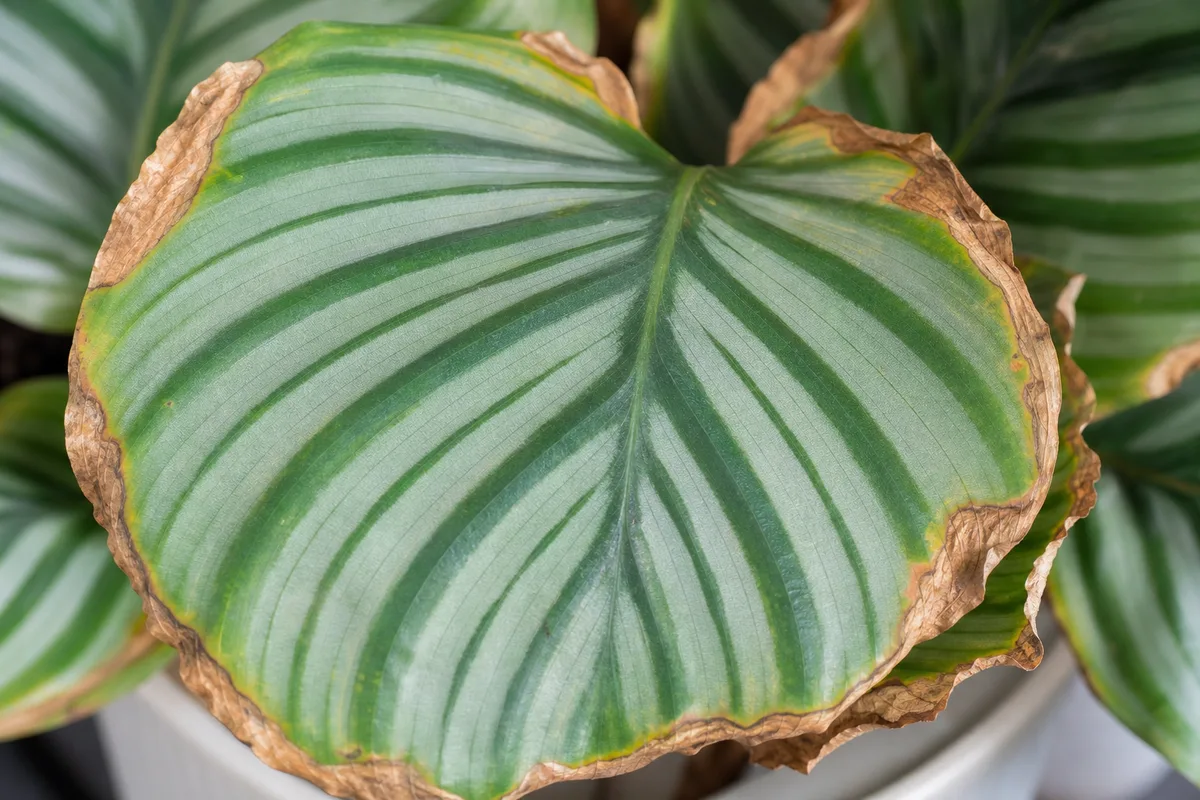
Low Humidity symptoms on Calathea Orbifolia - compare with healthy tissue on the same plant.
Early dry-air stress:
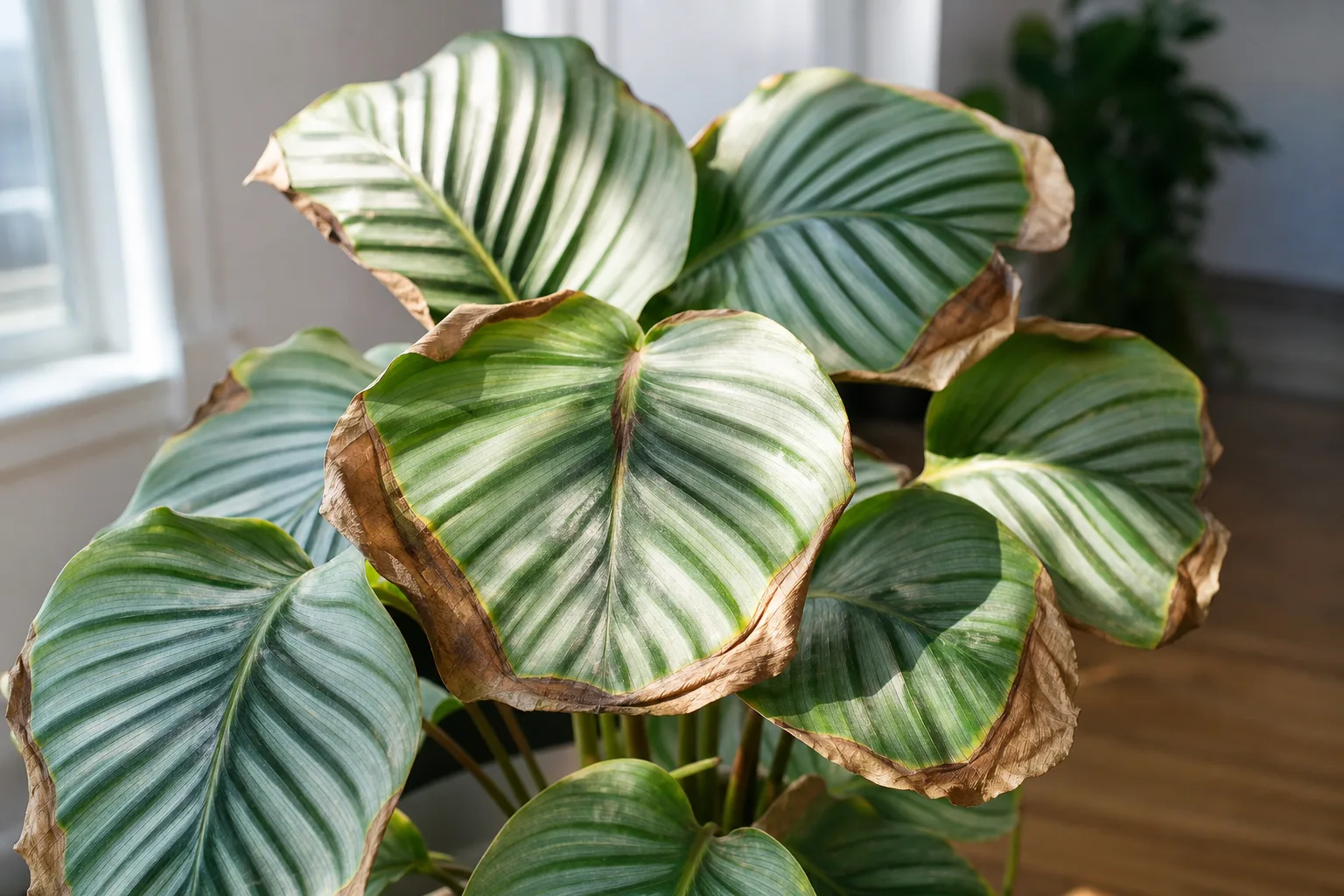
- Tan or brown crisping on leaf margins and tips while the silver-green center still looks plump
- Slight inward curl on the most exposed blades, distinct from the daily nyctinasty droop that follows a normal day-night cycle
- New rolled spears slow to unfurl, brown at the tip before opening, or tear along the seam as they expand
- Leaves feel papery at the edges rather than smooth and turgid across the whole round blade
Established dry-air damage:
- Widespread brown tips across multiple large leaves, often worst on the side facing a heat register, radiator, or sunny winter window
- Stuck or aborted new growth - spears that never reach full 12-inch width
- Persistent curling through day and night (not just evening prayer-plant movement)
- Fine stippling on undersides if spider mites move in behind the humidity drop
Symptom reference (what to compare on your plant):
- Low humidity: even brown margin crisping on several round leaves, moist soil at depth, RH below 50% at canopy, damage worse near vents or dry glass
- Tap-water burn: sharp brown lines on newest unfurling leaves with otherwise adequate humidity - see brown tips
- Normal nyctinasty: leaves angle downward during the day and rise in evening on a predictable schedule; stems stay firm and soil moisture is normal
What damaged tissue will not do:
- Crisp brown edges do not turn green again on the same leaf
- Fully desiccated spear tips rarely reopen cleanly - wait for the next leaf
Because one Orbifolia leaf can dominate the visual balance of the whole pot, a single crispy margin is cosmetic; repeated failed spears mean the environment still needs work.
Why Calathea Orbifolia needs higher humidity than most houseplants
Goeppertia orbifolia evolved under a tropical canopy where warm shade and steady vapor keep broad leaves hydrated. NC State lists consistent temperatures of 65–75°F and high humidity of at least 60% as requirements to make this plant thrive. The RHS calathea growing guide notes that browning of leaf tips and edges is usually a result of low humidity on Marantaceae relatives.
Orbifolia’s large round blades transpire heavily. When vapor pressure deficit rises - common with forced-air heating, wood stoves, and desert-climate HVAC - the plant loses moisture through leaf edges faster than roots can replace it, and tissue dies at the margins first. A pothos might tolerate 35% RH; Orbifolia often shows edge burn while the pot still feels evenly moist.
Winter is the usual trigger. Most indoor environments lack sufficient humidity for healthy houseplants, particularly in winter. Heat vents and sunny window sills create microclimates even drier than the thermostat suggests. Moving a greenhouse-grown Orbifolia straight into a heated living room without acclimation accelerates the same injury.
Dry air also weakens natural defenses. Spider mites thrive in warm, dry conditions - so low humidity and mite stippling often appear together on prayer-plant foliage. See spider mites on Calathea Orbifolia if webbing shows up after a dry spell.
Lookalike symptoms to rule out
| What you see | Likely cause | Where to read more |
|---|---|---|
| Even crisp margins, moist soil, RH below 50% at canopy | Low humidity | This page |
| Sharp brown lines on newest leaves with adequate RH | Tap-water fluoride or mineral burn | Brown tips |
| Whole leaves limp, mix pulls from pot sides, pot very light | Underwatering | Underwatering |
| Limp leaves with wet, sour mix and yellowing lower leaves | Overwatering / root stress | Overwatering |
| Bleached or tan patches on window-facing side only | Direct sun scorch | Light guide |
| Daytime droop that resolves each evening, firm stems | Normal nyctinasty | Calathea Orbifolia overview |
| Bronze stippling and webbing on undersides | Spider mites | Spider mites |
| Sudden wilt with dry soil throughout | Underwatering overlap | Wilting |
Nyctinasty vs. drought curl: Orbifolia’s daily prayer-plant movement follows light - leaves droop or angle during the day and rise in evening. Drought or dry-air curl is persistent through the day and night, often with dry soil or low RH. Always check moisture at root depth and a hygrometer reading before reacting to curled leaves.
How to confirm the cause
Work through these checks before changing multiple care variables at once:
- Measure humidity at canopy height - Room thermostats lie. Hold a hygrometer 15–30 cm above the pot for 24 hours. Below 50% RH near the leaves strongly supports dry-air stress; NC State targets at least 60% for thriving Orbifolia.
- Map heat and airflow - Note radiators, forced-air vents, fireplace proximity, and drafty winter glass. Damage clustered on one side of a large round leaf usually traces to a local dry zone.
- Check soil moisture honestly - Stick a finger into the top 2 cm. If mix is wet and heavy but margins still crisp, the problem is likely air moisture, not drought. If bone dry throughout, underwatering may be primary or compounding.
- Inspect the newest rolled spear - A firm spear with a brown tip in moist soil screams humidity gap. Soft, mushy stems at the crown point elsewhere.
- Review water quality - Fluoride in tap water can cause leaf tips to brown independently of humidity. If you use hard tap water, edge browning may be chemical - filtered or rainwater helps either way, but humidity still needs fixing.
- Look for mites - Tap a marked leaf over white paper. Moving specks plus fine webbing mean pests joined the stress; treat mites after stabilizing humidity.
If RH stays above 55–60%, soil cycles normally per the watering guide, and new spears open cleanly, low humidity is unlikely the main issue - look at light scorch, mineral burn, or root problems instead.
First fix for Calathea Orbifolia
Place a humidifier within 1–2 metres of the plant and run it long enough to bring canopy-level RH to roughly 60–70%.
Choose a cool-mist or ultrasonic unit sized for the room - not a one-shot misting bottle. Misting is questionable as a meaningful humidity strategy and wet leaf surfaces in stagnant air can invite fungal issues on large thin blades. Sustained vapor in the air is what Orbifolia responds to.
Keep the humidifier running through the dry period, not only for ten minutes after you notice damage. Orbifolia responds to average conditions over days, not a single moisture spike.
While humidity climbs, leave watering rhythm alone unless soil is genuinely dry at the top 2 cm. Do not compensate for crisp leaves by keeping mix constantly wet - that raises root-rot risk while edges stay dry.
Step-by-step recovery
After the humidifier is running:
- Relocate away from dry microclimates - Move the pot off radiator covers and out of direct heat blasts. Bright indirect light is fine; hot afternoon sun through glass dries large round leaves faster.
- Group with other tropicals - Grouping plants together raises humidity in their vicinity through shared transpiration. It supplements a humidifier but rarely replaces one in heated winter rooms.
- Add a pebble tray if needed - Set the pot on stones above - not in - water. NC State notes humidity can be increased by placing the container on a tray of wet pebbles; combine with the humidifier rather than expecting the tray alone to solve winter dryness.
- Switch to filtered or rainwater if newest leaves show sharp brown lines that look chemical as well as dry - distilled or rainwater is preferred to reduce fluoride browning while humidity stabilizes.
- Trim only fully dead tissue - Snip crispy brown tips or entire leaves that are mostly desiccated once conditions improve. Sterilize scissors between cuts. Partial edge damage can stay until the leaf is replaced naturally.
- Scout for spider mites weekly - Rinse undersides with lukewarm water if stippling appears. Dry air often precedes mite flare-ups on Marantaceae plants.
Hold Calathea Orbifolia repotting guide, fertilizer, and major pruning until new spears unfurl cleanly for two to three weeks.
Recovery timeline
Humidity corrections show in new growth, not old leaves. Within 7–14 days of stable 55–65% RH, the next spear should open with less tip burn. A full flush of clean round foliage may take one to two months as older damaged leaves age out.
If margins keep spreading while RH reads adequate, reassess water quality, light intensity, or hidden pests before assuming humidity was the only factor.
Worsening signs: yellowing across whole leaves while soil stays wet, soft stems at the crown, widespread leaf drop, or mite webbing spreading - those mean a different or additional problem and need a new diagnosis path.
Mistakes to avoid
Do not mist once daily and assume the problem is solved. Brief leaf wetting evaporates in minutes on a 12-inch blade and can spot silver banding if water sits in folded leaves overnight.
Do not overwater to “help” crisp leaves. Extra water without humidity raises root-rot risk while edges stay dry.
Do not blast Orbifolia with direct sun to “dry it out faster” after overwatering - that compounds margin burn on large thin leaves.
Do not relocate the plant daily between rooms hunting humidity. Stable conditions beat bouncing between a dry living room and a steamy bathroom unless light in both spots is adequate.
Do not trim every leaf the moment edges brown. Wait until humidity holds, then remove only tissue that will never recover.
Do not increase fertilizer to “green up” humidity-stressed leaves. Feed only after new growth looks stable.
Orbifolia care cross-check
Low humidity fixes work best when the rest of the routine supports steady transpiration:
- Light - Bright indirect light keeps silver banding vivid without scorching large round blades. Too dim and growth weakens; too harsh and edges desiccate faster in dry air. Full placement guidance: light guide.
- Water - Keep evenly moist; water when the top 2 cm begins to dry. Use filtered water to avoid stacking mineral burn on humidity stress.
- Temperature - Orbifolia prefers roughly 65–75°F (18–24°C). Cold window glass and heat vents both stress leaf margins.
- Soil - Moisture-retentive but well-draining mix. Heavy soggy pots worsen stress when you overwater during a humidity panic.
How to prevent low humidity damage next time
Run a humidifier from the first cold snap, not after widespread crisping. A hygrometer near the plant gives early warning when RH slides under 50%.
Place Orbifolia where bright filtered light and humidity can coexist - east or north windows with sheer curtains often work better than a hot south sill above a radiator.
Group Orbifolia with other humidity lovers to buffer microclimates. In very dry regions, a glass cabinet with bright indirect light can maintain the sustained moisture this species prefers.
Acclimate new plants gradually when moving from greenhouse to home. A week of stable intermediate conditions reduces shock crisping on thin new spears.
Inspect newest rolled leaves weekly through winter. One brown tip on a single old leaf is cosmetic; repeated failed spears mean the environment still needs work.
When to worry
Treat as urgent when multiple new spears brown and stall within one week, when crisping spreads across the entire clump despite moist soil, or when mite webbing covers several large leaves. Those patterns suggest the plant is losing leaf area faster than it can replace.
Step up intervention - stronger humidification, pest control if confirmed, and trimming dead spears - before stems soften at the crown.
A few brown tips on lower leaves after a dry spell is not an emergency if new growth stays clean once humidity rises. Orbifolia always shows some cosmetic edge wear in average homes; judge health by the newest round leaves.
Conclusion
Low humidity on Calathea Orbifolia is an environmental problem with a clear first response: measure air moisture at the leaves and run a humidifier until RH stays consistently around 60–70%, with 50% as the floor. Old crispy margins on large round blades will not heal, but firm roots and clean new spears tell you the fix is working. Keep filtered-water watering steady, stay away from heat vents, and watch new growth - not yesterday’s brown edge - for proof of recovery.
Related Calathea Orbifolia problems
- Brown tips - tap-water burn overlapping with dry-air crisping
- Spider mites - dry-air pest risk on prayer-plant foliage
- Wilting - limp leaves when drought or root stress compounds humidity stress
- Underwatering - drought curl when mix is bone dry
- Overwatering - wet soil with limp leaves, not dry margins alone
- Calathea Orbifolia overview - Orbifolia biology, nyctinasty, and baseline humidity needs
When to use this page vs other Calathea Orbifolia guides
- Calathea Orbifolia watering guide - Use for routine moisture checks before assuming low humidity is the main issue.
- Calathea Orbifolia problems hub - Browse all 16 common issues on this species.
- Brown Tips on Calathea Orbifolia - Different entry point when symptoms overlap with low humidity.