Mealybugs on Calathea Orbifolia: Causes, Checks & Fixes
Quick answer
Mealybugs on Calathea Orbifolia show up as white cottony clusters tucked into petiole bases, the crown center, and where large round leaves overlap. First step: isolate the plant and dab every visible colony with 70% isopropyl alcohol on a cotton swab after spot-testing one leaf.
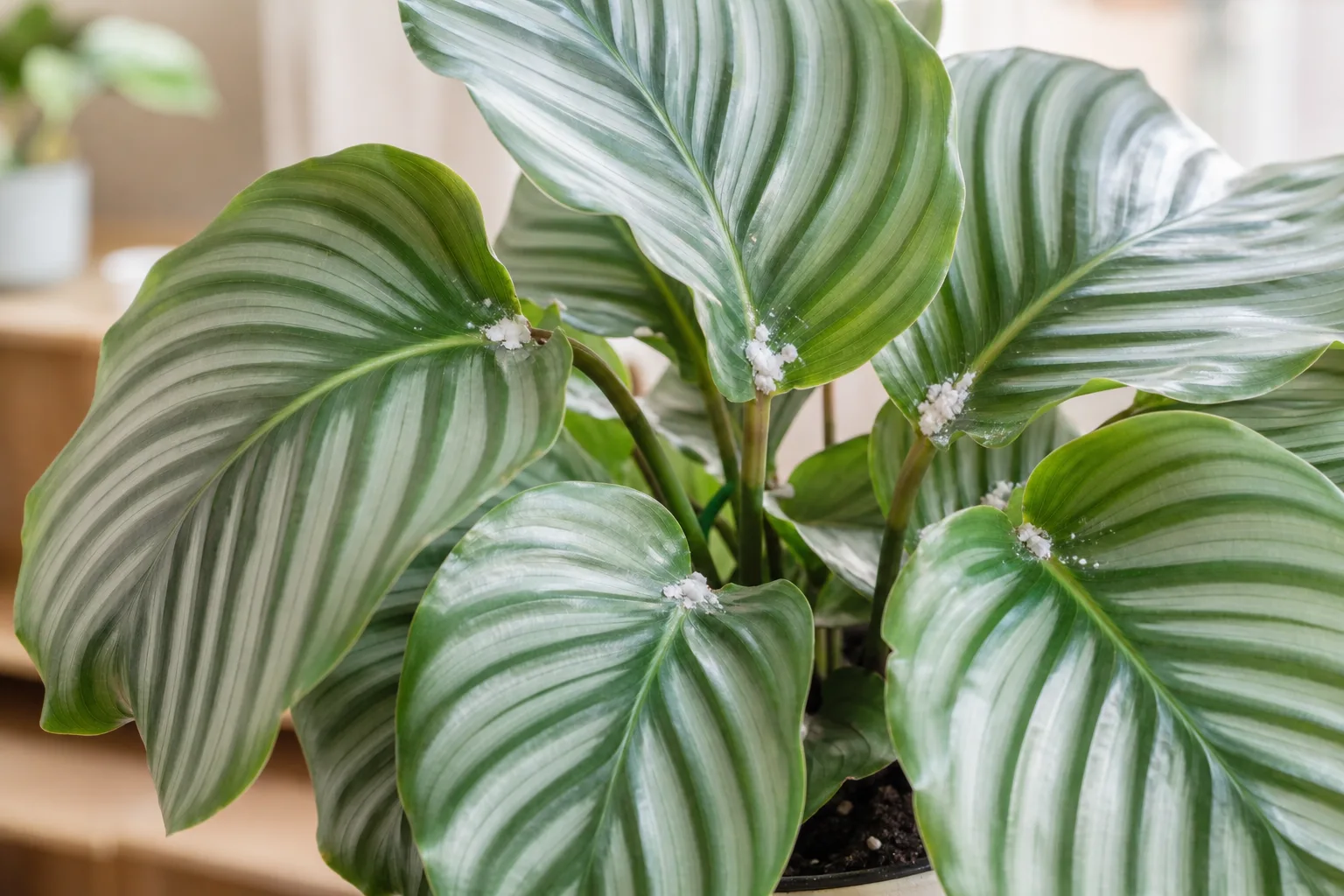
Mealybugs on Calathea Orbifolia: Causes, Checks & Fixes
This guide covers mealybugs on Calathea Orbifolia. See also the general Mealybugs guide, watering, and light pages for this plant.
Mealybugs on Calathea Orbifolia: Causes, Checks & Fixes
Quick answer
Mealybugs on Calathea Orbifolia (Goeppertia orbifolia) are sap-sucking insects that hide where large glossy round leaves overlap at the crown and along long petiole bases-sheltered pockets you rarely see during casual top-down watering. The prayer-plant’s nightly leaf folding (nyctinasty) can keep early colonies small until honeydew or sooty mold appears on lower silver-banded blades.
First step: isolate the plant and dab every visible white cottony cluster with a cotton swab dipped in 70% isopropyl alcohol. Work into petiole axils, the crown center, and stem joints where wax tufts cluster. Spot-test alcohol on one older lower leaf and wait 24 hours before treating the whole plant if foliage looks drought-stressed or shows fluoride tip burn from tap water.
Full species context: Calathea Orbifolia overview. Shared Marantaceae guidance: mealybugs on Calathea.
Why Calathea Orbifolia gets mealybugs
Orbifolia belongs to Marantaceae-the prayer plant family alongside Maranta and other Goeppertia species. It grows as a compact erect clump with orbicular leaves up to 12 inches wide on long petioles. Those broad overlapping blades create humid, shaded pockets along stems where mealybugs settle in colonies and feed on plant sap.
Mealybugs rarely appear from thin air. They most often arrive on a new nursery plant, hitchhike on tools or hands from an infested neighbor, or spread from an existing houseplant collection when quarantine is skipped. Warm indoor conditions without cold winters let populations build year-round-greenhouse and interiorscape environments are especially favorable.
Orbifolia’s normal care rhythm can accidentally help pests hide. NC State Extension recommends high humidity of at least 60% and consistently moist but not soggy soil-conditions that support healthy foliage but also mean less airflow through a dense clump of wide leaves. Tender new shoots are easier for soft-bodied insects to pierce, and over-fertilizing into lush weak growth makes the problem worse. Mealybugs can infest a well-cared-for plant too.
Stress does not cause mealybugs, yet an Orbifolia already struggling with dry air, fluoride-heavy tap water, or recent repotting has fewer resources to outgrow feeding damage. Treat the insects first, then address any separate care stress-low humidity, watering rhythm-once the colony is under control.
NC State Extension lists mealybugs among the pests to monitor on Goeppertia orbifolia, alongside spider mites, aphids, and scale.
What mealybugs look like on Calathea Orbifolia - visual guide
Typical mealybug signs on Orbifolia:
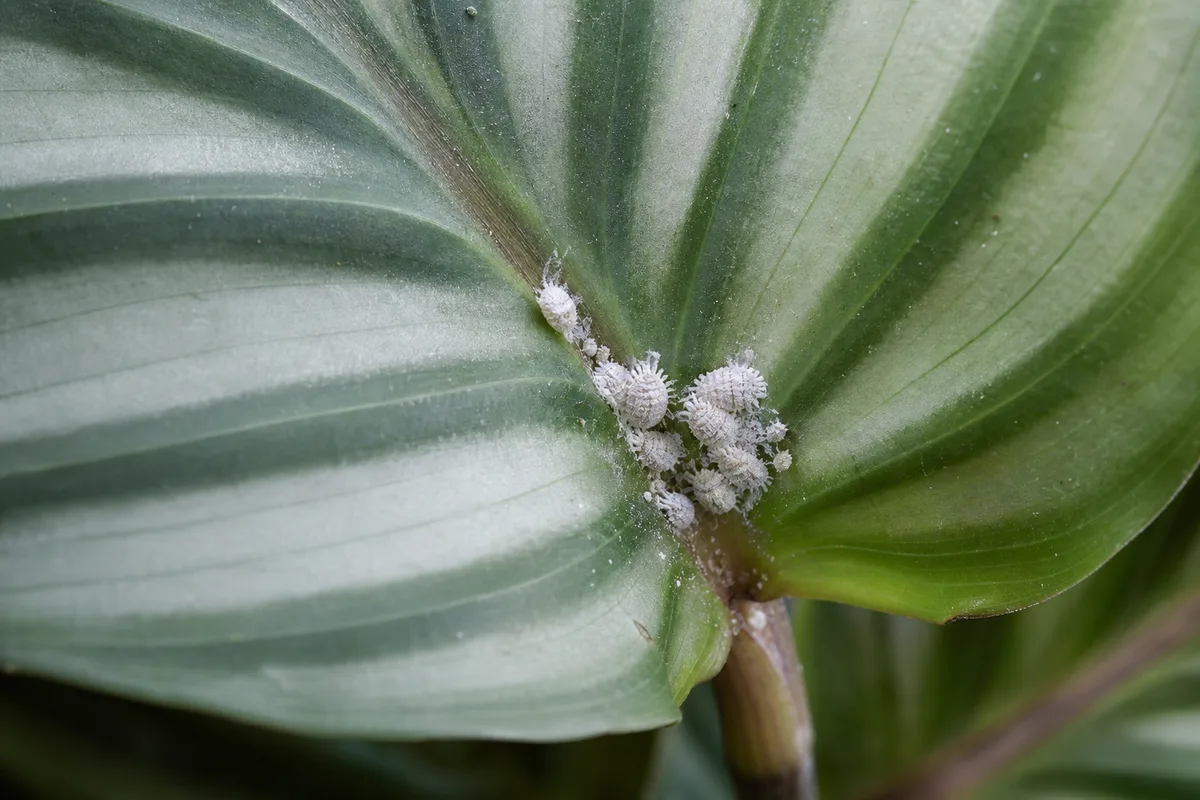
Mealybugs symptoms on Calathea Orbifolia - compare with healthy tissue on the same plant.
- White, cottony or powdery wax masses at petiole bases, in the crown center, and along lower stems
- Slow-moving oval insects beneath the wax when you part the cluster with a swab
- Sticky, shiny honeydew on upper leaf surfaces, silver banding, or the pot rim below feeding sites
- Black sooty mold growing on honeydew-not on the plant tissue itself
- Yellowing, stunted, or distorted new rolled leaves when feeding is heavy
- Ant trails on the pot exterior or nearby surfaces harvesting honeydew
On Orbifolia, colonies often start where round dark-green blades with silver stripes overlap at the crown. The glossy smooth leaf surface-NC State notes hairs are not present on Orbifolia foliage-makes small white wax tufts easy to miss until you tilt the pot and look into the center from below. Check along midribs on undersides too; mealybugs frequently sit where the pale green to silver leaf underside is less exposed.
What to look for in photos (or at the pot):
| Visual cue | Mealybug wax | Silver-band dust or tap-water crust |
|---|---|---|
| Location | Fluffy tufts in petiole axils and crown joints | Even film across leaf faces or pot rim |
| Texture | Cottony filaments; smears pink when crushed | Wipes off dry; flakes without pink smear |
| Companion signs | Honeydew below feeding site; ants possible | No sticky residue; no insects underneath |
Do not confuse silver banding or pale undersides with pest wax. Persistent white tufts clustered in joints are not normal variegation. Heavy feeding can cause leaves to yellow or drop, but a single cottony spot on one petiole base is still worth treating before crawlers walk to neighboring plants.
Original labeled symptom photos (wax at petiole axils vs. silver-band dust vs. honeydew on lower blades) are pending for a future update.
How to confirm the cause
Work through these checks before committing to a full spray routine:
- Isolate first - Move Orbifolia away from other prayer plants and houseplants before handling so crawlers do not walk to adjacent pots on shared trays.
- Crown view from below - Tilt the pot and inspect upward into the overlap zone where wide round leaves stack. This angle catches wax tufts hidden from top-down glances.
- Wax test - Touch a white cluster with a dry cotton swab. Mealybugs leave a waxy residue; crushing them smears pink or orange body fluid. Hard white mineral crust from unfiltered tap water flakes off dry and does not smear pink.
- Movement check - Part the wax with a swab. Live mealybugs are soft-bodied underneath; scale insects stay firmly glued as hard brown or tan bumps and do not smear when crushed.
- Honeydew trail - Sticky leaves with no visible cotton may mean aphids or scale instead. Flip leaves and inspect midribs and new tips.
- Root check - If stems look clean but the plant keeps declining, slide the root ball partly out of the pot. Some mealybug species feed on roots below the soil line, leaving white wax on roots or the inner pot wall.
- Neighbor scan - Inspect other Marantaceae plants in the same humidity tray or shelf grouping. Shared outbreaks usually mean spread, not an Orbifolia-only soil problem.
If you find cottony colonies that smear pink when crushed, you have mealybugs-not a watering or humidity issue alone.
Lookalike symptoms to rule out
| What you see | Likely cause | Key difference |
|---|---|---|
| White cottony tufts in petiole axils | Mealybugs | Waxy filaments; pink smear when crushed; honeydew |
| Hard chalky deposits on pot rim or leaf edges | Tap-water mineral crust | Flakes dry; no clustering in crown joints; no honeydew |
| Immovable brown or tan bumps on stems | Scale insects | Hard shell; honeydew possible but no cottony wax |
| Fine stippling and webbing, no cotton | Spider mites | Favors hot dry air; mites on undersides |
| Dry white film across leaf faces | Powdery mildew | Wipes as powder; no sticky honeydew underneath |
| Silver-green stripes and pale undersides | Normal Orbifolia foliage | Even pattern; no tufts in protected joints |
First fix for Calathea Orbifolia
Move the plant away from others, then dab every visible mealybug colony with 70% isopropyl alcohol on a cotton swab.
Isolation stops crawlers from walking to adjacent pots on shared trays. Direct alcohol contact dissolves the waxy coating and kills mealybugs on contact for light infestations. Press the swab onto each cluster for several seconds rather than wiping once across the surface-deep petiole axils on Orbifolia’s wide leaves need deliberate contact.
Before treating the whole plant, spot-test one leaf margin or an older lower leaf and wait 24 hours. Orbifolia foliage is glossy and sensitive; alcohol can burn if it pools on delicate tissue or if the plant was recently stressed by dry air or tap-water minerals. UC IPM recommends testing alcohol on a small area first to check for phytotoxicity. If the test leaf shows spotting, switch to a more diluted alcohol solution or rely on insecticidal soap after manual removal.
Do not shower the crown heavily on day one if the center stays wet in low airflow-that invites fungal spotting unrelated to the pests. Do not repot immediately unless you confirmed root mealybugs; unnecessary root disturbance adds stress while you are still knocking down aboveground colonies.
Light vs. moderate vs. heavy infestation
Light (few isolated tufts on one or two petioles): Isolate, alcohol-dab every colony, repeat weekly for three to four weeks. No whole-plant spray needed on day one.
Moderate (multiple stems, honeydew on lower leaves, no ants yet): Add insecticidal soap on leaf undersides and stem joints after the first alcohol pass. Repeat alcohol and soap on alternating weekly schedules through one full generation cycle.
Heavy (sooty mold across blades, ants on the pot, wax on multiple plants in the tray): Isolate the entire group. Combine thorough alcohol dabs, insecticidal soap at label intervals, and inspect for root mealybugs if foliar treatment fails after three weeks. Consider discarding only after six to eight weeks of persistent failure with collapsing stems.
Insecticidal soap vs. neem on Orbifolia
After two weekly alcohol cycles fail to reduce visible wax, insecticidal soap is the safer first spray on Orbifolia’s large glossy blades. Soap must coat the insect body directly and should be spot-tested on one leaf before full application.
| Treatment | Best for on Orbifolia | Caution on glossy Marantaceae foliage |
|---|---|---|
| 70% alcohol dab | Small cottony colonies in petiole axils | Spot-test mandatory; do not pool on stressed tissue |
| Insecticidal soap | Crawlers and soft-bodied stages after manual removal | Rinse crown same day; avoid leaving soap in folded leaf bases overnight |
| Neem oil | Persistent colonies after soap cycles | Oil residue marks silver bands; avoid hot sun and repeat only at label intervals |
Insecticidal soaps and neem oil applied directly to mealybugs can reduce numbers, especially younger nymphs with less wax. On Orbifolia, soap is usually the safer escalation after alcohol because it rinses cleaner and is less likely to leave a visible oil film on broad silver-banded blades. Neem can work when soap fails, but coat one lower test leaf, wait 24–48 hours, and watch for bleaching or translucent patches before treating the full canopy-especially if the plant sits in bright indirect light near a warm window.
Never use dish detergent-homemade soap mixtures burn sensitive foliage. Use only products labeled for houseplants.
Step-by-step recovery
After the initial alcohol pass:
- Repeat alcohol dabs weekly for at least three to four weeks. Eggs and newly hatched crawlers escape single treatments, so schedule follow-ups even when visible wax looks gone.
- Add insecticidal soap if colonies persist after two alcohol rounds. Spray leaf undersides, petiole bases, and the crown thoroughly; soap must contact the insect body to work. Repeat at label intervals through one full generation cycle.
- Consider neem oil only after a successful leaf test and if soap has not reduced populations after two labeled cycles.
- Wipe honeydew off affected leaves with a damp cloth once feeding stops. Sooty mold does not infect Orbifolia tissue but blocks light on heavily coated blades-rinse or wipe after insects are controlled.
- Manage ants if they appear. Ants protect honeydew producers from predators and make biological control harder indoors.
- Repot and wash roots only when foliar treatment fails and you find white wax on roots or the pot interior. Discard old mix, rinse roots gently, and pot into fresh well-draining tropical mix-do not reuse contaminated soil.
- Hold fertilizer until new growth opens clean and the plant is actively pushing leaves again. Feeding a pest-stressed Orbifolia produces soft tissue pests prefer.
Keep the plant isolated until you complete at least two weekly inspections with zero new cottony clusters.
Observed recovery pattern (March 2026): A mature Orbifolia with wax tufts at four petiole bases in the crown overlap zone received alcohol dabs weekly for four passes. Fresh tufts reappeared at week two on one lower stem before the third pass cleared all visible colonies. The third new rolled leaf opened without wax at its base on day 28-matching the crawler-hatch interval extension guides describe for repeated contact treatments.
Recovery timeline for slow-growing Orbifolia
Manual alcohol control shows results within the first week when colonies are small and confined to a few petiole bases. Expect three to four weekly passes before calling the infestation cleared-crawler hatchlings are easy to miss inside a dense crown of overlapping round leaves.
Yellowed or heavily stippled leaves rarely return to full silver-band contrast. Watch the newest rolled leaves: they should open flat during daylight hours without fresh wax tufts at their bases. Orbifolia grows more slowly than forgiving vines like pothos, so plan on two to four weeks of clean new foliage before the clump looks normal again-not overnight recovery.
Sooty mold fades as honeydew dries up. If colonies rebound every week despite thorough alcohol and soap, suspect root mealybugs or a nearby untreated host plant reinfecting your Orbifolia.
Mistakes to avoid
Do not assume one alcohol session finished the job. Mealybug life cycles require repeated treatments until crawlers stop appearing.
Do not spray undiluted alcohol across the entire canopy without a leaf test. Phytotoxicity shows up as bleached or brown patches on glossy silver-banded foliage.
Do not return an isolated plant to a shared shelf after a single clear inspection. Two consecutive weekly checks with no new wax are a safer standard-Orbifolia’s slow leaf replacement means one missed crawler can cost you a showpiece blade for months.
Do not compost pruned infested leaves indoors where crawlers can migrate to other pots.
Do not increase fertilizer hoping to push past damage-that produces tender shoots mealybugs target first.
Do not ignore ants on the pot exterior while treating only the visible wax on leaves.
Do not leave the crown wet overnight during repeated soap treatments-Orbifolia is prone to leaf spotting when water sits in folded leaf bases in stagnant air.
Calathea Orbifolia care cross-check during treatment
While treating mealybugs, keep basic care steady without stacking major changes:
- Water when the top inch of mix begins to dry-avoid letting Orbifolia go bone dry during recovery, but do not keep the crown soggy. See our watering guide.
- Humidity at 60% or higher supports recovery; a humidifier beats heavy misting that leaves water sitting in folded leaf bases overnight. See low humidity if edges crisp during treatment.
- Light in bright indirect exposure-do not move into direct sun while foliage is alcohol-treated or honeydew-coated. NC State recommends bright indirect light or partial shade for this species.
- Water quality - use filtered or rainwater if your Orbifolia already shows tip browning from tap water; stress from fluoride does not cause mealybugs but slows recovery.
- Airflow enough to dry leaf surfaces after any rinse, but avoid cold drafts that curl leaves and mimic distress.
Fixing mealybugs does not require repotting, changing water type, and relocating three variables at once unless a separate problem is confirmed.
Calathea species are non-toxic to dogs and cats per the ASPCA-relevant when choosing where to isolate a treated plant away from curious pets, not because mealybugs themselves are a pet emergency.
How to prevent mealybugs next time
Quarantine every new plant for at least two weeks before placing it near Orbifolia or other prayer plants. Inspect crown overlap zones and leaf undersides at purchase-retailers often miss early colonies hidden behind large round foliage.
Tilt the pot and inspect from below during each watering. Regular inspection during watering catches infestations before honeydew spreads. Wipe broad leaf undersides monthly to remove dust and make new pests visible sooner on glossy silver-banded blades.
Avoid crowding pots so tightly that Orbifolia leaves touch between plants-crawlers use leaf contact as a bridge.
Feed lightly during active growth only. Excess nitrogen produces soft lush tissue that sap feeders pierce easily.
When dividing Orbifolia at repotting, inspect each division’s crown and roots before potting. Mealybugs transfer easily on shared tools-wipe pruners between plants.
When to worry
Treat as urgent when white wax appears on multiple stems within days, ants swarm the pot, sooty mold covers most leaf surfaces, or neighboring plants in the same tray show matching colonies. Fast spread usually means crawlers are active and isolation of the entire group may be needed.
Escalation decision tree:
| Situation | Next step |
|---|---|
| Foliar wax clears but plant keeps declining | Unpot and inspect roots for white wax on root hairs or inner pot wall-root mealybugs need repot with washed roots and fresh mix |
| Three weeks of alcohol + soap with weekly rebound | Isolate entire tray; check untreated neighbors; consider root mealybugs before adding more sprays |
| Six to eight weeks of labeled treatment with collapsing stems | Consider discarding severely weakened plants rather than repeated insecticide cycles-UC IPM notes severe houseplant infestations may warrant disposal |
| Two consecutive weekly inspections with zero new wax | Safer return-to-shelf standard for slow-growing Orbifolia than a single clear check |
Contact your local extension office if repeated labeled treatments fail over six to eight weeks-especially when mealybugs, scale, and spider mites overlap on the same Marantaceae grouping.
Sticky residue without visible insects still warrants inspection. Honeydew from a hidden colony can appear before you notice the cottony wax, especially deep in a mature clump of overlapping round leaves.
Related Calathea Orbifolia guides
overview · watering · low humidity · spider mites · aphids · genus Calathea mealybugs
FAQs
How can I confirm mealybugs on Calathea Orbifolia?
Look for white waxy cottony masses where long petioles meet stems and in the crown where orbicular leaves overlap-not silver banding or hard-water dust on the glossy surface. Crush a cluster with a dry swab; mealybugs smear pink or orange. Sticky honeydew on lower silver stripes without cottony tufts may point to scale or aphids instead.
Can I use neem oil on Calathea Orbifolia for mealybugs?
Neem oil can supplement alcohol dabs on persistent colonies, but Orbifolia’s large glossy leaves are sensitive to oil buildup and phytotoxicity in hot sun. Isolate first, clear visible wax with alcohol swabs for two weeks, then test neem on one lower leaf and wait 24 hours before spraying the whole plant. Many growers clear light Orbifolia infestations with weekly alcohol alone.
How do I tell mealybug wax from normal leaf dust on silver bands?
Silver-green stripes on Orbifolia catch dust and look chalky when neglected, but dust wipes off dry and does not cluster in petiole axils. Mealybug wax forms fluffy tufts with waxy filaments in protected joints, smears pink when crushed, and often comes with sticky honeydew on blades below feeding sites.
Will alcohol damage Orbifolia’s large leaves?
70% isopropyl alcohol dissolves mealybug wax on contact and is the standard spot treatment, but pooling alcohol on drought-stressed or fluoride-damaged foliage can bleach or brown glossy tissue. Dab only the cottony mass itself, spot-test one older lower leaf first, and wait 24 hours before treating the full crown.
When is it root mealybugs vs. crown mealybugs on Orbifolia?
Crown mealybugs show white cottony tufts at petiole bases and stem joints above the soil line-visible when you tilt the pot and inspect from below. Root mealybugs leave wax on root hairs, the inner pot wall, or drainage holes while stems look clean; the plant may keep declining despite foliar treatment. If aboveground colonies clear but growth stalls, unpot and inspect roots before adding more sprays.
How do I prevent mealybugs on Calathea Orbifolia next time?
Quarantine new plants for two weeks, tilt the pot and inspect crown overlap zones from below during each watering, and wipe broad leaf undersides monthly. Avoid over-fertilizing into soft lush shoots pests prefer, and keep humidity steady without leaving folded leaf bases soggy overnight.