Not Enough Light on Calathea Orbifolia: Causes, Checks &
Quick answer
Calathea Orbifolia needs bright, filtered indirect light-not a dim corner. First step: move the pot to the brightest spot in your home that still avoids direct sun on the leaves, then watch the next two new leaves for stronger banding and shorter stems.
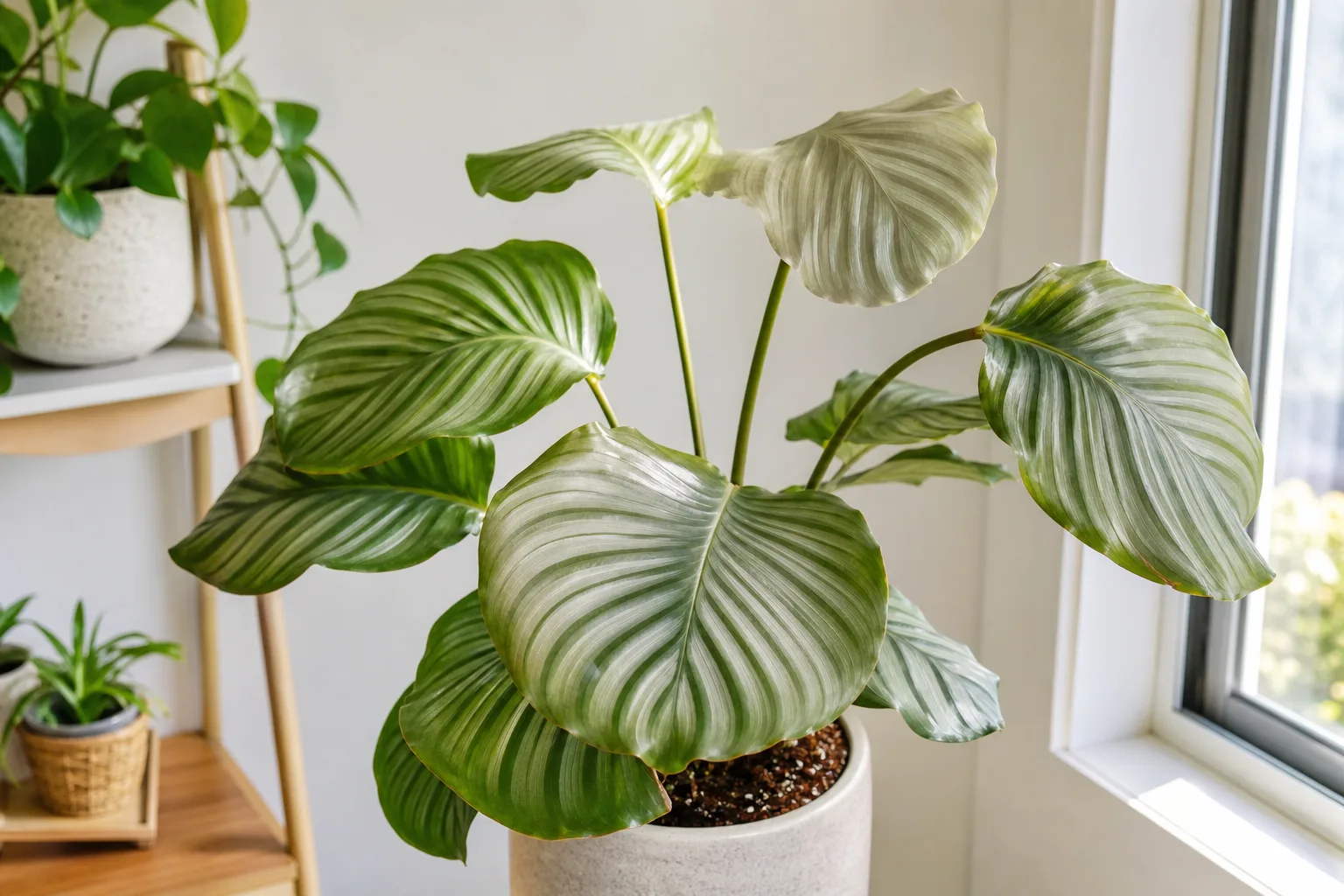
Not Enough Light on Calathea Orbifolia: Causes, Checks & Fixes
This guide covers not enough light on Calathea Orbifolia. See also the general Not Enough Light guide, watering, and light pages for this plant.
Not Enough Light on Calathea Orbifolia: Causes, Checks & Fixes
Quick answer
Calathea Orbifolia is grown for oversized round leaves with bold silver-green banding-and that pattern is one of the first things to fade when light is too weak. The plant may survive in a dim room, but it will not keep the crisp, metallic contrast that makes Orbifolia worth the extra humidity and filtered-water routine.
First step: move the pot to the brightest location that still keeps direct sun off the leaf surface. For most homes that means within a few feet of an east-facing window, close to a north window with clear glass, or several feet back from a south- or west-facing window behind sheer curtains. Do not jump to fertilizer, Calathea Orbifolia repotting guide, or heavy pruning until you have watched how the next one or two new leaves respond over two to three weeks.
What not enough light looks like on Calathea Orbifolia
Orbifolia signals low light through new growth, not old cosmetic marks. The large existing blades may look fine for months while the plant quietly struggles.
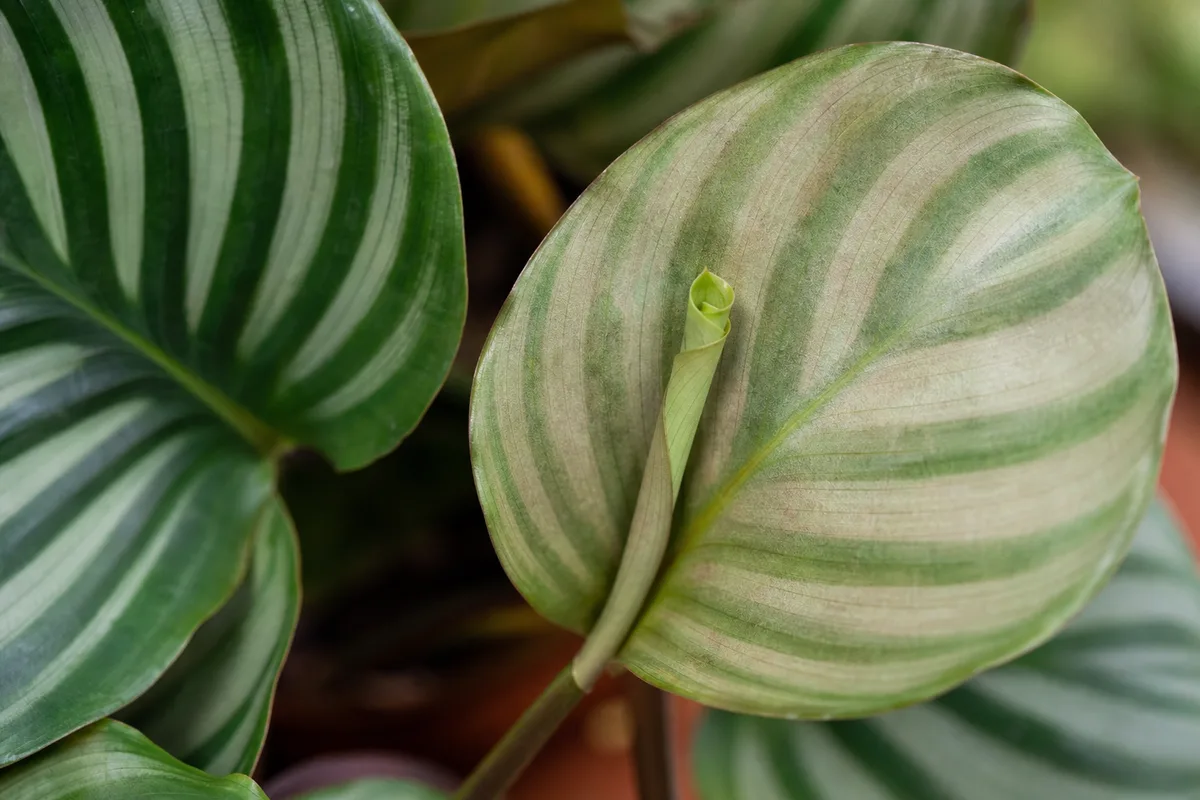
Faded silver-green banding on a new Orbifolia leaf with a long thin petiole - compare with sharper contrast on older foliage.
Watch for these patterns:
- Faded or muddy silver banding on the newest unfurling leaf-the contrast between dark green and silver should be sharp on healthy Orbifolia; insufficient light fades leaf color
- Smaller new leaves than older ones, even though the pot has not been recently repotted
- Long, thin petioles (leaf stalks) holding blades farther from the crown than earlier leaves-typical of plants stretching for more light
- A lean or one-sided growth habit as stems reach toward the brightest direction
- Slow or absent center growth-no new rolled leaf for many weeks during spring or summer
- Dull, dark green overall color instead of the glossy two-tone look
- Reduced evening leaf movement-Orbifolia is in the prayer-plant family and normally shifts leaf position with the light cycle; stressed plants move less dramatically
Lower-leaf yellowing can appear alongside low light, but it often traces to overwatering on Calathea Orbifolia in a dim spot rather than light alone. When roots use less water because photosynthesis is weak, the same Calathea Orbifolia watering guide keeps mix wet longer and yellowing follows.
Orbifolia rarely flowers indoors, so weak light will not show up as poor blooming-it shows up as flat pattern, stretch, and stall.
Why Calathea Orbifolia struggles in low light
Goeppertia orbifolia (formerly sold as Calathea orbifolia) evolved on the rainforest floor in eastern Brazil, under a canopy that filters sunlight rather than blocking it entirely. Indoors, that translates to bright, indirect light or partial shade-not a hallway with no window or a shelf more than six feet from glass.
Those broad, round leaves are expensive to build. Each blade can span a foot across and needs steady light energy to maintain silver variegation and thick tissue. When light drops:
- Photosynthesis slows, so the plant builds smaller leaves on longer stalks to capture more photons
- Variegation fades because the plant produces more chlorophyll to compensate-silver areas turn greener and less defined
- Water use drops, which makes Orbifolia’s moisture-retentive mix stay wet longer and invites root stress, fungus gnats, and yellow lower leaves
- Dust on the glossy surface matters more in dim conditions because every blocked ray counts-Orbifolia’s wide blades collect dust that can interfere with photosynthesis if never wiped
Marketing labels often call calatheas “low-light plants.” Orbifolia may tolerate low light longer than a fiddle-leaf fig, but tolerance is not the same as thriving. In practice, Orbifolia sits in the medium-to-bright indirect range-roughly the 100–500 foot-candle zone suited to east or west windows, not the 25–100 foot-candle zone suited to snake plants and ZZ plants.
How to confirm the cause
Work through these checks before changing anything else:
- Window direction and distance - Note how many feet the pot sits from the pane and whether light is filtered. A spot more than six feet from the only window in a north room is usually too dim for Orbifolia to hold strong banding.
- Shadow test at midday - Hold your hand between the plant and the window. A soft, fuzzy shadow suggests usable indirect light; no shadow means the spot is too dark; a hard dark shadow on the leaves means direct sun that can bleach silver stripes.
- New leaf quality - Compare the last two leaves that unfurled to leaves from when you first got the plant. Fading banding and longer petioles on new leaves confirm light is the limiter.
- Soil dry-down speed - Stick a finger into the top 2 cm. If the pot stays wet for ten days or more in a dim corner, low light may be slowing uptake and mimicking overwatering symptoms.
- Season - Shorter winter days can stall growth even in the same spot. If symptoms appeared after October, note whether the plant is simply paused versus actively stretching.
- Rule out lookalikes - Brown crispy rim edges with good banding point to tap water or dry air, not light. Bleached pale patches on sun-facing sections mean too much direct sun, not too little.
If the plant improves after a two-week move closer to filtered light-tighter new growth, clearer silver bands-you have confirmed insufficient light.
First fix for Calathea Orbifolia
Move the pot to brighter, filtered indirect light today.
Choose a spot where leaves never receive direct sunbeams but the plant clearly receives daylight for most of the day. Practical targets:
- East-facing window: 1–3 feet back from the glass, or on the sill if morning sun is gentle and brief
- North-facing window: as close to the glass as possible; farther back often fails for Orbifolia
- South- or west-facing window: 3–6 feet back, or behind a sheer curtain that softens afternoon rays
Move gradually over three to five days if the plant is coming from a very dark room-shift it one foot closer to the target window each day to limit shock. Once in place, rotate the pot a quarter turn every week so the next leaves do not lean hard to one side.
Do not place Orbifolia in direct hot sun to “fix” dim growth. Direct sun can scorch the leaves and bleach silver patterning within days.
Step-by-step recovery
After the light move:
- Pause fertilizer until you see a healthy new leaf with improved banding. Feeding a stressed, light-starved plant does not replace photons.
- Recheck watering - In brighter indirect light, the top 2 cm should begin drying on the rhythm Orbifolia expects (roughly every 5–7 days in active growth, longer in winter). Water when that layer starts to dry, not on the old calendar from the dark corner.
- Wipe dust from the broad blades with a damp cloth so remaining light is not wasted on a gray film.
- Maintain humidity at 60% or higher - Light fixes structure; humidity still prevents edge crisping while the plant rebuilds. Low light plus dry air produces a confusing mix of fade and brown tips.
- Add supplemental light if windows are insufficient - A full-spectrum LED grow light 12–18 inches above the foliage for 12–14 hours daily can support Orbifolia in interior rooms. Keep total daily light under about 16 hours.
- Remove only fully yellow or collapsed lower leaves after the plant pushes one good new leaf-do not strip half the plant while it is adjusting.
If no improved new leaf appears after four to six weeks in a clearly brighter spot during spring or summer, reassess whether the location still falls below medium indirect levels or whether a second stressor (wet roots, pests) is blocking recovery.
Recovery timeline
Expect subtle improvement within two to three weeks and clearer proof on the second new leaf after the move-shorter petiole, rounder blade, sharper silver stripes. Old stretched leaves keep their shape permanently; judge success on center growth, not the oldest blades.
Winter recovery can take longer because day length is short even after a light upgrade. A grow light during dark months often speeds the first good leaf.
Signs you are on track:
- A new rolled leaf emerges from the center
- Silver banding on the newest blade looks closer to nursery quality
- Petioles on new leaves are shorter than the last weak leaf
- Soil dries on a predictable schedule again
Signs the problem is worsening or another issue is involved:
- Continued stretch with no new center leaf after six weeks in brighter light during growing season
- Yellowing spreading up the plant while soil stays wet-inspect roots
- Bleached patches or crispy scorch on leaf faces-pull back from direct sun
- Sticky residue or webbing on undersides-pests, not light
Lookalike symptoms
Overwatering in low light - Wilting or yellow lower leaves with sour, wet mix. Light is still part of the fix because dim conditions reduce water use, but you may also need to let the top 2 cm dry before the next drink and confirm drainage.
Low humidity - Brown, crisp leaf edges and tips with otherwise normal banding and stem length. Humidity and filtered water address this; moving to brighter light alone will not cure edge burn.
Too much direct sun - Bleached, washed-out patches on the leaf section facing the window, sometimes with brown scorch. This is light stress from excess intensity, the opposite problem.
Seasonal slow growth - Orbifolia naturally slows in short winter days. Stretch and fade across months in the same dim spot is different from a brief winter pause in an otherwise adequate window.
Normal older-leaf decline - One or two bottom leaves yellow and drop over time while center growth stays strong and banding stays crisp. That is senescence, not insufficient light.
Mistakes to avoid
- Treating Orbifolia like a snake plant in a windowless corner-it will linger, then decline
- Jumping into direct south-window sun to compensate for months of dim growth-silver variegation bleaches fast
- Watering on the old schedule after a light upgrade without checking dry-down
- Fertilizing heavily to “wake up” a dull plant-salt buildup yellows leaves further
- Repotting immediately when the real issue is placement; unnecessary root disturbance on a light-stressed Orbifolia adds shock
- Misting instead of fixing light or humidity-surface moisture does not replace photons or stable 60%+ humidity
Calathea Orbifolia care cross-check
Light sits at the center of Orbifolia care, but Calathea Orbifolia overview fails when basics drift:
- Water: Filtered or rainwater; top 2 cm beginning to dry before the next drink in active growth
- Humidity: 60% or higher-humidifier beats misting
- Temperature: Roughly 18–27°C (65–80°F); avoid cold drafts on wide leaves
- Soil: Moisture-retentive but well-draining mix; never let the pot sit in a full saucer
- Space: Keep broad blades from rubbing walls or neighbors-mechanical edge damage does not heal
When light is corrected, the other routines become easier because the plant uses water and nutrients at a normal pace again.
How to prevent not enough light next time
- Choose placement for photons first, décor second-Orbifolia is a statement plant that needs a real window or quality grow light
- Re-evaluate in October and February when sun angle and day length shift
- Clean windows inside and out once or twice a year; grime cuts light more than people notice
- Rotate weekly for even growth
- Use a grow light in rooms where foot-candles stay in the low range year-round
- Watch the newest leaf monthly-fading banding is an early warning before stretch becomes severe
When to worry
Low light alone rarely kills Orbifolia quickly. Escalate when:
- Wet soil, sour smell, and widespread yellowing occur together-unpot and inspect roots for rot
- No new center growth for a full growing season in a spot you believed was adequate-your light may still be below medium indirect, or pests may be present
- Multiple leaves collapse after a sudden move from deep shade to harsh direct sun-that is scorch and shock combined
If the crown and stems are firm, roots are white and intact on inspection, and only old leaves look stretched, patience after a proper light move is reasonable. Orbifolia is slow to forgive, but new leaves tell the truth within a few weeks.
Conclusion
Not enough light on Calathea Orbifolia shows up as lost silver contrast, stretched stems, and stalled center growth-not as a single brown tip. The fix is not a product or a repot; it is brighter filtered indirect light, adjusted watering to match, and patience while the next leaves prove the spot works. Old blades will stay stretched, but a round new leaf with sharp banding means you solved the real problem.
When to use this page vs other Calathea Orbifolia guides
- Calathea Orbifolia watering guide - Use for routine moisture checks before assuming not enough light is the main issue.
- Calathea Orbifolia problems hub - Browse all 16 common issues on this species.
- Leggy Growth on Calathea Orbifolia - Different entry point when symptoms overlap with not enough light.
- Slow Growth on Calathea Orbifolia - Different entry point when symptoms overlap with not enough light.
- Yellow Leaves on Calathea Orbifolia - Different entry point when symptoms overlap with not enough light.