Leggy Growth on Calathea Orbifolia: Causes, Checks & Fixes
Quick answer
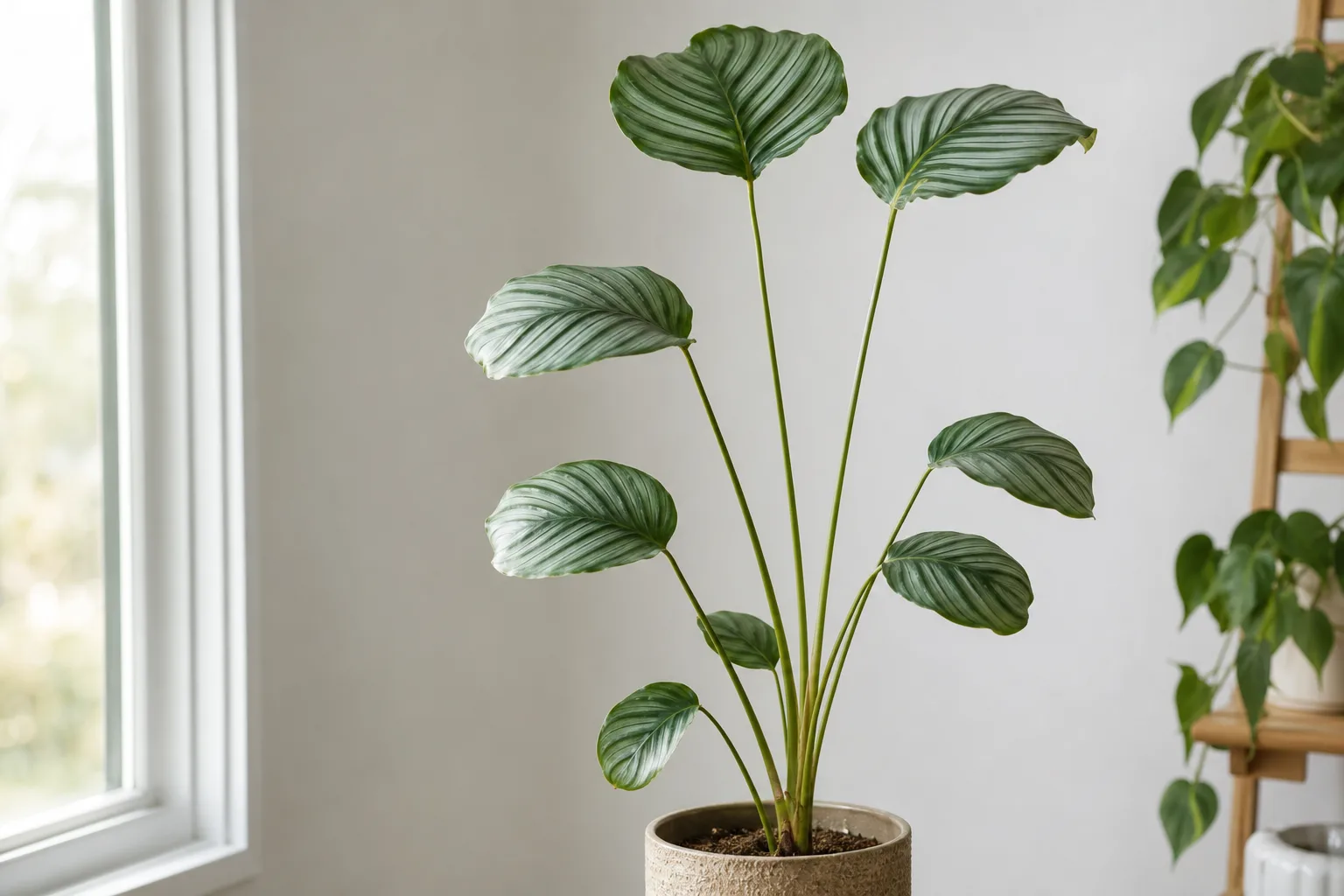
Leggy Calathea Orbifolia shows long thin petioles, smaller new round leaves, and a lean toward the brightest window-classic etiolation from insufficient light. First step: move the pot to the brightest filtered indirect spot in your home (not direct sun on the silver banding), then watch the next two new leaves for shorter stems and sharper banding.
Leggy Growth on Calathea Orbifolia: Causes, Checks & Fixes
This guide covers leggy growth on Calathea Orbifolia. See also the general Leggy Growth guide, watering, and light pages for this plant.
Leggy Growth on Calathea Orbifolia: Causes, Checks & Fixes
Quick answer
Leggy growth on Calathea Orbifolia is etiolation-the plant stretching toward usable light by building long thin petioles and smaller new leaves instead of the short-stemmed, oversized round blades with bold silver banding that make this species worth the extra humidity routine.
Orbifolia may survive in a dim hallway, but it will not stay compact there. The first fix is always more bright filtered indirect light, not fertilizer, Calathea Orbifolia repotting guide, or a batch prune.
First step: move the pot today to the brightest location that still keeps direct sun off the leaf surface-typically within a few feet of an east-facing window, close to a north window with clear glass, or several feet back from a south- or west-facing window behind sheer curtains. Rotate the pot a quarter turn weekly. Judge progress on the next two new leaves from the center, not on old stretched blades.
For window placement, shadow tests, and acclimation in depth, see not enough light on Calathea Orbifolia. This page is the stretch-and-prune anchor-how to confirm etiolation, trim permanently elongated leaves after light correction, and tell leggy growth from slow growth or overwatering.
Leggy growth vs. not enough light on Calathea Orbifolia
Both pages address etiolation from insufficient usable light, but they serve different reader intents:
| Your question | Start here |
|---|---|
| Where should I put the pot? Window distance and shadow test? | Not enough light |
| Should I cut stretched leaves? When? How much at the crown? | This page |
| Is long petiole stretch etiolation, rot, or just winter pause? | This page (lookalike table below) |
| Grow-light distance, hours, and bleaching warnings | Light guide and grow-light section below |
Leggy growth is what etiolation looks like on Orbifolia-elongated petioles, smaller new round blades, and a lean toward the brightest direction. The not-enough-light guide walks through the first light correction; this page picks up at recognition, confirmation, crown pruning after light is stable, and realistic reshape timelines.
What leggy growth looks like on Calathea Orbifolia
Leggy growth is not fast healthy vigor on Orbifolia-it is a low-light adaptation. The plant spends energy on petiole length (leaf stalks) rather than building the broad, patterned blades it is grown for.
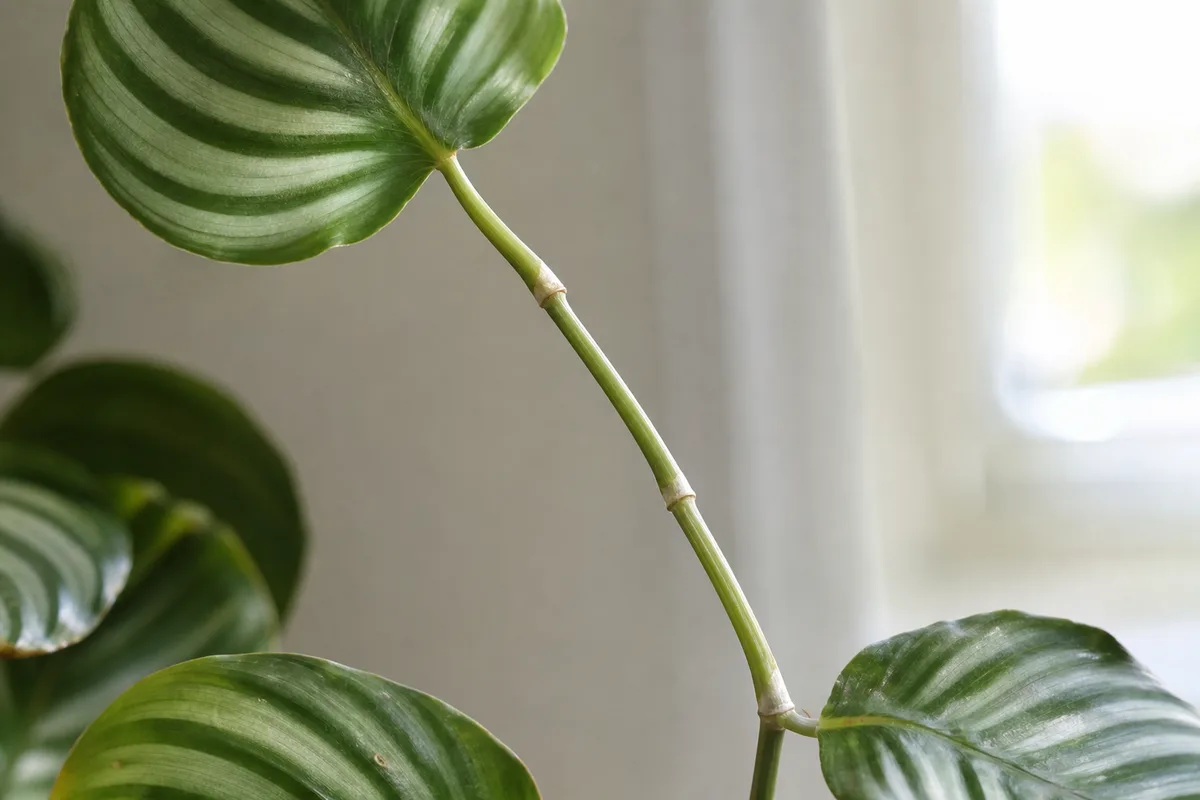
Leggy Growth symptoms on Calathea Orbifolia - compare with healthy tissue on the same plant.
Watch for these stretch patterns on new growth:
- Long, thin petioles holding leaves farther from the rhizome crown than earlier leaves-typical of plants reaching for more light indoors
- Smaller new round leaves than older ones, even though the pot has not been recently repotted
- A strong lean or one-sided habit as the clump grows toward the brightest direction
- Faded or muddy silver banding on the newest unfurling leaf-insufficient light dulls variegation before stretch becomes extreme
- Wide gaps between leaves along each petiole compared with compact nursery growth
- Slow center growth paired with continued outer stem extension-stretch without replacement leaves
- Reduced evening leaf folding-Orbifolia is a prayer-plant relative; nyctinastic movement weakens when light is too low for a clear day-night signal
Lower-leaf yellowing can appear alongside legginess, but it often traces to overwatering in a dim spot rather than stretch alone. When photosynthesis is weak, roots use less water, mix stays wet longer, and yellow lower leaves follow. Fix light first, then recheck Calathea Orbifolia watering guide.
Why Calathea Orbifolia stretches
Goeppertia orbifolia (still widely sold as Calathea orbifolia) evolved on the rainforest floor in eastern Brazil, where canopy-filtered light is bright in aggregate but never harsh on leaf tissue. Indoors, that translates to bright, indirect light or partial shade-not a shelf six feet from the only window.
When photons drop below what those large round leaves need:
- The plant elongates petioles to place blades closer to the light source-classic etiolation
- New leaves shrink because each blade is expensive to build; stretch is cheaper than full-size tissue
- Silver banding fades as chlorophyll increases to capture more light
- Water use falls, which makes Orbifolia’s moisture-retentive mix stay wet longer and compounds stress
Marketing often groups calatheas as “low-light plants.” Orbifolia may tolerate dim corners longer than a fiddle-leaf fig, but tolerance is not compact growth. In practice Orbifolia needs medium-to-bright filtered indirect light-roughly the 100–500 foot-candle zone at east or west windows, not the 25–100 foot-candle zone suited to snake plants. The RHS growing guide notes that poor, weak growth from low light is especially common in Goeppertia species-Orbifolia’s large leaf surface area makes that stretch visible faster than on compact cultivars.
Secondary stretch triggers include infrequent rotation (one-sided lean), crowding that blocks light to inner leaves, and short winter days without supplemental lighting. Fertilizer in low light can drive weak elongation without fixing the root cause.
Leggy growth vs lookalikes
| What you see | Likely cause | First check |
|---|---|---|
| Long petioles, lean to window, faded new banding | Leggy growth / low light (etiolation) | Window distance, shadow test, new leaf quality |
| No new center leaf for months but old leaves look fine | Slow growth - cold, dormancy, or chronic under-light | Season, temperature, whether stretch is absent |
| Yellow lower leaves, wet mix, sour smell | Overwatering - often in dim light | Top 2 cm dry-down, drainage, root firmness |
| Brown crisp edges with normal stem length | Low humidity or tap water - not legginess | Hygrometer, water source |
| Bleached patches on window-facing leaf half | Too much direct sun - opposite problem | Move back or filter; read light guide |
If symptoms match the first row and improve after two weeks in brighter filtered light, you have confirmed leggy growth from insufficient light.
How to confirm the cause
Work through this checklist before pruning or repotting:
- Window direction and distance - Note feet from glass and whether curtains filter rays. A spot more than six feet from the only window in a north room is usually too dim for compact Orbifolia.
- Shadow test at midday - Hold your hand between plant and window. A soft, fuzzy shadow suggests usable indirect light; no shadow means too dark; a hard dark shadow on leaves means direct sun that can bleach silver stripes. Appropriate light intensity supports compact foliage indoors.
- Petiole comparison - Measure or eyeball the last two new leaves against leaves from when you bought the plant. Longer stalks plus smaller blades confirm stretch.
- Lean direction - Strong growth toward one window confirms the plant is hunting photons.
- Soil dry-down - If mix stays wet ten or more days in the dim corner, low light may be slowing uptake; adjust watering after the light move.
- Season - Winter short days can pause growth; months of continuous stretch in the same spot is different from a brief winter pause.
First fix: improve light without scorching silver banding
Move the pot to brighter filtered indirect light today. That is the only first fix that stops new stretch.
Use the Calathea Orbifolia light guide for full window-by-window placement. The essentials for a leggy plant:
- Pick the brightest filtered spot where direct sunbeams never land on the silver banding for more than brief gentle morning minutes
- Acclimate gradually over three to five days if coming from a very dark room-shift one foot closer to the target window each day
- Rotate the pot a quarter turn every week so the clump does not lean permanently to one side
- Recheck watering so the top 2 cm dries on Orbifolia’s normal rhythm in the brighter spot-roughly every 5–7 days in active growth
Direct sun can scorch Orbifolia leaves and bleach silver patterning within days; do not “fix” legginess with unfiltered south-window sun.
Grow-light setup when windows are not enough
If the brightest window still produces stretch after two weeks, or winter days drop below useful natural light, add supplemental illumination rather than accepting elongated petioles.
- Fixture: Full-spectrum LED grow light aimed at the full crown, not just one side of the clump
- Distance: 18–24 inches above the foliage-consistent with the Orbifolia light guide. Closer risks bleaching silver stripes; farther lets petioles keep stretching toward the bulb
- Duration: 10–12 hours daily on a timer, combined with whatever natural window light you have
- Cap: Keep total daily light under about 16 hours when supplementing
- Adjust: Raise the fixture if new leaves bleach; lower slightly if petioles still lean toward the bulb after one week
The RHS growing guide recommends artificial grow lights when natural light is insufficient-especially for Goeppertia species prone to weak stretch indoors.
Recovery vignette: A home grower moved a stretched Orbifolia from a north-facing hallway (roughly six feet from glass) to within two feet of an east window in early March. The first new rolled leaf opened three weeks later with a noticeably shorter petiole; the second leaf at week five showed sharper silver banding-matching the typical two-leaf proof window described in extension etiolation guidance.
When to prune stretched leaves at the crown
Light correction stops new stretch; it does not shorten old petioles. Once at least one improved new leaf has opened with shorter stems and sharper banding, you can remove the worst stretched outer leaves for aesthetics.
Orbifolia does not branch from mid-leaf cuts. Follow each long petiole to the rhizome crown and cut flush at the base with sterilized snips-never through the middle of the round blade. The RHS Calathea growing guide advises removing faded or dead stems just above the compost; the same crown cut applies to live but permanently stretched leaves you no longer want in the display.
Rules from the Orbifolia pruning guide:
- Remove all clearly dead or yellow leaves on Calathea Orbifolia any time
- Limit healthy or partly green leaf removal to about one-third of total foliage in one session during spring through early summer
- Do not heavy-prune in winter or immediately after repotting
- Never pull resistant yellow leaves-cut cleanly when fully spent
- Sterilize snips between cuts on different plants if you grow multiple calatheas-sap-sucking pests spread easily across prayer-plant shelves
Pruning without improving light produces repeat legginess on the next leaves. Fix photons first, then groom.
Recovery timeline
Expect subtle improvement within two to three weeks and clearer proof on the second new leaf after the light move-shorter petiole, rounder blade, sharper silver stripes.
Old stretched leaves keep their shape permanently. Judge success on center growth, not the oldest blades. Aesthetic recovery may require waiting for several new leaves or selective crown pruning after light is stable.
Signs you are on track:
- A new rolled leaf emerges from the center
- Petioles on the newest blade are shorter than the last weak leaf
- Silver banding on fresh growth looks closer to nursery quality
- Soil dries on a predictable schedule again
Signs the problem is worsening or another issue is involved:
- Continued stretch with no new center leaf after six weeks in brighter light during growing season
- Yellowing spreading up the plant while soil stays wet-inspect roots
- Bleached or crispy patches on leaf faces-pull back from direct sun
- Sticky residue or webbing-pests, not light alone
Winter recovery can take longer even after a light upgrade; a grow light during dark months often speeds the first compact leaf.
What not to do
- Prune heavily before fixing light-new leaves will stretch again in the same dim spot
- Jump from a dark corner to unfiltered south-window sun-silver variegation bleaches fast
- Fertilize a stretched plant to “wake it up”-salts stress roots without replacing photons
- Repot immediately when placement is the real issue-unnecessary root disturbance adds shock
- Strip more than one-third of live foliage at once during active grooming
- Assume rapid stem extension equals healthy growth-on Orbifolia it usually signals etiolation
- Water on the old schedule after a light upgrade without checking dry-down
How to prevent leggy growth on Calathea Orbifolia
- Choose placement for photons first, décor second-Orbifolia is a statement plant that needs a real window or quality grow light
- Rotate the pot weekly so stems do not lean permanently to one side
- Clean windows inside and out once or twice a year; grime cuts usable light
- Re-evaluate in October and February when sun angle and day length shift
- Add a grow light in rooms where foot-candles stay low year-round
- Watch the newest leaf monthly-longer petioles and dull banding are early warnings before stretch becomes severe
- Match watering to light level-dim corners keep mix wet longer; brighter spots need the normal Orbifolia rhythm
Related Calathea Orbifolia problems
- Not enough light - comprehensive light diagnosis when fade and stall accompany stretch
- Calathea Orbifolia light - window placement, grow lights, and warning signs
- Pruning Calathea Orbifolia - safe crown cuts and one-third removal limits
- Slow growth - stalled center growth without extreme petiole elongation
- Overwatering - yellow lower leaves when dim light slows dry-down
- Calathea Orbifolia overview - species biology and baseline care
When to use this page vs other Calathea Orbifolia guides
- Calathea Orbifolia watering guide - Use for routine moisture checks before assuming leggy growth is the main issue.
- Calathea Orbifolia problems hub - Browse all 16 common issues on this species.
- Not Enough Light on Calathea Orbifolia - Different entry point when symptoms overlap with leggy growth.
- Slow Growth on Calathea Orbifolia - Different entry point when symptoms overlap with leggy growth.
- Yellow Leaves on Calathea Orbifolia - Different entry point when symptoms overlap with leggy growth.