Leggy Monstera: Causes and Fixes for Fuller Indoor Growth
Fix a leggy Monstera with better light, pruning, support, rotation and propagation strategies for fuller growth.
Quick answer: fix the conditions before the shape
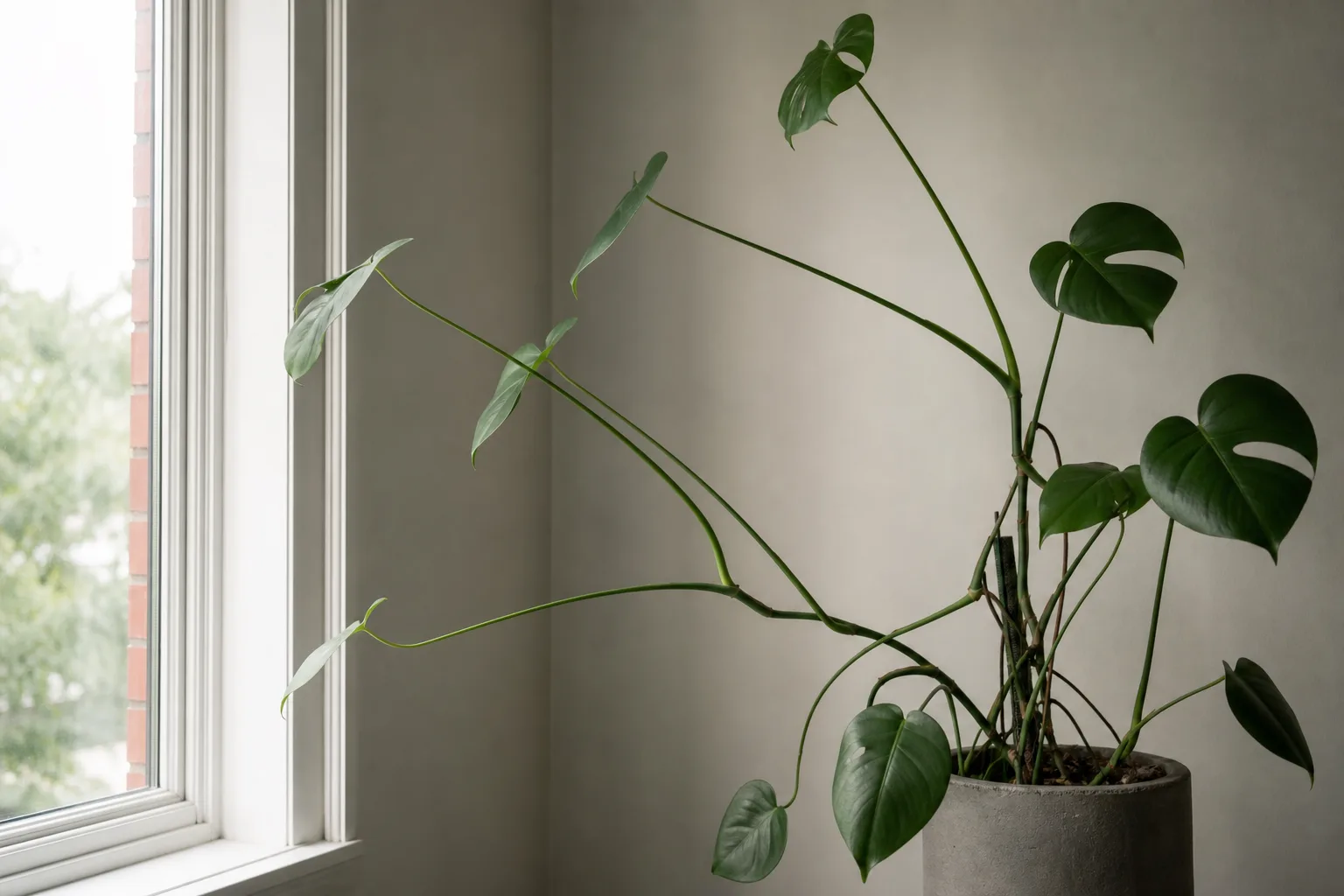
A leggy Monstera deliciosa has increasingly long bare stem sections between leaves, often with smaller new blades, a lean toward the brightest window, and an unsupported vine that sprawls instead of climbing. Penn State Extension states directly that Monstera becomes leggy in lower light, while University of Maryland Extension explains that insufficient light can make indoor plants stretch and lean toward a one-sided source. The visible shape is the result; light and structure are the first variables to correct.
Use this order:
- Compare the newest internodes with older internodes on the same vine.
- Rule out wet-soil and soft-stem trouble before treating the issue as cosmetic.
- Move the canopy gradually into stronger bright, indirect light.
- Add stable vertical support, then prune only if old bare sections still spoil the shape.
- Root node-bearing cuttings and replant them if you want a fuller pot.
Existing stretched sections will not compress. Recovery appears in the next leaves and internodes, while pruning and propagation change the old structure. For a detailed symptom comparison and measurement walkthrough, use the Monstera leggy-growth diagnostic; this guide focuses on the complete five-step recovery workflow.
What “leggy” means on Monstera deliciosa
Legginess is a trend, not a single awkward leaf. Look for a run of new growth with wider spaces between leaves, thinner or longer petioles, smaller blades, reduced fenestration on a previously mature vine, and a directional reach toward a window. University of Maryland Extension describes low-light indoor growth as spindly or leggy and notes that one-directional light can create a lean.
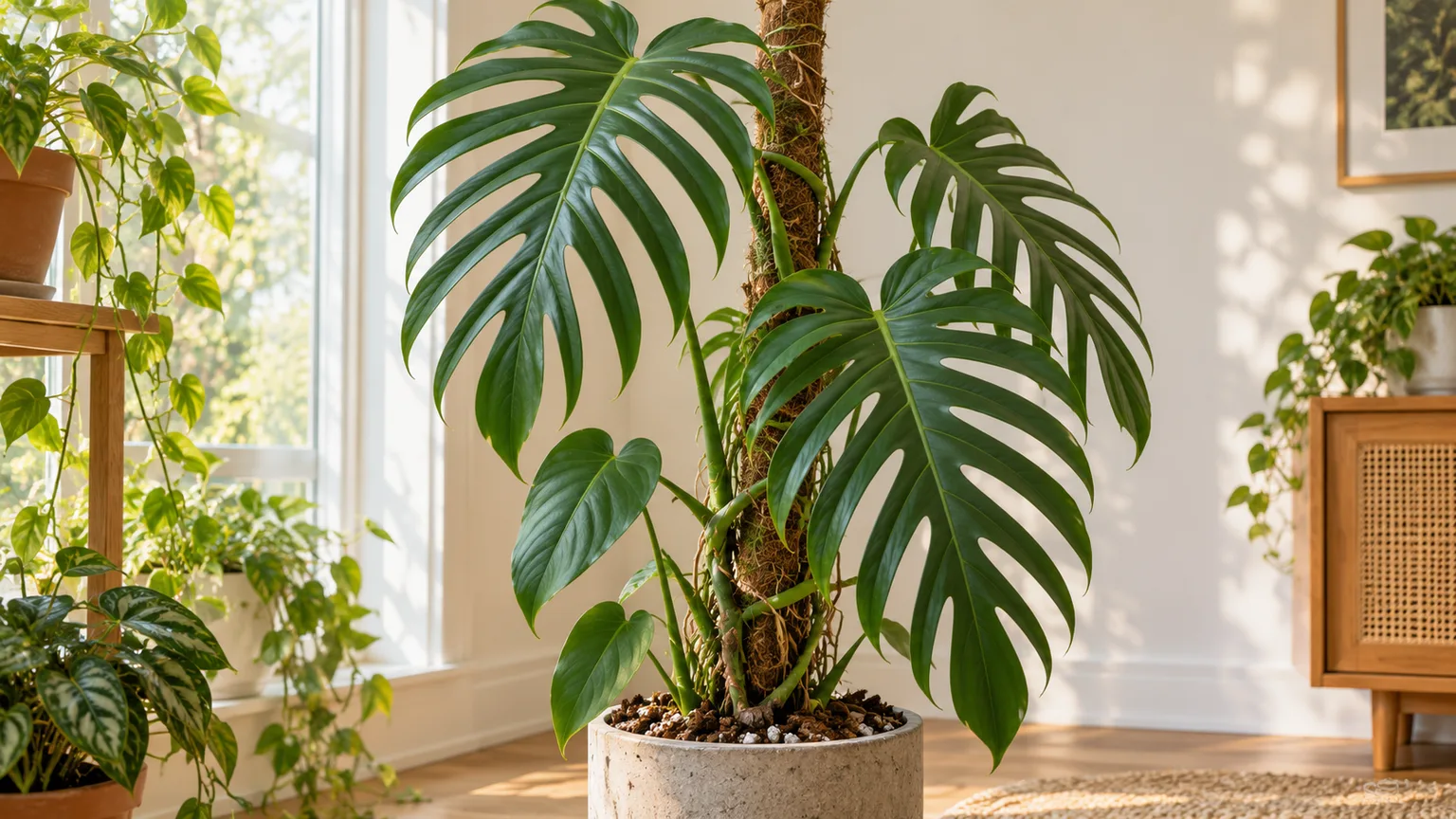
 Do not confuse normal vine architecture with failure. Monstera deliciosa is a climbing plant, not a compact shrub. NC State Extension describes it as a climbing vine with aerial roots and recommends sturdy support for indoor specimens. A healthy plant can therefore look open, especially if one stem is grown vertically; the concern is a clear deterioration in spacing, leaf size, or balance under your current conditions.
Measure internodes on the same vine
An internode is the stem between two nodes, and each node is a point where a leaf and potential bud arise. Lay a flexible tape along the main stem and record the last three completed internodes. Then compare their average with three mature internodes lower on that same vine. If the new run is consistently much longer and the leaves are smaller, the plant is stretching.
The stronger plant-care diagnostic gives an example benchmark of 8–15 cm on newest growth versus 3–5 cm on older growth, but treat those numbers as a flag rather than a universal rule. Age, cultivar, season, support, and previous growing conditions change normal spacing. The same-stem comparison is more useful than declaring every internode above one number defective.
Why Monstera deliciosa gets leggy
The usual cause stack is weak usable light plus absent or ineffective climbing support. Watering, pot size, and feeding do not usually create etiolation by themselves, but they can weaken roots or produce disappointing growth while the light problem continues. Diagnose the stack rather than reaching for one universal fix.
Too little usable light is the primary cause
Room brightness is a poor proxy for leaf-level light. The canopy may sit well above or beside the window even when the pot looks close to it, and light intensity falls rapidly with distance from the source. University of Maryland Extension identifies intensity, duration, and quality as separate parts of indoor light and connects light intensity with stem length, leaf size, and photosynthesis.
Penn State recommends a position near a sunny window with bright light but not harsh direct sun and specifically warns about legginess in lower light. If the plant leans, produces progressively smaller leaves, and stretches while soil also dries more slowly, begin with the Monstera light requirements guide or the detailed Monstera light care page rather than adding fertilizer.
Missing support makes a climber look sparse
In tropical forests, Monstera climbs and anchors with aerial roots. The RHS growing guide explains that stem roots attach to trees and that a moss-covered pole can replicate this support indoors. Wisconsin Horticulture likewise recommends a strong moss-covered support for the aerial roots of vigorous specimens.
Support does not cure etiolation in a dim room. It gives the vine a useful direction, prevents heavy stems from sagging, and keeps successive leaves positioned where they can receive light. A pole in bad light can make a stretched vine tidier, but it cannot make the next internode compact without improving the energy supply.
Watering, pot size, and fertilizer can compound the problem
Low-light plants generally use water more slowly, so a routine that worked beside a brighter window may keep the root zone wet after a move. Penn State advises thorough watering followed by allowing the upper 1–2 inches of soil to dry and warns that overwatering can cause root rot. The exact drying point varies with pot depth and mix, so check the root zone rather than watering on a fixed weekday.
An unnecessarily large pot adds a volume of mix that a modest root system cannot dry quickly. The RHS advises moving Swiss cheese plants only into a container a few centimetres larger and warns against significantly oversized pots. Fertilizer also cannot substitute for photons: feeding a light-limited plant does not shorten existing internodes, so correct placement before changing the feeding program.
Can a leggy Monstera recover?
Yes, if recovery means better future growth and a deliberately rebuilt silhouette. Stronger light can produce more compact new sections; support can organize the vine; pruning can remove an objectionable bare run; and propagation can turn viable nodes into additional stems. None of those actions makes old stretched tissue shorter.
Separate mild and severe cases. A mildly stretched, healthy vine may only need better light and a stable pole. A plant with a long bare base may need a top cutting, several node cuttings, or multiple rooted cuttings returned to the pot. If your real goal is density rather than a single climbing specimen, the guide to making a Monstera bushier explains why multiple rooted stems usually create that look more reliably.
Diagnose before you cut
Inspect the plant in this sequence: recent internode spacing, new-leaf size, direction of lean, actual canopy-to-window distance, support stability, stem firmness, pot weight, and drainage. A stretched vine with firm stems and a normally drying mix supports a light-and-structure diagnosis. A plant that has stopped growing, is losing leaves rapidly, or stays wet for many days needs a broader root-zone check.
Also check maturity. Wisconsin Horticulture notes that juvenile plants naturally have smaller leaves without lobes or holes. A young plant with solid heart-shaped leaves is not necessarily light-starved. Concern rises when a previously maturing vine reverses course across several nodes, especially when wider spacing and smaller leaves arrive together.
Wet soil and soft stems change the priority
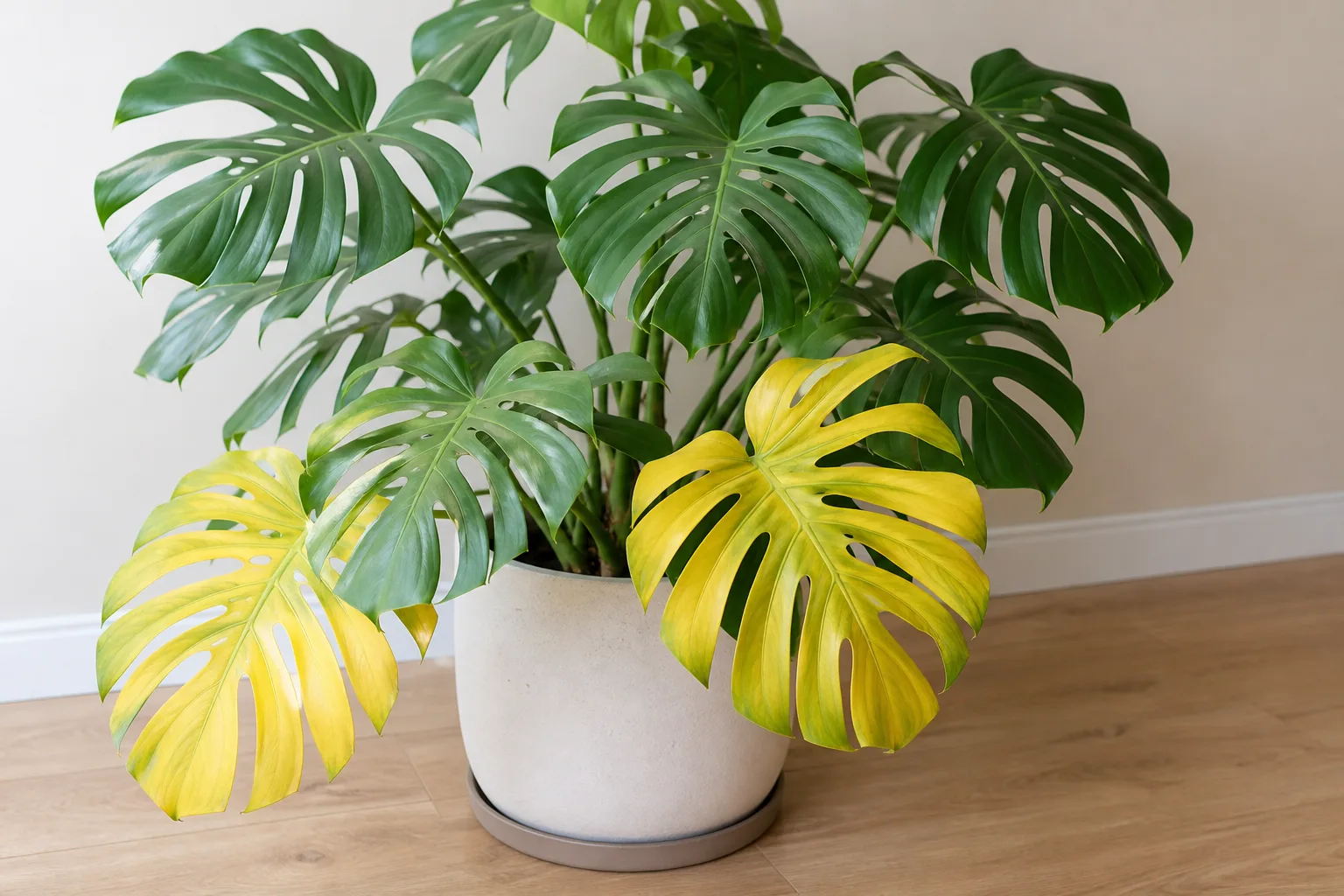
Leggy growth alone is not an emergency. Persistently wet mix plus a soft stem base, spreading yellow leaves, a sour smell, or rapid collapse is different. UF/IFAS notes that Monstera is not tolerant of flooded or excessively wet soil, and Penn State connects overwatering with root rot. Stop treating the plant as a styling project and inspect drainage and roots promptly.
Use the Monstera root-rot guide if stems soften or roots are brown and mushy. Delay major shape pruning until viable roots and firm stem tissue are identified. A healthy top cutting may sometimes preserve the plant when the base is failing, but use clean tools and keep visibly diseased material away from propagation media.
Step 1: improve light without scorching the leaves
Move the leaf canopy, not merely the pot, toward stronger indirect light. An east window is a forgiving starting point. A south or west exposure may work behind a sheer curtain or at a tested distance, but direct midday sun can damage foliage. University of Maryland Extension advises using distance or light shade to protect houseplants from excessive summer sun.
Acclimate a plant coming from deep shade. Move it closer in stages over roughly one to two weeks and inspect exposed leaf surfaces for pale or brown patches. Wisconsin Horticulture specifically warns that indoor Monsteras moved into higher outdoor light need gradual acclimation to avoid sunburn; the same conservative principle applies when making a large indoor exposure change.
Judge the correction by the next two or three leaves. Record internode length, leaf width, and the direction the new petiole faces. This simple log is more useful than waiting for old leaves or stems to change, because they will not reverse their established form.
Use a grow light when the window cannot do the job
If an office or north-facing room cannot provide enough natural light, artificial light is a practical fallback. University of Maryland Extension says artificial lighting can improve plant growth when available natural light is unsuitable. Choose a broad-spectrum horticultural fixture, follow the manufacturer’s distance guidance, and measure at the top and lower canopy because a tall Monstera can receive very different intensities across its leaves.
Start conservatively and increase duration or proximity while watching for heat and bleaching. Avoid running a lamp around the clock; University of Maryland Extension advises no more than 16 total hours of illumination because plants need darkness as part of normal development. The detailed grow-light guide for indoor plants covers placement and measurement without turning this recovery guide into a lighting manual.
Step 2: add support and train the vine
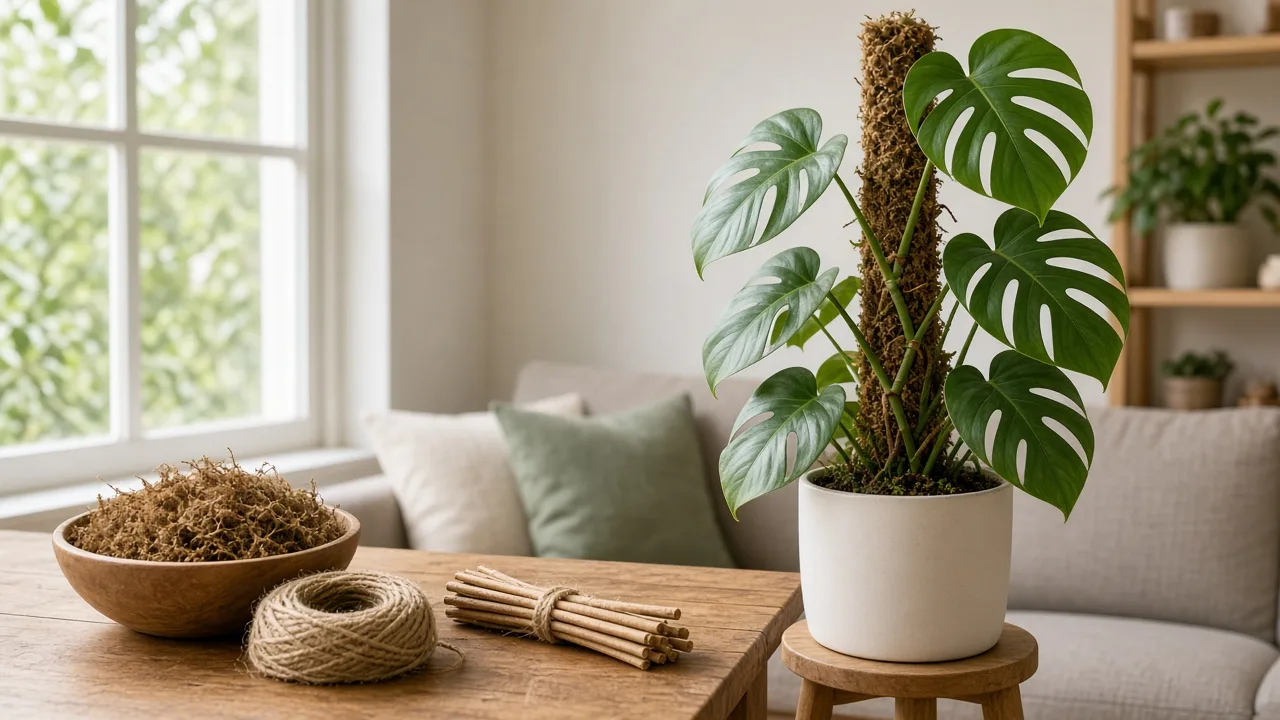
Install support before the plant becomes too top-heavy to handle safely. Place the pole behind the stem, with the side bearing aerial roots toward the support. Secure the main stem loosely with soft ties; do not bind petioles, because they need freedom to orient their leaves toward light.
The support must be stable in the pot. A short pole in loose mix can lever against roots and tip with the plant. For a large specimen, anchor support during a justified repot rather than repeatedly pushing stakes through an established root ball. The Monstera care hub links to repotting, soil, and support-related care when the container itself is part of the stability problem.
Moss pole vs stake vs plank
| Support | Best use | What it does well | Limitation |
|---|---|---|---|
| Bamboo or rigid stake | Short-term stabilization | Cheap and easy to install | Offers little surface for aerial-root attachment |
| Coir or moss pole | General indoor climbing | Guides vertical growth and offers a textured attachment surface | Must be stable; some poles need moisture management |
| Wood or bark plank | Large, controlled specimens | Strong, simple vertical plane | Bulky and less adjustable in small rooms |
| Trellis | Several stems in one pot | Spreads stems across a wider support | Can encourage a broad rather than upright display |
RHS and Wisconsin both support using a moss-covered pole or similar sturdy structure. Select by plant size and the display you want, not by the claim that one material will automatically produce bigger leaves. Light, attachment, root health, and time still govern the result.
Step 3: prune only after conditions improve
Do not remove a large share of foliage from a light-starved or root-stressed plant and then expect a fast response. Improve light, stabilize watering, and give the plant time to resume active growth. Then decide whether support alone makes the existing vine acceptable or whether the bare section should be removed.
For the parent plant, make a clean cut just above the node you want to retain. For a propagation piece, the cutting must include a node and preferably an axillary bud. University of Minnesota Extension explains that leaves and petioles without a node and axillary bud do not produce new growth, and its illustrated method places a propagation cut 1–2 inches below the node.
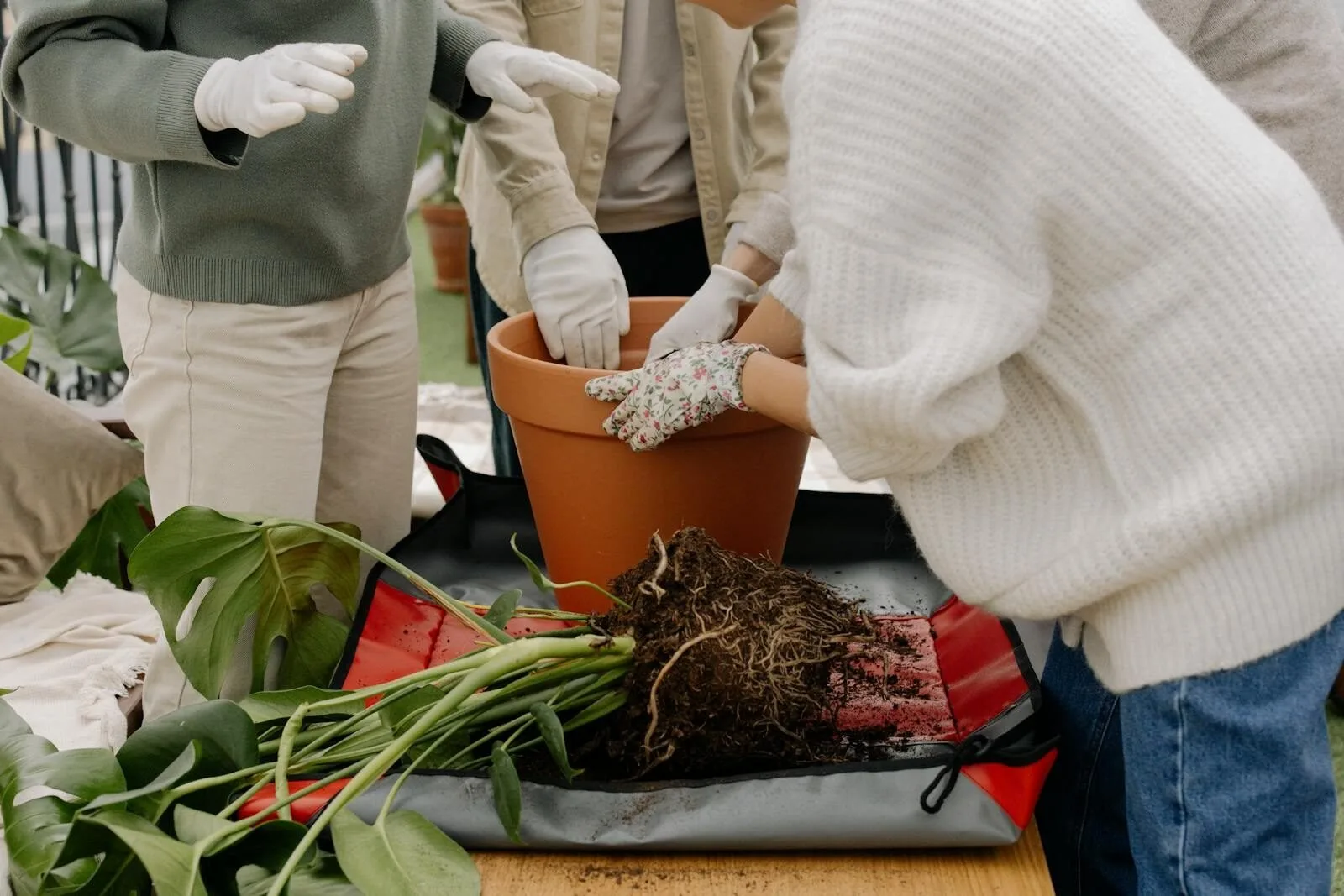
Use clean, sharp tools and gloves. The RHS advises gloves because Swiss cheese plants contain toxic compounds, and the ASPCA identifies Monstera deliciosa as toxic to dogs and cats due to insoluble calcium oxalates. Keep cut pieces and sap away from children and pets; if a pet chews the plant, contact a veterinarian or animal poison service rather than relying on home remedies. For cut placement and aftercare in more detail, use the Monstera pruning page.
Step 4: propagate bare sections with viable nodes
Propagation is the structural reset for a vine whose old spacing is too sparse to keep. Preserve a healthy top cutting, then divide a longer bare stem only where each section has a viable node. Mark the original top and bottom before cutting so each section is oriented correctly.
University of Minnesota Extension supports stem cuttings, air layering, and division when a node is present. It reports that roots can form in about two to four weeks, while propagated nodes may take two to three months to form new leaves. Those ranges are useful planning windows, not deadlines; temperature, season, light, tissue condition, and medium all change the pace.
Replant only after healthy roots have formed and active growth is evident. Several rooted cuttings can return to the parent pot to create a fuller display, provided the container has room and drainage. The Monstera propagation page covers water, moss, and air-layering methods, while the Monstera propagation guide provides a shorter decision overview.
Step 5: reset care and judge only new growth
After the move and structural work, water according to drying rather than the old schedule. Better light can increase water use, while a reduced plant or newly rooted cutting may use less. Check the mix and pot weight, water thoroughly when appropriate, and let excess drain. The species-specific Monstera watering page gives a fuller moisture-check workflow.
Do not increase fertilizer to force recovery. Resume a moderate program only when the plant is actively producing healthy growth and roots are sound. Rotate the pot only enough to balance exposure without repeatedly turning the climbing face away from its pole.
Track three things for the next leaves: internode length, leaf size, and stem direction. A successful correction produces a consistent trend toward tighter spacing and better orientation. Fenestrations may improve later on a mature vine, but juvenile leaves and previously formed foliage will not be rewritten by the new routine.
Related Monstera guides
- Leggy-growth diagnostic - compare internodes and separate etiolation from lookalike problems.
- Monstera light requirements - choose a window position and measure usable light.
- Monstera pruning - plan node placement, removal limits, and aftercare.
- Monstera propagation - select a method and pot up rooted cuttings.
- Monstera watering - adjust moisture checks after changing light or plant mass.
Practical questions about leggy Monsteras
How do I make my Monstera deliciosa bushier? Improve light first, then root node-bearing cuttings and return several established stems to a suitably sized pot. One vine is naturally open; multiple vines create the fuller container look.
Will old leggy stems become shorter or fuller on their own? No. Existing internodes remain their current length. Better conditions change subsequent growth, while pruning or propagation changes the old silhouette.
Does a moss pole fix a leggy Monstera? It fixes direction and support, not inadequate light. Use a pole with brighter usable light; otherwise the vine can continue stretching vertically.
Should I repot a leggy Monstera? Only when roots, drainage, or stability justify it. A larger pot is not a treatment for etiolation and can make moisture control harder when oversized.
Can I propagate a Monstera from one leaf? Not from a leaf and petiole alone. University of Minnesota Extension states that new growth requires a stem node and axillary bud.
Conclusion
Fix the environment before editing the plant. Measure the newest internodes, rule out wet-root trouble, improve light gradually, and give this natural climber stable support. Then prune or propagate only as much old stretched structure as the final shape requires.
The decisive evidence is new growth. If the next leaves emerge closer together, larger, and better oriented, the correction is working. If the mix stays wet, stems soften, or decline accelerates, stop waiting for cosmetic improvement and investigate the roots.