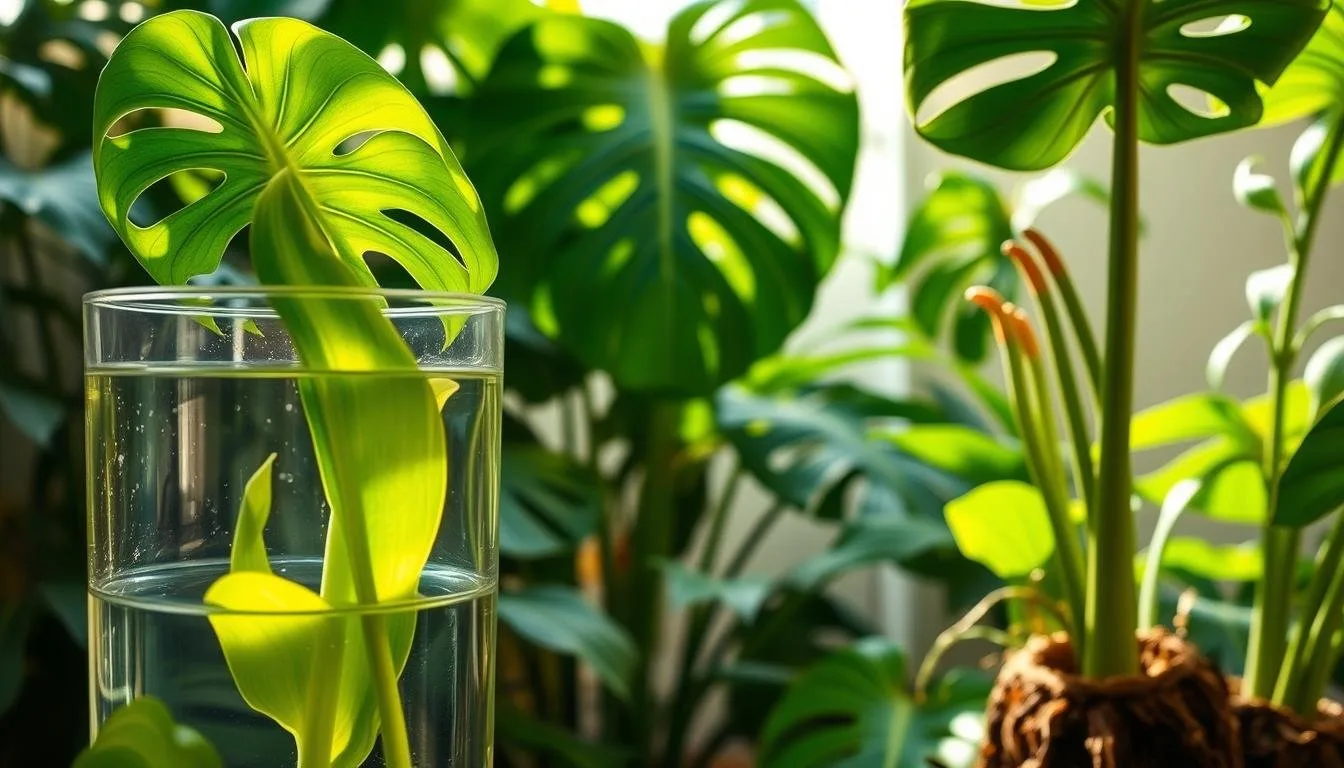
How to Make a Monstera Bushier: 9 Fixes for Fuller Growth
Make your Monstera look fuller with pruning, rotation, support, light improvements, potting fixes and propagation tips.
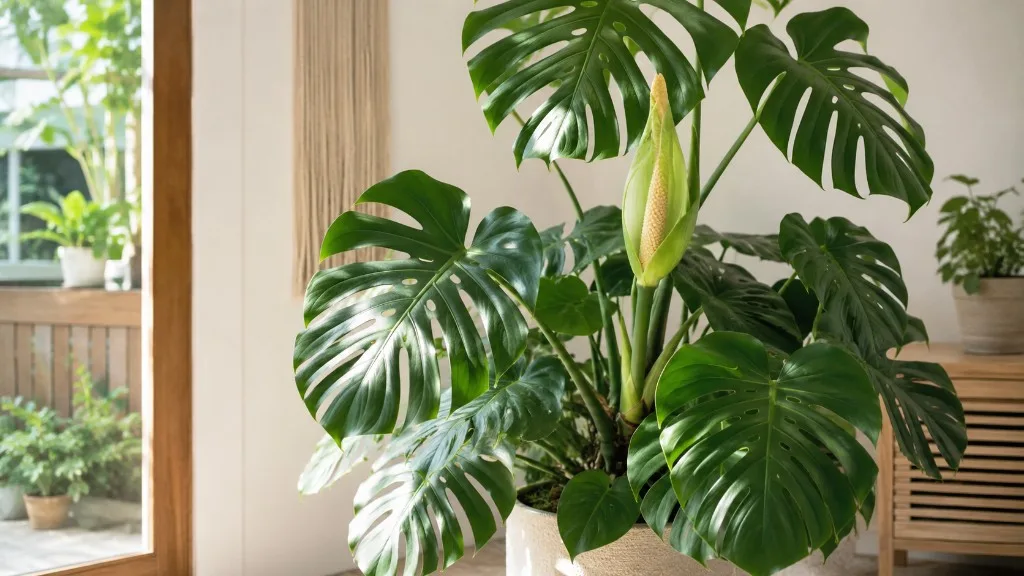
Quick answer
The fastest way to make a Monstera deliciosa look bushier is to stack three moves in order: improve bright indirect light, prune one leggy growth tip above a node, and root cuttings to plant back into the same pot. Light tightens future internodes and improves leaf size. Pruning redirects energy and gives you propagation material. Replanting rooted sections adds active stems the original vine cannot produce on its own.
This guide is the holistic shaping playbook - how climbing biology, light, pruning, propagation, and support work together for a fuller silhouette. For step-by-step cut placement, see Monstera deliciosa pruning. For rooting timelines and method details, see the Monstera propagation guide and propagation topic page. If stretch is your main symptom, start with leggy growth on Monstera deliciosa.
Why your Monstera looks sparse before you fix anything
A lot of people ask how to make a Monstera bushier when what they are really seeing is a plant that looks leggy, sparse, top-heavy, or one-sided. That matters because the fix depends on the real problem. A Monstera stretching for light needs a different solution than a healthy climber that simply has one long vine and an empty pot rim.
The less-fun truth: you usually get fullness through better light, pruning, support, and propagation, not one magic trick. The fastest visual upgrade almost always comes from growing multiple rooted vines together or taking cuttings from your existing plant and planting them back into the same container once they root. That is the piece many thin articles skip.
Climbers, not shrubs - the biology behind fullness
Monstera deliciosa is a climbing aroid, not a naturally branching houseplant that wants to form a dense mound. RHS describes Swiss cheese plants as climbers that benefit from training onto a moss pole. NC State Extension notes that Monstera species use aerial roots to attach and climb toward better light in their native habitat. That habit explains why one vine often moves upward and forward, not outward into a neat, bushy dome.
You are not trying to turn a Monstera into a pothos basket or a compact peperomia. You are shaping a climber so it appears fuller from the front, produces shorter internodes, develops larger leaves, and fills visual gaps near the soil line. That is a realistic goal - and it leads to better decisions.
What “bushier” actually means on Monstera deliciosa
In practical terms, a bushier Monstera usually means four things: more leaves visible at once, tighter spacing between leaves, fuller coverage near the soil line, and a more balanced silhouette. You get that by reducing stretching, encouraging new active growth, and adding more rooted growth points to the pot.
So here is a simple definition: a bushier Monstera is a healthier, better-lit, better-supported plant with more active stems per pot. Pruning helps. Better light helps more than most people think. A support pole changes the look because once a Monstera climbs, it often produces larger, more mature leaves with more fenestrations - Wisconsin Horticulture links missing splits to inadequate light and maturity, while support helps the plant reach that mature climbing form indoors.
9 fixes that make a Monstera bushier
These nine fixes match the title promise. They are ordered roughly by impact: fix the environment that controls growth quality first, then shape, then multiply stems in the same pot.
Fix 1: Move to brighter indirect light
If your Monstera sits in a dim corner, it will not become bushier because you fertilize it or repot it into a prettier container. RHS recommends indirect light - east- or west-facing windows or a bright room away from harsh direct sun - and notes that in very low light leaves tend to have fewer holes.
The practical read: if stems are long, bare in spots, and leaning hard toward one window, your Monstera is spending energy reaching, not filling in. Move it closer to bright filtered light, or add a grow light if the room is dark. You are trying to shorten future internodes and increase leaf size. For measurable light bands and window placement, see Monstera deliciosa light requirements and the Monstera light requirements guide.
Fix 2: Let tighter internodes form before you prune
Pruning a light-starved vine before light improves often stalls recovery. The leggy-growth problem page for Monstera deliciosa recommends improving bright indirect exposure first, waiting two to three weeks, then cutting elongated bare sections once the next leaf opens with tighter spacing.
Existing stretched internodes never shorten on their own - only new growth can look compact. Judge progress on the next two or three leaves, not on old bare stem length.
Fix 3: Install a moss pole early
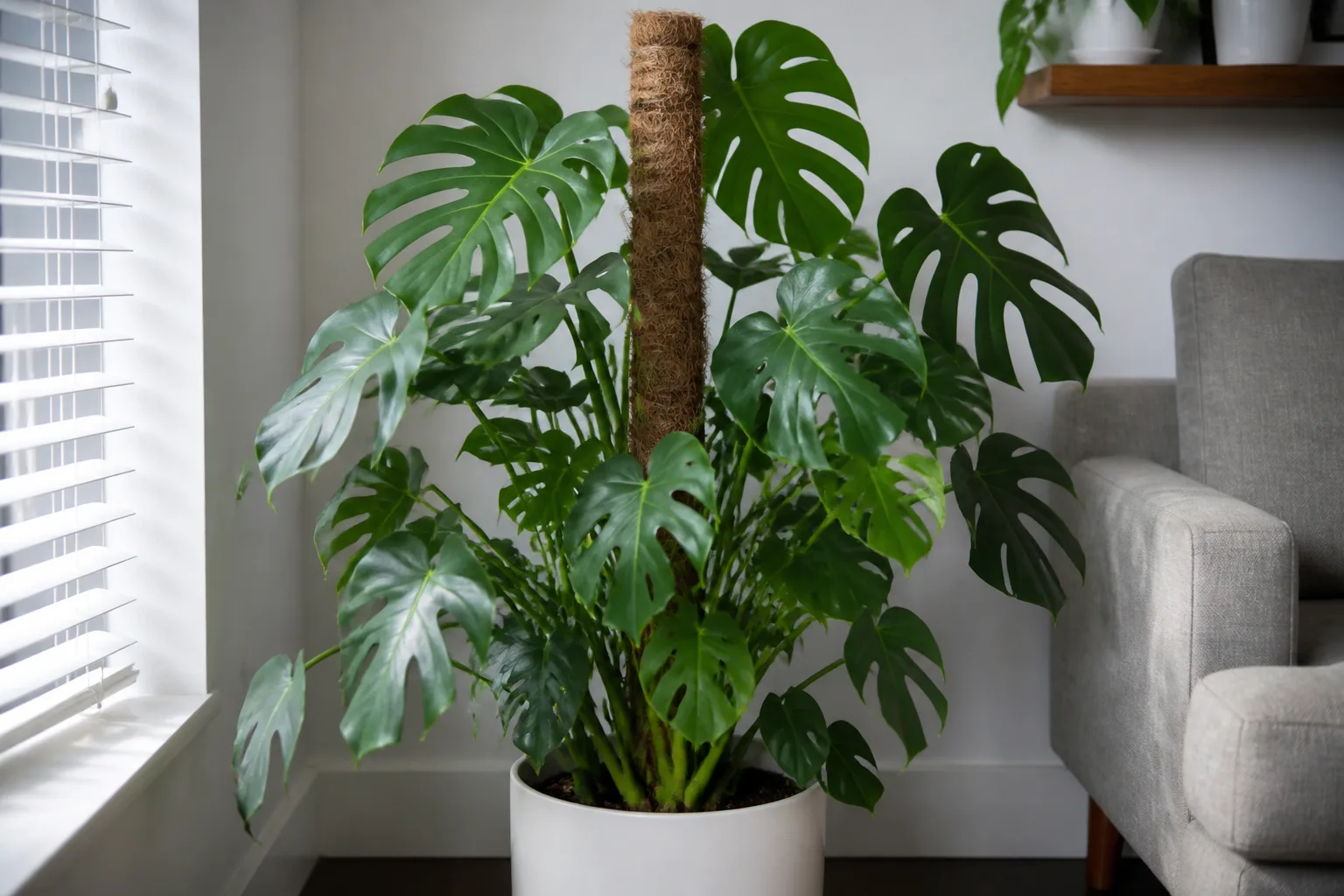
A moss pole is not just decorative. RHS says Swiss cheese plants benefit from training onto a moss pole and that climbing plants often produce larger, more mature leaves with more fenestrations once supported. NC State describes Monstera deliciosa as needing sturdy support to prevent stems from breaking as vines lengthen.
Support helps you stack growth vertically from the viewer’s perspective, gives aerial roots something to engage, and reduces the floppy sparse look of an unsupported vine. For aerial-root behavior and training details, see the Monstera aerial roots guide.
Fix 4: Prune the growing tip above a node
Yes, pruning can make a Monstera look bushier - with an important limit. Removing the top growing tip can redirect energy and wake lower growth points. It does not magically turn a climbing vine into a naturally branching shrub. RHS advises spring pruning if the plant outgrows its space.
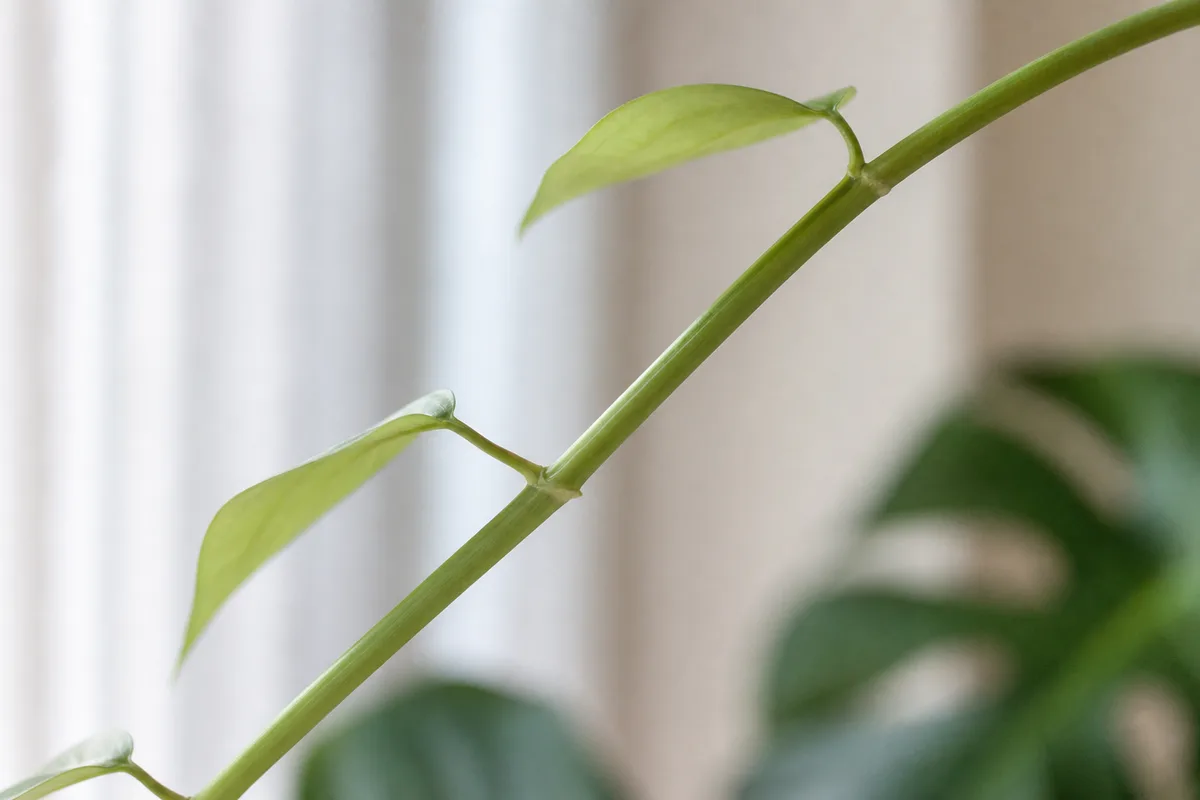
Cut just below a node if you want a viable cutting. University of Minnesota Extension is clear: a cutting without a node and axillary bud will not produce new growth. Do not randomly remove leaves - cut with a reason: shorten a leggy top, remove awkward empty stem length, or create material for a denser pot later. Full cut-placement walkthrough: Monstera deliciosa pruning.
Editorial diagram: cut 6–10 mm below the node bump, not through the leaf petiole. The node - not the leaf alone - is where new roots and shoots originate.
Fix 5: Propagate stem cuttings with nodes
Propagation is where “healthy” turns into “visibly fuller.” UMN Extension supports stem cuttings, air layering, and division for Monstera as long as each piece includes a node. UConn’s Monstera factsheet adds that vines with established aerial roots can often be buried within a couple of inches of the first leaf node with high success.
Water propagation is the easiest entry point for beginners because you can see root development. Air layering is slower but lower-risk on valuable mature vines because rooting begins before the stem is severed. Method-by-method detail lives on the Monstera propagation guide.
Fix 6: Replant rooted cuttings in the same pot
If you want the biggest visual upgrade, this is it. A single Monstera vine can look elegant, but it often will not look thick near the base. Propagating a healthy stem cutting and replanting it into the original pot adds another active stem, another leaf source, and another visual layer.
Once rooted - often two to six weeks in water for healthy cuttings in warm bright conditions, though soil and air-layer timing vary - place the new section strategically to fill gaps or balance the lean of the original vine. Many impressive indoor Monsteras are not one perfectly behaved stem. They are multiple vines arranged well in the same container.
A fuller pot is great, but do not pack too many large vines into one container and ignore root competition forever. Two or a few well-placed stems can look lush. A crowded pot of mature plants becomes a watering and repotting headache. Bushy should still be manageable.
Fix 7: Match potting mix and pot size to the root zone
A Monstera buried in dense, soggy mix or sitting oversized in a wet pot is not positioned to produce strong compact growth. RHS recommends peat-free, loam-based compost in bright indirect light and warns against rushing into oversize pots when repotting.
For fullness, roots need air and moisture at the same time - not dry forever, not swampy. A chunky indoor aroid mix with decent drainage and a pot that fits the rootball sensibly gives you better odds of active growth. Soil specifics: Monstera deliciosa soil guide and how to do Monstera soil mix.
Fix 8: Fertilize only during active growth
People often try to “push” a fuller Monstera with more fertilizer, but fertilizer is not a substitute for light or root health. RHS recommends a balanced liquid fertilizer monthly when the plant is in growth. Penn State Extension warns that excess fertilizer can cause browning tips, yellowing, and salt buildup.
Use feed as support during active growth, not a shortcut in a dark room. Heavy feeding in poor light usually creates stress, not lushness. Humidity matters as a supporting factor - see Monstera humidity needs - but it does not fix poor lighting or overwatering.
Fix 9: Rotate and train for a balanced silhouette
Placement matters almost as much as support. Put the fullest side where you see it most. Rotate the pot weekly if one window pulls all growth in a single direction. Keep the plant away from harsh direct sun that scorches foliage, but do not confuse “avoid scorching” with “keep it in a dim corner.”
Tie vines gently to the pole, guide aerial roots toward moss or mix, and keep the pole slightly moist if you want roots to engage more readily. You are training the plant to stack growth vertically and read as denser from the front. Penn State notes Monstera prefers bright indirect light as a houseplant - pairing good light with rotation prevents the one-sided “show side / bald back” look.
Diagnose legginess before you cut
A Monstera does not get full by accident. It gets full when conditions stop pushing weak, stretched, uneven growth. Before you prune or repot, diagnose the cause. Sparse growth usually comes from insufficient light, lack of support, poor root-zone conditions, inconsistent watering, or nutrient mistakes. If you do not fix those, any bushy result will be temporary.
Think of it this way: pruning is shape control, but environment is growth control. You can shape a plant once. You live with its conditions every day. The conditions always win.
Light, internodes, and when to read the leggy-growth page
If your Monstera is producing lots of empty stem between leaves, light is the first suspect. RHS notes very low light leads to leaves with fewer holes. Sparse growth is often a light story before it is anything else.
Move gradually toward an east or west window, or a filtered south window. If natural light is poor, use a grow light consistently. When stretch is the dominant symptom - long internodes, small new leaves, one-sided lean - treat leggy growth on Monstera deliciosa as your diagnostic companion page before aggressive chopping.
When not to prune: skip structural cuts if the plant is wilted from root rot, was repotted within the last two weeks, or is pushing little growth in deep winter unless you have grow lights and stable warmth. Fix the underlying stress first.
Pruning and propagation at a glance
This section summarizes - it does not replace the dedicated guides linked above.
Pruning for fullness means removing what is not serving the shape you want and preserving enough healthy leaf area to recover. Remove yellowing or damaged tissue first. Then cut the stretchiest section that throws off balance - often a long top runner with wide internode gaps. The remaining plant should keep enough leaves to photosynthesize while the cutting roots for same-pot replanting.
Propagation for a fuller pot gives you new stems without buying another plant:
| Method | Best for | Main advantage | Main drawback |
|---|---|---|---|
| Water propagation | Beginners who want visible progress | Easy to monitor roots | Transition to soil can shock fragile roots |
| Soil propagation | Growers who want fewer transitions | Roots adapt to soil from the start | Harder to monitor early rooting |
| Air layering | Mature plants or valuable stems | Roots form before the stem is cut | Slower and more hands-on |
Illinois Extension’s Monstera discussion describes air layering by preparing the stem, surrounding it with moist medium, and wrapping until roots form before cutting. For full timelines and troubleshooting, use Monstera deliciosa propagation.
Leave healthy aerial roots alone unless they are truly unmanageable. NC State’s Monstera deliciosa profile describes aerial roots as part of the climbing habit - support structures work best when those roots can engage with the pole or are guided into soil where appropriate.
Support, training, and placement for denser growth
A moss pole mostly makes the plant a better climber, but that often improves fullness too. Bigger leaves and better-supported stems create a denser appearance even if the plant is also growing upward. That is different from “bushier” in the shrub sense - you may get taller and fuller - which is why readers conflate the two goals.
 One safety note: Monsteras contain irritating compounds and are toxic to cats and dogs per ASPCA guidance. RHS also flags toxic compounds and recommends keeping plants away from children and pets. If your ideal display spot is low and pet-accessible, choose a safer location. Fuller growth is not worth an ingestion scare.
Conclusion
You make a Monstera bushier by working with its climbing nature, not fighting it. Fix light first so future growth is tighter and larger. Add support so the plant climbs and matures. Use Fix 4–6 - prune with intent, propagate with nodes, replant into the same pot - when you want the fastest jump in visual fullness. Match pot, soil, and fertilizer to active growth rather than chasing shortcuts.
The biggest mistake is treating one move as enough. Fertilizer alone will not fix low light. A moss pole alone will not fill an empty pot base. Pruning alone will not make a single vine behave like a shrub. Stack the nine fixes and the plant changes. Ignore the cause of legginess and you just get a taller problem.
Return to the Monstera deliciosa care hub for watering, pests, and seasonal care when shaping is only part of the picture.
Related guides
- Monstera deliciosa care hub - full species overview, watering, light, and problem index
- Monstera deliciosa pruning - cut placement, timing, and moss-pole training
- Monstera deliciosa propagation - node rules, rooting timelines, same-pot replanting
- Monstera deliciosa light - bright indirect targets and window placement
- Leggy growth on Monstera deliciosa - diagnose stretch before you chop
- Monstera propagation guide - water vs soil vs air layering deep dive
- Monstera aerial roots guide - training roots onto poles and into mix
- Monstera care 101 - baseline culture if you are new to the genus