Leggy Growth on Monstera Deliciosa: Causes, Checks & Fixes
Quick answer
Leggy growth on Monstera deliciosa means long gaps between leaves on stretched vines-etiolation from too little daily light, often without climbing support. First step: move to bright indirect light within a few feet of an east or filtered south/west window, install a moss pole, then prune elongated bare stems above nodes once light improves.
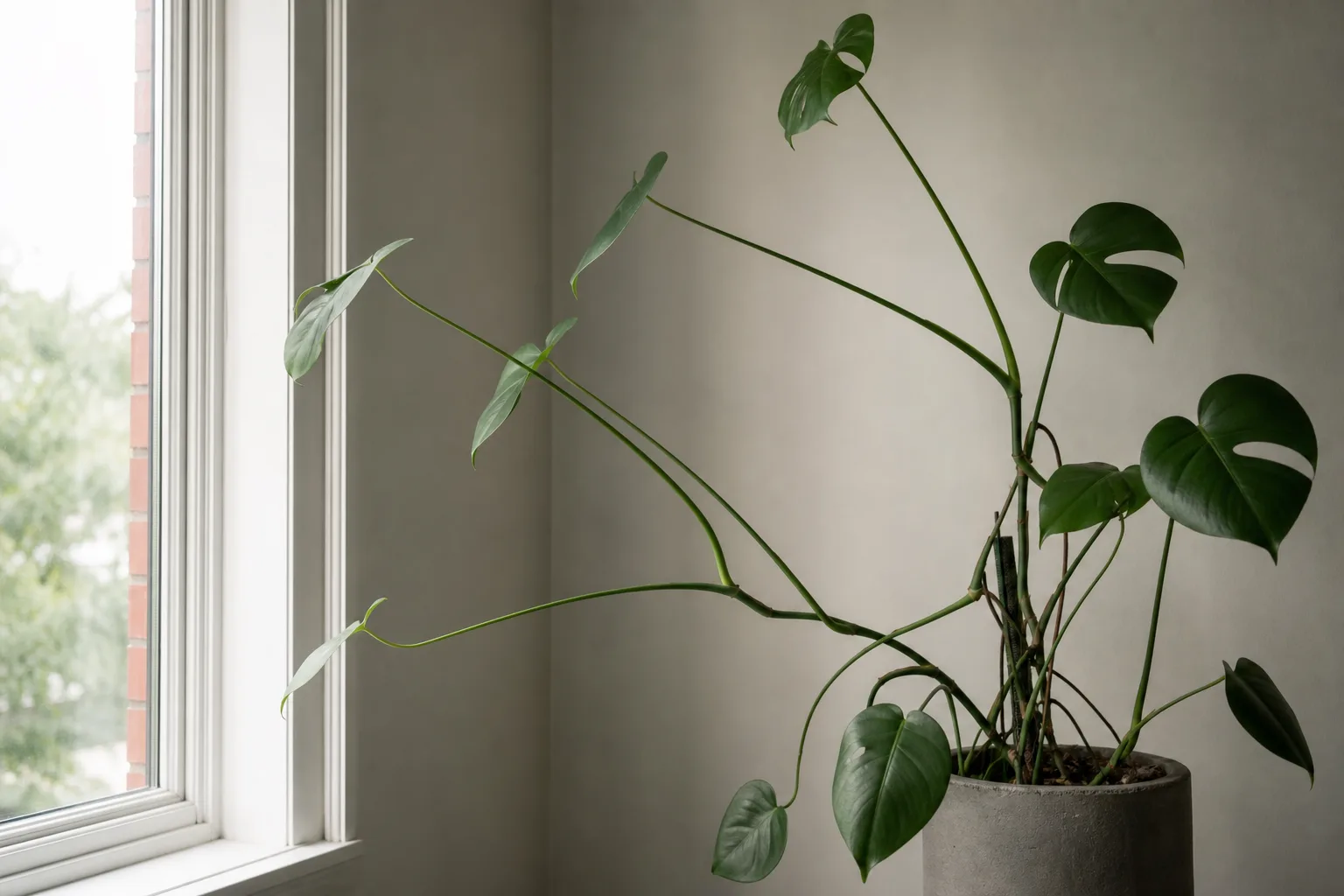
Leggy Growth on Monstera Deliciosa: Causes, Checks & Fixes
This guide covers leggy growth on Monstera Deliciosa. See also the general Leggy Growth guide, watering, and light pages for this plant.
Leggy Growth on Monstera Deliciosa: Causes, Checks & Fixes
Quick answer
Leggy growth on Monstera deliciosa (Monstera deliciosa) is etiolation-the vine lengthens the bare stem sections between leaves while producing smaller blades. On this large climbing hemiepiphyte, the pattern is hard to miss: wide internode gaps on new growth, thin petioles, a one-sided lean toward the brightest window, and aerial roots reaching along furniture when the canopy sits too far from usable light.
First step: move the pot to bright indirect light within a few feet of an east-facing window or a south- or west-facing window filtered by sheer curtains. Install or re-seat a moss pole so aerial roots can attach. Wait two to three weeks for the next leaf to show tighter spacing, then prune elongated bare stems above nodes if you want a compact shape-existing stretched internodes never shorten on their own.
This page covers stretch while leaves are still forming and the prune-and-support recovery path. If your main concern is solid new leaves without splits on a mature vine, see not enough light. If the plant has stopped producing leaves entirely, see slow growth.
What leggy growth (etiolation) looks like on Monstera deliciosa
Internode gaps and vine architecture
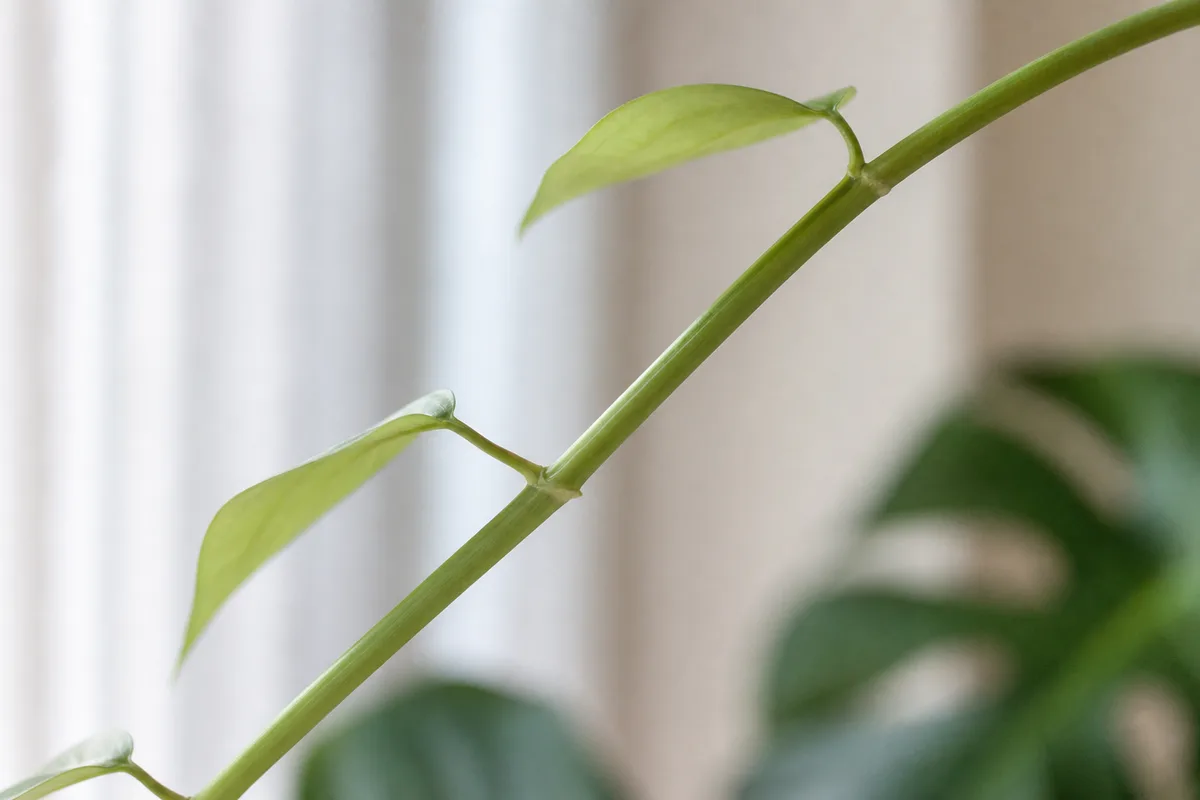
Leggy Growth symptoms on Monstera Deliciosa - compare with healthy tissue on the same plant.
The clearest leggy signal is internode elongation-the bare stem between two leaves grows longer than it did on older sections of the same vine. On deliciosa, gaps of 8–15 cm or more on the newest growth while lower nodes stay 3–5 cm apart is a classic etiolation pattern. Penn State Extension notes Monstera gets leggy in lower light as it reaches for brighter exposure.
Watch these visual markers together:
- Long bare stem sections between recent leaves, sometimes with no foliage for 30–60 cm on floor specimens
- Smaller new blades than mature leaves farther down the same vine
- Thin, elongated petioles holding leaves farther from the stem
- Directional lean toward one window, lamp, or doorway
- Aerial roots extending along walls, shelves, or moss poles with little upward architectural growth
- Reduced or delayed fenestrations on new leaves-splits may shrink or disappear while stretch continues
A young plant with only a few solid heart-shaped leaves may simply be juvenile. Concern starts when a climbing specimen with aerial roots and prior fenestrations suddenly pushes widely spaced small leaves for several nodes in a row.
Floor plant vs. moss-pole display
Unsupported floor vines often sprawl horizontally across the room, producing long naked stem runs between occasional leaves. A vine on a moss pole in the same dim corner may still stretch, but attached aerial roots and vertical climb can produce slightly larger leaves once light improves-support alone does not fix legginess, but it changes how recovery looks. NC State Extension describes sturdy vertical support as necessary to prevent heavy stems from breaking on large specimens.
Why Monstera deliciosa stretches - light, support, and growth habit
Canopy-climber biology indoors
In Central American rainforests, deliciosa starts on the forest floor, then climbs tree trunks toward brighter canopy light using cord-like aerial roots. Indoors, that same programming drives internode elongation whenever daily light falls below what the plant needs for compact growth. The plant can still produce net energy-it is simultaneously stretching to reach more photons. “Enough light to survive” and “enough light to stay compact” are different thresholds, and deliciosa sits among the most visibly leggy popular houseplants when the second threshold is missed.
Low light is the primary driver
Dim corners, interior rooms far from windows, north-only glass without supplementation, and tall floor pots parked in the center of a bright room while the canopy never sees the window all trigger stretch. Winter day-length drops can worsen etiolation even when you have not moved the pot.
Missing or loose climbing support
Deliciosa is not a self-supporting bush. Without a moss pole, trellis, or bark board, vining stems may elongate across the floor searching for structure. Aerial roots left dangling cannot anchor the plant into the compact vertical habit that produces larger split leaves in brighter light.
Why fertilizer does not fix stretch
Leggy growth is almost always a light problem, not a nutrient shortage. Over-fertilizing a light-starved vine adds salt stress without shortening internodes. Wisconsin Horticulture Extension links missing leaf perforations to inadequate light-not nitrogen deficiency. Fix placement first.
How to confirm leggy growth vs. other problems
Work through this checklist before repotting, feeding, or heavy pruning:
- Internode-gap comparison - Measure spacing between the last three new leaves and compare to a section from six months ago on the same stem. Widening gaps confirm etiolation.
- Leaf production rhythm - Leggy plants usually still push new leaves, just farther apart. No new leaves for months points to slow growth or root issues instead.
- Shadow test at the canopy - At midday, hold your hand between the top leaves and the window. A soft, defined shadow suggests moderate usable light; a faint or absent shadow means the spot is too dim by extension indoor-light standards.
- Window distance and direction - Within 2–4 feet of an east window or filtered south/west glass usually counts as bright indirect for deliciosa. Deep interior placement typically needs a grow lamp.
- Support audit - Is a moss pole present, stable, and moist enough for aerial roots to grip? Unsupported floor sprawl plus stretch confirms both light and structure gaps.
- Soil moisture and stem firmness - Wet mix for weeks with soft stems and yellowing leaves is overwatering in a dim corner-not etiolation alone. Firm stems on moderately dry soil support a light-first diagnosis.
- Fenestration trend - Shrinking splits on new leaves overlap with not enough light; long internodes with leaves still forming are this page’s focus.
Confirmation test: Move to brighter indirect light and add or re-seat a moss pole. If the next one or two leaves emerge with tighter internode spacing within two to three weeks, light was the limiter.
First fix: improve light and add climbing support
Relocate to bright indirect light-ideally within a few feet of an east-facing window or a south- or west-facing window softened by sheer curtains.
Penn State Extension advises placing Monstera near a sunny window where it receives bright light but not direct sun. NC State Extension lists moderate brightness without direct sunlight as the indoor target.
Do not jump from a dark corner into harsh unfiltered midday sun. Tissue formed in deep shade needs gradual acclimation over one to two weeks to avoid scorch.
Grow-light supplementation
If a brighter window is unavailable, add a full-spectrum LED grow light 12–18 inches above the canopy for 10–12 hours daily. University of Maryland Extension notes plants stretch when light arrives from one direction-center the lamp over the vine, not off to the side, and rotate the pot weekly.
Moss-pole installation
Install a sturdy moss pole or coco coir totem beside the main stem. Gently tie the vine below nodes with soft plant ties. Mist the pole or keep it slightly moist so aerial roots attach-attached roots help fuel larger architectural leaves once light improves. See the repotting and moss-pole guide for installation detail.
Make the light move first. Wait two to three weeks before repotting, fertilizing, or pruning heavily so you can read the plant’s response clearly.
Prune and reshape elongated vines
Existing stretched internodes do not shorten-the only way to remove naked stem runs is to cut them. This is why leggy recovery differs from simple light correction: you improve conditions for compact new growth, then prune what already stretched.
When to prune
Improve light and wait until the plant pushes at least one new leaf with tighter spacing-usually two to three weeks after relocation. Pruning before the light fix can stall a weak vine that lacks energy to activate buds below cuts.
Where and how to cut
Identify nodes-slight swellings where leaves, aerial roots, or leaf scars attach to the vine. Cut 6–10 mm above the node at a slight angle so water runs off the wound. UMN Extension confirms cuttings without nodes fail to produce new growth; the same node biology drives post-prune branching.
For maximum bushiness on a long bare vine, make several cuts above different lower nodes rather than one tip-only trim that leaves feet of naked stem below the foliage crown. Full protocol lives on the Monstera pruning guide.
Propagate the trimmings
Each node-bearing section can root in water or sphagnum. Plant rooted cuttings back into the same pot for immediate fullness, or start a new compact specimen. RHS emphasizes support for healthy climbing growth-re-tie shortened vines to the moss pole after pruning so new shoots climb upward rather than sprawling across the floor.
Pet safety when pruning
Monstera contains calcium oxalate crystals. Wear gloves if sap irritates your skin, and keep trimmings away from pets-the overview guide documents ASPCA toxicity for cats and dogs.
Recovery timeline - what old stems vs. new growth do
Expect tighter internode spacing on new leaves within two to four weeks after light improves. Fenestrations on mature vines typically return on progressively larger new blades over two to four months, not on the first leaf after a move.
Old elongated stems and stretched petioles remain unless you prune them-judge success by the next two or three new leaves, not by hoping existing tissue reshapes. Pruned sections may show visible buds from nodes within two to four weeks during spring and summer active growth.
Winter corrections may show little until day length and warmth increase-plan on four to eight weeks after conditions improve before deciding the fix failed.
Worsening signs: continued stretch with yellowing on wet soil, soft stems, or sour-smelling mix mean the diagnosis is incomplete-re-check roots and watering rather than only adding light or pruning again.
Leggy stretch vs. not enough light vs. drooping vs. slow growth
| Pattern | Key signals | Primary issue | Best page |
|---|---|---|---|
| Leggy etiolation | Long internodes, new leaves still forming, lean, aerial roots searching | Light plus support; prune to reshape | This page |
| Not enough light | Solid new leaves on mature vine, fenestration loss, long petioles | Bright indirect placement; fenestration focus | Not enough light |
| Slow growth stall | No new leaves for months; firm foliage | Light, roots, season, or pests | Slow growth |
| Drooping leaves | Limp blades, turgor loss, wilted petioles | Water stress, rot, or heat-not stretch alone | Drooping leaves |
| Overwatering in dim corner | Yellow lower leaves, wet soil weeks, soft stem base | Root stress in low metabolism | Overwatering |
| Normal juvenile stage | Small solid hearts on young plant; no prior fenestrations | Age-not a problem | Overview |
Mistakes to avoid
Do not over-fertilize to compensate for low light-salt buildup stresses roots without shortening internodes. Do not move instantly from deep shade to unfiltered south glass without acclimating; scorched leaves set recovery back. Do not expect moss poles alone to compact a vine in a dim corner-support helps architecture once light is adequate. Do not prune heavily before improving light on a weak, stretched plant. Do not ignore wet soil in a dark room; slow metabolism plus damp mix is a common path to root rot on large floor specimens. Do not tip-prune only on a 60 cm bare stem-that leaves most of the stretch in place.
How to prevent leggy growth next time
Place new deliciosa where the leaf canopy sees the window, not just where the pot fits the room layout. For floor specimens, shorten vines or raise the moss pole so top leaves sit in the light cone.
Rotate the pot every one to two weeks so vines do not lean permanently toward one side. Clean glass seasonally-sheers, tint, and outdoor foliage block more photons than many owners realize.
Install a moss pole early and keep it moist so aerial roots attach before the vine sprawls across the floor. Use grow lights in offices, north-facing rooms, and during short winter days-10–12 hours of supplemental light when natural levels drop.
Track internode spacing on each new leaf during the growing season so stretch shows up before a full season of naked stem accumulates. The light guide covers long-term placement and foot-candle targets for reliable fenestrations.
How this page fits the Monstera cluster
| Your question | Best page |
|---|---|
| Long stems with wide leaf gaps; still producing leaves | This page |
| Solid new leaves / missing splits on mature vine | Not enough light |
| No new leaves at all for months | Slow growth |
| Where to put my Monstera long term | Light guide |
| How to cut above nodes and propagate trimmings | Pruning and propagation |
| Yellow leaves on wet soil in a dim corner | Overwatering |
Related Monstera deliciosa guides
- Monstera deliciosa overview - species hub and climbing biology
- Light needs - window placement and grow lights
- Pruning - node placement and bushiness protocol
- Propagation - rooting leggy cuttings
- Repotting and moss poles - support installation
- Not enough light - fenestration loss focus
- Slow growth - when the plant stalls entirely
Leggy growth on Monstera deliciosa is etiolation on a canopy-climbing aroid-not a mystery disease or fertilizer shortage. Measure internode gaps, improve bright indirect light, add a moss pole, and prune bare stems above nodes once new growth compacts. Old stretched tissue never shortens; recovery shows up in tighter spacing and returning splits on the next few leaves. When you can execute that full path without searching again, you have fixed what a dim corner and an unsupported floor vine could not hide.
Related tool
Use the Plant Problem Diagnosis Tool to narrow causes for leggy growth on this plant before changing multiple variables at once.