Grow Lights for Indoor Plants: Complete Beginner Guide
Choose the right grow light for houseplants with tips on brightness, distance, timing, plant types and common mistakes.
What Grow Lights Do (and Don’t Do)
Grow lights give plants usable light for photosynthesis when window light is weak, blocked, or inconsistent. They do not replace good watering, drainage, or pest control. A grow light solves one problem: the plant is not receiving enough useful light for the growth you want.
Indoor plants can look fine for weeks on stored energy, then slowly show light stress. New leaves shrink. Stems stretch toward glass. Variegation fades. A basil plant turns woody. A monstera stops producing larger leaves. A succulent opens up and leans. These are light symptoms, not personality quirks.
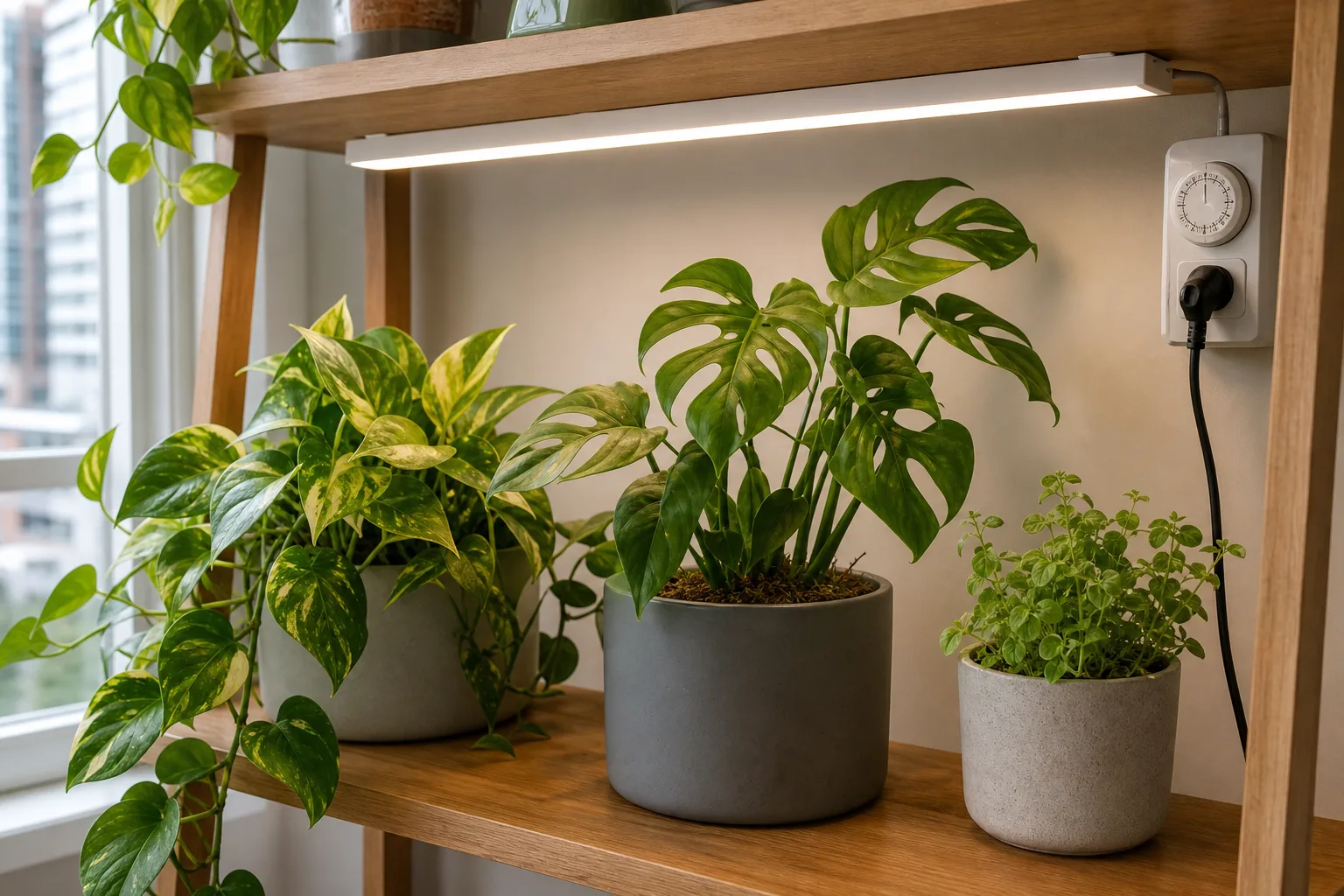
Editorial note: In a LeafyPixels shelf test, a white LED bar at 14 inches above a north-facing pothos shelf delivered roughly 180–220 µmol/m²/s at the top leaves (per the fixture’s PPFD chart). After three weeks at 12 hours daily, new growth was noticeably tighter than the same cultivar on an unlit shelf six feet from the window.
DLI caveat: Oklahoma State Extension DLI ranges below come from horticultural production contexts. Use them as directional guidance for home growers, not rigid houseplant rules.
Why Window Light Often Falls Short
A bright room is not always bright for a plant. Human eyes adapt to low light, so a space that feels well lit may still be weak from a plant’s perspective. Glass, curtains, tint, deep rooms, and winter sun angle all reduce usable light. A plant two meters from a bright window may receive only a fraction of the light beside the glass.
This is why vague labels like “bright indirect light” frustrate beginners. The phrase is a category, not a measurement. Judge light by plant response: compact new growth and stable color suggest success; stretching, leaning, pale leaves, and stalled growth suggest failure. Grow lights let you correct that without moving every plant to the only good window.
University of Minnesota Extension explains that plants use Photosynthetically Active Radiation—mainly red and blue wavelengths—for photosynthesis, and that artificial lighting must be judged by quality, duration, and intensity, not human brightness alone. (University of Minnesota Extension)
Light Science: PAR, PPFD, DLI, and Spectrum
Grow light marketing throws around full spectrum, PAR, PPFD, DLI, wattage, and lumens. You do not need to become a lighting engineer. You need to know which terms affect plant growth and which describe human vision.
The three ideas that matter most are intensity (how much usable light reaches leaves), duration (hours per day), and spectrum (color mix). A weak light for 16 hours may still underperform. A strong light too close may bleach leaves. Poor coverage may light the top while the rest of the plant sits in shade.
PAR, PPFD, and DLI in Plain English
PAR is the wavelength range plants use for photosynthesis. PPFD measures how many useful photons reach a square meter each second (µmol/m²/s). DLI is the total useful light over a full day (mol/m²/day). Iowa State Extension describes DLI as one of the most important measurements under supplemental lights because it combines intensity and time. (Yard and Garden)
PPFD is flow from the tap now. DLI is water collected in the bucket by day’s end. You can reach similar daily totals with stronger light for fewer hours or weaker light for more hours—within reason. Plants still need darkness, and very weak light cannot always be fixed by running lamps endlessly.
Oklahoma State Extension gives general DLI ranges: about 5–10 mol/m²/day for low-light plants, 10–20 for medium-light, 20–30 for high-light, and 30–50 for very high-light categories in production settings. (extension.okstate.edu)
Iowa State also provides the home calculation: DLI = PPFD × hours × 0.0036. (Yard and Garden)
Worked example: PPFD to DLI
Suppose a manufacturer’s chart lists 200 µmol/m²/s at 12 inches (30 cm) above the canopy, and you run the lamp 12 hours per day:
200 × 12 × 0.0036 = 8.6 mol/m²/day
That lands in the low-to-medium directional range for many foliage houseplants. If new growth still stretches, raise intensity (move closer), extend hours modestly, or improve coverage—not all three at once.
How to read a PPFD map: Find the distance row on the chart (often 6, 12, 18, 24 inches). Read the center PPFD value, then check edge values—edges are often 40–60% of center. Match the center reading to your plant’s needs, then verify side plants are not in the weak fringe. A single headline PPFD number without distance is incomplete.

Spectrum: Blue, Red, White, and Full-Spectrum
The RHS explains that blue light generally supports growth, while red light is important for growth and flower production. (RHS) Older “blurple” LEDs targeted those bands heavily. They can work, but they distort leaf color and make pest inspection harder.
For bedrooms, living rooms, and offices, a white full-spectrum LED is usually easier to live with. “Full spectrum” is only meaningful paired with enough intensity and coverage. A weak full-spectrum bulb far away still produces weak growth.
Types of Grow Lights
The best grow light matches your plant, space, heat tolerance, and budget—not the loudest marketing. A desk snake plant needs a different setup than a seed-starting rack or kitchen herb shelf.
Four broad categories matter for homes: LED, fluorescent, HID, and ordinary household bulbs. LEDs dominate for efficiency, fixture variety, and lower heat. Fluorescents still suit seed trays. HID is usually excessive for houseplants. Regular LEDs can supplement easy plants but are not dedicated grow lights.
| Light type | Best use | Strengths | Weaknesses |
|---|---|---|---|
| LED grow lights | Most houseplants, herbs, shelves, seedlings | Efficient, versatile, lower heat | Quality varies; specs confuse |
| Fluorescent (T5) | Seed trays, budget shelves | Even coverage, affordable | Less efficient than LEDs |
| HID | Large-scale growing | Very powerful | Hot, energy-heavy for homes |
| Regular LED bulbs | Supplemental light for easy plants | Cheap, pleasant visually | Often weak at plant distance |
The U.S. Department of Energy notes that LED technology can deliver varied spectra and intensities for plant production—one reason LEDs became central to horticultural lighting. (The Department of Energy’s Energy.gov)
LED Grow Lights
LED grow lights are the default for most homes: bulbs for single plants, bars for shelves, panels for collections. Energy efficiency matters as setups grow. ENERGY STAR states that LED products can produce light up to 90% more efficiently than incandescent bulbs. (ENERGY STAR) The Department of Energy estimates converting horticultural lighting to LED could cut annual horticultural lighting consumption by 34%. (The Department of Energy’s Energy.gov)
Match fixture shape to the job: screw-in bulbs have narrow coverage; bars spread across shelves; panels suit trays or groups. The best setup is one you will position correctly and run on a timer.
Fluorescent, HID, and Regular LED Bulbs
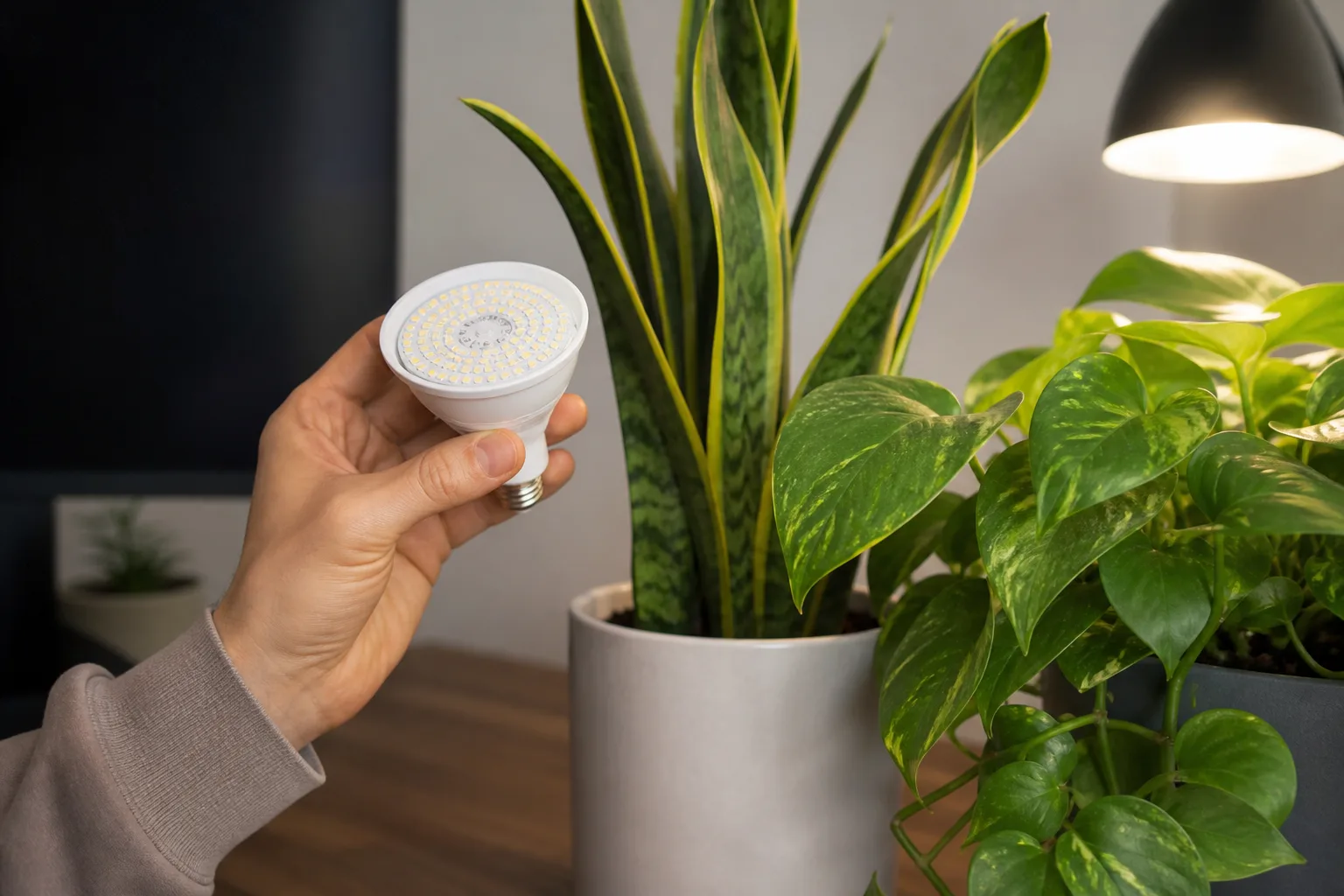
T5 fluorescents still work for seed starting with even, close light. They are bulkier and less efficient than LEDs but proven on trays. HID (metal halide, high-pressure sodium) is powerful greenhouse gear—usually wrong for a living room collection. Regular LED bulbs may help low- or medium-light foliage if bright, close, and daylight-colored, but they are measured in lumens for human eyes, not photosynthetic output. Herbs, seedlings, and succulents usually need dedicated grow fixtures.
How to Choose the Right Grow Light
Stop asking “Which grow light is best?” Ask “What job does this light need to do?” Winter maintenance for a pothos differs from keeping kitchen basil productive or starting tomato seedlings.
Match the Light to the Plant’s Job
Low-light foliage (snake plant, ZZ plant, pothos, philodendron): modest LED bars or bulbs at 10–12 hours prevent decline in dim rooms. Aim for maintenance, not explosive growth.
Medium-light tropicals (monstera, hoya, peperomia, calathea): full-spectrum LEDs at moderate distance; acclimate gradually. Too much intensity on thin leaves causes stress.
Succulents and cacti: need stronger intensity to stay compact. Decorative weak lamps often disappoint.
Herbs and edible greens: need productive light for regrowth after harvest—see best herbs to grow indoors for species-specific windowsill limits.
Seedlings: close, consistent, adjustable-height light to prevent legginess.
Read Specs Without Getting Misled
Wattage is energy draw, not useful plant light. Lumens describe human brightness. Better specs include PPFD at stated distances, coverage maps, spectrum charts, actual power draw, and heat notes.
Buying checklist:
- Choose full-spectrum white LED for most living spaces.
- Demand PPFD data or credible distance guidance.
- Match fixture shape to the plant area.
- Prefer adjustable height for seedlings, herbs, and succulents.
- Use a timer-compatible fixture.
- Check cord length, mounting, and damp-location ratings near misting trays.
Setup: Distance, Coverage, and Timing
Good fixtures fail with bad setup. The two biggest mistakes: placing lights too far away and lighting only part of the plant. Think in a triangle: distance, coverage, duration. Change one variable at a time and read the plant’s response.
Do not blast a plant from a dim corner onto a strong panel without acclimation. Increase exposure over several days or start farther away. New growth adapts faster than older leaves.
Distance and Coverage
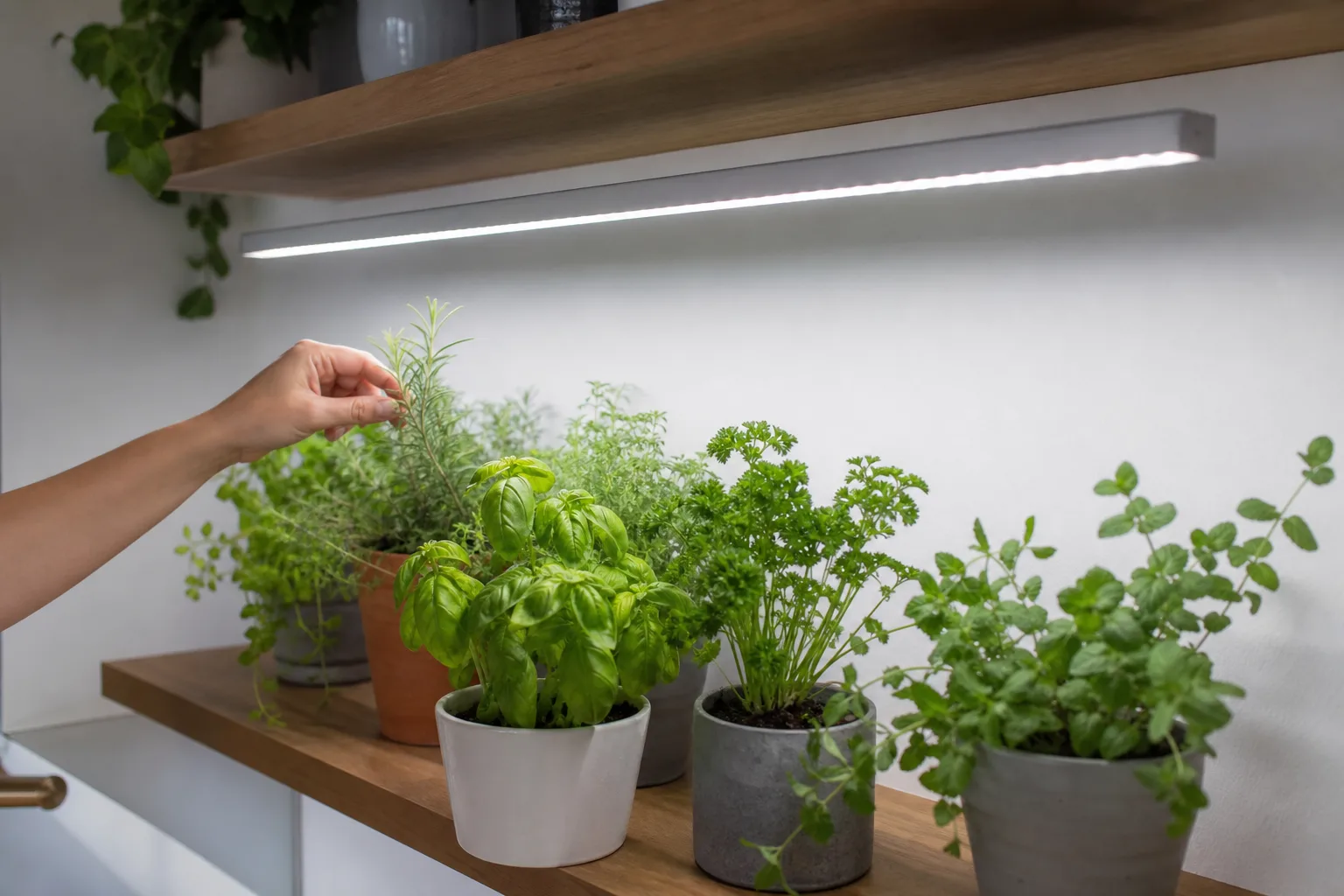
Intensity drops quickly with distance. Coverage matters as much as peak brightness—a narrow bulb may light one top leaf while lower leaves and neighbors sit in shade. For shelves, mount lights under each shelf. For tall plants, overhead light is primary; side light is supplemental only.
Rotate leaning plants or improve placement. If only growth near the fixture is compact, coverage is uneven—widen the beam, add a second fixture, or reduce crowding.
Quick reference: distance and hours by plant type
University of Minnesota Extension provides starting distances and daily hours (adjust for your fixture and plant response): (University of Minnesota Extension)
| Plant category | Starting distance | Daily light hours |
|---|---|---|
| Seedlings | 4–6 inches (10–15 cm); raise as they grow | 16–18 hours |
| Herbs / hydroponic lettuce | 6–12 inches (15–30 cm) | 12–14 hours |
| Foliage houseplants | 12–24 inches (30–60 cm) | 12–14 hours |
| Flowering houseplants | 6–12 inches (15–30 cm) | 14–16 hours |
Seasonal example: In a north-facing room in January, a foliage pothos shelf with no direct sun might run a white LED bar 12–14 hours daily at roughly 12–18 inches, then reduce hours or increase distance in summer if window light strengthens. Pair with winter houseplant care adjustments for watering and humidity.
Timing, Timers, and Rest Periods
Most indoor plants do well with 10 to 14 hours of supplemental light daily, depending on species and window contribution. Use a timer—consistency beats memory.
Do not run grow lights 24 hours for normal houseplants. University of Maryland Extension advises illuminating plants for no more than 16 hours total per day because most plants need a dark period to develop properly. (University of Maryland Extension)
Match schedules to your home. White full-spectrum fixtures are usually more pleasant than purple in living spaces. High-intensity LEDs at desk distance can glare—angle shields or increase distance if the beam is uncomfortable for your eyes.
Adding light changes watering: faster growth and fixture warmth can dry soil quicker. Check moisture before watering on the old calendar.
Troubleshooting Grow Light Problems
When a plant looks worse after adding light, check distance, schedule, acclimation, watering, humidity, and airflow before blaming the fixture.
Too little light shows as stretching, leaning, pale new growth, smaller leaves, sparse herbs, or tall thin seedlings. See the not enough light symptom guide for patterns beyond grow-light setup.
Too much light causes bleaching, crispy patches, curling, or leaves angling away—especially when strong LEDs sit close to thin-leaved tropicals without acclimation.
Poor coverage creates one strong side and one stretched side, or good top growth with weak lower leaves. More hours rarely fix a narrow footprint—widen or reposition instead.
Costs, Safety, and Maintenance
Electricity math is straightforward: a 20-watt lamp for 12 hours uses 0.24 kWh/day. Multiply by your rate and fixture count. LEDs generally balance output and efficiency, but cheap optics waste photons outside the canopy.
Safety matters near water and humidity: keep cords from standing water, avoid spraying non-rated fixtures, do not overload strips, mount securely, and stop using damaged or flickering units. For trays and misting zones, prefer fixtures with appropriate UL/ETL listing and damp-location ratings where the manufacturer specifies them.
Dust lenses and diodes gently while unplugged. Raise fixtures as plants grow. Reassess seasonally—in winter extend supplemental hours; in bright summer, back off.
Conclusion
Grow lights are practical tools for the one factor many indoor spaces lack: enough usable light. Match the fixture to the plant’s job, use white full-spectrum LEDs in living spaces, read PPFD at distance—not wattage alone—and adjust distance, coverage, and hours while watching the plant.
A healthy setup feels boring in the best way: the timer runs, growth stays compact, and you stop chasing the only good window in the house.
Related Guides
- Indoor plant watering basics — light changes how fast soil dries
- Winter houseplant care — seasonal supplemental lighting and humidity
- Why houseplants struggle in winter — short days and weak window light
- Best herbs to grow indoors — kitchen light requirements beyond a windowsill
- Not enough light — symptom patterns when light is the limiting factor
- Monstera deliciosa care hub — medium-light tropical example named throughout this guide