Winter Houseplant Care: Watering, Light, Humidity and Pest Checks
Keep houseplants healthy in winter with seasonal watering, light adjustments, humidity tips and pest inspection routines.
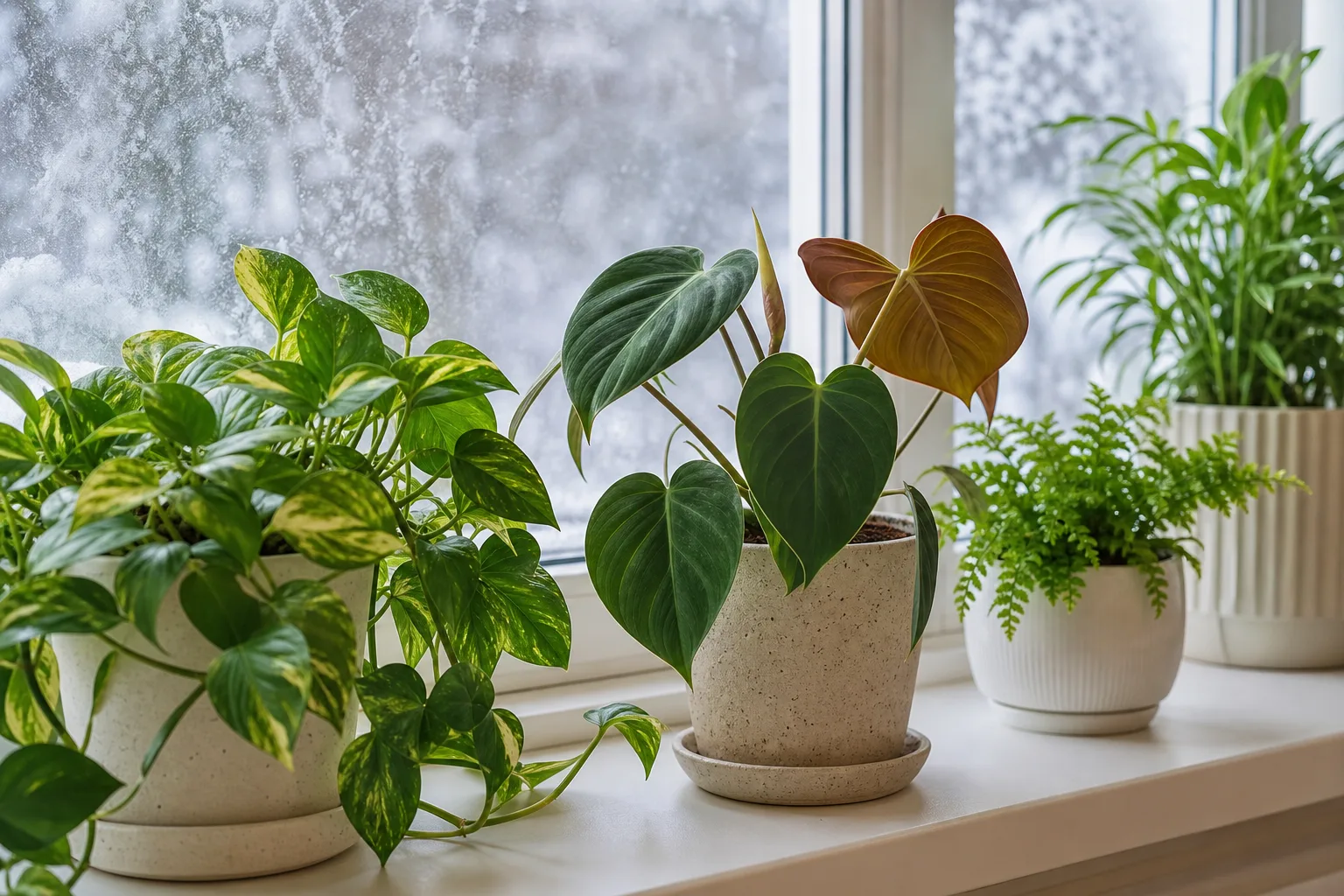
Already seeing yellow leaves, mushy stems, or webbing under the foliage? This page is the weekly maintenance checklist for plants that are still stable. If a plant is already declining, switch to the diagnostic companion at why houseplants struggle in winter before adjusting routine—it walks the symptom → environment → fix chain and is where symptom-stacking triage belongs.
Winter changes everything indoors. Shorter days, a lower sun angle, dry forced-air heat, and cold glass around windows stack from late October through early March. Use this page as your seasonal maintenance checklist for stable plants—the diagnostic deep-dive lives in why houseplants struggle in winter.
Treat winter as a recovery and maintenance season, not peak growing season (RHS winter guidance).
What this guide is (and what it is not)
This guide is the weekly maintenance checklist—light, water, humidity, placement, fertilizer restraint, and a 60-second pest inspection.
This guide does NOT cover:
- Symptom-stacking triage (yellow leaves vs. cold damage vs. root rot vs. salt buildup)—see why houseplants struggle in winter.
- Species-specific watering depth—see per-plant hubs like the Monstera care hub.
- Grow-light fixture selection—see the complete grow lights guide.
- Full IPM escalation—see the indoor IPM guide.
- Repotting mechanics—see the repotting guide.
If a plant is already declining, close this tab and open the diagnostic companion.
What winter actually does indoors
Four environmental factors change at once. Most winter problems are combinations, not single causes.
| Factor | Winter effect | Plant response |
|---|---|---|
| Day length | Shorter photoperiod | Slower growth, less water use |
| Sun angle | Weaker window light, lower intensity | Leggy stretch, smaller new leaves, leaf drop |
| Heating | Dry air, warm drafts near vents | Tip burn, brittle edges, mite outbreaks |
| Cold glass | Night chill near windows | Cold damage on tropical foliage |
UVM Extension describes winter houseplant growth as considerably slower under fewer hours and lower intensity of sunlight. That slowdown is why routine changes.
The five levers, in order
Check the levers in this order when something looks off. The first two explain most winter problems: light; water; humidity; temperature and placement; pests and fertilizer restraint.
Lever 1 — Maximize usable light
Plants that sat mid-room in summer usually need to move closer to windows in December. In our experience on a north-Ohio windowsill (USDA zone 6a), the difference between a plant placed two feet back from a south window and one placed six inches from the same glass is the difference between leggy stretch and steady slow growth by February.
“Bright indirect” is easier to act on with a number. University of Maryland Extension classifies 100–500 foot-candles as medium-bright indoor light, while Missouri Botanical Garden uses 25–100 fc for low light, 100–300 fc for indirect, and 300–1,000 fc for direct southern exposure. Use a phone lux meter (divide lux by ~10.76 for fc) or a dedicated light meter at leaf height on a bright overcast or clear midday.
| Window direction | Typical fc at sill (midday, unobstructed) | Typical fc 2–3 ft back | Winter move rule |
|---|---|---|---|
| North | 50–150 fc | Often below 75 fc | Pull tropicals to within 12 in. of glass; add grow light if new leaves shrink |
| East | 200–400 fc | 100–250 fc | Best gentle winter bright zone; rotate weekly |
| West | 300–600 fc (hotter PM sun) | 150–350 fc | Watch afternoon heat + winter chill swing; sheer curtain helps |
| South | 500–1,000+ fc direct; 300–500 filtered | 200–400 fc filtered | Brightest but coldest at night—pull back after sunset |
Ranges are editorial working bands synthesized from UMN Extension, MOBOT, and UF/IFAS houseplant light guidance—your overhangs, tint, and trees will shift readings.
- Rotate pots a quarter turn weekly for even growth—see photo below.
- Clean windows and dust broad leaves—a thin dust layer meaningfully cuts light (UVM Extension).
- Add a grow light if leaves pale, stems stretch, or new leaves stay small.
- Cold-glass caution: tropical leaves touching cold pane at night can show cold damage. Pull pots back after sunset, use an insulating curtain, or relocate to a brighter but warmer spot.
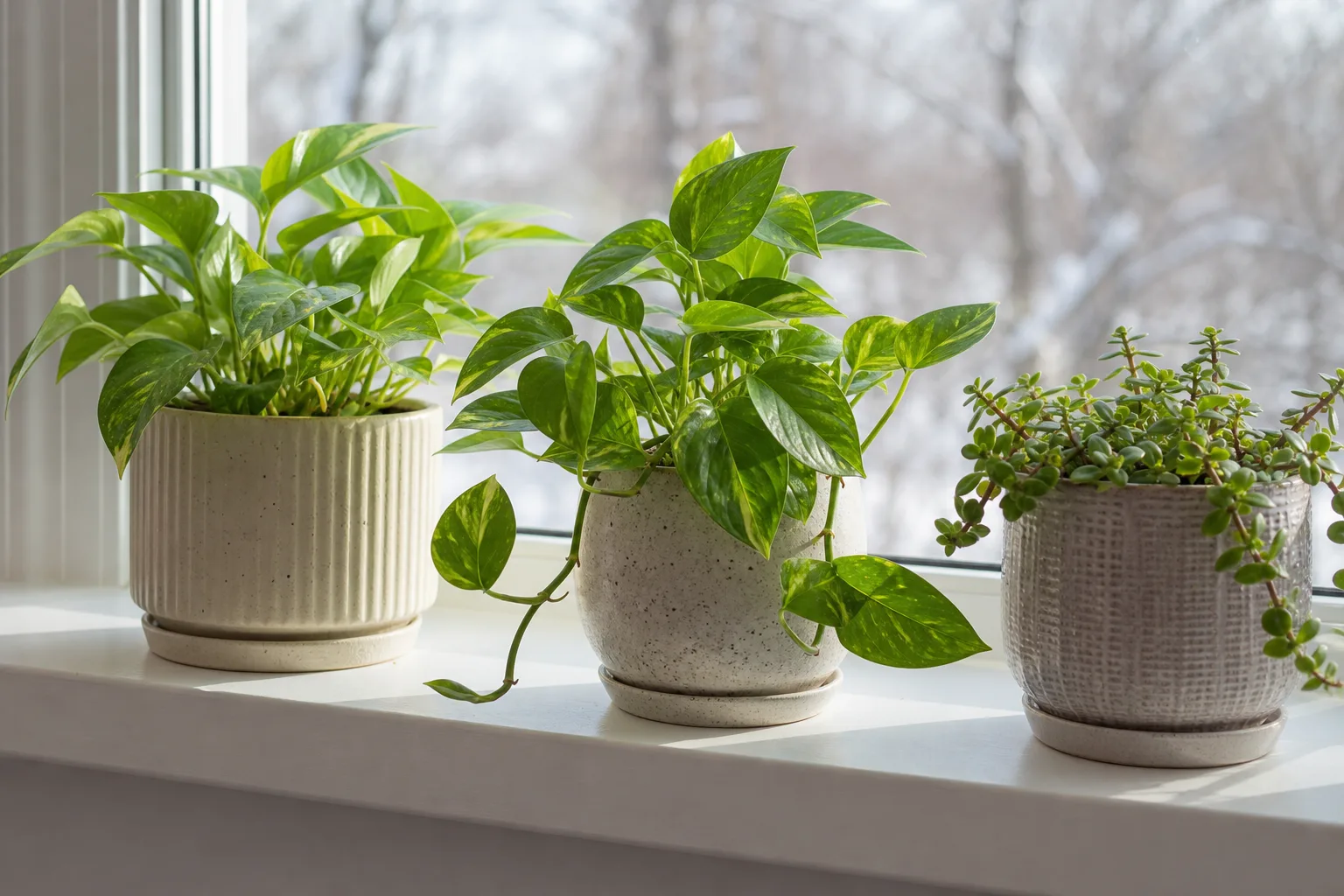
Caption: Rotate each pot a quarter turn weekly so every face of the canopy gets usable winter light—especially on east and south exposures where the sun angle is low.
NC State Extension notes dim winter months require clean windows, supplemental lighting, or both to keep most tropicals healthy.
Lever 2 — Water less, but check just as often
“Water less” means reducing frequency when the root zone stays wet longer—not tiny sips or bone-dry pots. The RHS advises checking whether a pot actually needs water rather than watering on a routine (RHS winter guidance).
- Check twice a week, water only when the root zone has dried to the depth the species prefers. Most tropicals want the top 2 inches dry; succulents want the full pot dry.
- Use a wooden skewer pushed to the bottom of deep containers (NC State Extension).
- Lift the pot after watering and again a few days later—the weight difference is your “is it dry yet” signal.
- Empty cachepots and saucers within 15 minutes of watering (UVM Extension).
In a typical forced-air home, watering frequency drops 30–50% versus summer (NC State Extension).
Lever 3 — Humidity without keeping roots wet
Low humidity is an air problem, not a reason to keep potting mix saturated. Penn State Extension reports heated winter homes can fall below 30% relative humidity, while many tropicals prefer closer to 40–50%.
| Strategy | Effect | Limitation |
|---|---|---|
| Humidifier near plants | Best for sustained room RH | Needs cleaning, sizing, electricity |
| Grouping plants | Local micro-humidity | Modest effect; mind airflow |
| Pebble tray | Minor local boost | Not enough alone—see comparison |
| Misting | Brief leaf wetness | Does not replace humidifier |
Use a small hygrometer near the plant cluster before deciding how aggressive to be. UNH Extension recommends a portable humidifier plus humidity monitoring for dry winter conditions.
Pebble trays in winter
Pebble trays fit winter care as a modest local aid, not as a substitute for the other four levers. The setup is the same year-round: a waterproof tray wider than the pot, clean pebbles or similar inert supports, water below the pot base, and the pot held above the waterline (Missouri Botanical Garden indoor-plant guide).
Radiator and draft placement. Keep the tray away from radiators, forced-air vents, fireplaces, and exterior doors. Heat blasts dry the tray faster than it can raise local humidity and add direct thermal stress to the foliage (UNH Extension). Cold windows and entry-door drafts add the opposite problem: leaf chill and slowed growth. A bright but stable spot a foot or two away from the glass beats either extreme.
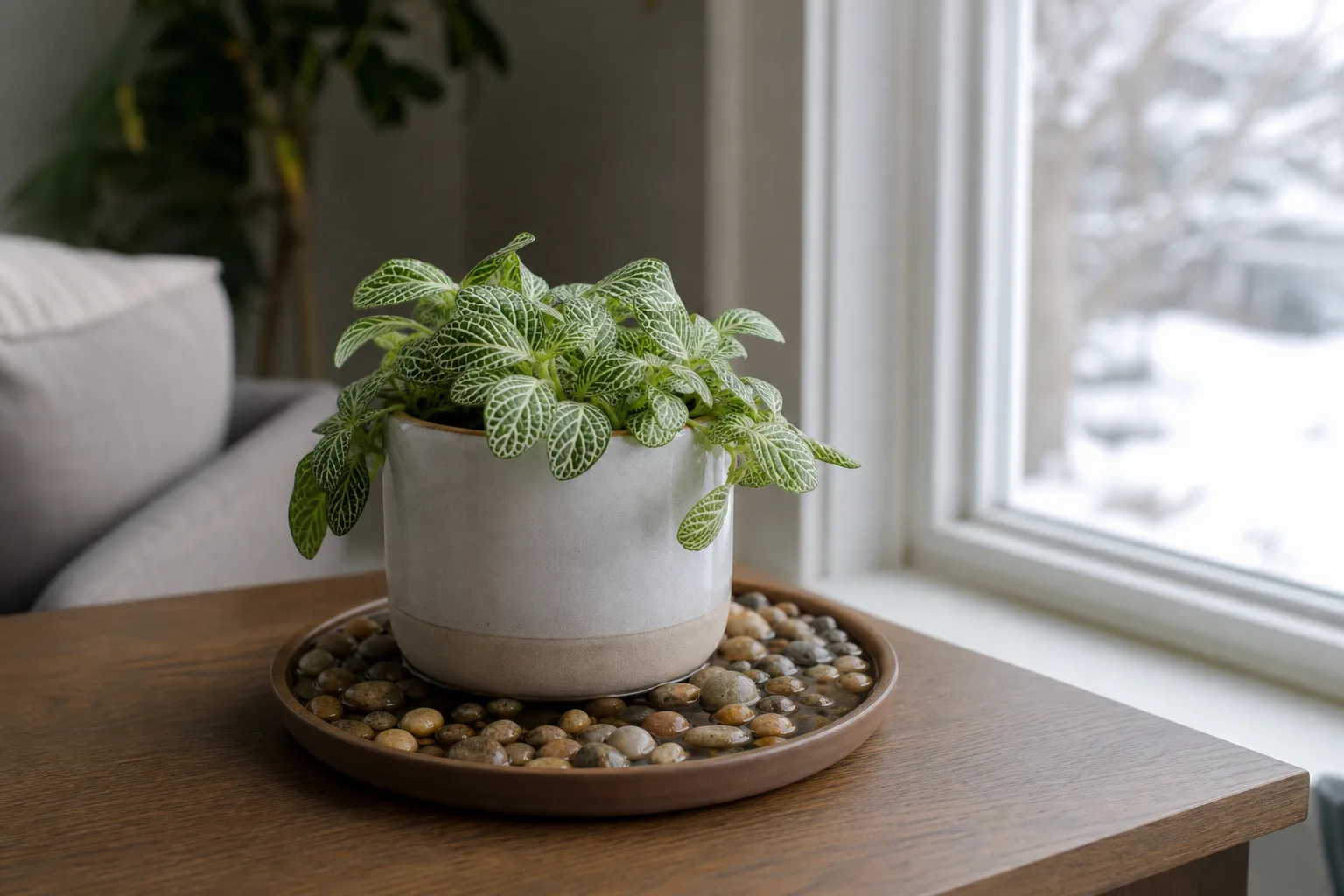
Caption: Winter pebble-tray placement: bright enough for slow growth, stable temperature, pot base above the waterline, and not pressed against cold glass.
Lower evaporation demand. Because winter air holds less moisture and most tropicals slow their water use, a tray may not need refilling as often as in summer—but check it at first every few days to learn the actual rhythm. Wide trays in moving heated air may still empty faster than narrow trays in a cool, still room. The only fixed rule is to keep the waterline below the pot base on every refill (Cornell Cooperative Extension).
When a pebble tray is the wrong diagnosis. A tray cannot rescue a plant whose symptoms come from low light, cold damage, root rot, or fertilizer salts. Brown tips and crispy edges are not exclusive humidity symptoms. UNH Extension notes root rots can impair water transport and produce wilting even when the mix is wet. If a hygrometer at leaf height already reads in the plant’s preferred range, more humidity is not the fix.
Cleaning matters more in winter. Indoor heating speeds evaporation, which means mineral crust, algae, and debris concentrate faster. Empty and scrub the tray whenever residue, algae, or smell appears. University of Maryland Extension places pebble-tray hygiene in the same winter inspection pass as spider-mite checks on leaf undersides.
Lever 4 — Temperature and placement risk map
Move plants away from radiator tops, forced-air vents, fireplaces, exterior doors, and direct contact with cold glass. The RHS warns that heat sources can crisp delicate leaves while cold windows and drafts can damage plants (RHS winter guidance).
| Location | Risk | Mitigation |
|---|---|---|
| South window | Day heat, night chill | Curtain at night, or pull pot back |
| Above radiator | Heat blast | Elevate on stand; relocate if possible |
| Entry door | Cold drafts | Move inward |
| Bathroom | Higher RH | Good for ferns if bright enough |
| Windowless room | Light failure | Add grow light or relocate |
| AC vent | Constant cool dry air | Redirect vent or move plant |
A slightly less bright but stable location beats a cold south windowsill that drops 20°F overnight.
Lever 5 — Pause fertilizer, postpone optional repotting
Most slowed plants do not need routine feeding. Salt builds up when growth and water use are reduced, and excess salts travel to leaf tips, producing the classic brown-edge symptom that mimics under-watering (Penn State Extension over-fertilization).
- Pause or reduce fertilizer unless the plant is demonstrably growing under strong light or is a winter bloomer.
- Skip cosmetic repotting. Act only for emergencies: broken pot, missing drainage, compromised roots, or active rot (University of Minnesota Extension).
- Save major pruning for late winter or early spring. Light shaping is fine anytime.
Adjust the routine by plant type
Tropical foliage (Monstera, philodendron, pothos, calathea, fern). Most sensitive to dry air and cold drafts. Calathea, ferns, and prayer plants show stress first as brown edges or curling—humidifier and avoid vents. See the Monstera care hub and winter Monstera care.
Succulents and cacti. Likely to suffer from insufficient light combined with excessive water. Brightest, coolest spot, very little water—sometimes none for an entire month in a dim, cool room (UVM Extension).
Winter bloomers (cyclamen, christmas cactus, kalanchoe, some orchids). Still actively growing or flowering. Light feeding is appropriate; do not let them completely dry out.
Herbs and edibles. Shortest lifespan group—most culinary herbs want more direct sun than a kitchen window delivers. Use a grow light, rotate frequently.
Pest diagnostic block — the 60-second inspection
Winter is pest season because dry air and reduced vigor favor spider mites. Iowa State Extension notes spider mites are commonly noticed on houseplants in winter and should be detected through regular inspection.
| Pest | Where to look | Quick sign |
|---|---|---|
| Spider mites | Leaf undersides, especially smooth-leaved plants | Fine stippling, bronze tone, delicate webbing |
| Fungus gnats | Soil surface and pot rim | Small dark flies hovering above moist soil |
| Mealybugs | Stem joints and leaf axils | White cottony tufts |
| Scale | Stems or leaves that don’t wipe off | Hard bumps, sticky residue beneath |
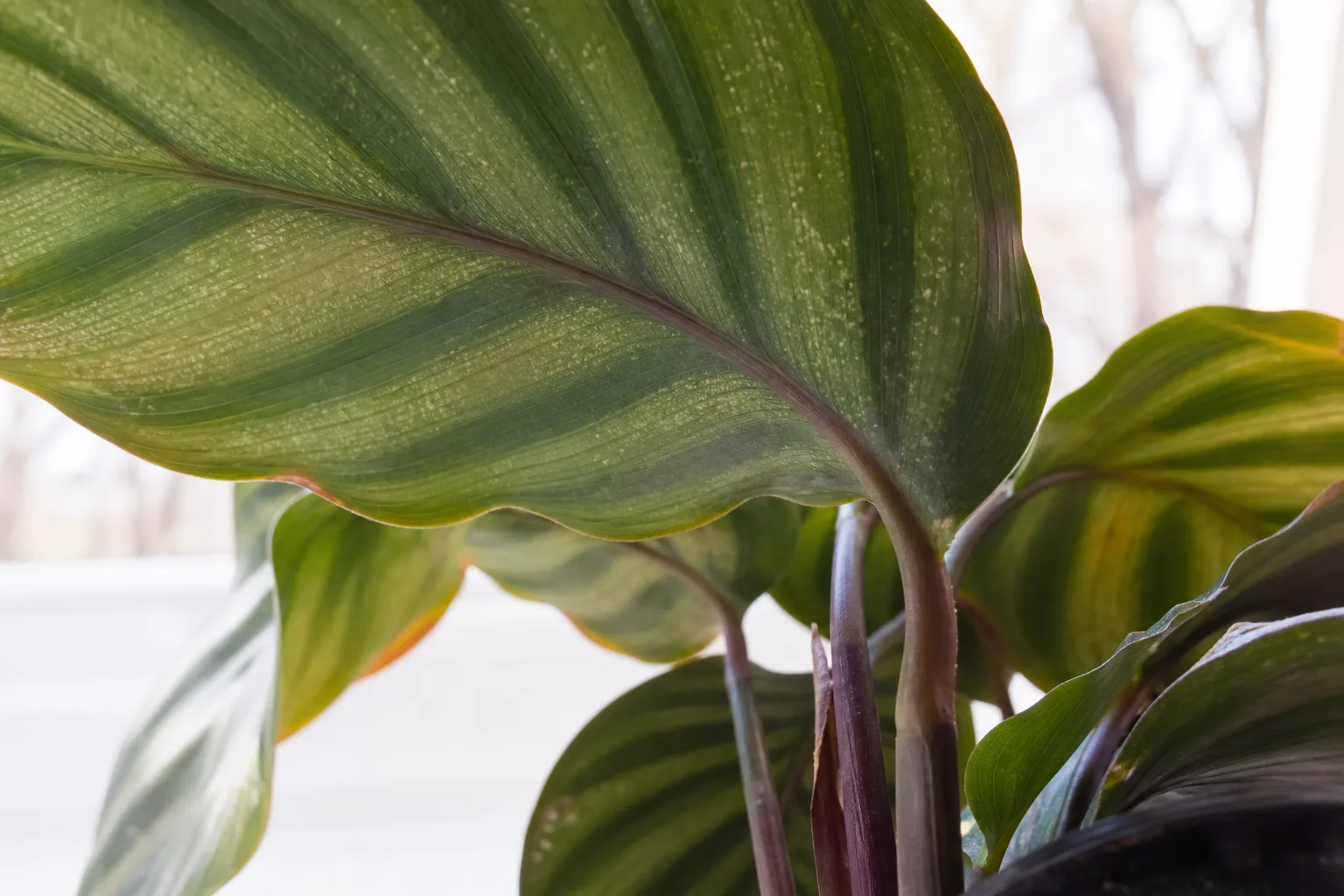
Caption: Spend 60 seconds each week inspecting leaf undersides on smooth-leaved plants—stippling and fine webbing show up here before the top surface looks damaged.
Colorado State Extension identifies stippling, bronzing, webbing, and premature leaf drop as typical spider-mite damage. Sticky residue usually signals honeydew from aphids, mealybugs, scale, or whiteflies. Isolate a suspicious plant, then follow the indoor IPM guide for escalation.
Weekly rhythm — early January versus mid-February
In our experience running a roughly 25-plant indoor collection through the heating season in north-central Ohio (USDA zone 6a), the early-January weeks still hold residual moisture from cool soil and the sun returns at a useful angle by mid-February, so the weekly routine actually tightens as the season progresses.
Measured check (8 January 2026): A ThermoPro TP50 hygrometer on the living-room plant shelf read 22% RH at 68°F (20°C) with the forced-air heat cycling—well below the UNH Extension benchmark of concern below 30% in heated winter homes. A calathea 18 inches from an east window showed crisp new-leaf edges that week; bumping a portable humidifier to hold 38–42% RH stopped new damage within ten days (older browned tips did not green up). Your room will differ—log your own reading before copying our humidifier move.
By early January, indoor humidity in heated homes often dips below 25% without a humidifier, the skewer test on most tropicals comes up damp at day 5, and spider-mite stippling on smooth-leaved plants (calathea, schefflera, dieffenbachia) is the most common new finding. By mid-February, mites have had two months to multiply and a routine February week typically reveals one or two plants that need isolation. By late March, warm drafts from heating-system cycling dry windowsill clusters faster than midwinter.
Pet and child safety during winter
Plants move closer to windows in winter—sometimes into rooms where pets or toddlers spend more time.
- Confirm winter-relocated plants against the ASPCA toxic and non-toxic plants list if pets have access.
- Watch hanging baskets and tall floor plants near pet perches.
Pet safety — act fast if a pet chews a plant
If a pet chews any plant and you are unsure of toxicity, call ASPCA Animal Poison Control at (888) 426-4435 and your veterinarian immediately. The hotline can advise on whether the species and amount chewed warrants an emergency visit. Do not wait for symptoms on known toxic species such as dieffenbachia, philodendron, or sago palm.
The seven-step weekly checklist
Run once a week from late October through early March. Most weeks you will check off five or six items in under five minutes.
- Water by check, not by calendar. Skewer test or pot weight comparison.
- Rotate pots a quarter turn for even light exposure.
- Wipe leaves or rinse gently if dust is visible.
- Inspect leaf undersides, soil surface, stem joints for early signs of mites, gnats, or mealybugs.
- Refill humidifier or top off pebble trays if the hygrometer reads below 35%.
- Confirm no leaf is touching cold glass after sunset—pull pots back if nights are freezing.
- Note any new symptoms in a quick log so trends show up before they become crises.
Printable one-page checklist
Same seven steps in at-a-glance format for the fridge or a plant notebook.
| # | Step | Threshold | Done? |
|---|---|---|---|
| 1 | Water by check, not calendar | Skewer test or pot weight | ☐ |
| 2 | Rotate pots a quarter turn | Once per week | ☐ |
| 3 | Wipe or rinse dusty leaves | When dust is visible | ☐ |
| 4 | Inspect undersides, soil, joints | 60-second scan | ☐ |
| 5 | Top up humidity if < 35% RH | Hygrometer near plants | ☐ |
| 6 | Pull pots from cold glass | Freezing nights | ☐ |
| 7 | Log any new symptoms | Phone note is fine | ☐ |
Spring transition — a 2-to-3 week ramp table
When days lengthen in late February or early March, growth resumes. A slow ramp prevents the classic “rescue overwater” pattern.
| Week | Water | Light | Fertilizer | Repotting |
|---|---|---|---|---|
| Week 1 | Increase frequency by ~25%; skewer test still rules | Keep grow light on if used through winter | Hold; resume at first sign of new growth | Identify candidates |
| Week 2 | Increase by another ~25%; watch pot weight | If light was moved, leave plant where it thrived | Half-strength balanced feed once | Optional cosmetic repot for stable plants |
| Week 3 | Resume normal spring rhythm | Begin natural-light-only if appropriate | Resume full-strength at regular schedule | Routine repotting window opens |
The diagnostic companion stays open for the spring weeks—yellow leaves versus cold damage versus root rot versus salt buildup is still the triage the sibling guide owns (why houseplants struggle in winter).
Related guides
- Why houseplants struggle in winter — diagnostic companion when a plant is already declining
- Houseplant humidity guide — sustained RH strategies beyond pebble trays
- Winter Monstera care — species-specific cold and water adjustments
- Grow lights complete guide — when window light is not enough
- Integrated pest management indoors — escalation after the 60-second scan
Conclusion
Winter houseplant care runs on five levers in order: light, water, humidity, temperature and placement, then pest vigilance with fertilizer restraint. Check twice a week, water only what has dried to the depth the species prefers, keep leaves off cold glass, top up humidity below 35%, and spend 60 seconds a week looking under leaves. That rhythm keeps plants ready for spring growth.
When a plant is already declining, use the why houseplants struggle in winter diagnostic guide for the symptom → environment → fix chain. This checklist companion keeps a healthy plant healthy; the diagnostic guide figures out what changed when it is not.
Written by Sai Ananth and reviewed by Dr. Priya Menon (botanist and indoor plant specialist) on 2026-06-18. Recommendations were checked against RHS, UVM, Penn State, NC State, University of Minnesota, Colorado State, Iowa State, UNH, UMD, Missouri Botanical Garden, Cornell Cooperative Extension, and UF/IFAS guidance, plus LeafyPixels plant-care data. The January 2026 hygrometer reading and foot-candle table document one north-central Ohio (USDA zone 6a) editorial setup—your home will differ.