Pebble Tray vs Humidifier: Which Is Better for Houseplants?
Compare pebble trays and humidifiers for plant humidity, including cost, effectiveness, maintenance and best use cases.
Pebble Tray vs Humidifier for Indoor Plant Care
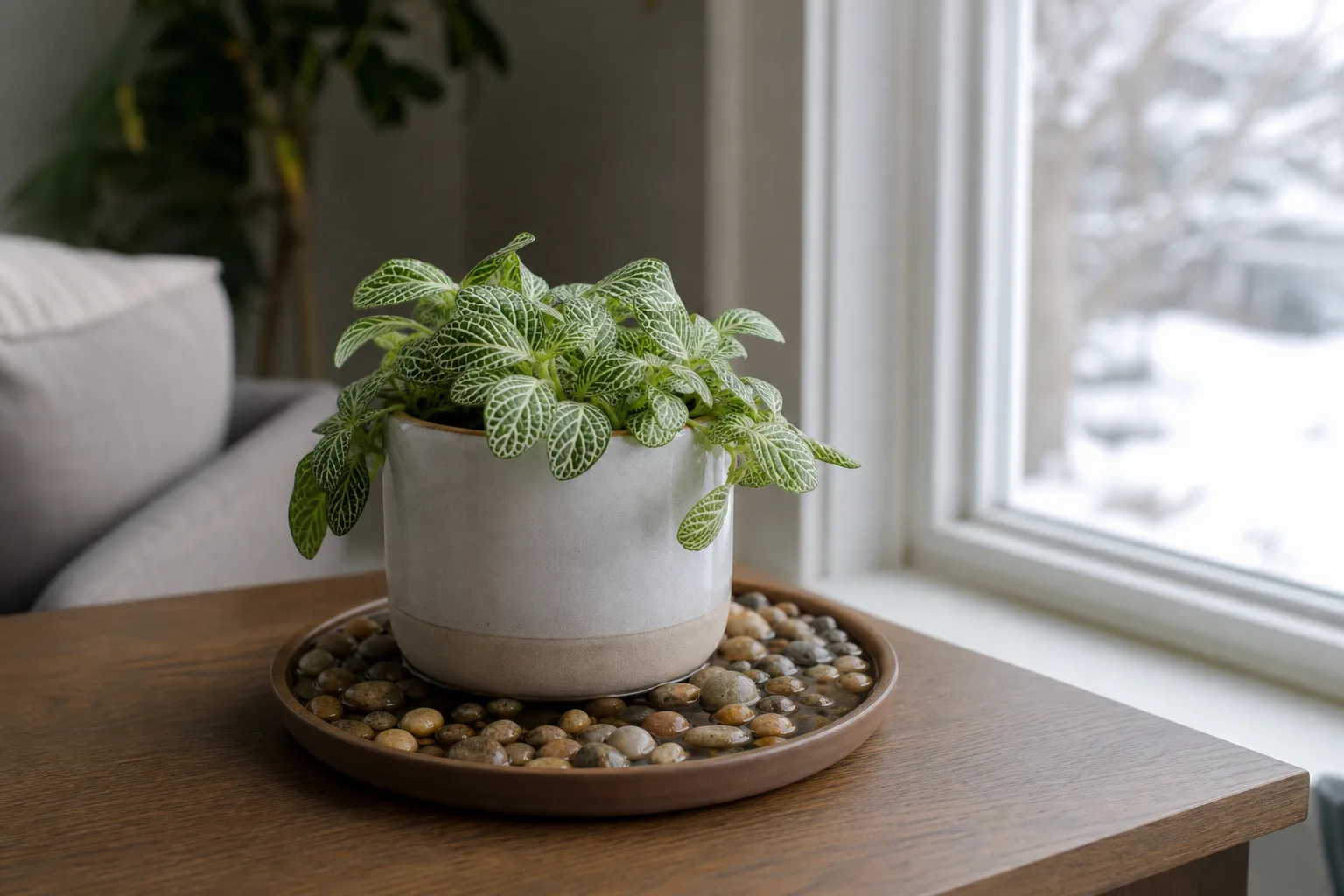
If you want the blunt answer, a humidifier is the stronger tool. A pebble tray can raise humidity a little in the air immediately around a low plant, which may be enough for a compact fittonia on a desk when your room is only slightly dry. A humidifier is the better choice when you need a reliable, measurable increase across part of a room-especially for tropical plants that crisp up in forced-air winter heat. Extension services and botanical gardens agree on the split: trays help locally and modestly; portable humidifiers do more when dry air is a real constraint. (Extension | University of New Hampshire)
The mistake is treating these options like interchangeable versions of the same fix. They are not. One is a low-cost micro-adjustment. The other is an environmental intervention you can monitor with a hygrometer. If your calathea is browning beside a heating vent, a decorative tray of wet stones is not in the same league as a properly sized humidifier and a humidity target you can actually read. For the full humidity picture-including targets, grouping, and room strategy-see our houseplant humidity guide.
What Each Method Actually Changes
Pebble Tray
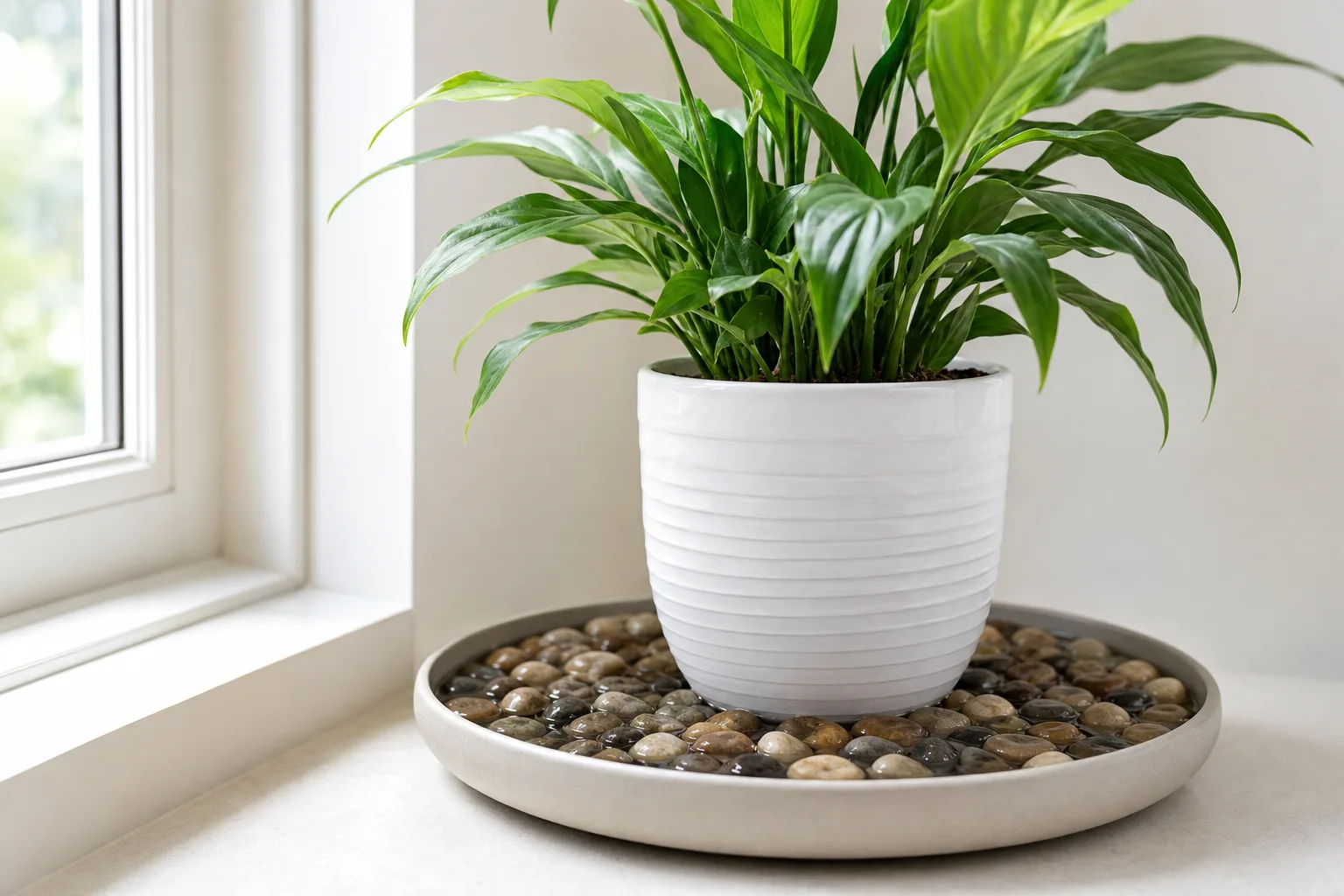
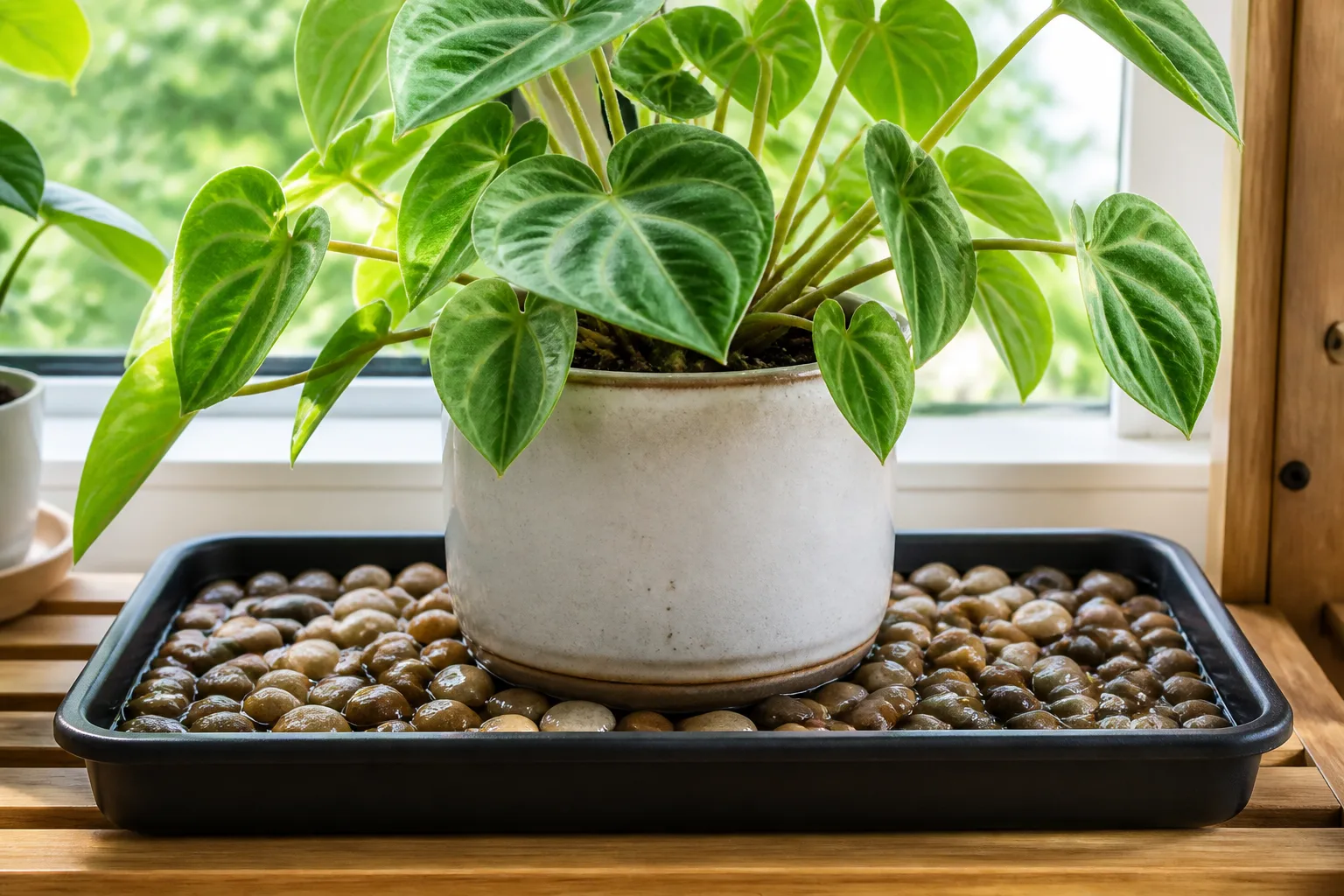
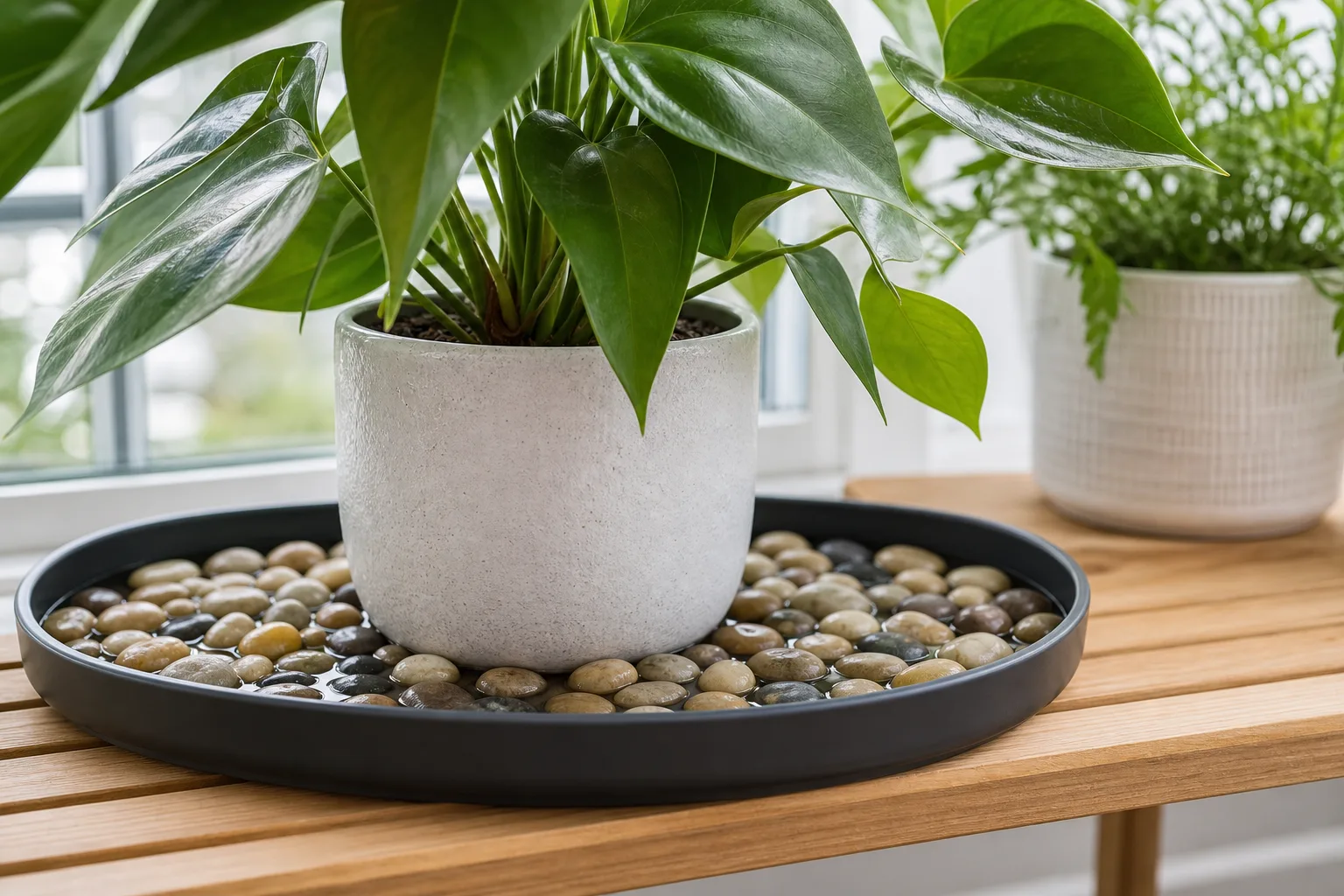
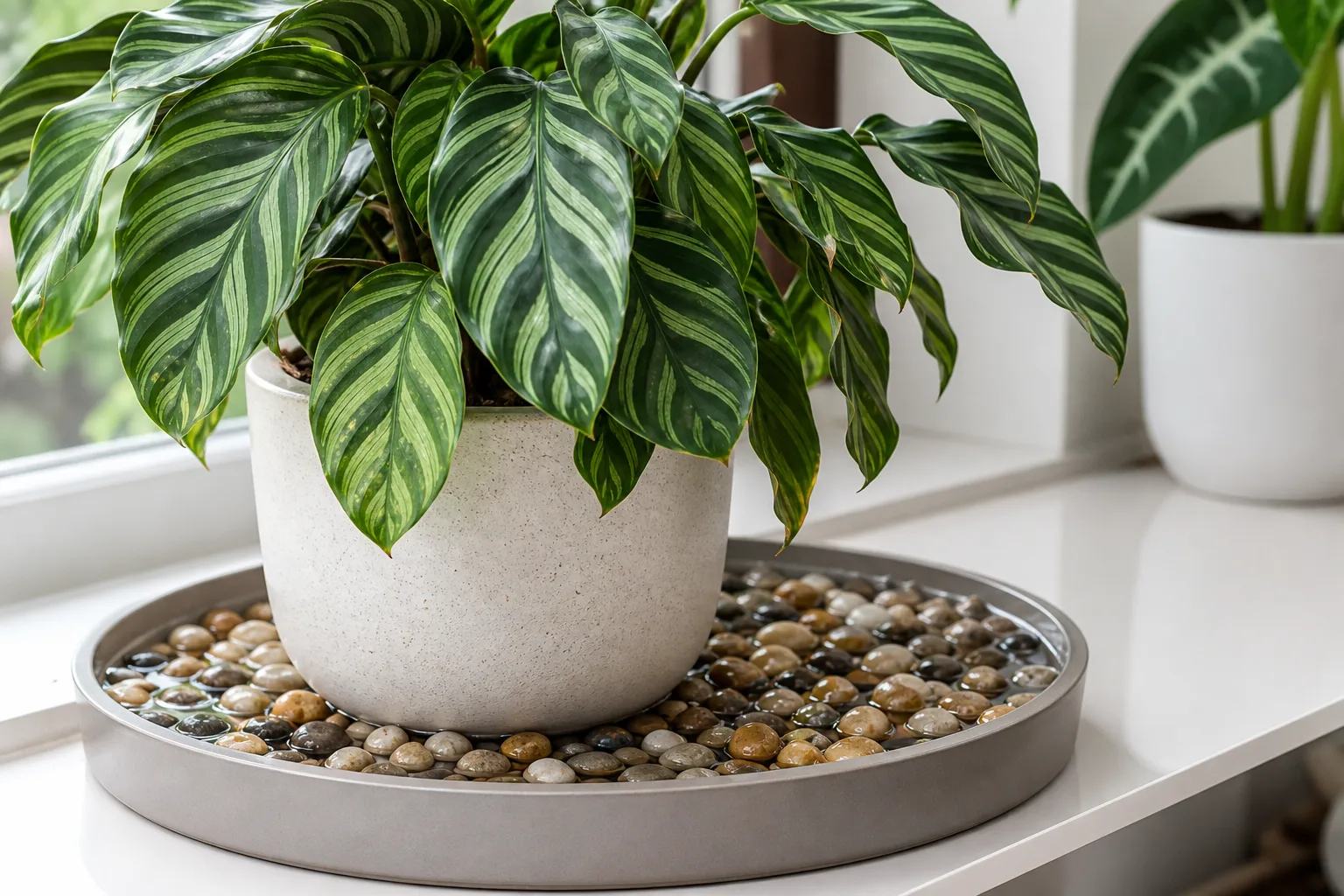
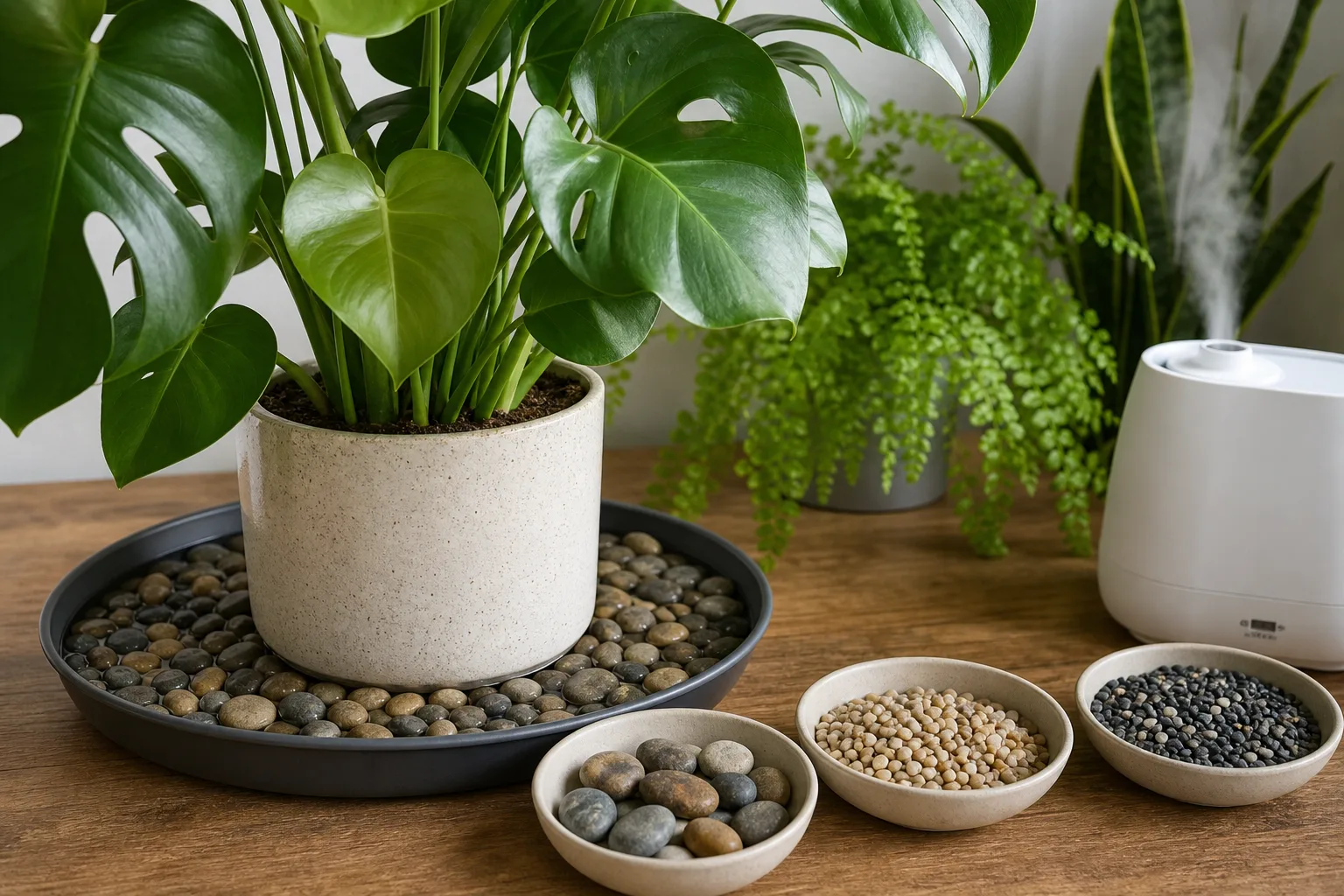
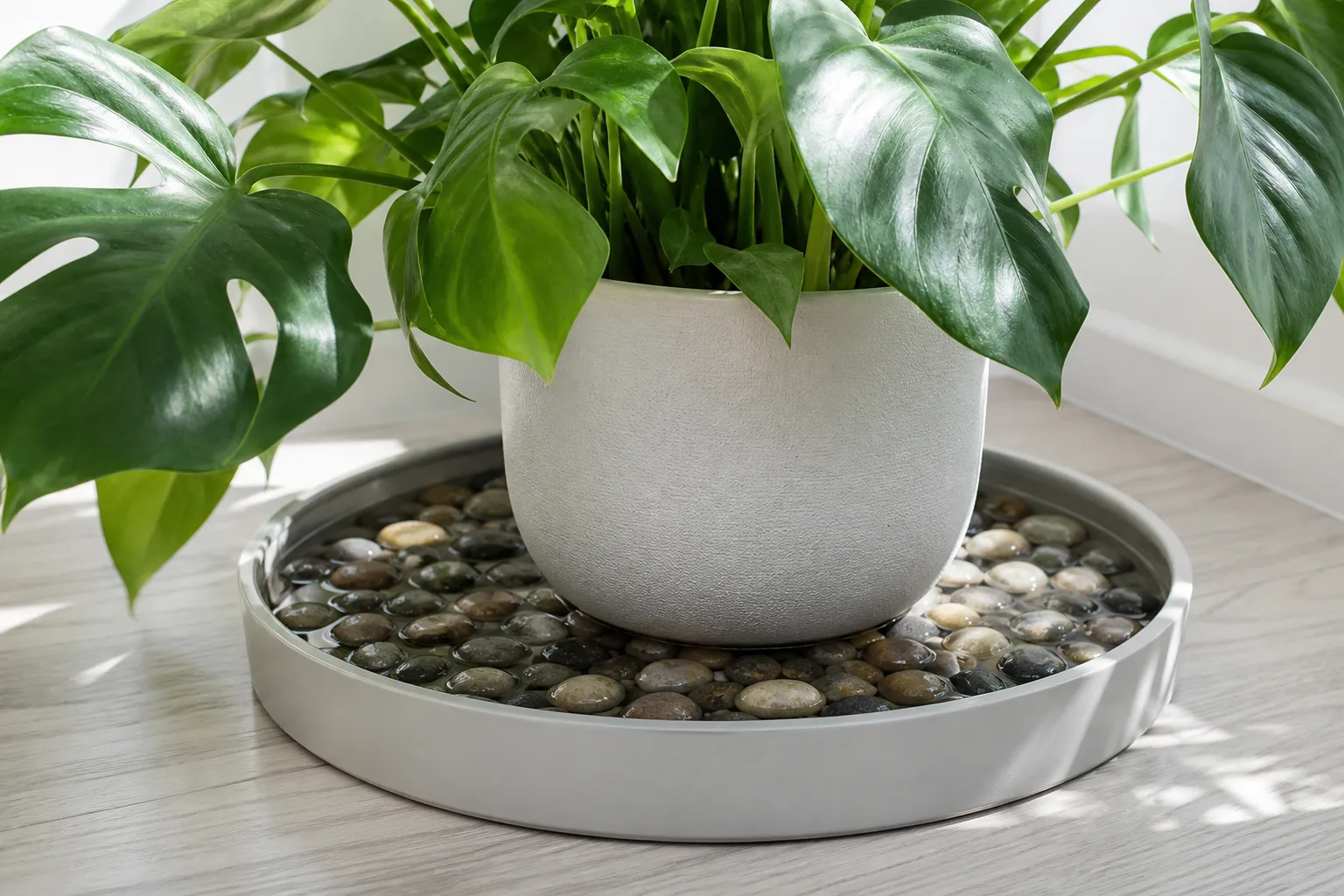
A pebble tray is simple: pebbles in a shallow tray, water filled to just below the stone tops, pot sitting above the waterline so roots never soak. As water evaporates, it can increase humidity in the air immediately around the plant. Missouri Botanical Garden and extension sources still mention the method, but the qualifier matters: the effect is local and modest, not a room-wide fix. (Missouri Botanical Garden)
That distinction is what gets lost online. Pebble trays are not fake, but they are often oversold. They are most plausible for short plants over a tray wider than the pot, in relatively still air. Once circulation disperses moisture-or the foliage sits far above the water-the benefit drops fast. Better Homes & Gardens notes trays increase humidity in the immediate vicinity and suit smaller, lower-growing plants better than tall floor specimens. (Better Homes & Gardens)
Humidifier
A humidifier actively adds moisture to room air. That puts it in a different category, not just a stronger tray. University of New Hampshire Extension points to portable humidifiers near plants plus a humidity sensor as the option that provides the most benefit in dry indoor conditions. Product testing on current models shows why: tested units raised room humidity by double-digit percentages in measurable ways over hours of operation. (Extension | University of New Hampshire)
That does not mean every owner needs one. It means a humidifier gives you control: target a room, read the result, and hold conditions in a range sensitive plants notice. The tradeoff is maintenance, electricity, upfront cost, and the need to avoid turning a healthy room into a damp one. The EPA recommends keeping indoor relative humidity around 30% to 50% and not exceeding 50% with a humidifier. (US EPA)
Why Humidity Matters More Than Most Growers Think
Humidity affects how quickly plants lose water through their leaves. When indoor air is dry, transpiration pressure rises, and plants from humid tropics can show stress even when soil moisture looks fine. Botanical and extension sources tie low humidity to brown leaf edges, crisp foliage, and poor performance in ferns, orchids, and calatheas. (Missouri Botanical Garden)
The useful tension is this: the EPA recommends 30% to 50% for the home, while many houseplants do well around 50%, and some tropical species prefer 70% to 80% locally. What helps a maidenhair fern is not always ideal for the whole room, your walls, or your comfort. Good humidity strategy means enough for the plant without over-humidifying the house-often a local tactic, seasonal humidifier, or grouped plants rather than greenhouse-level air everywhere. (US EPA)
Blanket advice fails because cases differ. A pothos in average room conditions is not the same as a fern in forced-air winter heat. Illinois Extension notes many homes fall below 30% humidity in winter, which explains why humidity debates spike every cold season. If you want the broader pebble-tray context without repeating setup steps here, read indoor humidity and pebble trays. (Illinois Extension)
Pebble Trays: Best Uses and Limits
A pebble tray makes sense when your goal is modest. It is cheap, silent, non-electric, and useful when you need a small boost around a compact plant-not when you need to rescue a dry room full of tropicals. Extension and expert commentary align on best-fit cases: small, low-growing plants on shelves, desks, or windowsills where you are softening dry air rather than transforming the room. Think fittonia, selaginella, or a small fern-not a tall fiddle-leaf fig. (Better Homes & Gardens)
The limit is scale. Pebble trays do not change room humidity in any meaningful way. They barely change the plant’s microclimate unless geometry helps: wide tray, low canopy, minimal airflow, regular refilling. Brooklyn Botanic Garden’s calathea guidance takes a similarly restrained line-trays are less effective than humidifiers and add maintenance if ignored. (Brooklyn Botanic Garden)
Side effects matter too. Constantly wet surfaces can encourage fungus gnats, algae, mineral residue, and occasional mold if trays are never cleaned. That does not make trays bad-it means they are not maintenance-free décor. If you keep a tray wet for weeks without scrubbing, you may trade dry-air stress for a messier problem. (Brooklyn Botanic Garden)
Humidifiers: Best Uses and Limits
A humidifier is the better choice when humidity is a real growing constraint: tropical plants in winter, multiple humidity-lovers in one room, dry forced-heat homes, or species showing clear low-humidity stress. UNH Extension’s practical pairing-portable humidifier plus humidity sensor-is still the clearest extension shorthand for dry indoor plant rooms. (Extension | University of New Hampshire)
This is where humidifiers earn their cost. In Better Homes & Gardens testing, a top plant-friendly model raised humidity nearly 15% on low and 28% on high at 2 feet away after eight hours in a 430-square-foot room-confirming measurable change, not theory. Performance tapers with distance, which is why room size and placement matter as much as the sticker price. (Better Homes & Gardens)
The catch is discipline. The EPA advises emptying portable humidifier tanks, wiping surfaces dry, and refilling daily, plus cleaning portable units every third day. The CDC notes germs can grow in humidifiers and spread through mist, and recommends distilled or boiled-and-cooled water to reduce growth and mineral issues. Humidifiers work better than trays; they also punish lazy maintenance harder. (US EPA)
Pebble Tray vs Humidifier: Side-by-Side
| Factor | Pebble Tray | Humidifier |
|---|---|---|
| Typical RH impact | Roughly 1–4% locally at canopy height; negligible room change | 10–30%+ possible in part of a room (model and size dependent) |
| Best for | Small, low-growing plants; mild dryness | Tropical plants, groups, chronically dry winter rooms |
| Upfront cost | Very low | Moderate to high |
| Ongoing effort | Refill and clean tray weekly | Daily water change; clean every 3 days (EPA) |
| Coverage | Immediate micro-area only | Part of room or full room by capacity |
| Noise / power | Silent; no electricity | Uses power; may hum |
| Main risk | Gnats, algae, stagnant tray water | Germ growth, mineral dust, over-humidifying past 50% RH |
| EPA household guardrail | N/A (passive evaporation) | Do not humidify above 50% indoor RH |
That table frames the real comparison: impact versus simplicity. Trays win on cost and convenience. Humidifiers win on performance and control. A struggling calathea collection in a dry apartment points to the humidifier; one small desk fern with slightly dry air may be fine with a tray.
The bigger insight: a pebble tray is a micro-adjustment; a humidifier is an environmental intervention. Once you frame it that way, you stop asking which is “best” in the abstract and start asking what problem you actually have.
Decision Matrix: Room, Season, and Plant Sensitivity
Use this matrix after you know your plant tier and rough room dryness. It is a shortcut, not a substitute for a hygrometer reading.
| Room dryness (winter RH) | Plant sensitivity | Season | Start with |
|---|---|---|---|
| Above 40% | Forgiving (pothos, snake plant, ZZ) | Any | Nothing required; fix placement first |
| Above 40% | Moderate (many philodendrons) | Any | Grouping or tray optional |
| 30–40% | Sensitive (calathea, fern, fittonia) | Winter | Tray + grouping; humidifier if symptoms persist |
| Below 30% | Sensitive | Winter | Humidifier near plant group |
| Below 30% | Forgiving | Winter | Tray optional; humidifier only if you want faster growth |
| Any | Sensitive collection (5+ tropicals) | Dry months | Humidifier sized to room |
| Bathroom / kitchen steam | Any | Summer | Usually neither; watch over-watering instead |
University of Maryland Extension notes relative humidity preferences vary by species and that grouping plants can raise local humidity slightly through shared transpiration-useful alongside either tool. (University of Maryland Extension)
How to Choose Based on Plant Type
Some plants genuinely care about this decision. Calatheas, ferns, fittonias, many orchids, and selaginella show low-humidity stress faster than mainstream houseplants. For these, a pebble tray can help at the margins, but a humidifier usually gives a better shot at stable foliage-especially with several plants together or a dry room. See calathea low humidity for species-specific symptoms. (Brooklyn Botanic Garden)
Other plants are more forgiving. Pothos, philodendrons, snake plants, ZZ plants, and many common aroids tolerate typical indoor air better, even if they still appreciate moderate humidity. Clemson’s pothos guidance lists a preference of 50% to 70% humidity, but that does not mean every pothos owner needs a humidifier-it means the plant grows best in that range while often remaining fine outside it. (Home & Garden Information Center)
Spend money where biology justifies it. Sensitive plants need more help. Tough plants often get by with better placement away from vents, smarter watering, grouping, and maybe a tray-not because social media made humidity look universally essential.
How to Choose Based on Room, Climate, and Season
Your room matters as much as your plant. A bright bathroom with regular steam is already a humidity zone. A living room with forced-air heat, long winter runtime, and vents pushing dry air across leaves is the opposite. Illinois Extension notes winter indoor humidity often drops below 30%, while the EPA says the broader home target should usually stay between 30% and 50%. The same plant can thrive in one room and crisp in another. (Illinois Extension)
Climate matters too. Humid regions may need no added moisture. Cold climates where heating strips air for months make humidifiers easier to justify. Compact rooms full of tropicals, or shelf setups where airflow dries leaves quickly, also push you toward active humidification. A pebble tray is a small correction; a humidifier is what you use when the whole room works against the plant.
Seasonality is the hidden lever. Many owners think a plant “got dramatic” in winter when the environment changed: lower humidity, warmer drafts, shorter days, heater cycles. A humidifier may be seasonal-late fall through early spring-then barely needed once ambient air improves.
What We Measured: Tray vs Humidifier in a 12×14 ft Bedroom
To give this comparison one primary datapoint beyond third-party product tests, we logged relative humidity in a 12×14 ft (168 sq ft) bedroom in north-central Ohio during a dry winter week. Heat was on; door closed; no shower or cooking nearby. Device: a calibrated digital hygrometer at canopy height (~8 inches above the tray or humidifier). Baseline room RH before either tool: 31%.
Pebble tray test: 14-inch saucer, pot 6 inches wide, water to ⅛ inch below pebble tops. After 6 hours, RH at canopy height read 33% (+2 points). A control hygrometer on the opposite side of the room stayed at 31%. After 24 hours with one refill, the tray side peaked at 34% (+3 points); room center unchanged.
Humidifier test: Same room, tray removed, baseline again 31%. A mid-size ultrasonic portable unit on low, placed 4 feet from plants, ran 4 hours. Canopy-height RH reached 46% (+15 points). Room center reached 39% (+8 points). On medium for two additional hours, canopy hit 52%-above the EPA’s 50% ceiling-so we dialed back.
Takeaway: In this room, the tray nudged local RH by a few points-enough to matter only for borderline cases. The humidifier changed conditions the plant and the room both registered. Your numbers will differ by tray width, plant height, airflow, and machine capacity; the pattern-tray = local bump, humidifier = room lever-matches extension expectations and independent tray tests showing 1–4% local gains. Treat our log as one honest data point, not a universal promise.
How to Set Up a Pebble Tray So It Helps Instead of Hurts
If you use a tray, do it properly-but do not rebuild a full DIY tutorial here. For materials, pebble depth, and step-by-step photos, use our DIY pebble tray guide. The comparison-page essentials:
Use a tray several inches wider than the pot. Fill with clean pebbles and water to just below the stone tops so roots never sit in water. Keep foliage close to the moisture source-a tall plant over a narrow tray gains little. Refill as water evaporates and scrub the tray weekly to limit gnats and algae. (Missouri Botanical Garden)
Set expectations correctly. A tray is a supporting tactic, not a substitute for fixing vent blast, underwatering, or a room stuck at 25% RH all winter.
How to Use a Humidifier Without Creating New Problems
Start with sizing and placement. Choose a unit rated for your room square footage (manufacturer labels are a starting point, not gospel). Use a hygrometer so you see results instead of guessing. Place the humidifier close enough to benefit plants, but avoid blasting leaves with continuous mist contact. BHG testing showed gains are strongest near the machine and weaken with distance-exactly why room size matters. (Better Homes & Gardens)
Humidifier Types and Room Sizing
Ultrasonic units produce a cool mist quickly and run quietly; they are popular near plants but can leave white mineral dust on leaves and furniture if you use hard tap water-distilled water helps. Evaporative units pull air through a wet wick; they self-limit somewhat as humidity rises, tend to be louder, and are less prone to visible mist settling on leaves. Either type can work; match the unit to room size and your tolerance for cleaning.
Rule of thumb: for a 150–250 sq ft bedroom with tropicals, a portable unit rated for that range on low or medium usually beats running a whole-house humidifier you cannot monitor. If condensation appears on windows or walls, relocate the unit, lower output, or pause run time-the EPA treats that as a sign RH is too high. (US EPA)
Maintenance stays non-negotiable: empty, dry, and refill daily; scrub every third day; use low-mineral water when possible. The CDC warns that microorganisms in dirty tanks can enter the air with the mist. Good plant care should not create bad air quality. (CDC)
Conclusion
Stop treating a pebble tray and a humidifier like equals. Choose a pebble tray when you want a cheap, quiet, low-stakes local boost for a small plant in mildly dry air. Choose a humidifier when you need real control over dry indoor air-especially in winter, with sensitive tropicals, or when a hygrometer shows the room stuck below 40%. Use the comparison table and decision matrix above rather than guessing.
A tray is not useless; it is limited. A humidifier is not automatically necessary; it is more effective when the problem is real. Match the tool to the plant, room, and season, then verify with a hygrometer. That saves money, reduces plant stress, and keeps your setup grounded in what actually changes the environment.
Related Guides
- Houseplant humidity guide - year-round RH targets, humidifier types, and room-level strategy
- Indoor humidity and pebble trays - how trays fit into broader humidity planning
- DIY pebble tray for houseplants - full build steps, materials, and cleaning routine
- Signs your houseplants need more humidity - winter symptom checklist
- Pebble tray FAQs - quick answers on tray limits and maintenance