Pebble Tray FAQs: Do They Really Help Houseplants?
Get clear answers to common pebble tray questions about humidity, setup, cleaning, water levels and plant safety.
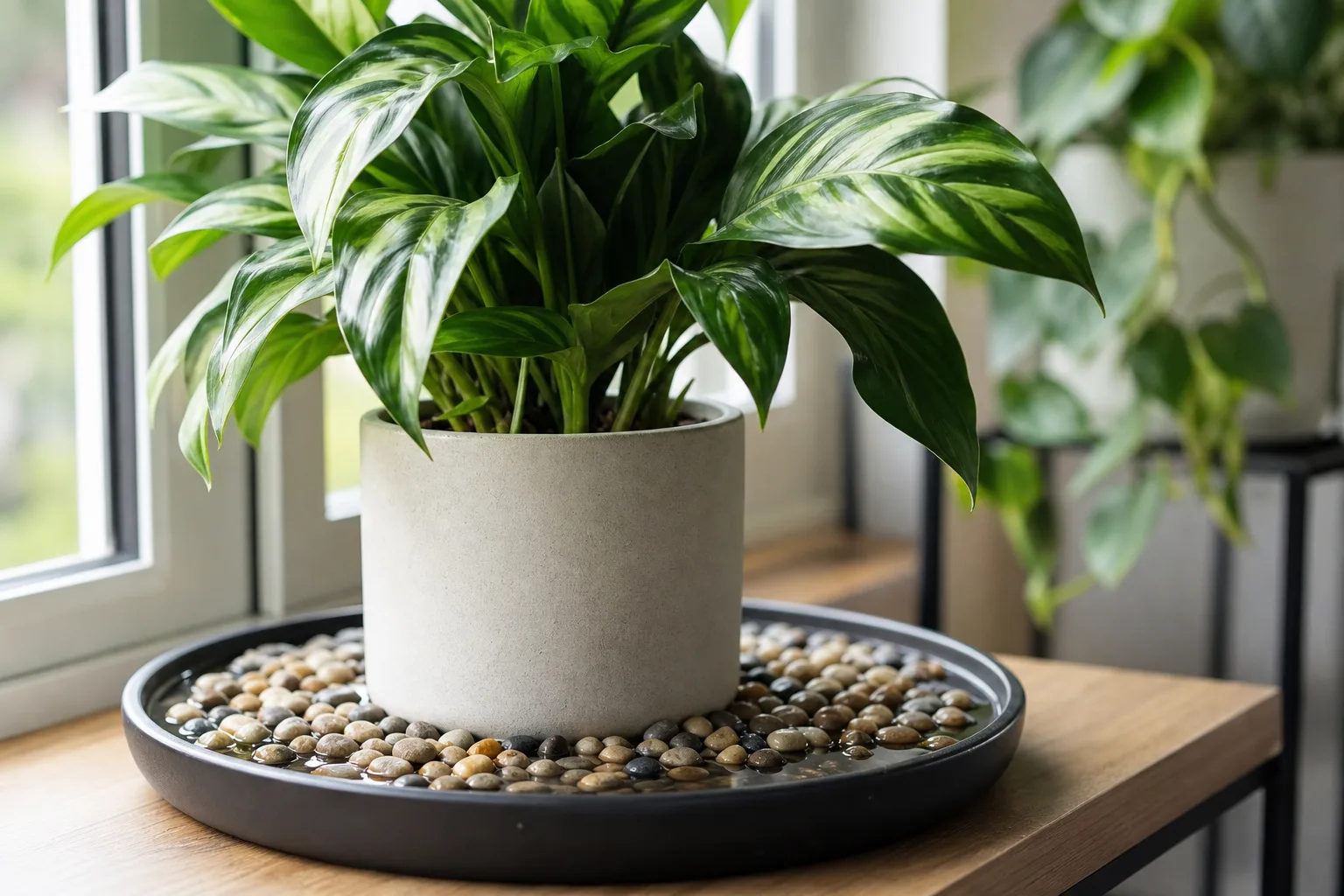
A pebble tray is a small, passive humidity aid, not a room humidifier and not a cure for every brown leaf tip. It can add moisture as water evaporates near a plant, but the size of the effect depends on tray area, airflow, room dryness, and how close the leaves are to the water surface. That qualified answer is more useful than either “pebble trays always work” or “pebble trays are useless.”
This FAQ focuses on the decisions that matter: whether your plant is a sensible candidate, where the waterline belongs, what can replace pebbles, how to keep the tray clean, and how to check the result instead of relying on guesswork.
Pebble Tray FAQs: Quick Answers and Jump Links
| Question | Short answer |
|---|---|
| Do pebble trays work? | Sometimes, but mainly as a modest, local aid. |
| Do they suit every houseplant? | No. Humidity-loving, compact plants are better candidates than arid-adapted plants. |
| How often should I refill one? | Check the water level, not the calendar, and refill before the tray dries out. |
| Can I use LECA? | Yes, if it is clean, stable, and keeps the pot above the water. |
| Can a tray attract mold or gnats? | A neglected tray can grow algae or biofilm; fungus gnats are primarily associated with moist organic potting media. |
| Is a tray enough for calatheas and ferns? | Only when the room is already close to the plant’s preferred range. |
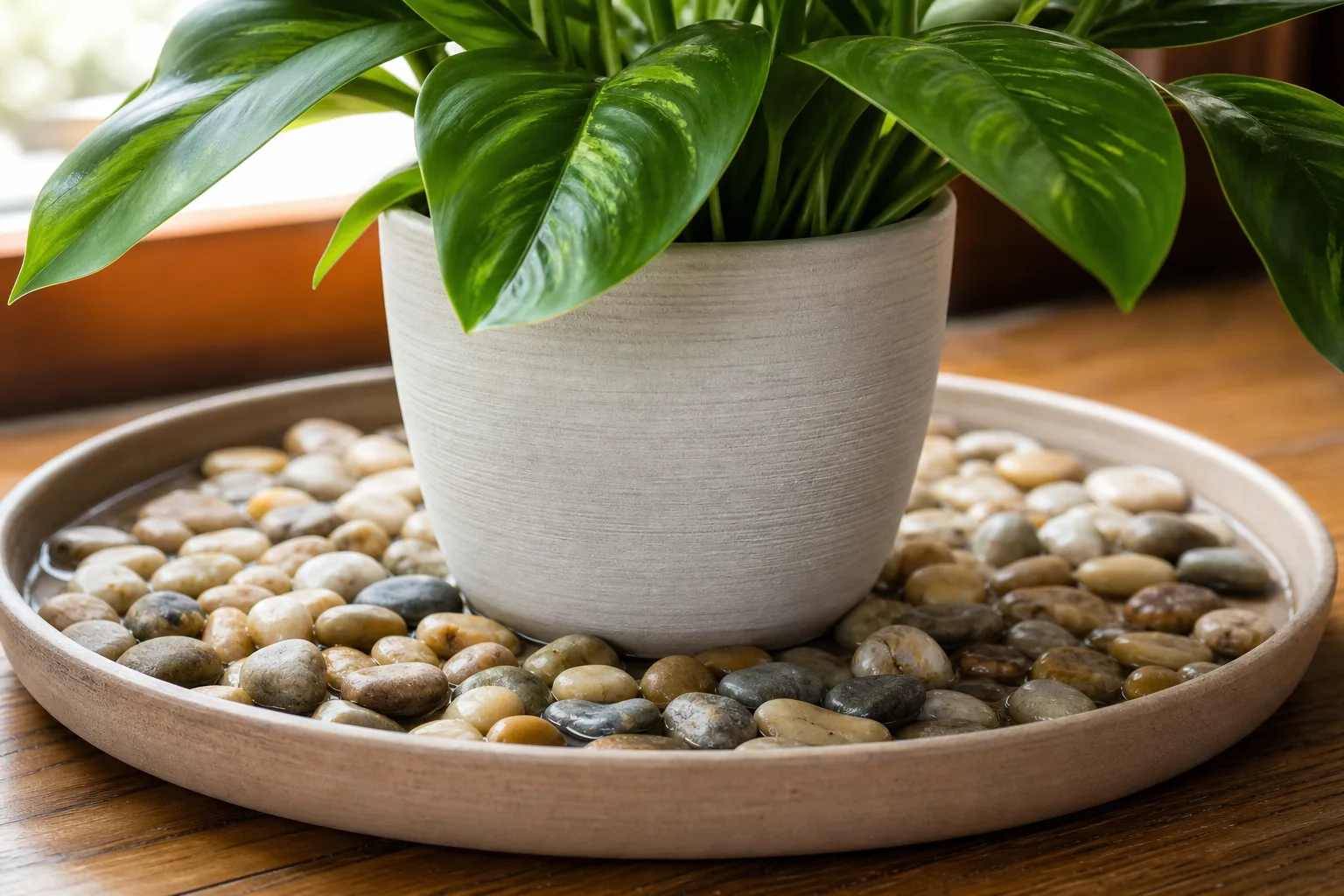 |
The non-negotiable safety rule is simple: the pot base must stay above the waterline. Penn State Extension’s houseplant-care guidance specifies filling to just below the top of the pebbles so the potting mix does not remain constantly wet.
Do Pebble Trays Actually Work for Houseplants?
They can contribute some moisture immediately around a plant, but authoritative sources differ on how useful that contribution is. The University of New Hampshire Extension describes a properly built tray as providing a small humidity benefit, especially with several plants in a low-airflow room. Penn State Extension takes a more skeptical view: evaporated moisture diffuses through the room and has almost no overall impact on relative humidity.
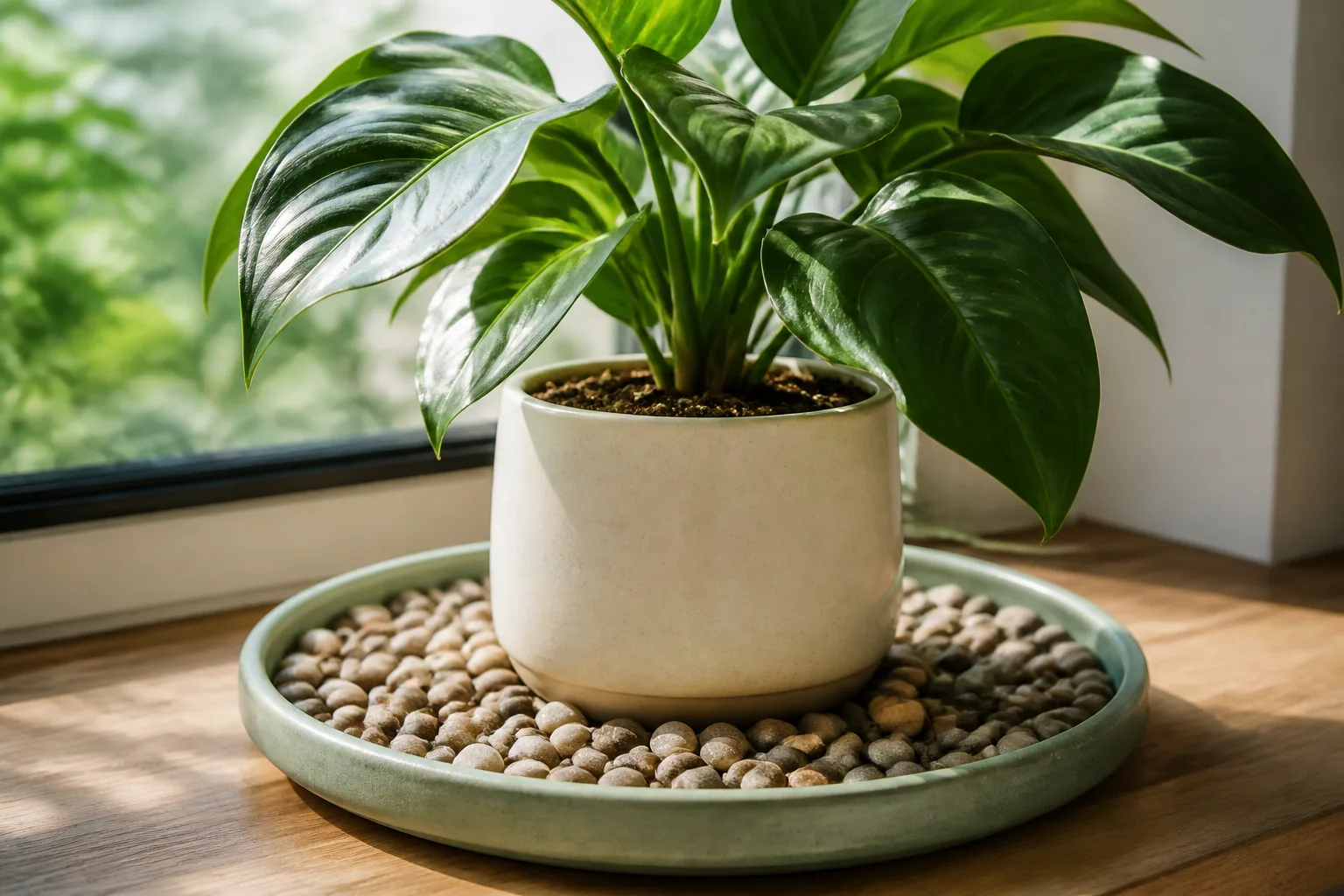
Those positions are not as contradictory as they first appear. A tray can evaporate water while still failing to change the humidity of an entire room in a meaningful way. Treat it as a localized experiment, not as a guaranteed environmental control.
When a Small Local Effect Is Still Useful
A tray is most defensible when a compact plant sits close to a broad evaporating surface and the room is only mildly dry. It is less convincing beneath a tall plant in an open room with a fan, heater, or air-conditioning vent moving air away. UNH Extension likewise says the method is maximized with multiple plants and low air circulation.
If your goal is to move a whole room from very dry to reliably humid, skip the tray experiment and use a humidifier with a sensor. If your goal is to add a little local moisture without electricity, a tray is inexpensive to test.
What Is a Pebble Tray?
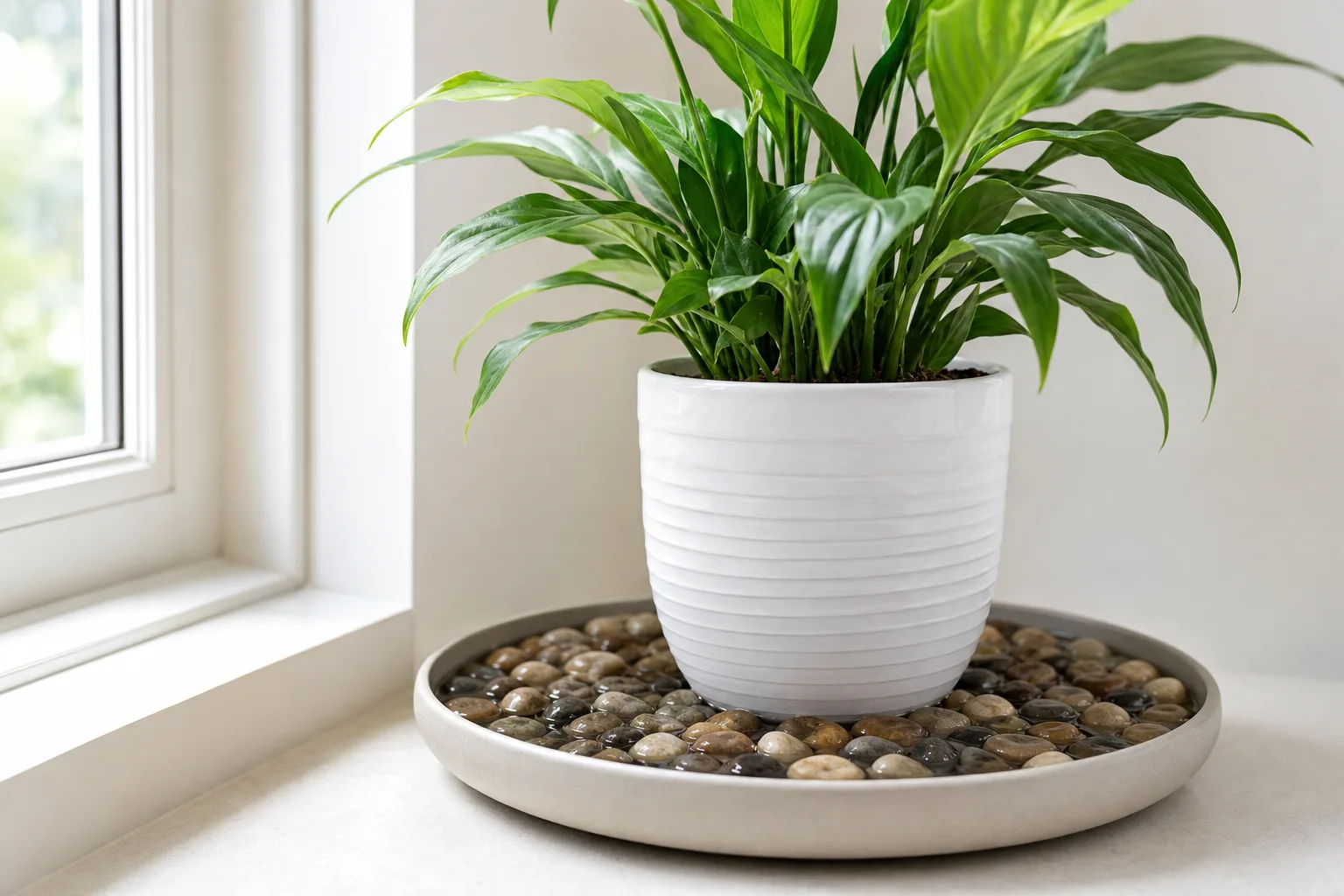
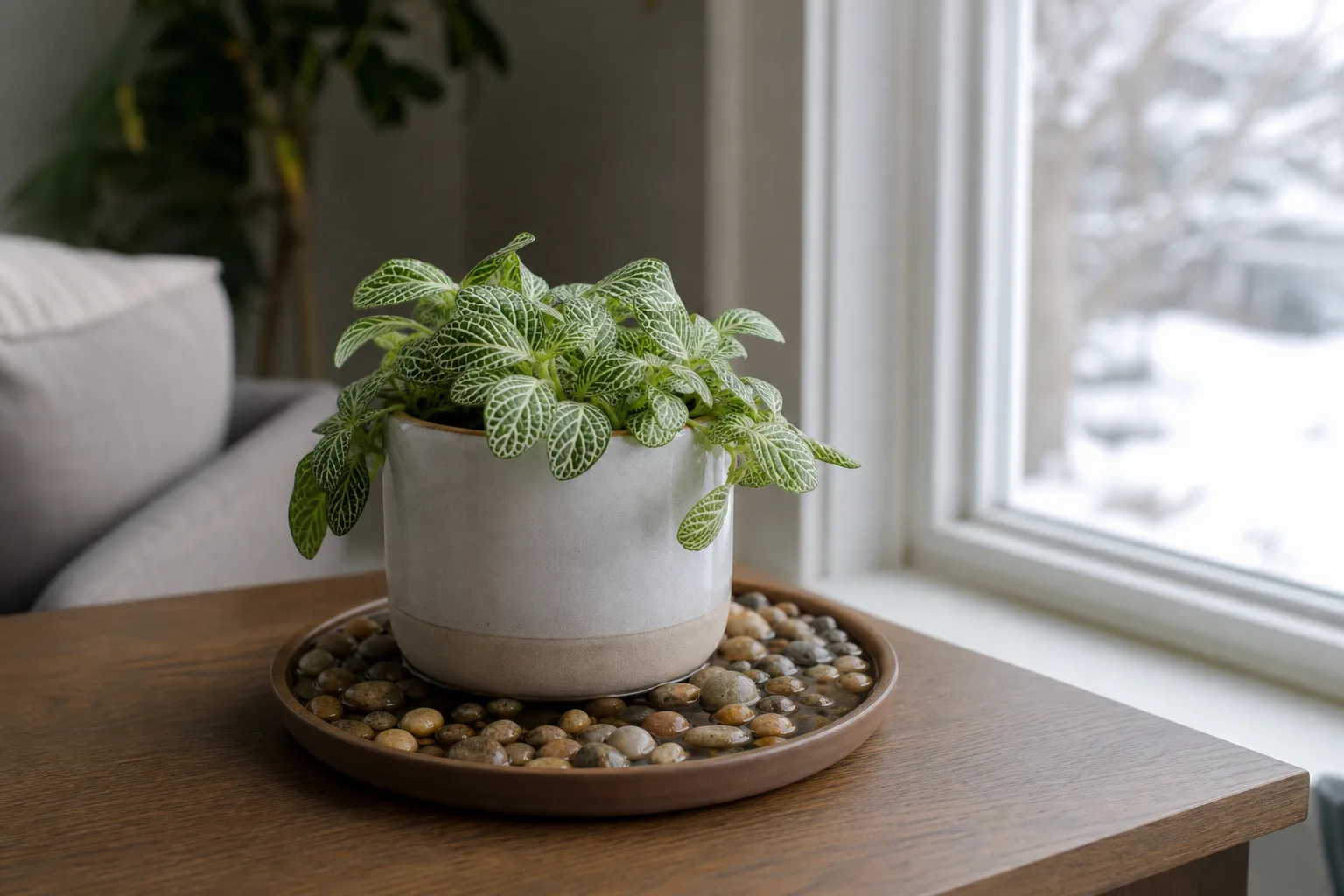
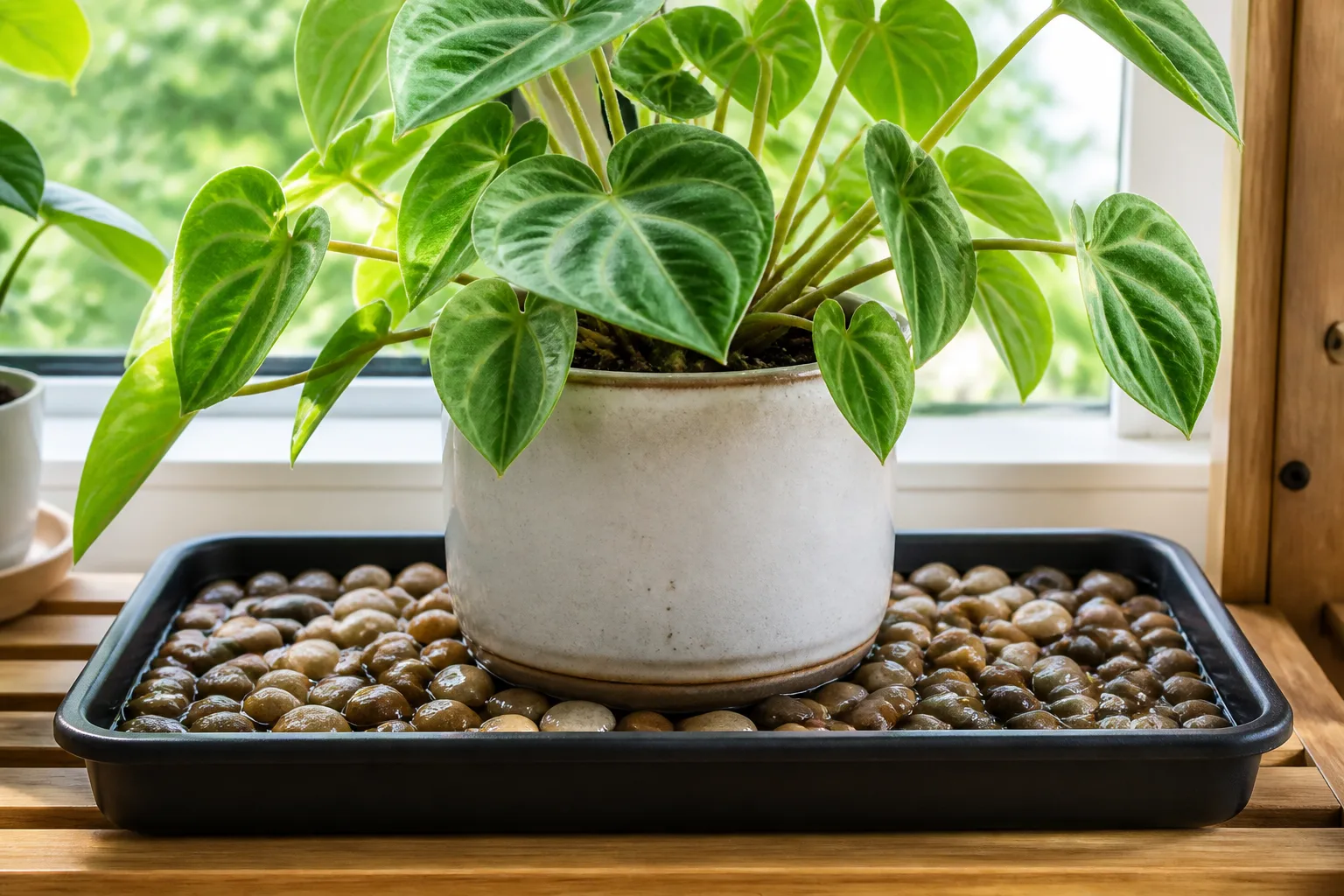
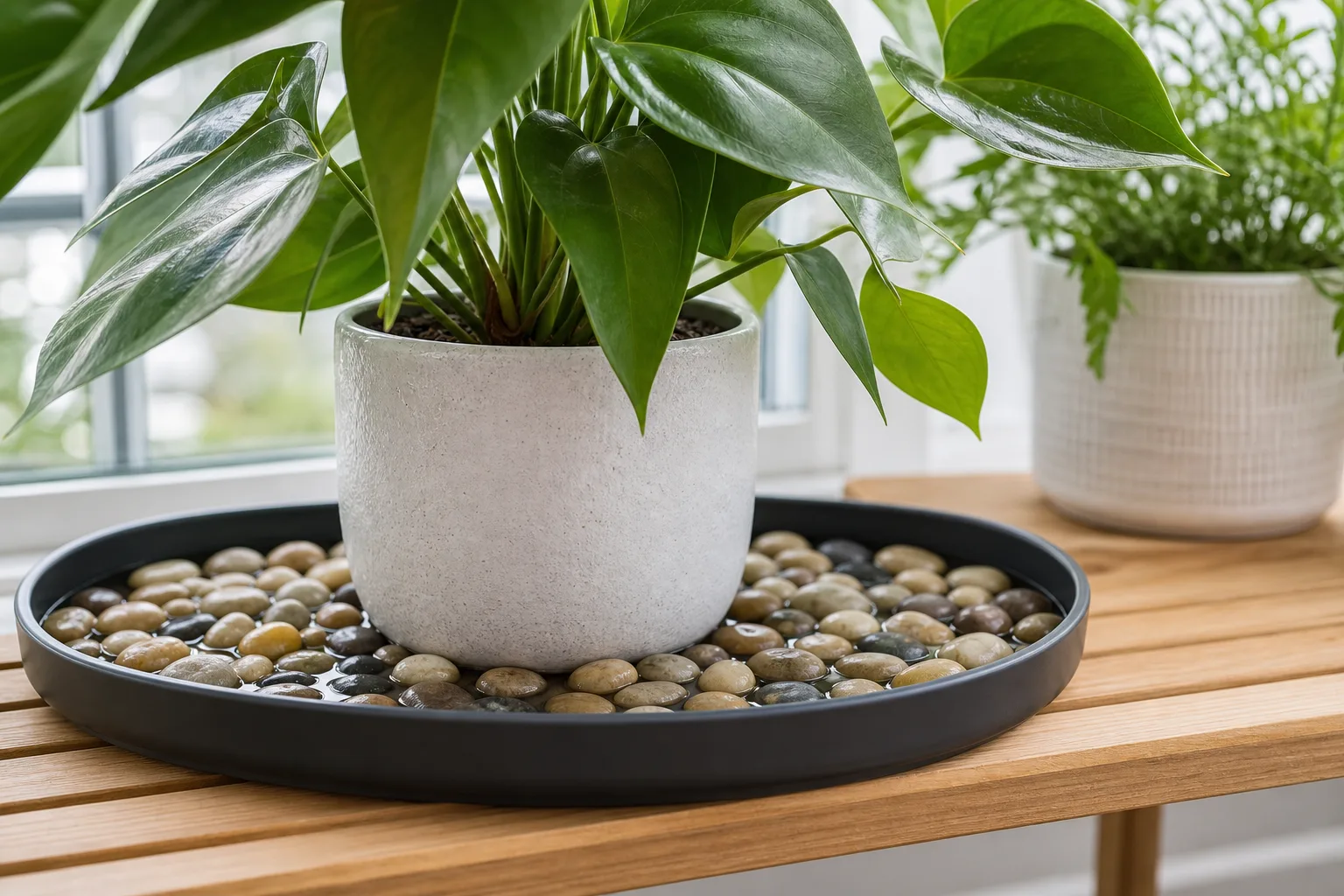
A pebble tray is a waterproof, shallow container holding water and an inert support layer. The plant pot rests on that support above the water. As the exposed water evaporates, it adds water vapor close to the plant; Iowa State University Extension describes the same arrangement as a tray whose rocks keep the pot above water level.
The stones do not feed the plant, and the tray does not water the roots when assembled correctly. Its job is to provide stable elevation plus exposed water. For a fuller explanation of the mechanism, use the pebble tray definition guide.
Do Pebble Trays Work for All Houseplants?
No. A tray is most relevant to plants that prefer more humid air and are small enough to remain near the evaporating surface. Ferns are a practical example: the University of Connecticut notes that low humidity can contribute to browning frond tips and recommends a pebble-lined tray as one possible humidity measure for indoor ferns.
Plant identity is only half the decision. Measure the room first. A humidity-loving plant in an already humid bathroom may gain nothing useful, while the same plant beside a winter heating vent may need a humidifier rather than a tray.
Poor Candidates for a Pebble Tray
Cacti and many succulents are generally poor candidates because they tolerate lower indoor humidity better than many tropical foliage plants. UNH Extension explicitly excludes cacti, succulents, and a few others from its general 40–60% houseplant range. Exceptions exist, including epiphytic “jungle cacti,” so identify the plant rather than applying one rule to every succulent-looking species.
A pebble tray is also a poor choice when the pot is unstable, the tray cannot be protected from spills, or the plant’s drainage holes would touch water. In those cases, solve the physical setup before considering humidity.
How Often Should I Refill a Pebble Tray?
Refill when the water has fallen low enough that little exposed water remains, but keep the new level below the pot base. There is no defensible universal schedule. Evaporation changes with water surface area, temperature, airflow, and existing relative humidity, so “every three days” may be too frequent in one home and too slow in another.
Check the tray during your normal plant inspection. Marking a maximum waterline on the inside edge makes overfilling less likely. If the tray empties unusually fast, check for a leak before assuming the room is simply dry; if it stays full and develops film, clean it rather than topping it up indefinitely.
Can I Use LECA or Decorative Stones Instead of Pebbles?
Yes. The support material can be LECA, washed gravel, glass beads, or decorative stone if it is clean, water-stable, and broad enough to hold the pot securely. Minnesota Extension specifically describes a saucer filled with clay pebbles and water, with the water below the top of the clay layer.
Do not assume porous LECA transforms the tray into a stronger humidifier. Its essential function here is mechanical: it elevates the pot. Avoid dyed material that sheds color, sharp pieces that damage the tray, and small round beads that let the pot wobble. Rinse dusty material before use.
Is a Pebble Tray Enough for Calatheas and Ferns?
Sometimes, but only if the ambient conditions are already close to acceptable. A tray cannot reliably compensate for a severely dry heated room. UNH Extension recommends a portable humidifier near the plants, paired with a hygrometer, for the most consistent humidity control.
For a compact fern or calathea in a sheltered plant grouping, a tray may be worth testing. For several demanding tropicals, use measured room humidity to choose between a humidifier, an enclosure, or a different location. The houseplant humidity guide explains those broader options without turning this FAQ into another full humidity primer.
Can a Pebble Tray Attract Mold or Fungus Gnats?
A dirty tray can develop algae, mineral deposits, or a slippery microbial film because it repeatedly holds water and collects dust. Empty it, scrub the tray and support material, rinse well, and refill with fresh water. The University of Connecticut advises washing or replacing gravel periodically to limit algae development.
Fungus gnats are more directly tied to damp organic potting media than to clean water over inert stones. University of Minnesota Extension says the insects lay eggs in moist soil and are especially associated with overwatered houseplants. A filthy tray can still become an unnecessary sanitation problem, but if gnats are emerging from the pot, fix the potting-mix moisture cycle first. For tray hygiene, empty the tray, scrub it, rinse the support material, and refill with fresh water on a regular schedule.
How Do I Set Up a Pebble Tray Correctly?
Use a waterproof tray wider than the pot, a stable layer of clean stone or LECA, and enough water to expose a wet surface without reaching the pot. Oklahoma State University Extension warns that contact with the pot base can wick water into the growing medium and keep the plant too wet.
The tray must remain level and must support the entire pot footprint. If the plant leans or the saucer flexes under its weight, use a stronger tray. The dedicated step-by-step pebble tray guide covers sizing and materials in more depth.
Five Setup Steps
- Choose a shallow, waterproof tray wider than the pot.
- Wash the tray and the pebbles, gravel, glass beads, or LECA.
- Add a level support layer deep enough to hold the pot securely.
- Pour in water, stopping below the top of the support layer and below the pot base.
- Place the pot on top, confirm it is stable, and mark the safe maximum waterline.
Setup check: the water is visible between the stones, but the drainage holes and pot base remain dry. This separation prevents the humidity tray from becoming a bottom-watering tray.
What Pebble Tray Mistakes Cause Problems?
The most consequential mistake is submerging the pot base. Illinois Extension instructs growers to make sure pots are not sitting directly in water. Constant contact can keep the mix wet and increase the risk of root damage; it also makes it impossible to tell whether the tray is affecting air humidity or simply watering the pot from below.
Other common mistakes are using a tray barely wider than the pot, placing it in strong airflow, trusting it without measuring, and continually topping up cloudy water. A tray should not replace correct light, watering, drainage, or pest inspection.
Common Mistakes at a Glance
The seven failures below account for most of the disappointing pebble-tray setups. Each is fixable; none requires buying a humidifier.
|| Mistake | How to spot it | Fix | Escalate when | ||---|---|---|---|---| || Expecting room-wide humidity | One small tray in a large dry room; no hygrometer change | Group small plants; accept local-only effect | Room stays below 40% RH at leaf height | || Pot sitting in water | Drainage holes wet; heavy pot; sour smell | Lower water at least ½ inch below pot base; deeper pebbles | Yellow leaves and wet soil persist | || Tray too narrow | Saucer matches pot; constant dry-out | Wider tray, 1–2 inches beyond pot rim | Still no lift on hygrometer at leaves | || Wrong plant or problem | Succulent on tray; brown tips after heavy feeding | Match tool to species; diagnose tips before adding humidity | Symptoms spread after fixing watering | || Bad location | Tray by vent, radiator, or drafty window | Move to a stable spot away from HVAC blasts | No improvement after relocation | || Slimy or stagnant tray | Algae film, gnats, sour odor | Empty, scrub pebbles, rinse tray, refill with fresh water | Gnats persist in potting mix too | || Guessing instead of measuring | “Feels dry” but no numbers | Buy a hygrometer and log RH at leaf height | RH stays far below plant needs after fixes |
Flora Grubb Gardens recommends wider trays because a larger surface creates more evaporation and a slightly larger moist-air pocket around grouped plants. Flora Grubb Gardens Plant Nursery When a tray sits beside a heating vent or AC register, the moist layer is dispersed before the foliage can use it, so even a correctly built tray will read as a failure. UNH Extension likewise advises keeping humidity-sensitive plants away from heat vents, radiators, and poorly insulated doors. University of New Hampshire Extension
Fungus gnats are a frequent “pebble tray” complaint that is usually a watering problem in disguise. Clemson HGIC notes that fungus gnat larvae develop in damp potting media and moist surface environments; if gnats appear, fix the soil-moisture cycle alongside tray hygiene. Home & Garden Information Center Likewise, brown leaf tips blamed on a tray can come from inconsistent watering, fertilizer salts, or unsuitable tap water - none of which a humidity tray fixes on its own. Iowa State lists these causes for brown leaf tips alongside low humidity. Iowa State brown leaf tips
How Do I Know Whether the Tray Is Helping?
Use a digital hygrometer and observe the plant over time. Do not use one better-looking leaf as proof; leaf condition also responds to watering, salts, light, temperature, pests, and normal aging. A repeatable measurement is more useful than a before-and-after impression.
Success does not require a dramatic room-wide change. It means the plant-level reading is modestly more stable while the tray remains clean and the potting mix is not staying wetter. If you cannot measure a repeatable difference, the tray may still be decorative, but it should not be credited as humidity control.
A Simple Hygrometer Test
Place the sensor near the foliage without letting it touch wet stones. Record relative humidity at the same times for two days with the tray dry, then two comparable days with water in the tray. Keep the plant location, heating, fan use, and sensor position unchanged. Virginia Cooperative Extension explains that temperature and humidity influence plant water use and recommends humidity methods, including humidifiers and pebble trays.
Treat the result cautiously. Humidity sensors require calibration, and weather or heating cycles may move the reading more than the tray does. A repeated difference is more meaningful than a single reading. This is an editorial test protocol, not a claim that every tray will produce a specific percentage increase.
When Is Low Humidity Not the Real Problem?
Brown tips, curling, wilting, and leaf drop are not exclusive humidity symptoms. Roots damaged by prolonged wet conditions can leave a plant wilted even when the mix is wet; UNH Extension notes that root rots can impair water transport and produce paradoxical wilting. Fertilizer salts and inconsistent watering can also produce overlapping brown-tip damage.
Check soil moisture, drainage, recent care changes, and leaf undersides before adding more humidity. The brown leaf tip guide helps separate dry-air stress from other causes. A hygrometer reading below the plant’s normal range is evidence; a crisp edge by itself is only a clue.
Pebble Tray vs Humidifier: Which Should I Use?
Choose a pebble tray for a low-cost local experiment around one or two compact plants. Choose a humidifier when you need a measurable, sustained change for a collection or a very dry room. Iowa State Extension calls humidifiers very effective at raising humidity, while its pebble-tray advice is framed as one method for the immediate area.
Humidifiers require cleaning, electricity, and appropriate placement; trays require refilling and cleaning but offer less control. Neither should wet foliage continuously or leave roots standing in water. For a full decision breakdown, use pebble tray vs humidifier or review the evidence behind pebble tray myths.
Related Guides
- How to set up a pebble tray - materials, sizing, and assembly.
- Do pebble trays really increase humidity? - a deeper effectiveness review.
- Pebble tray vs humidifier - choose the right tool for the size of the humidity gap.
- DIY pebble tray for houseplants - the canonical build guide, now covering refill amounts by tray size, cleaning cadence, and the two-week before/after observation protocol.
- Signs houseplants need more humidity - diagnose symptoms before changing the setup.
Conclusion
A pebble tray is worth using when its limits match the job. Keep the pot above the water, use a stable and reasonably broad tray, clean it regularly, and verify the effect near the leaves. If the room is substantially too dry or the plant remains stressed, a humidifier or enclosed growing space offers more control.
The useful question is not whether every pebble tray works. It is whether this tray produces a repeatable improvement for this plant without keeping the roots wet. Measure that, and the decision becomes straightforward.