Can a Pebble Tray Fix Brown Leaf Tips? What to Check First
Find out when pebble trays help brown tips, when they don't, and what watering, humidity or salt issues to check first.
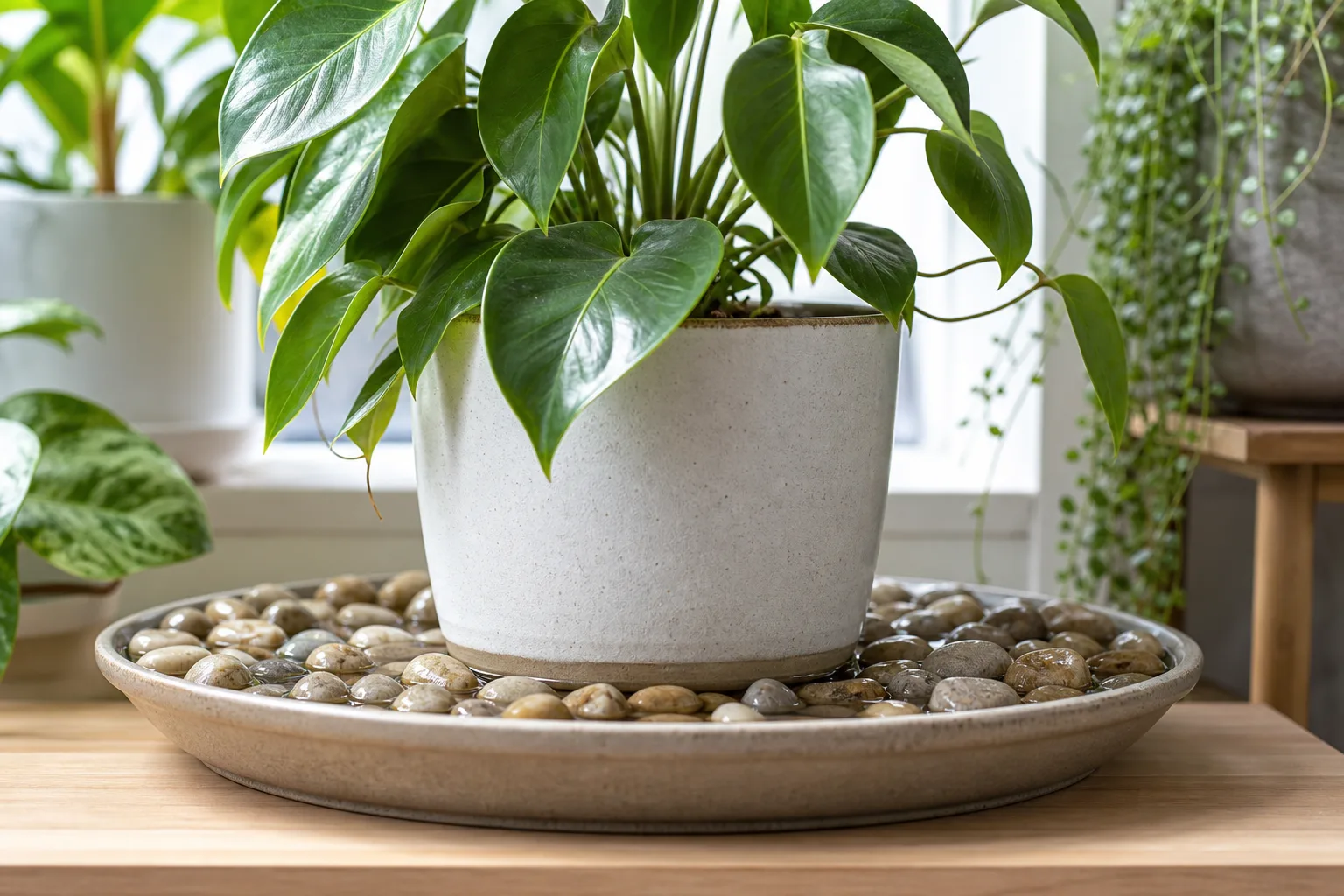
Quick Answer: A Tray Helps Only When Dry Air Is the Cause
A pebble tray can be part of the fix when low relative humidity is actually causing the brown tips. It cannot reverse dead tissue, correct erratic watering, remove fertilizer salts, improve damaged roots, or make unsuitable tap water safe for a sensitive plant. Iowa State Extension lists low humidity, inconsistent watering, excess fertilizer salts, and water chemicals among the common causes of brown tips, so the symptom alone does not tell you which treatment to use. (Iowa State Extension)
Treat the tray as a small, testable intervention rather than a cure. If a hygrometer confirms dry air, the plant is humidity-sensitive, and its root-zone care is sound, a tray may provide modest local support. If you find a white crust on the potting mix, wet soil around wilting roots, or a plant sitting in a heating vent’s airflow, correct that stronger clue first.
Brown Tips Are a Symptom, Not a Diagnosis
Use the whole pattern-season, soil moisture, water source, location, and which leaves are affected-before choosing a fix. UC IPM notes that brown or scorched tips can result from overfertilization, soluble salts, excessively dry or wet soil, specific mineral toxicities, low humidity, or mechanical injury. (UC Statewide IPM)
| What you observe | More likely cause | First action |
|---|---|---|
| Browning worsens after heating starts; air measures dry; plant is near a vent | Low humidity or hot, dry airflow | Move it out of the draft and measure RH at leaf level |
| Mix repeatedly becomes very dry; pot feels light; leaves wilt before watering | Underwatering or uneven wetting | Rehydrate thoroughly and adjust how often you check the mix |
| Mix stays wet; leaves yellow or wilt; roots smell sour or feel soft | Overwatering, poor drainage, or root damage | Stop adding water and inspect drainage and roots |
| White or gray crust on soil or pot rim; fertilizer is frequent | Soluble-salt buildup | Pause fertilizer and leach or replace the mix as appropriate |
| Spider plant, dracaena, prayer plant, or calathea declines despite adequate RH | Water-quality sensitivity | Compare results with rain, distilled, or reverse-osmosis water |
| Damage is strongest on the window- or vent-facing side | Heat, direct sun, or a draft | Change placement before changing humidity |
| Fine stippling, webbing, sticky residue, or visible insects accompany browning | Pest damage | Isolate and identify the pest before treating |
Clues That Point to Low Humidity
Dry-air damage becomes more plausible when the problem starts or accelerates during the heating season, the room measures below the plant’s normal range, and crisp margins appear without evidence of soggy roots or salt deposits. Hot or cold drafts strengthen that diagnosis because moving air can increase water loss and directly stress foliage. Clemson Extension includes hot, dry air among the causes of brown margins, while New Hampshire Extension advises keeping humidity-sensitive plants away from vents, radiators, and outside doors. (Clemson Cooperative Extension)
Do not diagnose humidity from texture alone. A crisp tip can also follow a dry root ball, salt injury, or heat at a sunny window. Dry air is a reasonable hypothesis only when the plant, measured environment, and care history point in the same direction.
Clues That Point to Watering Stress
Check the potting mix at depth rather than reacting to the leaf. Repeatedly letting the root ball dry too far can brown tips, but overwatering and damaged roots can also leave foliage short of usable water even while the mix is wet. UC IPM explicitly lists both excessively dry and excessively wet soil among possible causes. (UC Statewide IPM)
If the pot is light and dry, restore consistent watering before adding a humidity device. If it is heavy, wet, poorly drained, or foul-smelling, a tray cannot repair the root problem; make the watering and drainage diagnosis first using the site’s complete indoor-plant watering guide.
Clues That Point to Salts or Water Quality
White or gray crust on the mix or pot rim is a useful salt clue. Clemson Extension identifies salt accumulation, improper watering, and hot dry air as causes of brown tips and recommends avoiding overfertilization, removing crusts, and periodically leaching salts where appropriate. (Clemson Cooperative Extension)
Species matters. Wisconsin Horticulture reports that spider-plant tip burn can be associated with low humidity, dry soil, salt accumulation, and chemicals such as fluoride or chlorine in tap water. (Wisconsin Horticulture) If a spider plant or similarly sensitive plant keeps browning in adequately humid air, run a water-source comparison before assuming it needs more evaporation.
Clues That Point Elsewhere
Damage on the side facing a hot window, radiator, air conditioner, or door suggests placement stress. Pale stippling and webbing suggest spider mites; sticky residue or cottony clusters point toward other pests. Root binding can also make a pot dry unusually fast, and University of Maryland Extension notes that pot-bound indoor plants can develop brown or dead leaf tips. (University of Maryland Extension)
Treat those signs as scope changes. A humidity tray is irrelevant until the pest, root, light, temperature, or drainage issue is identified. Multiple problems can coexist, so fixing one factor does not prove every remaining tip came from humidity.
Measure Humidity Before You Treat It
Place a digital hygrometer near the foliage, not across the room or directly above the water. Record a baseline at the same times for several days, then run the tray in the same location and compare like with like. Temperature changes alter relative humidity, so a single reading taken at a different time of day is weak evidence.
This is the editorial test protocol LeafyPixels recommends: record room temperature and RH at leaf height, note tray dimensions and water level, keep plant placement and watering unchanged, and compare repeated readings rather than selecting the highest number. New Hampshire Extension similarly recommends pairing humidity changes with a digital thermometer and hygrometer. (University of New Hampshire Extension) A basic pebble tray setup guide covers tray dimensions and placement, two variables that directly affect measured results.
What a Pebble Tray Can and Cannot Do
A tray increases evaporation close to the pot, but that moisture diffuses into the surrounding room. UNH Extension describes the benefit as small and says it is more useful with multiple plants or low air circulation, while Penn State Extension argues that wet-pebble trays make almost no overall difference to room RH. (Penn State Extension) The defensible conclusion is limited: results depend on tray surface area, airflow, temperature, plant grouping, and measurement position, and a room-wide rise should not be assumed.
This guide therefore does not promise a particular humidity increase. For a fuller discussion of mechanism and evidence, use Do Pebble Trays Really Increase Humidity?. Here, the tray’s value is simply whether a measured local change coincides with healthier new growth after more likely causes have been controlled.
Materials for a Brown-Tip Pebble-Tray Test
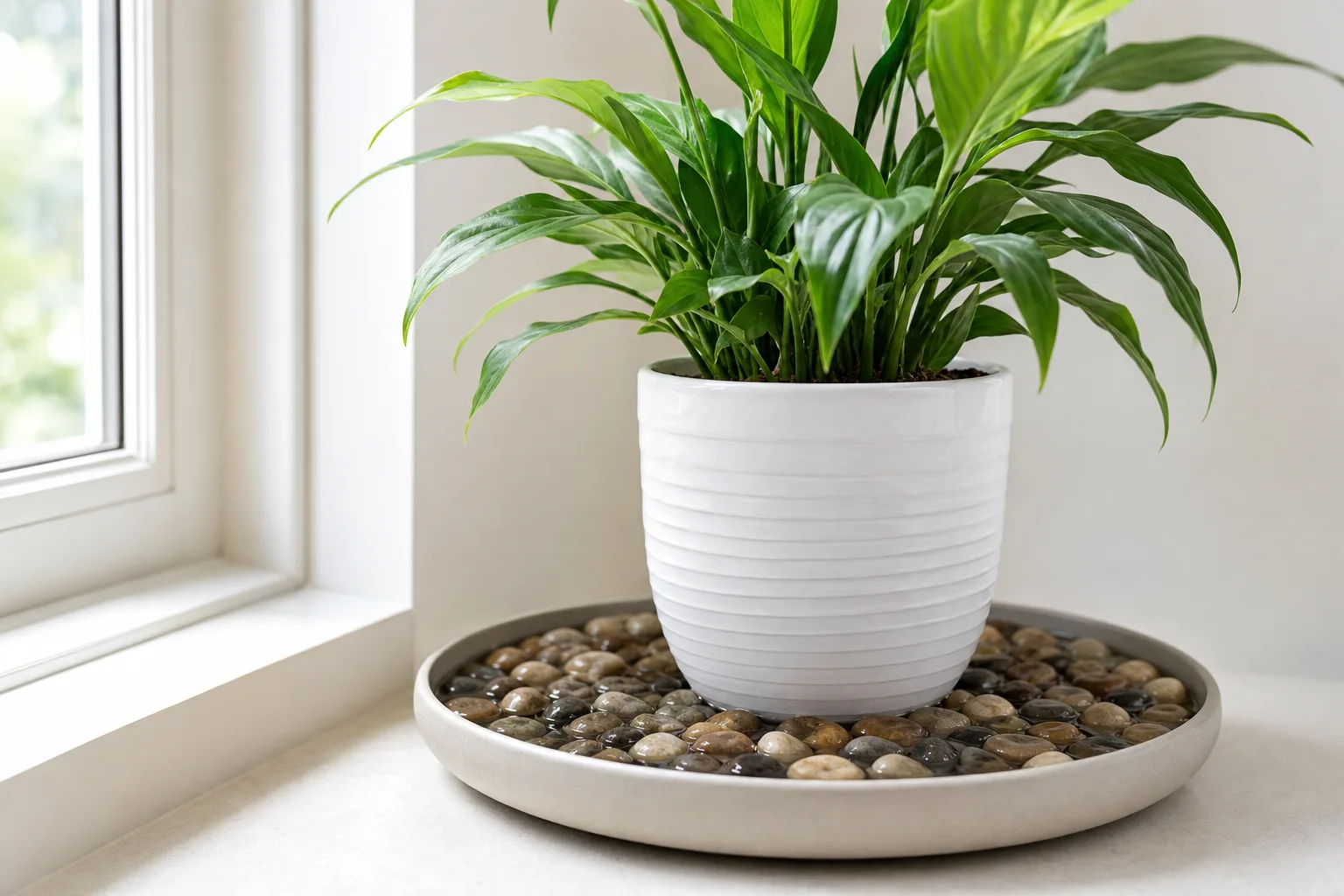
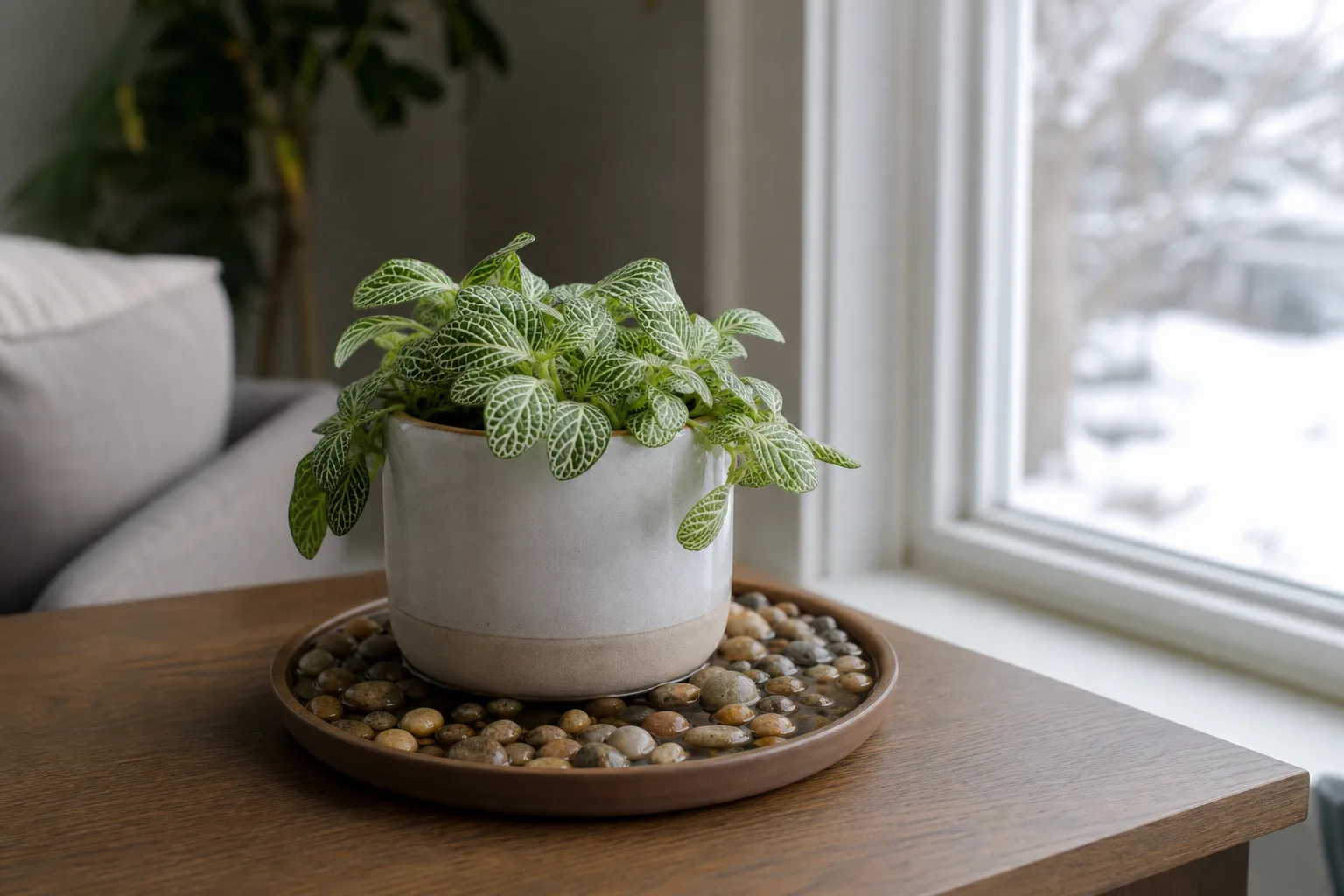
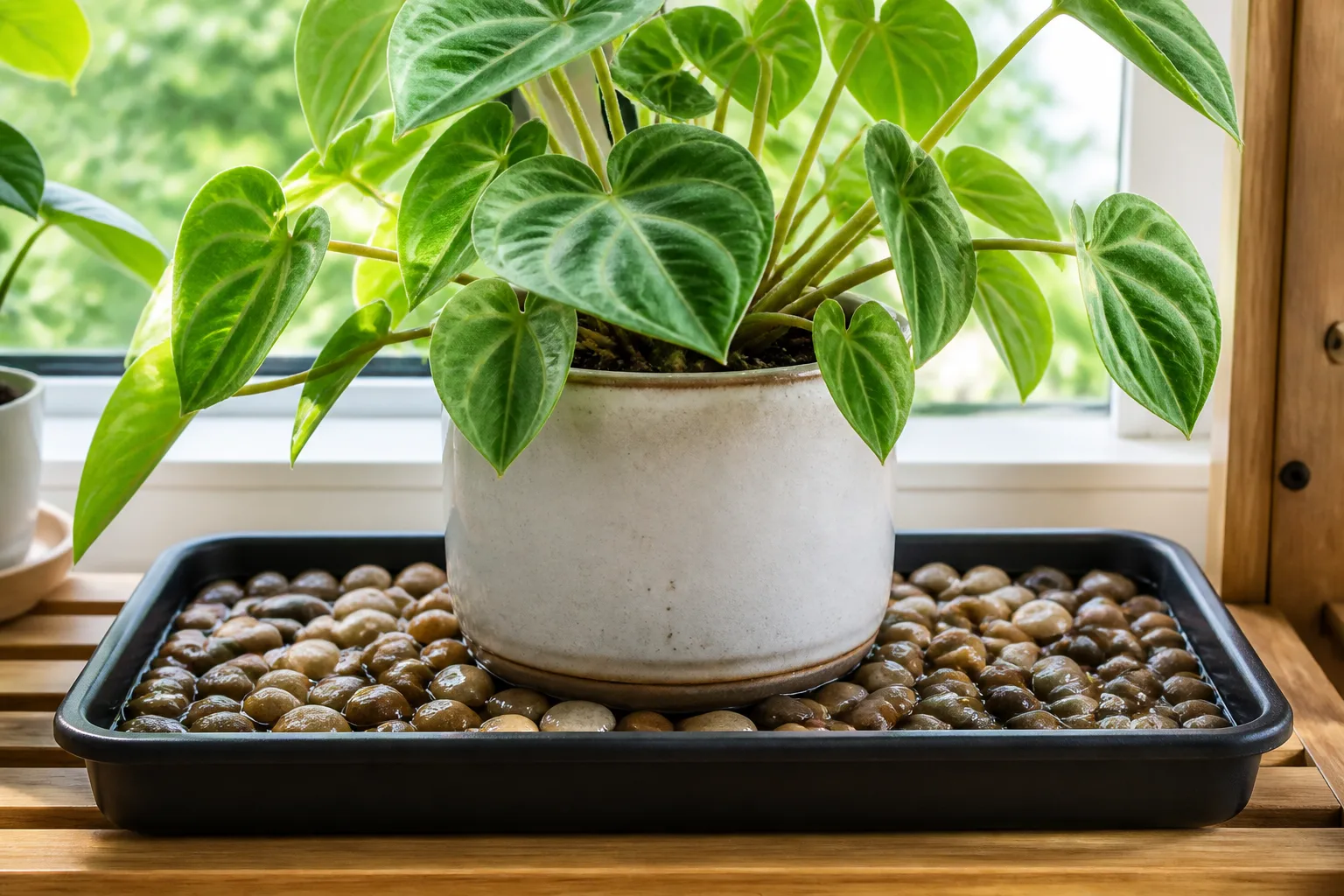
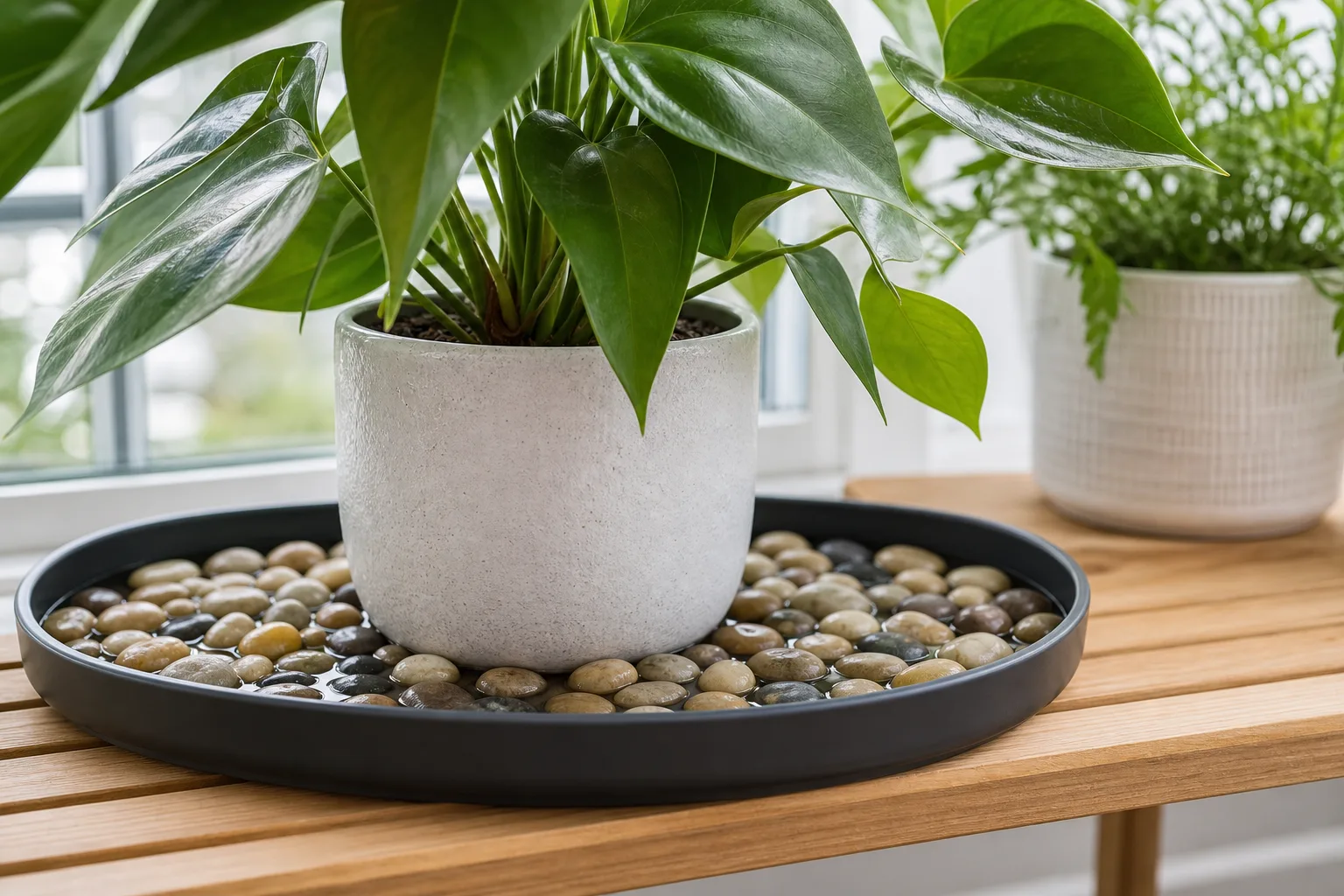
Gather a shallow, watertight tray wider than the pot base; clean, nonporous pebbles or gravel; water; and a hygrometer. Use a stable tray with enough clearance that the pot cannot tip, and use a waterproof barrier if the setup sits on vulnerable furniture.
The pebbles are supports, not a drainage layer inside the pot. Their job is to hold the container above the reservoir while exposing water surface for evaporation. A transparent or light-colored tray makes algae and debris easier to spot during cleaning.
Set Up the Tray in Five Steps
- Wash the tray and stones. Remove dust and residues before bringing the setup close to the plant.
- Add an even layer of pebbles. Make a broad, stable platform rather than a steep mound.
- Add water below the pebble tops. Penn State advises keeping the water level just below the top of the pebbles so the potting mix does not remain constantly wet. (Penn State Extension)
- Set the pot securely above the water. The pot base and drainage holes must not sit in the reservoir.
- Place the hygrometer at leaf height and log readings. Keep the plant’s light, watering, and location stable while you test one variable.
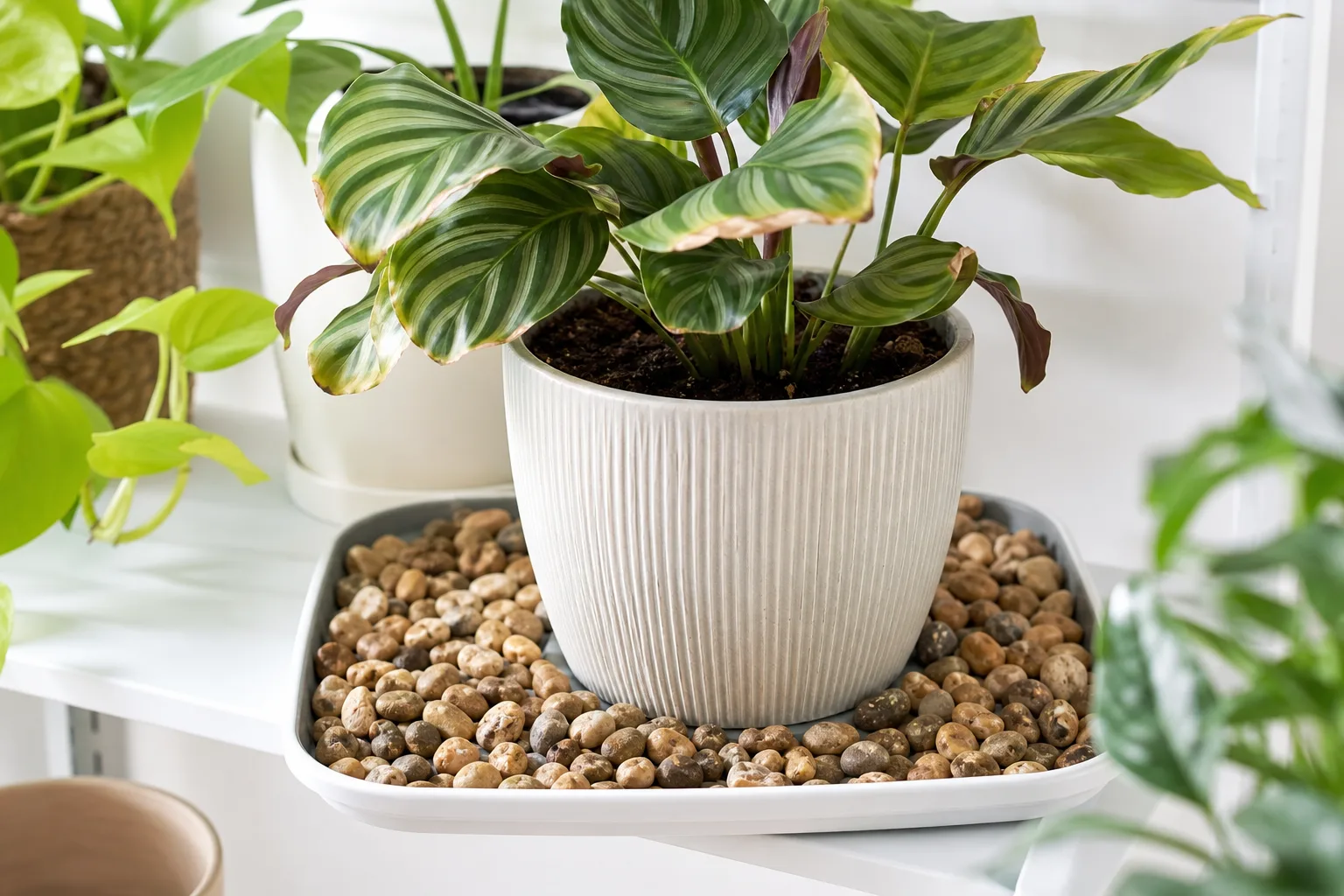 For tray sizing, decorative options, and setup illustrations, use the canonical step-by-step pebble-tray setup guide. The key safety rule is unchanged: this is an evaporation reservoir, not continuous bottom watering.
Maintain the Tray Without Creating New Problems
Top up only to the safe level below the pot, and empty, scrub, and rinse the tray when it becomes slimy or collects debris. Do not pour fertilizer runoff into it and leave it there. Standing organic debris and constantly wet nearby potting mix can create a sanitation problem instead of a humidity solution.
If fungus gnats appear, confirm whether the potting mix-not merely the open water-is staying wet too long. If the reservoir repeatedly reaches the drainage holes, reduce the level or change the support height. Revisit the setup checklist rather than compensating with more stones or water.
Which Plants Are Reasonable Candidates?
Humidity-sensitive tropical foliage plants are more rational candidates than cacti, succulents, or plants already comfortable in ordinary room air. UNH Extension says most houseplants other than cacti, succulents, and a few others prefer roughly 40–60% RH, although species differ and some tropical plants prefer more. (University of New Hampshire Extension) Measure and check the species guide instead of applying one target to every plant.
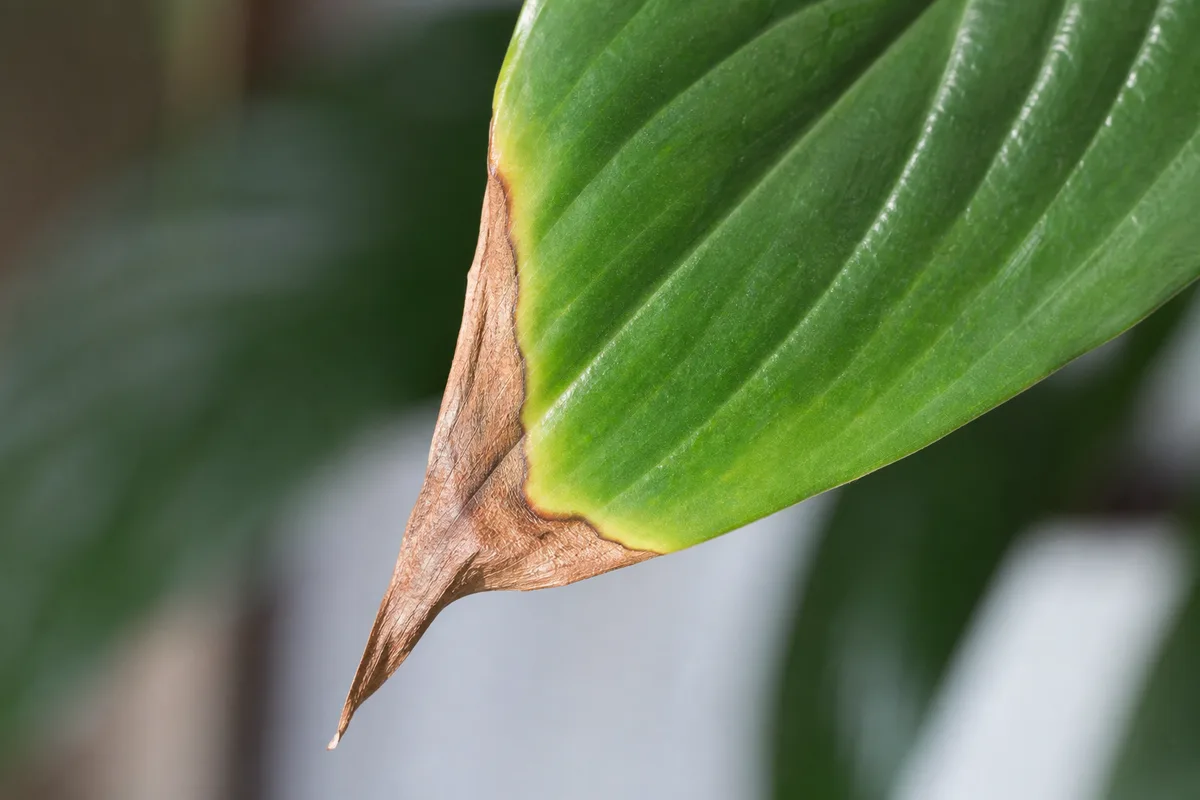
Calatheas, prayer plants, ferns, and some peace lilies may justify a test, but they can also brown from water quality or inconsistent watering. Use the dedicated peace lily brown-tips guide or spider plant brown-tips guide when species-specific clues matter more than general tray advice.
Three Setup Mistakes to Avoid
First, do not let the pot touch the water; chronic wetness around the lower mix can stress roots. Second, do not assume a decorative saucer under one plant will humidify an entire room. Third, do not change watering, fertilizer, location, and humidity on the same day, because you will lose the ability to tell which change mattered.
A fourth error is psychological: seeing old brown tissue and declaring the test a failure. The existing damage is permanent. Judge the next leaves and whether the boundary of existing damage keeps advancing after the underlying cause is corrected.
When a Humidifier Is the Better Tool
Choose a humidifier when the measured room RH is persistently low, several plants need the same correction, or the tray produces no repeatable change near the foliage. UNH Extension says a portable humidifier near plants, monitored with a sensor, provides the most benefit; Purdue likewise describes a humidifier as the most effective option compared with grouping and occasional misting. (Purdue University)
Avoid pushing whole-room humidity indefinitely upward. EPA guidance recommends keeping indoor RH below 60% and ideally between 30% and 50% where possible to reduce mold risk. (U.S. Environmental Protection Agency) Balance the plant’s needs against condensation and building conditions, and compare operating tradeoffs in Pebble Tray vs. Humidifier.
Trim Old Damage, Then Watch New Growth
Brown tissue will not turn green again. Iowa State Extension notes that trimming brown portions can improve appearance, but new browning continues unless the cause is addressed. (Iowa State Extension) Use clean scissors and follow the leaf’s natural outline, leaving a narrow brown margin if cutting into living tissue would enlarge the wound.
Photography is useful evidence. Take a dated close-up before changing care, then photograph the same leaf and the next emerging leaf under similar light. Improvement means the damage stops advancing and new growth develops normally, not that the original tip heals.
Troubleshoot Persistent Brown Tips in This Order
- Check the roots and potting mix. Wet, sour, compacted, or bone-dry conditions outrank humidity as immediate problems.
- Review watering consistency. Correct repeated drought or saturation without watering by calendar.
- Look for salts. Pause excess fertilizer and address visible deposits or unsuitable softened water.
- Review water quality for sensitive species. Compare a different source over new growth rather than expecting overnight change.
- Move the plant out of direct hot or cold airflow. Keep appropriate light while avoiding vents and temperature swings.
- Measure RH at leaf height. Use a tray only when the result and species justify it.
- Escalate to a humidifier or enclosure if needed. Monitor the room and avoid condensation.
- Inspect for pests and root disease if decline continues. Contact a local Extension office when the cause remains unclear or the plant is rapidly deteriorating.
Change one major variable at a time and keep a short log. That discipline is slower than buying another accessory, but it produces a diagnosis you can reuse across the rest of your collection.
Related Guides for the Next Diagnosis
- Do pebble trays really increase humidity? explains the evidence and limits behind the local-humidity claim.
- How to set up a pebble tray covers sizing, assembly, and placement in detail.
- Pebble tray vs. humidifier helps when measured room humidity needs a larger correction.
- How to water indoor plants is the better starting point when the root ball swings between too wet and too dry.
- Houseplant humidity guide explains measurement, placement, and species differences.
Conclusion
A pebble tray can help prevent more brown-tip damage only when dry air is a meaningful part of the diagnosis and the setup produces a useful local change. It cannot repair old tissue, rescue damaged roots, flush salts, or solve unsuitable water. Measure first, correct the strongest clue, keep the pot above the reservoir, and judge the response in new growth.
If the tray makes no repeatable difference, that result is useful. Move to the next evidence-backed cause instead of adding more water to the saucer. Brown tips are best solved as a diagnosis problem; the tray is only one possible treatment.