Brown Tips on Peace Lily: Causes, Checks & Fixes
Quick answer
Brown tips on peace lily are most often caused by fluoride or salt buildup from tap water, especially when humidity is low. First fix: switch to rainwater, distilled, or reverse-osmosis water for every watering while you run a quick humidity, light, and fertilizer check.
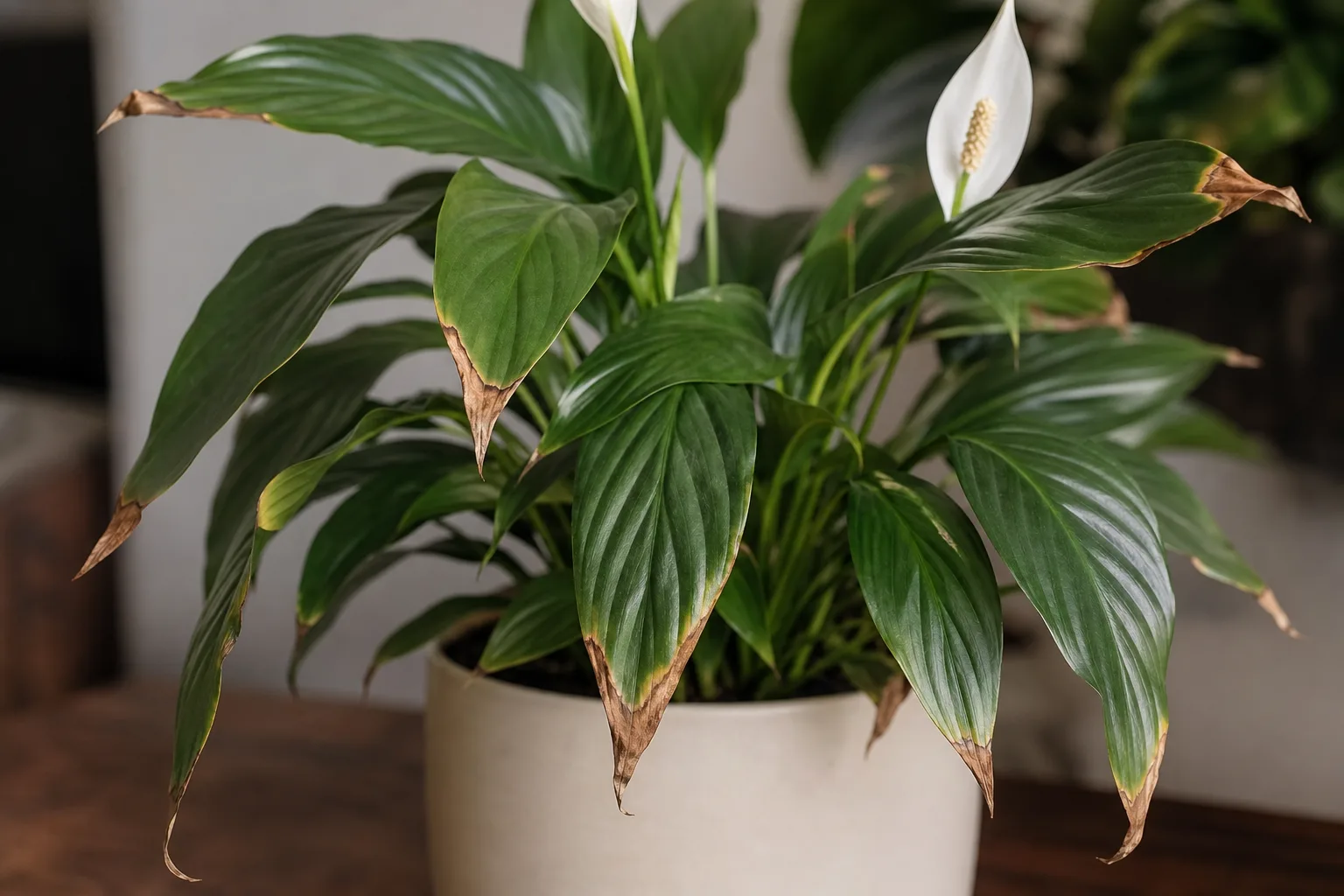
Brown Tips on Peace Lily: Causes, Checks & Fixes
This guide covers brown tips on Peace Lily. See also the general Brown Tips guide, watering, and light pages for this plant.
Brown Tips on Peace Lily: Causes, Checks & Fixes
Quick answer
Brown tips on peace lily (Spathiphyllum wallisii and hybrids) are usually a stacked-stress pattern, not a leaf disease. The clearest first diagnostic move is switching all watering to low-mineral water-rainwater, distilled, or reverse-osmosis-because peace lily is widely reported as a fluoride-sensitive houseplant and municipal tap water can accumulate salts at leaf margins over time.
Then check humidity at leaf level, fertilizer history, and light exposure in that order. Peace lilies droop dramatically from thirst and rebound after watering, but persistent tip burn despite “normal watering” often points to water chemistry, dry air, or salt buildup-not pure underwatering.
Escalation rule: Soft tip browning with yellowing leaves, sour soil smell, or wilt that does not recover within a few hours after a thorough drink means root stress, not cosmetic edge burn. Route to overwatering or root rot before trimming more foliage.
For humidity-only cases, see low humidity on peace lily. For baseline watering rhythm, see peace lily watering.
What brown tips look like on Peace Lily
Match your plant to one of these three patterns before changing five variables at once.
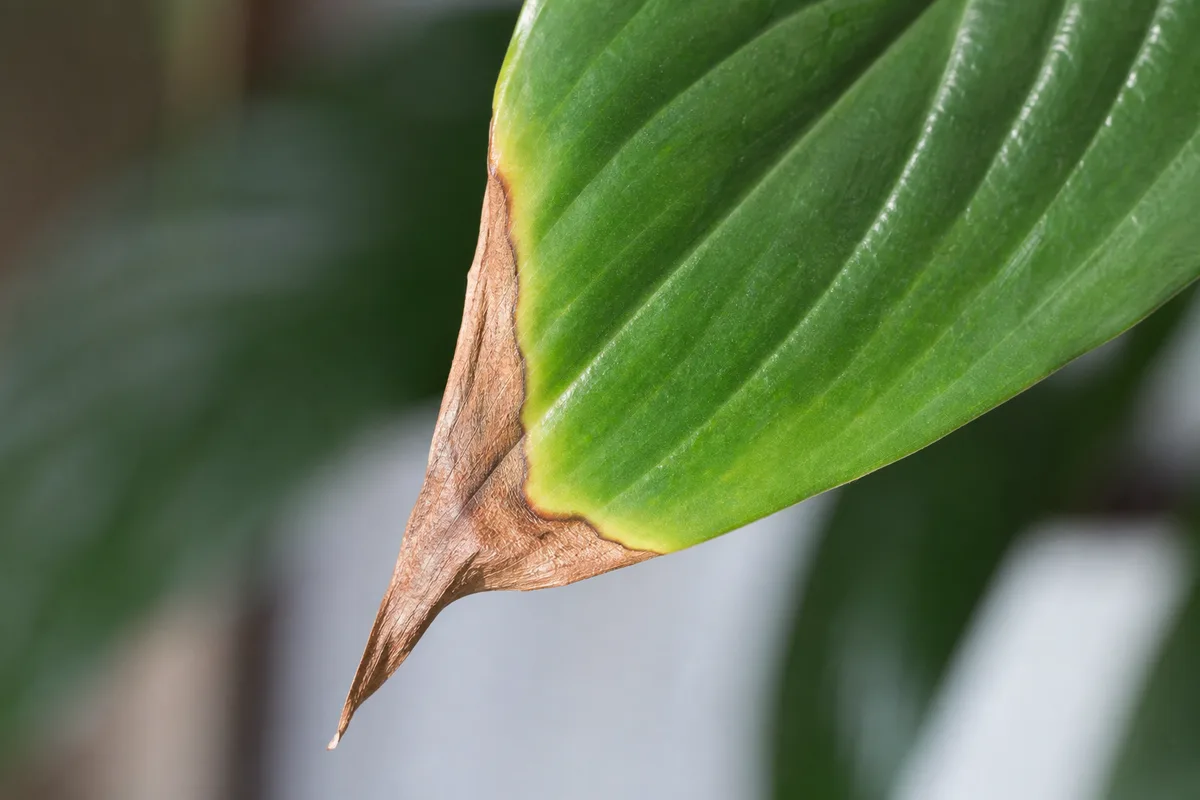
Brown Tips symptoms on Peace Lily - compare with healthy tissue on the same plant.
Crispy tips with green centers
This is the classic fluoride-or-salt signature: tan-to-brown, papery damage at the tip or margin while most of the blade stays green. Damage often appears on several leaves at once and may creep slowly inward along the edge over weeks. It commonly tracks tap-water chemistry plus dry winter air-not a sudden overnight collapse.
Soft tip browning with yellowing
If tips brown while leaves also yellow, wilt on wet soil, or collapse at the base, treat this as a lookalike and inspect roots. Peace lily prefers evenly moist but aerated mix; prolonged saturation damages roots before the whole leaf goes uniformly brown. See overwatering and root rot.
Window-side scorch patches
Peace lily grows best in bright, indirect light and foliage can scorch in direct sun. Sun stress often appears as broader tan or bleached patches on the exposed side of the leaf, not only narrow tip necrosis. Heat from a hot south or west window can add margin burn even when water quality is fine.
Why Peace Lily margins brown first
Peace lily leaves are wide, glossy, and thin-edged-built for understory humidity in tropical forests. Indoors, the outer margin is the last part of the blade to receive water and the first place excess minerals concentrate as water evaporates from the tip and edge. That physiology explains why fluoride, chlorine, and fertilizer salts so often show up as tip and margin necrosis before the leaf center fails.
Contributing causes on this species:
- Water quality (fluoride and mineral load): Extension guidance lists peace lily among fluoride-sensitive houseplants. Fluoride added to many municipal supplies does not evaporate when tap water sits overnight; only chlorine dissipates. Regional fluoride levels vary-some cities fluoridate heavily, others minimally-so two peace lilies on tap water in different zip codes can look very different after a year.
- Dry air near vents: Leaves can brown at edges and tips in low humidity, especially when forced-air heat pulls room RH below 30% in winter.
- Fertilizer salt buildup: Overfeeding can burn margins and tips; white crust on the soil surface after heavy feeding is a visual clue.
- Direct sun and heat exposure: Full sun can scorch leaves; harsh drafts from HVAC vents dehydrate margins quickly.
- Moisture swings: Severe dry-down followed by heavy soaking stresses tissue at the leaf edge on a plant that prefers steady moisture.
In many homes, winter stacks the triggers: drier air, heating vents, slower growth, and salts accumulating in older potting mix while watering rhythm stays on a summer calendar.
RH thresholds at leaf level
Place a digital hygrometer beside the foliage-not across the room-for two to three days before you blame humidity alone.
| Leaf-level RH | What it usually means for peace lily tip burn |
|---|---|
| Below 30% | Very dry - high margin-browning risk near heat or vents |
| 30–40% | Marginal - tip burn likely if plant sits in airflow |
| 40–60% | Comfortable target band for most peace lilies indoors |
| Above 45% with ongoing crisp tips | Humidity less likely the sole cause - test water quality and salts |
Winter heating often pulls whole-room RH well below 30%, while peace lily performs best closer to the 40–60% band during dry months. Local readings at the plant matter more than a hallway sensor.
Lookalike comparison table
Use this table to route your first fix without confusing cosmetic edge burn with root failure or sun scorch.
| Pattern | Leaf appearance | Soil / pot | Smell / posture | Likely cause | First action |
|---|---|---|---|---|---|
| Fluoride / tap-water burn | Dry crispy tips; green center; no yellow halo | Normal dry-down; firm stems | Normal droop recovers after water | Water chemistry | Switch to low-mineral water for 4–6 weeks |
| Low humidity | Crisp margins; often near vent or winter window | Normal moisture | Normal posture | Dry air | Move off airflow; raise RH to 40–60% - low humidity |
| Fertilizer salt burn | Margin burn after recent feeding; white crust possible | Normal to dry | Neutral | Salt buildup | Flush pot; pause fertilizer |
| Sun / heat scorch | Broad tan patches on sun-facing side | Normal | Leaves may curl in hot beam | Too much direct light | Move to bright filtered light - light guide |
| Underwatering episode | Crisp tips after severe wilt; whole leaf limp | Light, dry pot | Dramatic droop perks up after soak | Drought stress | Deep drink when top inch dries - underwatering |
| Root-stress lookalike | Soft yellowing + brown tips; multi-leaf spread | Heavy, wet 3–5 cm down for days | Wilt on wet soil; sour smell | Overwatering / rot | Stop water; inspect roots - overwatering, root rot |
| Natural aging | One older lower leaf at a time | Normal | Firm petiole | Senescence | Remove leaf when fully brown; no repot |
Yellow halos around brown tips more often fit humidity stress; crispy tips without a yellow ring on older leaves first more often fit fluoride accumulation-though both can coexist in winter.
How to confirm the cause (in order)
- Water source: If you use tap or softened water, switch immediately to rainwater, distilled, or RO water and track the next two to three emerging leaves. Softened water adds sodium and can worsen salt stress-avoid it for peace lily.
- Humidity: Log RH at leaf height for several days. Persistent readings below 40% during heating season support dry-air injury; above 45% with ongoing crisp tips points more toward water quality or fertilizer salts.
- Fertilizer record: Frequent or full-strength feeding raises salt-burn risk. Pause feeding until clean new growth appears; flush once with plain low-mineral water if you recently overfed.
- Soil and roots: Sour smell, chronically wet mix, or dark mushy roots points to root stress rather than cosmetic tip burn-escalate to root inspection before trimming more leaves.
- Light pattern: One-sided damage near glass or a direct sunbeam supports light scorch. Peace lily wants bright indirect light, not direct midday sun.
Change one major variable at a time so the next leaves tell a clear story.
The first fix to try
For the next four to six weeks, change only one major variable: water exclusively with rainwater, distilled, or reverse-osmosis water. This isolates the most common peace-lily-specific cause quickly and avoids confusion from repotting, feeding, and moving the plant all at once.
If you recently fertilized, flush the pot once with plain low-mineral water until about 15–20% drains from the bottom, discard runoff, and pause feeding until new growth looks healthy. Keep the plant in bright indirect light, away from direct sun and HVAC airflow.
Do not compensate for dry air by overwatering-wet roots plus stressed foliage invites root problems without fixing edge burn.
Step-by-step recovery
- Switch water as above; label the calendar so you can judge the next two leaves fairly.
- Trim dead tip tissue for appearance only-clean scissors, follow the leaf curve, keep all green blade. Trimmed tissue will not re-green.
- Raise humidity with a humidifier or grouped plants if RH readings are low; pebble trays help modestly if the pot base stays above standing water.
- Keep mix evenly moist but not saturated; empty saucers so roots do not sit in stagnant water.
- Resume feeding lightly only after new growth emerges with clean margins-low-strength fertilization during active growth.
- Repot only if mix is compacted, salty, smells stale, or roots are clearly unhealthy.
Recovery timeline and what to expect
Old brown tips do not heal. Recovery means the damage stops spreading and new leaves emerge cleaner. Many peace lilies show clearer improvement within two to six weeks after correcting water quality and humidity, then stabilize over one to two leaf cycles.
Track these markers:
- Next two leaves: margins emerge green and intact.
- Spread: browning on older foliage stops advancing inward.
- Posture: normal thirst droop still recovers within an hour after watering; persistent wilt on wet soil is a red flag.
Reviewed case: tap water to filtered water
Editorial case note reviewed by LeafyPixels Review Board - composite of common winter desk setups.
A three-year-old peace lily on a bright east windowsill developed crispy brown tips on five older leaves over two months while the owner watered with straight municipal tap water every seven days. A leaf-level hygrometer logged 42–48% RH-adequate but not high. The plant sat 2 feet from a forced-air heat register.
Actions taken: moved the pot four feet from the vent; switched all watering to reverse-osmosis water; paused fertilizer; trimmed dead tips for appearance only.
Measured outcome: the next emerging leaf showed a clean margin by week four; the following leaf was fully green at the tip by week six. Older brown tissue did not re-green. No repot was needed.
This pattern-acceptable humidity, vent proximity, cleaner new growth after water switch-is the recovery signal to watch for. If new leaves stay burned after six weeks on low-mineral water, escalate to fertilizer flush, root check, or light review.
Mistakes to avoid
- Do not keep using softened water; sodium worsens salt stress.
- Do not increase fertilizer to “green it back up” while margins are still burning.
- Do not overwater to compensate for dry air or trimmed tips.
- Do not expect trimmed tips to regrow green tissue.
- Do not assume every city tap water causes fluoride burn-test with a four-to-six-week water switch before buying expensive gear.
How to prevent brown tips on Peace Lily
Use low-mineral water long term if your plant proved sensitive, maintain moderate humidity (40–60% at leaf level), keep bright indirect light, and fertilize lightly during active growth. Recheck placement each season so the plant stays away from direct vent blast and hot window glass.
For humidity-heavy winter rooms, pair environmental fixes with the peace lily overview watering hub so dry-down rhythm matches slower winter growth.
Pet safety note while trimming
Peace lily is listed as toxic to cats and dogs due to insoluble calcium oxalates. Keep clippings away from pets, wash hands after handling cut tissue, and clean up sap-contaminated debris promptly.
If a pet chews leaves or ingests trimmings, contact your veterinarian or the ASPCA Animal Poison Control Center at (888) 426-4435 - peace lily irritation is usually oral, not kidney failure like true lilies, but professional guidance is still appropriate.
Related peace lily problem guides
- Low humidity - RH-based recovery when dry air is the confirmed driver
- Overwatering - wet-soil wilt paradox and dry-down protocol
- Root rot - mushy roots, trim rules, and salvage cuts
- Yellow leaves - multi-leaf yellowing triage vs. edge burn only
- Underwatering - drought after severe wilt
- Peace lily light - placement that prevents scorch
- Peace lily watering - moisture rhythm hub
- Peace lily overview - species basics and full care hub
Conclusion
Brown tips on peace lily reward a simple diagnostic order: pattern first, then water chemistry, then humidity and salts, then root check if soft yellowing appears. Crispy green-centered tips on tap water usually mean switch to low-mineral water before repotting. Soft yellowing on wet soil means pause water and inspect roots today-not another trim session. Judge success by the next two leaves, not old brown edges turning green again.
Frequently asked questions
How do I confirm tap-water or fluoride stress on peace lily?
Tip burn from water quality is usually dry and crispy at the very tip and margin while most of the leaf stays green. If new leaves emerge cleaner after 3–6 weeks on rainwater, distilled, or RO water, your diagnosis is likely right. Existing brown tissue will not turn green again.
Should I trim brown tips on peace lily leaves?
Yes, for appearance only-once you have started the corrective fix. Snip dead brown tissue with clean scissors, following the natural leaf curve, and leave all green blade intact. Trimmed tips do not regrow green; judge recovery by whether the next one to two emerging leaves have clean margins.
Can brown peace lily tips recover?
Damaged tips are permanent, but the plant can still recover well. Judge progress by cleaner new leaves and a stop in symptom spread, not by expecting old tips to heal. Many plants improve within one to two new-leaf cycles after water quality and humidity are corrected.
When are brown tips a serious warning instead of cosmetic stress?
Escalate quickly when brown tips come with yellowing, foul soil odor, soft stems, or persistent wilt after watering. That combination can point to root stress instead of simple edge burn. Check roots and drainage right away-see our overwatering and root-rot guides before adding more water.
Is this different from low-humidity damage on peace lily?
Low humidity usually dries only the outer tip and is often seasonal near heating or AC vents. Water-quality and fertilizer-salt issues usually creep farther along the margins over time. Many homes have both stressors at once, so fixing only one may not stop new damage-see our low-humidity guide if RH stays below 40% at leaf level.