Do Pebble Trays Increase Humidity? What to Know
Understand how much humidity pebble trays can add, where they work best, and when your plants need a better fix.
The Short Answer
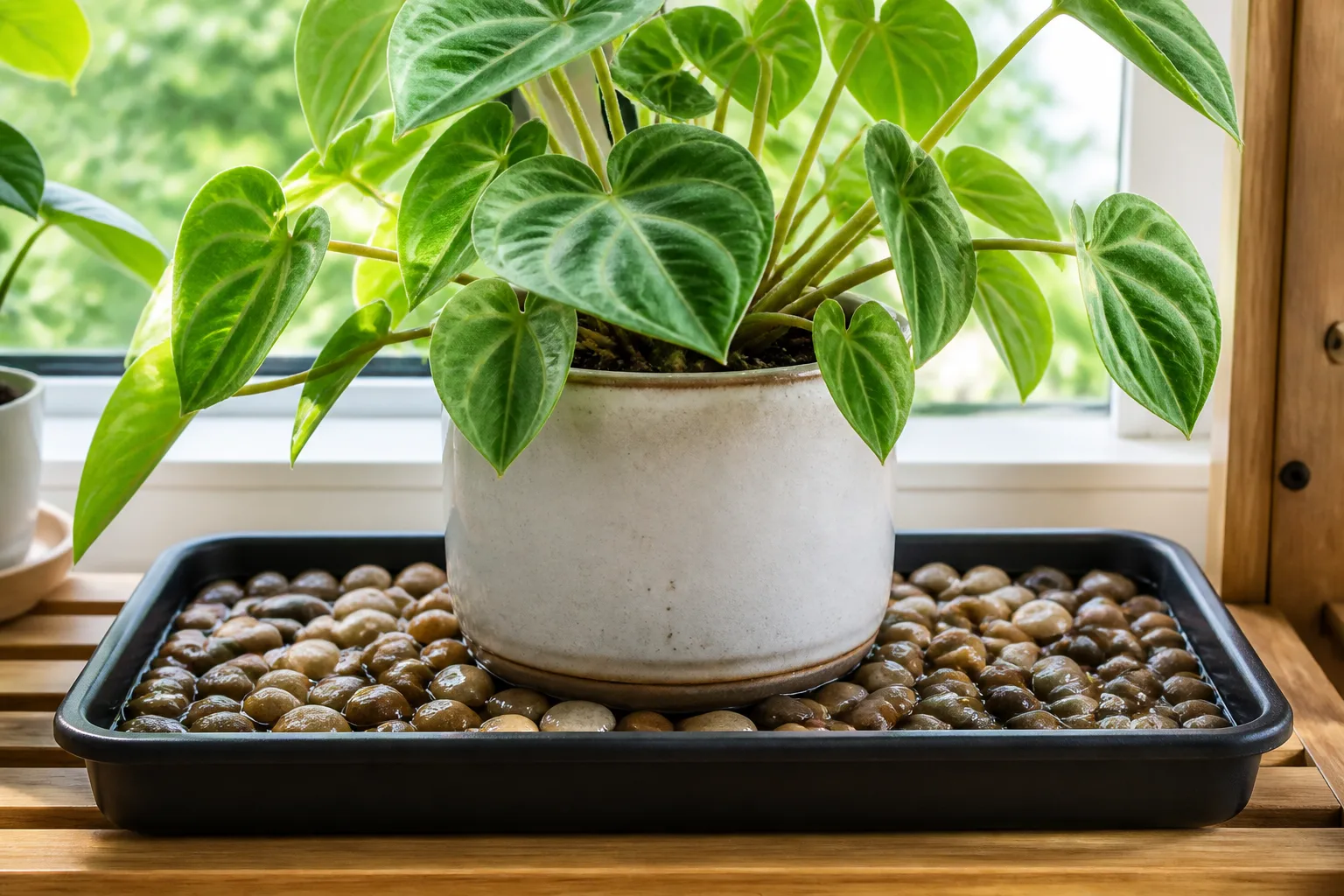
Yes, pebble trays can increase humidity near the tray, but usually only a little and only very close to the water surface. Evaporation is real. The practical question is whether that extra moisture reaches the leaves in a useful amount — and in most heated homes with normal airflow, the answer is often not by much.
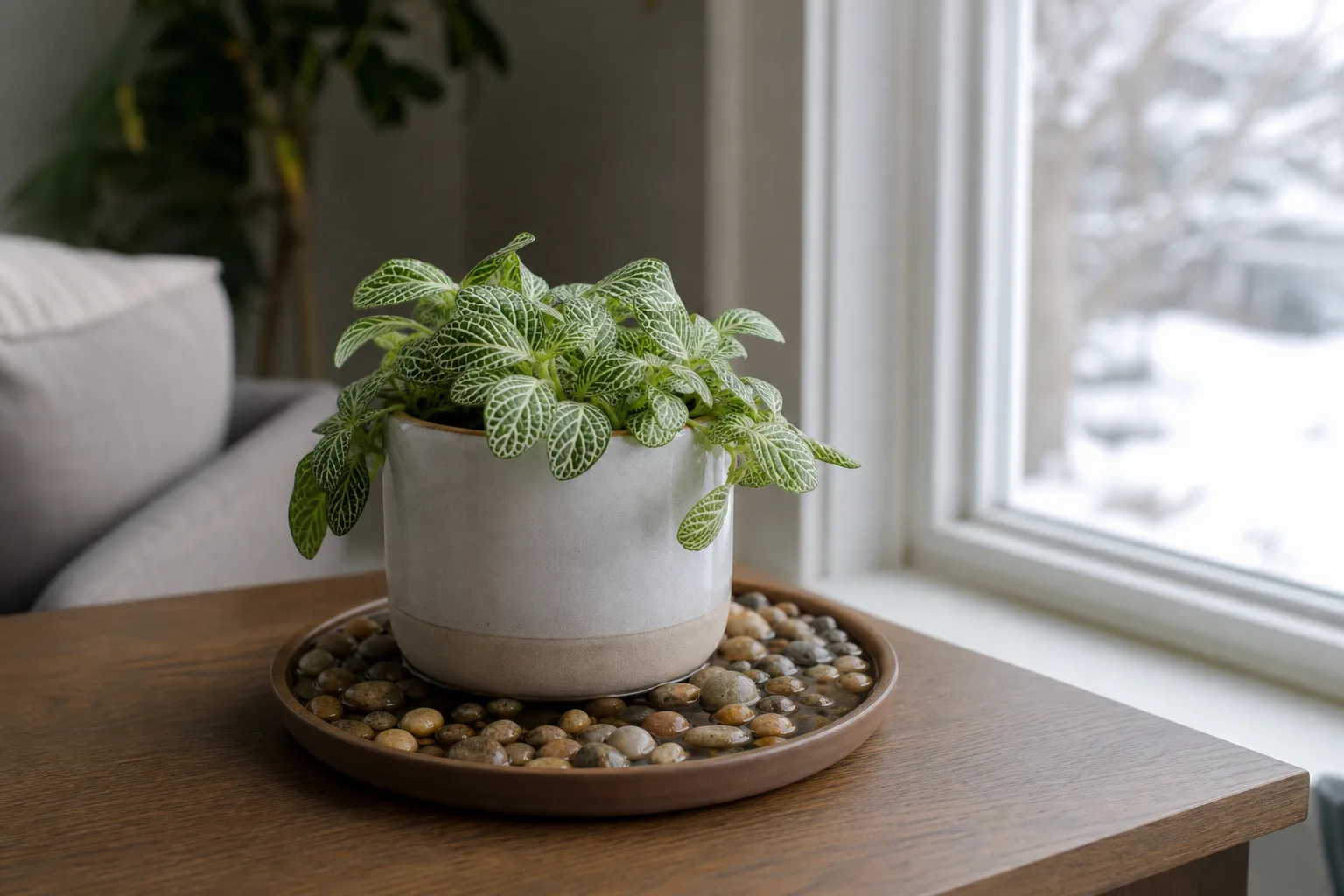
In a LeafyPixels winter editorial check, a fittonia on a 10-inch pebble tray in a 21% RH room read about 25% at lower foliage (+4 percentage points) and 29% within two inches of the stones (+8 points). Across the room, the tray changed nothing. That pattern matches what University of New Hampshire Extension and Iowa State Extension describe: trays help in the vicinity of the plant, not the whole room.
Think of a pebble tray as a microclimate tool, not a room humidifier. If your plant is compact, the tray is wide, and the air is fairly still, a modest local bump may be worth trying. If the room sits in the low teens or low twenties all winter, or the plant canopy sits far above the tray, measure first — then decide whether a humidifier is the better scale of fix. For humidity math and symptom differentials, see the indoor humidity and pebble trays hub; this page owns the raw test data.
What We Measured at Leaf Level
Most articles say pebble trays “help a little” without showing what that looks like on a hygrometer. The tables below come from one transparent home observation — not a controlled lab study — so you can replicate the logic in your own room.
Editorial Test Setup
- Climate zone: USDA 6a (cold-winter, mid-Atlantic–style climate).
- Time period: January through March 2026, ten consecutive days per sub-test.
- Room: 14 × 12 ft, forced-air heat running most days, thermostat near 68°F.
- Plant: One fittonia (Fittonia albivenis) in a 4-inch nursery pot unless noted.
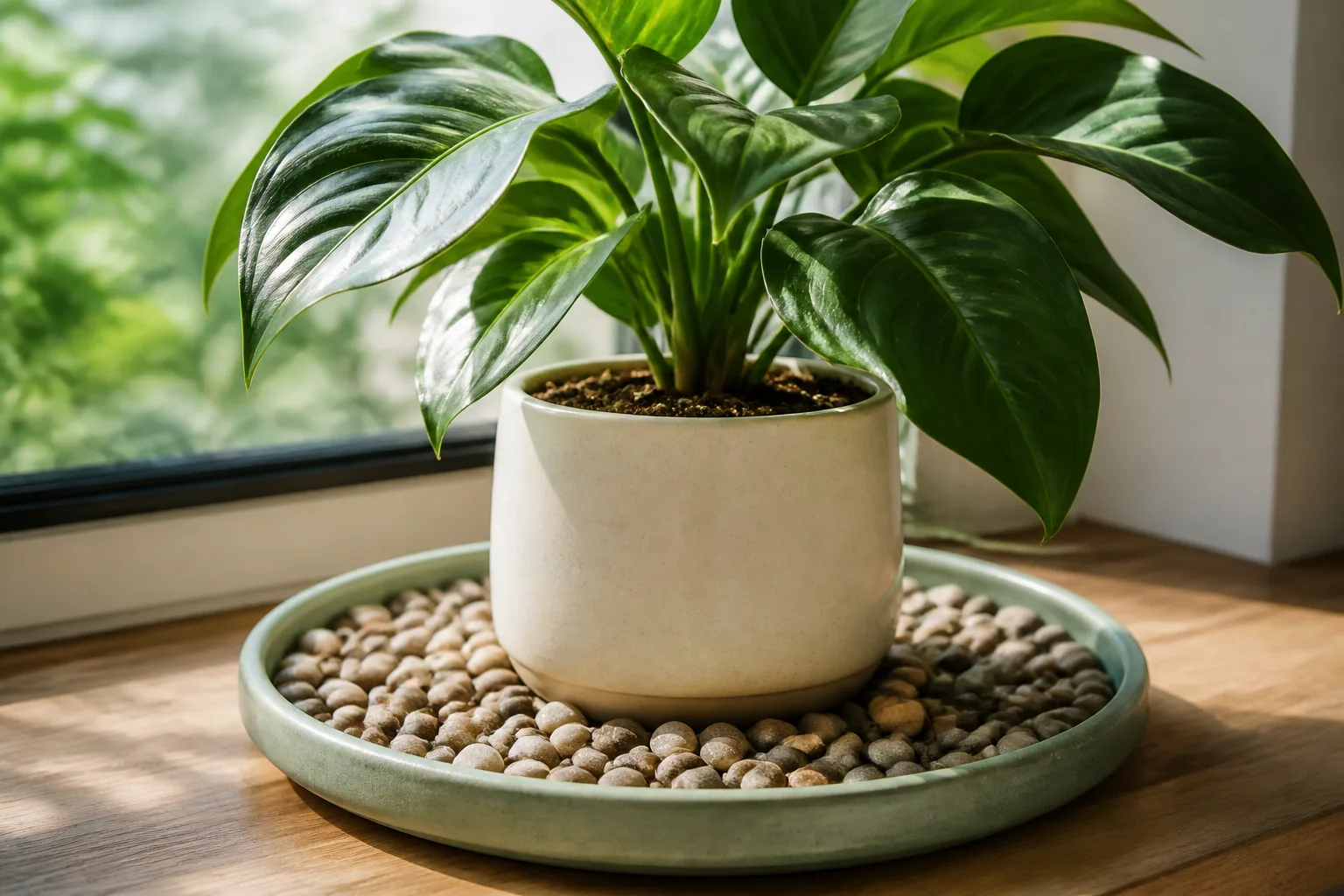
- Baseline tray: 10-inch-wide plastic saucer, 1.5 inches deep, 1-inch washed pea-gravel layer, water line just below stone tops.
- Sensor: One ThermoPro TP50 digital hygrometer/thermometer moved between positions (not three separate meters). Consumer units like this are typically accurate within about ±2–3% RH when compared against themselves; NIST calibrates reference sensors in controlled chambers, which is a useful reminder not to treat cheap meters as lab instruments.
- Protocol: Morning and early-evening readings at each position; three-day dry baseline before each tray configuration; same watering and light throughout.
This is one editorial observation, not a universal performance claim. Warmer rooms, quieter HVAC, or a different tray geometry will shift the absolute numbers. The distance pattern — strong near the water, weak at height — has held up in independent commentary from Garden Myths author Robert Pavlis, who measured similarly small local lifts with skeptical framing.
RH Readings at 2, 6, and 12 Inches Above the Tray
Readings below are daily averages across the ten-day window with the 10-inch tray filled and stable.
| Position | Daily average RH | Delta vs. room control |
|---|---|---|
| Control: opposite wall, mid-height | 21% | — |
| 12 inches above the tray | 22% | +1 point |
| 6 inches above the tray (lower foliage) | 25% | +4 points |
| 2 inches above the tray (just above stones) | 29% | +8 points |
The pattern is the answer skeptics and believers both miss. Humidity rises most within a few inches of the evaporation surface and falls off quickly with distance. At leaf level for this fittonia, the lift was about four percentage points — useful for a compact plant in a moderately dry room, but not a rescue tool for a whole space stuck at 21% RH.
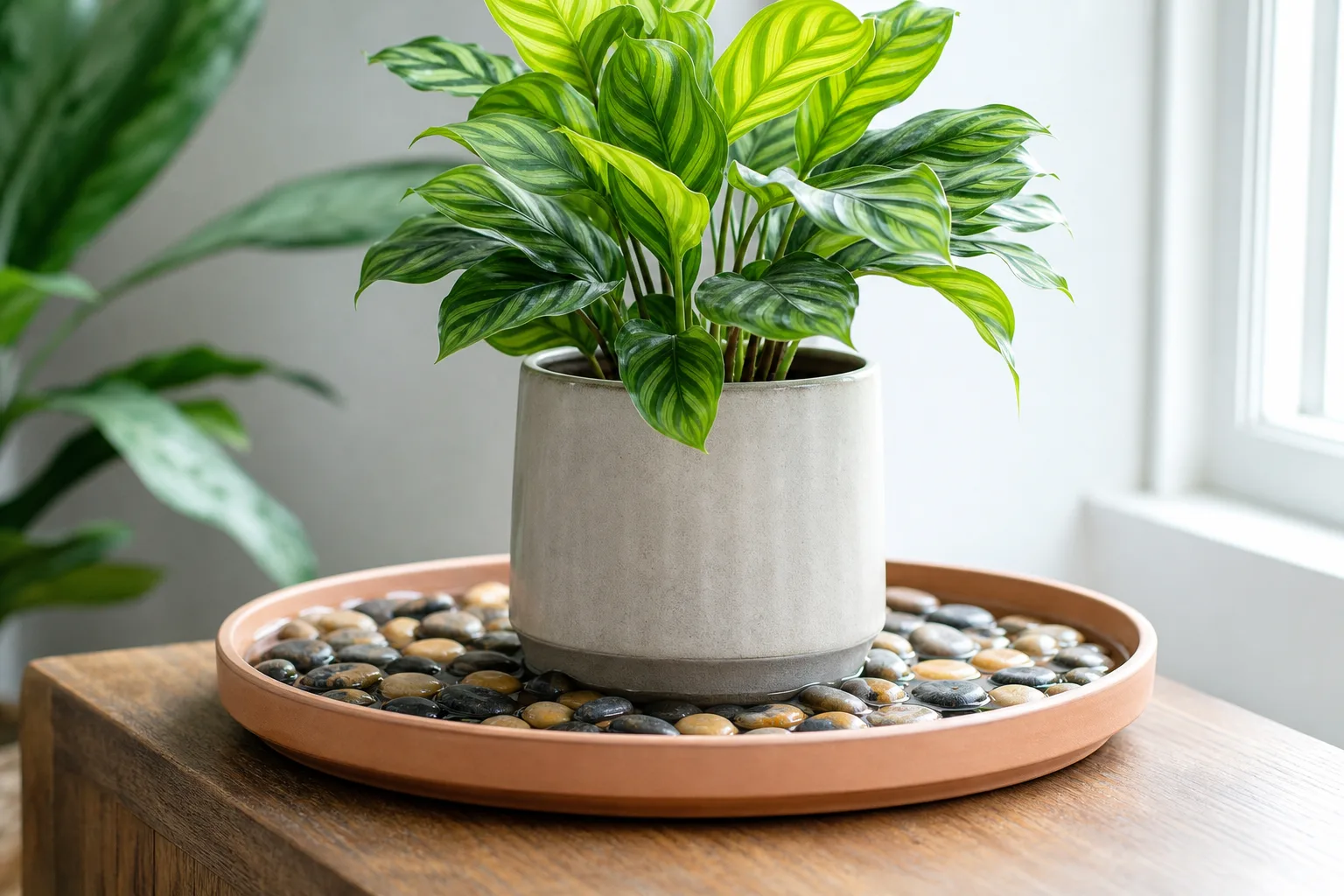
To replicate: move one meter between positions and allow 15–20 minutes to stabilize at each height. Do not compare three uncalibrated sensors as if they were identical. Place the sensor near foliage, not on wet stones or in direct sun. Penn State Extension emphasizes that moisture disperses quickly in normal room air — which is exactly what the distance column shows.
Still Air vs a Small Desk Fan
Airflow was the second-biggest variable after distance. With the fittonia and 10-inch tray unchanged, we retested at 6 inches above the tray under two conditions:
| Condition | RH at 6 inches | Delta vs. 21% control |
|---|---|---|
| Still air (HVAC cycling, no fan) | 25% | +4 points |
| Small desk fan on low, 3 ft away, pointed past the plant | 22% | +1 point |
A modest local gain collapsed to barely above noise once air moved through the space. University of New Hampshire Extension notes that grouping plants and calmer air improve results — the fan test shows the opposite in measurable form. If your plant lives under a vent or beside a constantly running fan, expect tray benefits to shrink sharply.
Wide Tray vs Narrow Tray vs Grouped Plants
Tray width and plant grouping were the third variable. Same room, same meter, same refill cadence; only the tray layout changed for a separate five-day comparison at 6 inches above the water:
| Setup | RH at 6 inches | Delta vs. control |
|---|---|---|
| Narrow 6-inch saucer (pot-width only) | 23% | +2 points |
| Standard 10-inch tray (single fittonia) | 25% | +4 points |
| Wide 14-inch tray (2–3 in. exposed on each side) | 27% | +6 points |
| Three compact plants grouped on the 14-inch tray | 28% | +7 points |
More exposed water surface and shared transpiration from grouped plants both nudged leaf-level RH upward — but none of these configurations moved the opposite-wall control reading off 21%. Nebraska Extension recommends a tray a few inches wider than the pot; the sub-test supports that guidance in measured form. Iowa State Extension also lists grouping as a low-cost humidity helper; grouped plants on one wide tray read about one point higher than a single plant on the same tray here.
Replication steps: (1) Log a three-day baseline without a tray. (2) Install one configuration at a time. (3) Record RH at leaf height and a room control twice daily. (4) Change only one variable — tray width, fan, or grouping — between runs. (5) Compare averages, not one lucky spike.
How a Pebble Tray Works (Brief)
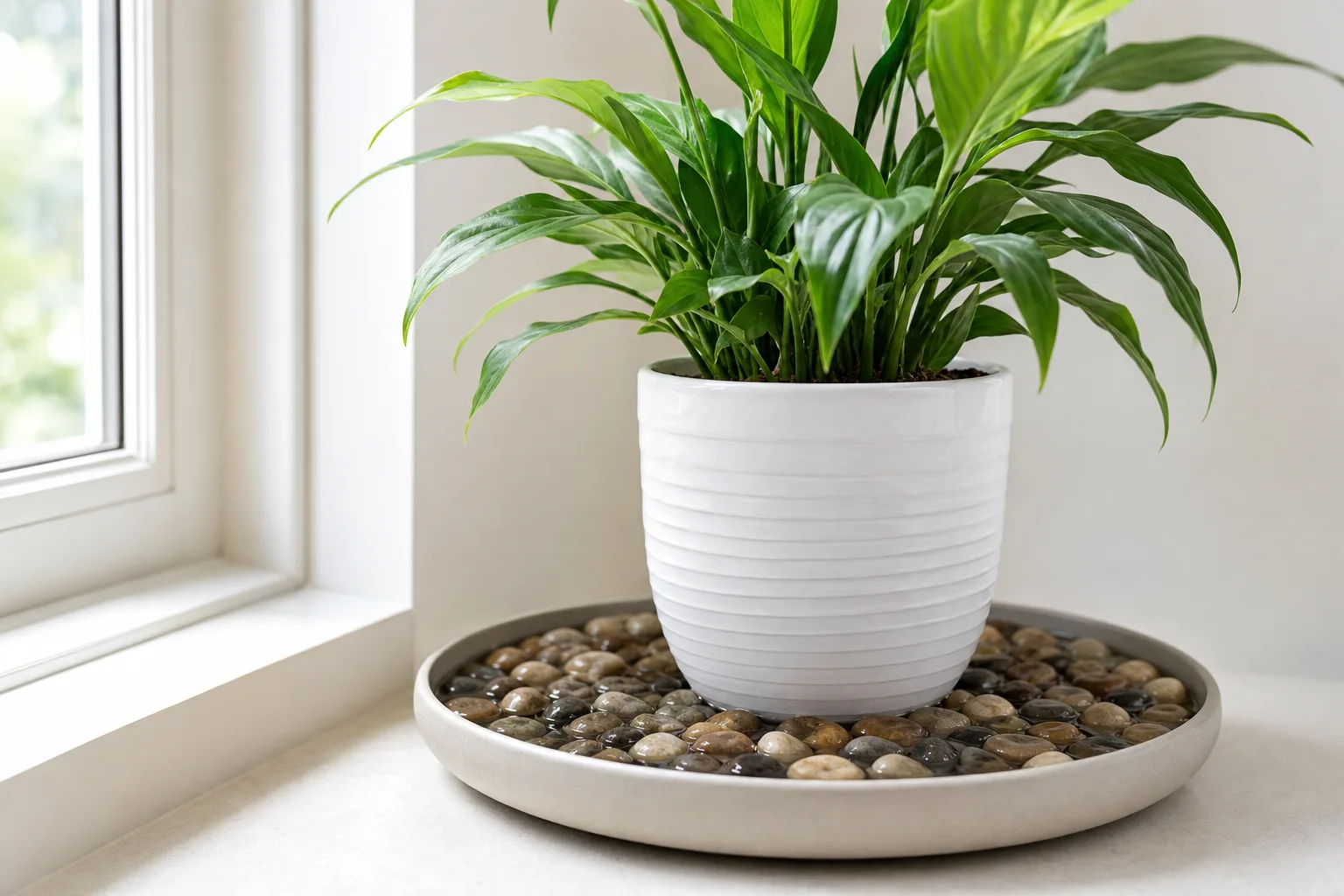
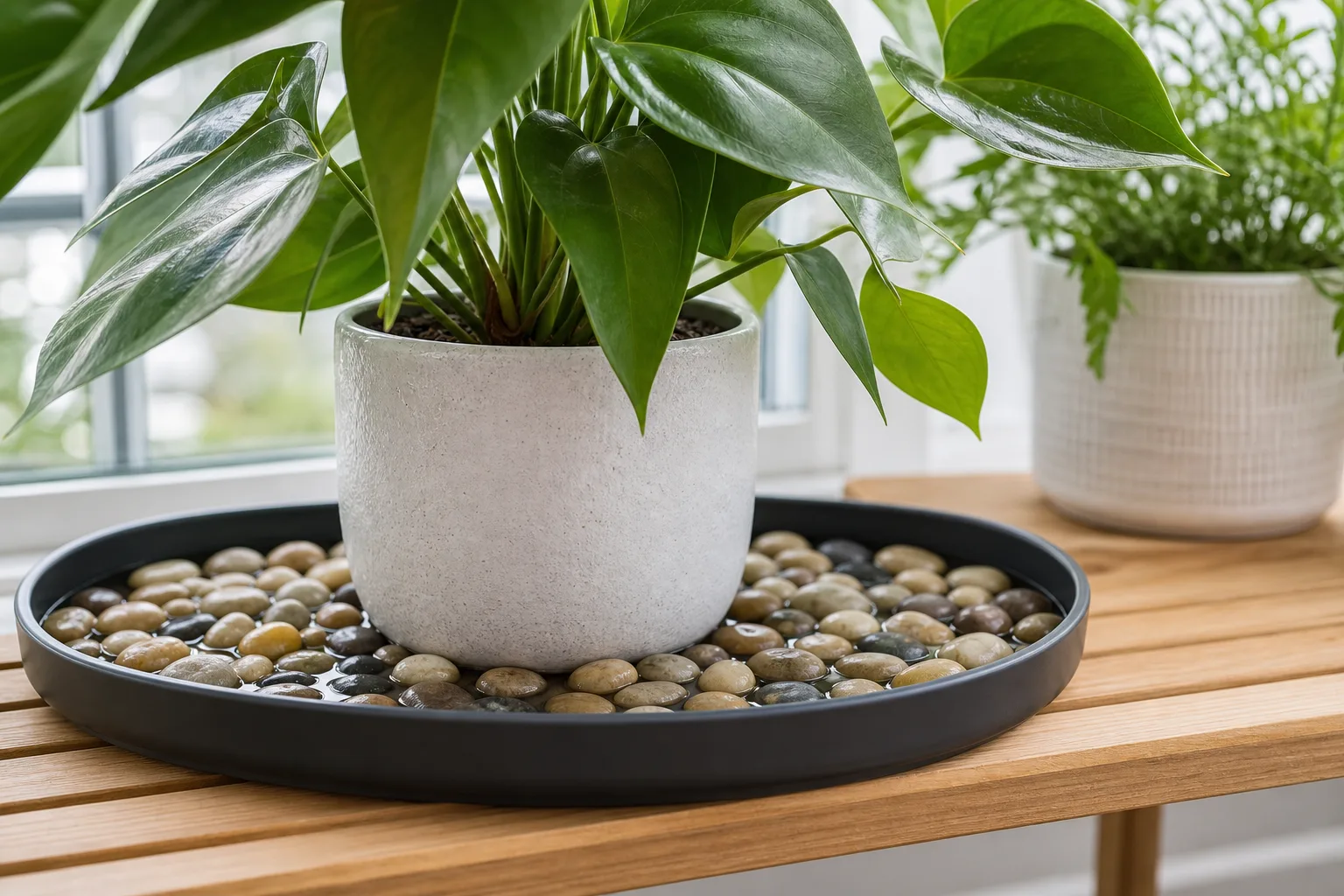
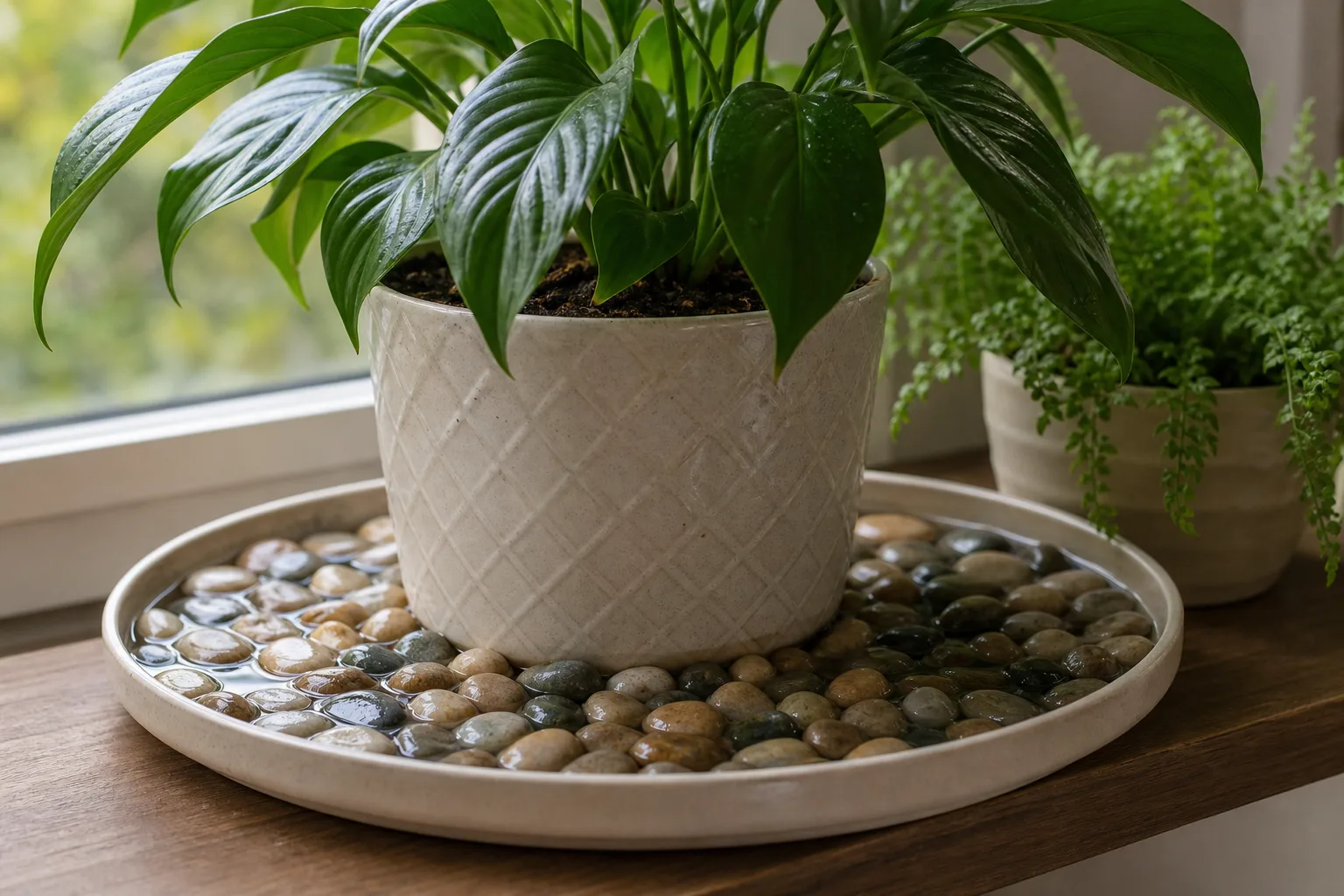
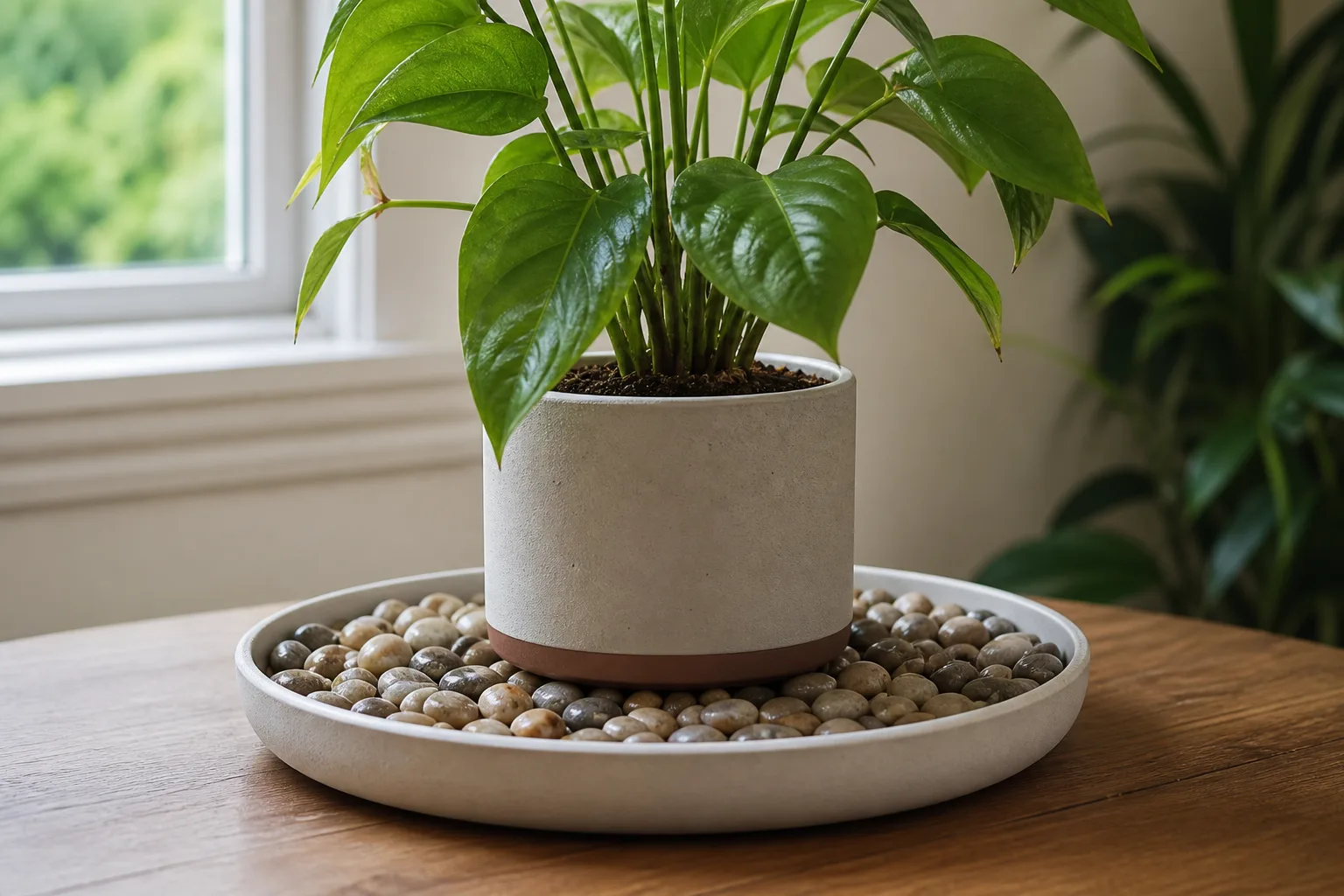
A pebble tray is a shallow waterproof dish filled with stones and a thin water layer. The pot sits on the stones with drainage holes above the waterline so evaporation adds moisture to the air immediately around the pot without wicking into the root zone. Missouri Botanical Garden and Iowa State Extension describe the same geometry: water below pebbles, pot above water.
That mechanism is straightforward. The limitation is scale — a saucer evaporates a teacup’s worth of moisture into a room-sized air volume. For the full definition, tray types, and geometry diagrams, see what is a pebble tray. This page stays focused on whether the effect is large enough to matter.
What Counts as a Meaningful Humidity Increase
Relative humidity is the moisture in the air compared with what that air could hold at the current temperature — not a fixed “wetness” score. National Weather Service explains why heated winter air often reads dry even when the room feels comfortable to people.
Many houseplant references cite a 40% to 60% comfort band for tropical foliage. Winter forced-air homes often sit around 10% to 20% RH, which is why crisp leaf edges show up on sensitive species. University of Maryland Extension treats pebble trays as local tools within that broader picture.
A meaningful increase is one that moves the plant from stressful dryness toward tolerable conditions at leaf height for long enough to show up in new growth — not one that heals old brown tips. EPA recommends keeping homes roughly 30% to 50% RH for human health, which matters when you are tempted to humidify an entire room without limits. Plants may want more than people in some cases; buildings still have moisture ceilings.
Our +4-point lift at foliage (21% → 25%) is real but small. It might smooth a borderline case. It will not turn a 21% room into a 50% greenhouse. For target ranges, symptom tables, and EPA guardrails in one place, use the indoor humidity and pebble trays hub rather than re-deriving the math here.
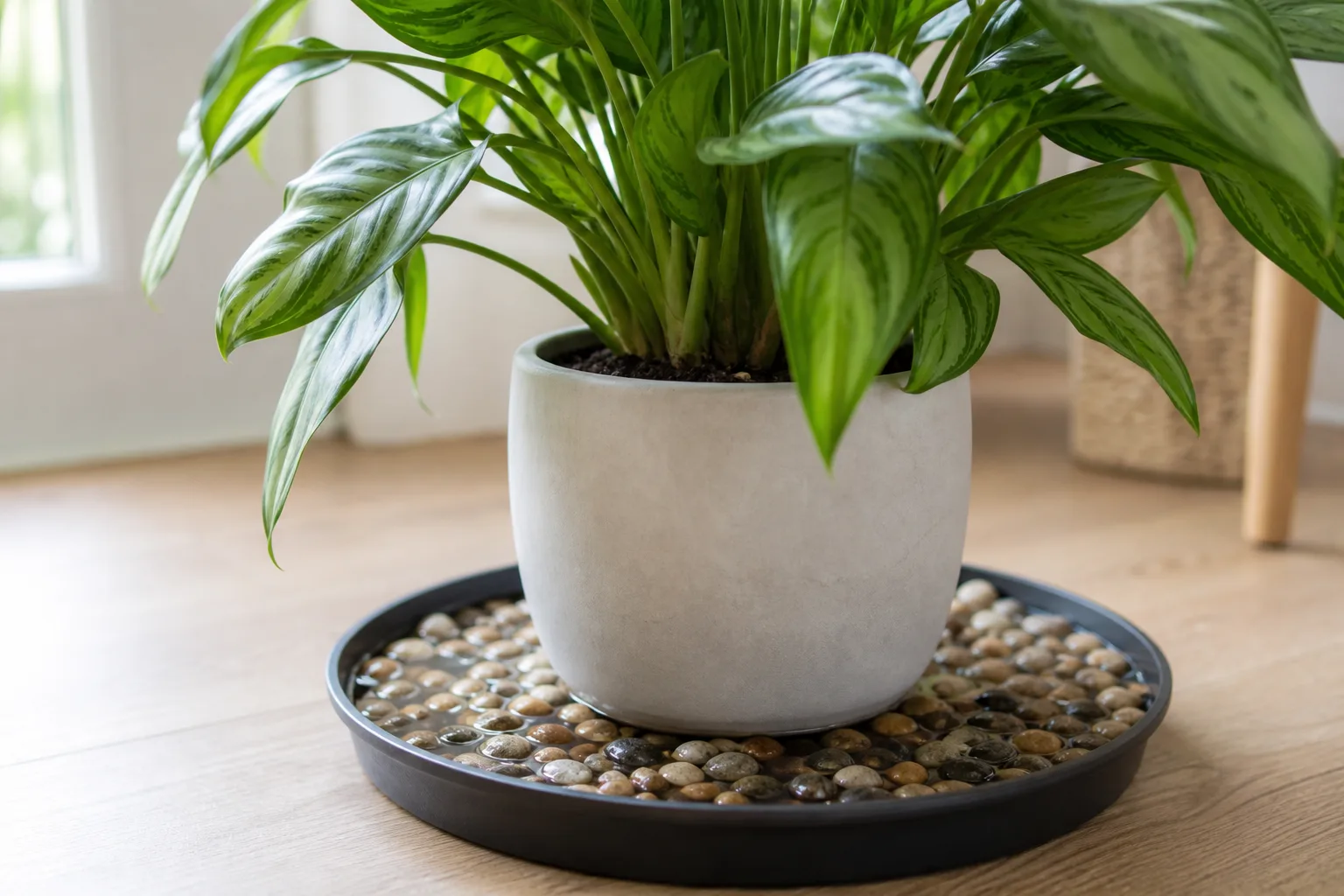
Why Pebble Trays Usually Underperform
Pebble trays persist because they are cheap, harmless when built correctly, and sometimes help a little. They disappoint when people ask a shallow saucer to behave like climate control for a tall plant in a dry, drafty room.
Air Circulation Spreads the Moisture
Better Homes & Gardens horticulturist Justin Hancock notes that circulating air disperses humidity as you move away from the tray — which matches both physics and our fan retest (+4 → +1 at six inches). NC State Extension lists humidifiers first for dry winter rooms and trays as lower-impact helpers. Winter is exactly when trays are most tempting and most weakened by HVAC cycles.
Distance From the Tray Limits the Effect
Even in still air, distance dilutes the effect. Leaves six inches above the tray experienced about four points of lift in our test; at twelve inches, only one. A floor plant with foliage three feet above a narrow saucer is barely sharing an air column with the evaporating water — one reason “it did nothing for my Monstera deliciosa” and “it helped my fittonia” can both be true. See Monstera humidity needs for a species where tray scale rarely matches plant size.
Larger Plants Outgrow the Microclimate
Compact, low-growing plants keep foliage inside the humidity pocket. Large upright plants push most leaf area far above it, and the water a small tray evaporates is tiny relative to the air volume around a broad canopy. Hancock specifically names creeping ficus, fittonia, hemigraphis, and selaginella as better tray candidates than tall floor plants (Better Homes & Gardens). Brown tips on a large plant may reflect watering, salts, or vent blast — not humidity alone. Can pebble trays prevent crispy leaves? walks through that triage before you buy stones.
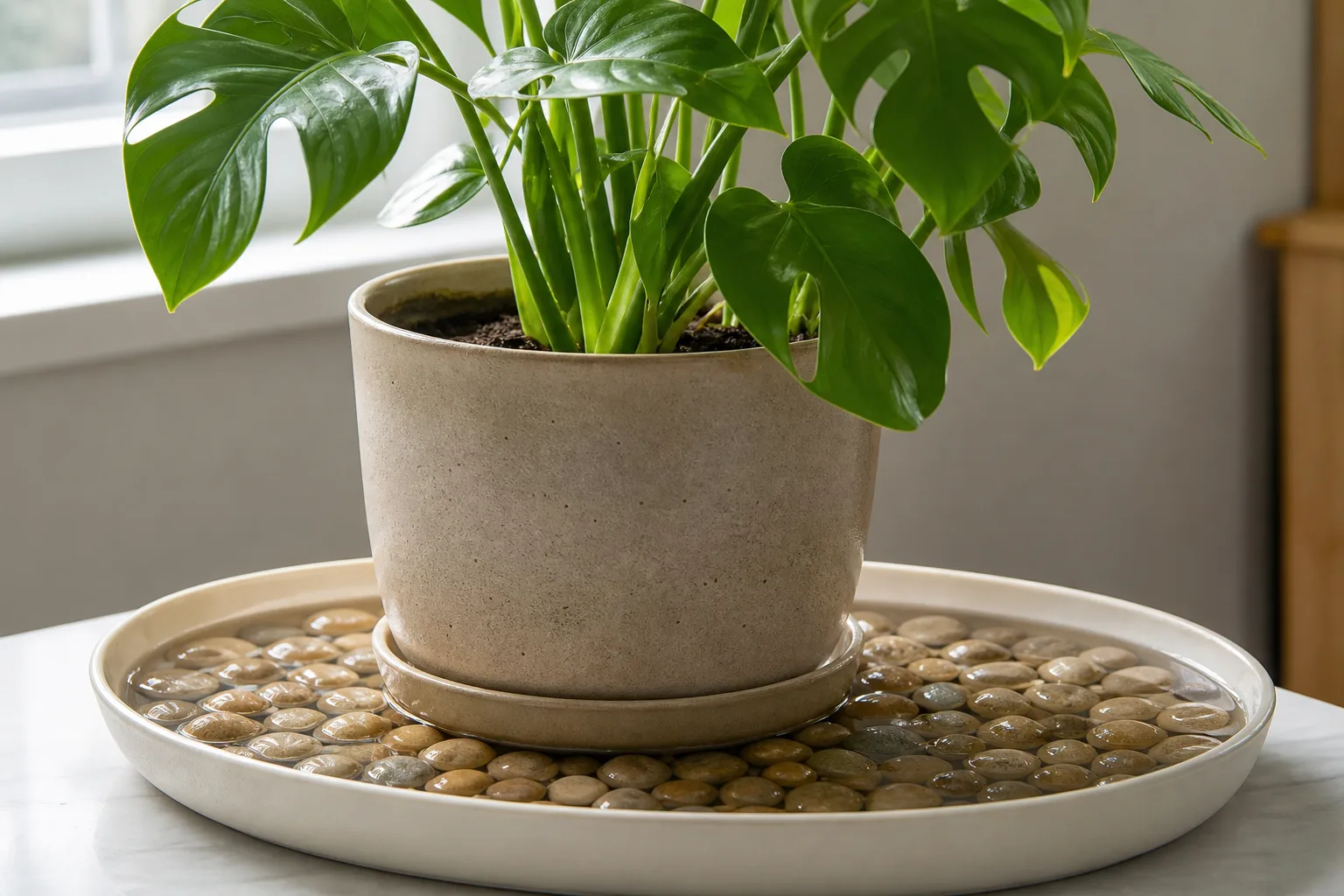
When a Pebble Tray Is Still Worth Trying
A tray still makes sense when the goal is modest and specific:
- The plant is compact with lower leaves near the tray surface.
- The room is only moderately too dry — not stuck in the low teens all winter.
- You want a cheap experiment before buying a humidifier.
- You will measure at leaf height instead of guessing from old damage.
Watch new leaves, not old crispy edges — old tissue does not uncurl when humidity improves. If repeated readings show no useful lift and new growth still struggles, the tray is the wrong scale of tool. Persistent decline despite humidity fixes may need a local extension office review of watering, roots, and pests — not another humidity gadget.
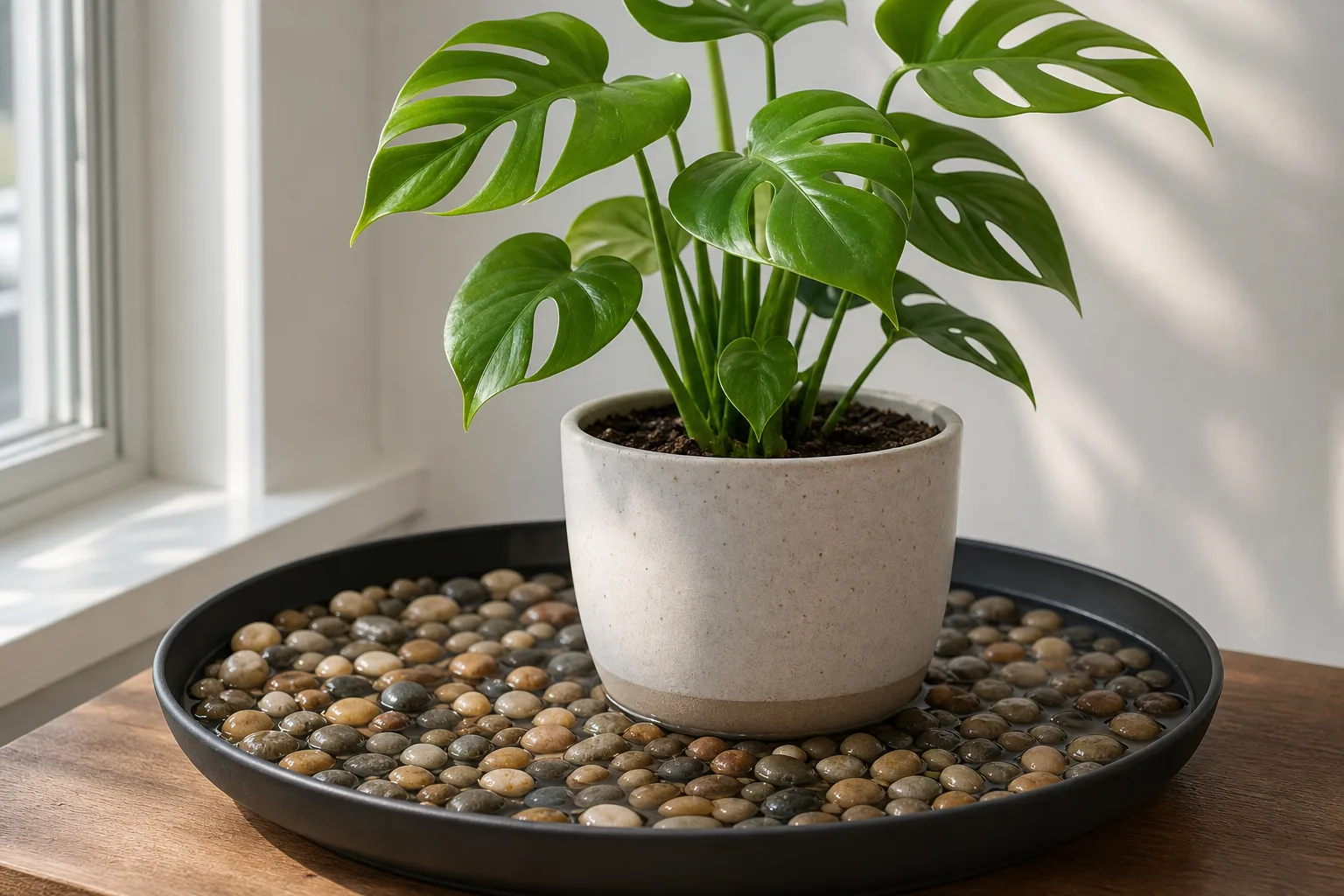
Which Houseplants Benefit Most (and Which Don’t)
Best candidates: small, humidity-sensitive, low-growing plants whose foliage stays near the evaporation zone — fittonia, small ferns, prayer-plant relatives, selaginella, and similar compact tropicals. Costa Farms notes many homes hover around 40–50% RH while some tropicals prefer 50–60%; a tray may close a small gap, not a chasm.
Poor candidates: succulents, cacti, and tall structural plants whose leaves sit far above any saucer. Calathea and the calathea care guide cover a high-humidity classic that often needs more than a tray in a dry room — measure before assuming the saucer is enough.
Link compact humidity lovers to their care hubs when you test: grouping a fern with a fittonia on one wide tray matches both extension advice and our grouped-plant reading.
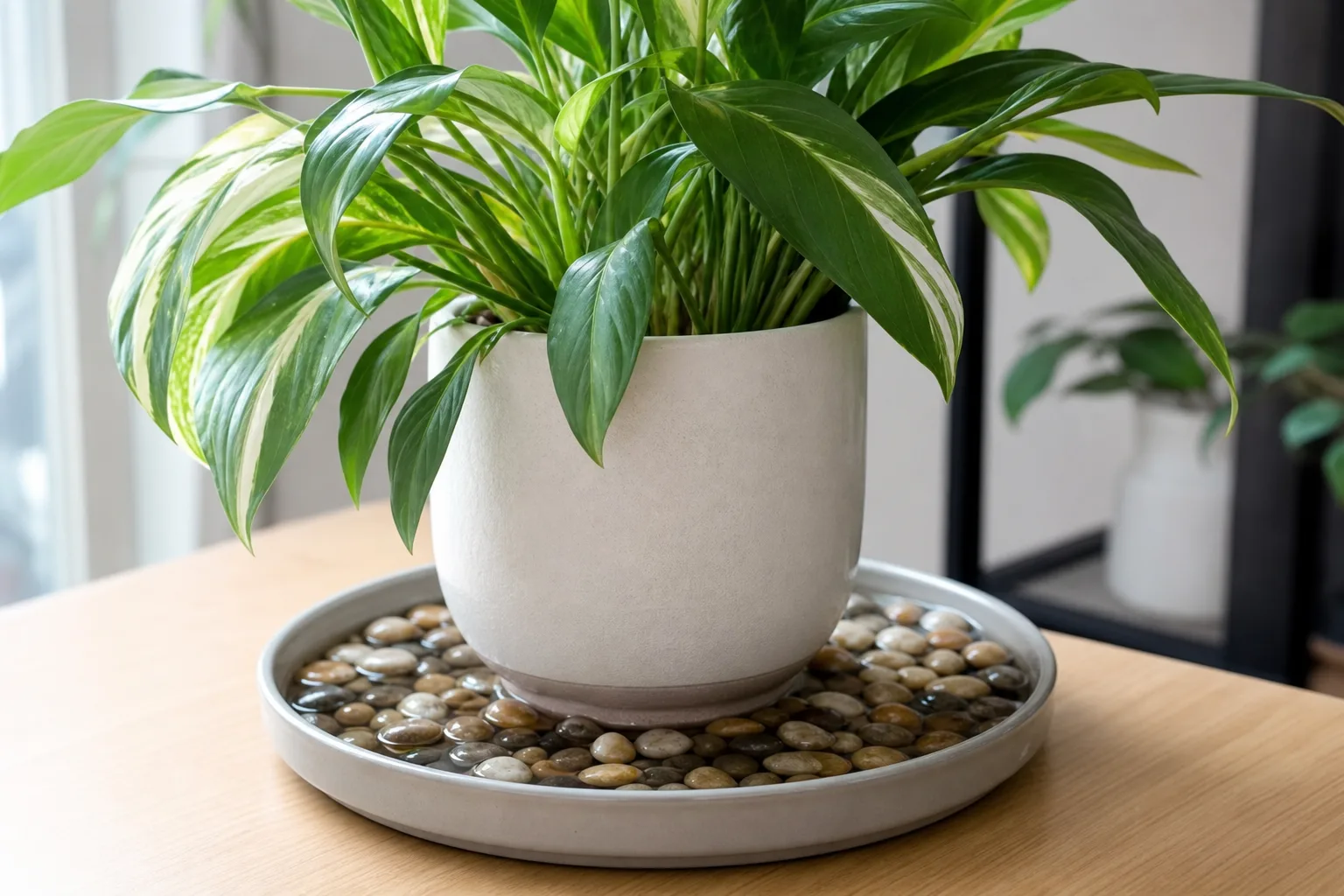
Pebble Tray vs Humidifier vs Misting (Quick Comparison)
For dry winter rooms and multiple sensitive plants, a humidifier changes room-scale RH; a pebble tray nudges a local pocket; misting is brief surface wetting that Iowa State Extension does not treat as meaningful long-term humidity care. Trays beat misting on duration; humidifiers beat trays on reach. Full sizing, EPA limits, and decision tables live in pebble tray vs humidifier — not duplicated here.
How to Set Up a Pebble Tray Correctly
Setup will not turn a weak method into a strong one, but bad geometry guarantees failure. Specs below are editorial build targets tied to the measurement tests above; the photo walkthrough is in how to set up a pebble tray.
Materials and Specs
| Item | Practical specification | Why it matters |
|---|---|---|
| Tray | Watertight, rigid, 1–2 in. deep | Holds a shallow reservoir without flexing |
| Tray width | ≥1.5× pot diameter; wider reads higher in our sub-test | More exposed water = more evaporation |
| Pebbles | Washed, stable, 0.5–1 in. | Supports pot; simplifies cleaning |
| Water line | Below pebble tops and pot base | Prevents root-zone wetting |
| Hygrometer | At lower-leaf height, same meter each time | Measures the microclimate foliage actually sees |
Step-by-Step Setup
- Wash tray and stones before the first fill.
- Spread an even pebble layer and test pot stability dry.
- Add water below stone tops — never to the pot base.
- Set the pot on stones with all drainage holes above the reservoir.
- Place the hygrometer near lower foliage and log a baseline for several days.
- Refill and clean on a regular cadence so the tray does not turn stagnant. Penn State Extension ties wet surface conditions to fungus-gnat pressure when hygiene slips.
For build options and cost breakdowns, see DIY pebble tray for indoor plants.
Conclusion
Pebble trays do increase humidity in the narrow sense that evaporation creates a slightly less dry zone near the water. They do not reliably fix a dry room, rescue a tall plant, or replace diagnosis when watering, roots, salts, or vents are the real problem.
The measured story in one line: about +4 percentage points at leaf height in still air, about +1 point once a fan moved air, and zero change across the room. If that scale matches your plant and room, a clean wide tray is a reasonable experiment. If the gap is larger, skip wishful thinking and use a hygrometer-controlled humidifier while keeping indoor RH within EPA home limits.
Related pebble tray guides
- Indoor humidity and pebble trays — humidity math, symptom differentials, and hub primer (links here for raw test data).
- What is a pebble tray? — definition, geometry, and tray types.
- How to set up a pebble tray — step-by-step setup and refill math.
- Pebble tray vs humidifier — full comparison when the tray is not enough.
- Pebble trays for plants — when to use a tray in a broader care routine.
- Pebble tray myths — common overstated claims debunked.
- Signs your houseplants need more humidity — symptom checklist before you add hardware.