Types of Monstera: 12 Varieties to Know Before You Buy
Compare popular Monstera varieties by leaf shape, rarity, care needs and what to know before buying one.
Monstera leaves look dramatic, the genus is huge, and the names on plant tags are often wrong. Walk into any nursery or scroll any marketplace and you will see borsigiana, obliqua, Peru, Esqueleto, and mini monstera used as if they were clean botanical categories. Some labels describe real species. Some describe cultivars. Some are outdated synonyms. Some are not Monsteras at all.
This guide is a taxonomy-first buyer reference. It is not a full care manual—that belongs on the Monstera deliciosa plant hub and our Monstera care basics guide. Here you will learn how to separate species, cultivars, and trade names; which 12 Monstera-related types this article covers; how to read a comparison table before you buy; and where sellers most often mislabel plants. If you already own a Monstera and want purchase diligence, pair this with buying a Monstera plant.
Why Monstera Names Are Confusing (and What This Guide Covers)
The houseplant trade borrows Latin names because they sound authoritative. A species is a formally accepted plant, like Monstera deliciosa. A cultivar is a cultivated selection—Thai Constellation is a variegated form of deliciosa in trade, not a separate species. A trade name is marketing shorthand: Esqueleto, Peru, or Monkey Mask may help sellers describe a look without guaranteeing botanical precision.
That three-layer split is the whole game. Buyers who understand it stop overpaying for glamour labels and start judging the plant in the pot: leaf texture, fenestration density, stem spacing, growth habit, and whether the seller can show mature growth. Kew’s Plants of the World Online currently lists 71 accepted Monstera species in the genus, but only a small subset appears regularly in indoor shops. The Royal Horticultural Society notes that Monstera deliciosa dominates as the best-known houseplant Monstera by a wide margin.
This page maps twelve commercially relevant types—seven core species plus variegated deliciosa forms, Peru, and three collector favorites—so the title promise matches the body. For ongoing culture after you choose a species, use the Monstera deliciosa hub or Monstera adansonii hub rather than expecting every care detail here.
At a specialty shop last spring, a bench row tagged Monstera obliqua turned out to be narrow-form adansonii on closer inspection—same holey look from three feet away, but the leaves were leathery and opaque when held to a window, not paper-thin. The price tag was triple what the adansonii two pots down cost. That is the everyday mislabel pattern this guide is built to catch.
What Monstera Actually Is
At the botanical level, Monstera is a genus in the Araceae family. Species are native to tropical regions of the Americas, where many climb tree trunks as hemiepiphytes with aerial roots and large leaves. The look most people associate with Monstera is fenestration: natural holes, slits, or splits that develop as leaves mature under adequate light and support.
Research on fenestration has explored possible benefits in shaded forest conditions, including light capture and reduced drag in wind and rain (PubMed). The evolutionary story is still debated, which matters because many articles present one explanation as settled fact when it is not. What you can trust visually is simpler: fenestration is normal mature architecture for several species, not leaf damage.
Species, Cultivars, and Trade Names — What Sellers Get Wrong
Use this filter when reading any label:
| Label type | Example | What it means |
|---|---|---|
| Accepted species | Monstera adansonii | POWO-recognized botanical name |
| Synonym (historical) | Monstera borsigiana | Old name folded into M. deliciosa |
| Cultivar / horticultural form | Thai Constellation, Albo | Selected variegation on deliciosa |
| Trade nickname | Esqueleto, Monkey Mask | Describes a look; verify the plant |
| Wrong genus entirely | Mini monstera | Usually Rhaphidophora tetrasperma |
Names like “Monstera borsigiana,” “Monstera Peru,” “Monstera Esqueleto,” or “mini monstera” sit in different rows of that table. Some remain useful descriptively. None should be trusted without looking at the plant.
Quick Answer: 12 Monstera Types Worth Knowing
If you want the shortlist before the deep cuts, these are the twelve types this guide treats as worth knowing for indoor buyers:
- Monstera deliciosa — classic large split-leaf climber
- Monstera adansonii — smaller perforated vine
- Monstera dubia — shingling juvenile foliage
- Monstera siltepecana — silvery juvenile leaves
- Monstera standleyana — sleek, often variegated leaves
- Monstera obliqua — extremely rare, paper-thin, heavily perforated
- Thai Constellation — stable speckled variegation on deliciosa
- Albo (Monstera deliciosa ‘Albo-variegata’) — sector white variegation on deliciosa
- Monstera “Peru” — thick quilted leaves; taxonomy messy
- Monstera lechleriana — collector fenestrated climber
- Esqueleto / Monstera epipremnoides — trade identity vs. accepted species
- Monstera pinnatipartita — deeply divided mature foliage
For most homes, the practical fork is not “which of 71 species?” It is whether you want the big classic climber, the compact holey vine, unusual juvenile foliage, variegation, or a collector challenge.
The 12 Varieties This Guide Covers
The numbered list above is the explicit map between the title and the sections below. Items 1–5 are accepted species you will see repeatedly in specialty shops. Items 6–8 cover rarity and variegated deliciosa economics. Item 9 is a trade name with synonym confusion on POWO. Items 10–12 are collector types that appear in enthusiast listings more often than big-box benches.
| Type | Why people want it | Best fit |
|---|---|---|
| Monstera deliciosa | Huge split leaves, iconic look | Beginners with floor space |
| Monstera adansonii | Holey leaves, smaller vine | Shelves, poles, hanging setups |
| Monstera dubia | Shingling juvenile pattern | Collectors who train on boards |
| Monstera siltepecana | Silver juvenile foliage | Smaller spaces, foliage texture |
| Monstera standleyana | Sleek leaves, variegated forms | Graphic, non-holey Monstera look |
| Monstera obliqua | Extreme fenestration | Advanced collectors only |
| Thai Constellation / Albo | White or cream variegation | Collectors with strong light |
| Monstera “Peru” | Thick quilted texture | Textural foliage lovers |
| Lechleriana / Esqueleto / pinnatipartita | Unusual venation or division | Experienced aroid growers |
Species Identification Key at a Glance
Use this table at the bench or when comparing seller photos. It prioritizes field marks buyers can check without a microscope.
| Type | Leaf shape & texture | Fenestration | Growth habit | Difficulty (indoor) |
|---|---|---|---|---|
| M. deliciosa | Thick, glossy, heart-shaped becoming broad | Deep splits + inner holes at maturity | Climbing; large when mature | Easy–moderate |
| M. adansonii | Medium thickness, oval to pointed | Round to oval holes, often <~50% of blade | Continuous leafy vine | Easy–moderate |
| M. obliqua | Paper-thin, nearly translucent | Extreme holes, often >70% of blade | Slow; may produce leafless stolons | Expert |
| M. dubia | Flat juvenile blades pressed to support | Minimal when shingling; changes at maturity | Shingles vertically | Moderate |
| M. siltepecana | Silvery juvenile with dark veins | Develops with age on climb | Climbing vine | Moderate |
| M. standleyana | Narrow, smooth, often variegated | Usually none to mild | Climbing; variegated sports common | Moderate |
| M. lechleriana | Thick, oblong; larger than adansonii | Oval to elongated holes along midrib | Climbing vine | Moderate–advanced |
| M. epipremnoides / Esqueleto | Leathery, elongated | Large irregular holes, skeletal look | Climbing vine | Advanced |
| M. pinnatipartita | Juvenile entire; mature deeply lobed | Deep pinnate splits at maturity | Climbing hemiepiphyte | Advanced |
| ”Peru” | Thick, quilted, little fenestration | Rare on typical trade plants | Compact climber | Moderate |
| R. tetrasperma | Thin, small split leaves | Splits early, stays small | Fast vining | Easy |
Labeled ID Gallery: Compare Leaves Side by Side
Visual ID is where most types guides fail—they list names without showing what changes between juvenile and mature leaves, or between species that share a “holey” silhouette. The panels below use guide-native paths for this URL so you can compare field marks without borrowing photos from propagation or fenestration articles elsewhere on the site.
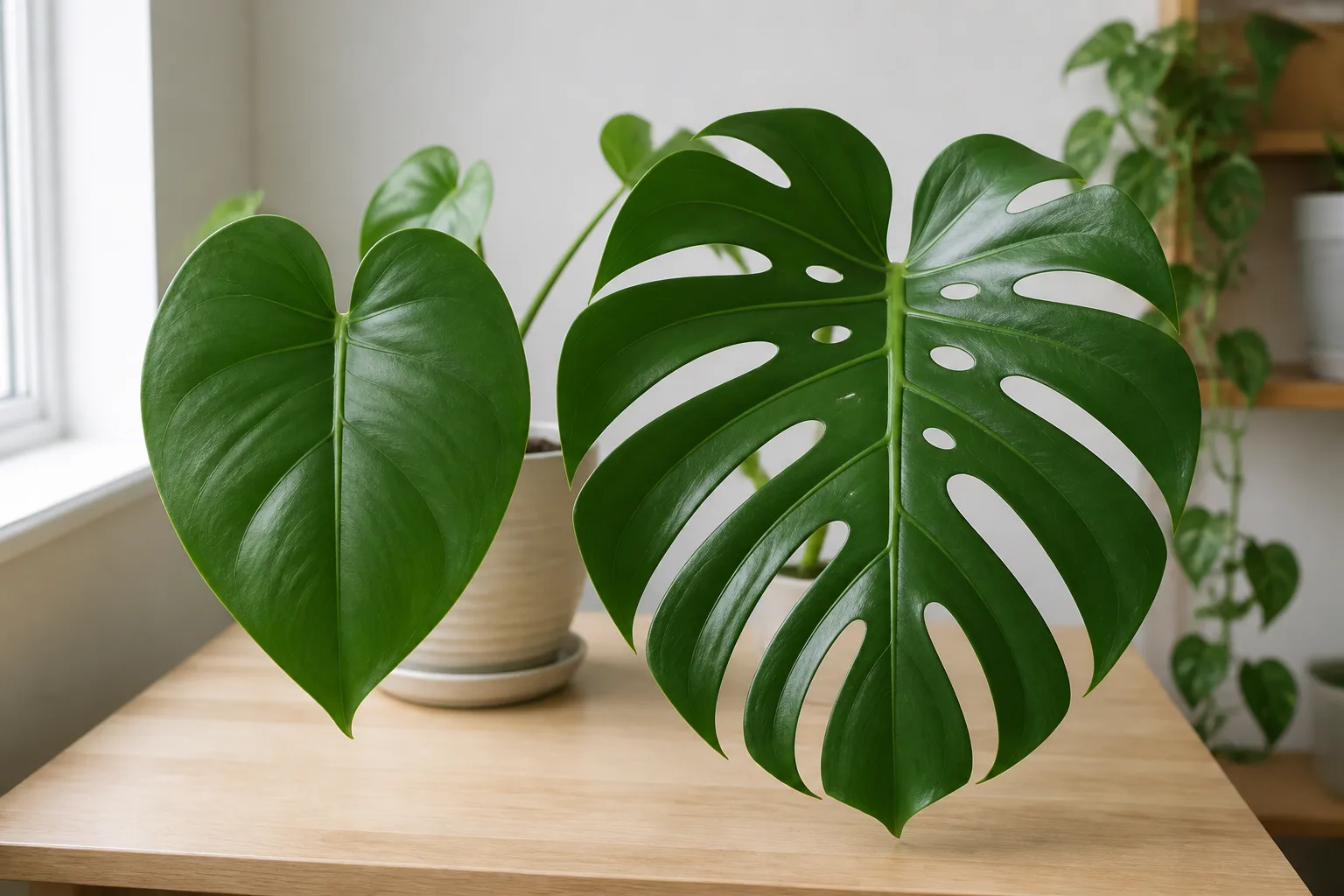
Panel 1 — Monstera deliciosa (juvenile vs. mature): Juvenile deliciosa often looks like a plain heart-leaf philodendron. Mature leaves develop outer splits and inner fenestrations once the plant climbs and receives brighter indirect light. Do not reject a young deliciosa because it lacks holes yet.
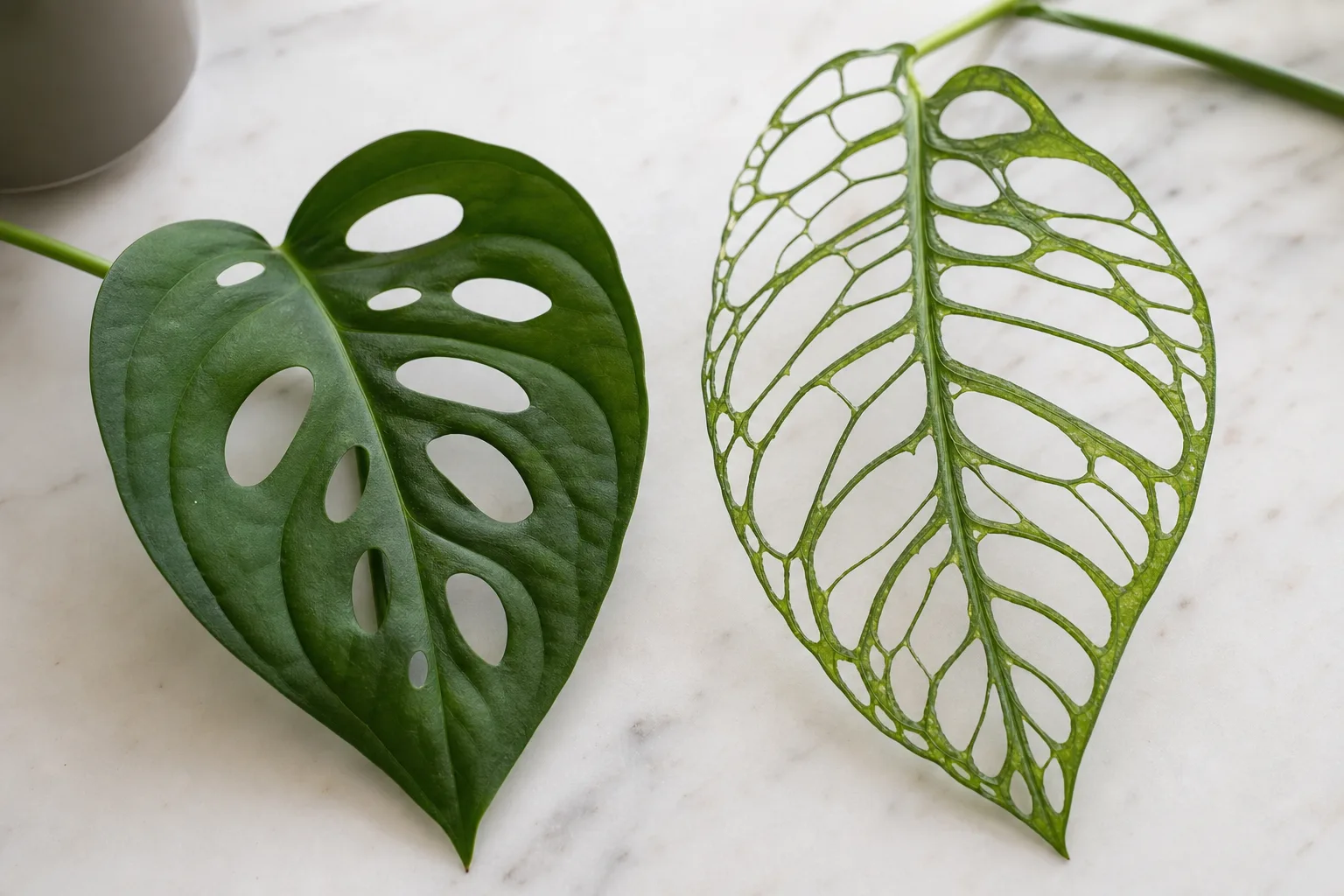
Panel 2 — Monstera adansonii vs. mislabeled obliqua: Adansonii leaves stay opaque and leathery when backlit. True obliqua looks skeletal, with far more hole than tissue. Retail “obliqua” is almost always adansonii or another common vine.
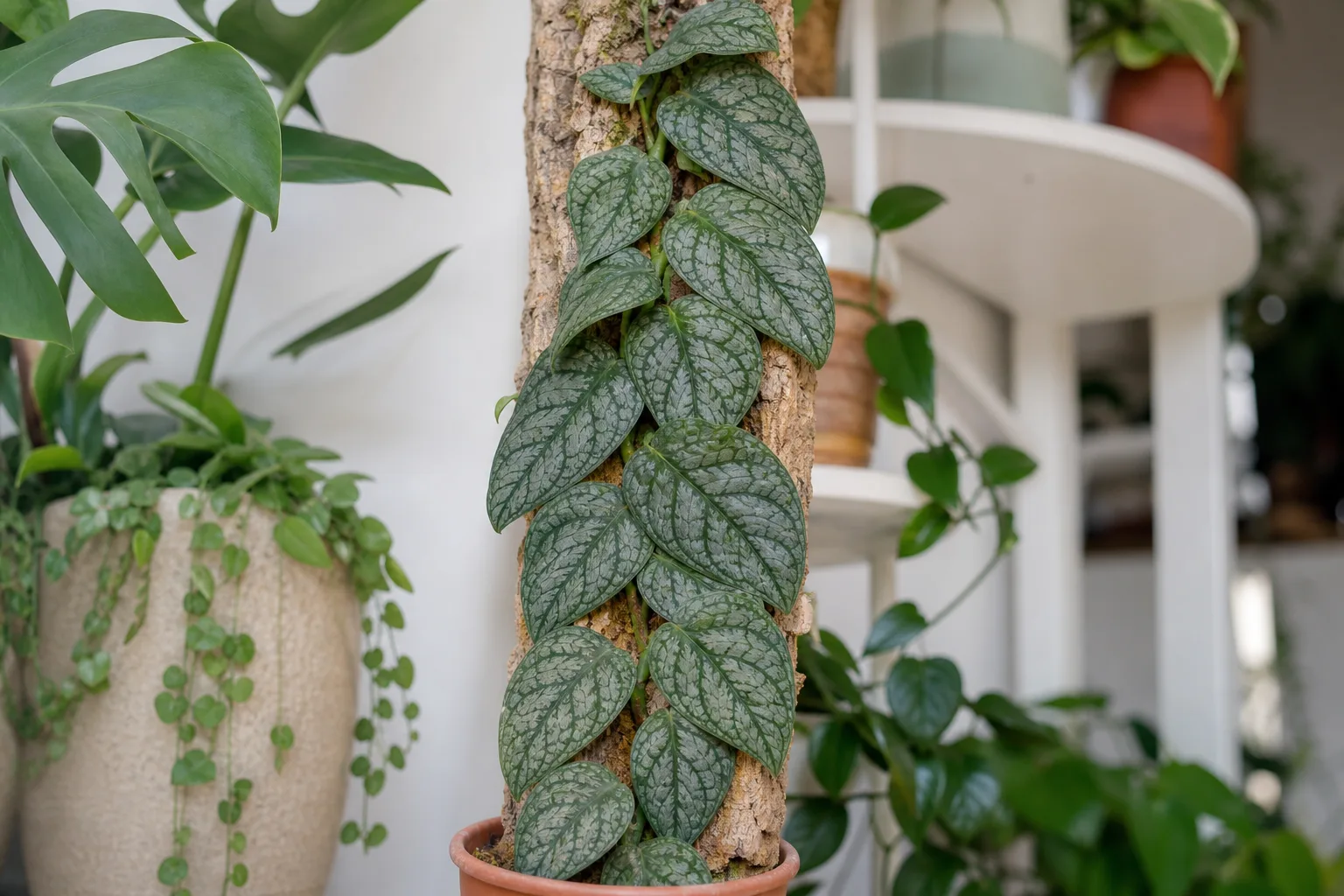
Panel 3 — Monstera dubia shingling: Juvenile dubia presses flattened leaves flush to a vertical surface. Without a board or bark slab, you miss the signature look entirely.
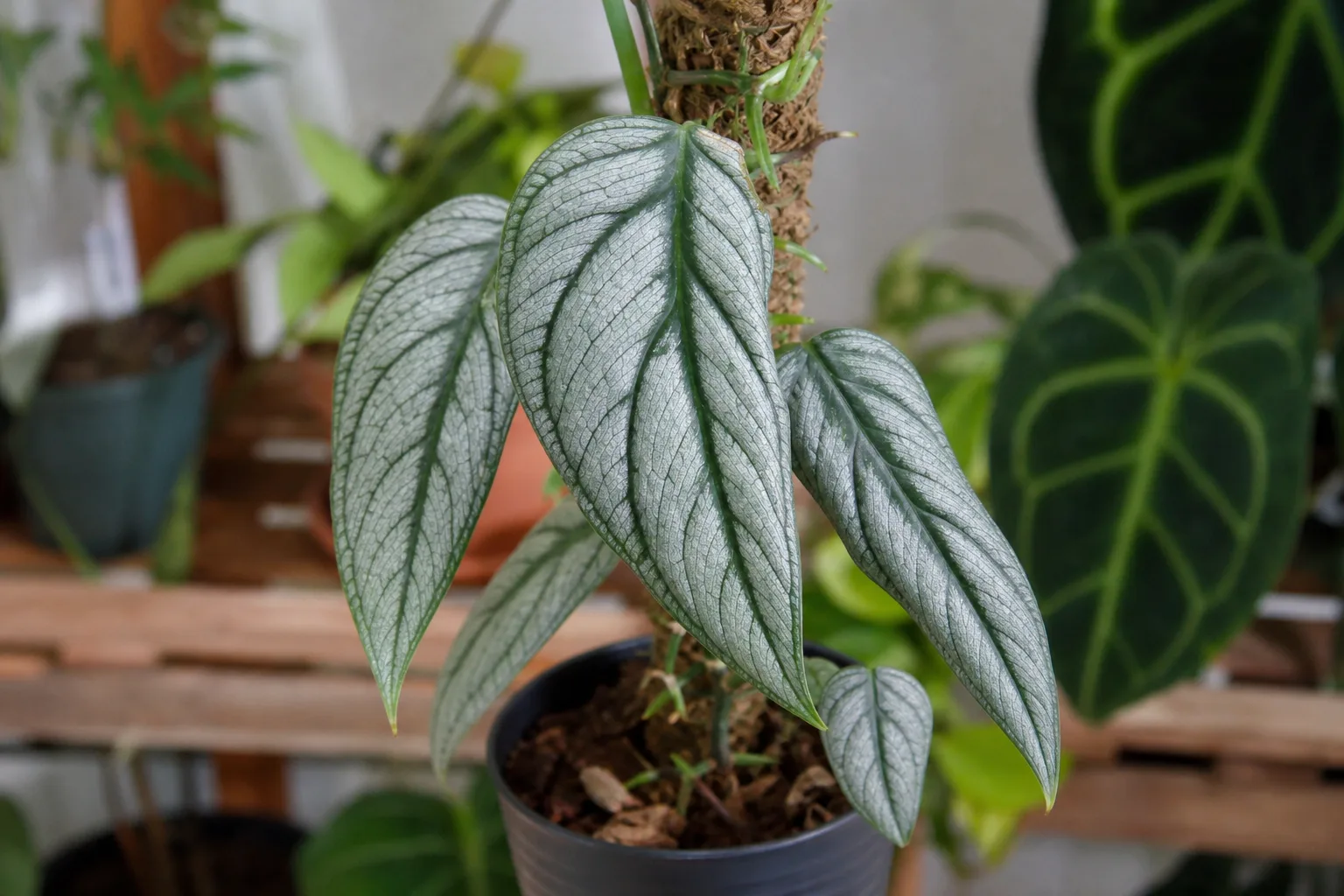
Panel 4 — Monstera siltepecana juvenile silver phase: The sell point is silvery immature foliage with contrasting veins. Fenestration comes later on a climb—not on a trailing juvenile in a four-inch pot.

Panel 5 — Monstera standleyana: Narrow, often variegated leaves with little to no fenestration. A healthy standleyana can look “wrong” to buyers expecting Swiss-cheese holes—that is normal for the species.
Monstera deliciosa — The Classic Swiss Cheese Plant
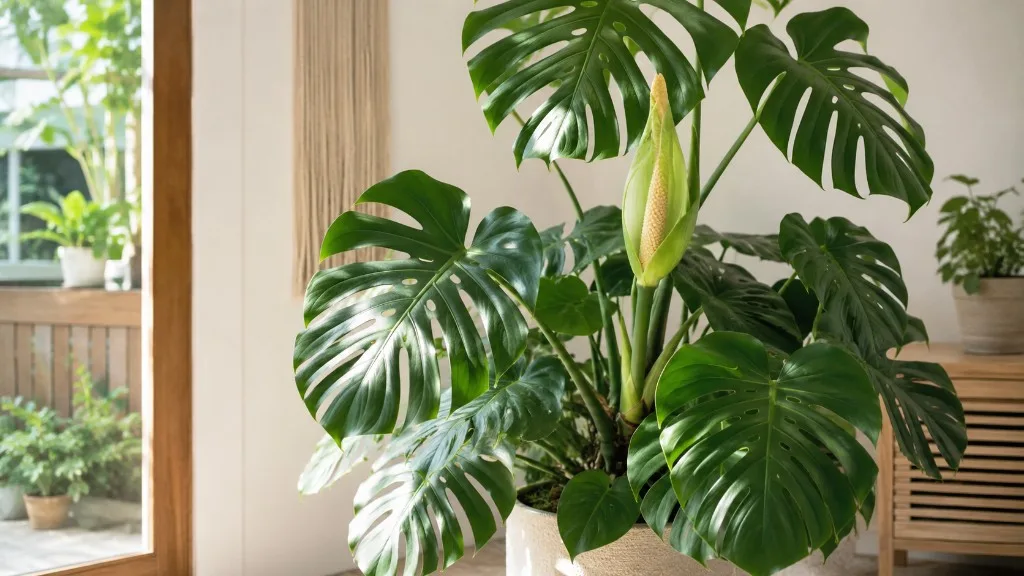
Monstera deliciosa is the plant most people picture as the Swiss cheese plant: large glossy leaves that develop deep splits and perforations with age, maturity, light, and a support pole. POWO lists it as an accepted species native from Mexico into Guatemala. It dominates retail because it delivers the signature look with relatively straightforward indoor culture compared with rarer species—details live on the Monstera deliciosa hub and in watering Monstera deliciosa.
Juvenile nursery plants often have plain heart-shaped leaves with few splits. That throws beginners off; they did not buy the wrong species—they bought a juvenile plant that needs time and brighter indirect light. For fenestration timing, see how to get Monstera leaves to split.
Deliciosa vs. “Borsigiana”
Marketplaces often sell “Monstera borsigiana” as a separate species. POWO treats Monstera borsigiana as a heterotypic synonym of Monstera deliciosa, alongside the historical name Monstera deliciosa var. borsigiana. In plain language: current accepted taxonomy recognizes one species, while the trade still uses borsigiana to describe a smaller, faster, more vining growth habit.
Growers are not imagining size differences. Environment, internode spacing, training, and maturity all change appearance. When buying, weigh the actual plant—stem spacing, leaf size potential, root health—more than whether the tag says borsigiana.
Thai Constellation, Albo, and Variegated Forms
Most premium variegated Monsteras in trade are forms of Monstera deliciosa. Thai Constellation shows stable cream speckling from tissue culture—variegation is embedded in the lab process, so reversion risk is lower than on sport-cut plants, though white tissue still browns if light or humidity is wrong. Albo is known for stronger white sectors or marbling, often from sport cuttings with higher reversion risk: a node that produced beautiful variegation can push mostly green growth on the next leaf.
Variegation reduces chlorophyll, slows growth, and increases browning on white tissue. Both forms need brighter indirect light than a green deliciosa and tighter humidity control to keep white sections from crisping. Beginners in dim or dry rooms usually do better with a healthy green deliciosa from the buying guide checklist than with a heavily variegated plant that demands cabinet-level conditions.
Monstera adansonii — The Compact Fenestrated Vine
Monstera adansonii is the second species most indoor growers meet. POWO recognizes it across tropical America. It delivers fenestrations in a lighter, smaller, faster-growing vine that fits tighter spaces than a mature deliciosa. It works on a moss pole or trailing, though climbing typically yields better leaf size. Culture specifics sit on the Monstera adansonii hub.
Adansonii is also the species most often sold under flashier names. Monkey Mask, Swiss cheese vine, and even obliqua frequently describe adansonii—not a rare species lottery win.
Narrow Form, Wide Form, and Label Chaos
Growers distinguish narrow form and wide form adansonii by leaf width and hole pattern. Narrow form leaves are typically under about 3 inches wide with more elongated holes along the midrib; wide form leaves are broader and rounder with a different hole layout. These are visual categories, not always precise on tags. POWO also recognizes infraspecific names such as Monstera adansonii subsp. laniata. For buyers, leaf shape, hole pattern, thickness, and habit matter more than a subtype name on Etsy.
Monstera obliqua — Rare, Mislabeled, and Overpriced
Monstera obliqua is real, accepted on POWO, and far rarer in cultivation than tags suggest. It is native from Costa Rica through parts of tropical South America and Trinidad. The defining field marks are paper-thin, nearly translucent leaves with a very high proportion of hole to tissue, plus slow growth and, in many forms, long leafless stolons rather than a continuous leafy vine like adansonii.
The blunt buyer rule: if you think you found a cheap Monstera obliqua at a local shop, you almost certainly found Monstera adansonii or another common plant. Hold a mature leaf to light—adansonii stays opaque and leathery; true obliqua looks skeletal. That does not make your plant worse. It means you should care for what is in front of you, not the name on the hype listing.
Monstera dubia — Shingling Juvenile Foliage
Monstera dubia juvenile plants shingle: flattened leaves pressed against a vertical surface, often silver-green patterned. POWO accepts the species from Mexico into tropical South America. Given a plank or bark, dubia expresses the habit that makes it collectible; left to trail like a pothos, you miss the point and may wonder why the plant looks nothing like the listing photo.
Mature dubia can develop larger, fenestrated foliage once it climbs—another case where juvenile appearance misleads buyers. Support and time explain most “wrong plant” complaints, not misidentification.
Monstera siltepecana — Silver Juvenile Leaves
Monstera siltepecana sells on silvery juvenile foliage with contrasting dark veins. POWO accepts the species from eastern Mexico through Nicaragua as a wet-tropical climber. As it climbs, fenestrations can develop in multiple series along the blade, but the silver juvenile phase is why people buy it.
Indoors, siltepecana behaves like other climbing aroids: brighter indirect light and a moss pole or trellis produce better mature leaves than a dim shelf with no support. The species is not a deliciosa substitute—it is a texture play for collectors who want silver juvenile color without jumping to obliqua-level fragility.
Monstera standleyana — Sleek, Often Variegated Leaves
Monstera standleyana breaks the “every Monstera has holes” assumption. POWO accepts it from southeastern Nicaragua into northwestern Colombia. Leaves are narrower and smoother, often sold in variegated sports with cream or white streaking along the midrib.
A non-fenestrated standleyana can still be healthy; it is simply a different species shape within the genus. Trade listings sometimes call it philodendron cobra or five holes plant even when the leaves have no holes—another reminder to trust the leaf, not the nickname.
Names That Sound Like Monsteras but Are Not
Monstera “Peru” and the Taxonomy Mess
The plant sold as Monstera Peru has thick, quilted, glossy leaves with little fenestration. It is popular because the texture reads sculptural in small spaces. Taxonomy is messier than the nickname. POWO lists Monstera karstenianum as a synonym of Philodendron opacum, not an accepted Monstera species. The bench plant still exists; the label may not map cleanly to current accepted names.
Buy for the foliage you see, not the Latin on the tag. If you want confirmed Monstera species with stable care paths on this site, start with deliciosa or adansonii.
Mini Monstera (Rhaphidophora tetrasperma)
Mini monstera is usually Rhaphidophora tetrasperma, a different genus in Araceae native to Thailand and Malaysia. NC State Extension states plainly that mini Monstera is not a Monstera nor a Philodendron despite common names like Monstera Ginny. It is a good houseplant. It is not a true Monstera, and its leaves stay smaller with earlier fenestration than deliciosa.
Rare Collector Types Worth Knowing
Beyond the mainstream six species, enthusiasts chase three types that round out the title’s items 10–12. Each has distinct field marks, trade-name noise, and higher care demands than deliciosa or adansonii.
Monstera lechleriana
Monstera lechleriana is a climbing species accepted on POWO from Panama through Venezuela and into Bolivia. In cultivation it sits between adansonii and deliciosa in scale: thicker, oblong leaves with fenestrations that tend to run along the midrib rather than scattered across the blade like adansonii.
Lechleriana is genuinely uncommon in big-box retail but appears regularly in aroid specialty listings—often at prices that assume the buyer knows the difference from adansonii. Field marks to verify: larger leaf size than typical adansonii, heavier leaf texture, and fenestration pattern that follows the central vein. It needs climbing support and humidity closer to other tropical aroids than to a forgiving green deliciosa in a dry living room.
Esqueleto / Monstera epipremnoides
Esqueleto is a trade nickname for plants circulated as a skeletal, heavily fenestrated Monstera distinct from adansonii. Botanically, Monstera epipremnoides is an accepted species native to Costa Rica and Panama. The collector market moves faster than herbarium labels—listings may say Esqueleto, epipremnoides, or even obliqua depending on the seller’s source material.
What buyers should look for: leathery elongated leaves with large, irregular fenestrations that read more “windowed” than the round holes of adansonii, on a climbing vine rather than obliqua’s often stolon-heavy habit. Esqueleto is not a beginner plant; it expects warm, humid, bright conditions and accurate labeling is still inconsistent across tissue-culture batches.
Monstera pinnatipartita
Monstera pinnatipartita is accepted on POWO across Central and South Tropical America. Its signature is transformation: juvenile leaves may look unremarkable and entire, while mature foliage becomes deeply pinnatifid—split into narrow lobes like a feather, not just perforated with holes.
That juvenile-to-mature shift causes buyer disappointment when someone expects holey Swiss-cheese leaves and gets solid juvenile blades for the first year. Give pinnatipartita a pole, patience, and intermediate humidity; mature division is the payoff, not early fenestration. For propagation habits shared across the genus, see the Monstera propagation guide.
How to Identify the Right Monstera Before You Buy
Stop trusting the label first. Run this sequence:
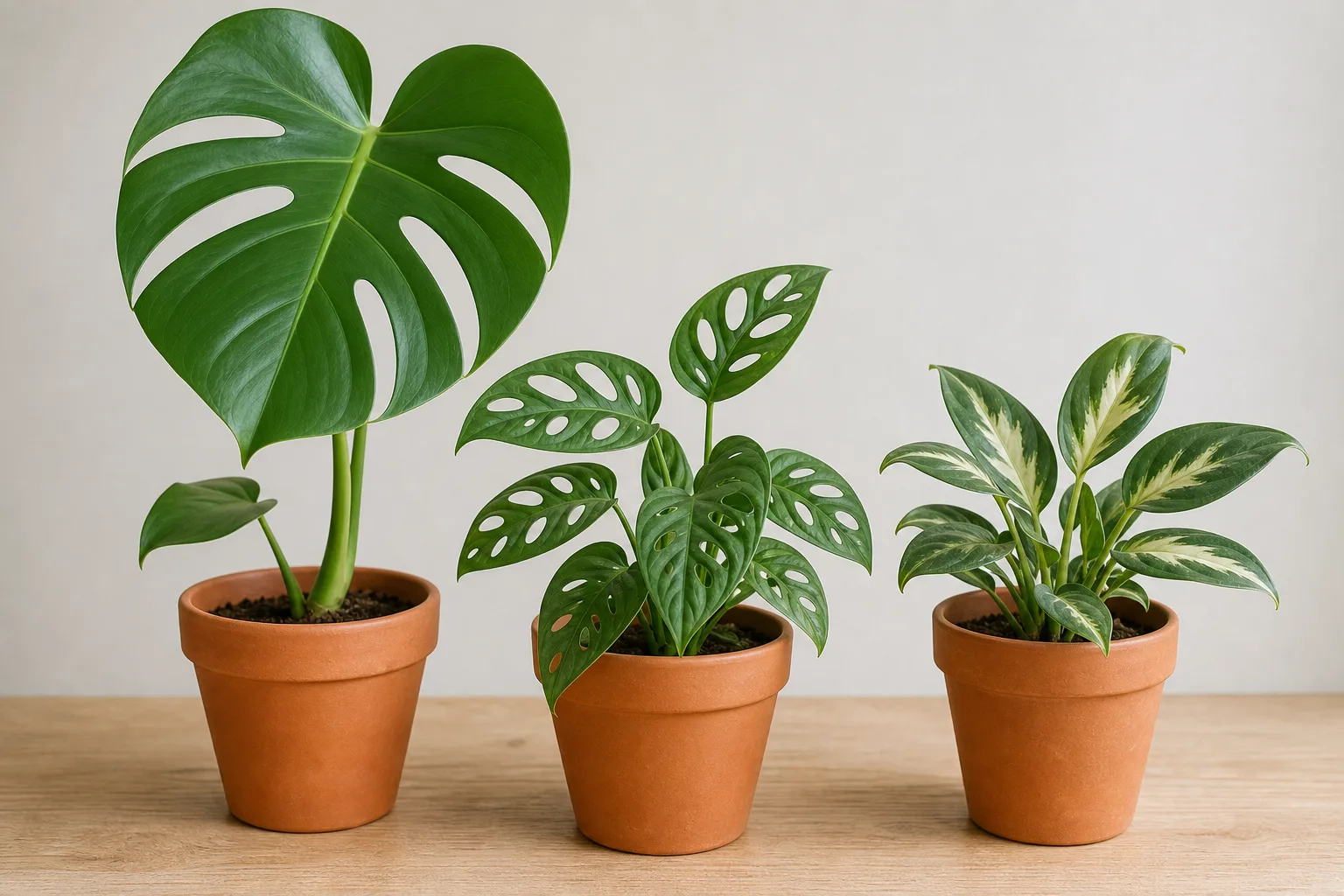
- Leaf texture — thick and glossy (deliciosa), medium and leathery (adansonii), or paper-thin (obliqua).
- Fenestration density — broad splits (deliciosa), oval holes (adansonii), extreme lace (obliqua), pinnate lobes (pinnatipartita), or none (standleyana, Peru).
- Growth habit — shingling against a board (dubia), continuous vine (adansonii), or large self-heading climber (deliciosa).
- Stem spacing — ultra-long internodes on small leaves can mean immature deliciosa or a “borsigiana” trade form; verify health over hype.
- Label category — species, cultivar, synonym, or marketing name from the table above.
Then cross-check price and seller proof. Variegated deliciosa and anything tagged obliqua deserve mature photos, node shots, and realistic expectations. Our buying a Monstera plant guide walks through bench inspection after you narrow the type.
Common Mistakes, Pet Safety, and What Not to Confuse
Mistake one: treating mini monstera as a true Monstera—it is usually Rhaphidophora tetrasperma.
Mistake two: assuming every heavily perforated small leaf is obliqua—adansonii wins almost every retail encounter.
Mistake three: judging species from juvenile appearance alone—deliciosa without splits, siltepecana without fenestration, dubia without a vertical board, and pinnatipartita before mature lobes all look “wrong” until conditions catch up.
Mistake four: paying collector prices for Peru or Esqueleto tags without verifying mature growth photos from the same mother plant.
Pet safety: Monstera species contain insoluble calcium oxalates. The ASPCA lists Monstera deliciosa as toxic to cats and dogs, causing oral irritation, drooling, vomiting, and swallowing difficulty if chewed. Keep plants out of reach; call your veterinarian or ASPCA Animal Poison Control at (888) 426-4435 if ingestion is suspected.
Related guides
- Buying a Monstera plant — inspect roots, leaves, and labels after you pick a type
- Monstera care guide for beginners — first setup once species is settled
- Monstera deliciosa plant hub — watering, light, problems, and propagation for the classic species
- Monstera adansonii plant hub — care depth for the compact vine
- How to get Monstera leaves to split — juvenile vs. mature deliciosa expectations
- Monstera propagation guide — rooting cuttings once you know the species
Conclusion
The useful way to read types of Monstera plants is through three filters: botany (what POWO accepts), trade naming (what tags say), and buyer reality (what will grow in your room). The genus is large; the indoor shortlist is small. Monstera deliciosa and Monstera adansonii still cover most beginners. Dubia, siltepecana, and standleyana add texture without obliqua risk. Lechleriana, Esqueleto, and pinnatipartita reward experienced growers who verify field marks before paying rarity prices. Obliqua deserves skepticism, not impulse shopping. Peru and mini monstera remind you that Latin on a sticker is not proof.
Choose the plant that matches your space and skill, verify it with the ID table and gallery, then hand off culture to the Monstera deliciosa hub or Monstera adansonii hub. Names get easier once you buy for the leaf in the pot—not the fantasy on the listing.