7 Research-Backed Benefits of Indoor Plants and Real Limits
Explore science-backed indoor plant benefits for mood, stress and home comfort, plus the limits of common claims.
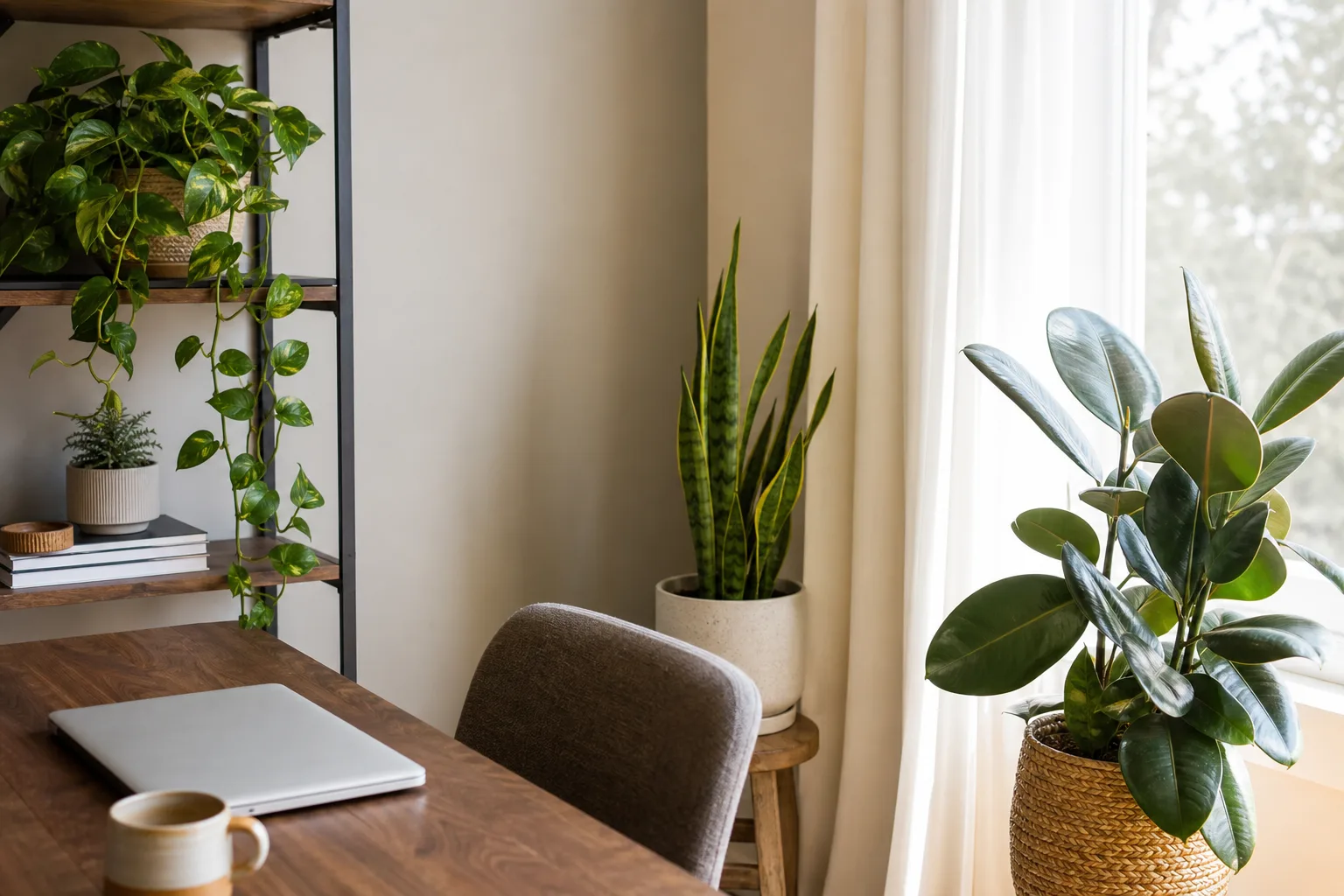
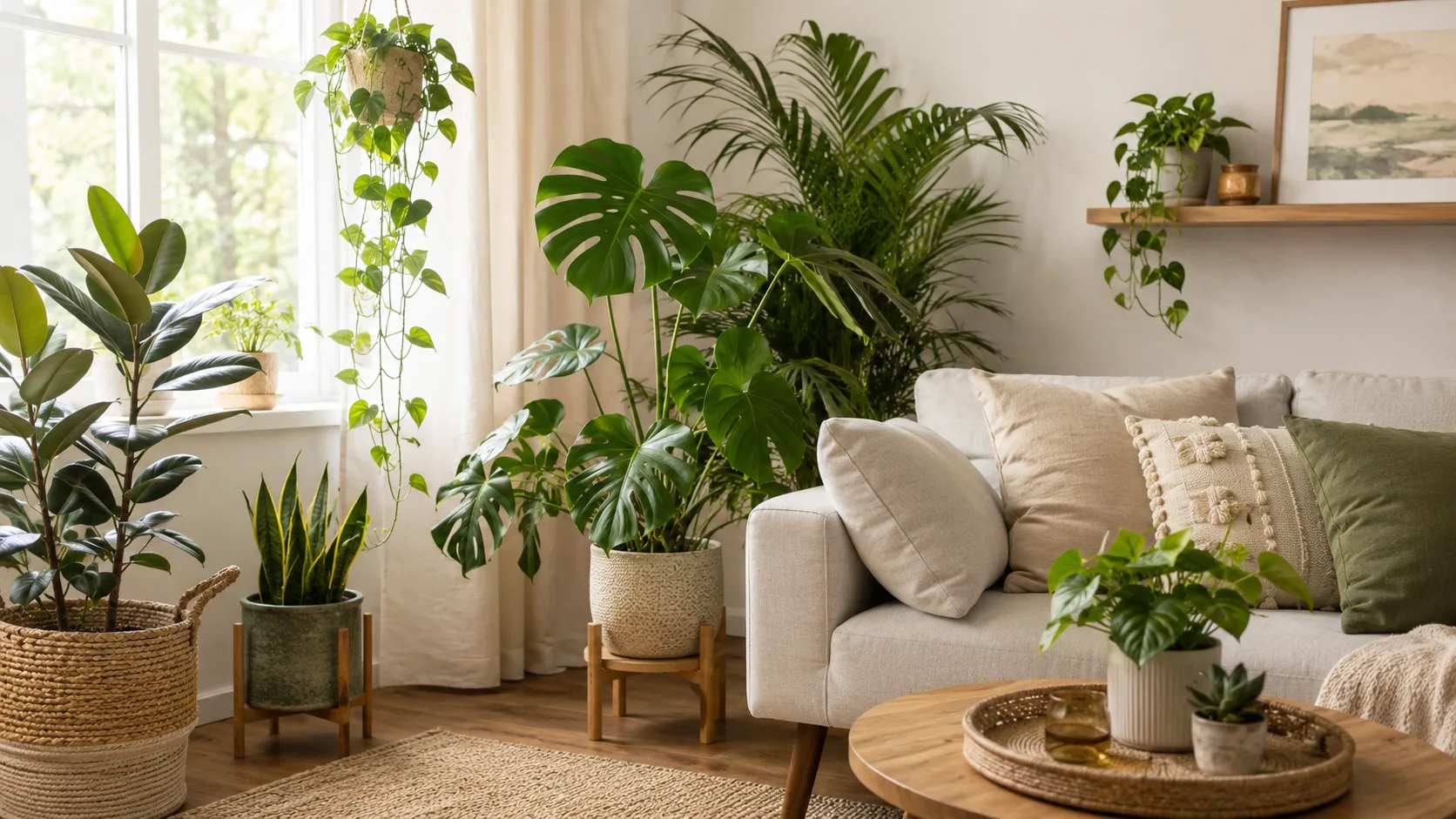
Most people buy indoor plants because they look good. That is reason enough. A healthy pothos trailing from a shelf, a snake plant beside a desk, or a rubber plant near a bright window can make a room feel less sterile almost immediately. The harder question is whether indoor plants do anything measurable for human wellbeing—and where marketing outruns the evidence.
This guide is the evidence-graded deep dive: seven benefits mapped to study types, physiological markers, and explicit limits. If you want room placement maps, surprising everyday payoffs, and a Monday-morning starter plan instead, read 5 Surprising Houseplant Benefits — What Actually Changes at Home first. That sibling page is the home-use companion. This one is the lab-coat sibling.
Research links indoor plants with lower stress, better mood, improved attention, higher workplace satisfaction, modest productivity gains, better perceived comfort, and supportive recovery environments. The strongest evidence is not that one houseplant will magically purify a room. The stronger evidence is that indoor greenery changes how people experience indoor spaces, how their bodies respond to stress, and how well they tolerate mentally demanding environments.
Modern life is heavily indoor life. The U.S. Environmental Protection Agency says Americans spend about 90% of their time indoors, where some pollutant concentrations are often 2 to 5 times higher than typical outdoor levels. (US EPA) Plants are not a complete solution to indoor health, but they can be part of a healthier indoor environment when paired with ventilation, light, cleaning, moisture control, and sensible plant care.
The Evidence Behind Indoor Plants and Wellbeing
The best way to understand indoor plant benefits is to separate three things: what is strongly supported, what is promising, and what is often exaggerated. A 2022 systematic review of 42 studies found that indoor plants generally had positive effects on human functions, especially physiology and cognition. (PMC) That does not mean every plant produces every benefit in every room. It means the overall pattern of evidence favors indoor plants as a low-risk environmental support for wellbeing.
The science is strongest when plants are treated as part of the indoor environment rather than as miracle objects. A plant can provide visual softness, living texture, routine, contact with nature, and a small restorative break from screens. Those effects are psychologically meaningful. They are also more realistic than expecting a few decorative plants to fix poor ventilation, remove all pollutants, or replace medical treatment for stress, anxiety, sleep problems, or respiratory illness.
What “Scientifically Proven” Means Here
“Scientifically proven” does not mean every study agrees perfectly. In this topic, it means there is credible evidence from controlled experiments, workplace studies, hospital studies, and systematic reviews showing measurable benefits. Some outcomes, like short-term stress reduction after plant interaction, are supported by direct physiological measures. Others, like productivity and recovery, are promising but depend heavily on setting, study design, plant density, and what exactly is being measured.
This is why the article uses careful language. Indoor plants can support focus; they do not guarantee focus. They may improve perceived comfort; they do not replace HVAC design. They can remove certain pollutants in sealed chambers; they usually do not clean real homes fast enough to replace ventilation or filtration. That distinction is what makes the evidence useful instead of misleading.
Evidence Strength at a Glance
Use this table when deciding where to invest effort. It grades each benefit by study quality and realistic home effect—not by Instagram promise.
| Benefit | Strongest study types | Evidence tier | Realistic home expectation |
|---|---|---|---|
| Stress reduction | Randomized crossover with physiological markers | Strong | Visible plant + brief tactile care in high-stress rooms |
| Mood | Systematic reviews, self-report + physiology | Strong to promising | Calmer-feeling rooms; not treatment for depression |
| Focus / attention | Cognition reviews, Attention Restoration Theory | Promising | Soft visual breaks during screen-heavy work |
| Workplace productivity | Field office studies, self-report | Promising | Better satisfaction; variable task performance |
| Recovery / pain tolerance | Hospital room comparisons | Promising | Softer rest environments; not tissue healing |
| Indoor comfort / humidity | Chamber and office experiments | Modest | Local humidity bump with grouped leafy plants |
| Air quality | Sealed-chamber VOC removal | Overstated at home | Ventilation and filtration remain primary |
The Royal Horticultural Society summarizes houseplant value as psychological wellbeing plus physical-environment support—mood, stress, attention, and conditions like humidity—while stressing that plants work best as part of a healthy indoor environment, not as replacements for ventilation or medical care. (RHS)
The Important Air-Cleaning Caveat
The most famous claim about indoor plants comes from NASA’s 1989 study, which found that certain plants could remove organic chemicals from air in sealed test conditions. (NASA Technical Reports Server) That finding is real, but it is often misused. Real homes and offices are not sealed laboratory chambers. Air enters, exits, mixes, and carries new pollutants continuously.
A 2020 review in the Journal of Exposure Science & Environmental Epidemiology concluded that potted plants have shown VOC-removal ability in small sealed chambers, but those results do not translate well into meaningful air-cleaning performance in typical buildings. (PubMed) This does not make plants useless. It simply means the best reasons to keep indoor plants are broader and more realistic than the common “air purifier” claim. For humidity context beyond a single tray, see the houseplant humidity guide.
Benefit 1: Indoor Plants Can Reduce Stress
One of the clearest benefits of indoor plants is stress reduction. This is not just a feeling people report after looking at greenery. Some studies have measured physiological changes, including blood pressure and autonomic nervous system activity, after people interact with plants.
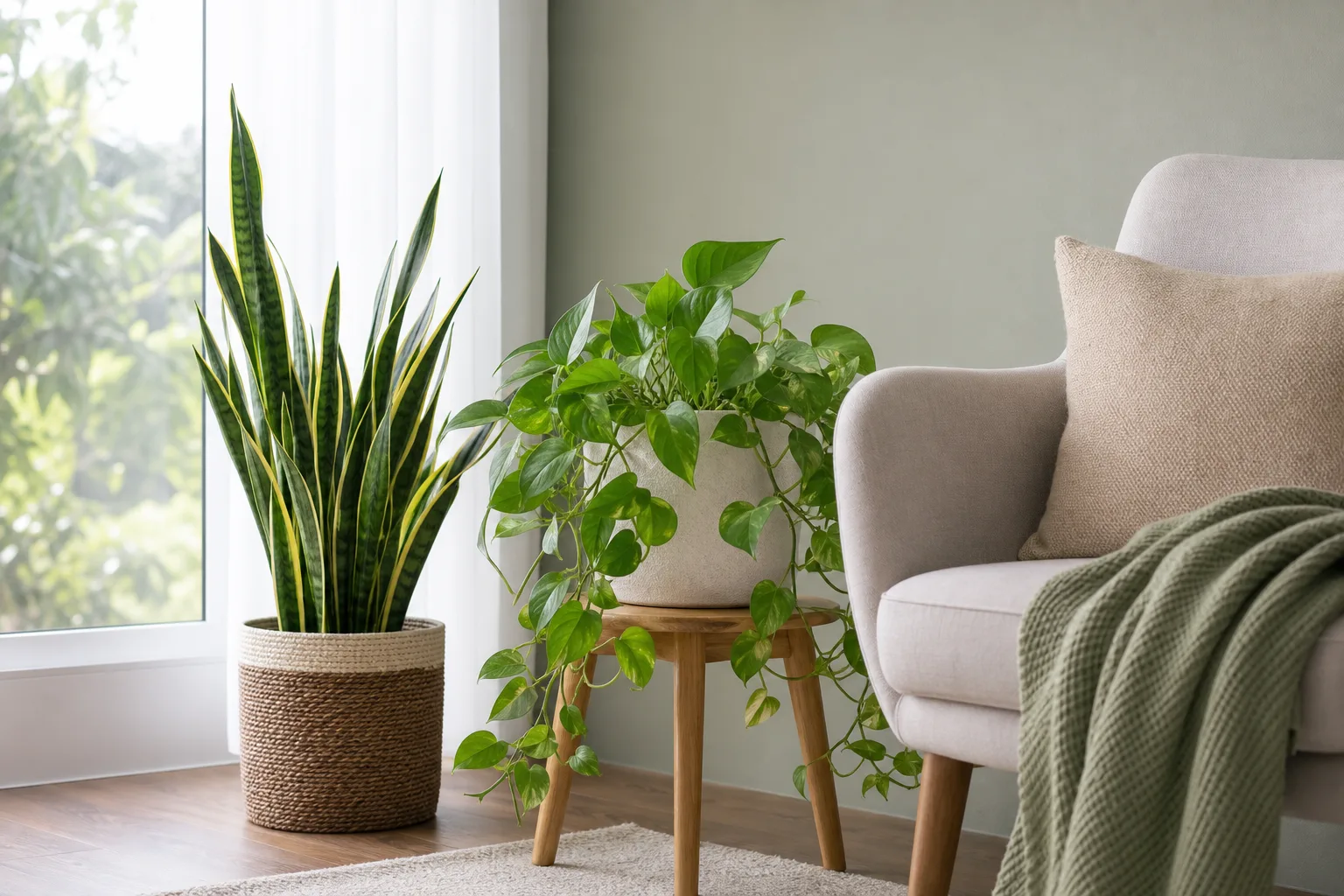 A 2015 randomized crossover study compared plant-related activity with computer-based mental work. Participants who transplanted an indoor plant showed reduced psychological and physiological stress compared with those doing the computer task. The researchers reported lower diastolic blood pressure and signs of reduced sympathetic nervous system activity after plant interaction. (Springer) In plain language, the body appeared to shift away from a more activated stress state.
This makes sense in everyday life. A short plant-care task is slow, tactile, and visually grounded. You check soil, remove a yellow leaf, rotate the pot, or water carefully. None of that demands the same kind of attention as email, spreadsheets, notifications, or social media. The activity creates a small break that is not passive scrolling and not another productivity task.
How to Use Plants for Daily Stress Relief
The stress benefit is more likely when plants are visible and easy to interact with. A plant hidden in a dark corner may decorate the room, but it will not give you many restorative moments. Place one or two plants where you already experience mental load: near your work desk, beside a reading chair, in the kitchen, or in a bright corner you pass often.
Keep the care routine simple. Choose hardy plants such as snake plant, ZZ plant, pothos, spider plant, philodendron, or rubber plant if you are new to houseplants. The goal is not to create a demanding indoor jungle that becomes another source of guilt. The goal is to introduce a living element that gives you a low-friction pause during the day.
Plants can support stress management, but they are not treatment for chronic anxiety, depression, burnout, or panic symptoms. If stress is affecting sleep, appetite, work, relationships, or safety, professional support matters. Indoor plants work best as one small environmental tool, not as a substitute for medical or psychological care.
Benefit 2: Indoor Plants Can Improve Mood
Indoor plants can make rooms feel calmer, warmer, and more emotionally pleasant. That may sound subjective, but subjective experience matters because people live inside perceptions, not just square footage. A room that feels sterile, harsh, or visually empty can make daily life feel more draining. A room with living greenery often feels softer and more cared for.
Research reviews support this pattern. A 2024 Frontiers editorial summarized evidence that indoor plants and greenery have been associated with increased positive emotions, reduced negative feelings, reduced physical discomfort, relaxed physiology, and enhanced cognition. (Frontiers) The effect is not only about beauty. Plants signal life, growth, seasonality, and care inside built spaces that are often dominated by screens, walls, plastic, glass, and artificial light.
There is also a behavioral layer. Taking care of a plant gives people a small, visible feedback loop. You water it, it perks up. You move it closer to light, it grows better. You neglect it, it tells you through drooping, yellowing, or dry soil. For many people, that gentle responsibility creates a sense of agency without the intensity of bigger life responsibilities.
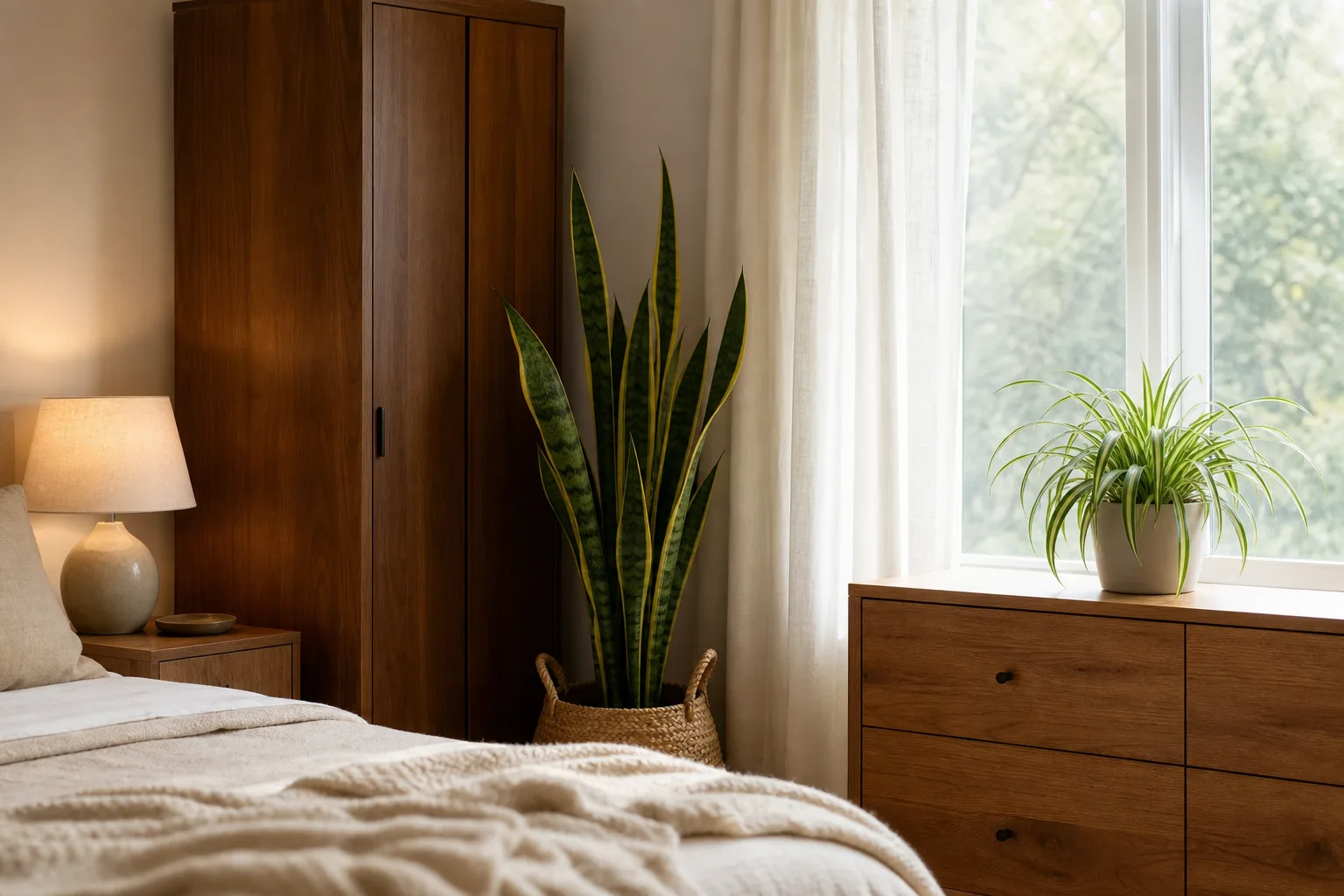
Mood benefits are especially useful in rooms where people spend long, repetitive hours. A home office, study corner, bedroom, or rented apartment can feel temporary or impersonal. A few well-placed plants can make the space feel more inhabited and less transactional. For bedroom-specific species and sleep-adjacent expectations, see 7 calming indoor plants to help you sleep better—but remember that plants support room feel, not sleep medicine.
Benefit 3: Indoor Plants Can Support Better Focus
Indoor plants may help focus by reducing mental fatigue and making attention feel less forced. This is usually explained through Attention Restoration Theory, which Rachel and Stephen Kaplan developed in their 1989 work on restorative environments. The theory suggests that natural settings engage the mind through “soft fascination”: enough visual interest to rest attention without overwhelming it. (European Centre for Environment and Human Health)
A plant on a desk does not work like a stimulant. It will not make a boring task exciting or solve poor sleep. Its value is subtler. Leaves, branching patterns, soil texture, and growth changes provide a visual break that is less cognitively aggressive than checking a phone. Looking at a plant for 20 seconds between work blocks is different from opening an app designed to hold your attention for 20 minutes.
The 2022 systematic review of indoor plants and human functions found positive effects particularly in physiology and cognition. (PMC) That does not mean every desk plant improves every cognitive task. The more realistic takeaway is that indoor plants can make environments more mentally restorative, especially when people are doing screen-heavy work.
Why Plants Help Mentally Tired Brains
Mental fatigue often builds when attention has no natural place to rest. A blank wall gives little restoration. A phone gives too much stimulation. A plant sits in the useful middle: visually interesting, low-pressure, and non-demanding. That makes it a good object for micro-breaks.
For work or study, place plants in your peripheral vision rather than directly blocking your workspace. A medium plant beside the monitor, a trailing pothos on a shelf, or a small pot near a window can be enough. The plant should be visible without becoming clutter. If you work in a tiny space, one healthy plant is better than five neglected ones fighting for light.
Focus also depends on care quality. Dead leaves, fungus gnats, moldy soil, or overcrowded pots can create irritation instead of restoration. A plant that looks healthy is more likely to support calm attention. A plant that constantly needs rescue may become visual stress.
Benefit 4: Indoor Plants Can Improve Workplace Productivity
Workplace plant studies often look at productivity, satisfaction, perceived air quality, concentration, and wellbeing. The results are not all identical, but the overall direction is positive enough that indoor plants have become a serious part of biophilic office design rather than just decoration.
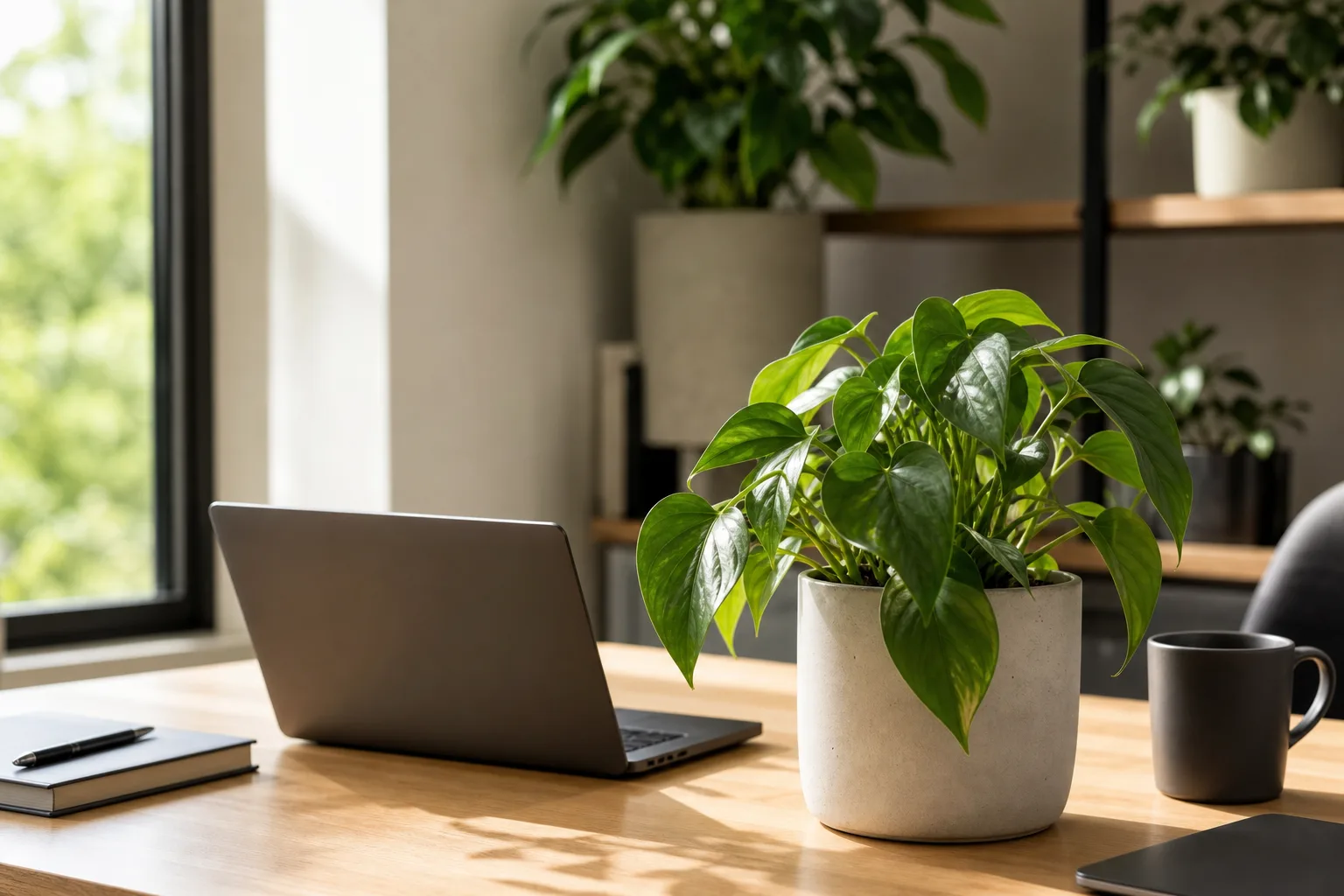 A real-world office study by Toyoda and colleagues tested whether small indoor plants on desks could reduce stress among employees. The study was designed around actual workplace settings rather than only laboratory conditions, which makes it especially relevant for offices and home offices. (ASHS Journals) Other workplace research has linked office plants with psychological benefits, though effects can vary depending on task type, visibility, and the nature of the workspace. (ASHS Journals)
Plants may help productivity in three practical ways. First, they make the workspace feel less barren, which can improve satisfaction. Second, they provide restorative visual breaks, which can support attention during long work periods. Third, they can signal that the environment has been designed for human comfort, not only efficiency. That signal matters because people often perform better in spaces where they feel considered.
What This Means for Home Offices
The home office is one of the best places to use indoor plants intentionally. Many people work in rooms that were not designed for work: bedrooms, dining corners, spare rooms, or small apartments. Plants can help create a psychological boundary between “random table with laptop” and “place where focused work happens.”
A practical home-office setup does not need many plants. One medium plant near natural light and one smaller desk plant can be enough to change the feel of the space. If your desk gets low light, choose ZZ plant, snake plant, pothos, or aglaonema. If you have bright indirect light, try rubber plant, monstera deliciosa, philodendron, or dracaena. If you travel often or forget watering, avoid ferns and moisture-demanding plants.
Do not use plants to hide bigger workplace problems. If your office has poor ventilation, glare, noise, bad ergonomics, or impossible workloads, plants will not fix those issues. They can improve the environment, but they cannot compensate for unhealthy work design.
Benefit 5: Indoor Plants May Support Recovery and Pain Tolerance
Indoor plants may help recovery by making stressful environments feel calmer and more supportive. This benefit is most relevant in hospitals, dental clinics, waiting rooms, recovery spaces, and bedrooms used during illness. The idea is not that plants directly heal tissue. The more plausible mechanism is that plants reduce stress, improve room satisfaction, and influence pain or discomfort perception.
A 2009 study on patients recovering from surgery found that patients in rooms with plants and flowers had more positive physiological responses, including lower systolic blood pressure, and reported lower pain, anxiety, and fatigue than patients in control rooms. (PubMed) A 2023 study in a dental clinic setting also suggested that indoor plants may contribute to relaxation and improved coping during recovery-related stress. (ASHS Journals)
This is important because recovery is not only biological. It is also environmental. Noise, harsh lighting, blank walls, fear, boredom, and lack of control can make discomfort feel worse. Plants can soften that experience. They add visual life to spaces that often feel clinical or emotionally cold.
Where This Benefit Matters Most
Plants are most useful in recovery spaces when they are easy to see, clean, and maintain. In a hospital or clinic, infection-control rules matter and living plants may not be allowed in certain units. In a home recovery setting, plants should not create extra work for the person recovering. Low-maintenance plants in clean pots are better than high-maintenance plants that shed leaves, attract pests, or need constant watering.
For bedrooms, choose plants based on care and safety rather than myths about oxygen. Plants photosynthesize in light and respire continuously, but the oxygen effect of a few plants in a bedroom is not the main benefit. The more meaningful benefit is that a calm, natural-looking room may feel more restful and less sterile. If you have asthma, allergies, pets, or mold sensitivity, be careful with damp soil, pollen-producing flowers, and dusty leaves.
Benefit 6: Indoor Plants Can Improve Indoor Comfort
Indoor comfort is not only about temperature. It is also about humidity, dryness, perceived freshness, light, texture, and how pleasant a room feels over time. Indoor plants can affect some of these factors directly and others indirectly.
Plants release water vapor through transpiration, and groups of plants can influence local humidity. A 2024 experimental study examined indoor plants’ effects on CO2 concentration, relative humidity, temperature, and comfort in office spaces. (PMC) The practical takeaway is not that every plant will transform a dry room. It is that plant density, species, potting media, light, watering, airflow, and room size all influence whether plants noticeably affect indoor conditions.
This is where many plant articles oversimplify. A single succulent on a table will not humidify a dry apartment. A cluster of leafy plants near a bright window may make a small area feel more comfortable. A large number of plants in a poorly ventilated room may raise moisture too much and create mold risk. The benefit depends on balance.
Humidity, Temperature, and Room Feel
For comfort, think in terms of plant grouping and room conditions. Leafy plants with higher transpiration rates, such as peace lily, areca palm, calathea, and ferns, may contribute more moisture than succulents or cacti. But moisture-loving plants also need more careful maintenance. If your room has poor airflow or you tend to overwater, these plants can backfire.
A better approach is to use a small hygrometer and observe the room. If relative humidity is very low, plants may help slightly, but a humidifier may be more effective. If humidity is already high, focus on airflow, drainage, and avoiding constantly wet soil. Indoor plants should make a room feel fresher, not damp. Penn State Extension notes that grouping plants can raise local humidity modestly, but it is not a substitute for whole-room moisture management in dry winter heat. (Penn State Extension)
Comfort also includes visual temperature. Greenery can make a room feel softer and less harsh even when the thermostat does not change. This perceived comfort matters. People are more likely to enjoy and maintain spaces that feel alive, balanced, and visually calm.
Benefit 7: Indoor Plants Can Support Air Quality, With Limits
Indoor plants can support air quality in narrow ways, but the popular claim that a few houseplants “purify the air” is usually overstated. This is the benefit that needs the most honesty.
NASA’s sealed-chamber research showed that plants can remove certain volatile organic compounds under controlled conditions. (NASA Technical Reports Server) Later reviews confirmed that potted plants can remove VOCs in small chamber experiments, but questioned whether the effect is large enough in real buildings. The 2020 review by Cummings and Waring found that translating chamber results to typical indoor spaces would require unrealistically high plant density to match normal building air exchange. (PubMed)
So, are air-purifying plants a myth? Not exactly. Plants and their root-zone microbes can interact with pollutants. Leaves can capture some particles on surfaces. Soil and plant systems can influence indoor microbiology. But in a normal home, the main tools for healthier air remain source control, ventilation, filtration, humidity management, and cleaning. Plants are a supplement, not the foundation.
What Plants Can and Cannot Do
Indoor plants can make air feel fresher because they improve the sensory experience of a room. They may contribute small effects on VOCs, humidity, and dust deposition depending on plant type and density. They can also encourage better care of the space, because people who maintain plants may become more attentive to light, airflow, and cleanliness.
But plants cannot remove smoke, cooking pollution, mold spores, high PM2.5, carbon monoxide, or chemical emissions fast enough to be relied on as protection. If indoor air quality is a serious concern, use evidence-based measures. The EPA emphasizes controlling common indoor pollutants, ventilation, and reducing exposure risks. (US EPA) For homes with asthma, respiratory disease, dampness, gas appliances, or wildfire smoke exposure, plants should never replace proper air quality interventions.
This balanced view does not weaken the case for indoor plants. It strengthens it. Plants are valuable because they improve human experience indoors in multiple small ways. They do not need to be sold as living air filters to be worth keeping.
How to Choose Indoor Plants for Real Benefits
The best indoor plant is not the trendiest plant. It is the plant that can stay healthy in your actual room with your actual habits. A thriving low-maintenance plant gives more benefit than a rare plant slowly dying in the wrong light.
Start with light. Most common indoor plants prefer bright indirect light, but some tolerate lower light better than others. Snake plant, ZZ plant, pothos, philodendron, and aglaonema are forgiving choices for beginners. Rubber plant, monstera deliciosa, dracaena, and peace lily usually do better with brighter indirect light. Calathea and ferns can look beautiful, but they often need more humidity and consistent care.
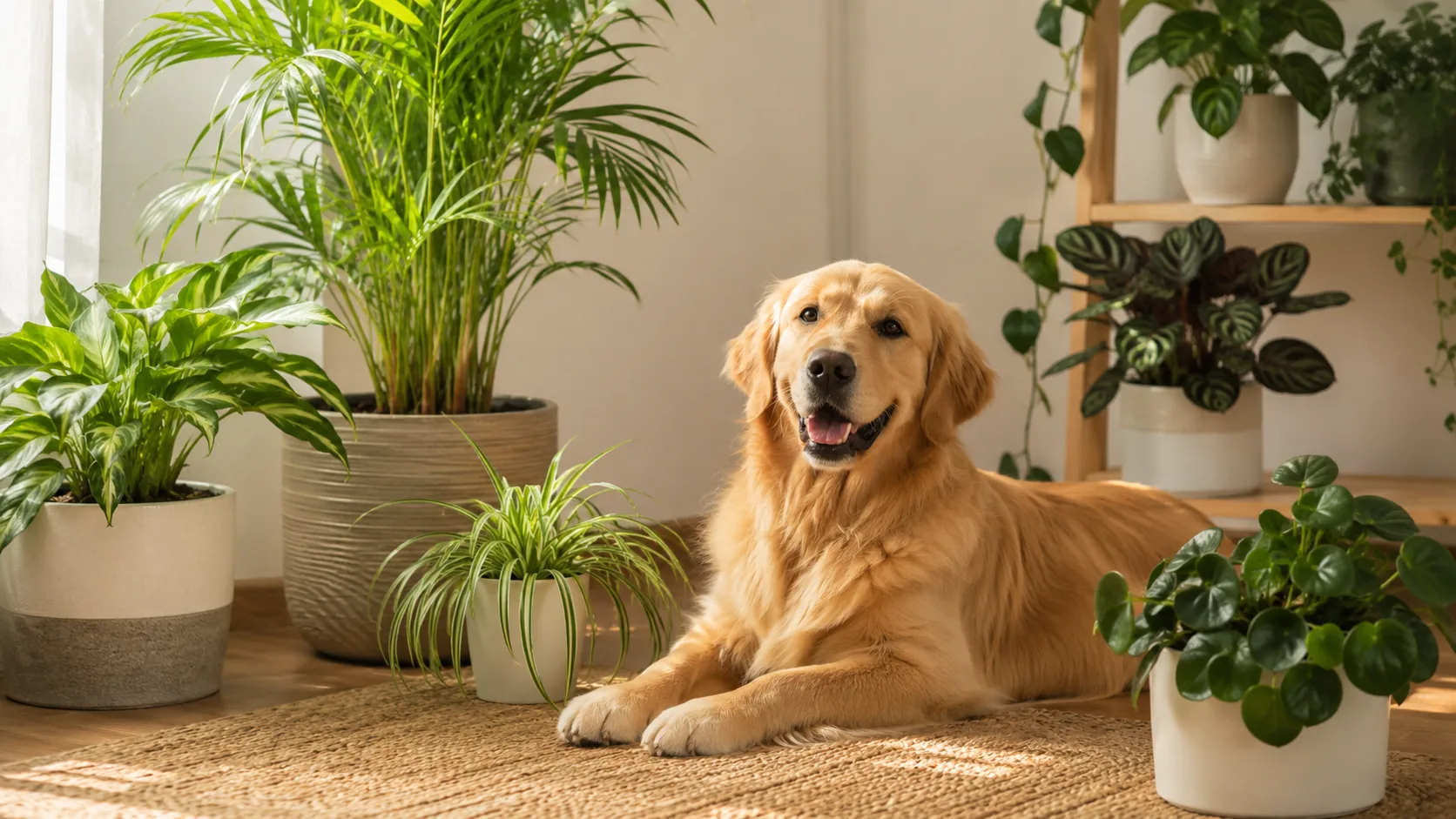
Then consider the purpose of the room. For a desk, choose a compact plant that does not shed heavily or block your workspace. For a living room, a larger floor plant can create a stronger visual effect. For a bedroom, choose low-maintenance plants that do not require frequent watering. For a bathroom with light, humidity-loving plants may do well. For homes with pets, check toxicity before buying; many common plants, including peace lily, pothos, philodendron, and snake plant, can be unsafe for cats and dogs if chewed. Verify any species in the ASPCA toxic and non-toxic plants database.
Plant quantity should follow your capacity. One healthy plant in every room you use daily is a reasonable starting point. If you enjoy plant care, build from there. If you are busy, travel often, or dislike maintenance, keep the collection small. The benefits come from living greenery that supports your space, not from turning plant ownership into another obligation.
The most common mistake is overwatering. Many indoor plants die because people water on a fixed schedule instead of checking soil moisture. Wet soil can attract fungus gnats, damage roots, and increase mold risk. Learn each plant’s drying pattern and water only when the soil condition fits that plant’s needs—see how to water indoor plants the right way for the full routine. The second mistake is buying plants for aesthetics while ignoring light. The third is expecting plants to solve ventilation, therapy, or veterinary problems they cannot solve.
Related Guides
- 5 surprising houseplant benefits at home — room placement and everyday surprises when you already understand the evidence limits.
- How to water indoor plants the right way — keep starter plants healthy so benefits do not turn into guilt.
- Houseplant humidity guide — when comfort benefits need more than a few leafy pots.
- 7 calming indoor plants to help you sleep better — bedroom species with realistic sleep-adjacent expectations.
Conclusion
Indoor plants have real, research-backed benefits, but the strongest case for them is not the exaggerated claim that a few pots will purify your home. The stronger case is more human: plants can reduce stress, improve mood, support attention, make workspaces more pleasant, soften recovery environments, improve perceived comfort, and contribute modestly to indoor environmental quality.
The benefits are most reliable when plants are healthy, visible, appropriate for the room, and easy to maintain. A single thriving pothos near your desk can be more useful than a dozen struggling plants bought for decoration. Start with one or two hardy species linked above, keep them alive with solid watering habits, and add more only when plant care feels enjoyable rather than burdensome.