Monstera Deliciosa Care Guide: Light, Water & Moss Pole
Monstera deliciosa
Grow split-leaf monstera indoors - watering, bright indirect light, moss pole support, and fixes for yellow leaves.
Monstera Deliciosa Care Guide: Light, Water & Moss Pole
Start with wateringThe most common care mistake for Monstera DeliciosaWatering guide →Monstera Deliciosa care essentials
Light
bright indirect light, medium indirect light
Water
Every 7–10 days - allow top 3–5 cm to dry. Water thoroughly. Reduce to every 10–14 days in winter. Avoid chronic overwatering.
Soil
Standard potting mix + 20–25 % perlite + 10–15 % orchid bark. Well-draining chunky aroid mix. pH 5.5–7.0.
Humidity
50–70%
Temperature
18–30°C (65–86°F)
Fertilizer
Feed lightly during active growth. Use monthly during spring and summer.
About Monstera Deliciosa
Monstera Deliciosa has a upright growth habit. It is also known as Swiss Cheese Plant.
| Detail | Information |
|---|---|
| Also known as | Swiss Cheese Plant |
| Growth habit | Upright |
| Scientific name | Monstera deliciosa |
Monstera Deliciosa Care Guide: Light, Water & Moss Pole
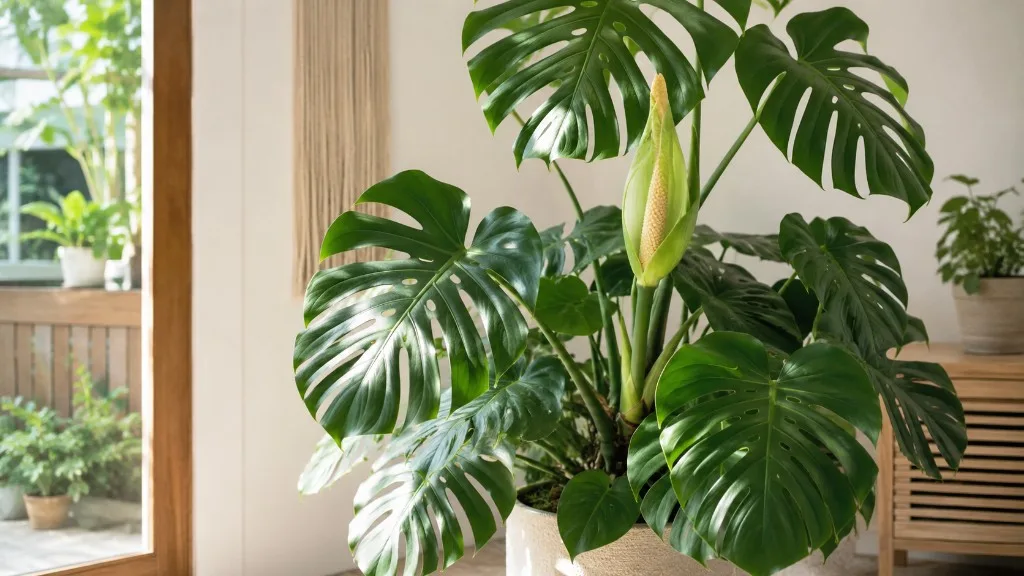
Monstera deliciosa is the archetypal statement houseplant: glossy, heart-shaped leaves that can grow dinner-plate size, dramatic splits and holes called fenestrations, and thick stems that want to climb. It is sold everywhere under names like Swiss cheese plant, hurricane plant, ceriman, and split-leaf philodendron - and that last name is the first clue that confusion starts at the nursery tag. This guide is written for the person standing in front of a floor-sized Monstera wondering why the leaves are still solid, whether the moss pole is optional, and whether it is safe next to a cat.
The care that actually works indoors is simpler than the Instagram aesthetic suggests: Monstera Deliciosa light guide, a chunky well-draining aroid mix, water only when the top of the mix has dried, and a stable vertical support so the plant can behave like the climbing hemiepiphyte it is. Get those four right and fenestrations, aerial roots, and architectural scale follow over time. Skip support or park it in a dim corner and you will still have a living plant - just a juvenile one with small, unsplit leaves and a reputation for being “slow.”
What Monstera Deliciosa Actually Is (Not a Philodendron)
Monstera deliciosa is a species in the Araceae (arum) family, the same broad group as peace lilies, Anthurium, and true philodendrons. The NC State Extension Gardener Plant Toolbox is explicit: split-leaf philodendron is not a philodendron at all. It is a woody, perennial, broadleaf evergreen climbing vine native from Mexico to Panama, capable of reaching 70 feet on a tree in the wild but typically staying 6 to 8 feet in most home environments.
In nature the life cycle matters for your care routine. Monstera starts life on the forest floor as a terrestrial seedling, then becomes epiphytic once it contacts a tree trunk, sending long cord-like aerial roots into bark while the stem climbs toward brighter canopy light. Indoors you are reproducing that second phase when you offer a moss pole or totem. The NParks Flora & Fauna Web entry for Monstera deliciosa notes leathery leaves up to 90 cm wide with deep lobes and fenestrations, thick petioles up to 1 m long, and an etymology that translates roughly to “delicious monstrosity” - a reference to the edible ripe fruit, not the foliage.
Young plants produce entire, heart-shaped leaves without holes. Fenestrations develop as individual leaves mature and as the overall plant shifts toward adult climbing growth. That juvenile-to-adult transition is why a small nursery Monstera looks nothing like the loft-dweller in design magazines, and why patience plus proper conditions beats any single “hack.”
The name Monstera comes from the Latin word for monstrous or abnormal, referring to those perforated leaves that struck early European botanists as wildly unusual. Deliciosa refers to the fruit. Indoors, flowering and fruiting are rare; the Missouri Botanical Garden notes that interior specimens typically do not produce the spadix-and-spathe inflorescence or the pineapple-banana-flavored aggregate fruit that gives the plant its “Mexican breadfruit” common name. Unripe fruit contains the same irritant crystals as the leaves and is not safe to eat.
Monstera deliciosa vs. Adansonii and Common Lookalikes
Three different plants routinely share shelf space and Pinterest boards, and mixing them up leads to wrong size expectations and wrong support choices.
Monstera deliciosa is the large species. Leaves are broad, glossy, and thick, developing marginal splits and internal holes on mature foliage. Stems are substantial. A happy indoor specimen becomes a floor plant that needs ceiling clearance and a heavy pot.
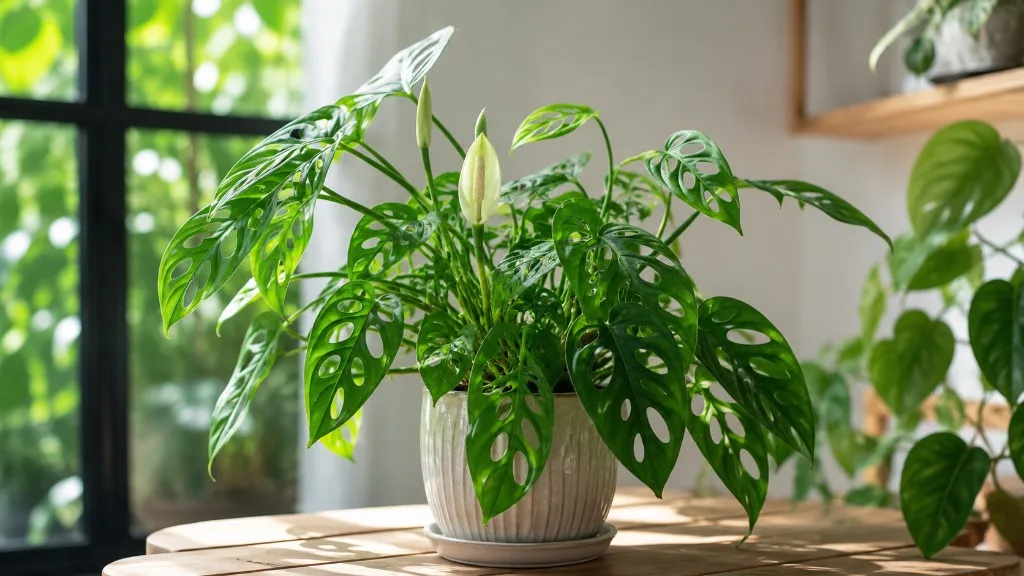
Monstera adansonii (often called Swiss cheese vine) is the smaller, narrower-leaved climber with more uniform oval holes and thinner stems. It wants the same general aroid care but stays manageable on a trellis or hanging basket and matures faster in small spaces.
Rhaphidophora tetrasperma is sold as “mini Monstera” but is a different genus entirely. NC State Extension lists it as a plant commonly confused with M. deliciosa. Leaves are smaller, splits are narrower, and growth is faster and more delicate. Care is similar; scale is not.
The name split-leaf philodendron is also applied to Thaumatophyllum bipinnatifidum (formerly Philodendron bipinnatifidum), a completely separate large aroid with deeply lobed but typically non-perforated leaves. If your “Monstera” has deeply cut edges but no Swiss-cheese holes, verify the botanical name on the tag.
For shopping and care planning, treat deliciosa as the architectural floor Monstera that rewards moss poles and space. Treat adansonii as the trailing or compact fenestrated Monstera. Treat R. tetrasperma as a lookalike vine with its own Monstera Deliciosa repotting guide calendar. The watering and soil principles overlap; the size, weight, and light budget do not.
Light Requirements for Big Leaves and Fenestrations
Light is the variable that separates a surviving Monstera from one that produces large, fenestrated leaves. NC State Extension recommends moderate brightness but not direct sunlight, with variegated cultivars such as ‘Albo Variegata’ and ‘Thai Constellation’ needing more light than solid-green plants because the white sectors photosynthesize less efficiently.
In home terms, bright indirect light for most of the day is the target: near an east-facing window, a few feet back from a south- or west-facing window with a sheer curtain, or under a quality full-spectrum grow light if your brightest room still feels dim. Dappled or partial shade mimics the forest edge where wild plants climb; harsh midday sun through clear glass scorches the leathery leaf surface within days, showing up as bleached patches, brown crispy spots, or curled margins.
How Much Light Is Enough Indoors
Survival is possible in medium indirect light several feet from a window, but fenestrations stall there. Extension and specialist growers converge on a practical threshold: sustained bright indirect exposure - often described in the roughly 200–400 foot-candle range for reliable split development - combined with plant maturity and climbing habit. Below that band, the plant economizes: smaller blades, fewer holes, longer internodes.
Use your eyes before buying a meter. New growth should be firm and appropriately deep green (allowing for variegation patterns). Long, thin petioles and small leaves mean the plant is reaching for photons. Slow leaf production with every new leaf identical to the last solid juvenile leaf often means light, not fertilizer, is the bottleneck. If you cannot move the pot closer to a window, a full-spectrum LED grow light 12–18 inches above the canopy for 10–12 hours daily is a legitimate fix, not an enthusiast luxury - especially in winter at higher latitudes.
Acclimate gradually when increasing light. A Monstera pulled from a dim shop corner into blazing western exposure will burn even though it “needed more light.” Move it in stages over one to two weeks, or filter the window. Rotate the pot a quarter turn weekly so growth stays balanced and every face of the plant participates in photosynthesis.
Watering Without root rot on Monstera Deliciosa
Monstera deliciosa is moderately drought-tolerant once established - aerial roots and a chunky mix help - but it is not tolerant of chronic wet feet. The University of Florida IFAS poisonous houseplants publication notes thick stems and long aerial roots on a plant that can climb dramatically outdoors; indoors, those same roots rot quickly if the mix stays saturated in low light.
The operational rule: water thoroughly when the top 1–2 inches (3–5 cm) of potting mix feels dry, then empty the saucer so the pot never sits in runoff. In active spring and summer growth, that often means every 7–10 days for a medium pot in bright light, but pot volume, humidity, and season shift the interval. In winter, when growth slows and mix dries slower, every 10–14 days is a common starting point - always verified by touch, not by calendar.
NC State Extension advises watering thoroughly, then allowing the top quarter to one-third of the container to dry before the next watering. That slightly deeper dry-back is a useful cross-check in large pots where the surface dries faster than the core. If the top is dry but a chopstick inserted to mid-depth still pulls up damp crumbs, wait.
Reading Soil Moisture in a Large Pot
Large Monsteras live in 10-inch pots and bigger, sometimes with a moss pole installed off-center. Surface dryness is misleading: the root mass may still be wet below. Combine three checks: finger or chopstick to mid-depth, pot weight (lift after a thorough watering once to learn the heavy feel), and plant signals (slight leaf droop on an otherwise healthy plant often means dry; yellow lower leaves on wet mix mean too much water).
When you water, soak until water runs freely from drainage holes. Partial sips that never reach the lower roots train a shallow root system and encourage fungus gnats. If water channels through dry, compacted mix and out the bottom in seconds, the soil structure has failed - root ball lightly scarified and repot into fresh chunky mix is the fix, not more frequent splashes.
Overwatering remains the primary killer. Signs include yellowing lower leaves, a musty or sour smell, soft brown stems at the soil line, and black mushy roots if you unpot. Underwatering shows as dry, crispy leaf edges, wilting that recovers after a soak, and slow new leaf production. The diagnostic order is always: moisture in the pot first, then light, then pests - not the reverse.
Reduce watering frequency after repotting, during root rot recovery, and in the dimmest winter weeks. Increase it when the plant pushes a new leaf every few weeks in bright summer light and the pot dries in under a week.
Soil and Pot Choice for a Large Climbing Plant
Aroids want fast drainage and plenty of oxygen at the roots. A standard indoor recipe that works for Monstera deliciosa: quality all-purpose potting mix plus 20–25% perlite plus 10–15% orchid bark, producing a chunky, well-draining aroid mix with target pH roughly 6.0–8.0 per NC State Extension. The bark and perlite prevent compaction; the peat or coir base retains enough moisture that you are not watering daily.
Avoid straight bagged “moisture control” mixes in oversized pots unless you amend heavily with bark. Avoid pots without drainage holes, no matter how good the ceramic looks. For a plant that will weigh 30 pounds or more at maturity, stability beats aesthetics: a wide-based nursery pot inside a decorative cache pot is safer than a tall, narrow cylinder that tips when the moss pole catches a curtain.
Terracotta dries faster - helpful if you tend to overwater. Plastic or fiberglass retains moisture longer - helpful if you underwater but risky in low light. When upsizing, go one pot size at a time (about 2 inches of diameter). A pot vastly larger than the root ball holds water the roots cannot use and is the most common post-repot rot scenario.
Because Monstera becomes a large plant, plan placement before the root ball grows immovable. Moving a 6-foot vine with a saturated 12-inch pot is a two-person job. If you know the ceiling height is fixed, train the stem horizontally along a wall-mounted trellis or prune the top after a node to control height rather than fighting a pole that outgrows the room.
Humidity and Temperature
Monstera deliciosa prefers warm, humid rainforest-edge conditions translated into apartment terms. NC State Extension lists 60–85°F (roughly 16–29°C) as the comfortable range, with high humidity recommended - practical indoor targets of 50–70% relative humidity produce the cleanest new leaves. Below 40%, especially in heated winter air, brown crispy leaf margins and spider mite pressure increase even when watering is correct.
Raise humidity with a pebble tray (pot above the water line), grouping plants, or a cool-mist humidifier near the plant - not by misting leaves, which gives a minutes-long bump and can encourage fungal spotting if foliage stays wet in dim corners. Good air circulation between humid conditions matters; stagnant damp air plus weak light invites leaf spot problems.
Watch cold drafts: single-pane winter window sills, AC vents blasting directly on the pot, and porch doors that open to freezing air can stall growth overnight. Monstera tolerates ordinary indoor warmth in summer; it dislikes sudden temperature swings more than absolute highs.
Moss Poles and Vertical Support
A moss pole (or coco coir totem, bark board, or sturdy trellis) is not décor. It is a functional substitute for the tree trunk the plant evolved to climb. NC State Extension notes that sturdy support is necessary to prevent stems from breaking on a heavy vine. Without vertical structure, Monstera sprawls, produces smaller leaves, and often stays in juvenile foliage indefinitely - the most common reason indoor plants “never get splits.”
Climbing changes hormone and leaf morphology signals. As stems ascend and aerial roots attach to a moist support, new leaves tend to come in larger, thicker, and more fenestrated. The Royal Horticultural Society recommends guiding aerial roots into a moss pole kept consistently slightly moist so roots anchor and absorb at the same time.
Setting Up and Maintaining a Moss Pole
Install a pole when the plant is roughly 2–3 feet tall, or as soon as you have a stem stiff enough to tie - earlier is fine if the pot is stable. Steps that work in real homes:
Choose a pole tall enough for the next 12–18 months of growth, secured in the pot without wobbling. A wobbling totem tears fresh aerial roots and topples heavy pots.
Set the pole beside the thickest stem, not through the center of the root ball unless the pot is deep and the pole base is long.
Loosely tie the stem to the pole with soft plant ties, velcro strips, or cut-up tights - never wire that cuts the stem. Place ties just below a node where aerial roots emerge.
Mist or drip-water the pole surface when you water the pot, keeping the coir or moss damp but not dripping into the pot constantly. The goal is attachment, not a second swamp at the root zone.
Redirect new growth upward as it appears. Once several aerial roots grip, you can reduce ties. Do not routinely cut healthy aerial roots; each one is a future anchor or supplemental water uptake point. Trim only if a root is fully desiccated and brittle, or if it threatens a wall or floorboard - and expect some re-adjustment time after removal.
When the plant outgrows one pole, add a extension pole or second support rather than letting the top collapse sideways. For very large specimens, a wall-mounted trellis plus pole combo distributes weight better than a single skinny stake in a plastic pot.
Understanding Fenestrations (Splits and Holes)
Fenestration (from the Latin for window) means the natural holes and marginal splits in mature Monstera deliciosa leaves. Botanists still debate the evolutionary fine print - hypotheses include letting storm rain pass through to roots below, reducing wind damage on large sails of tissue, and optimizing dappled light capture in the understory - but the horticultural takeaway is stable: fenestrations are a maturity feature, not a defect or nutrient deficiency.
Indoors, fenestrations track three inputs: age, bright enough light, and vertical climbing habit. A solid heart-shaped leaf on a new runner is normal. A plant that has climbed two meters on a moist pole in good light should progressively produce deeper splits and more internal perforations on successive leaves. The plant is reporting conditions in real time - each new leaf is a journal entry.
Fenestrations are not produced by cutting existing leaves, painting holes, or overdosing fertilizer. Those internet shortcuts do not trigger the developmental pathway. Patience and environment do.
Why Your Monstera Has Solid Leaves
If your Monstera keeps producing small, entire leaves, work through this sequence before buying another product:
Juvenile stage. Nursery plants and recent cuttings often need several months to years of stable care before adult leaf forms appear. Leaf number eight, ten, or twelve on a climbing stem is a rough milestone in many homes - not a guarantee, but a realistic horizon.
Insufficient light. The plant stays in energy-conservation mode: smaller blades, no holes. Move closer to the window, filter harsh sun, or add a grow light. This is the single most common fix.
No climbing support. A Monstera lounging across a shelf behaves like a sprawler, not a canopy climber. Add a pole and tie the lead stem vertically.
Recent stress. Repotting, root rot recovery, pest treatment, or a cold draft can pause fenestration for several leaves. Stabilize conditions first.
Wrong species. M. adansonii holes early but leaves stay smaller. R. tetrasperma splits differently. Confirm you actually have M. deliciosa.
Variegated cultivars may fenestrate more slowly because less chlorophyll means less energy per square inch of leaf. Give them more light, not more fertilizer.
Fertilizer During Active Growth
Monstera deliciosa is not a heavy feeder, but a large plant in bright light uses nutrients faster than a small pot in a dim office. Feed monthly during spring and summer with a balanced liquid fertilizer at half strength on already-moist soil. A formula slightly higher in nitrogen supports leaf size; avoid super-bloom blends as the primary feed.
NC State and most extension sources align with pause feeding in winter, after repotting, and during any stress period (rot recovery, major pest infestation, prolonged droop). Fertilizer on dry roots or on a plant that is not growing burns tips and salts the mix. If a white crust rims the pot, flush with plain water and skip the next feeding.
Organic slow-release granules at label rate once in spring work for growers who forget monthly liquids. Watch new leaf color: deep green (or stable variegation) and increasing size mean nutrition is adequate. Persistent pale new growth despite good light may indicate deficiency - but check roots and watering before escalating dose.
Repotting a Large Monstera
Repot every 1–2 years, or when roots circle the surface, emerge from drainage holes, or water runs straight through without soaking. The best timing is early active growth in spring, giving a full season to re-establish. Signs you cannot ignore: top-heavy pots that tip, mix that smells sour, or watering daily because the root ball is all roots and no soil.
Go up one pot size. Slide the plant out horizontally with help if needed - do not yank by the stem. Tease circling roots gently; cut only black, mushy tissue with clean pruners. Set the moss pole base stable in the new pot before backfilling fresh chunky aroid mix. Water lightly the first week, then return to the normal dry-back rhythm.
Large repots are messy. Tarp the floor, pre-moisten mix, and accept that one person cannot easily repot a 5-foot Monstera alone. If the plant is too big to move, top-dressing - scraping out the top 2 inches of old mix and replacing with fresh bark-heavy soil each spring - is a partial alternative, not a forever substitute.
Do not repot on day one after purchase unless the mix is clearly failing or pests are visible. Quarantine new plants, learn the drying rhythm in the existing pot, and repot once acclimated.
Seasonal Care Rhythm
Deliciosa care is not static across the year. In spring and summer, growth usually accelerates: the plant uses more water, dries the pot faster, and pushes new leaves. That is the active window for feeding, training onto a moss pole, taking propagation cuttings, and the only sensible time to repot. In fall and winter, growth slows, the mix stays wet longer, and the main risk shifts toward overwatering - NC State Extension and Royal Horticultural Society both recommend watering less often over winter and pausing fertilizer until light returns. Treat humidity as a performance enhancer, not a core engine: a humidifier cannot rescue a Monstera drowning in dense compost, but it does smooth crispy edges in dry heated rooms when light, watering, and soil are already dialed in.
Propagation by Stem Cuttings
The reliable home method is a stem cutting with at least one node - the knuckle where leaves and aerial roots attach. A leaf without a node will not root. Cut below the node with sterile shears, optionally air-dry the cut end for an hour, then root in water, moist sphagnum moss, or chunky potting mix in a humid enclosure.
Roots typically form in 3–6 weeks in warm, bright indirect conditions. Change water weekly if using a jar; keep moss barely moist, not wet. Once roots are 2–3 inches long, pot into aroid mix and treat as a juvenile plant with slightly more conservative watering until new growth confirms root function.
NC State Extension lists layering and stem cutting as recommended propagation strategies. Division is possible on multi-stem clumps but less common than single-stem cuttings for deliciosa. Do not propagate from pest-infested or rot-compromised tissue - cuttings inherit the parent’s problems.
Variegated cultivars propagate the same way but may revert or lose balance; that is a genetics conversation beyond basic care, not a reason to skip node-bearing cuttings from healthy stems.
Toxicity to Pets and People
Monstera deliciosa is toxic to cats and dogs and irritating to humans on contact with sap. It is not a plant for low shelves, cat highways, or puppy teething zones. Treat it as a display plant out of reach, and choose a pet-safe alternative for floor-level greenery if your animals chew vegetation.
All parts contain insoluble calcium oxalate crystals (raphides) typical of Araceae. The ASPCA toxic plant listing for Swiss cheese plant (Monstera deliciosa) classifies it as toxic to dogs and toxic to cats, with toxic principle insoluble calcium oxalates and clinical signs including oral irritation, intense burning of mouth, tongue and lips, excessive drooling, vomiting, and difficulty swallowing. The duplicate ASPCA hurricane plant entry confirms the same species and signs under alternate common names (cutleaf philodendron, ceriman, Mexican breadfruit).
Cats and Dogs (ASPCA)
Mechanism matters for panic control. When chewed, needle-like crystals embed in mucous membranes, causing immediate pain and swelling. The Merck Veterinary Manual notes that insoluble oxalate exposures in pets typically cause hypersalivation, pawing at the mouth, reduced appetite, and oral edema, with supportive care including rinsing the mouth and sometimes calcium-containing dairy to bind crystals - and that most cases carry a good prognosis without renal injury, unlike soluble oxalate plants.
That does not mean you wait out severe symptoms. If your cat or dog ate Monstera tissue, call ASPCA Animal Poison Control at (888) 426-4435 (consultation fee may apply) and your veterinarian promptly. Watch for labored breathing if throat swelling is significant - that is an emergency, not a watch-and-wait scenario.
For people, NC State Extension lists low severity poison with intense mouth burning, nausea, vomiting, and difficulty swallowing if large quantities are eaten, plus contact dermatitis from sap. Wear gloves when pruning or repotting if you are sensitive. Wash hands after handling cut stems. Keep toddlers away from fallen leaves.
The ripe fruit is historically eaten in tropical regions and described as tasting like pineapple and banana, but indoor plants rarely fruit, and unripe fruit is toxic - UF IFAS EP639 warns that all plant parts including unripe fruit contain oxalate crystals. This is not a plant to experiment with in the kitchen.
Common Problems and Real Fixes
Most Monstera problems are environmental patterns, not mysteries. Read the whole plant - soil moisture, light level, support, pest inspection - before changing four variables at once.
Yellow leaves. Lower yellowing on wet mix points to overwatering or root rot. Yellow on dry, light mix suggests underwatering. Uniform pale yellow with long petioles means low light. Spotty yellow with webbing means spider mites. Fix the cause, then remove fully yellow leaves once the plant stabilizes.
Brown tips and edges. Usually low humidity, underwatering, or salt buildup from tap water and over-fertilizing. Raise humidity, flush the pot, trim dead tips cosmetically.
Black or brown spots on leaves. Often fungal leaf spot from wet foliage in stagnant air, or physical damage. Improve airflow, avoid misting, remove severely affected leaves, and do not splash water on leaves at night.
Drooping. Underwatered plants droop and recover after a soak. Overwatered plants droop with soft stems and yellow lower leaves - unpot if suspected.
Leggy growth. Insufficient light. Move or supplement; add support so new growth climbs instead of flopping.
Pests. Spider mites in dry air - shower the plant, increase humidity, treat with insecticidal soap. Mealybugs and scale along stems - alcohol swabs plus soap repeats. Fungus gnats - let the surface dry, use sticky traps, address overwatering.
No fenestrations. Covered above: light, moss pole, time. Not a deficiency of “split-leaf fertilizer.”
Root rot. Unpot, trim mushy roots, repot fresh mix, water sparingly until new growth. Severe cases may not recover - prevention via drainage and dry-back is easier.
When problems stack after purchase, change one variable per week. Repotting, fertilizing, moving to blazing light, and pruning hard on the same weekend converts a recoverable stress into a death spiral.
Conclusion
Monstera deliciosa rewards growers who treat it as a large climbing aroid, not a tabletop philodendron. Give it bright indirect light, water when the top few centimeters of mix dry, plant it in chunky well-draining soil, maintain moderate to high humidity, and - critically - offer a moist moss pole or trellis so stems climb and leaves can mature into the split, fenestrated form that made the species famous. Expect 6–8 feet indoors with time, plan for heavy pots and stable support, and repot on a 1–2 year rhythm as the root ball grows.
Fenestrations are the plant telling you the setup works. Solid small leaves are it asking for more light, a vertical habit, and patience. On safety: the ASPCA lists Monstera as toxic to cats and dogs due to calcium oxalate crystals - keep the plant inaccessible to pets and curious children, and call poison control or your vet if ingestion happens.
If you can meet those conditions, deliciosa is one of the most satisfying indoor specimens you can grow: architectural, fast enough to feel alive, and honest about its needs. If you cannot - especially if you share your home with chewers - a non-toxic alternative is the kinder choice than hoping interest in the leaves stays theoretical.
When to use this page vs other Monstera Deliciosa guides
- Monstera Deliciosa overview - Canonical hub for this species - care topics and problems branch from here.
- Monstera Deliciosa problems - Symptom-first path when you already know something is wrong.
Related Monstera Deliciosa guides
- Monstera Deliciosa watering
- Monstera Deliciosa light
- Monstera Deliciosa soil
- Monstera Deliciosa propagation
- Monstera Deliciosa fertilizer
- Monstera Deliciosa repotting
- Monstera Deliciosa pruning
- Brown Tips on Monstera Deliciosa
- Ants on Plant on Monstera Deliciosa
- Crispy Leaves on Monstera Deliciosa
- Drooping Leaves on Monstera Deliciosa
- Holes in Leaves on Monstera Deliciosa
How to care for Monstera Deliciosa?
How much light does Monstera Deliciosa need?
bright indirect light, medium indirect light
- bright indirect light, medium indirect light - bright indirect light, medium indirect light.
When should you water Monstera Deliciosa?
Every 7–10 days - allow top 3–5 cm to dry. Water thoroughly. Reduce to every 10–14 days in winter. Avoid chronic overwatering.
- Check top 2 inches - Every 7–10 days - allow top 3–5 cm to dry.
- Drain excess water - Water thoroughly.
What soil works best for Monstera Deliciosa?
Standard potting mix + 20–25 % perlite + 10–15 % orchid bark. Well-draining chunky aroid mix. pH 5.5–7.0.
- Well-draining mix - Well-draining chunky aroid mix.
Grower notes for Monstera Deliciosa
Deliciosa identity note
Monstera deliciosa is the large split-leaf floor plant, and it needs space, support, and stronger light than people expect. Mature fenestrations come from age, light, and climbing support, not from cutting the leaves or adding fertilizer. A heavy pot and a stable pole are practical tools, not decoration. Compared with Adansonii, Deliciosa is slower to reposition but much more architectural once settled.
What makes Deliciosa different
Monstera deliciosa is a large climbing aroid that needs space, support, and patience for mature splits. It is not just a bigger Adansonii; the goal is a sturdy vine with anchored aerial roots and progressively larger leaves.
What matters most with Monstera Deliciosa
Monstera Deliciosa is easiest to grow when you judge the whole plant: new growth, root-zone moisture, light exposure, and how quickly the pot dries after watering. In practice, the care checkpoint is simple: bright indirect light, medium indirect light. Pair that with standard potting mix + 20–25 % perlite + 10–15 % orchid bark. Well-draining chunky aroid mix; pH 5.5–7.0, and avoid changing water, pot size, and placement all at once.
Best placement in a real home
Monstera Deliciosa belongs where bright indirect light, medium indirect light is realistic for most of the day, not only where the pot looks good. Every 7–10 days - allow top 3–5 cm to dry. Water thoroughly. Reduce to every 10–14 days in winter. Avoid chronic overwatering. If the pot stays wet longer than expected, move the plant into better light or reassess the mix before watering again. Humidity target: 50–70%. Temperature comfort zone: 18–30°C (65–86°F).
Before you buy this plant
Choose Monstera Deliciosa with firm new growth, clean leaf undersides, and soil that does not smell sour or feel compacted. Be cautious if you see yellow-leaves, sticky residue, collapsed crowns, or a pot that is wet in poor light. Cosmetic old-leaf damage is less worrying than weak roots or active pests.
First month after bringing it home
Do not repot Monstera Deliciosa on day one unless the mix is failing or pests are obvious. Quarantine it, learn how fast the pot dries, and keep care boring while it adjusts. Watch especially for yellow-leaves, brown-tips, and root-rot. If problems appear, correct the condition first rather than stacking fertilizer, repotting, and pruning together.
Safety note for Monstera Deliciosa
Monstera Deliciosa is not a plant to keep within reach of pets or children. Treat it as an inaccessible display plant. Use gloves if sap or plant tissue is irritating, and pick a pet-safe alternative for floor pots or low shelves.
How to tell Monstera Deliciosa is settling in
If you plan to multiply it later, common methods include Stem cuttings in water and Stem cuttings in sphagnum moss. If brown-tips shows up early, inspect light, watering, and roots before assuming the plant is permanently weak.
Is it pet safe?
Monstera Deliciosa is toxic to cats and dogs.
Contains insoluble calcium oxalate crystals and other irritants. Ingestion causes oral irritation, intense burning, swelling, drooling, and vomiting in pets.
Watering Monstera Deliciosa
Every 7–10 days - allow top 3–5 cm to dry. Water thoroughly. Reduce to every 10–14 days in winter. Avoid chronic overwatering.
Soil & potting for Monstera Deliciosa
Standard potting mix + 20–25 % perlite + 10–15 % orchid bark. Well-draining chunky aroid mix. pH 5.5–7.0.
Humidity & temperature for Monstera Deliciosa
Monstera Deliciosa prefers 50–70%, though normal home humidity is usually fine. Keep temperatures around 18–30°C (65–86°F).
| Detail | Information |
|---|---|
| Humidity | 50–70% - normal home humidity is fine. |
| Ideal temperature | 18–30°C (65–86°F) |
Fertilizer & pruning for Monstera Deliciosa
Use feed lightly during active growth. Use monthly during spring and summer. for Monstera Deliciosa.
| Detail | Information |
|---|---|
| Fertilizer type | Feed lightly during active growth. Use monthly during spring and summer. |
Common problems on Monstera Deliciosa
Brown Tips
MediumLikely cause: Low humidity or inconsistent watering
Quick fix: Increase humidity; water more consistently
Full fix guide →Likely cause: Monstera adansonii Monsteras are widely cultivated as ornamental houseplants around the world for their large, decorative foliage and tolerance of indoor conditions.
Quick fix: Confirm diagnosis on your Monstera Deliciosa, then address the most likely care or pest factor described in current extension guidance.
Full fix guide →Crispy Leaves
MediumLikely cause: Mar 13, 2025 · Monstera deliciosa: The most popular variety, Monstera deliciosa, is known for its large, dark green leaves that can reach 2 feet or more across and are decorated with fenestrations, says …
Quick fix: Confirm diagnosis on your Monstera Deliciosa, then address the most likely care or pest factor described in current extension guidance.
Full fix guide →Drooping Leaves
MediumLikely cause: Mar 13, 2025 · Monstera deliciosa: The most popular variety, Monstera deliciosa, is known for its large, dark green leaves that can reach 2 feet or more across and are decorated with fenestrations, says …
Quick fix: Confirm diagnosis on your Monstera Deliciosa, then address the most likely care or pest factor described in current extension guidance.
Full fix guide →Holes in Leaves
MediumLikely cause: Mar 13, 2025 · Monstera deliciosa: The most popular variety, Monstera deliciosa, is known for its large, dark green leaves that can reach 2 feet or more across and are decorated with fenestrations, says …
Quick fix: Confirm diagnosis on your Monstera Deliciosa, then address the most likely care or pest factor described in current extension guidance.
Full fix guide →Leaf Drop
MediumLikely cause: Feb 9, 2026 · The split-leaf philodendron (Monstera deliciosa) is a stunning climbing evergreen for indoors and out. Here's a care …
Quick fix: Follow extension or botanical guidance for Monstera Deliciosa leaf drop; adjust care before applying broad treatments.
Full fix guide →Faded Leaves
MediumLikely cause: Mar 13, 2025 · Monstera deliciosa: The most popular variety, Monstera deliciosa, is known for its large, dark green leaves that can reach 2 feet or more across and are decorated with fenestrations, says …
Quick fix: Confirm diagnosis on your Monstera Deliciosa, then address the most likely care or pest factor described in current extension guidance.
Full fix guide →Leaf Spot Disease
MediumLikely cause: Feb 9, 2026 · The split-leaf philodendron (Monstera deliciosa) is a stunning climbing evergreen for indoors and out. Here's a care guide for your full-grown monstera.
Quick fix: Follow extension or botanical guidance for Monstera Deliciosa leaf spot disease; adjust care before applying broad treatments.
Full fix guide →Leggy Growth
MediumLikely cause: Insufficient light or no climbing support
Quick fix: Move to brighter light; provide moss pole
Full fix guide →Leaf Miners
MediumLikely cause: Feb 9, 2026 · The split-leaf philodendron (Monstera deliciosa) is a stunning climbing evergreen for indoors and out. Here's a care guide for your full-grown monstera.
Quick fix: Follow extension or botanical guidance for Monstera Deliciosa leaf miners; adjust care before applying broad treatments.
Full fix guide →Not Enough Light
MediumLikely cause: Dec 23, 2025 · Learn how to grow monstera as a houseplant, including care needs such as amount of light, water, soil type, and the best fertilizer. Plus find out how to propagate and prune a monstera.
Quick fix: Confirm diagnosis on your Monstera Deliciosa, then address the most likely care or pest factor described in current extension guidance.
Full fix guide →Plant Leaning
MediumLikely cause: Monstera adansonii Monsteras are widely cultivated as ornamental houseplants around the world for their large, decorative foliage and tolerance of indoor conditions.
Quick fix: Confirm diagnosis on your Monstera Deliciosa, then address the most likely care or pest factor described in current extension guidance.
Full fix guide →Red Leaves
MediumLikely cause: Mar 13, 2025 · Monstera deliciosa: The most popular variety, Monstera deliciosa, is known for its large, dark green leaves that can reach 2 feet or more across and are decorated with fenestrations, says …
Quick fix: Confirm diagnosis on your Monstera Deliciosa, then address the most likely care or pest factor described in current extension guidance.
Full fix guide →Pot Too Large
MediumLikely cause: Monstera adansonii Monsteras are widely cultivated as ornamental houseplants around the world for their large, decorative foliage and tolerance of indoor conditions.
Quick fix: Confirm diagnosis on your Monstera Deliciosa, then address the most likely care or pest factor described in current extension guidance.
Full fix guide →Purple Leaves
MediumLikely cause: Mar 13, 2025 · Monstera deliciosa: The most popular variety, Monstera deliciosa, is known for its large, dark green leaves that can reach 2 feet or more across and are decorated with fenestrations, says …
Quick fix: Confirm diagnosis on your Monstera Deliciosa, then address the most likely care or pest factor described in current extension guidance.
Full fix guide →Root Rot
HighLikely cause: Persistently wet soil
Quick fix: Repot in fresh draining mix; correct watering schedule
Full fix guide →Sticky Leaves
MediumLikely cause: Mar 13, 2025 · Monstera deliciosa: The most popular variety, Monstera deliciosa, is known for its large, dark green leaves that can reach 2 feet or more across and are decorated with fenestrations, says …
Quick fix: Confirm diagnosis on your Monstera Deliciosa, then address the most likely care or pest factor described in current extension guidance.
Full fix guide →Yellow Leaves
MediumLikely cause: Overwatering - most common issue
Quick fix: Allow top 3–5 cm to dry; reduce watering frequency
Full fix guide →Aphids
MediumLikely cause: Aphids on Monstera Deliciosa show up as soft clusters inside unfurling fenestrated leaves, on flower stalks, and in leaf axils near aerial roots-often with sticky honeydew on broad lower blades. First
Quick fix: See plant-specific guide for step-by-step fixes.
Full fix guide →Fungus Gnats
MediumLikely cause: Fungus gnats on Monstera Deliciosa mean the potting mix stays wet too long-adults hover near the soil and larvae feed in the damp top layer. First step: stop watering until the top quarter to one-thir
Quick fix: See plant-specific guide for step-by-step fixes.
Full fix guide →Low Humidity
MediumLikely cause: Low humidity on Monstera Deliciosa shows as crispy brown leaf margins, slow or stuck new-leaf unfurling, and higher spider mite risk in heated rooms. First step: raise ambient humidity to 50–60% with
Quick fix: See plant-specific guide for step-by-step fixes.
Full fix guide →Mealybugs
MediumLikely cause: Mealybugs on Monstera deliciosa show as white cottony clusters in leaf axils, along petioles, at aerial root bases, and in the central crown-often with sticky honeydew on split leaves. First step: iso
Quick fix: See plant-specific guide for step-by-step fixes.
Full fix guide →Mold on Soil
MediumLikely cause: White or gray fuzz on Monstera Deliciosa soil is usually harmless saprophytic mold on a damp surface-not a leaf disease. First step: scrape the top 1–2 cm, then let the top 1–2 inches of mix dry befor
Quick fix: See plant-specific guide for step-by-step fixes.
Full fix guide →Overwatering
MediumLikely cause: Overwatering on Monstera deliciosa shows as yellowing lower leaves on persistently wet mix, limp foliage despite damp soil, fungus gnats, and soft darkening at the stem base. First step: stop watering
Quick fix: See plant-specific guide for step-by-step fixes.
Full fix guide →Slow Growth
MediumLikely cause: Slow growth on Monstera deliciosa is usually low light, winter rest, or a root-bound pot-not hunger. First step: check light exposure and season before changing fertilizer or repotting.
Quick fix: See plant-specific guide for step-by-step fixes.
Full fix guide →Spider Mites
MediumLikely cause: Spider mites on Monstera deliciosa cause fine stippling and webbing on large split leaves in dry, warm indoor air. First step: isolate the plant and rinse every leaf underside-including overlapping fe
Quick fix: See plant-specific guide for step-by-step fixes.
Full fix guide →Underwatering
MediumLikely cause: Underwatered Monstera deliciosa wilts with a light pot and dry chunky mix-but unlike overwatering, leaves often perk within hours after a thorough soak. First step: probe soil moisture 3–5 cm deep and
Quick fix: See plant-specific guide for step-by-step fixes.
Full fix guide →Wilting
MediumLikely cause: Wilting on Monstera Deliciosa means roots are not moving water-probe 2–3 in (5–7 cm) into the mix and lift the pot before you water again. Dry soil calls for a soak; wet soil calls for withholding wat
Quick fix: See plant-specific guide for step-by-step fixes.
Full fix guide →Curling Leaves
MediumLikely cause: Common curling leaves pattern on Monstera Deliciosa under indoor care stress.
Quick fix: Inspect roots, watering, light, and pests; adjust one variable and monitor new growth.
Full fix guide →Brown Leaves
MediumLikely cause: Common brown leaves pattern on Monstera Deliciosa under indoor care stress.
Quick fix: Inspect roots, watering, light, and pests; adjust one variable and monitor new growth.
Full fix guide →Black Spots
MediumLikely cause: Common black spots pattern on Monstera Deliciosa under indoor care stress.
Quick fix: Inspect roots, watering, light, and pests; adjust one variable and monitor new growth.
Full fix guide →Pale Leaves
MediumLikely cause: Common pale leaves pattern on Monstera Deliciosa under indoor care stress.
Quick fix: Inspect roots, watering, light, and pests; adjust one variable and monitor new growth.
Full fix guide →Distorted Leaves
MediumLikely cause: Common distorted leaves pattern on Monstera Deliciosa under indoor care stress.
Quick fix: Inspect roots, watering, light, and pests; adjust one variable and monitor new growth.
Full fix guide →Scale Insects
MediumLikely cause: Common scale insects pattern on Monstera Deliciosa under indoor care stress.
Quick fix: Inspect roots, watering, light, and pests; adjust one variable and monitor new growth.
Full fix guide →Thrips
MediumLikely cause: Common thrips pattern on Monstera Deliciosa under indoor care stress.
Quick fix: Inspect roots, watering, light, and pests; adjust one variable and monitor new growth.
Full fix guide →Whiteflies
MediumLikely cause: Common whiteflies pattern on Monstera Deliciosa under indoor care stress.
Quick fix: Inspect roots, watering, light, and pests; adjust one variable and monitor new growth.
Full fix guide →Caterpillars
MediumLikely cause: Common caterpillars pattern on Monstera Deliciosa under indoor care stress.
Quick fix: Inspect roots, watering, light, and pests; adjust one variable and monitor new growth.
Full fix guide →Nitrogen Deficiency
MediumLikely cause: Common nitrogen deficiency pattern on Monstera Deliciosa under indoor care stress.
Quick fix: Inspect roots, watering, light, and pests; adjust one variable and monitor new growth.
Full fix guide →Iron Deficiency
MediumLikely cause: Common iron deficiency pattern on Monstera Deliciosa under indoor care stress.
Quick fix: Inspect roots, watering, light, and pests; adjust one variable and monitor new growth.
Full fix guide →Magnesium Deficiency
MediumLikely cause: Common magnesium deficiency pattern on Monstera Deliciosa under indoor care stress.
Quick fix: Inspect roots, watering, light, and pests; adjust one variable and monitor new growth.
Full fix guide →Potassium Deficiency
MediumLikely cause: Common potassium deficiency pattern on Monstera Deliciosa under indoor care stress.
Quick fix: Inspect roots, watering, light, and pests; adjust one variable and monitor new growth.
Full fix guide →Calcium Deficiency
MediumLikely cause: Common calcium deficiency pattern on Monstera Deliciosa under indoor care stress.
Quick fix: Inspect roots, watering, light, and pests; adjust one variable and monitor new growth.
Full fix guide →