Calathea Medallion Care: Light, Water, Humidity
Calathea veitchiana
Calathea Medallion needs filtered water, 60–80% humidity (humidifier essential), medium indirect light (no direct sun), and watering every 5–7 days when the top 2 cm is beginning to dry.
Calathea Medallion Care: Light, Water, Humidity, and Problems
Start with wateringThe most common care mistake for Calathea MedallionWatering guide →Calathea Medallion care essentials
Light
medium indirect light, low indirect light
Water
Every 5–7 days growing season (top 2 cm beginning to dry). 7–10 days winter. Filtered water or rainwater only.
Soil
Moisture-retentive but well-draining potting mix. pH 6.0–7.5.
Humidity
High humidity (60%+)
Temperature
18°C to 27°C (65–80°F)
Fertilizer
Feed lightly during active growth. Use monthly during spring and summer at quarter strength..
About Calathea Medallion
Calathea Medallion has a upright growth habit.
| Detail | Information |
|---|---|
| Growth habit | Upright |
| Scientific name | Calathea veitchiana |
Calathea Medallion Care: Light, Water, Humidity, and Problems
Calathea Medallion is not difficult because it is “dramatic.” It is difficult because it makes small mistakes visible fast. The broad round leaves show water-quality damage at the margins, dry air during unfurl, and watering mistakes at the newest spear long before a tougher plant would tell you anything.
This guide is written for Goeppertia veitchiana ‘Medallion’, still widely sold under the older Calathea name. The point is not to bury you in generic prayer-plant advice. It is to explain what matters specifically for Medallion: broad patterned foliage, high humidity, clean water, and a watering rhythm that stays even without leaving the roots airless.
What Medallion actually is
Medallion is a cultivar of Goeppertia veitchiana, a Marantaceae species native to Ecuadorian rainforest habitat. USDA GRIN lists Calathea veitchiana as a synonym of the accepted Goeppertia veitchiana name (USDA GRIN). Plant tags still use both names, but the care is the same plant either way.
Why that matters: this is a humid understory plant, not a dry-tolerant foliage plant that happens to have decorative leaves. NC State lists high humidity, indirect light, and sensitivity to tap-water fluoride among the defining care points for the species (NC State Extension).
How Medallion differs from other prayer plants
Medallion has three traits that change the care logic:
- broad, round blades that lose edge moisture quickly
- new leaves that emerge rolled tightly from the center, making unfurl conditions important
- less obvious nighttime movement than many people expect from a “prayer plant”
That last point is useful. If your Medallion does not raise and lower its leaves dramatically overnight, that is not automatically a problem. NC State notes that this species does not fold at night the way many other prayer plants do (NC State Extension).
Light: bright indirect, not deep shade
Medallion is often sold as a low-light plant, but that oversimplifies things. It survives medium light better than direct sun, yet its best leaf size and pattern show up in bright indirect light.
Good placements:
- an east window with gentle morning light
- a few feet back from a bright south or west window behind a sheer curtain
- a bright bathroom or kitchen with stable humidity
Risky placements:
- deep interior corners where the pot stays wet for too long
- hot direct sun that bleaches the pattern
- windowsills with strong cold-night exposure
If the plant is stretching, the pattern is fading, and the pot is staying wet too long, the room is not “easy low light.” It is dim enough to weaken growth while slowing water use.
Watering: even moisture without swampy roots
Medallion wants moisture consistency, not constant saturation. The practical target is simple: water when the top layer has started drying and the pot feels lighter, then water thoroughly and let excess drain away.
Do not let the mix go bone dry for long stretches. Do not keep it soggy either. Both mistakes can produce the same visual complaint later: brown edges and tired-looking leaves.
Use physical checks, not calendar confidence:
- finger at the top layer
- pot weight
- speed of dry-down compared with the last few weeks
- condition of the newest spear
If the newest leaf is forming and the mix is repeatedly swinging from wet to bone dry, Medallion will show it on the margins.
Water quality matters more here than on many houseplants
This is one of the highest-value distinctions for Medallion. NC State specifically recommends rainwater or distilled water because fluoride can brown the foliage (NC State Extension). The RHS also recommends rainwater for calatheas because tap water can leave them unhappy over time (RHS).
That means a plant can be:
- watered on the right schedule
- kept in the right light
- still developing brown tips because the water source itself is wrong
If every new leaf opens with margin damage, water quality belongs near the top of your list.
Humidity is not optional on this cultivar
Medallion tolerates average homes worse than sturdier foliage plants because the leaves are wide and visually unforgiving. NC State recommends high humidity for this species (NC State Extension).
What low humidity often looks like here:
- brown tips on the newest unfurl
- leaves sticking while they open
- crisp outer margins in heating season
- mites getting a foothold faster than they do in summer
What actually helps:
- a real humidifier near the plant
- stable placement away from vent airflow
- grouping with other tropicals when appropriate
What helps less than people think:
- random misting once or twice a day
Temperature and drafts
Medallion likes the same steady warm range most people like indoors. NC State gives roughly 65 to 85 F as the comfortable range for the species (NC State Extension). The bigger issue is not usually the number itself. It is abrupt airflow and swings:
- AC blasting the crown
- winter glass close to the leaves
- doors that dump cold air repeatedly
- heaters drying one side of the plant
Those conditions often show up as one-sided edge damage or a suddenly unhappy new spear.
Soil and pot choice
Medallion needs a mix that holds moisture but still breathes. A heavy peat block that stays soaked for a week invites root stress. An ultra-fast cactus mix dries too hard and too fast.
A balanced indoor mix usually includes:
- quality houseplant mix
- perlite or pumice for air
- some bark or coarse structure to keep it open
The pot needs drainage holes. Decorative cover pots are fine only if you always empty trapped runoff. If you routinely leave water in the cachepot, you are training the roots into a problem they cannot solve.
Feeding and salt discipline
This plant does not need aggressive fertilizer. Monthly light feeding in active growth is usually enough for the species, and excess salts often show up as edge burn before people realize they overfed it (NC State Extension).
If the plant is already stressed, feeding harder is usually the wrong move. Fix water, humidity, and root-zone balance first.
The best diagnostic habit: read the newest spear
Medallion tells you the truth at the center of the plant.
Use the newest spear as your weekly audit:
- clean unfurl means current humidity and water quality are probably working
- sticking or tearing points to dry air, inconsistent moisture, or stress during formation
- brown edge from the start points strongly toward water quality, salts, or low humidity
This is more useful than obsessing over one old leaf at the edge of the pot.
Common problems Medallion shows first
The repeat offenders are predictable:
- Brown Tips on Calathea Medallion - usually water quality, dry air, or salts
- Low Humidity on Calathea Medallion - especially in heating season
- Overwatering on Calathea Medallion - when the pot stays wet and the crown weakens
- Spider Mites on Calathea Medallion - broad leaves make the damage visible quickly
- Yellow Leaves on Calathea Medallion - often a moisture or root-zone signal
If you are symptom-first today, use the Calathea Medallion problems hub rather than trying to diagnose everything from the overview alone.
Pet safety
ASPCA lists Calathea species as non-toxic to cats, dogs, and horses (ASPCA). That does not make the plant edible, but it does mean Medallion is one of the safer dramatic foliage choices for pet homes.
Conclusion
Medallion gets easier when you stop treating it like a vague tropical foliage plant and start treating it like a broad-leaf, high-humidity, water-quality-sensitive cultivar with a very honest center spear. Bright indirect light, stable humidity, clean water, and a root zone that is moist but airy matter far more than gadget-heavy routines.
If you remember one rule, make it this: read the newest unfurl before you react to the oldest damaged leaf. For the next step, move to the symptom page that matches what the center of the plant is showing now.
Related Calathea Medallion guides
How to care for Calathea Medallion?
How much light does Calathea Medallion need?
medium indirect light, low indirect light
- medium indirect light, low indirect light - medium indirect light, low indirect light.
When should you water Calathea Medallion?
Every 5–7 days growing season (top 2 cm beginning to dry). 7–10 days winter. Filtered water or rainwater only.
- Check top 2 inches - Every 5–7 days growing season (top 2 cm beginning to dry).
- Drain excess water - Filtered water or rainwater only.
What soil works best for Calathea Medallion?
Moisture-retentive but well-draining potting mix. pH 6.0–7.5.
- Well-draining mix - Moisture-retentive but well-draining potting mix.
Grower notes for Calathea Medallion
Medallion cultivar field note
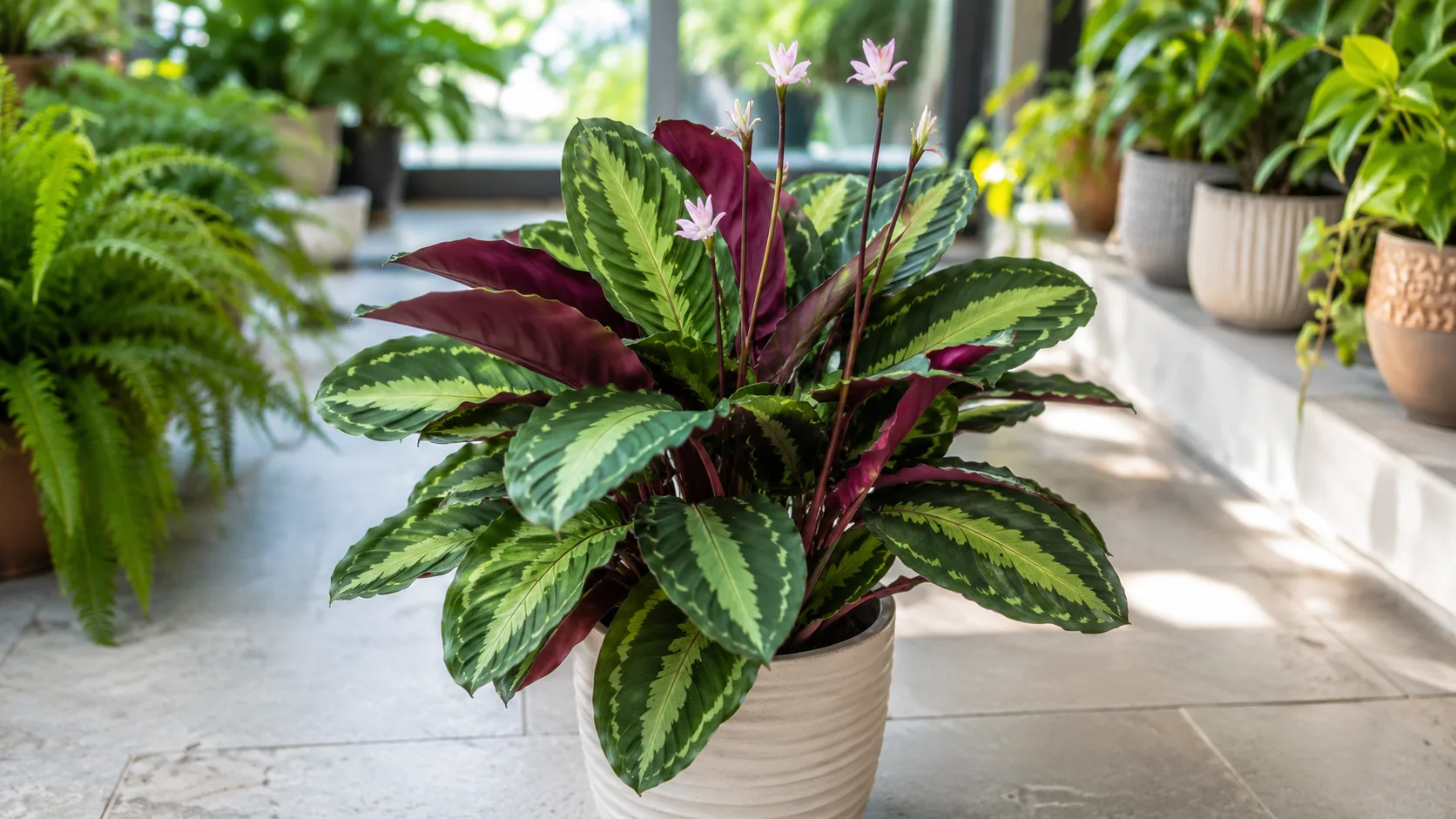
Medallion is the high-contrast round-leaf Calathea, so the plant lives or dies visually by the condition of its broad newest leaves. A single crisp rim or torn unfurl is more obvious here than on narrow-leaf prayer plants. Put it somewhere stable, humid, and reachable for leaf cleaning. If the newest leaf opens marked, review humidity, water quality, and whether the plant was allowed to dry while the spear was forming.
Placement note for Medallion
Medallion is best where you can inspect it easily, not tucked behind larger plants. Its wide leaves collect dust and show water stress, so a reachable shelf with filtered light is better than a deep decorative corner.
Buying check for Medallion
Look into the center of the rosette before buying. A good Medallion has a tight crown, new leaves that are not stuck or torn, and undersides that are not speckled with mite damage. Avoid plants with many cut leaf edges because they may already be cycling through humidity stress.
What makes Medallion different
Calathea Medallion is the round-leaf, high-contrast option in the prayer plant group. The broad leaves show a painted green pattern with burgundy undersides, so edge crisping is obvious fast. It is less about fast growth and more about keeping each new leaf opening clean, flat, and richly colored.
What matters most with Calathea Medallion
Calathea Medallion is part of the fussy foliage group where leaf movement, crisping, and humidity stress can look dramatic before the plant is truly lost. Judge the newest rolled leaves and root moisture before reacting to every old edge mark. In practice, the care checkpoint is simple: medium indirect light, low indirect light. Pair that with moisture-retentive but well-draining potting mix; pH 6.0–7.5, and avoid changing water, pot size, and placement all at once.
Best placement in a real home
Calathea Medallion belongs where medium indirect light, low indirect light is realistic for most of the day, not only where the pot looks good. Every 5–7 days growing season (top 2 cm beginning to dry). 7–10 days winter. Filtered water or rainwater only. If the pot stays wet longer than expected, move the plant into better light or reassess the mix before watering again. Humidity target: High humidity (60%+).. Temperature comfort zone: 18°C to 27°C (65–80°F).
Before you buy this plant
Choose Calathea Medallion with firm new growth, clean leaf undersides, and soil that does not smell sour or feel compacted. Be cautious if you see brown-tips, sticky residue, collapsed crowns, or a pot that is wet in poor light. Cosmetic old-leaf damage is less worrying than weak roots or active pests.
First month after bringing it home
Do not repot Calathea Medallion on day one unless the mix is failing or pests are obvious. Quarantine it, learn how fast the pot dries, and keep care boring while it adjusts. Watch especially for brown-tips and yellow-leaves. If problems appear, correct the condition first rather than stacking fertilizer, repotting, and pruning together.
Safety note for Calathea Medallion
Calathea Medallion is not a plant to keep within reach of pets or children. Treat it as an inaccessible display plant. Use gloves if sap or plant tissue is irritating, and pick a pet-safe alternative for floor pots or low shelves.
How to tell Calathea Medallion is settling in
If you plan to multiply it later, common methods include Division. If yellow-leaves shows up early, inspect light, watering, and roots before assuming the plant is permanently weak.
Is it pet safe?
Calathea Medallion is generally considered pet safe.
Watering Calathea Medallion
Every 5–7 days growing season (top 2 cm beginning to dry). 7–10 days winter. Filtered water or rainwater only.
Soil & potting for Calathea Medallion
Moisture-retentive but well-draining potting mix. pH 6.0–7.5.
Humidity & temperature for Calathea Medallion
Calathea Medallion prefers high humidity (60%+), though normal home humidity is usually fine. Keep temperatures around 18°C to 27°C (65–80°F).
| Detail | Information |
|---|---|
| Humidity | High humidity (60%+) - normal home humidity is fine. |
| Ideal temperature | 18°C to 27°C (65–80°F) |
Fertilizer & pruning for Calathea Medallion
Use feed lightly during active growth. Use monthly during spring and summer at quarter strength.. for Calathea Medallion.
| Detail | Information |
|---|---|
| Fertilizer type | Feed lightly during active growth. Use monthly during spring and summer at quarter strength.. |
Common problems on Calathea Medallion
Brown Tips
MediumLikely cause: Tap water fluoride/chlorine or low humidity below 50%.
Quick fix: Filtered or rainwater. Humidifier 60–80% RH.
Full fix guide →Yellow Leaves
MediumLikely cause: Overwatering in low light or natural leaf ageing.
Quick fix: Allow top 2 cm to dry. Improve light.
Full fix guide →Root Rot
MediumLikely cause: Common on this plant type; confirm with recent watering, light, and root checks.
Quick fix: Inspect the plant and correct the most likely care stressor before stacking treatments.
Full fix guide →Overwatering
MediumLikely cause: Common on this plant type; confirm with recent watering, light, and root checks.
Quick fix: Inspect the plant and correct the most likely care stressor before stacking treatments.
Full fix guide →Underwatering
MediumLikely cause: Common on this plant type; confirm with recent watering, light, and root checks.
Quick fix: Inspect the plant and correct the most likely care stressor before stacking treatments.
Full fix guide →Spider Mites
MediumLikely cause: Common on this plant type; confirm with recent watering, light, and root checks.
Quick fix: Inspect the plant and correct the most likely care stressor before stacking treatments.
Full fix guide →Mealybugs
MediumLikely cause: Common on this plant type; confirm with recent watering, light, and root checks.
Quick fix: Inspect the plant and correct the most likely care stressor before stacking treatments.
Full fix guide →Aphids
MediumLikely cause: Common on this plant type; confirm with recent watering, light, and root checks.
Quick fix: Inspect the plant and correct the most likely care stressor before stacking treatments.
Full fix guide →Leggy Growth
MediumLikely cause: Common on this plant type; confirm with recent watering, light, and root checks.
Quick fix: Inspect the plant and correct the most likely care stressor before stacking treatments.
Full fix guide →Slow Growth
MediumLikely cause: Common on this plant type; confirm with recent watering, light, and root checks.
Quick fix: Inspect the plant and correct the most likely care stressor before stacking treatments.
Full fix guide →Wilting
MediumLikely cause: Common on this plant type; confirm with recent watering, light, and root checks.
Quick fix: Inspect the plant and correct the most likely care stressor before stacking treatments.
Full fix guide →Drooping Leaves
MediumLikely cause: Common on this plant type; confirm with recent watering, light, and root checks.
Quick fix: Inspect the plant and correct the most likely care stressor before stacking treatments.
Full fix guide →Low Humidity
MediumLikely cause: Common on this plant type; confirm with recent watering, light, and root checks.
Quick fix: Inspect the plant and correct the most likely care stressor before stacking treatments.
Full fix guide →Not Enough Light
MediumLikely cause: Common on this plant type; confirm with recent watering, light, and root checks.
Quick fix: Inspect the plant and correct the most likely care stressor before stacking treatments.
Full fix guide →Fungus Gnats
MediumLikely cause: Common on this plant type; confirm with recent watering, light, and root checks.
Quick fix: Inspect the plant and correct the most likely care stressor before stacking treatments.
Full fix guide →Mold on Soil
MediumLikely cause: Common on this plant type; confirm with recent watering, light, and root checks.
Quick fix: Inspect the plant and correct the most likely care stressor before stacking treatments.
Full fix guide →