Overwatering on Calathea Medallion: Causes, Checks & Fixes
Quick answer
Overwatering Calathea Medallion shows as limp painted leaves on heavy wet soil, yellow lower leaves, and sometimes a stalled new spear. First step: stop watering until the top 1–2 inches of mix dry and the pot drains freely.
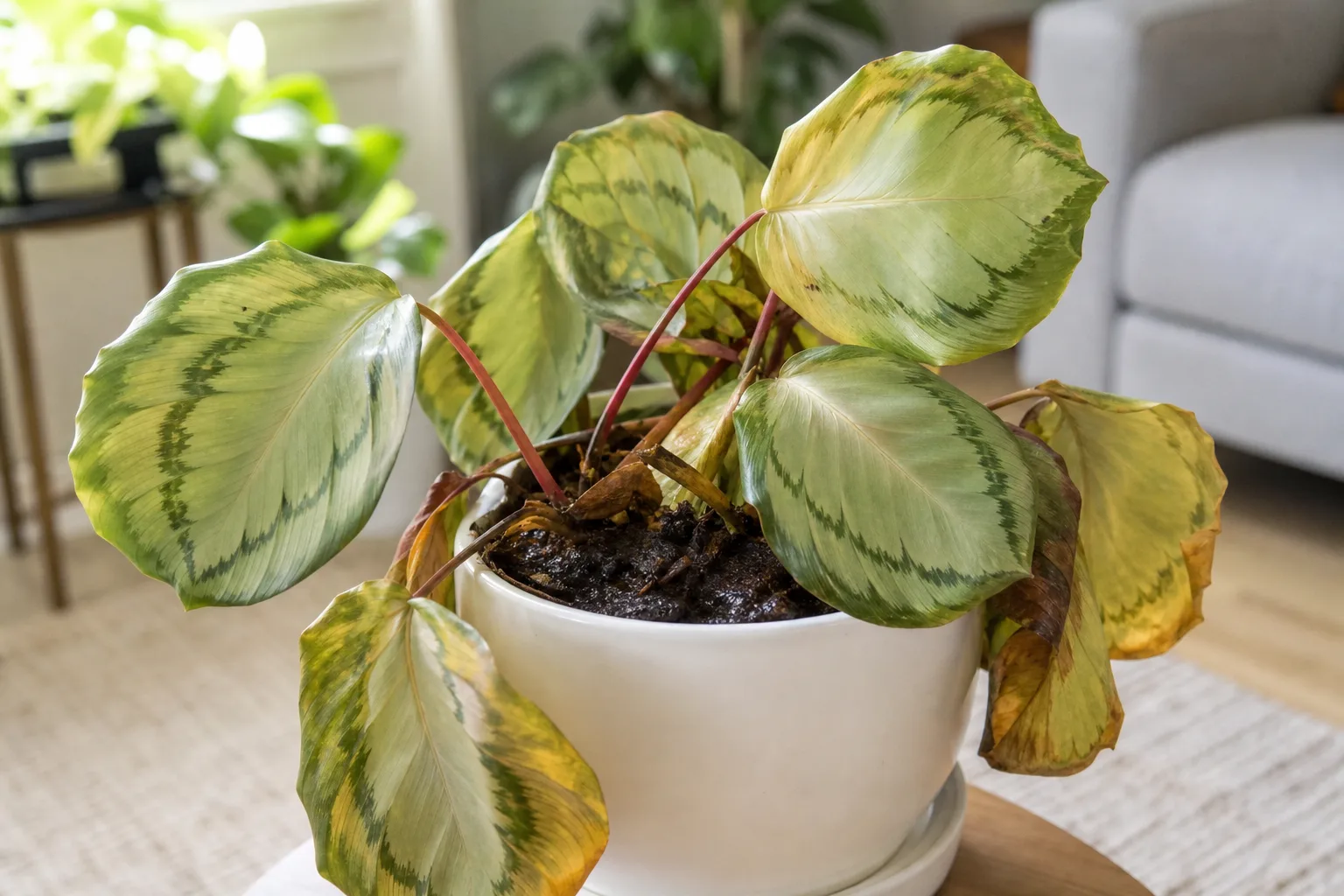
Overwatering on Calathea Medallion: Causes, Checks & Fixes
This guide covers overwatering on Calathea Medallion. See also the general Overwatering guide, watering, and light pages for this plant.
Overwatering on Calathea Medallion: Causes, Checks & Fixes
Quick answer
Overwatering Calathea Medallion (Goeppertia veitchiana) means the root zone stays wet too long for a plant built for moist, well-drained potting mix in Ecuadorian rainforest understory-not permanently saturated soil. The painted round leaves may still look fine for days while roots lose oxygen below.
The one rule that saves most misdiagnoses: limp or curling leaves on heavy wet soil almost always mean root stress, not thirst. Do not water again. First step: stop watering until the top 1–2 inches of mix feel dry to the touch and excess runoff has drained completely from the pot.
What overwatering looks like on Calathea Medallion
Medallion hides early root stress behind large painted blades. Unlike many prayer plants, Goeppertia veitchiana does not fold its leaves at night, so daytime posture on wet soil is your primary diagnostic signal-not evening movement.
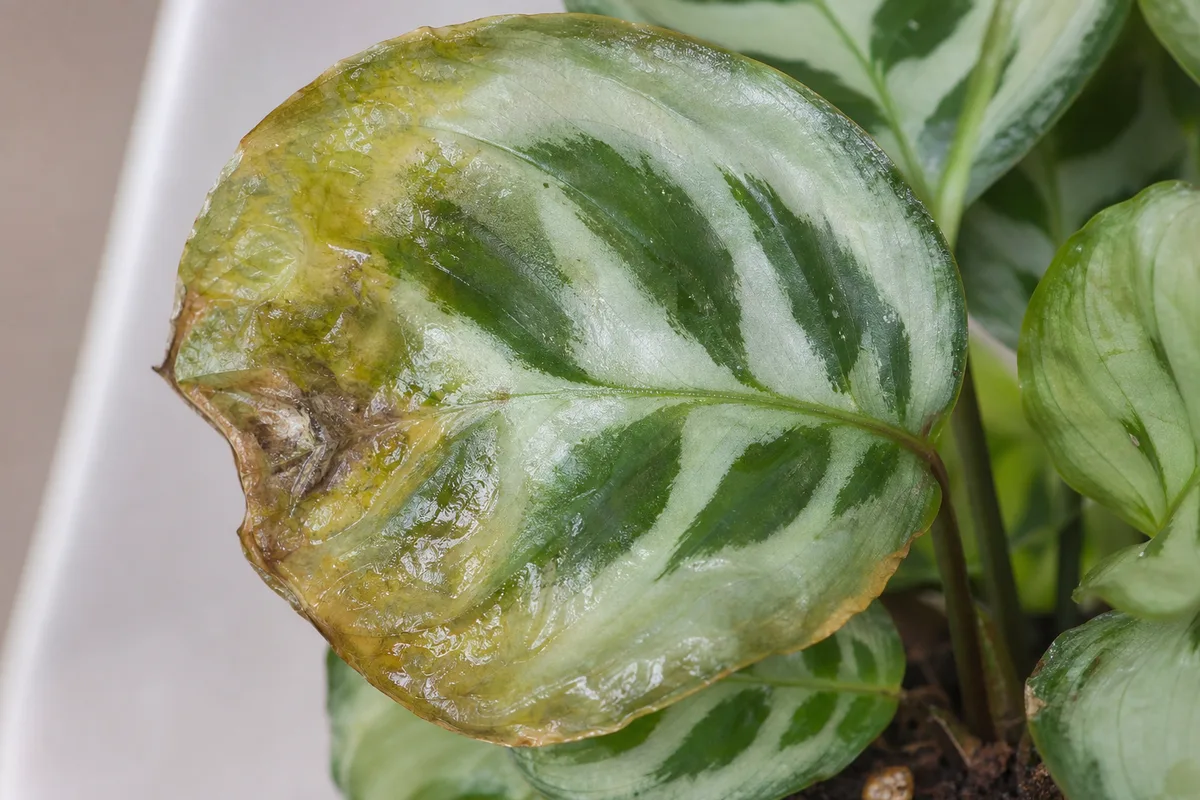
Overwatering symptoms on Calathea Medallion - compare with healthy tissue on the same plant.
Early overwatering:
- Limp or drooping round leaves while the pot feels heavy and cool
- Yellowing lower leaves, often soft rather than crispy
- Mix stays dark and damp at the surface for many days after watering
- New center spear stalls or browns before unfurling
- Fungus gnats hover near constantly damp surface soil
Established overwatering:
- Daytime leaf curl that persists despite wet mix (different from drought curl on a light dry pot)
- Sour or musty smell when you lift the pot or press the surface
- Soft petioles at the base where stems meet wet soil
- Oedema-small water-soaked blisters on leaf margins-in cool humid rooms with chronically wet mix
- Upper painted leaves still look acceptable while the rosette collapses from the bottom up
What overwatering does not look like:
- Crisp brown edges on a light, dry pot with soil pulling from the walls - that pattern points to underwatering or low humidity
- Uniform margin burn on new leaves with normal soil moisture - often tap-water brown tips, not rot
- One or two fading lowest leaves on an otherwise firm rosette with appropriate dry-down - natural aging
Yellow or limp tissue on old leaves may not fully recover even after roots heal. Judge improvement by a firm center spear and clean new round leaves, not by old damage reversing.
Why Calathea Medallion gets overwatered
Medallion sits in a narrow moisture window: moist, well-drained mix with oxygen still moving through the root zone-not bone dry and not soggy. Several indoor habits push it past that band:
Calendar watering. A fixed weekly pour ignores how fast your pot dries. Cool winter rooms, dim corners, and fresh Calathea Medallion repotting guide all slow evaporation while the same schedule keeps mix wet for weeks.
Fear of crisp edges. Growers see brown margins and add water, but edge burn often traces to low humidity or tap-water minerals-not drought. Extra water on already-wet mix is the faster path to root rot.
Oversized pots and heavy mix. A large container holds excess wet soil around a small root ball. Dense peat without perlite stays saturated in the center even when the surface looks acceptable.
Cachepots and full saucers. Decorative outer pots trap runoff. Medallion roots standing in stale water lose oxygen quickly-even in a humidity-loving plant.
Low light plus slow transpiration. A Medallion on a dim shelf uses less water per week. The painted upper leaves mask stress while the bottom of the root ball stays anaerobic.
Cool rooms slow dry-down. Evaporation drops below 65°F, so mix that dried in five days in summer may stay wet for two weeks in a cold winter room-while you keep the same watering habit.
Bottom-watering overuse. Repeated bottom soaks without occasional top flushing can keep the surface looking dry while the core stays saturated-especially in deep pots.
Lookalike symptoms to rule out
| Pattern | Pot weight | Soil at 1–2 inches | Center spear | What it usually means |
|---|---|---|---|---|
| Overwatering | Heavy | Wet, cool, clings to finger | Soft, brown, or stalled | Saturated mix, failing roots |
| Underwatering | Light | Dry and crumbly | Firm; curl by day on dry soil | Turgor loss from drought |
| Root rot (advanced) | Heavy | Wet, sour smell | Soft or blackening | Escalation from chronic wetness |
| Low humidity | Normal on schedule | Moist when checked | Firm | Crisp edges, not base yellowing |
| Tap-water burn | Normal | Moist on schedule | Firm | Margin tips on newest leaves |
| Natural aging | Normal | Dry on schedule | Firm | One or two old lower leaves fade |
If leaves are limp on wet soil, do not reach for the watering can. If margins are crisp on a light dry pot, see underwatering instead. For yellow lower leaves with overlapping wet-soil advice, see yellow leaves on Calathea Medallion.
How to confirm overwatering before you act
Always verify soil moisture and pot weight before changing care. Prayer plant relatives wilt from both too much and too little water.
Work through these checks in order:
- Pot weight - Lift the container days after your last watering. A still-heavy, cool pot with limp leaves supports overwatering over drought.
- Finger test at 1–2 inches - Push your finger near the pot edge. Wet clinging soil at depth with yellow lower leaves means do not water again yet.
- Skewer or chopstick test - Insert a dry stick to the lower third, wait thirty seconds, pull out. Dark clinging particles mean the core is still wet even if the surface crust looks lighter.
- Smell check - Sour or rotten odor from the mix strongly supports root stress on saturated soil.
- Center spear check - Press the base of the newest rolled leaf. Firm and green is hopeful; soft, brown, or stalled means crown involvement-escalate toward root rot treatment.
- Rule out dry-soil curl - If the pot is light, top 2 cm is dry and crumbly, and leaves curl inward by day, that is thirst-not overwatering.
When heavy wet soil, sour smell, or yellow lower leaves align with limp daytime foliage, overwatering is confirmed. First fix: stop watering until the top 1–2 inches dry and drainage is clear.
First fix for overwatered Calathea Medallion
Stop watering immediately. Do not add more water because round leaves look limp on already-wet soil-wilting with moist soil often means damaged roots, not thirst.
Then:
- Empty all standing water from saucers, trays, and decorative cachepots. Lift the inner nursery pot out if you use a cover pot for display.
- Move to Calathea Medallion light guide with good air movement - not direct sun. Partial shade or filtered light helps the mix dry at a controlled pace. Harsh sun on stressed Medallion foliage scorches broad painted blades and adds a second stress layer.
- Wait for legitimate dry-down - Let the top 1–2 inches approach dryness before the next full drink. This often takes 5–10 days in a cool room; do not rush with heat lamps or repotting on day one.
- Inspect roots only if decline continues - If soil stays wet more than a week without improvement, yellowing spreads, or the center spear softens, gently unpot and rinse roots. Firm pale tan roots mean dry-down may still work; mushy brown roots need trimming and repotting per our root rot guide.
Do not fertilize a waterlogged plant. Do not mist heavily as a substitute for fixing soil moisture. Do not repot into a larger pot to “help drying”-that adds more wet soil volume around the root ball.
Step-by-step recovery
Choose the path that matches severity after you stop watering.
Mild overwatering - dry-down only
Use when the center spear is firm, smell is neutral or only slightly off, and roots are still mostly pale if you peek at the drainage hole:
- Hold all water until the top 1–2 inches feel dry.
- Keep bright indirect light and airflow so evaporation proceeds steadily.
- When dry-down completes, water once thoroughly with filtered, rain, or distilled water until runoff, then drain fully within thirty minutes.
- Resume check-based watering per our Calathea Medallion watering guide-never return to calendar autopilot.
Moderate overwatering - unpot, trim, repot
Use when sour smell persists, multiple lower leaves yellow on damp soil, or roots look brown and soft when you slide the plant out:
- Gently knock the plant from its pot and rinse roots under lukewarm water.
- Trim mushy brown roots with clean scissors. Leave firm pale tissue intact.
- Repot into fresh airy, well-draining mix in the same size or slightly smaller pot-never upsize while roots are compromised.
- Water lightly once to settle mix, then let dry-down begin again before the next full drink.
- Keep humidity near 60% to support stressed foliage without keeping soil soggy.
Hold off on fertilizer until new growth looks stable for several weeks.
Recovery timeline
Mild overwatering with healthy roots often shows firmer petioles within several days once soil oxygen returns-though old yellow leaves may not green up again.
Moderate root damage typically needs one to three weeks of correct dry-down or repot recovery before new spears push cleanly. Medallion’s slow growth rate means rebuilding takes longer than on faster tropicals.
Severe crown involvement-soft center tissue on wet mix-may be past salvage. Honest threshold: if the new spear rots and most roots are mushy after trimming, recovery is unlikely even with perfect aftercare.
Signs you are improving: pot weight cycles predictably between heavy after watering and lighter before the next drink; center spear stays firm; new round leaves unfurl without browning at the rim; wilting stops appearing on wet soil.
Signs the problem is worsening: continued collapse after a full dry-down cycle; new spears dying before opening; stems softening at the base; fungus gnats increasing on never-drying surface soil.
Mistakes to avoid
Do not water because painted upper leaves still look pretty while lower leaves yellow on wet mix-the rosette fails from the bottom up.
Do not give tiny daily sips to “ease stress.” That keeps the center anaerobic without flushing salts or drying the root zone properly.
Do not compensate for low humidity by watering more-fix humidity separately per our low-humidity guide.
Do not move a recovering Medallion into direct sun to speed drying. Bright indirect light with airflow is enough; sun scorches broad leaves quickly.
Do not repot into a larger container on day one unless roots are clearly rotting and need trim-and-repot rescue.
Do not resume calendar watering after recovery without re-establishing finger, skewer, and pot-weight checks from the watering guide.
How to prevent overwatering next time
Prevention on Medallion is mostly about checking before every pour, not copying someone else’s weekly schedule.
Watering rhythm: Water when the top 1–2 inches begin to dry, then soak until runoff and drain completely. In active growth that often means every 5–7 days indoors; in cooler winter months, 7–14 days or longer-but always confirm with weight and touch.
Drainage discipline: Use pots with open drainage holes. Never let the plant sit in a full saucer or cachepot. Lift the inner pot to water at the sink when using decorative covers.
Mix and pot size: Choose light, well-drained peaty mix with perlite. Match pot size to the root ball-not an oversized cache for future growth.
Water quality: Rainwater or distilled water reduces edge burn that can be mistaken for drought stress and trigger extra watering.
Seasonal adjustment: Shorten check intervals in bright warm months; allow longer dry-down in cool dim winter when growth slows.
Humidity without overwatering: Target 60% or higher near the canopy during heating season. Humid air supports leaf quality but does not replace drainage discipline.
When to worry
Treat overwatering as urgent when the center spear turns soft or brown, multiple lower leaves yellow while soil stays wet for more than a week, or stems feel mushy at the base. Those patterns suggest advancing root rot-unpot, trim, and repot within days rather than waiting for another dry-down cycle.
Escalate immediately if the crown smells rotten or blackens. Salvage is unlikely once crown tissue collapses on soggy mix.
If symptoms are mild-firm spear, mostly pale roots, no sour smell-a controlled dry-down in bright indirect light is usually the right first rescue. When in doubt after two weeks without improvement, inspect roots rather than guessing.
Calathea Medallion care cross-check
Overwatering rarely exists in isolation. After you stabilize moisture, review the full care picture on our Calathea Medallion overview:
- Watering - moisture window, seasonal rhythm, and triple soil checks
- Underwatering - dry-soil curl vs. wet-soil wilt
- Root rot - unpotting, trimming, and repot rescue when rot advances
- Wilting - posture changes on wet vs. dry mix
- Yellow leaves - lower-leaf yellowing with overlapping wet-soil causes
- Fungus gnats - pests that follow chronically damp surface soil
- Soil - drainage mix requirements for this moisture-sensitive species
Conclusion
Overwatering on Calathea Medallion is a root-zone oxygen problem disguised by painted round leaves that lag behind root decline. Confirm with a heavy wet pot, damp mix at 1–2 inches, and limp daytime foliage on saturated soil-then stop watering, drain completely, and let legitimate dry-down proceed before the next full drink. Firm new spears and predictable pot-weight cycles tell you the moisture window is working again; soft crown tissue on soggy mix means escalate to root rot rescue without delay.
When to use this page vs other Calathea Medallion guides
- Calathea Medallion watering guide - Use for routine moisture checks before assuming overwatering is the main issue.
- Calathea Medallion problems hub - Browse all 16 common issues on this species.
- Root Rot on Calathea Medallion - Different entry point when symptoms overlap with overwatering.
- Yellow Leaves on Calathea Medallion - Different entry point when symptoms overlap with overwatering.
- Wilting on Calathea Medallion - Different entry point when symptoms overlap with overwatering.
Related Calathea Medallion guides
- Calathea Medallion overview
- Calathea Medallion watering
- Calathea Medallion light
- Calathea Medallion soil
- Root Rot on Calathea Medallion
- Yellow Leaves on Calathea Medallion
- Wilting on Calathea Medallion
- Fungus Gnats on Calathea Medallion
- Mold on Soil on Calathea Medallion
- Drooping Leaves on Calathea Medallion
- Calathea Medallion problems