Brown Tips on Calathea Medallion: Unfurl Damage, Dry Air
Quick answer
Brown tips on Calathea Medallion usually come from one of four things: dry air while a new leaf is unfurling, mineral-heavy tap water, chronic dry-down mistakes, or wet roots that can no longer hydrate the margins. First step: inspect the newest spear before trimming anything and note whether you use tap, filtered, or rainwater.
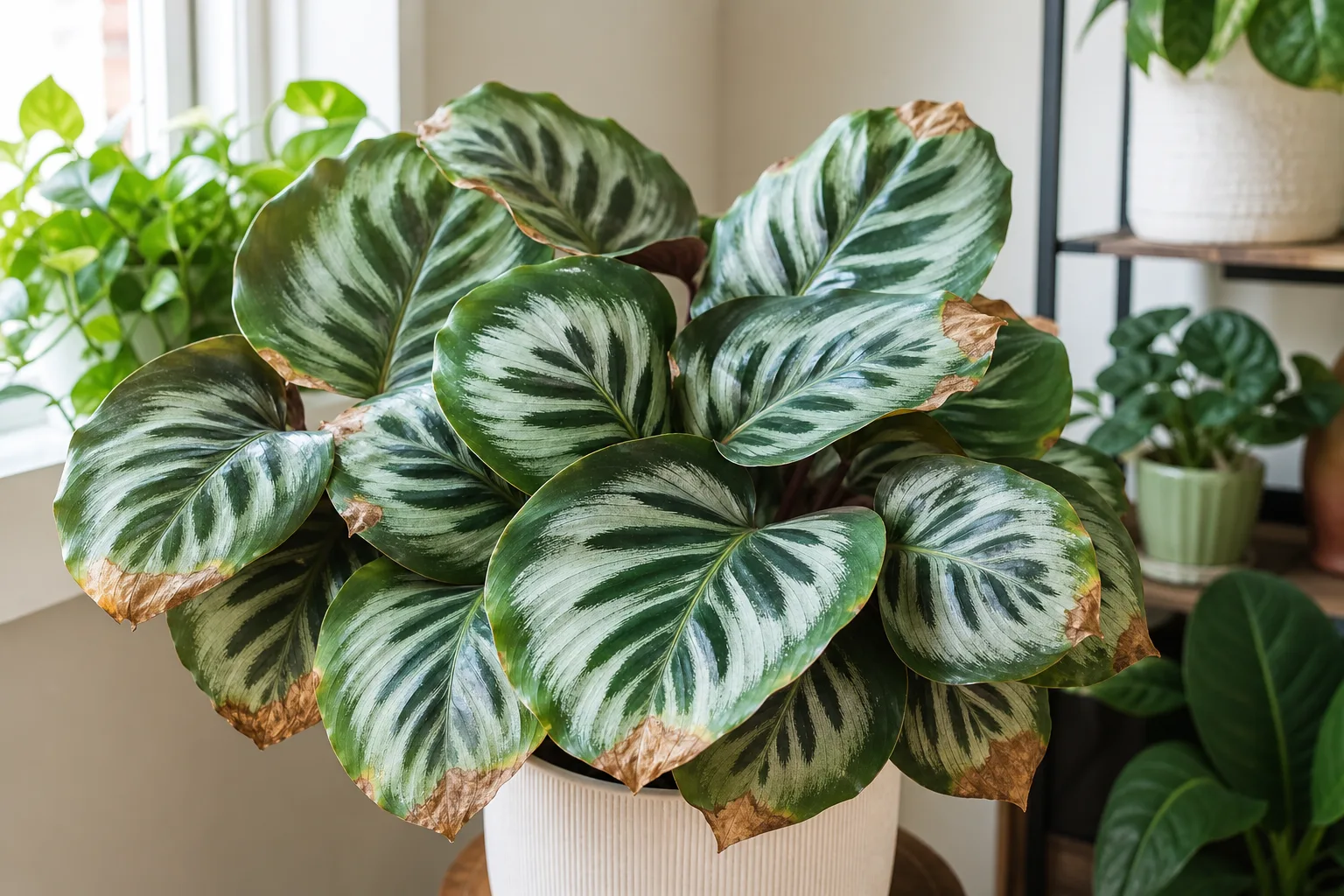
Brown Tips on Calathea Medallion: Unfurl Damage, Dry Air, or Water Quality?
This guide covers brown tips on Calathea Medallion. See also the general Brown Tips guide, watering, and light pages for this plant.
Brown Tips on Calathea Medallion: Unfurl Damage, Dry Air, or Water Quality?
Quick answer
Medallion is one of the easiest calatheas to read because the newest spear tells the story first. On this cultivar, brown tips usually start when a leaf is forming in air that is too dry, with water that is too mineral-heavy, or on roots that are either too dry or too air-starved to feed the margins well. NC State specifically notes that Goeppertia veitchiana prefers high humidity and that fluoride in tap water can brown the foliage (NC State Extension).
First step: inspect the newest spear before trimming old damage. If the central unfurl is sticking, tearing, or already browning at the edge, focus on humidity and water quality first. If the newest leaves are clean but old outer leaves are crisping, the problem is more likely placement, salts, or watering rhythm.
Why Medallion tips brown differently from generic calatheas
Medallion is not just “a calathea with round leaves.” Its broad blades and wide, painted margins make small environmental failures obvious fast.
Three cultivar-specific traits matter:
- large leaf surface means faster edge moisture loss in dry air
- rolled spear unfurls make leaf edges easy to damage before the leaf even opens
- dramatic patterning makes both brown tips and faded stressed tissue visually obvious earlier than on tougher, smaller-leaf plants
That is why Medallion owners often notice the problem at the newest leaf, not only on aging outer foliage.
What the pattern looks like
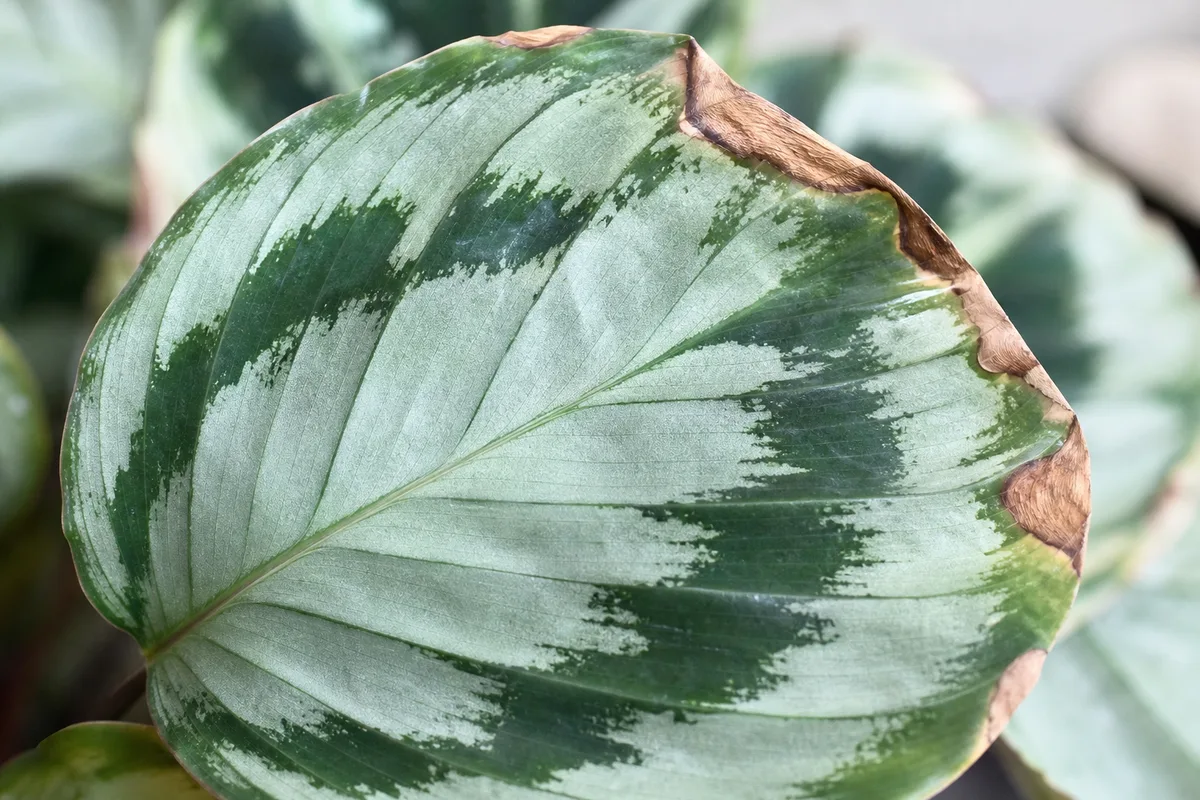
On Medallion, the location of the damage matters more than the color alone.
Use the pattern before you change care:
| Pattern | More likely cause | What to check first |
|---|---|---|
| Newest spear sticking, tearing, or crisping as it opens | Dry air during unfurl | Humidity at leaf height |
| New leaves opening with thin brown edging again and again | Tap-water minerals or fluoride | Water source |
| Outer leaves crisping near a vent or window side | Dry draft or heat blast | Placement |
| Brown tips plus yellow lower leaves and wet mix | Root stress from overwatering | Pot weight and crown firmness |
| Brown edges plus white crust on soil or rim | Fertilizer or salt buildup | Feeding history |
| Fine stippling or webbing with edge damage | Spider mites | Leaf undersides |
The main causes on Medallion
1. Dry air during unfurl
This is the classic Medallion failure mode. A broad round leaf begins opening, the room is too dry, and the outer edge desiccates before the leaf can flatten cleanly. The RHS notes that calathea leaf browning is commonly linked to low humidity (RHS).
On Medallion, this often looks like:
- one side of the spear sticking
- thin brown seams at the rim of the fresh leaf
- a torn opening edge that never smooths out later
2. Tap-water minerals and fluoride
NC State specifically recommends rainwater or distilled water for Goeppertia veitchiana because tap-water fluoride can damage foliage (NC State Extension). If your humidity is acceptable but every new leaf still opens with tip burn, the water source becomes the leading suspect.
3. Dry-down mistakes
Medallion does not want bone-dry soil, but it also does not want a saturated pot. If the mix dries too far while a new spear is forming, margins crisp. If roots stay wet too long, they stop hydrating the edges properly and the result can still look like dryness.
4. Salt buildup and overfeeding
Monthly feeding is enough for this plant in active growth, and excess salts can scorch margins, especially on a plant already stressed by dry air or tap water (NC State Extension).
How to confirm the real cause
Run these checks in order:
- Look at the newest spear. This is the most important Medallion-specific clue.
- Read humidity at leaf height. Not across the room, not at floor level.
- Check the water source. Straight tap, filtered, distilled, or rainwater.
- Lift the pot. If it is heavy and wet, do not keep diagnosing this as simple dry air.
- Inspect for salts or pests. White crust and stippling change the diagnosis.
If you only do one comparison, do this one:
- newest leaf damaged = think humidity or water quality first
- oldest leaves damaged first = think placement, dry air, or normal accumulation
- whole plant declining with brown tips = think roots
First fix
Do not trim the damage yet. Switch the next watering to rain, distilled, or filtered water and leave the rest of the routine unchanged long enough to read the next spear.
That one change is useful because it tests a high-probability cause on this cultivar without stacking a dozen variables at once. If you also know the plant sits in very dry air or in front of a vent, correct that placement immediately, but keep the main experiment simple enough to read.
Recovery by cause
If dry air is the driver
- move the plant away from direct vent or heater airflow
- use a humidifier near the plant, not a single daily mist
- watch the next spear, not the old leaves
If water quality is the driver
- switch to rain, distilled, or filtered water
- avoid softened water
- flush old salts only if the pot drains well and roots are healthy
If the pot is drying too far
- do not wait for the whole mix to become dust-dry
- water when the top layer has started drying but the root zone is not collapsing
- pay extra attention while a new spear is forming
If the roots are too wet
- stop watering
- let the mix breathe
- inspect the crown and roots if decline continues
- follow overwatering or root rot if the crown is soft
What not to do
- Do not trim first and diagnose later.
- Do not chase brown tips by watering more when the pot is already wet.
- Do not assume misting once a day replaces real ambient humidity.
- Do not keep feeding a plant that is already burning at the edges.
- Do not judge success by old leaves getting pretty again.
Recovery timeline
Old brown edges stay brown. The useful recovery timeline on Medallion is the next one to two unfurls.
Good signs:
- new spear opens without tearing
- margins are cleaner on the next leaf
- no fresh crisping after the water-source change
- the pot is drying on a normal rhythm
If two consecutive new leaves still open with brown tips after you corrected water and placement, recheck humidity, salts, and roots rather than repeating the same guess.
When to use this page vs other Calathea Medallion guides
- Calathea Medallion watering guide - for routine moisture management
- Low Humidity on Calathea Medallion - for room-air problems as the main diagnosis
- Overwatering on Calathea Medallion - for heavy wet pots and root stress
- Spider Mites on Calathea Medallion - for stippling and webbing
- Calathea Medallion overview - for full cultivar care