Spider Mites on Calathea Medallion: Causes, Checks & Fixes
Quick answer
Spider mites on Calathea Medallion cause pinhead stippling across painted round blades and fine webbing on purple undersides when winter heating drops humidity below 50%. First step: isolate the plant and rinse every leaf underside-including the central unfurling spear-before applying any spray.
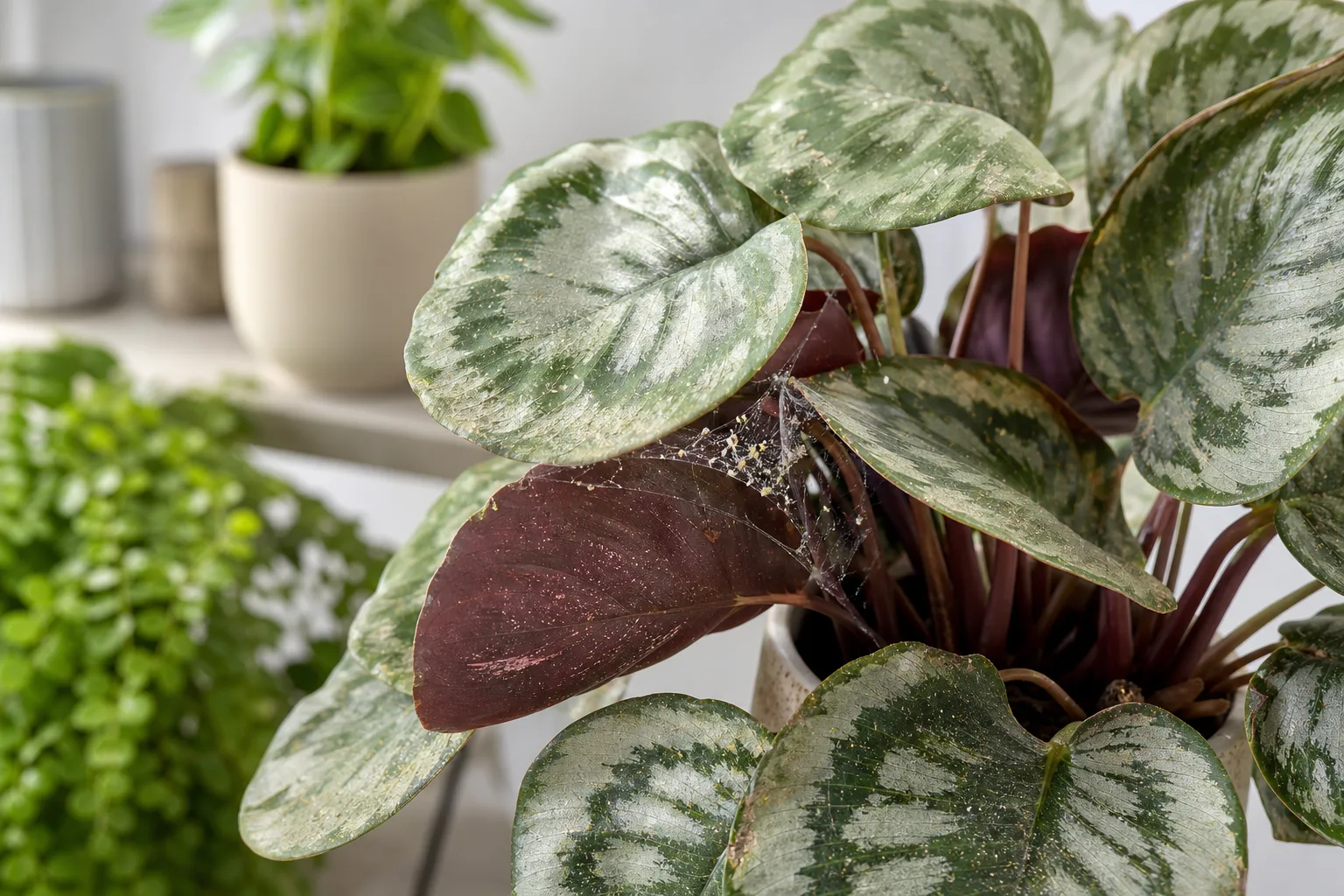
Spider Mites on Calathea Medallion: Causes, Checks & Fixes
This guide covers spider mites on Calathea Medallion. See also the general Spider Mites guide, watering, and light pages for this plant.
Spider Mites on Calathea Medallion: Causes, Checks & Fixes
Quick answer
Spider mites on Calathea Medallion (Goeppertia veitchiana ‘Medallion’) show as pinhead yellow or tan stippling across the silver-green painted pattern on broad round blades, with fine webbing on purple undersides and at petiole bases. They thrive in hot, dry indoor air-especially when winter heating pulls humidity far below what this Ecuadorian rainforest floor plant tolerates.
First step: isolate the plant and rinse every leaf underside with lukewarm water. Move the pot away from other prayer plants, shower or hose from below so water hits purple reverses and the central unfurling spear, then let broad foliage drain in bright indirect light before choosing sprays. If margins are uniformly crisp with no dots underneath, check low humidity before you treat for mites. See our Calathea Medallion overview for baseline humidity, filtered water, and room-placement guidance.
What spider mites look like on Calathea Medallion
Early damage is easy to miss because mites feed on leaf undersides while the painted upper surface still looks acceptable from across the room. Medallion’s wide round blades make stippling visible on the silver-green pattern before heavy webbing appears-an advantage over narrower-leaf calatheas like Rattlesnake, where dots hide longer in dark green stripes.
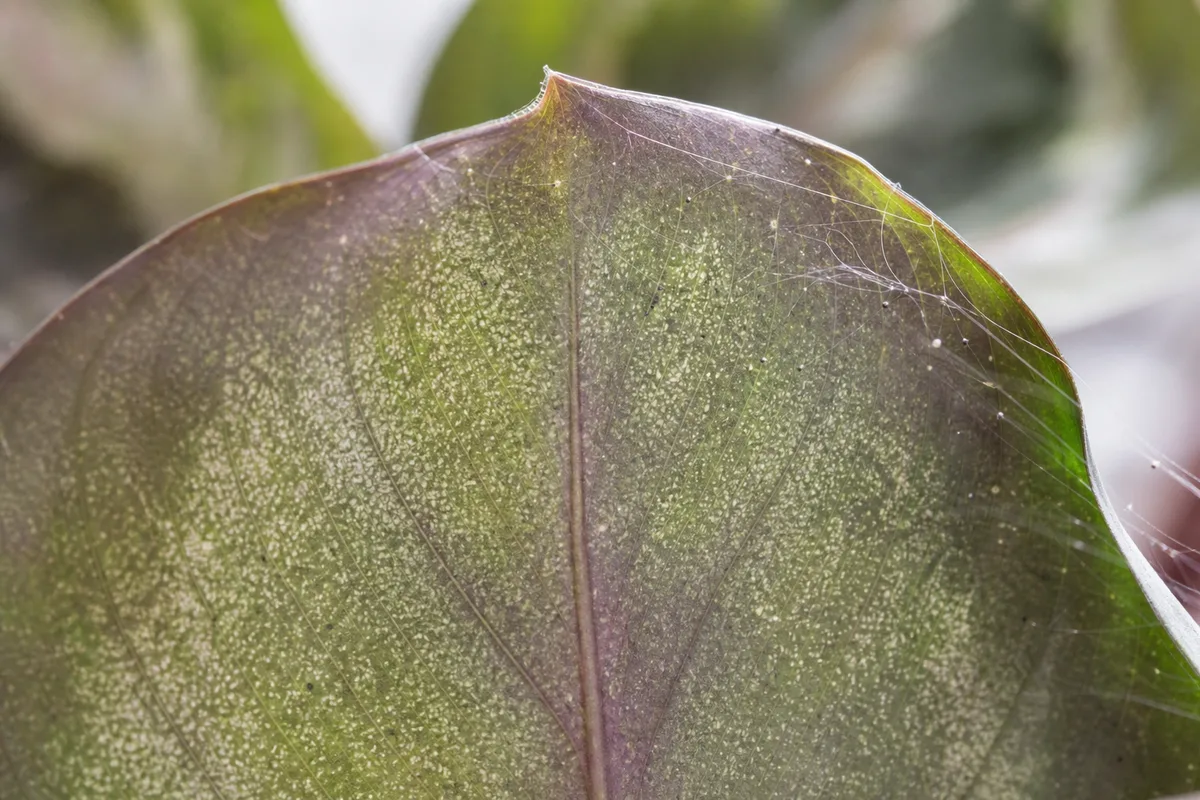
Spider Mites symptoms on Calathea Medallion - compare with healthy tissue on the same plant.
Stippling on painted foliage:
- Pinhead yellow, tan, or bronze dots scattered across the silver-green center and cream sectors
- Dull patches where the high-contrast pattern loses its crisp painted look
- Damage often worse on outer round leaves facing a heater, sunny winter window, or forced-air vent
- Gritty texture on purple undersides when you run a finger along the reverse
Underside and crown signs:
- Tiny moving specks-barely visible without a hand lens
- Fine silk threads at the junction where the round blade meets the petiole
- Webbing tucked under overlapping leaves at the central crown, especially around a rolled unfurling spear
- Amber eggs and whitish cast skins on purple reverses in moderate infestations
Plant-level clues:
- Newest unfurling spear shows dots or stuck edges while older painted blades still look partly clean
- Several round leaves yellowing and crisping within weeks despite normal watering rhythm
- Symptoms worsening in January and February when heating runs continuously and humidity crashes
Unlike many prayer plants, Medallion does not fold its leaves at night-so daytime curl plus stippling is environmental or pest stress, not normal nyctinasty. If blades stay open around the clock but show dots underneath, suspect mites rather than prayer-plant movement.
Photo check: Use a phone macro shot on the purple reverse of a round leaf-compare scattered pinhead dots and fine silk at the petiole base against uniform crisp margins from dry air on the upper painted surface. Original symptom photos for this cultivar are pending for a future update.
Why Calathea Medallion gets spider mites
Spider mites are arachnids, not insects. The common indoor species, twospotted spider mite (Tetranychus urticae), pierces individual leaf cells and sucks contents, creating the stippled pattern. Warm, dry conditions shorten their life cycle-mite outbreaks on houseplants frequently spike when furnaces switch on and indoor air dries.
Medallion’s normal indoor setup often creates exactly that environment:
Winter heating and dry vents. NC State Extension recommends humidity above 60% for Goeppertia veitchiana, while NDSU Extension recommends 30–40% relative humidity for winter home comfort-a gap that leaves heated rooms far too dry for Medallion foliage. A pot on a window ledge above a radiator or beside a floor register loses leaf moisture fast while mites reproduce in the warm microclimate at leaf height.
Broad leaf architecture. Each round medallion blade has wide thin margins that transpire faster than narrower calathea leaves. Overlapping painted blades at the crown create shaded purple undersides where mites colonize before webbing shows on the upper pattern. Spray coverage is easy to miss on a dense clump with a central spear unfurling.
Unfurl-stage vulnerability. New leaves emerge as a rolled spear from the crown over several days. Mites feeding during unfurl cause permanent stippling, stuck edges, or torn margins on that round blade even after you clear the colony-see our low-humidity guide for the same unfurl risk from dry air alone.
Crowded Marantaceae collections. Medallion sits beside Maranta, Stromanthe, and other calatheas on shared humidity trays. Mites move on fine webbing and spread on tools or clothing-one infested Medallion can seed an entire prayer-plant grouping before you notice dots on the silver pattern.
Stress does not cause spider mites, yet a Medallion already struggling with low humidity, fluoride-heavy tap water, or recent overwatering has fewer resources to outgrow feeding damage. Treat the mites first, then address separate care stress once the population is under control.
Lookalike symptoms to rule out
| What you see | Likely cause | Key difference on Medallion |
|---|---|---|
| Pinhead yellow dots with fine silk on purple undersides | Spider mites | Moving specks on paper-tap test; webbing at petiole bases |
| Uniform crisp brown margins, no dot pattern | Low humidity | Edge burn on outer leaves and unfurl spear; no moving specks |
| Brown tips on newest painted leaves, normal humidity | Tap-water brown tips | Year-round margin burn from fluoride; no webbing or grit |
| Silvery streaks on young leaves, no webbing | Thrips | Thrips jump when disturbed; mites crawl slowly |
| White cottony wax in crown axils | Mealybugs | Waxy tufts smear pink when crushed; sticky honeydew |
| Yellow lower leaves with wet heavy soil | Overwatering | Base-up yellowing, sour mix-no stippling or webbing |
If only leaf edges are crisp with no stippling, grit, or webbing, check low humidity and brown tips before you treat for mites.
How to confirm the cause
Work through these checks in order before you spray anything:
- Isolate first - Move Medallion away from other Marantaceae before handling. UMN Extension recommends isolating infested plants so mites do not spread on contact, webbing, or tools.
- Paper tap test - Hold a stippled round leaf over white paper and tap the purple underside sharply. Moving specks confirm live mites; static dots may be dust or pollen.
- Webbing search - Lift overlapping outer blades and inspect petiole bases and the central crown with a hand lens. Fine silk at one joint usually means more colonies under neighboring round leaves.
- Unfurl spear check - Inspect the newest rolled leaf at the center. Stippling or webbing on a spear that is still opening confirms active feeding at Medallion’s most vulnerable growth point.
- Pattern vs. humidity - Crisp uniform margins on multiple outer blades without dots underneath fit dry air. Scattered pinhead dots across the painted pattern with gritty purple reverses fit mites-even when the room also runs dry.
- Location audit - Note heat vents, radiators, sunny glass, and forced-air paths within arm’s reach. Mites plus hot dry placement fit together on humidity-sensitive Medallion pots.
- Neighbor scan - Inspect Maranta, Stromanthe, and other calatheas on the same shelf or humidity tray. Shared stippling suggests contagious mites rather than a one-off cultural issue.
If you find moving specks or webbing, the diagnosis is confirmed. If margins are uniformly brown with firm petioles, normal soil moisture, and no speckling, route to low humidity or brown tips instead.
First fix for Calathea Medallion
Isolate the plant and rinse all foliage-especially purple undersides-with a steady stream of lukewarm water.
Move Medallion away from other plants immediately. Shower the pot in a sink or bath, spraying each round leaf from below so water hits painted reverses, petiole bases, and the central unfurling spear. Support broad blades from underneath to avoid tearing thin margins. Let foliage drip dry in bright indirect light the same day-do not leave the plant in direct sun while leaves are wet, because Medallion blades scorch easily.
This single rinse knocks down adults, disrupts egg-laying webs, and gives you a clean baseline to see whether mites return. Do not jump to oils or miticides before this step-you need to confirm the population dropped and avoid stacking treatments on saturated foliage.
Repeat rinse and spray schedule
Most miticides and contact sprays do not kill eggs. UF/IFAS recommends two or more applications at five-day intervals in summer or seven-day intervals in cooler conditions because new hatchlings emerge continuously.
A practical Medallion schedule:
- Day 1 - Isolate and thorough underside rinse.
- Day 3–5 (warm rooms) or Day 7 (cooler rooms) - Rinse again, then apply insecticidal soap or horticultural oil labeled for spider mites. Coat both sides of every round leaf and petiole base per label rates-typically 1–2% oil or ready-to-use soap.
- Repeat the rinse-and-spray cycle on the same interval for at least two to three weeks.
- Stop when you record two consecutive clean paper-tap tests on separate weeks.
UMN Extension lists insecticidal soap and plant oil extracts as effective against spider mites on indoor plants, with repeat applications necessary because sprays must contact live mites directly.
Indoor spray safety: When applying soap or oil indoors, UMN Extension recommends spraying in a well-ventilated area-open a window or run an exhaust fan, follow the product label exactly, and keep the plant out of direct sun until leaves dry. Never use homemade soap mixes; commercial products labeled for plants reduce phytotoxicity risk on Medallion’s thin painted blades.
Light vs. moderate vs. heavy infestation
Light - Stippling on a few outer round leaves, no webbing on the central spear: isolation plus rinse schedule alone may clear the colony if you start before heating season peaks.
Moderate - Webbing at multiple petiole bases, dots on purple undersides across several blades: add labeled soap or oil on the repeat schedule above; raise humidity toward 60% with a humidifier to slow new reproduction.
Heavy - Webbing spanning the crown, stippling on the unfurling spear, mites on neighboring pots: prune the worst webbed leaves at the crown base per our pruning guide, bag and discard trimmings, continue the full rinse-and-spray cycle for three weeks minimum, and inspect the entire Marantaceae grouping weekly. If more than half the foliage is webbed and new spears stall, discarding may be more practical than months of treatment on a severely weakened clump.
Recovery timeline
Stippling stops spreading within one to two weeks once you isolate, rinse on schedule, and keep humidity stable. Damaged chlorophyll on mature round leaves does not green up again-the painted tissue stays marked.
Judge recovery on Medallion by new growth, not old blades:
- 1–2 weeks - No fresh dots on purple undersides after a rinse; webbing stops appearing at petiole bases
- 2–4 weeks - Central spear opens without new stippling if humidity holds near 60% per NC State guidance
- 4–8 weeks - One or two clean round leaves unfurl with strong silver-green pattern and intact burgundy reverses
A leaf that opened damaged during infestation never repairs itself-wait for replacement foliage from the crown. Do not fertilize heavily during active treatment; resume modest feeding only after two clean tap tests and normal watering rhythm return.
Recovery snapshot: In a typical winter case, raising a room humidifier to 62% at leaf height, rinsing purple undersides every four days, and applying labeled soap on days 4 and 11 cleared a clean central spear by day 21-outer stippled blades stayed marked, but the newest round leaf opened with full painted contrast .
What not to do
- Do not assume insecticides kill mites. Few insecticides are effective on spider mites; many worsen outbreaks. Use products labeled for mites-soaps, horticultural oils, or specific miticides.
- Do not apply oil or soap in direct sun. Medallion foliage burns easily when wet treatments sit on painted blades in strong light. Treat in bright indirect light and let leaves dry the same day.
- Do not soak the crown overnight. Rinse thoroughly, then let broad round leaves and the central spear dry before evening. Wet crowns in stagnant air invite fungal spotting unrelated to the mites.
- Do not compensate for mites by overwatering. Soggy rhizomes plus pest stress compound damage-check soil moisture per our watering guide before changing the drink schedule.
- Do not return Medallion to the display shelf after one rinse. A single pass rarely clears eggs; premature reunion spreads mites to Stromanthe and Maranta neighbors.
- Do not confuse dry-air brown tips with mite stippling. Treating humidity alone will not clear a confirmed colony; treating mites alone will not fix fluoride or drought edge burn-use the lookalike table above.
How to prevent spider mites on Calathea Medallion
Prevention on this cultivar is mostly humidity stability plus early inspection on broad painted leaves:
- Run a humidifier targeting 60% or higher at leaf height before winter heating starts-not after stippling appears
- Keep the pot at least one metre from radiators, fireplaces, and AC vents; see low-humidity prevention for placement detail
- Wipe dust from round blades with a damp soft cloth monthly-clean painted surfaces make early dots easier to spot
- Inspect purple undersides weekly during dry months; mites colonize reverses days before webbing shows on the silver pattern
- Quarantine new plants two weeks with at least one paper-tap test before placing them beside Medallion on a shared tray
- Group Marantaceae thoughtfully-shared humidity helps, but overlapping leaves transfer mites quickly; leave airflow gaps between pots
Raising humidity does not cure an active infestation, but dry conditions favor spider mite reproduction while stressing Medallion’s wide margins. Stable 60%+ RH at the crown is the best long-term prevention for this species.
When to worry or escalate
Treat as urgent if:
- Webbing reaches the central unfurling spear-damage on that leaf will be permanent once it opens
- Stippling spreads to multiple new round leaves within a week despite two rinse cycles
- Mites appear on neighboring prayer plants in the same room
- The plant loses several painted blades while the crown stays wet and soil smells sour-suspect root rot alongside pests
Escalate or discard if:
- After three weeks of scheduled rinse-and-spray treatment, paper-tap tests still show moving specks every pass
- More than half the foliage is webbed and no clean spears have opened in a month
- The clump is small, recently purchased, and heavily infested-replacing may cost less than months of treatment
For genus-level mite biology and treatment tiers shared across calatheas, see spider mites on Calathea. This page focuses on Medallion morphology-round painted blades, purple reverses, unfurl-stage vulnerability, and winter heating risk.
FAQs
Is stippling or brown tips on Medallion more likely mites or low humidity?
Uniform crisp brown margins on outer leaves with no moving specks usually means dry air-see our low-humidity guide. Pinhead yellow or tan dots scattered across the silver-green pattern, gritty purple undersides, and fine silk at petiole bases confirm spider mites. Both problems share dry winter air, so run a white-paper tap test before you treat.
Will a damaged unfurling Medallion leaf recover after mites are gone?
No. A round leaf that opened with stippling or torn margins while mites fed during unfurl stays marked permanently-Medallion does not repair older painted tissue. Judge recovery by the next one or two central spears opening clean with strong pattern and burgundy undersides, not by expecting damaged blades to regreen.
How often should I rinse Medallion leaves during mite treatment?
Rinse purple undersides with lukewarm water every three to five days in warm rooms, or about weekly in cooler conditions, then follow with insecticidal soap or horticultural oil labeled for mites on the same schedule. Continue for at least two to three weeks until two consecutive white-paper tap tests show no moving specks.
When is spider mites urgent on Calathea Medallion?
Treat immediately if webbing spans multiple petiole bases, stippling reaches a newly unfurling spear, or mites appear on neighboring Marantaceae plants on the same humidity tray. Isolate before you rinse-Medallion’s broad overlapping leaves contact Stromanthe, Maranta, and other calatheas easily in grouped displays.
How do I prevent spider mites on Calathea Medallion next time?
Run a humidifier targeting 60% or higher at leaf height before winter heating starts, keep the pot at least one metre from radiators and AC vents, and inspect purple undersides weekly during dry months. Quarantine new plants two weeks before placing them beside Medallion, and wipe dust from broad round blades monthly so early stippling shows on the painted pattern.
Related Calathea Medallion problems
- Calathea Medallion overview - baseline humidity, water quality, and room placement
- Low humidity - primary lookalike for crisp edges without stippling
- Brown tips - tap-water and fluoride margin burn vs. mite dots
- Mealybugs - white wax clusters in the crown
- Pruning - removing heavily webbed leaves at the crown
- Watering - moisture balance during pest recovery
When to use this page vs other Calathea Medallion guides
- Calathea Medallion watering guide - Use for routine moisture checks before assuming spider mites is the main issue.
- Calathea Medallion problems hub - Browse all 16 common issues on this species.
- Low Humidity on Calathea Medallion - Different entry point when symptoms overlap with spider mites.
- Slow Growth on Calathea Medallion - Different entry point when symptoms overlap with spider mites.