Mold on Soil on Calathea Medallion: Causes, Checks & Fixes
Quick answer
Fluffy white or gray mold on Calathea Medallion soil is usually harmless saprophytic fungus fed by a damp peat surface. The real risk is chronic wetness stressing roots. First step: scrape the top layer and pause watering until the top 1–2 inches of mix feel dry.
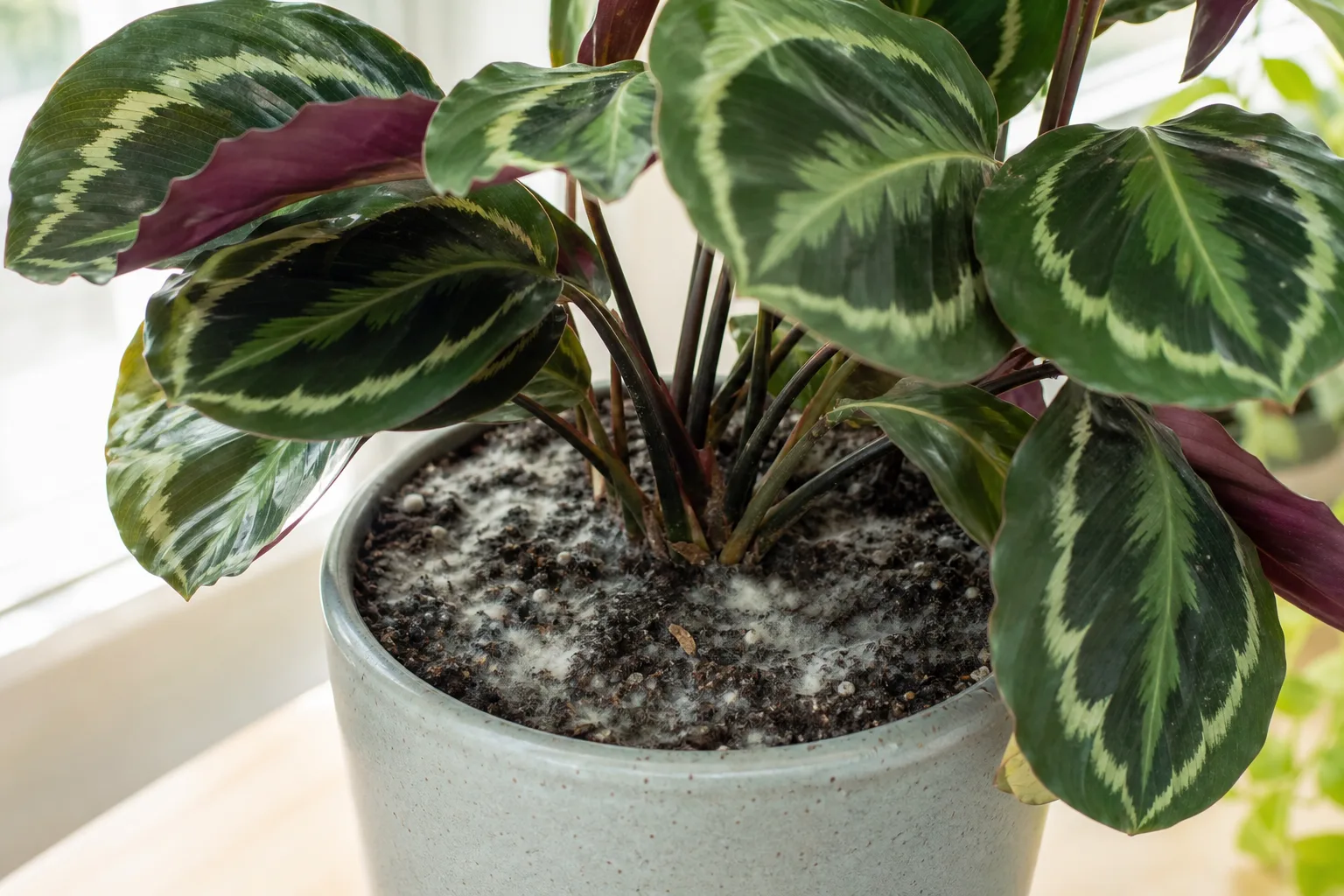
Mold on Soil on Calathea Medallion: Causes, Checks & Fixes
This guide covers mold on soil on Calathea Medallion. See also the general Mold on Soil guide, watering, and light pages for this plant.
Mold on Soil on Calathea Medallion: Causes, Checks & Fixes
Quick answer
White or gray fuzz on your Calathea Medallion (Goeppertia veitchiana ‘Medallion’) pot looks alarming on a plant whose broad painted leaves show every blemish, but it is usually saprophytic mold breaking down organic matter in a wet surface layer-not a fungus attacking the round leaves above. The mold itself rarely harms a healthy rhizome. What should worry you is the moisture that grows it: Medallion needs evenly moist roots but soils that stay wet too long can damage roots and invite decay.
First step: scrape off the top half-inch to inch of moldy soil, discard it, and stop watering until the top 1–2 inches of mix feel dry. That single action removes active spores and breaks the wet surface cycle. Only after the dry-down test passes should you water again-and thoroughly enough that excess drains from the holes.
For generic prayer-plant mold basics across other Calathea types, see our genus mold guide. This page focuses on Medallion’s wide round-leaf rosette and rhizome crown checks.
What mold on soil looks like on Calathea Medallion
Surface mold on Medallion appears on the potting mix, not on the painted green panels or burgundy leaf undersides. Healthy Medallion foliage should still show firm painted blades and a tight crown unless a separate problem is active. Unlike many prayer plants, Goeppertia veitchiana does not fold its leaves at night-so daytime leaf posture on wet versus dry soil is your clearest stress signal, not evening movement.
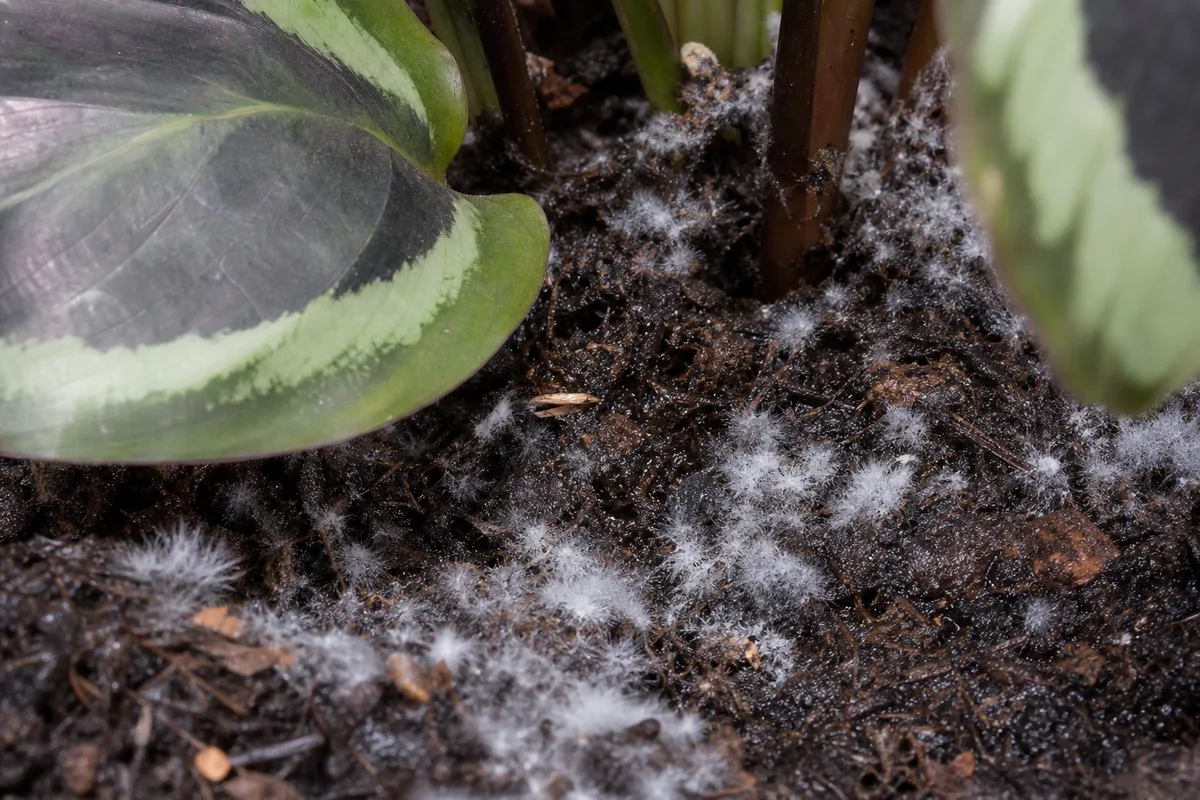
Mold on Soil symptoms on Calathea Medallion - compare with healthy tissue on the same plant.
Typical surface mold:
- White, gray, or occasionally yellow-tan fuzzy patches on the top of the mix
- Cottony threads spreading across damp peat after watering
- Soil surface staying dark and wet for three or more days
- Musty smell when you lift the pot near the rim
- Broad round leaves still look firm and richly colored above the soil line
When mold signals deeper trouble:
- Mold reappears within days of scraping
- Mix feels heavy and cool many days after you thought it dried
- Lower leaves yellow while the surface stays wet
- Newest rolled leaf spears stall, tear, or open with brown edges
- Tiny dark flies rise when you water-fungus gnats sharing the same wet habitat
- Sour or rotten odor from drainage holes or soft tissue at the crown
Medallion’s wide newest leaves can look dramatic when stressed, but soil mold by itself rarely causes overnight collapse. If leaves yellow and go limp while soil stays wet, treat that as a root-moisture problem first-not a leaf fungus.
Why Calathea Medallion gets mold on soil
Mold on houseplant soil is typically a saprophytic fungus feeding on decaying organic matter in consistently moist mix. On Medallion, the usual trigger is how long the peat-based surface stays damp-not a mysterious disease attacking painted foliage.
Peat-heavy mix that holds surface moisture. Medallion performs best in moist, well-drained potting mix kept evenly moist during active growth. That same organic surface holds water and provides food for saprophytic fungi when it never dries between waterings.
“Evenly moist” misread as “always wet on top.” Medallion wants consistent moisture in the root zone, but the top 1–2 inches should still dry slightly before the next drink. Watering on a fixed calendar-especially in winter when growth slows-keeps the surface soggy for days while roots sit in stale mix.
Broad rosette shading the soil line. Medallion’s wide painted leaves hang over the pot rim. In medium or low indirect light, that canopy slows surface evaporation compared with narrow-leaf calatheas on the same shelf-even if watering never changed.
High humidity without airflow. Medallion needs high humidity for leaf edges, but humid, still air around crowded plant groupings slows evaporation from the soil surface. Humidity at leaf level does not require a constantly wet top layer-see our low-humidity guide for canopy moisture without overwatering the roots.
Broad rosette debris. Medallion’s wide leaves shed bits into the crown and onto the soil. Fallen leaf fragments, broken tips, and decomposing peat particles feed surface fungi. Leave them on wet soil and mold has free food.
Oversized or cache pots. A Medallion in a pot far wider than its rhizome holds excess wet soil around roots. The center stays saturated while mold shows on top first. Decorative outer pots without drainage trap saucer water against the root ball. See our watering guide for cachepot drainage protocol.
Self-watering pots and wicking reservoirs. Constant bottom moisture keeps the core wet while mold appears on the visible surface first. Self-watering systems work poorly for Medallion unless you monitor dry-down at the top 1–2 inches and never let the reservoir stay full through a cool winter week.
Cool winter rooms. When temperatures drop and day length shortens, the same watering volume keeps soil wetter longer. Mold often appears in January or February on plants that were fine all summer-especially when irrigation is not reduced as plants use less water.
The mold may be harmless on its own, but the wet conditions that grow it are the same ones that invite fungus gnats and root rot on prayer-plant relatives.
Lookalike symptoms to rule out
| What you see | Where it appears | Texture / smell | Likely cause | What to check |
|---|---|---|---|---|
| White or gray cottony fuzz | Soil surface only | Soft threads; musty | Harmless saprophytic mold on wet peat | Top 1–2 inches damp for days; firm crown |
| Dry white powder | Leaf blades, not soil | Wipes off dry; on foliage | Powdery mildew | Stagnant humid air on leaves |
| Hard white film | Soil surface | Crusty; mineral feel | Salt or hard-water crust | Tap-water use; fertilizer buildup |
| Slimy green film | Soil surface in bright spot | Wet and green | Algae | Constant light plus moisture together |
| Yellow limp lower leaves | Foliage + wet soil | Sour smell possible | Overwatering / root rot | Mushy roots; soft crown at soil line |
| Crisp brown leaf edges | Leaf margins | Dry, papery tips | Low humidity or tap-water brown tips | Light dry pot; normal soil moisture |
Powdery mildew puts a dry white powder on leaf surfaces, not a fuzzy mat on soil. It spreads on foliage in stagnant humid air-not as cottony patches confined to the potting mix.
Mineral crust on soil looks like a hard white film, not fluffy mold. It often follows hard tap water or fertilizer salts and wipes differently than soft fungal threads. Medallion is sensitive to tap water chemistry, but crust and mold are separate problems.
Green algae on the soil surface needs constant light and moisture together. It appears slimy and green rather than cottony white.
Brown tips and edge crisping trace to low humidity or tap water quality-they do not produce mold on soil. Healthy roots still depend on correct surface moisture even when leaf edges look stressed.
Normal lower-leaf aging on a mature rosette is not mold-related. A few fading bottom leaves may be natural shedding unless the soil stays wet and the crown softens.
How to confirm the cause
Work through these checks before repotting or spraying anything:
- Surface moisture test - Push your finger into the top 1–2 inches. If only the surface is wet but deeper mix feels appropriately moist, you likely have surface mold from splash watering or debris. If the whole profile feels cool and clinging, overwatering is the main issue.
- Pot weight - Lift the container. Heavy many days after watering confirms saturation; light weight with mold still visible may mean only the surface layer is holding moisture from a full saucer.
- Root spot-check - Slide the rhizome partly out of its pot. Firm pale roots with no smell mean mold has not progressed to rot. Mushy brown roots with sour odor mean escalate to root rot care.
- Leaf pattern - Firm broad leaves with mold only on soil point to environmental mold. Yellow limp lower leaves plus wet mix suggest roots are already stressed.
- Crown firmness - Press gently at the soil line where new leaves emerge. A tight firm crown with surface mold only is reassuring. Soft, spongy tissue at the base is not.
- Gnat check - Watch for small dark flies when you water. Fungus gnats breed in moist soil rich in decaying organic matter-persistent swarms alongside mold point to chronically damp mix; see our fungus gnat guide for larval-cycle breaks.
- Drainage audit - Confirm open drainage holes, the saucer is emptied after watering, and no decorative cover traps humidity at the rim.
If the crown is firm, newest leaves look normal, roots smell neutral, and mold is limited to the surface, you have environmental mold-not an emergency repot.
First fix for Calathea Medallion
Scrape off the top half-inch to inch of moldy soil, discard it, and pause all watering until the top 1–2 inches of mix feel dry to your finger.
This single step removes active spores and stops feeding surface fungi while you confirm how fast the pot actually dries in your room. Do not water on a calendar while waiting-test the mix at the depth Medallion care uses as the watering trigger per our watering guide.
After the dry-down test passes:
- Replace the scraped area with a thin layer of fresh, dry potting mix-not wet from the bag.
- Water thoroughly once at the soil line, letting excess drain freely, then empty the saucer.
- Move the pot slightly away from walls or crowded plant groupings to improve air movement at the soil line.
Do not reach for fungicide on day one for harmless surface mold. Do not repot immediately unless roots are mushy or mold returns within a week of scraping. Do not mist foliage while the soil surface is still recovering-that adds humidity without helping the root zone dry.
Step-by-step recovery
After the initial scrape and dry-down:
- Adjust watering to the pot, not the calendar. Water only when the top 1–2 inches begin to dry-every five to seven days in active growth, longer in winter when the pot dries slowly.
- Bottom-water if surface mold keeps returning. Set the pot in a tray of water for 15–30 minutes so roots absorb moisture from below while the top layer stays drier-a technique that discourages fungus gnats from laying eggs on the surface.
- Remove debris weekly. Pick fallen Medallion leaf bits off the soil and out of the rosette before they decompose.
- Add yellow sticky traps near the pot base if gnats appeared with the mold. Traps catch adults but do not replace drying the soil.
- Brighten light slightly if the plant sits in very dim conditions. Medium indirect light helps the mix dry between waterings without sun-scorching painted leaves.
- Repot only if mold recurs after two dry-down cycles or roots smell sour. Use fresh moisture-retentive but well-draining mix with perlite and a pot sized to the rhizome-not a dramatic upsize.
Skip cinnamon, baking soda, or hydrogen peroxide drenches as a first response-they treat the surface while wet soil keeps the problem alive.
Recovery timeline
Surface mold should stop spreading within a few days once the top layer dries. After one correct watering cycle, you should see no new fuzzy growth for one to two weeks.
Judge recovery by dry soil rhythm and clean new rolled leaves from the center-not by whether old scraped patches leave a bare spot. Lower yellow leaves from prior overwatering will not turn green again; they can be trimmed once the plant stabilizes.
If mold returns within seven days of scraping, your watering interval, light level, or pot size still does not match how fast this Medallion uses water in its current room.
Mistakes to avoid
Do not keep watering on the same schedule after scraping mold-the surface will stay wet again within days.
Do not leave the plant sitting in a full saucer. Overwatering and poor drainage damage roots long before mold becomes the only visible sign.
Do not assume mold is harmless when fungus gnats swarm, soil smells sour, or lower leaves yellow in clusters.
Do not repot into an oversized container hoping fresh soil fixes mold. A bigger wet zone makes both mold and root rot more likely on rhizomatous prayer plants.
Do not pile decorative moss or rocks on the soil surface-they trap humidity where mold starts.
Do not confuse surface mold with a need for fertilizer. Feeding a stressed, wet-rooted Medallion pushes soft growth without fixing the moisture problem.
Calathea Medallion care cross-check
Mold on soil is almost always a watering and environment signal on this plant. Cross-check these Medallion basics while you recover:
- Light: Medium indirect light dries pots faster than deep shade. Low-light tolerance does not mean low light is ideal when soil never dries.
- Water: Top 1–2 inches dry before the next drink-not surface alone, not a fixed weekly date. Use filtered or rainwater to avoid fluoride crisping unrelated to mold.
- Mix: Moisture-retentive but well-draining peat-based medium with perlite. Replace tired mix that has compacted and holds water in the center.
- Humidity: High humidity at leaf level supports clean new growth; it does not require a constantly wet soil surface.
- Temperature: Average household warmth supports steady growth; cold drafty windowsills slow drying and stress unfolding spears.
When these align, surface mold usually disappears and does not return.
How to prevent mold next time
Water by dry-down test, not habit. Insert your finger to the top 1–2 inches-or lift the pot for weight-before every major watering per our watering guide.
Remove fallen leaves from the soil surface and rosette before they rot. Medallion sheds older blades naturally; do not let them become fungal food.
Empty saucers within an hour of watering. Stagnant water wicks back into the mix and keeps the surface damp.
Improve airflow at the pot base with slight spacing from walls and neighboring plants. A small fan in a closed room helps during winter heating season without blasting dry heat directly on leaves.
Repot every one to two years-or when mix breaks down and stays wet-into fresh well-draining soil and an appropriately sized pot.
Use bottom-watering if surface mold was a repeat problem. Keeping the top layer drier disrupts fungus gnat egg-laying and mold growth without starving the rhizome below.
Reduce watering volume in fall and winter when day length drops and the plant uses less moisture.
When to worry
Treat as urgent when mold returns within a week of scraping, soil smells sour or rotten, the crown feels soft, leaves wilt while mix stays wet, or fungus gnats persist after two dry-down cycles. Those patterns suggest root damage from chronically wet soil rather than harmless surface fungus alone.
Repot into fresh mix, trim mushy roots, and adjust light and watering together if roots are brown and soft. A Medallion with more than half its root mass rotted may not fully recover-focus on saving firm rhizome sections if division is an option.
Surface mold on a firm crown with healthy painted leaves and neutral-smelling roots is not urgent. Fix moisture first; escalate only when inspection shows root-zone failure.
Related Calathea Medallion guides
Mold on soil rarely exists in isolation on Medallion. After you stabilize the surface, review these related pages on our Calathea Medallion overview:
- Fungus gnats - pests that share the same damp surface habitat
- Overwatering - wet-soil stress behind recurring mold
- Root rot - escalation when roots are mushy or the crown softens
- Watering - dry-down rhythm and cachepot drainage
- Not enough light - dim corners that slow pot dry-down
- Low humidity - canopy moisture without overwatering roots
- Brown tips - tap-water edge burn mistaken for drought stress
- Genus Calathea mold guide - generic prayer-plant mold basics across cultivars