Calathea Medallion Fertilizer: When, How, and Mistakes
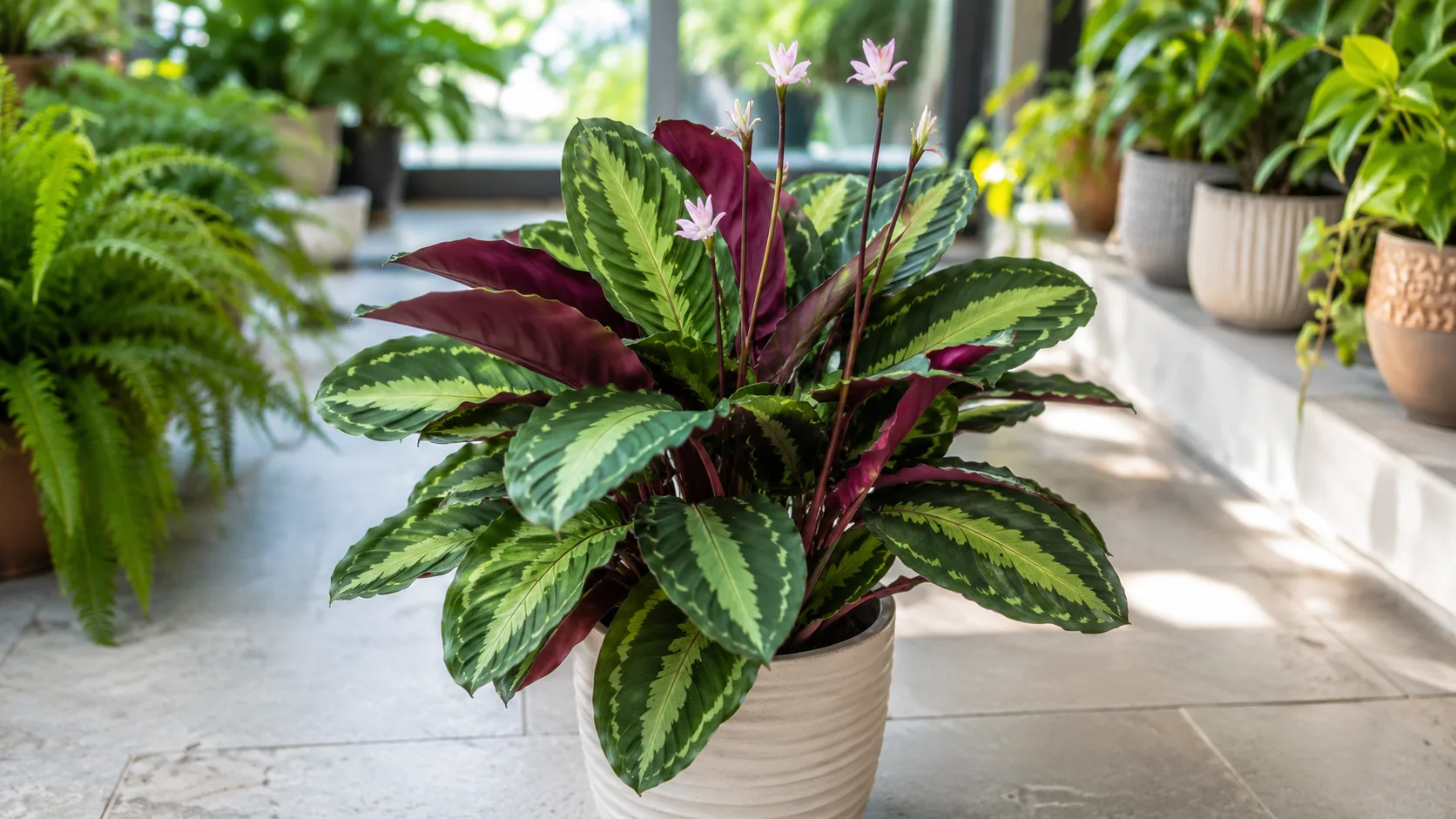
Calathea Medallion Fertilizer: When, How, and Mistakes to Avoid
Calathea Medallion Fertilizer: When, How, and Mistakes to Avoid
Why Calathea Medallion Rewards Restraint More Than Heavy Feeding
Calathea Medallion - the round-leaf prayer plant sold under names including Calathea veitchiana and, in current taxonomy, Goeppertia veitchiana - is not a hungry feeder. It is a precise one. Its wide, silver-and-green patterned leaves unfurl slowly, one at a time, from a tight rosette. Each new leaf is a report card: crisp margins, full diameter, and strong contrast mean the whole system - light, humidity, water, and soil - is working. Brown rims on that newest round leaf mean something failed, and fertilizer salts are a common culprit even when the plant looks otherwise healthy.
Medallion shares the Marantaceae reality of fine roots in a small pot volume, modest growth rate, and low tolerance for concentrated minerals. Fertilizer does not manufacture the Medallion’s signature medallion pattern. Calathea Medallion light guide, stable humidity, and even moisture do most of that visual work. Nutrients simply replace what the plant uses while it is actually building tissue. University of Maryland Extension states that indoor feeding should add just enough nutrients so new growth compensates for leaf loss, not push rapid enlargement. Medallion fits that profile closely.
The mistake most growers make is treating fertilizer like a growth accelerator for a plant that already demands careful watering and filtered light. When you overfeed Medallion, the problem is not instant collapse - it is soluble salt accumulation in a closed container where evaporation leaves minerals behind even when the plant did not use them. Those salts show up first on the broad leaf edges Medallion is famous for, because the surface area is large and the margins dry slightly faster than the center. That is why the best Calathea Medallion fertilizer routine sounds boring: a complete liquid product, reduced label strength, and a clear seasonal pause. Restraint protects the root zone and keeps the next unfurl clean.
What Fertilizer Does for Medallion Growth and Leaf Pattern
Fertilizer supplies mineral elements the potting mix loses over time. Each watering carries some nutrients out the drainage hole. Root uptake removes others. Peat or coir breaks down and releases less nutrition over months. Even a well-run Medallion routine - stable humidity near fifty to sixty percent, bright indirect light, careful tap-water management - eventually needs a modest nutrient input if you want full-sized round leaves rather than progressively smaller ones with washed-out pattern.
Medallion uses those nutrients to build chlorophyll-rich foliage and maintain root tips. Unlike many prayer plants, Goeppertia veitchiana does not fold its leaves at night, so fertilizer will not restore nightly leaf movement. None of that requires heavy feeding. It requires consistent availability during active growth without spikes that dehydrate root hairs through osmotic stress. Think of fertilizer as maintenance for the growth you can already see, not a substitute for fixing dim light, dry air, or alternating drought and flood.
Pale new Medallion leaves can mean several things. Low light produces smaller, lighter spears before they open. Iron or nitrogen deficiency can yellow tissue between veins on newer leaves when the mix is truly depleted. Salt burn browns margins while the center may still look green. Jumping to more fertilizer when the real limit is light or water quality is one of the fastest ways to damage a cultivar whose whole appeal is the condition of its newest round leaf.
How NPK Supports Round Leaves and Root Health
Fertilizer labels show three numbers - N-P-K - for nitrogen, available phosphate, and soluble potash. Nitrogen drives leaf and stem development, which matters for a plant sold entirely for its broad foliage. Phosphorus supports energy transfer and root function. Potassium helps regulate water movement inside cells and contributes to general stress tolerance. Severe mineral imbalance - especially when growers use pure distilled water with zero supplementation - can weaken root function over time, though potassium deficiency is only one possible cause among several.
A balanced formula such as 10-10-10 or a foliage-oriented ratio such as 3-1-2 both work when diluted properly. The numbers describe proportions, not permission to pour concentrate. 20-20-20 contains twice the percentage of each nutrient compared with 10-10-10 at the same volume, so measuring by habit rather than label is a common burn source on Medallion’s sensitive roots. Choose a complete houseplant fertilizer that lists micronutrients - iron, manganese, zinc, and others - because long-term indoor culture can deplete trace elements even when N-P-K looks fine on paper.
Avoid high-phosphorus bloom boosters for routine Medallion care. High-phosphorus feeds are designed for flowering crops, not foliage maintenance, and phosphorus accumulates when applied repeatedly without need. Likewise, skip foliar feeds as your primary method. Medallion’s broad leaves spot easily; nutrient sprays can mark the silver bands and do not replace steady root uptake for maintenance feeding.
Choosing the Best Fertilizer for Calathea Medallion
The best product is one you can measure accurately, dilute conservatively, and stop immediately if the plant reacts. Brand matters less than form, analysis, and your ability to avoid doubling doses accidentally. Many experienced prayer-plant growers prefer urea-free liquid formulas because urea can convert to ammonia in certain root-zone conditions and add stress to sensitive species, though plenty of growers succeed with standard complete houseplant liquids when those products are diluted and applied on moist soil.
Medallion does not need a special “Medallion formula.” It needs the same complete nutrition other Calatheas use, applied more carefully because damage is visible on large round leaves within one or two unfurls. If a product label offers a houseplant or indoor plant rate, treat that rate as the ceiling, then cut it again for Medallion. Never combine a full liquid dose with fresh controlled-release fertilizer unless you know exactly what is already in the mix.
Liquid, Slow-Release, and Organic Options Compared
| Form | Advantage for Medallion | Main risk | Best use case |
|---|---|---|---|
| Liquid or water-soluble | Precise dose; easy to pause | Over-application; salt spikes | Most indoor Medallion growers |
| Slow-release prills | Convenient; gradual release | Hard to remove; overlaps with liquid | Stable warm room with strong light |
| Organic liquids (fish emulsion, seaweed) | Familiar routine; mild when diluted | Odor; variable analysis; salt if overused | Growers who measure carefully |
| Worm castings / compost top-dress | Gentle organic input | Compaction; gnats; uneven release | Light top-dress in airy mix only |
Liquid fertilizer is the default recommendation for Calathea Medallion because you can tie feeding to visible growth and skip a month without leaving hidden prills releasing in the background. N.C. Cooperative Extension notes that many indoor gardeners get excellent results diluting fertilizer to half strength and applying it on a regular spring-and-summer schedule, while reducing or stopping in winter. That aligns well with Medallion’s seasonal rhythm in most Northern Hemisphere homes.
Slow-release pellets can work for an established Medallion in a warm, bright spot with stable watering, but they are harder to undo if you misgauge. If your potting mix already contains prills or a starter charge, do not add another layer without reading the bag. Organic liquids are fine when the guaranteed analysis is complete and you dilute according to directions - “organic” does not mean salt-free or impossible to overapply. Kitchen shortcuts such as banana water or unmeasured coffee do not provide complete, predictable nutrition and may introduce mold or compaction on Medallion’s shallow root zone.
The Half-Strength Rule for Calathea Medallion
“Half strength” means half the fertilizer quantity in the same final volume of water the label specifies for houseplants - not half the water with full product, and not an eyeball splash into a partly filled can. If the label says one teaspoon per gallon for indoor plants, half strength is half a teaspoon per gallon. Write the math once and reuse it. Memory fails when you care for multiple plants on the same watering day.
For Calathea Medallion, quarter to half label strength is the safe starting band. Plants in lower light, small six-inch pots, or recently stressed conditions should start at the lower end. Plants with strong spring growth, healthy roots, bright indirect light, and steady humidity may tolerate the upper end after several uneventful applications - increase only one variable at a time. K-State Extension recommends following product directions and, for heavy-handed feeders, starting at half dilution to prevent salt injury - advice that maps directly onto Medallion’s thin root system.
More fertilizer cannot force a faster unfurl when light is the limiting factor. It can, however, leave salts that brown the wide leaf margins by midwinter even if you blame humidity first. When in doubt, feed weaker and less often. Skipping one month in summer is safer than doubling after a slow spell. Medallion tolerates lean months far better than salty ones, and one clean new round leaf is worth more than a aggressive feed that marks the next three.
When Calathea Medallion Needs Fertilizer - and When It Does Not
Feed Calathea Medallion when it is in active growth with healthy roots, moist but aerated soil, and enough light to produce full-sized new leaves. Do not feed when the plant is dry and wilted, soggy and declining, recently repotted, cold, or dropping leaves from a sudden environmental change. Fertilizer supplies minerals; it does not repair rotted roots, compensate for fluoride-heavy tap water, or replace humidity that keeps Medallion’s broad leaves from crisping at the edges.
University of Maryland Extension advises fertilizing most indoor plants from March through September and avoiding winter feeding when reduced light and temperature slow growth - guidance that matches Medallion’s typical indoor cycle. In practice, your calendar should follow the plant’s behavior, not the wall clock alone. A Medallion under grow lights in a warm room may grow through winter and accept very light, infrequent feeding; one in a cool dim corner may need zero from October onward even when growth has slowed.
Never feed while a new leaf spear is stuck or tearing during unfurl. That is a humidity or water-quality problem, not a hunger signal. Adding fertilizer to a stressed unfurl often worsens edge burn on the leaf Medallion is trying to open. Fix moisture and air first, then resume feeding only when the next spear opens cleanly.
Reading Active Growth vs Dormancy on Medallion
Active growth looks like regular new round leaves unfurling with reasonable diameter, increased watering frequency as the pot dries faster, and firm existing foliage without widespread yellowing. The silver-green contrast on new leaves should approach the mature pattern once fully open, though very young tissue is naturally lighter. Dormancy or semi-dormancy shows minimal new leaves, slower dry-down, and sometimes older leaf loss as the plant reallocates energy - normal in low winter light. Occasional winter leaves do not automatically justify monthly feeding if overall metabolism has slowed; salts can still accumulate while uptake drops.
Resume or increase feeding when spring lengthening days coincide with clear new growth, not the first sunny afternoon in February. Ramp up over two to three applications rather than jumping from zero to full schedule overnight. That gradual return mirrors how Medallion re-engages its root system after a quiet season and reduces the chance that the first spring unfurl opens with brown rims.
A Practical Spring and Summer Feeding Schedule
For most established indoor Calathea Medallions, a workable baseline is every three to four weeks from mid-spring through early fall, using quarter to half-strength complete liquid fertilizer on already-moist soil. That interval equals roughly monthly feeding with room for a skipped week when travel, Calathea Medallion repotting guide, or stress intervenes. Growers in very bright conditions with fast dry-down and steady new round leaves may lean toward every three weeks at quarter strength rather than monthly at half - total nutrient load matters more than the label on the calendar.
Pair feeding with plain-water waterings between applications. Constant micro-doses at every watering can work mathematically but fail practically because people miscalculate cumulative salts, especially in six-inch pots where Medallion’s root zone is tiny relative to its large leaves. A discrete monthly feed plus regular moisture checks is simpler and easier to diagnose when tips brown. Track applications in a note or phone reminder with date, product, and dilution. When a problem appears six weeks later, that record tells you whether to flush, pause, or adjust light and water instead.
If your Medallion sits where you already manage high humidity and filtered water, it may use nutrients steadily through summer without needing more than the baseline schedule. Extra feeding does not deepen the silver pattern or enlarge leaves beyond what light allows. Resist the urge to feed because the plant “looks so beautiful in June.” Beautiful June leaves usually mean the environment is right, not that the fertilizer bottle should come out weekly.
Reducing and Stopping Feed in Fall and Winter
Taper feeding as day length shortens and new leaf frequency drops. From late summer onward, extend the interval - for example from every three weeks to every five or six - before stopping entirely. By late autumn, most Medallions in natural light should receive no fertilizer until growth clearly resumes. Continuing through winter is one of the fastest routes to white crust on the soil surface and brown, crisp edges on round leaves that mimic low humidity.
Winter exceptions exist but should be narrow. If you run supplemental grow lights ten to twelve hours daily, keep temperatures in the upper 60s to mid-70s Fahrenheit, and the plant produces full-sized round leaves regularly, a quarter-strength dose every six to eight weeks may be appropriate. If any of those conditions fails, pause. Cold roots absorb nutrients poorly; Missouri Extension specifically warns against applying liquid fertilizer to wilted plants and emphasizes that restricted container roots burn easily from excess - both relevant when winter heating dries air while soil stays cold near a window.
When spring returns, restart only after two to three weeks of visible new growth, not the day you rotate the pot toward the window. Early spring feeds should be weaker than midsummer feeds even if enthusiasm is high. Medallion’s first spring unfurl after a quiet winter is the worst leaf to overfeed; salts on recovering roots mark that showcase leaf immediately.
How to Fertilize Calathea Medallion Step by Step
Safe feeding is mostly sequence and concentration. Gather a measuring spoon or syringe, your diluted solution, and confirm the pot has a drainage hole and is not sitting in yesterday’s runoff. Remove decorative cachepots before watering through. Fertilizer that drains into a sealed outer pot recirculates salts around Medallion’s fine roots.
Check the plant the day before if soil is very dry. Medallion prefers even moisture, but if the top has dried appropriately, you may apply diluted fertilizer as that watering. If the root ball is hard and hydrophobic, rewet gradually with plain water first so the feed distributes evenly instead of running down the pot wall. Never pour concentrate directly onto dry peat. Keep solution off the broad leaf surfaces; silver pattern bands can spot if fertilizer dries on them.
Pre-Moisten, Dilute, Apply, and Drain
Step 1 - Mix accurately. Dilute complete houseplant fertilizer to quarter or half the label’s indoor rate in a known water volume. Stir well. Step 2 - Inspect the plant. Confirm no salt crust, no active pest outbreak, no recent repot within the last four weeks, no stuck leaf spear, and no wilt from drought. Step 3 - Apply evenly. Pour slowly across the soil surface, not over the crown, until excess exits the drainage hole. Step 4 - Discard runoff. Empty the saucer after fifteen to thirty minutes. Step 5 - Record and observe. Note the date; watch the next one or two new round leaves for diameter and edge color.
If fertilizer contacts foliage, rinse gently with plain water. Medallion leaves mark easily and dust shows on the silver bands - another reason to keep the measuring spoon near the soil, not the leaf tips. The goal is moist, aerated root zone with surplus salts carried out, not a flooded swamp left overnight.
Adjusting Dose for Light, Humidity, and Water Quality
Medallion in bright indirect light photosynthesizes more actively and may use slightly more nutrients than the same plant several feet from the window - but it also dries faster and risks stress if fed on a summer schedule while sitting in winter-light conditions. Feed the growth you see, not the spot you wish the plant occupied. Lower light means longer intervals and weaker dilution, not the same dose “because it is June.”
Pot size changes salt concentration faster than leaf size suggests. A root-bound Medallion in a small pot experiences higher EC per unit of applied fertilizer than a recently repotted one with fresh, lean mix. After repotting into nutrient-containing soil, wait before adding liquid feed unless you know the mix has no starter charge. Large leaves in a small pot are visually impressive but biologically misleading for dosing math.
Water quality matters independently of fertilizer. Many Medallion growers use filtered, rainwater, or overnight-set tap water to reduce fluoride and chlorine leaf edge burn - a separate issue from fertilizer salts, though both show as brown tips on broad round leaves. If you use distilled or reverse-osmosis water exclusively, you remove incidental minerals too. Those plants depend more on fertilizer for calcium, magnesium, and micronutrients that tap water might otherwise supply in trace amounts. Do not zero out feeding while zeroing out water minerals unless you replace both deliberately with a complete product at conservative doses.
Hard tap water plus regular feeding accelerates white mineral crust on pot rims and soil surfaces. Crust is a signal to flush and review both water and dose, not to scrape and feed harder. High humidity reduces edge desiccation but does not prevent salt burn; a humid Medallion with salty soil still browns margins after the next feed.
Signs Your Calathea Medallion Fertilizer Routine Is Working
Correct feeding shows up in new round leaves, not instant miracles on old ones. Watch the newest unfurling leaf: it should approach the diameter of the prior leaf, show strong silver-green contrast appropriate to Medallion, and open without extensive crispy margins. Established leaves keep their color; they do not magically green up from a single feed if they were pale from low light.
The soil surface stays free of thick white crust except occasional hard-water spotting you can wipe away. The pot does not smell sour. Water uptake stays steady - neither constant wilting nor perpetual sogginess. Over months, the plant maintains a slow, rhythmic push of round foliage through spring and summer rather than a burst followed by collapse.
Healthy feeding also means plain-water months feel safe. If skipping August feeding makes you anxious but the next unfurl looks unchanged, your prior doses were likely adequate. Medallion tolerates lean months far better than salty ones, and one perfect round leaf proves more than a calendar full of checkmarks.
Over-Fertilizing Calathea Medallion: Symptoms and Recovery
Over-fertilizing is among the most common Medallion mistakes because symptoms overlap with underwatering on Calathea Medallion, low humidity, and fluoride damage - all of which also brown edges on broad leaves. Fertilizer burn tends to arrive after a feed or two, often with white crystalline crust on soil or pot edges, brown tips progressing along margins on the newest round leaf first, sudden leaf drop despite moist soil, or stalled spears that abort halfway open. Roots may look brown and limp in extreme cases when salt desiccated fine root hairs.
Recovery starts with stopping all fertilizer immediately. Flush the pot with plain water equal to roughly three times the pot volume, allowing full drainage between passes if crust is heavy. Discard all runoff. Place the plant in stable humidity and indirect light - not a hot window - and let it recover on plain water for four to six weeks minimum. Old burned leaf tissue will not revert green; judge success by the next one or two clean round leaves opening without rim damage.
If flushing does not reduce crust or the plant keeps declining, inspect roots after removing the plant from the pot. Severe salt injury may require repotting into fresh mix without adding new fertilizer for another month. Do not compensate with extra feed “to help it bounce back.” That repeats the injury on the very leaf Medallion is valued for. Trim severely burned leaf tips only if they are fully dead and dry; do not cut into living green tissue chasing a perfect circle.
Feeding New, Repotted, and Stressed Medallion Plants
Newly purchased Medallions often arrive in mix with a starter nutrient charge or slow-release prills. N.C. Cooperative Extension notes that recent purchases may not need additional fertilizer for two to three months if color and growth are good. Let the plant acclimate to your water and humidity before assuming it is underfed. Retail Medallions are often pushed with strong pattern under greenhouse conditions; your home may produce slightly smaller spring leaves without any fertilizer change.
After repotting, wait four to six weeks before the first liquid application unless you used completely inert mix and the plant is actively growing with no transplant shock. Fresh roots are vulnerable; salts on damaged tissue burn quickly on Medallion’s fine root tips. The same waiting period applies after division or serious root pruning. If you repotted because of salt crust, do not feed until at least one clean new leaf opens on plain water alone.
Stressed plants - leaf curl from dry air, droop from underwatering, yellowing from rot, stuck unfurls - need the stress resolved first. Rehydrate evenly, fix drainage, improve humidity, or trim rotted roots before any nutrient talk. Fertilizer on a suffering root system is an irritant, not medicine. If pests such as spider mites speckle the leaf undersides, treat them and pause feeding until new growth resumes. Medallion shows mite damage on silver bands quickly; do not confuse that stippling with nutrient deficiency.
Flushing Fertilizer Salts from the Root Zone
Even careful feeders should leach salts periodically during active growth. Once every one to two months, water thoroughly with plain water until excess drains freely, and repeat after the pot stops dripping if you suspect buildup. Think of flushing as resetting the root zone’s salt budget, not as watering on a calendar unrelated to soil checks. Medallion’s large leaves transpire steadily in humid rooms, which can mask early salt stress until the next unfurl opens marked.
For visible crust, combine flushing with gentle surface scraping of loose crystals - do not gouge living roots. If water runs straight through without wetting the root ball, fix hydrophobic peat with gradual plain-water rewetting before the next fertilizer application. A flush on dry, repelling mix washes around the ball, not through it. Growers who feed monthly in summer and pause in winter still benefit from a plain-water flush in late summer before the dormant season. Lower winter uptake makes autumn salt loads especially risky for a plant that will spend months without using them.
Use the same filtered or settled water you normally give Medallion for flushing when possible. A sudden switch to hard tap water during flush can add minerals while you are trying to remove them. The objective is lower total dissolved salts in the root zone, not a dramatic chemistry swing.
Common Calathea Medallion Fertilizer Mistakes to Avoid
Full-strength label doses top the list. Indoor containers concentrate salts; Medallion roots are fine and sensitive. Half strength is standard extension advice; for this cultivar, quarter strength is often smarter at first, especially after purchase or repot.
Winter feeding “because one round leaf appeared” stacks salts when uptake is low. Wait for sustained spring growth before restarting.
Feeding every watering with micro-doses sounds scientific but fails in practice when dilution math drifts. Monthly or three-week intervals with plain water between are easier to audit on a plant whose leaves advertise every mistake.
Slow-release plus liquid without reading the soil label doubles nutrients silently. Know what is already in the mix before you celebrate a new Medallion with an extra scoop.
Foliar feeding as primary nutrition spots silver-patterned leaves and skips root uptake.
Chasing brown tips with more fertilizer worsens salt burn on Medallion’s broad margins. Diagnose first: crust means flush; uniform low-humidity crispness without crust means humidity and water quality; yellowing with wet soil means roots, not N-P-K.
Feeding during a stuck unfurl marks the leaf permanently. Fix humidity and moisture, not the N-P-K ratio.
Kitchen shortcuts - banana water, eggshell water, unmeasured coffee - do not provide complete, predictable nutrition and may introduce mold or compaction.
Finally, remember the ASPCA lists Calathea spp. as non-toxic to dogs, cats, and horses, though eating any plant material can still cause mild gastrointestinal upset. Keep plants and stored fertilizer out of reach.
Conclusion
Calathea Medallion fertilizer success is less about finding a magic bottle and more about timing, dilution, and stopping when the plant rests. Use a complete liquid houseplant formula at quarter to half label strength, apply it to moist soil every three to four weeks during active growth, flush salts with plain water on a regular schedule, and pause through late autumn and winter unless strong grow-light growth clearly justifies a weak exception. Feed visible growth, not frustration over one pale leaf.
When broad leaf edges brown, ask whether salts, water quality, or humidity is responsible before reaching for the measuring spoon again. After repotting or stress, wait. When the next round leaf opens clean, full-sized, and sharp in pattern, you will know the routine fits Medallion - and that is the only result worth chasing.
When to use this page vs other Calathea Medallion guides
- Calathea Medallion overview - Start here for whole-plant context before deep-diving this topic.
- Calathea Medallion problems hub - Jump to symptom-specific fix guides when this care topic does not resolve the issue.
Related Calathea Medallion guides
- Calathea Medallion overview
- Calathea Medallion watering
- Calathea Medallion light
- Calathea Medallion soil
- Calathea Medallion propagation
- Calathea Medallion repotting
- Calathea Medallion problems
Related tool
Try the Fertilizer Dilution Calculator with calathea-medallion pre-selected to estimate needs for your setup.