Fiddle-Leaf Fig Care: Light, Water & Tips
Ficus lyrata
Fiddle leaf fig needs stable bright indirect light and consistent watering. Two types of brown spots: root rot (edge-inward, soft) and sunburn (papery, anywhere). Never move the plant unnecessarily.
Fiddle-Leaf Fig Care: Light, Water & Tips
Start with wateringThe most common care mistake for Fiddle Leaf FigWatering guide →Fiddle Leaf Fig care essentials
About Fiddle Leaf Fig
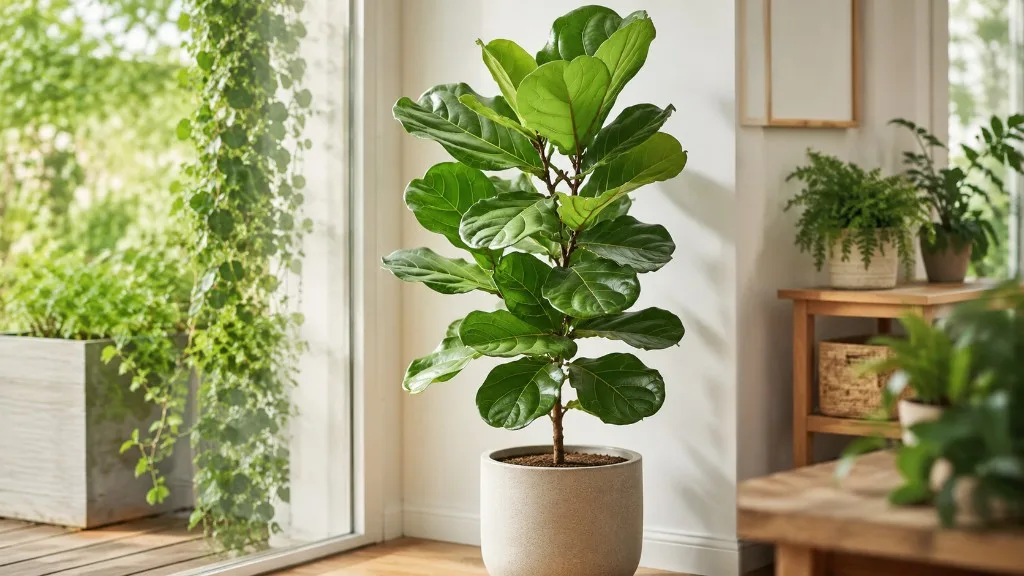
Fiddle Leaf Fig is native to Western Africa (Sierra Leone to Cameroon) - lowland tropical rainforests, typically reaches 6–10 ft tall indoors; large violin-shaped leaves 12–18 inches long indoors, with moderate growth. Fiddle Leaf Fig has a tree like growth habit and part of the Moraceae family. It is also known as Banjo Fig and Lyre-Leaf Fig.
| Detail | Information |
|---|---|
| Also known as | Banjo Fig, Lyre-Leaf Fig |
| Native region | Western Africa (Sierra Leone to Cameroon) - lowland tropical rainforests |
| Mature size | 6–10 ft tall indoors; large violin-shaped leaves 12–18 inches long |
| Growth rate | Moderate |
| Growth habit | Tree Like |
| Scientific name | Ficus lyrata |
| Family | Moraceae |
Fiddle-Leaf Fig Care: Light, Water & Tips
What Is a Fiddle-Leaf Fig?
The fiddle-leaf fig is the houseplant that turned a West African rainforest tree into a living piece of furniture. Its botanical name is Ficus lyrata, and the common name describes the obvious feature: large, violin-shaped leaves that can reach 12 to 18 inches (30 to 45 cm) long on a mature indoor specimen. Grown as a houseplant, it typically reaches 2 to 10 feet tall over several years, forming a tree-like silhouette with a single or branched trunk and a canopy of broad, leathery foliage. Growth is moderate in a typical bright home - faster when light and warmth are strong, slower when either variable slips.
If you are deciding whether a fiddle-leaf fig fits your space, the honest summary is this: it rewards Fiddle Leaf Fig light guide, a consistent Fiddle Leaf Fig watering guide, stable placement, and moderate humidity - and it punishes relocation, low light, and soggy roots. It is harder than a pothos and easier than a demanding orchid collection, but its reputation for drama is earned. The plant does not sulk randomly; it responds sharply to environmental change, especially being moved, and its large leaves make every mistake visible within days. One critical caveat for pet owners: fiddle-leaf fig is toxic to cats and dogs if chewed, and its milky latex sap irritates skin on contact - wear gloves when pruning or propagating.
Botanical Background and Native Range
Fiddle-leaf fig belongs to the Moraceae family - the fig family - which includes weeping fig (Ficus benjamina), rubber plant (Ficus elastica), and edible fig (Ficus carica). Moraceae plants share a few baseline indoor patterns: they prefer well-drained soil, dislike sudden temperature swings, bleed latex sap when cut, and often drop leaves when their environment shifts faster than they can acclimate. Knowing the family helps you predict behavior before you blame yourself for “bad luck.”
The species is native to tropical western and central Africa, including lowland rainforest regions in Sierra Leone, Liberia, Ivory Coast, Ghana, Nigeria, Cameroon, Gabon, and Togo. In that habitat, Ficus lyrata grows as a small tropical tree in warm, humid understories and clearings - not on a dim bookshelf in a north-facing bedroom. Indoors, you are approximating rainforest edges: bright filtered light, warm stable air, and soil that dries partially between thorough soakings. When in doubt, mirror that rhythm rather than a rigid calendar.
As a houseplant, fiddle-leaf fig rarely flowers or fruits; the appeal is entirely foliar. Stems and leaves contain a milky sap that can irritate skin, which NC State Extension notes as a reason to wear gloves when handling the plant during pruning or propagation. The same sap is part of why the plant is classified as toxic if ingested by humans and pets. Retail plants are often sold as single-stem “standard” trees or multi-stem shrub forms; care requirements are the same regardless of shape.
Why the Violin-Shaped Leaves Change the Care Equation
Those oversized leaves are not just aesthetic - they are the plant’s entire water-management system. A single mature leaf presents a huge surface area for transpiration, the process by which the plant loses water vapor through its stomata. In dry indoor air, a fiddle-leaf fig can lose moisture from its foliage faster than roots replace it, which is why brown crispy edges so often trace to low humidity or inconsistent watering rather than a mysterious disease. Large leaves also mean large light demand: the plant needs enough photosynthetic energy to support each leaf’s maintenance cost. A dim corner may keep the plant alive for months while it slowly sheds leaves and produces smaller replacements - a decline that looks like neglect but is really insufficient light.
The violin shape matters for placement too. Leaves orient toward light sources, and a tree pushed against a wall with light from one side will lean and drop inner leaves that no longer receive usable light. Rotate the pot a quarter turn every few weeks during stable periods - not immediately after a move - so growth stays balanced. Avoid dust buildup on the broad leaf surfaces; a soft damp cloth wipe every month or two keeps stomata unobstructed and helps you spot pests early. Do not use leaf-shine products; they block gas exchange and add nothing the plant needs.
Fiddle-leaf fig also became a design-world staple because its vertical structure fills empty corners without spreading wide. That popularity created a mismatch: buyers expect a resilient decor object, but the plant behaves like a site-specific tree that wants to stay where it first acclimated. Understanding that tension - statement plant, sensitive organism - prevents most of the frustration people report online.
Best Growing Conditions for Fiddle-Leaf Fig
Fiddle-leaf fig does best when your home approximates the warm, bright, humid rhythm of its native range. The four variables that decide almost every outcome are light, water, soil, and temperature. Get those aligned and feeding, Fiddle Leaf Fig repotting guide, and propagation become routine. Get one badly wrong - especially light or water - and no amount of fertilizer will rescue a declining canopy.
Light Requirements
Fiddle-leaf fig needs bright indirect light for most of the day. A practical target is 6 to 8 hours of strong ambient daylight without harsh direct sun on the leaves for extended periods. In the Northern Hemisphere, placement within 2 to 6 feet (60 to 180 cm) of a large east- or south-facing window often works well. East exposures provide gentle morning sun followed by bright indirect light; south windows supply intensity but may need a sheer curtain to filter midday and afternoon rays that scorch leaves through glass. West windows can work with filtering; north windows are usually too dim unless the room is exceptionally bright.
The plant can tolerate some direct morning or late-afternoon sun once acclimated, but unfiltered hot afternoon sun causes leaf scorch - bleached patches, brown crispy spots, and curling at the sun-facing edge. Low light produces different symptoms: small new leaves, long bare stems, slow or absent growth, and gradual leaf drop as the plant sheds foliage it cannot support. If you cannot comfortably read a book at noon in the spot without turning on a lamp, the light is probably insufficient for active growth.
Acclimate any light change gradually over one to two weeks. Plants grown in greenhouses or dim shop floors have leaves calibrated to lower intensity; moving them straight into a south window burns foliage that cannot adjust overnight. Shift the pot closer in stages, or add sheer filtering first and remove it slowly. If natural light is weak - common in winter at higher latitudes - supplement with a full-spectrum LED grow light on a 10–12 hour timer, positioned 12 to 24 inches above the canopy. Without adequate light, fiddle-leaf fig is the wrong plant for that room; no watering trick compensates for chronic shade.
Light and watering are coupled. In lower light, a fiddle-leaf fig grows more slowly and the pot stays wet longer, so a watering interval that worked beside a bright window can become excessive after a move or seasonal light drop. UF/IFAS lists both low-light stress and excessively wet media as causes of green leaf drop in indoor Ficus. Check the root-zone moisture again whenever the light changes; do not keep the old calendar by habit.
Treat relocation as a recovery period, not an invitation to fix everything at once. UF/IFAS advises leaving newly placed indoor Ficus unpruned, unrepotted, unfertilized, and unmoved for about four weeks because each intervention adds stress. For a recently purchased or relocated fiddle-leaf fig, stabilize the position and watering first, then make one major change at a time.
Temperature and Humidity
Fiddle-leaf fig prefers stable indoor temperatures between 65 and 75°F (18 and 24°C) and generally tolerates a range of about 60 to 80°F (15 to 27°C) when other conditions are good. It dislikes cold drafts from winter windows, frequently opened doors, and air-conditioning vents blowing directly on the canopy. Sudden drops below about 55°F (13°C) can trigger leaf drop within days. Keep the plant away from radiators and heat registers too; hot dry air strips moisture from large leaves faster than roots can replace it.
Humidity matters more for fiddle-leaf fig than for many common houseplants because of those broad leaves. Target 40 to 60% relative humidity for healthy foliage. Average homes sit near 40% in summer and can fall below 30% in heated winter air, which encourages brown leaf edges, tip dieback, and spider mites. Grouping plants, using a pebble tray with the pot elevated above the water line, or running a small humidifier nearby all help more reliably than misting, which raises humidity briefly and can leave wet leaf surfaces that invite fungal spotting if airflow is poor.
Do not chase tropical greenhouse humidity unless you enjoy running equipment; the goal is stable moderate humidity, not saturation. If edges brown despite correct watering, humidity is a prime suspect - especially in winter. A simple hygrometer near the plant removes guesswork.
Soil and Drainage
Use a well-draining potting mix with perlite, targeting slightly acidic to neutral pH around 6.0 to 7.0. The exact recipe matters less than the principle: the mix should drain freely, hold enough air around roots, and not stay wet for days after watering. A workable home blend is roughly two parts quality peat-free or peat-based houseplant mix, one part perlite, and optionally one part bark chips for extra aeration on large trees in big pots. Avoid heavy garden soil in containers; it compacts and suffocates roots. Whatever container you use, the inner pot needs drainage; Clemson Extension recommends watering thoroughly and emptying the runoff tray rather than leaving roots in collected water.
Always plant in a container with a drainage hole. Decorative cachepots are fine only if you lift the nursery pot out to water and empty runoff afterward. Fiddle-leaf fig roots are sensitive to overwatering - sitting in waterlogged mix is the fastest route to root rot on Fiddle Leaf Fig and the leaf drop that follows. Refresh compacted mix every one to two years through repotting or top-dressing; old peat-heavy media that has broken down holds water longer than the plant can tolerate.
How to Water Fiddle-Leaf Fig
The general rule for fiddle-leaf fig is: water thoroughly when the top 2 to 3 inches (5 to 7 cm) of soil are dry. More precisely, plan around every 7 to 10 days in summer and every 14 to 21 days in winter as starting intervals, then refine based on how fast your specific pot dries in your home. Pot size, soil composition, light intensity, humidity, and season all change the interval, so a calendar schedule is a reminder to check - not a rule to follow blindly.
When you water, soak the entire root ball until water runs from the drainage holes, then empty the saucer within 20 to 30 minutes so the pot is not sitting in stale water. Use your finger, a wooden chopstick, or a moisture meter to verify dryness at depth before adding water. If the deeper mix is still damp, wait. If the top is dry and the pot feels noticeably lighter, it is usually time to water. Consistency matters: alternating drought and flood stresses roots and triggers leaf abscission more reliably than slightly early or slightly late watering.
Watering Rhythm During Active Growth
During active growth - typically spring through early fall when light is strong and new leaves unfold - fiddle-leaf fig uses water on a relatively steady rhythm. The pot dries at a predictable rate, and new growth should look firm, adequately sized, and deep green (exact shade depends on cultivar and light). Water thoroughly at each session rather than giving small daily sips that wet only the surface while the center stays dry.
If you just brought the plant home, expect a short adjustment period even when watering is correct. Nursery-grown specimens often arrive in peat-heavy mix with roots accustomed to greenhouse humidity and light. Do not compensate for transplant stress by watering more frequently unless the pot is genuinely dry at depth. Stabilize light and placement first, then fine-tune moisture based on how the specific container behaves in your room.
Seasonal Adjustments
In cooler, dimmer months, metabolism slows and the same summer rhythm will overwater the plant. Stretch the interval, verify dryness more carefully at depth, and pause or reduce fertilizer until new growth resumes. The most common winter failure mode is continuing a midsummer schedule in lower light, which keeps mix waterlogged and produces yellow lower leaves, fungus gnats, and root rot.
Heated winter air adds a wrinkle: pots may dry faster at the surface while staying wet deeper in compacted old mix. If that mismatch appears, check whether repotting is overdue before simply watering less - sometimes the fix is fresher, airier media rather than a rigid dry spell.
Common Watering Mistakes
The single most damaging mistake is watering on a fixed schedule without checking the pot. The second is letting the plant sit in a full saucer or cachepot, which suffocates roots within days even when the surface looks fine. The third is misreading wilt or leaf drop as thirst when the mix is actually wet - a classic root-rot pattern. Always pair visible stress with a moisture check at depth before adding water.
People also underwater chronically in fear of root rot, producing crisp brown edges, cupped leaves, and dry soil pulling away from the pot sides. underwatering on Fiddle Leaf Fig is less common than overwatering but equally capable of leaf loss over time. If stems are firm, roots are white and resilient when inspected, and the mix is evenly dry, a thorough soak is the right move. If stems are soft and mix smells sour, stop watering, inspect roots, trim brown mushy tissue, and repot into fresh mix.
How to Feed Fiddle-Leaf Fig
Fiddle-leaf fig is a moderate feeder during active growth, not a heavy one. A balanced water-soluble houseplant fertilizer - for example 10-10-10 or 3-1-2 formulations marketed for foliage plants - diluted to one-quarter to one-half of the label rate is sufficient for most indoor specimens. Apply to already-moist soil every four to six weeks from spring through early fall, or monthly if growth is vigorous and light is strong. If your potting mix contains a slow-release starter charge, hold supplemental feeding for the first four to six weeks after purchase or repotting.
Hold fertilizer entirely during cool, low-light months, after a major repot until new growth appears, and while the plant is recovering from root rot, relocation shock, or pest damage. Overfeeding produces salt buildup and brown leaf margins that persist even when watering seems correct. If crust accumulates on the soil surface or margins brown despite good moisture, flush the pot with plain water at two to three times the pot volume and pause feeding for six to eight weeks.
Strong growth in adequate light is the signal that feeding is helping; fertilizer cannot substitute for insufficient light or chronic overwatering. If the plant produces no new leaves for an entire growing season despite bright placement, investigate roots and light before increasing fertilizer strength.
Repotting and Root Health
Repot fiddle-leaf fig roughly every one to two years, or whenever roots circle drainage holes, water runs straight through without soaking in, or the plant dries out much faster than it used to. The best timing is early spring as active growth resumes, giving the plant a full warm season to colonize fresh mix. Because fiddle-leaf fig dislikes disturbance, repot only when necessary - unnecessary repotting is itself a relocation stress event.
Choose a pot only one size larger than the current root ball - typically 1 to 2 inches (2.5 to 5 cm) wider in diameter. Oversized pots hold excess wet mix around roots that cannot use it, which is the most common trigger for rot after repotting. Use fresh well-draining mix, maintain the same planting depth, and water lightly for the first week while cut roots heal. Keep the plant in bright indirect light and avoid fertilizer until new tip growth appears. Do not move the pot to a new room immediately after repotting; let it recover in place.
Signs It Is Time to Repot
Physical signs include roots emerging from drainage holes, a top-heavy plant that wilts shortly after watering despite moist surface mix, or water channeling through old compacted media without wetting the root zone. Performance signs include stalled growth for months during warm bright weather despite adequate light, or chronic edge burn that persists after watering corrections - sometimes indicating mineral-loaded old mix rather than current care errors.
Do not repot a plant actively collapsing from overwatering until you have inspected roots and trimmed rot. Moving a failing root ball into fresh mix without fixing the moisture problem rarely saves fiddle-leaf fig. When root work is required, wear gloves to avoid latex sap contact and work on a surface you can wipe clean.
Propagation Methods for Fiddle-Leaf Fig
The standard home propagation method for fiddle-leaf fig is stem cuttings taken from healthy mature growth. Air layering works on thick trunks but requires more patience and equipment; stem cuttings are faster for most growers. Whichever method you use, work with a well-hydrated, pest-free parent plant and clean, sharp tools - and expect latex sap to flow immediately when you cut.
Take a cutting 6 to 12 inches (15 to 30 cm) long with at least one leaf and one node, though two leaves are easier to balance. Remove the lower leaf if it would sit below the rooting medium. You can root in moist well-draining mix or water; water rooting lets you watch root formation but transplant shock can occur when moving to soil. If rooting in mix, keep humidity high with a clear bag or dome vented briefly every few days, and place the cutting in bright indirect light - not direct sun. Roots typically form in four to eight weeks at warm room temperatures; resist tugging until you see new leaf growth or firm resistance.
Wear gloves when taking cuttings. Latex sap can irritate skin and stain surfaces. Wipe tools and stems after cutting, and keep cuttings away from pets and children. Do not propagate stressed, diseased, or recently relocated plants; address the parent’s stability first. Patented nursery cultivars may carry propagation restrictions for commercial sale; home propagation for personal use is generally acceptable, but check plant tags if you operate a nursery business.
Common Fiddle-Leaf Fig Problems
Most fiddle-leaf fig problems are environmental, not mysterious diseases. The plant communicates through leaf size, color, and retention long before the entire tree collapses. The useful habit is to check placement stability, light, and moisture in that order before reaching for pesticide or extra fertilizer.
Leaf Drop, Brown Spots, and Pests
Leaf drop is the signature complaint, and it usually has a short list of causes. Recent relocation - new room, new window, even rotation to a very different exposure - triggers acclimation shock as the plant sheds leaves it can no longer support. Inconsistent watering, insufficient light, cold drafts, and root rot produce similar shedding with different accompanying signs. If you moved the plant within the last six weeks, assume relocation first: stop moving it, stabilize watering, and give bright indirect light without further experiments for at least a month.
Yellow leaves can mean overwatering, underwatering, low light, natural aging of older lower leaves, or nutrient issues after long-term neglect. If yellow leaves are soft and the mix is wet, suspect overwatering and inspect roots. If yellow leaves are crisp and the pot is light, drought stress is more likely. A single yellow lower leaf on an otherwise healthy tree is often normal senescence - remove it and monitor new growth.
Brown spots and edges require location-based diagnosis. Dark brown or black spots in leaf centers often indicate overwatering, edema, or bacterial infection from prolonged wet foliage or soggy mix - reduce watering and improve airflow. Light brown crispy edges and tips usually point to low humidity, underwatering, or salt buildup from hard tap water and over-fertilizing. Flush the pot periodically with plain water if salts are suspected.
Watch for scale along stems and leaf midribs, spider mites in dry air - fine webbing and stippled leaves - mealybugs in leaf axils, and thrips scarring on new growth. NC State Extension lists scale, aphids, mealybugs, thrips, and spider mites as houseplant pests to monitor. Inspect weekly. A strong shower, manual removal, and insecticidal soap applied per label directions handle most infestations if you act before populations spread. Leaf scorch from direct sun looks like bleached or tan patches on the sun-facing side; filter light rather than increasing water.
Is Fiddle-Leaf Fig Safe for Pets?
No - fiddle-leaf fig is toxic to cats and dogs if ingested, and its latex sap irritates skin on contact. The NC State Extension Gardener Plant Toolbox classifies Ficus lyrata as toxic to humans, cats, and dogs, with symptoms including oral irritation, excessive drooling, and vomiting after ingestion. The toxic principle includes insoluble calcium oxalate crystals in sap, leaves, stems, and roots; NC State lists poison severity as low for humans but notes difficulty swallowing among possible symptoms. The ASPCA identifies fiddle-leaf fig (Ficus lyrata) as mildly toxic to dogs and cats, with vomiting and diarrhea among common signs after ingestion and skin irritation possible from sap contact.
Toxic does not always mean fatal in small amounts, but do not rely on “my pet never chews plants” as a safety plan. Large floor trees place leaves at dog height and within climbing range for agile cats. Place pots where pets cannot access them, use stable heavy bases so dogs cannot knock trees over, and wear gloves when pruning to keep sap off your hands and surfaces pets might lick. If sap contacts skin, wash promptly with soap and water.
If you suspect your pet ingested fiddle-leaf fig or contacted sap, contact your veterinarian or the ASPCA Animal Poison Control Center at (888) 426-4435 (a consultation fee may apply). Bring a photo of the plant or a leaf sample for identification. This is general information, not veterinary advice - when symptoms are severe or persistent, professional care is the right move. For households with curious pets, fiddle-leaf fig belongs in the same caution category as other Ficus species: beautiful, but a poor choice at nose level without deliberate placement.
Conclusion
Fiddle-leaf fig (Ficus lyrata) is a West African rainforest tree grown indoors for large violin-shaped leaves on a moderate-growing, tree-like frame that can reach 6 to 10 feet over time. Give it bright indirect light for most of the day, well-draining soil, thorough watering when the top 2 to 3 inches of mix are dry, 40 to 60% humidity, and - critically - a stable location without repeated moves, and it will hold a canopy worth the floor space it demands. Break any one of those basics, especially light, watering, or relocation, and leaf drop follows predictably rather than mysteriously.
When something looks wrong, read the plant in context: recent moves mean acclimation time, not more fertilizer; small pale new leaves mean more light; crispy edges mean humidity or watering rhythm; dark spots on wet mix mean less water and root inspection. Propagate from healthy stems with gloves and clean tools, repot only when roots require it, and keep the plant away from pets that chew foliage. Fix the environment first, adjust watering second, and treat pests before they spread. Do that, and fiddle-leaf fig becomes a manageable statement tree - as long as you respect its dislike of being relocated and its latex sap around both people and pets.
When to use this page vs other Fiddle Leaf Fig guides
- Fiddle Leaf Fig overview - Canonical hub for this species - care topics and problems branch from here.
- Fiddle Leaf Fig problems - Symptom-first path when you already know something is wrong.
Related Fiddle Leaf Fig guides
- Fiddle Leaf Fig watering
- Fiddle Leaf Fig light
- Fiddle Leaf Fig soil
- Fiddle Leaf Fig propagation
- Fiddle Leaf Fig fertilizer
- Fiddle Leaf Fig repotting
- Fiddle Leaf Fig pruning
- Yellow Leaves on Fiddle Leaf Fig
- Leaf Drop on Fiddle Leaf Fig
- Brown Tips on Fiddle Leaf Fig
- Root Rot on Fiddle Leaf Fig
- Overwatering on Fiddle Leaf Fig
How to care for Fiddle Leaf Fig?
How much light does Fiddle Leaf Fig need?
bright indirect light
- bright indirect light - bright indirect light.
When should you water Fiddle Leaf Fig?
Water when top 2 inches dries. Every 7–10 days in summer; 14–21 days in winter. Water thoroughly - wet entire root ball.
- Use a moisture meter or finger test 2 inches deep - Water when top 2 inches dries.
- water thoroughly until it drains from the bottom - Water thoroughly - wet entire root ball.
- empty the saucer after 30 minutes
- Drain excess water - Water when top 2 inches dries.
What soil works best for Fiddle Leaf Fig?
Well-draining potting mix with perlite. Slightly acidic pH 6–7.
- high-quality potting compost - Well-draining potting mix with perlite.
- perlite (25%) - Well-draining potting mix with perlite.
- orchid bark (20%) - Chunky bark pieces that create air pockets and mimic epiphytic growing conditions.
Grower notes for Fiddle Leaf Fig
What matters most with Fiddle Leaf Fig
Fiddle Leaf Fig often reacts to change before it reacts to bad care. Leaf drop after a move is common, but repeated drop means light, drafts, watering, or root conditions are still unstable. In practice, the care checkpoint is simple: bright indirect light. Pair that with well-draining potting mix with perlite. Slightly acidic pH 6–7, and avoid changing water, pot size, and placement all at once.
Best placement in a real home
Fiddle Leaf Fig belongs where bright indirect light is realistic for most of the day, not only where the pot looks good. Water when top 2 inches dries. Every 7–10 days in summer; 14–21 days in winter. Water thoroughly - wet entire root ball. If the pot stays wet longer than expected, move the plant into better light or reassess the mix before watering again. Humidity target: 30–65%. Temperature comfort zone: 18–30°C (65–86°F).
Before you buy this plant
Choose Fiddle Leaf Fig with firm new growth, clean leaf undersides, and soil that does not smell sour or feel compacted. Be cautious if you see brown spots, sticky residue, collapsed crowns, or a pot that is wet in poor light. Cosmetic old-leaf damage is less worrying than weak roots or active pests.
First month after bringing it home
Do not repot Fiddle Leaf Fig on day one unless the mix is failing or pests are obvious. Quarantine it, learn how fast the pot dries, and keep care boring while it adjusts. Watch especially for brown spots, yellow-leaves, and leaf-drop. If problems appear, correct the condition first rather than stacking fertilizer, repotting, and pruning together.
Safety note for Fiddle Leaf Fig
Fiddle Leaf Fig is not a plant to keep within reach of pets or children. The database flags it for cats and dogs. Use gloves if sap or plant tissue is irritating, and pick a pet-safe alternative for floor pots or low shelves.
How to tell Fiddle Leaf Fig is settling in
Also sold as Banjo Fig and Lyre-Leaf Fig, this plant should be judged by stable new growth rather than label names alone. If you plan to multiply it later, common methods include Stem cuttings and Air layering. Repot only when you see Roots growing out of drainage holes and rapid drying of soil within a day of watering. If yellow-leaves shows up early, inspect light, watering, and roots before assuming the plant is permanently weak.
Is it pet safe?
Fiddle leaf fig is toxic to cats and dogs.
All parts toxic. Latex sap causes oral irritation, drooling, vomiting in pets. Skin irritant. Wear gloves when pruning.
Watering Fiddle Leaf Fig
For Fiddle Leaf Fig, use a moisture meter or finger test 2 inches deep; water thoroughly until it drains from the bottom; empty the saucer after 30 minutes and water every 7–10 days in summer; every 14–21 days in winter. Reduce watering in winter; do not let soil become bone dry but avoid any excess moisture.
| Detail | Information |
|---|---|
| How often | Every 7–10 days in summer; every 14–21 days in winter |
| How to check | Use a moisture meter or finger test 2 inches deep; water thoroughly until it drains from the bottom; empty the saucer after 30 minutes |
| Seasonal changes | Reduce watering in winter; do not let soil become bone dry but avoid any excess moisture |
Signs of overwatering
- Dark brown spots on leaves often in the middle of the leaf
- mushy stems near soil
- sudden leaf drop of multiple leaves
Signs of underwatering
- Brown dry spots at leaf edges
- drooping lower leaves
- soil extremely dry and pulling from pot sides
Soil & potting for Fiddle Leaf Fig
Use a mix of high-quality potting compost, perlite (25%), orchid bark (20%) for Fiddle Leaf Fig. Well-draining; a pot with at least two drainage holes recommended. Target soil pH around 6.0–7.0. Repot every 1–2 years while young; annually in spring is ideal, ideally in spring.
| Detail | Information |
|---|---|
| Recommended mix | high-quality potting compost, perlite (25%), orchid bark (20%) |
| Drainage | Well-draining; a pot with at least two drainage holes recommended |
| Soil pH | 6.0–7.0 |
| Repotting frequency | Every 1–2 years while young; annually in spring is ideal |
| Best season to repot | Spring |
Signs it needs repotting
- Roots growing out of drainage holes
- rapid drying of soil within a day of watering
- stunted new growth in the growing season
Humidity & temperature for Fiddle Leaf Fig
Fiddle Leaf Fig prefers 30–65%, though normal home humidity is usually fine. Keep temperatures around 18–30°C (65–86°F).
| Detail | Information |
|---|---|
| Humidity | 30–65% - normal home humidity is fine. |
| Ideal temperature | 18–30°C (65–86°F) |
Fertilizer & pruning for Fiddle Leaf Fig
Common problems on Fiddle Leaf Fig
Yellow Leaves
MediumLikely cause: Overwatering causes yellow leaves, often accompanying root rot brown spots
Quick fix: Allow soil to dry; check drainage; reduce watering frequency
Full fix guide →Leaf Drop
HighLikely cause: Environmental change - being moved, cold drafts, watering change - triggers leaf drop in this stability-dependent species
Quick fix: Remove stressor; stabilise all conditions; do not move; new growth returns in 6–12 weeks
Full fix guide →Brown Tips
MediumLikely cause: Common on this plant type; confirm with recent watering, light, and root checks.
Quick fix: Inspect the plant and correct the most likely care stressor before stacking treatments.
Full fix guide →Root Rot
MediumLikely cause: Common on this plant type; confirm with recent watering, light, and root checks.
Quick fix: Inspect the plant and correct the most likely care stressor before stacking treatments.
Full fix guide →Overwatering
MediumLikely cause: Common on this plant type; confirm with recent watering, light, and root checks.
Quick fix: Inspect the plant and correct the most likely care stressor before stacking treatments.
Full fix guide →Underwatering
MediumLikely cause: Common on this plant type; confirm with recent watering, light, and root checks.
Quick fix: Inspect the plant and correct the most likely care stressor before stacking treatments.
Full fix guide →Spider Mites
MediumLikely cause: Common on this plant type; confirm with recent watering, light, and root checks.
Quick fix: Inspect the plant and correct the most likely care stressor before stacking treatments.
Full fix guide →Mealybugs
MediumLikely cause: Common on this plant type; confirm with recent watering, light, and root checks.
Quick fix: Inspect the plant and correct the most likely care stressor before stacking treatments.
Full fix guide →Aphids
MediumLikely cause: Common on this plant type; confirm with recent watering, light, and root checks.
Quick fix: Inspect the plant and correct the most likely care stressor before stacking treatments.
Full fix guide →Leggy Growth
MediumLikely cause: Common on this plant type; confirm with recent watering, light, and root checks.
Quick fix: Inspect the plant and correct the most likely care stressor before stacking treatments.
Full fix guide →Slow Growth
MediumLikely cause: Common on this plant type; confirm with recent watering, light, and root checks.
Quick fix: Inspect the plant and correct the most likely care stressor before stacking treatments.
Full fix guide →Wilting
MediumLikely cause: Common on this plant type; confirm with recent watering, light, and root checks.
Quick fix: Inspect the plant and correct the most likely care stressor before stacking treatments.
Full fix guide →Drooping Leaves
MediumLikely cause: Common on this plant type; confirm with recent watering, light, and root checks.
Quick fix: Inspect the plant and correct the most likely care stressor before stacking treatments.
Full fix guide →Low Humidity
MediumLikely cause: Common on this plant type; confirm with recent watering, light, and root checks.
Quick fix: Inspect the plant and correct the most likely care stressor before stacking treatments.
Full fix guide →Not Enough Light
MediumLikely cause: Common on this plant type; confirm with recent watering, light, and root checks.
Quick fix: Inspect the plant and correct the most likely care stressor before stacking treatments.
Full fix guide →Fungus Gnats
MediumLikely cause: Common on this plant type; confirm with recent watering, light, and root checks.
Quick fix: Inspect the plant and correct the most likely care stressor before stacking treatments.
Full fix guide →Mold on Soil
MediumLikely cause: Common on this plant type; confirm with recent watering, light, and root checks.
Quick fix: Inspect the plant and correct the most likely care stressor before stacking treatments.
Full fix guide →Curling Leaves
MediumLikely cause: Common curling leaves pattern on Fiddle Leaf Fig under indoor care stress.
Quick fix: Inspect roots, watering, light, and pests; adjust one variable and monitor new growth.
Full fix guide →Brown Leaves
MediumLikely cause: Common brown leaves pattern on Fiddle Leaf Fig under indoor care stress.
Quick fix: Inspect roots, watering, light, and pests; adjust one variable and monitor new growth.
Full fix guide →Black Spots
MediumLikely cause: Common black spots pattern on Fiddle Leaf Fig under indoor care stress.
Quick fix: Inspect roots, watering, light, and pests; adjust one variable and monitor new growth.
Full fix guide →Holes in Leaves
MediumLikely cause: Common holes in leaves pattern on Fiddle Leaf Fig under indoor care stress.
Quick fix: Inspect roots, watering, light, and pests; adjust one variable and monitor new growth.
Full fix guide →Pale Leaves
MediumLikely cause: Common pale leaves pattern on Fiddle Leaf Fig under indoor care stress.
Quick fix: Inspect roots, watering, light, and pests; adjust one variable and monitor new growth.
Full fix guide →Distorted Leaves
MediumLikely cause: Common distorted leaves pattern on Fiddle Leaf Fig under indoor care stress.
Quick fix: Inspect roots, watering, light, and pests; adjust one variable and monitor new growth.
Full fix guide →Scale Insects
MediumLikely cause: Common scale insects pattern on Fiddle Leaf Fig under indoor care stress.
Quick fix: Inspect roots, watering, light, and pests; adjust one variable and monitor new growth.
Full fix guide →Thrips
MediumLikely cause: Common thrips pattern on Fiddle Leaf Fig under indoor care stress.
Quick fix: Inspect roots, watering, light, and pests; adjust one variable and monitor new growth.
Full fix guide →Whiteflies
MediumLikely cause: Common whiteflies pattern on Fiddle Leaf Fig under indoor care stress.
Quick fix: Inspect roots, watering, light, and pests; adjust one variable and monitor new growth.
Full fix guide →Leaf Miners
MediumLikely cause: Common leaf miners pattern on Fiddle Leaf Fig under indoor care stress.
Quick fix: Inspect roots, watering, light, and pests; adjust one variable and monitor new growth.
Full fix guide →Caterpillars
MediumLikely cause: Common caterpillars pattern on Fiddle Leaf Fig under indoor care stress.
Quick fix: Inspect roots, watering, light, and pests; adjust one variable and monitor new growth.
Full fix guide →Nitrogen Deficiency
MediumLikely cause: Common nitrogen deficiency pattern on Fiddle Leaf Fig under indoor care stress.
Quick fix: Inspect roots, watering, light, and pests; adjust one variable and monitor new growth.
Full fix guide →Iron Deficiency
MediumLikely cause: Common iron deficiency pattern on Fiddle Leaf Fig under indoor care stress.
Quick fix: Inspect roots, watering, light, and pests; adjust one variable and monitor new growth.
Full fix guide →Magnesium Deficiency
MediumLikely cause: Common magnesium deficiency pattern on Fiddle Leaf Fig under indoor care stress.
Quick fix: Inspect roots, watering, light, and pests; adjust one variable and monitor new growth.
Full fix guide →Potassium Deficiency
MediumLikely cause: Common potassium deficiency pattern on Fiddle Leaf Fig under indoor care stress.
Quick fix: Inspect roots, watering, light, and pests; adjust one variable and monitor new growth.
Full fix guide →Calcium Deficiency
MediumLikely cause: Common calcium deficiency pattern on Fiddle Leaf Fig under indoor care stress.
Quick fix: Inspect roots, watering, light, and pests; adjust one variable and monitor new growth.
Full fix guide →