Low Humidity on Fiddle Leaf Fig: Causes, Checks & Fixes
Quick answer
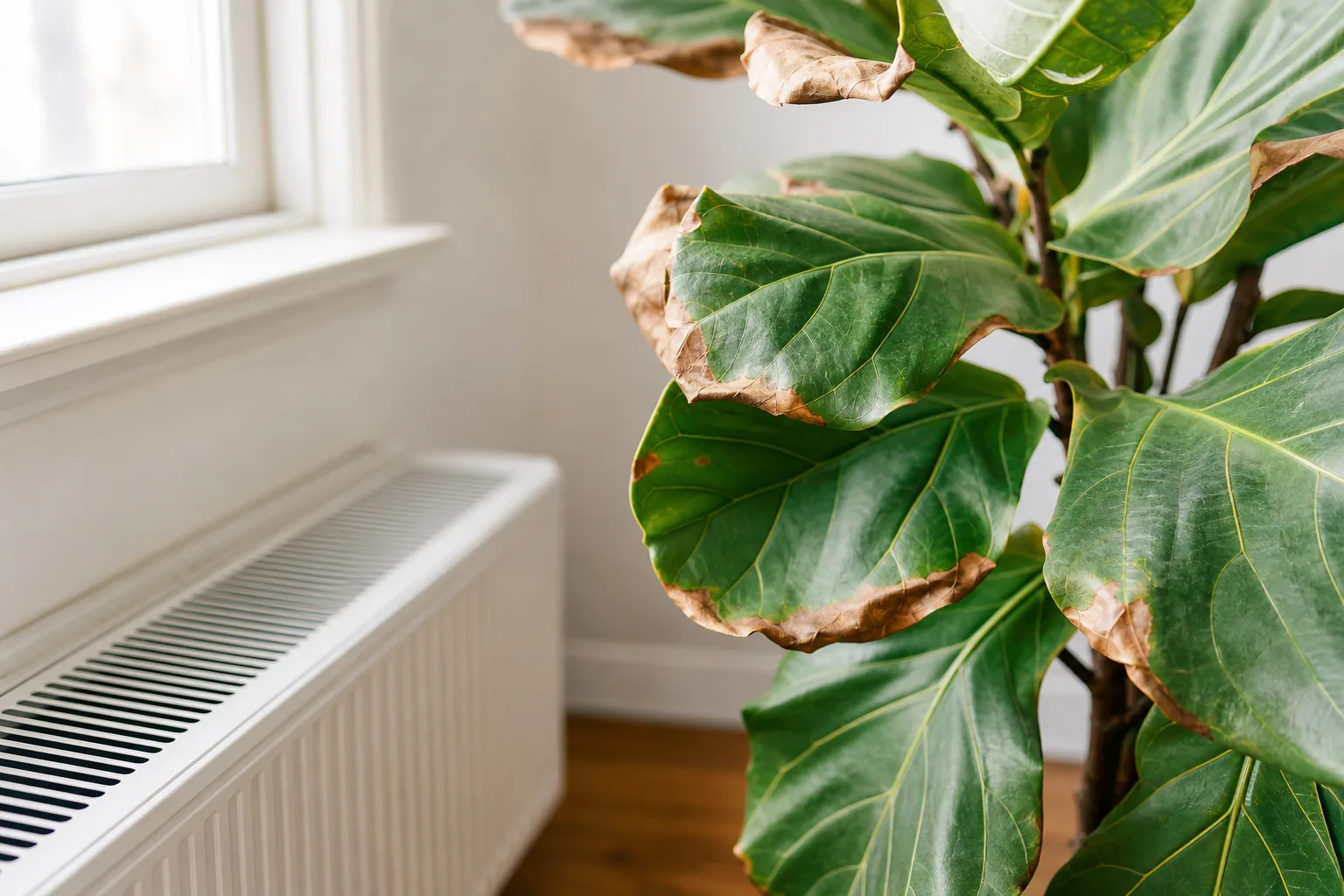
Low humidity on fiddle leaf fig shows as brown crispy leaf margins and tip dieback while stems stay firm-especially in heated winter rooms below 30% RH. First step: place a hygrometer at canopy height; if the reading is under 40%, run a humidifier near the tree and slide the pot away from radiators and AC vents before you change watering or fertilizer.
Low Humidity on Fiddle Leaf Fig: Causes, Checks & Fixes
This guide covers low humidity on Fiddle Leaf Fig. See also the general Low Humidity guide, watering, and light pages for this plant.
Low Humidity on Fiddle Leaf Fig: Causes, Checks & Fixes
Quick answer
Ficus lyrata - the fiddle leaf fig - loses water from its large violin-shaped leaves faster than many common houseplants. In dry indoor air, foliage can lose moisture through transpiration quicker than roots replace it, which produces light brown, papery margins and tip dieback even when your watering rhythm has not changed.
First step: measure relative humidity at canopy height with a hygrometer. If the reading is below 40%, run a small humidifier within a few feet of the tree and move the pot away from radiators, heat registers, and AC blowers before you repot, fertilize, or prune damaged leaves. NC State Extension notes that fiddle-leaf fig performs best in medium relative humidity with temperatures above 55°F (13°C) - and that brown spots can follow fluctuating room temperatures from heating or cooling vents.
This page covers dry-air stress on F. lyrata. For margin browning from salt buildup, tap water, or mixed causes, see brown tips. For stippling and webbing in dry warm rooms, see spider mites.
What low humidity looks like on Fiddle Leaf Fig
Low-humidity damage on fiddle leaf fig is a margin-first pattern on firm, upright stems - not the whole-plant collapse of severe underwatering.
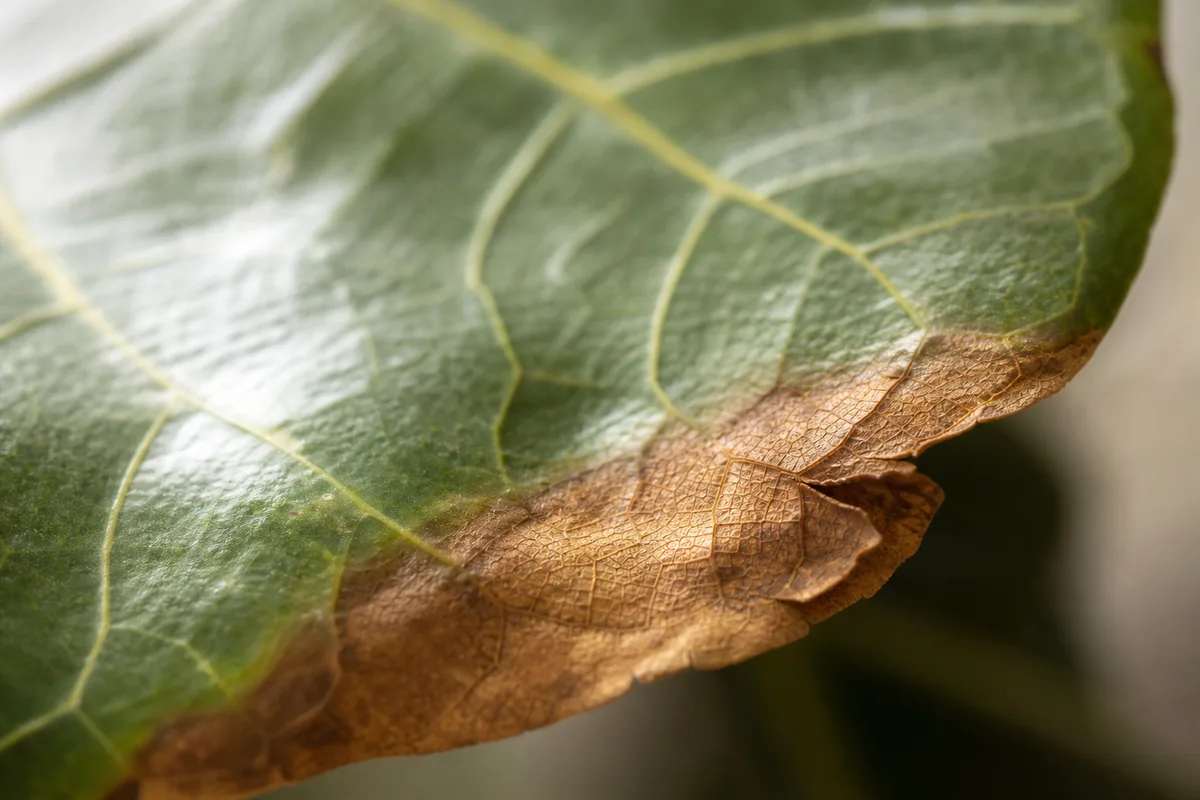
Low Humidity symptoms on Fiddle Leaf Fig - compare with healthy tissue on the same plant.
The signature sign is dry, light brown, papery edges that start at the farthest leaf margin and creep inward slowly over weeks. Tip dieback on newer leaves is common when heated winter air strips moisture from large surfaces. Affected tissue feels crispy and thin, not soft or water-soaked. Older leaves often show damage first because they have the greatest exposed edge length.
Leaves usually stay oriented normally - they do not hang limp unless a second problem (drought or root failure) is also present. The pot weight often feels normal for your schedule: top two inches dry on the usual interval, which confuses owners who assume brown edges always mean “water more.”
Seasonal timing is a strong clue. Damage that accelerates after the furnace starts, or on trees parked beside a south window with a heat register below, fits dry air more than a sudden root crisis. Multiple leaves browning at outer edges simultaneously - while inner leaf tissue stays green - points to environmental moisture loss.
Brown crispy edges vs. tip dieback vs. underwatering wilt
| Pattern | What you see on F. lyrata | Stem / pot clues | RH clue |
|---|---|---|---|
| Low humidity (this page) | Dry papery margins; tips crisp first; slow spread | Firm stems; typical pot weight | Hygrometer under 40% near canopy |
| Underwatering | Crisp edges plus limp petioles; dull, droopy canopy | Very light pot; dry mix deep down | RH may be normal; soil is dry |
| Sun scorch | Bleached or tan patches on sun-facing side | Often one window side only | Not RH-driven |
| Salt / fertilizer burn | Tip burn after feeding; crust on soil surface | Recent fertilizer; no vent proximity | RH often adequate |
| Spider mites | Fine stippling on undersides; webbing at leaf bases | Warm dry microclimate | Low RH plus pest signs |
Why Fiddle Leaf Fig gets low humidity
Large-leaf transpiration in dry indoor air
Each mature fiddle-leaf-fig leaf can reach 12 to 18 inches long with a broad violin shape - a huge evaporative surface. Missouri Botanical Garden describes Ficus lyrata as noted for large, lyre-shaped foliage on a tree-like houseplant frame. Those leaves transpire constantly; when ambient humidity is low, the plant loses water from foliage faster than roots can supply it, and margins desiccate first because they are farthest from the water-conducting midrib.
This is why fiddle-leaf fig reacts more visibly to dry air than a small-leaved succulent in the same room.
Winter heating below 30% RH
Winter houseplant guidance from University of Minnesota Extension notes that humidity levels are low indoors during winter months, which hurts humidity-sensitive plants. Furnaces replace moist air with dry heated air; many homes that read near 40% RH in summer drop toward 20–30% once heat runs steadily. That gap shows up on fiddle-leaf-fig edges within weeks even when watering is unchanged.
Heat registers and AC vents
NC State Extension specifically warns that brown spots may occur if room temperatures fluctuate from heating or cooling vents. Hot dry air from radiators and registers pulls moisture from the nearest leaves within days. Cold AC blowers do not humidify - they dehydrate leaf surfaces they strike. Floor trees beside sofa-height vents often show one-sided margin burn on the foliage closest to the airflow.
Draft exposure compounding moisture loss
Fiddle-leaf fig is stability-sensitive and dislikes cold drafts below about 55°F (13°C). A winter window leak plus dry furnace air stacks two stresses: cold-damaged tissue browns faster, and low RH keeps new growth from recovering cleanly. See the fiddle-leaf fig overview for full temperature and humidity targets.
How to confirm the cause
Work through these checks in order:
- Hygrometer at canopy height - Place a digital hygrometer beside the top leaves, not on the floor. Readings under 40% support low humidity; 40–60% suggests look elsewhere first.
- Heat-path scan - Note distance to radiators, floor registers, portable heaters, and AC vents. Leaves within three feet of a winter heat blast often crisp at margins first.
- Soil moisture fork - Press two inches into the mix. Normal dry-down with firm stems and edge-only browning fits dry air. Bone-dry throughout with a light pot points to underwatering overlap - fix both if present.
- Damage pattern - Margin-first, slow, winter-linked browning fits humidity. Bleached sun-facing patches fit light stress. Stippling and webbing fit mites - see spider mites.
- Recent care timeline - New fertilizer, repot, or move in the last month? Rule out salt burn and relocation shock before blaming humidity alone.
- Leaf undersides - Fine pale dots or silk threads mean pests, not humidity - treat pests before running humidity fixes only.
Lookalike summary
Low humidity is confirmed when RH is low at the canopy, stems are firm, soil moisture is appropriate, and damage is dry margin/tip browning without stippling or bleached sun patches. When two causes overlap - dry air plus underwatering - address humidity and placement first, then adjust watering only if the pot is genuinely dry at depth.
First fix for Fiddle Leaf Fig
Run a humidifier near the canopy until RH reaches 40–60%, and move the pot away from heat registers and AC blowers - as one placement-and-humidity correction.
Choose a cool-mist or evaporative humidifier sized for the room; point output so mist drifts toward leaves without soaking them overnight on cold windows. Tropical fern guidance from UMN Extension notes that misting is not very effective for raising ambient humidity and can increase foliar disease risk - room humidifiers work better than occasional spritzing on large Ficus leaves.
Move the tree so no leaf sits in the direct path of a heat register or radiator. Even three to six feet of separation can stop active margin burn. Do not relocate across the house the same week - fiddle-leaf fig drops leaves when moved; slide the pot within the same room if possible.
Humidifier vs. pebble tray
| Method | Best for F. lyrata | Limitation |
|---|---|---|
| Humidifier | Whole-room RH lift; winter heating season | Needs refilling; keep cord safe from saucers |
| Pebble tray | Small boost near pot base | Rarely enough alone for a tall floor tree in dry heat |
| Grouping plants | Mild microclimate | Modest effect in large open rooms |
| Misting | Brief surface wetting only | Does not sustain 40–60% RH; wet leaves in poor airflow invite spotting |
UMN winter houseplant tips recommend pebble trays and grouping for humidity-loving plants; pair those with a humidifier when a hygrometer stays under 40%.
Step-by-step recovery
After humidifier and placement correction:
- Hold other variables stable for fourteen days - No repot, no fertilizer, no heavy pruning the same week.
- Monitor RH daily until readings stabilize in the 40–60% band at canopy height.
- Trim only fully necrotic margins if they snag or look unsightly - use clean scissors; wear gloves because milky latex sap irritates skin.
- Scout undersides weekly - Spider mites thrive in dry, warm conditions; dry-air recovery fails if pests colonize stressed foliage.
- Dust leaves gently - A damp cloth monthly keeps stomata clear so corrected humidity actually benefits gas exchange.
- Adjust watering only after RH stabilizes - Brighter, more humid recovery zones may change dry-down rate slightly; check depth, do not auto-water more because edges looked dry.
Recovery timeline
Margin spread should slow within one to two weeks once RH rises and heat paths are removed. Existing brown tissue does not turn green - judge progress by new growth with clean edges.
Expect the first healthy new leaf within three to six weeks during spring or summer active growth if humidity and light are both adequate. Winter corrections may stall until longer days return - keep the humidifier running rather than moving the tree repeatedly.
Worsening signs: browning marching rapidly into leaf centers on multiple leaves while soil stays wet (rule out overwatering); stippling with webbing (mites); soft stems at the base (root failure - not humidity alone).
What not to do
Do not soak the plant because edges look dry - soggy roots on Ficus lyrata trigger leaf drop faster than dry margins. Confirm soil dryness before adding water.
Do not mist heavily twice daily as a humidity strategy - brief surface moisture does not fix 25% room RH and can leave wet foliage that spots in dim winter light.
Do not fertilize to “heal” brown edges - salts on stressed roots burn tips further. Wait until new growth looks normal for two weeks.
Do not stack repotting, pruning, and pesticide on the same day you add a humidifier. Make one care correction at a time so you can read the plant’s response.
Do not park the tree directly above a pebble tray if the pot base touches standing water - root rot on Fiddle Leaf Fig follows, and humidity was not the real problem.
How to prevent low humidity next time
Target 40 to 60% RH year-round at canopy height - run a humidifier from first furnace use through late winter in dry climates. A $10 hygrometer removes guesswork.
Keep the tree away from heat registers, radiators, fireplaces, and AC vents when you choose a “forever spot.” See repotting recovery guidance for the same 40–60% band after root work.
Group plants slightly to share transpired moisture, but do not crowd so tightly that airflow dies - fungal spotting rises in stagnant humid pockets.
Scout weekly in heating season; dry air and spider mites share the same environmental trigger.
For complete species care - light, watering, stability, and toxicity - see the fiddle-leaf fig overview.
Pet safety when trimming damaged foliage
Ficus lyrata is toxic to cats and dogs if ingested, with oral irritation and vomiting possible. Milky latex sap irritates human skin - wear gloves when trimming crisp edges or removing leaves. Bag trimmed debris and keep it away from pets that chew fallen foliage.
Conclusion
Low humidity on fiddle leaf fig is a large-leaf physics problem in small-room winter air: margins dry because transpiration outruns supply, not because the plant is mysteriously “unhappy.” Confirm with a hygrometer under 40%, raise RH to 40–60% with a humidifier, and pull the tree off the heat-register path - then wait for clean new leaves as proof. Brown edges already necrotic will not re-green; stability and humidity beat repeated watering or relocation. Get the air right, and Ficus lyrata holds the glossy violin leaves that justify the floor space.
This guide synthesizes NC State Extension, University of Minnesota Extension, Missouri Botanical Garden, and LeafyPixels fiddle-leaf fig overview, watering, light, repotting, brown tips, and spider mites pages. Claims were checked against those sources before publication.
Related guides
- Fiddle-leaf fig care overview - temperature, humidity, large-leaf biology, toxicity
- Fiddle-leaf fig watering - dry-down rhythm vs. dry-air margin browning
- Brown tips on Fiddle Leaf Fig - salt, water quality, and overlapping margin damage
- Spider mites on Fiddle Leaf Fig - dry warm air pest outbreaks
- Underwatering on Fiddle Leaf Fig - light pot and whole-leaf wilt vs. edge crisping
- Fiddle-leaf fig repotting - 40–60% RH during post-repot recovery
When to use this page vs other Fiddle Leaf Fig guides
- Fiddle Leaf Fig watering guide - Use for routine moisture checks before assuming low humidity is the main issue.
- Fiddle Leaf Fig problems hub - Browse all 17 common issues on this species.
- Brown Tips on Fiddle Leaf Fig - Different entry point when symptoms overlap with low humidity.
- Leaf Drop on Fiddle Leaf Fig - Different entry point when symptoms overlap with low humidity.