Underwatering on Fiddle Leaf Fig: Causes, Checks & Fixes
Quick answer
Underwatering on fiddle leaf fig means the root zone stayed dry too long for *Ficus lyrata* to replace water lost through its large leathery leaves. First step: bottom-water until the surface mix moistens, drain completely, then resume watering only when the top 2 inches of center soil feel dry.
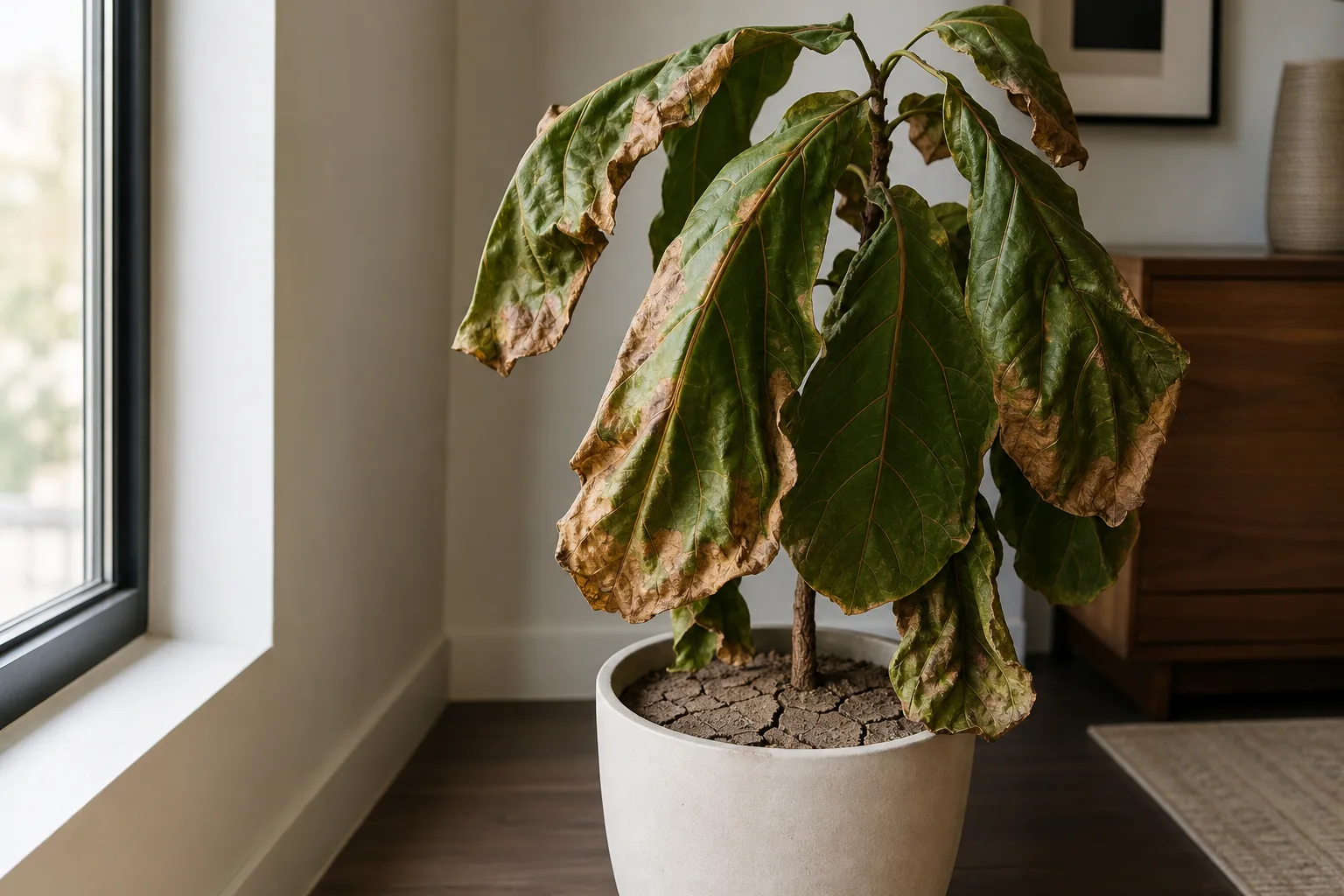
Underwatering on Fiddle Leaf Fig: Causes, Checks & Fixes
This guide covers underwatering on Fiddle Leaf Fig. See also the general Underwatering guide, watering, and light pages for this plant.
Underwatering on Fiddle Leaf Fig: Causes, Checks & Fixes
Quick answer
You come home from a two-week trip and your seven-foot fiddle leaf fig (Ficus lyrata) has dropped its posture-large violin-shaped leaves hanging limp, soil shrunken and pale, the pot so light you can tilt it with one hand. That pattern is underwatering: the root zone stayed dry longer than this tree could replace the water its broad leathery leaves lose every day.
First step: bottom-water the nursery pot in a basin until the surface mix darkens, then drain completely for 15 to 30 minutes. One deep soak rewets a pulled-away root ball better than repeated top sips that run down the dry gap along the pot wall. After that, resume watering only when the top 2 inches of center soil feel dry-the same trigger in our fiddle leaf fig watering guide and NYBG’s recommended check.
Wet soil vs. dry soil - when is it really underwatering?
Fiddle-leaf fig is famous for wilt that mimics both thirst and drowning. Use pot weight and depth moisture before you pour.
| Pattern | Pot weight | Soil at 2 inches (center) | Leaf signs | What it usually means |
|---|---|---|---|---|
| Underwatering | Light | Dry, crumbly | Limp leaves, crisp edges on dry mix | Drought |
| Overwatering | Heavy | Wet, cool | Limp leaves on damp mix, brown spots | Root failure |
| Low humidity | Normal | On schedule | Crisp margins, firm stem | Dry air |
| Sun scorch | Normal | On schedule | Bleached or tan patches on sun-facing tissue | Light burn |
| Relocation shock | Normal | On schedule | Sudden drop after a move | Environmental |
If the pot is heavy and soil stays damp while leaves droop, stop-adding water makes overwatering worse. If the pot is light and mix is dusty 2 inches down at center depth, proceed with rehydration. For advanced root failure, see root rot.
What underwatering looks like on Fiddle Leaf Fig
Ficus lyrata leaves are smooth, thick, and leathery-not fuzzy. Each mature indoor blade can reach 12 to 18 inches long, so when turgor fails the whole canopy sags visibly.
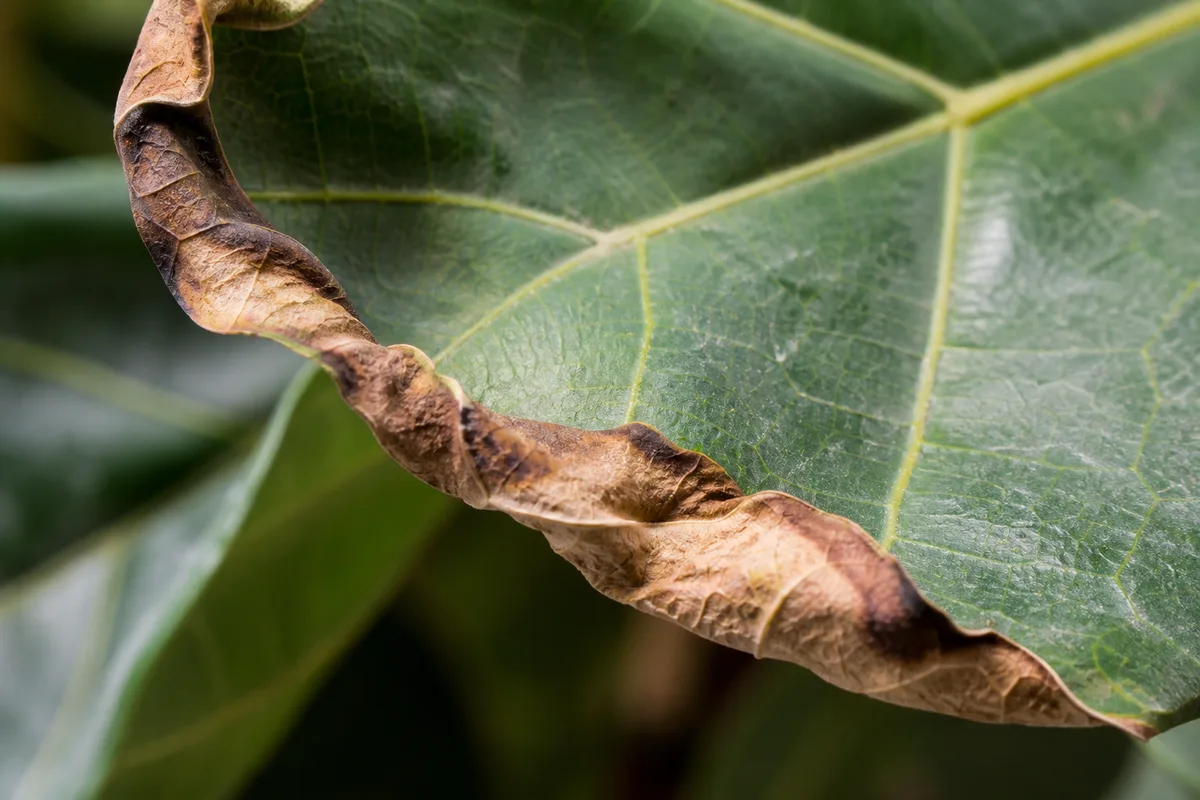
Underwatering symptoms on Fiddle Leaf Fig - compare with healthy tissue on the same plant.
Typical above-soil signs include:
- Drooping or limp violin-shaped leaves that feel dry or papery at the edges-not soft and darkening like overwatered tissue
- Brown, crispy margins, often starting at the tips or along the wavy edge of older lower leaves
- Soil pulled away from the pot wall, sometimes with a visible gap between mix and container
- A very lightweight pot when you lift it by the rim
- Older lower leaves dropping after repeated dry cycles, sometimes after turning brown rather than yellow
Below soil, healthy roots stay firm and pale tan or white. Underwatering rarely turns roots mushy-that pattern belongs to rot. If you unpot during a dry spell, you may see fine root tips dried and brittle, but the main root mass should still feel solid.
Fiddle-leaf-specific clue: Overwatering on this species often yellows lower leaves while soil stays damp and the pot feels heavy. Underwatering more often produces limp large leaves with bone-dry center mix. If margins are brown but leaves feel firm and soil moisture is normal, suspect low humidity in heated winter air instead-NYBG notes brown edges frequently indicate low humidity, not thirst alone.
Why Fiddle Leaf Fig gets underwatered
Fiddle-leaf fig tolerates brief drought better than constant sogginess-which makes many owners under-water after a scare with overwatering or root rot. NC State Extension describes Ficus lyrata as preferring moist, well-drained soil while also noting the species is sensitive to overwatering. That pairing pushes cautious growers toward long dry gaps that starve large leaves in bright light.
Common triggers on this species:
Large leaves and dry winter air accelerate transpiration
Each broad leaf loses moisture fast in heated rooms where humidity routinely falls below 40%. The fiddle leaf fig overview ties large-leaf transpiration to winter edge bronzing. A tree that survived a 14-day winter interval may need checks every 7 to 10 days once spring growth resumes in the same window.
Fear of overwatering after past root rot
After losing lower leaves to wet soil, many owners stretch intervals until the mix goes dust-dry. Chronic drought damages fine roots too-then the plant wilts on soil that looks merely “due” for water because uptake capacity is reduced.
Small or root-bound pots exhaust moisture quickly
A dense root mass in a nursery pot can drink available moisture in a day or two during summer. Rim soil on a fourteen-inch floor tree may look dry while the center still holds moisture-but the opposite also happens: surface looks damp while center is parched in an oversized decorative pot with sparse roots.
Bright windows and heating vents
Fiddle-leaf fig in bright indirect light transpires heavily. Radiators, fireplaces, and HVAC vents accelerate evaporation from large leaf surfaces and dry the mix faster than a dim-corner schedule allows.
Hydrophobic peat-heavy mix after long drought
When mix stays dry for weeks, peat can repel water. You pour from the top; water channels down the gap between soil and pot wall and exits the bottom without saturating the center-so the plant looks watered but stays thirsty. NYBG recommends bottom-watering to force hydrophobic soil to rehydrate on sizeable trees.
Calendar watering and travel gaps
Vacations, “water every two weeks” rules, and fear of leaf drop after relocation all leave floor trees dry longer than their leaf surface area can sustain.
How to confirm the cause
Work through these six checks before soaking or repotting:
- Pot weight - Lift the container. A light pot with limp leaves strongly suggests drought. A heavy pot with drooping leaves suggests overwatering or root damage instead.
- Moisture at 2 inches (center depth) - Insert a finger or bamboo skewer at the center of the pot, not only the rim where mix dries fastest. Dusty, crumbly soil throughout confirms dry conditions. Damp, cool mix at depth rules out underwatering as the main issue.
- Leaf texture - Pinch a drooping leaf. Papery, brittle, or deeply curled edges fit drought. Soft, darkening tissue with wet soil fits rot.
- Edge pattern vs. turgor - Crisp brown on limp leaves with dry soil points to underwatering or combined drought and low humidity. Brown tips on firm leaves in a dry room with evenly moist soil points mainly to humidity.
- Recent care history - Travel, a new “water sparingly” rule, or a move to a brighter window can explain sudden thirst without any disease involved.
- Drainage and hydrophobic check - Pour a small amount on the surface. If water runs through in seconds and the pot still feels light, the mix may be repelling water-not simply “due” for a normal drink.
If soil is dry at center depth, the pot is light, and leaves feel thin or crispy, you have enough evidence to proceed with rehydration. You do not need to unpot first unless the plant fails to perk up after a proper soak.
First fix for Fiddle Leaf Fig
Bottom-water until the mix is evenly moist, then drain completely.
Set the nursery pot in a basin of room-temperature water deep enough to reach the pot’s lower third. Leave it until the surface darkens-often 20 to 45 minutes for a moderately dry six-inch tabletop plant, and up to 60 minutes for a severely drought-stressed fourteen-inch floor tree. Remove the pot, let it drain in the sink or tub for 15 to 30 minutes, and empty the saucer. Do not leave the tree sitting in water overnight.
This single deep soak is the correct first response. It rewets a shrunken, pulled-away root ball more reliably than pouring a cup from the top, which can run down the dry gap along the pot wall without saturating the center-very dry soil may need to be soaked to wet properly again.
After the soak, wait until the top 2 inches of center mix feel dry before watering again. Your job for the next two weeks is observation, not extra treatments.
Step-by-step recovery after chronic dryness
Once the first soak is done, follow this order:
- Keep stable bright indirect light - Do not move a drought-stressed tree to a new corner for “recovery.” Ficus lyrata drops leaves from too much or too little water and from relocation even when watering is correct. Good light helps steady uptake without hot afternoon sun on dehydrated blades.
- Hold fertilizer - Do not feed until new growth looks firm for at least two weeks. Stressed roots absorb salts poorly.
- Trim only fully dead leaves - Brown crispy tissue will not recover. Snip leaves that are mostly dead for hygiene, avoiding heavy pruning while the plant rehydrates. Wear gloves; milky sap can irritate skin.
- Address hydrophobic mix if water runs through instantly - Bottom-water twice in one session, or poke a few shallow holes in the dry surface before soaking. Repot into fresh well-draining mix only if repeated soaks fail to hold moisture-see our soil guide.
- Raise humidity if edges keep browning on otherwise turgid leaves - A humidifier helps once roots are wet again; misting leaves is not a substitute for soil moisture. See low humidity on fiddle leaf fig.
- Adjust pot size only if root-bound - If roots circle densely and mix dries within two days every cycle, plan a spring repot into a container one size up with drainage holes-not as an emergency drought fix, but once hydration is stable.
Recovery timeline
Leaf turgor often improves within 12 to 48 hours after a thorough soak if roots are still healthy. Stems should stiffen and leaves hang closer to their normal angle by the next day.
New growth is the reliable success marker. Expect a fresh leaf from the stem tip within two to four weeks during warm active growth; winter recovery may take longer because uptake slows in low light.
Old damage does not heal. Crisp margins stay crisp; dropped leaves do not return. Judge recovery by new growth, not by old blemishes.
Worsening signs after soaking: continued collapse with soggy soil (overcorrection), stems shriveling and not re-firming within three days, or widespread leaf drop with still-dry mix (possible root loss from long drought). Those warrant unpotting to inspect roots.
Lookalike symptoms to rule out
- Overwatering - Limp leaves with wet, heavy soil, yellow lower leaves, and sometimes soft brown spots. Wilt with moist mix means roots may be failing, not thirsty. See overwatering on fiddle leaf fig.
- Low humidity - Brown tips on firm, turgid leaves while soil moisture is normal. Fix humidity, not watering frequency.
- Post-move leaf drop - Fiddle-leaf fig often sheds leaves after relocation even when watered correctly. A firm pot weight and moist (not swampy) soil with gradual drop over two weeks fits acclimation, not drought. See leaf drop.
- Root rot - Mushy roots, sour smell, and wilt despite wet soil. Do not keep soaking; dry down and inspect roots instead.
- Heat stress near a vent - Crisp edge bronzing with fast drying; combine rehydration with moving the pot off the hot air path.
- Gradual sag without the wet-soil paradox - Compare with drooping leaves and wilting for related diagnostic paths.
Mistakes to avoid
Do not drench daily after one dry spell-that swings fiddle-leaf fig into overwatering and invites root rot in cool, slow-drying conditions. Avoid misting instead of soaking; surface moisture does not rehydrate roots. Do not fertilize a collapsed plant to “perk it up.” Skip repotting on day one unless the mix is so hydrophobic that two bottom-soaks failed. Do not assume all brown tips mean underwatering-check soil at center depth first, because large leathery leaves brown easily in dry air alone. Do not relocate a drought-stressed tree to the shower without expecting some leaf drop from change stress.
Use room-temperature water for large root zones; tepid water absorbs more evenly into dry mix than cold water shock on stressed roots.
How to prevent underwatering next time
Build a habit around pot weight and center-depth moisture, not a calendar:
- Lift the pot before each watering; light means drink, heavy means wait.
- Water when the top 2 inches of center mix feel dry, then soak until a little excess drains out.
- Expect more frequent checks in summer and bright windows, fewer in winter-matching slower uptake from October through February in most homes.
- Keep the tree in bright indirect light so it grows steadily; just remember brighter spots dry faster.
- Refresh peat-heavy mix that has gone hydrophobic every few years so water absorbs evenly.
- Empty saucers within 30 minutes after watering so you never confuse stale standing water with proper hydration.
When to worry
Act the same day if the plant is fully wilted with soil shrunken and cracked, especially in a hot, sunny window. Prolonged severe drought can desiccate fine roots; recovery becomes uncertain if stems shrivel and do not re-firm after one good soak.
Also escalate if leaves drop in clusters while soil stays bone dry for weeks, or if the plant perks up briefly after watering then wilts again within two days-that can mean damaged roots from past drought or rot from later overcorrection. Unpot, inspect root firmness, and adjust watering based on what you find.
If the tree stays limp on moist soil 48 hours after a correct soak, do not keep pouring-inspect roots and compare with our root rot guide. Contact your local cooperative extension office if repeated drought cycles coincide with widespread root loss.
When to use this page vs. the watering guide
Use the fiddle leaf fig watering guide for your normal rhythm: top-two-inches-dry rule, finger and moisture-meter technique, seasonal interval adjustments, and saucer discipline.
Use this page when the tree is already showing drought stress-limp large leaves, light pot, dry pull-away mix-and you need to confirm underwatering, distinguish it from wet-soil wilt, execute one rescue bottom-water, and recover from hydrophobic mix without swinging into overwatering.
Related fiddle-leaf-fig guides
- Overview - species biology, placement, and troubleshooting hub
- Watering - ongoing moisture rhythm and top-two-inches-dry rule
- Overwatering - wet-soil wilt trap on large leaves
- Root rot - when rescue soaks fail
- Wilting - acute collapse diagnostic
- Drooping leaves - gradual sag patterns
- Low humidity - crisp edges without thirst
- Leaf drop - shedding after stress or moves
Conclusion
Underwatering on fiddle-leaf fig is usually a rhythm problem, not a mysterious disease: the pot dried faster than you watered, often after cautious under-watering, a bright-season shift, or a travel gap on a large floor tree. Confirm with a light pot and dry mix 2 inches down at center depth, bottom-water once, then resume the top-two-inches-dry schedule from the watering guide. Crisp old edges may stay, but firm new leaves tell you Ficus lyrata is back on track.
Related tool
Use the Plant Watering Calculator to narrow causes for underwatering on this plant before changing multiple variables at once.