Overwatering on Fiddle Leaf Fig: Causes, Checks & Fixes
Quick answer
Overwatering on Fiddle Leaf Fig means roots stay wet too long: the pot stays heavy, leaves droop on damp soil, and brown patches spread from lower leaves. First step: stop watering until the top two inches are dry in the center, then decide between gentle dry-down recovery or urgent root rescue.
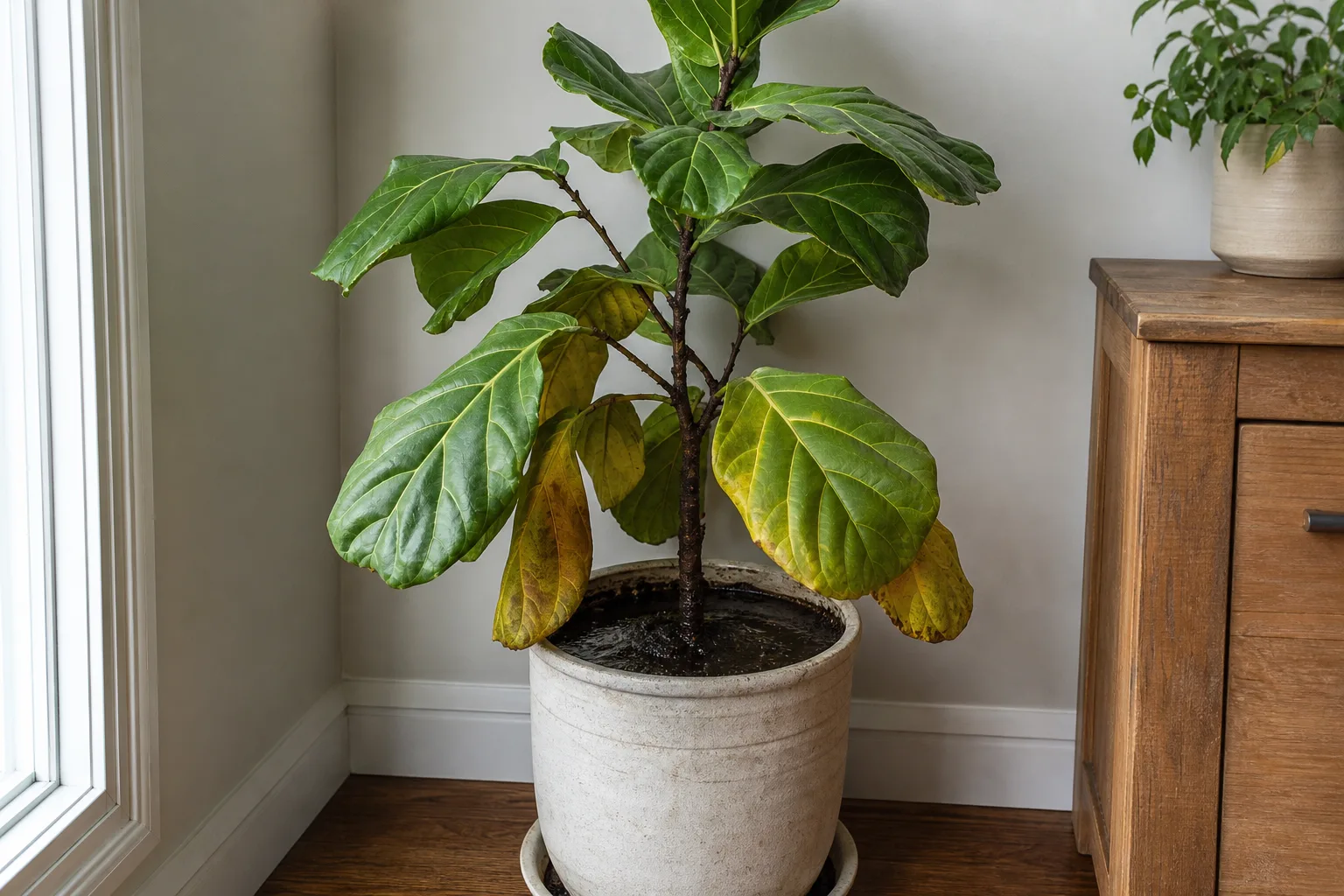
Overwatering on Fiddle Leaf Fig: Causes, Checks & Fixes
This guide covers overwatering on Fiddle Leaf Fig. See also the general Overwatering guide, watering, and light pages for this plant.
Overwatering on Fiddle Leaf Fig: Causes, Checks & Fixes
Quick answer
Overwatering on Fiddle Leaf Fig (Ficus lyrata) means the root zone stays saturated long enough to reduce oxygen around roots, so leaves can wilt even though soil is still wet (Clemson HGIC). With this large-leaved species, that “wilt-on-wet-soil” trap is common: owners see limp foliage and add more water, which worsens root stress.
First fix: pause watering until the top two inches are dry in the center of the root ball. Use pot weight and a chopstick or moisture probe in the middle, not just surface feel. If decline continues on wet soil, move immediately to root-rescue steps rather than waiting.
Overwatering vs. similar Fiddle Leaf Fig problems
| Pattern | Pot weight | Moisture at 2 inches | Typical leaf pattern | Most likely issue |
|---|---|---|---|---|
| Overwatering | Heavy for many days | Damp/cool | Droop plus lower-leaf brown patches | Root stress from excess moisture |
| Underwatering | Light | Dry | Crisp edges, curl, wilt that improves after deep drink | Drought stress |
| Low humidity | Variable | Usually appropriate | Crispy margins, tip browning, leaves mostly firm | Dry air stress |
| Bacterial leaf spot | Variable | May be appropriate | Dark lesions, often with yellow halo | Leaf pathogen |
| Relocation or draft stress | Variable | Variable | Sudden droop or drop after move/temperature change | Environmental shock |
If your pattern is unclear, compare with underwatering, wilting, and low humidity. If roots are soft or trunk tissue is soft at the base, switch to the root rot guide immediately.
What overwatering looks like on Fiddle Leaf Fig
Early signs
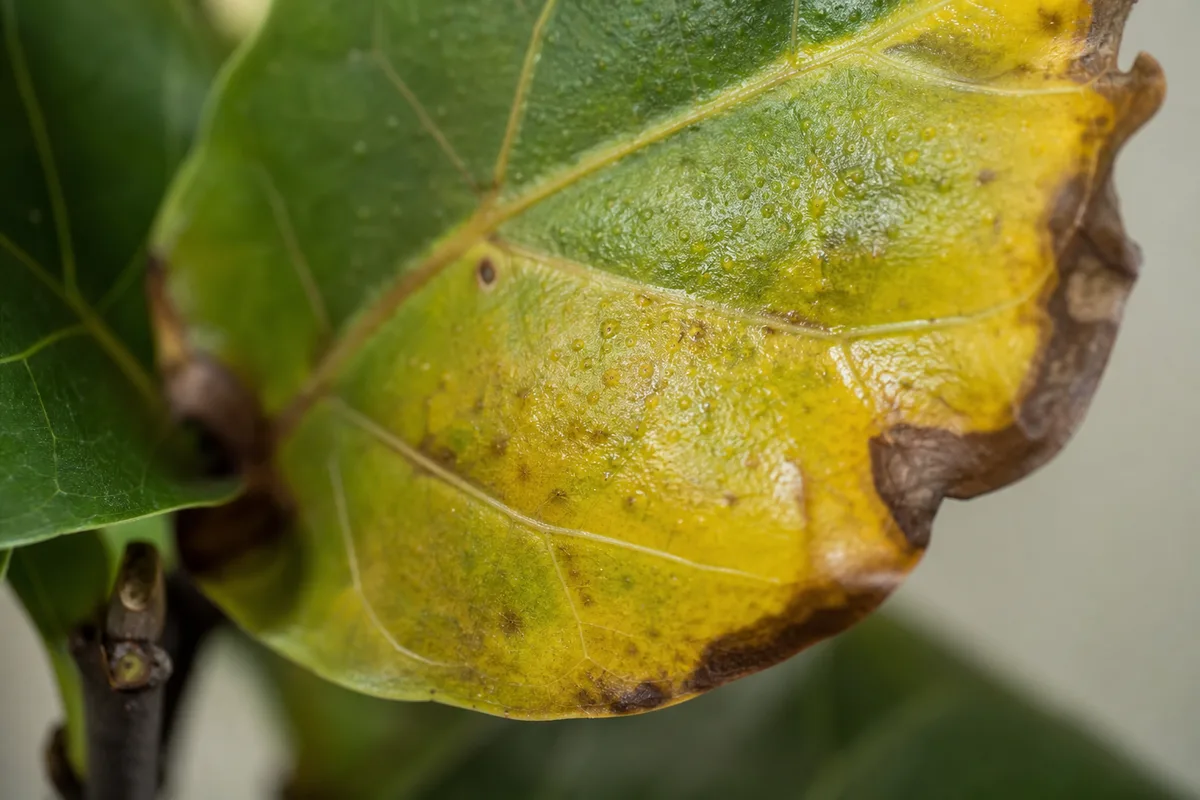
Overwatering symptoms on Fiddle Leaf Fig - compare with healthy tissue on the same plant.
- Pot remains heavy several days after watering
- Leaves look limp even though mix is still damp
- Brown patches begin on older/lower leaves first
- Fungus gnats increase around persistently wet mix
- New leaves emerge smaller or stall
These signs matter most when they appear together, not in isolation.
Escalation signs
- Brown patches spread leaf-to-leaf while mix stays wet
- Trunk base feels less firm
- Musty or sour smell appears at drainage holes
- Root tips look tan-to-brown and lose firmness
Healthy fiddle-leaf-fig roots are generally light colored and firm; dark, soft, collapsing roots indicate worsening root failure (NC State Extension).
Why Fiddle Leaf Fig gets overwatered indoors
Fiddle Leaf Fig prefers Fiddle Leaf Fig light guide and a well-drained medium, and should not sit constantly saturated (Missouri Botanical Garden). Most overwatering cases come from mismatch between watering volume and drying speed:
- Oversized containers: extra mix stays wet long after the root ball has taken what it needs.
- Lower light than expected: less photosynthesis means slower water use.
- Dense mix or blocked drainage: water cannot move out quickly enough.
- Decorative cachepots with trapped runoff: roots remain in pooled water.
- Seasonal slowdown: winter growth is slower, so summer cadence stays too wet.
How to confirm overwatering before you act
Follow this order so you do not confuse overwatering with drought:
- Check pot weight: very heavy compared with your normal “needs-water” weight suggests excess water.
- Check center moisture: test two inches down (or deeper in large containers) near center, not only the edge.
- Inspect smell: sour odor supports stagnant wet-media conditions.
- Read spot pattern: lower-leaf wet-soil browning is more consistent with overwatering than dry-air edge crisping.
- Do a root spot-check if worsening: slide root ball partially out; prioritize firmness and color.
The key principle is to water by plant and substrate signals, not by a fixed calendar (Missouri Botanical Garden overwatering guidance).
First fix for Fiddle Leaf Fig
Mild case: dry-down reset
Use this when trunk is firm and decline is slow.
- Stop watering until top two inches are dry in the center.
- Keep bright indirect light stable; avoid moving the plant during recovery.
- Resume with one moderate watering, then fully drain saucer/cachepot.
- Wait again for the same dryness threshold before next watering.
Severe case: same-day root rescue
Use this when base softens, decline is rapid, or roots are clearly mushy.
- Unpot and rinse old media gently from roots.
- Trim only soft, dark, collapsing roots with sterilized shears.
- Repot into an airy mix in a container just slightly larger than the remaining root mass.
- Keep warmth and bright indirect light consistent; avoid fertilizer during acute recovery.
- Rewater cautiously once the refreshed medium begins drying at the top.
For expanded rescue detail, continue with the dedicated root rot protocol.
Recovery timeline and what can recover
If damage is mild, leaf posture may improve over 1-2 weeks after a correct dry-down cycle. A stronger sign of recovery is stable new growth, not old lesion reversal (Missouri Botanical Garden visual guide).
- Weeks 1-2: droop may lessen if roots remain functional.
- Weeks 4-8: new top growth indicates root system is functioning again.
- 2-4 months: canopy density can improve in more severe cases.
Existing brown patches usually stay damaged; judge success by halted spread and healthier new leaves.
When to worry now
Escalate quickly (same day) if any of these appear:
- softening at the stem base
- rapid multi-leaf collapse on wet media
- persistent sour smell plus dark soft roots
- continued decline even after a proper dry-down pause
At that point, delayed action can convert moderate stress into full root rot.
What not to do
- Do not water again just because leaves look dramatic; verify soil condition first.
- Do not move the plant repeatedly while stressed.
- Do not fertilize in active overwatering recovery.
- Do not jump to a much larger pot “for drainage.”
- Do not assume every spot is overwatering; compare against bacterial leaf spot patterns.
How to prevent overwatering next time
Use a repeatable routine:
- Water only when the top two inches are dry in the center.
- Keep drainage holes unobstructed and empty collected runoff promptly.
- Match watering frequency to light and season.
- Use a chunky, oxygen-friendly mix for indoor containers.
- Recheck after environmental changes (new room, lower winter light, AC draft).
For broader care rhythm, see the Fiddle Leaf Fig overview, wilting, and leaf drop pages.
When to use this page vs other Fiddle Leaf Fig guides
- Fiddle Leaf Fig watering guide - Use for routine moisture checks before assuming overwatering is the main issue.
- Fiddle Leaf Fig problems hub - Browse all 17 common issues on this species.
- Root Rot on Fiddle Leaf Fig - Different entry point when symptoms overlap with overwatering.
- Yellow Leaves on Fiddle Leaf Fig - Different entry point when symptoms overlap with overwatering.
- Wilting on Fiddle Leaf Fig - Different entry point when symptoms overlap with overwatering.
Related Fiddle Leaf Fig guides
- Fiddle Leaf Fig overview
- Fiddle Leaf Fig watering
- Fiddle Leaf Fig light
- Fiddle Leaf Fig soil
- Root Rot on Fiddle Leaf Fig
- Yellow Leaves on Fiddle Leaf Fig
- Wilting on Fiddle Leaf Fig
- Fungus Gnats on Fiddle Leaf Fig
- Mold on Soil on Fiddle Leaf Fig
- Drooping Leaves on Fiddle Leaf Fig
- Fiddle Leaf Fig problems