Root Rot on Fiddle Leaf Fig: Causes, Checks & Fixes
Quick answer
Root rot on fiddle leaf fig means waterlogged mix has suffocated roots on this upright tropical tree. First step: stop watering immediately, confirm the top two inches of center mix are still wet, and check whether the pot is heavy with limp leaves-that wet-soil wilt pattern means damaged roots, not thirst. Unpot only if decline continues after a dry-down pause.
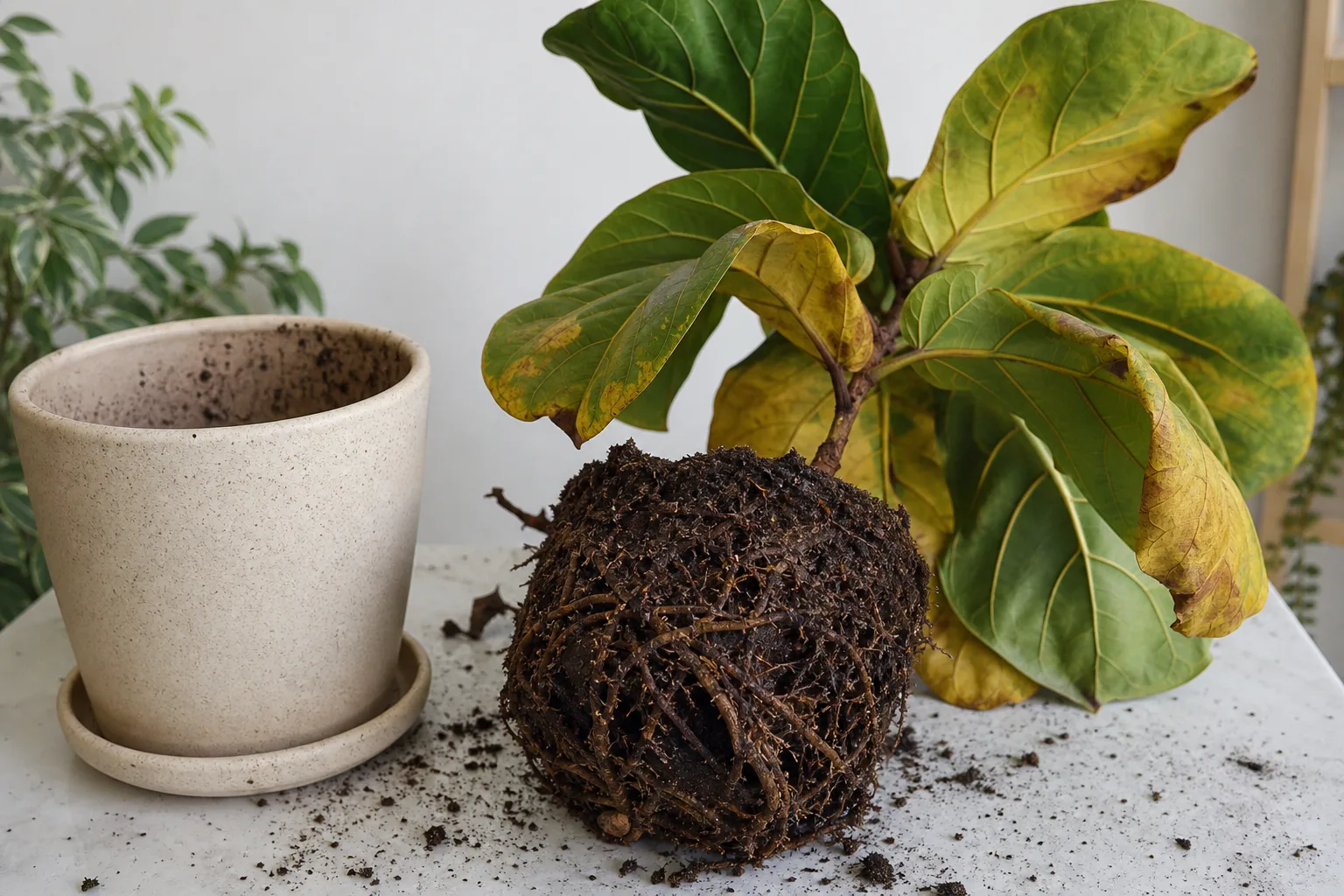
Root Rot on Fiddle Leaf Fig: Causes, Checks & Fixes
This guide covers root rot on Fiddle Leaf Fig. See also the general Root Rot guide, watering, and light pages for this plant.
Root Rot on Fiddle Leaf Fig: Causes, Checks & Fixes
Quick answer
Root rot on fiddle leaf fig (Ficus lyrata) is not a mysterious fungus attacking at random-it is almost always roots suffocating in soil that stayed too wet too long. On this small tropical tree with large violin-shaped leaves that can reach twelve to eighteen inches long indoors, the damage shows up fast: dark mid-leaf spots, multiple leaves dropping within days, limp foliage on a heavy wet pot, and mix that smells sour or stays damp for weeks.
First step: stop watering immediately. Do not repot, fertilize, or prune the canopy on day one. Confirm the top two inches of center mix are still wet, lift the pot-if it feels heavy and leaves hang limp despite moisture, you are in the wilt-on-wet-soil trap, not a drought emergency. Let the upper root zone dry, empty any saucer or cachepot runoff, and stabilize bright indirect light before unpotting.
This page covers confirmed and suspected root rot on upright fiddle-leaf figs-the numbered rescue workflow, stem-cutting salvage when roots are mostly gone, and prevention aligned with the fiddle leaf fig watering guide. For early overwatering before roots collapse, see overwatering on fiddle leaf fig. For the wet-soil wilt paradox without full rot, see wilting.
Root rot vs. other fiddle-leaf-fig problems - why wilt on wet soil matters
The diagnostic that separates root rot from almost every lookalike on Ficus lyrata is this: limp leaves on soil that is still wet at depth. Healthy roots pull water upward; rotting roots cannot, so the large transpiring leaves collapse even though the mix feels damp. Owners see wilt and reach for the watering can-the single fastest way to convert recoverable root stress into full rot.
NC State Extension describes fiddle leaf fig as preferring moist, well-drained, loamy soils while also noting the species is sensitive to overwatering. Those two requirements must stay paired: moist means a full soak followed by partial dry-down, not shiny-wet surface soil all week. When drainage fails-oversized pots, cachepots holding runoff, dense mix, or calendar watering in a dim winter room-anaerobic conditions let pathogens like Pythium and Phytophthora attack roots that were otherwise fine.
Root rot is the end stage of chronic wet-soil failure. Overwatering and poor drainage come first; sour mix, mushy roots, and canopy collapse follow if the wet cycle never breaks.
What root rot looks like on Fiddle Leaf Fig
Root rot on fiddle leaf fig presents on the upright trunk and broad canopy, not on a ground-hugging rosette. Symptoms cluster around the root zone and the large leaves that depend on it.
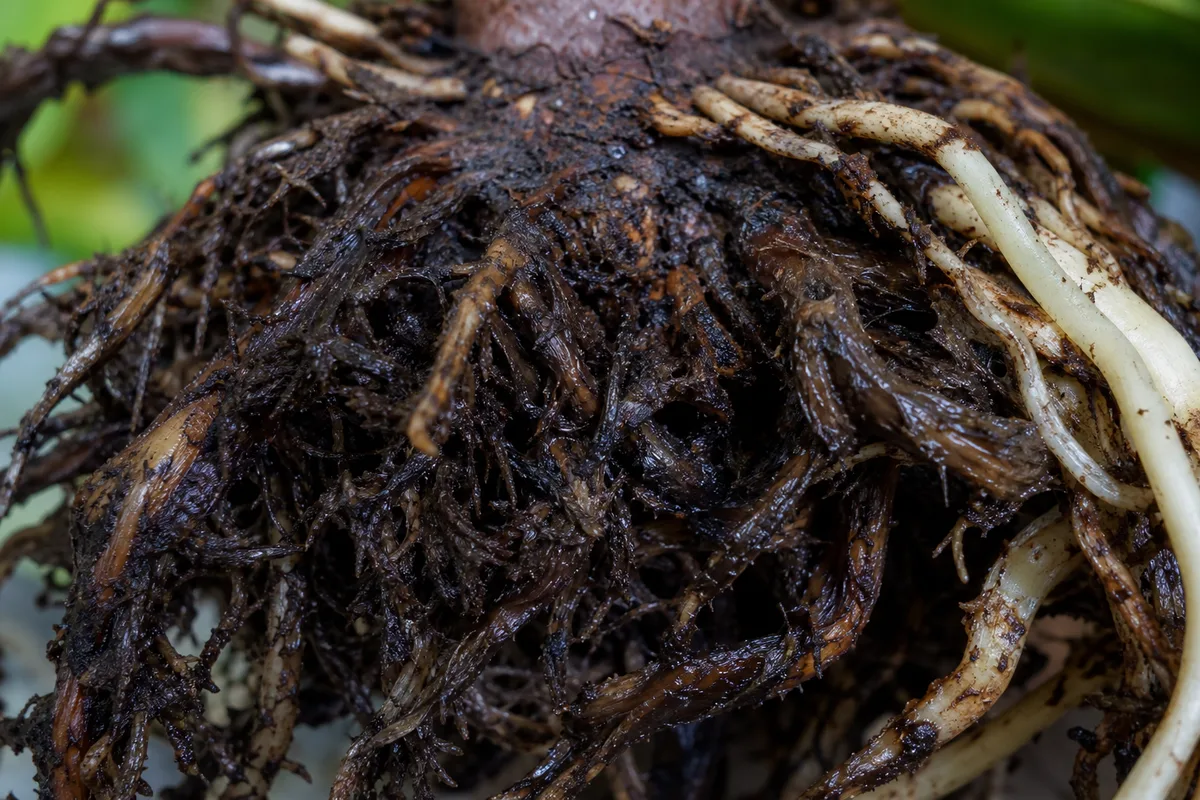
Root Rot symptoms on Fiddle Leaf Fig - compare with healthy tissue on the same plant.
Early signs
- Dark brown or black spots in the middle of leaves - distinct from crisp brown tips from drought or low humidity
- Multiple leaves yellowing or dropping within a short window - sometimes from mid-branch, not only the oldest lowest foliage
- Limp leaves on a heavy pot - mix stays dark and cool at two inches depth ten-plus days after last watering in summer
- Sour or fermented smell from drainage holes or when you probe the surface
- Fungus gnats hovering near soil - wet mix for weeks invites larvae; see fungus gnats if gnats persist after dry-down
- Soft or discolored tissue at the soil line while upper stem still feels firm
Advanced signs
- Mushy brown or black roots - translucent, slimy, or falling away when touched; healthy roots are firm and pale tan or white
- Stem softness spreading upward from the base - crown involvement is urgent
- Canopy collapse - more than three to four leaves drop in a week on wet soil
- New spotting on unfurling leaves after you have already paused water - decline is active, not stabilizing
What root rot usually is not: a single lower leaf yellowing over months (normal senescence-see yellow leaves); sudden wilt one to two weeks after a move with otherwise normal dry-down (relocation shock-see leaf drop); or a light dry pot with crisp edges (underwatering-see underwatering).
Why Fiddle Leaf Fig gets root rot
Fiddle leaf fig evolved in tropical regions of western and central Africa where forest soil drains quickly between rains. Indoors we often replicate the worst part: permanently damp mix in a decorative pot with no exit for stale water. Root rot kills more fiddle-leaf figs than drought.
Overwatering, poor drainage, oversized pots, and cachepots
The classic root-rot trio on large houseplants matches what Ask Extension field experts describe for declining fiddle-leaf figs: too large a container, the wrong soil, and too much water. A seven-foot tree in a fourteen-inch pot with only sparse roots cannot drink the extra soil volume-center mix stays wet for weeks while the owner keeps a weekly two-quart schedule regardless of moisture checks.
Cachepots - decorative outer shells with no drainage - trap every watering session’s runoff unless you empty them within fifteen to thirty minutes. Blocked drainage holes, dense peat or garden soil, and repotting into an even larger pot to “help drying” all deepen the wet cycle. NYBG advises watering thoroughly until runoff exits the bottom, then removing water from the run-off dish after fifteen minutes-skipping that step is one of the most common rot setups in design-forward living rooms.
Low light, cool rooms, and winter dry-down slowdown
In low light from roughly October through February, fiddle leaf fig takes up water more slowly than during active growth. NYBG notes the plant may take up water more slowly in winter low light-yet many owners keep summer volume on autopilot. Mix that never feels lighter within ten to fourteen days in warm bright conditions, or twenty-plus days in a cool dim corner, signals uptake failure before leaves show every symptom.
Large floor trees mislead watering checks: rim soil dries faster than center depth. Watering because the surface looks pale while two inches down stays damp is a direct path to rot. Always probe the center of the pot, not only the edges.
How to confirm the cause
Work through these checks before repotting or trimming.
- Pot weight - Heavy and hard to tilt with limp leaves and no recent soak suggests chronic wetness. Light with crisp edges points away from rot.
- Top-two-inch probe - Insert your finger two to three inches at pot center. Cool clinging soil on a heavy pot with mid-leaf dark spots raises rot suspicion.
- Smell and drainage - Sour mix or water pooling in saucers confirms anaerobic conditions. Confirm holes are open.
- Leaf pattern - Dark spots in leaf centers plus wet soil cluster toward rot. Crisp margins plus dry soil cluster toward drought.
- Stem base - Soft mushy tissue at soil line on wet mix is urgent; firm wood above dry soil is less alarming.
- Unpot inspection - Knock the plant gently from its container. Firm pale roots mean look elsewhere; brown slimy roots with sour mix confirm rot.
| What you find | Most likely cause | First action |
|---|---|---|
| Heavy wet pot, mid-leaf dark spots, sour smell | Root rot / advanced overwatering | Stop water; dry-down pause; then inspect roots |
| Light dry pot, crisp edges, wilt perks after soak | Underwatering | Thorough soak; see underwatering |
| Wilt 1–2 weeks after move, normal dry-down | Relocation shock | Stabilize light; avoid sympathy watering |
| Wet surface 10+ days, limp new growth, long stems | Low light + slow uptake | Brighten; see not enough light |
| Single lower leaf yellow over months | Natural aging | See yellow leaves |
First fix for Fiddle Leaf Fig
Your first action is one clear step: stop watering while you confirm wet-soil wilt versus dry-soil thirst. Do not stack repot, prune, and fertilizer on the same day.
Step 1 - Stop watering and stabilize the environment
Pause all watering until the top two inches of center mix are dry. Empty saucers and cachepots completely. Place the tree in bright indirect light so remaining healthy roots can recover uptake-dim corners keep mix wet longer. Minimize moving the pot; Ficus species drop leaves when relocated, and rescue repotting already stresses the tree.
Wait five to seven days after the top two inches dry before deciding whether unpotting is necessary. Mild root stress sometimes stabilizes once oxygen returns without immediate repotting.
Step 2 - Inspect, trim, air-dry, and repot
If leaves keep declining after a dry-down cycle, unpot and inspect:
- Knock the plant gently from the pot and shake excess mix from roots without tearing firm tissue.
- Identify rotted roots - brown, black, slimy, or hollow sections. Healthy tissue is firm and pale; rotted roots are mushy and dark.
- Trim all mushy roots with clean, sharp shears or pruners. Sterilize blades between cuts with rubbing alcohol if rot is extensive.
- Wear gloves - milky latex sap irritates skin, and fiddle leaf fig is toxic to cats and dogs if ingested. Bag trimmings out of pet reach.
- Let cut root surfaces air-dry two to four hours on newspaper in shade-do not leave roots exposed to direct sun or AC blast.
- Repot into fresh well-drained mix - perlite- or bark-amended potting blend per the soil guide, in a pot sized to the trimmed root mass, not the canopy height. Drainage holes are non-negotiable.
- Water once lightly after repot to settle mix, then let the top two inches dry before the next full soak. Do not fertilize until new growth resumes.
For repotting technique on large trees, see the repotting guide.
Step 3 - When to try stem-cutting salvage
If unpotting reveals most roots are gone but the trunk above the rot line is still firm with healthy nodes, a stem cutting may save genetics the main plant cannot support:
- Cut a six-to-twelve-inch section with at least one leaf and one node, using clean shears.
- Let sap dry one to two hours; root in moist perlite, sphagnum, or water.
- Keep humidity moderate and bright indirect light; avoid waterlogging the rooting medium.
See the propagation guide for detail. Repotting alone is preferable when enough firm roots remain after trim to support existing foliage.
Recovery timeline
Mild root stress - decline stops within one to two weeks after dry-down and saucer discipline; old spotted leaves may not re-green but no new spotting appears.
Moderate rot after trim and repot - expect four to eight weeks before firm new leaves emerge at stem tips. Some lower or damaged blades drop during stabilization-that is normal, not failure.
Severe crown involvement - soft mush spreading through the trunk often means the tree cannot recover regardless of repotting. Judge by firm new apical growth and a pot that cycles from heavy after watering to noticeably lighter within ten to fourteen days in summer-not by saving every old leaf.
Improving: No new mid-leaf spots, mix dries at a predictable rate, stem base stays firm, new buds stay green.
Worsening: Rapid multi-leaf drop continues, mix stays sour ten-plus days after last water in bright light, soft stem climbs upward, dark spots appear on newly unfurling leaves.
What not to do
- Water wilted leaves when soil is wet at depth - folks often mistake wilting for thirst and deepen rot.
- Fertilize a waterlogged or freshly repotted tree - stressed roots do not need feed.
- Repot into a larger pot to “help drying” - extra soil holds moisture longer.
- Use dense garden soil or mix without perlite - see soil guide for fast drainage.
- Move the tree repeatedly during rescue - relocation shock stacks onto root damage.
- Leave standing water in cachepots or saucers - empty within fifteen to thirty minutes after every soak.
- Prune the entire canopy on day one - leaves still photosynthesize; remove only clearly mushy foliage.
How to prevent root rot next time
Prevention on fiddle leaf fig is the same discipline as good watering: check the top two inches at center depth before every pour, soak until drainage runs, empty all runoff, and adjust interval for season-often every seven to ten days in active growth and every ten to twenty-one days in winter for large pots.
Use a right-sized pot with open drainage and fast-draining mix. Avoid cachepots that trap water unless you empty them religiously. Place the tree where it receives bright indirect light so it uses water at a reasonable rate-dim corners slow dry-down and invite wet-soil cycles.
After repotting or any move, reset expectations and watch dry-down for four weeks before trusting an old calendar schedule. For the full prevention workflow, see the watering guide root-rot section.
Pet safety when trimming roots and damaged foliage
Fiddle leaf fig contains compounds that cause oral irritation in cats and dogs if ingested. During root trim and cleanup, wear gloves for latex sap contact dermatitis, bag dropped leaves and root debris, and keep pets away from the work area until surfaces are wiped clean. This is handling context, not veterinary advice-contact your veterinarian if a pet ingests plant material.
Related Fiddle Leaf Fig guides
- Watering - top-two-inch rule, pot-weight test, root-rot prevention workflow
- Overwatering - early wet-soil stress before full rot
- Wilting - wet-pot versus dry-pot diagnostic
- Soil - drainage mix for Moraceae trees
- Repotting - right-sized containers and technique
- Propagation - stem-cutting salvage
- Leaf drop - relocation shock overlap
- Overview - species biology and placement basics