Spider Mites on Fiddle Leaf Fig: Causes, Checks & Fixes
Quick answer
Spider mites on fiddle leaf fig cause pale stippling on large smooth leaves in hot dry winter air. First step: isolate neighbors and rinse every leaf underside in place with lukewarm water before applying any spray.
Spider Mites on Fiddle Leaf Fig: Causes, Checks & Fixes
This guide covers spider mites on Fiddle Leaf Fig. See also the general Spider Mites guide, watering, and light pages for this plant.
Spider Mites on Fiddle Leaf Fig: Causes, Checks & Fixes
Quick answer
Spider mites on fiddle leaf fig (Ficus lyrata) are microscopic sap-feeders that thrive in warm, dry indoor air. On this tree-form houseplant, they pierce the smooth leathery undersides of large violin-shaped leaves-often 12 to 18 inches long indoors-and leave pale yellow or white stippling that spreads across the broad upper surface before you notice fine silk at petiole joints.
First step: isolate neighboring plants and rinse every leaf underside in place with lukewarm water. Mites concentrate where each thick petiole meets the stem and along leaf midribs on the back of those oversized blades. Only after you confirm live pests with a white-paper tap test should you add insecticidal soap or horticultural oil on a repeat schedule-and avoid unnecessary relocation, because this Moraceae species drops leaves when moved.
What mite damage looks like on large violin-shaped leaves
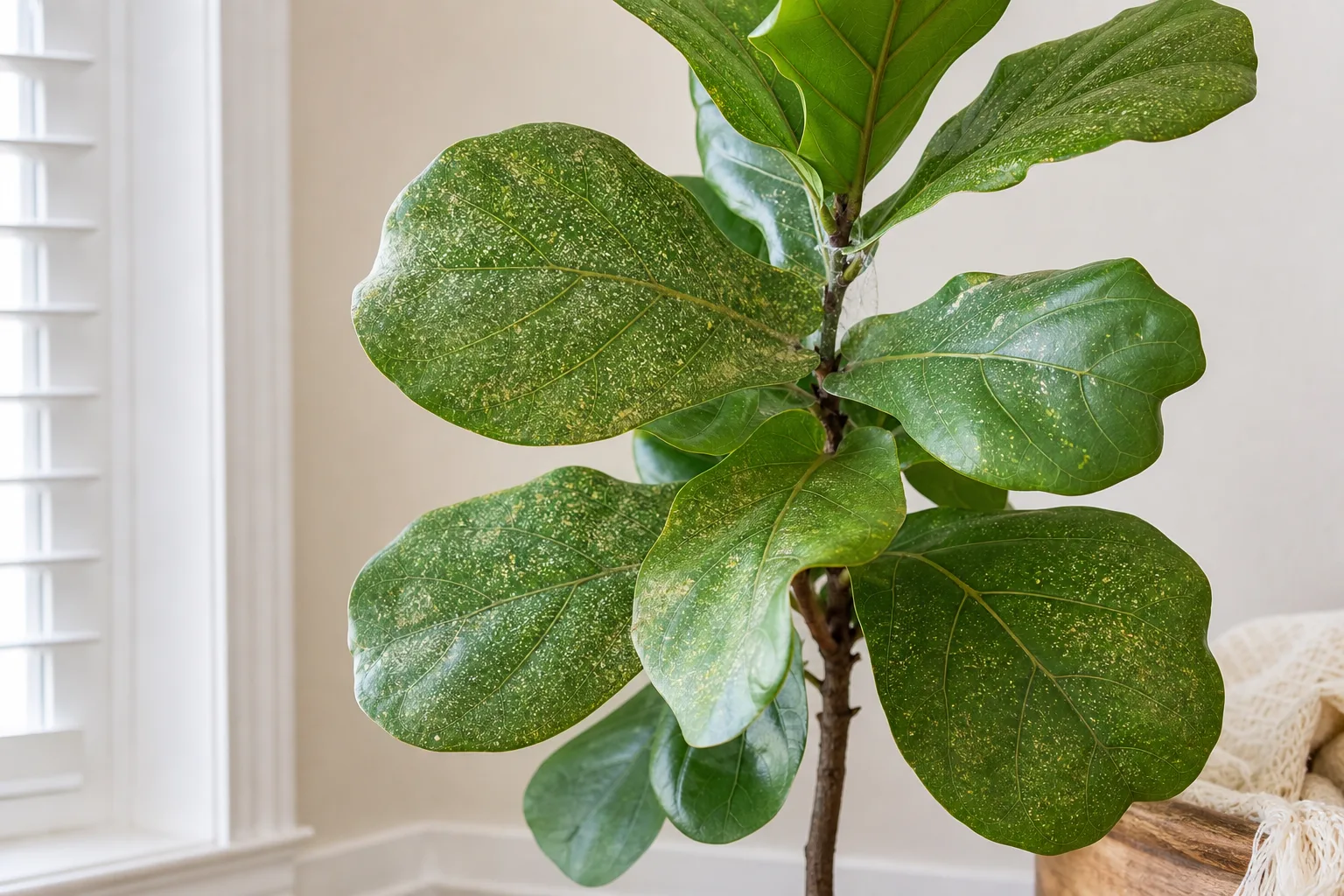
Fiddle leaf fig leaves are smooth, thick, and leathery-not fuzzy. Mite damage therefore shows as scattered speckles on the glossy upper surface rather than the dusty coating you might see on thin-leaved houseplants. Early feeding looks like someone dusted the leaf with fine sand. As colonies grow, tissue bronzes or dulls and the leaf loses its healthy sheen.
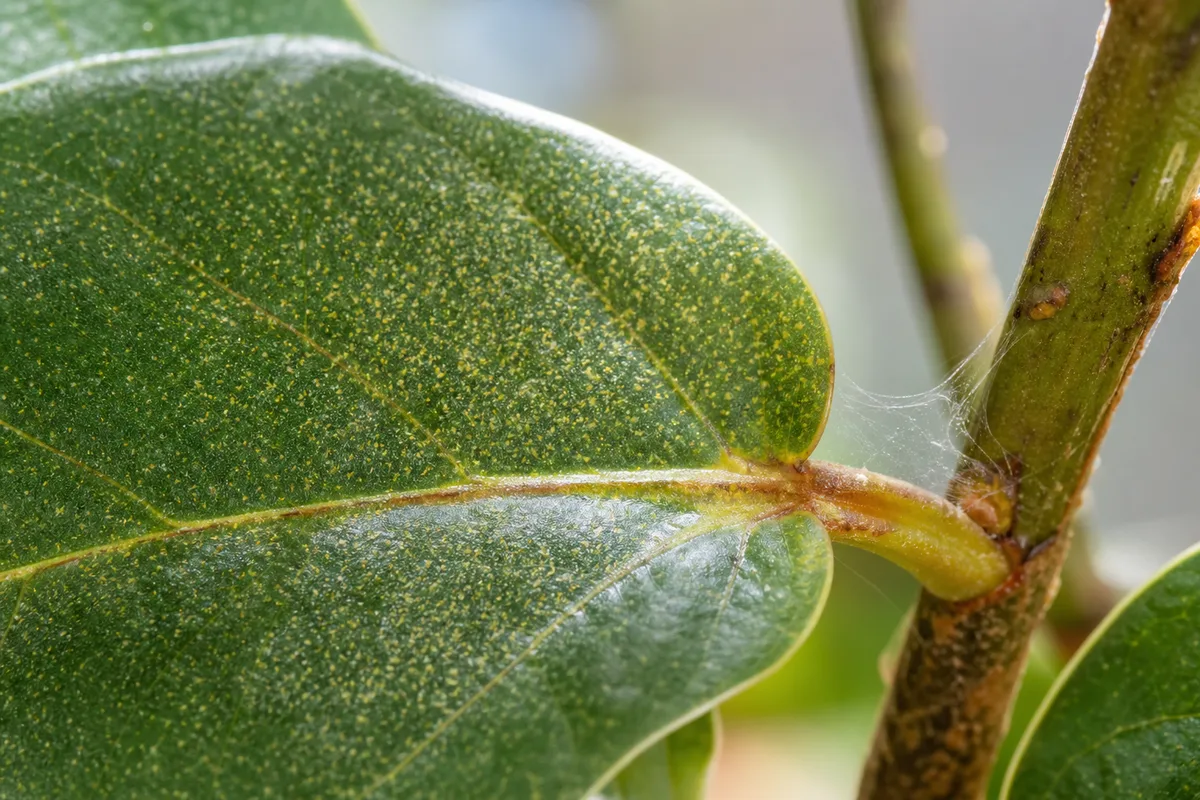
Scattered pale stippling across a violin-shaped fiddle leaf blade and fine webbing at the petiole base - compare with healthy deep green tissue on the same leaf.
The clearest signs on this plant:
- Fine yellow or white stippling scattered across the upper surface of large leaves, often starting on older lower foliage near a heat source
- A washed-out, bronzed look on otherwise deep green violin-shaped blades while the stem still feels firm
- Tiny moving dots on leaf undersides-red, brown, green, or nearly transparent when viewed with a hand lens or phone macro mode
- Fine silk webbing at petiole joints where the leaf stalk meets the trunk or branch, or between overlapping leaves on crowded stems
- Premature yellowing and drop of lower leaves when feeding is heavy-sometimes overlapping with leaf drop from relocation stress during treatment
Because each leaf presents a huge transpiring surface, stippling can look dramatic on a single blade even when the colony is still modest. Webbing at the petiole base is a late warning-the mites were already established on the underside before silk became visible from across the room.
Unlike mealybugs on fiddle leaf fig, spider mites do not form white cottony clusters or sticky honeydew. Unlike aphids, they do not colonize tender new crown growth in soft green clusters. The paper-tap test and underside webbing distinguish mites from those lookalikes.
Why fiddle-leaf fig gets spider mites in winter rooms
Spider mites are not unique to fiddle leaf fig, but how this species is usually grown indoors explains where outbreaks start. NC State Extension advises monitoring fiddle leaf fig for scale, aphids, mealybugs, thrips, and spider mites as a houseplant. Several traits of Ficus lyrata make dry-air mite flare-ups common.
Large leaves, high transpiration. Each mature violin-shaped leaf loses moisture fast in heated winter air that routinely falls below 30% relative humidity. The plant may still look structurally fine while foliage edges crisp from dryness-and mites exploit the same hot, dry microclimate. The fiddle leaf fig overview ties brown crispy edges and spider mites to low humidity in winter; this problem page covers the pest side of that overlap.
Typical placement near windows and heat. Fiddle leaf figs often sit in bright south- or west-facing rooms for light, which also means winter sun bays and nearby radiators or heat registers. The twospotted spider mite-the most important mite species on houseplants-reproduces fastest in warm, dry conditions.
Sheltered feeding sites on tree-form specimens. Tall plants offer dozens of petiole joints and broad undersides where webbing anchors out of sight. Mites on one branch can spread up the stem before stippling is obvious on the glossy upper side owners see from across the room.
Indoor collections without predators. Homes lack the predatory mites and insects that control spider mites outdoors. A single infested nursery plant or dusty neighbor can seed a colony that explodes unchecked on large-leaved ficuses.
Stress without obvious collapse. Fiddle leaf fig reacts dramatically to drafts, moves, and watering swings-but mite stippling can develop while the trunk still feels firm. Do not assume a stable silhouette means undersides are clean.
Spider mites vs. low humidity, thrips, scale, sun scorch, and stress leaf drop
| What you see | Likely cause | How to tell apart |
|---|---|---|
| Scattered pale stippling + fine webbing at petioles | Spider mites | Paper-tap test shows moving specks; damage patchy across leaf face |
| Uniform brown crispy edges and tips, no specks | Low humidity or brown tips | No webbing; no moving dots; edges match dry-air pattern |
| Silvery scarring, no cobweb-style silk | Thrips | Larger insects visible when shaking stem over paper |
| Hard brown bumps on stems and midribs | Scale | Immobile shells; sticky honeydew, not dry stippling |
| Bleached or tan patches on sun-facing side | Sun scorch | Damage on exposed face only; no underside mites |
| Whole leaves dropping after a move or shower | Relocation leaf drop | No stippling progression; drop follows disturbance, not feeding pattern |
| Sticky honeydew on new crown growth | Aphids | Soft pear-shaped clusters on tender shoots, not stippling |
On fiddle leaf fig specifically, the most common misdiagnosis is brown edges from dry winter air mistaken for mites. Low humidity damage usually affects margins and tips uniformly without scattered dots or silk. If you see crisp edges and stippling, treat the confirmed pest first while gradually improving humidity toward the 40–60% range this species prefers.
How to confirm spider mites (six-step checklist)
Work through these checks before committing to a multi-week treatment cycle:
- Paper tap test - Hold a suspect leaf over white paper and tap the petiole sharply. Spider mites fall as tiny moving specks. Static dust, dried water spots, and mineral residue do not crawl.
- Underside inspection - Tilt each large leaf and examine with a hand lens or phone macro mode. Mites, cast skins, and fine webbing concentrate along midribs and at the leaf base where the petiole attaches.
- Stippling pattern - Mite damage is speckled and patchy with healthy green tissue between dots. Overwatering yellows leaves more uniformly; sun scorch hits the exposed face.
- Location check - Is the pot against a heat vent, in a sun-baked winter window bay, or in a room that runs dry all season? Mites cluster in those microclimates first on fiddle leaf fig.
- Neighbor plants - Scan other houseplants on the same shelf or windowsill without hauling the fiddle leaf fig around. Mites crawl short distances and drift on silk threads between pots.
- Humidity cross-check - If edges are crispy but the paper test is clean and no webbing exists, read low humidity on fiddle leaf fig before launching chemicals.
Confirmed: moving specks on the paper test plus stippling and/or webbing on undersides.
Suspected but not confirmed: pale dull leaves with a clean tap test-recheck undersides in three days and improve humidity while you watch.
Monitor vs. treat vs. discard
| What you find | Urgency | Next move |
|---|---|---|
| A few pale dots on one lower leaf; clean paper test; no webbing | Monitor | Recheck in 3 days; improve humidity; wipe that underside |
| Moving specks + stippling on 1–3 leaves; silk at one petiole joint | Treat now | Isolate neighbors; in-place rinse; start repeat schedule |
| Webbing on multiple branches; stippling across several large blades | Treat urgently | Full rinse cycle + soap/oil; inspect every plant in the room |
| Crown new growth distorted; yellow leaves dropping in clusters weekly | Escalate | Restart full cycle; consider discard if reinfestation persists 4+ weeks |
| Severely defoliated specimen in a shared collection | Discard or isolate long-term | Remove source plant; treat neighbors before reintroducing |
First fix: isolate neighbors, rinse in place, and treat on a schedule
Pull the fiddle leaf fig away from other pots, then wash or wipe every leaf underside with lukewarm water without changing rooms.
That opening move matches what extension services recommend for houseplant mite control: physical removal before sprays. For tall tree-form specimens that will not fit under a faucet, wipe each underside with a soft damp cloth, working top to bottom so dislodged mites fall away from clean tissue. Cover the pot soil with plastic wrap during rinsing so a stressed fiddle leaf fig does not sit in waterlogged mix afterward.
How to rinse without unnecessary relocation shock:
- Use a step stool and good light at the existing spot; only move to a shower if infestation is heavy and in-place wiping cannot reach webbed tissue.
- Support each large leaf from underneath so you do not crack the petiole while tilting for access.
- Target petiole joints and midribs on the underside-mites rarely live only on the glossy upper surface owners see from the sofa.
- Let foliage drain and dry in bright indirect light, not hot direct sun on wet leaves.
- Wear gloves. Milky latex sap oozes when stems are damaged and irritates skin on contact.
Do not spray insecticide on day one if you have not confirmed mites. Do not repot, prune heavily, or fertilize during the first rinse-those add stress while the pest load is still unknown.
Step-by-step recovery
After the initial isolation and in-place rinse:
- Repeat water removal every three to five days for two weeks. Mite eggs survive a single rinse; repeated washing at short intervals is essential because soap and water sprays have no residual activity.
- Apply insecticidal soap or horticultural oil if live mites remain after several rinses. Use a product labeled for houseplants and mites-not homemade dish soap, which can burn large leathery leaves. Coat undersides completely; mites must be wet with the product to die.
- Repeat chemical treatments every five to seven days for at least three cycles-longer in warm rooms where the mite life cycle completes in about a week. Foliar sprays of horticultural oil or insecticidal soap are among the most effective homeowner treatments when undersides get thorough coverage at five-day intervals.
- Prune only heavily webbed leaves that are mostly bronze and no longer photosynthesizing. Bag and discard cuttings out of pet reach; do not compost infested tissue near other plants.
- Treat or inspect every plant within reach on the same shelf, windowsill, or room. Partial treatment leaves a reservoir for reinfestation.
- Shift the pot out of the hottest dry microclimate once rinsing is done-move it a few feet from the heat register or add a pebble tray for ambient humidity without misting broad leaf surfaces heavily at night in poor airflow.
Hold fertilizer until new growth emerges clean and mite counts stay low for two weeks. Feeding a pest-stressed fiddle leaf fig pushes soft tissue mites prefer.
When predatory mites make sense
If soap and oil cycles stall in a warm, dry room with several infested plants, Phytoseiulus persimilis-a predatory mite that feeds exclusively on web-spinning spider mites-is used in interior plantscapes and greenhouses after rinse steps reduce pest numbers. It works best when canopy humidity stays above roughly 60% and you have not recently sprayed broad pesticides that kill beneficials. On a single tall fiddle leaf fig in a heated living room below 40% humidity, rinses plus labeled soap or oil remain the practical first choice; predatory mites suit enclosed sunrooms or humidified plant rooms where populations rebound despite contact sprays.
Recovery timeline
Expect fewer live mites within three to five days of the first thorough rinse if coverage reached every underside and petiole joint. A full treatment cycle-rinse plus three soap or oil applications on schedule-typically runs three to four weeks before you can call the plant clear.
Stippled and bronzed leaves will not return to their original deep green gloss; judge recovery by clean new leaves emerging from the crown, not by old damaged tissue flattening. Lower leaves that bronzed heavily may drop naturally-sudden mass drop during active mite feeding means the infestation is still advancing, while a few shed leaves after one careful rinse often trace to relocation sensitivity rather than treatment failure.
Signs you are winning:
- No live mites on twice-weekly paper-tap checks
- Webbing stops appearing at petiole joints
- New leaves unfurl clean and firm at the top
- Stippling does not spread to previously healthy blades
Signs the problem is worsening:
- Webbing reappears on new growth after two weeks of consistent treatment
- Yellowing leaves drop in clusters within days
- Mites show up on multiple plants in the same room
- The only active growing tip stunts or fails to open
If webbing returns on new growth after four weeks of consistent treatment, re-isolate and restart the full cycle rather than assuming one more spray will finish the job.
Mistakes to avoid
Do not stop after one rinse because stippling looks lighter-eggs hatch within days in warm rooms.
Do not spray only the glossy upper leaf surface. Mites live underneath those large fiddle-leaf-fig blades, protected by thickness and midrib ridges.
Do not use household dish soap as a default spray. Ready-to-use insecticidal soap labeled for plants is safer on broad leathery foliage.
Do not apply horticultural oil or soap in direct hot sun on a window fiddle leaf fig-the combination can scorch leaves that normally tolerate bright light.
Do not move the plant repeatedly between rooms during treatment. Each relocation can trigger leaf drop that you misread as failed pest control. Pick an isolation spot and work in place when possible.
Do not assume chemical pesticides labeled for insects will kill mites-mites need miticides, horticultural oils, or insecticidal soaps with thorough contact coverage.
Do not let broad leaf surfaces stay wet overnight in a stagnant corner with poor airflow. Smooth leathery Ficus lyrata leaves tolerate gentle underside rinsing; the risk is prolonged wetness on both sides in still air, not the “fuzzy leaf” spotting warnings that apply to other species.
Do not ignore pet safety during treatment. Fiddle leaf fig is toxic to cats and dogs if ingested, with oral irritation and vomiting among possible signs per NC State Extension and the ASPCA. Keep treated plants off floors where animals might chew dropped leaves or lick residue; ventilate during application. Contact your veterinarian or the ASPCA Animal Poison Control Center at (888) 426-4435 if ingestion is suspected. This is general information, not veterinary advice.
How to prevent spider mites next time
Inspect two or three leaf undersides weekly from autumn through spring, when indoor heating dries the air most. Fiddle leaf fig’s large leaves make this quick once you build the habit-you do not need to examine every 18-inch blade every time.
Quarantine new houseplants for two weeks before placing them beside your fiddle leaf fig. Mites hitchhike on nursery stock and spread before symptoms show on thick-leaved hosts.
Avoid placing the pot directly on a radiator ledge or in a sun-scorched window corner where leaf temperature spikes. Shift position seasonally if a winter sun bay becomes a summer hot spot.
Run a humidifier or pebble tray in the room if humidity routinely drops below 40%. Dry conditions greatly favor spider mite reproduction while the large leaves this species is grown for lose moisture faster than roots replace it.
Wipe or rinse leaf surfaces every few weeks after recovery-not only for appearance but because clean foliage makes early stippling easier to spot on smooth, glossy blades.
During treatment recovery, keep watering steady when the top 2 to 3 inches of mix dry-avoid drafty spots below 55°F (13°C) while wet foliage dries, and see the watering and light guides if baseline care needs correction.
When to worry
Escalate immediately if webbing spans multiple branches, new leaves emerge distorted or fail to unfurl, or yellowing leaves drop in clusters within a week. A mature fiddle leaf fig with firm wood and several healthy leaves below the infestation almost always survives mites once populations are controlled.
Consider discarding a severely defoliated plant in a shared indoor collection rather than fighting endless reinfestation-heavily infested plants serve as a source for neighboring pots. That is especially true when several susceptible species share one warm, dry room.
A few stippled dots on one lower leaf with no webbing and a clean paper test is worth monitoring, not panicking. Confirm movement before launching a month-long treatment program.
Conclusion
Spider mites on fiddle leaf fig hide on undersides until stippling and petiole webbing give them away. Match your response to severity: monitor isolated pale dots with a clean tap test, treat confirmed colonies with in-place rinses and repeat soap or oil, and discard or long-term isolate only when a defoliated plant keeps reinfecting a shared collection after a full four-week cycle. Damaged blades will not polish back to perfect-clean crown growth is the real recovery signal. Build weekly underside checks into winter care, keep humidity in the 40–60% range, and read crisp edges alongside pest checks so dry air and mites do not blur together.
Related fiddle-leaf-fig guides
- Overview - species biology, humidity targets, and troubleshooting hub
- Leaf drop - relocation shock during treatment
- Low humidity - brown edges without mites
- Brown tips - margin damage from dry air
- Aphids - pest overlap and lookalike table
- Mealybugs - other common Ficus lyrata pests
- Watering - steady rhythm during recovery
- Light - bright indirect light without scorch
Related tool
Use the Pest Identifier Tool to narrow causes for spider mites on this plant before changing multiple variables at once.