Curry Leaf Plant Care: Light, Water & Tips
Murraya koenigii
Curry leaf plant needs 6+ hours of direct sun, moderate moisture, monthly fertilizer, and iron supplementation when soil goes alkaline. Winter leaf drop is normal dormancy - the plant returns in spring.
Curry Leaf Plant Care: Light, Water & Tips
Start with wateringThe most common care mistake for Curry Leaf PlantWatering guide →Curry Leaf Plant care essentials
Light
full sun - 6+ hours of direct sunlight
Water
Water when top 3–5 cm of soil dries out; reduce significantly in winter.
Soil
Well-draining, slightly acidic to neutral potting mix enriched with organic matter.
Humidity
Moderate to high (50–70%); native to Indian subcontinent and thrives in local conditions
Temperature
18°C to 38°C (65–100°F)
Fertilizer
Use balanced NPK fertilizer or organic compost and neem cake and stop if the plant is stressed, newly repotted, or not actively growing. Overly salty synthetic fertilizers - causes leaf margin burn.
About Curry Leaf Plant
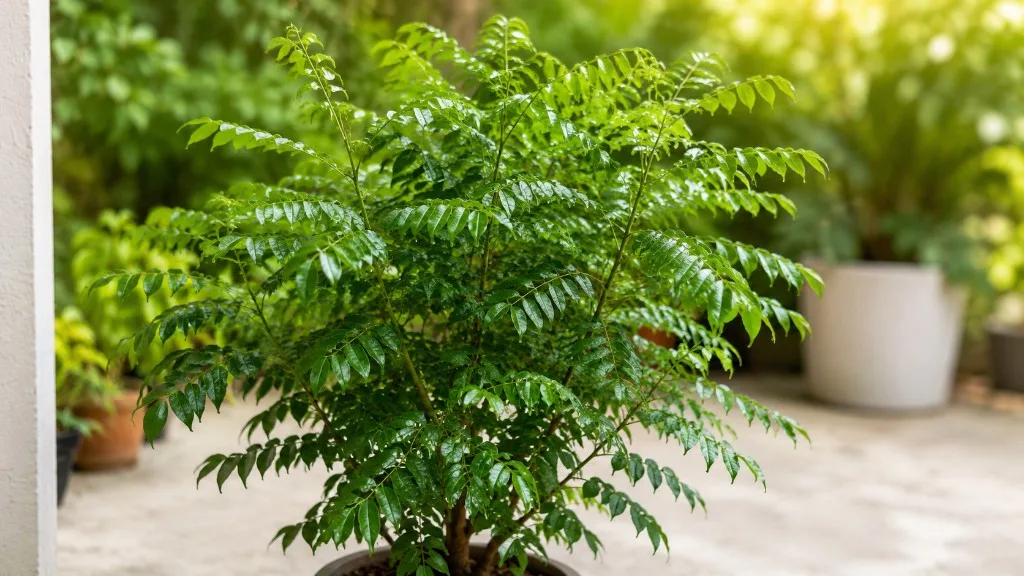
Curry Leaf Plant is native to Indian subcontinent and Sri Lanka, typically reaches Up to 4–6 m in ground; 60–120 cm in pots indoors, with moderate - faster in warm indian climate growth. Curry Leaf Plant has a tree like growth habit and part of the Rutaceae family. It is also known as Curry Patta, Kadi Patta, Sweet Neem, and Karivepallai.
| Detail | Information |
|---|---|
| Also known as | Curry Patta, Kadi Patta, Sweet Neem, Karivepallai |
| Native region | Indian subcontinent and Sri Lanka |
| Mature size | Up to 4–6 m in ground; 60–120 cm in pots |
| Growth rate | Moderate - faster in warm Indian climate |
| Growth habit | Tree Like |
| Scientific name | Murraya koenigii |
| Family | Rutaceae |
Curry Leaf Plant Care: Light, Water & Tips
What Is Curry Leaf Plant?
The Curry Leaf Plant is a small tropical tree grown almost exclusively for its fragrant, compound leaves - the ingredient that gives South Indian, Sri Lankan, and wider South Asian cooking its distinctive curry-leaf aroma. The accepted botanical name is Murraya koenigii, a member of the family Rutaceae (the rue and citrus family). You will also see it sold as Curry Patta, Kadi Patta, Sweet Neem, or Karivepallai, depending on the nursery and region. Those names describe the same species for practical care purposes, though seed-grown plants can vary slightly in vigor and leaf size.
In the ground in frost-free climates, Murraya koenigii can reach 4 to 6 meters (13 to 20 feet) over many years, developing a woody trunk and a rounded canopy of glossy, pinnate leaves. In containers - which is how most readers outside the tropics will grow it - expect roughly 60 to 120 cm (2 to 4 feet) with regular pruning and harvest. Growth is moderate in average home conditions and noticeably faster when temperatures stay warm and light is strong, which mirrors its native rhythm on the Indian subcontinent and Sri Lanka. The plant is evergreen in continuous warmth but often drops most of its foliage during a cool-season rest when nights fall below about 15°C (59°F), a pattern that alarms new growers until they learn it is normal dormancy rather than death.
If you are deciding whether Curry Leaf Plant overview fits your home, the honest summary is this: curry leaf plant rewards Curry Leaf Plant light guide, careful moisture management, and warm stable temperatures - and it punishes shade, soggy roots, and cold drafts. It is harder than a pothos and easier than a finicky orchid, but only if you treat it as a sun-loving tropical tree, not a generic kitchen herb that tolerates a dim windowsill. The payoff is fresh leaves on demand for tempering, chutneys, and dals - plus propagation through root suckers so straightforward that one established parent can supply a balcony full of pots. One critical distinction for buyers: curry leaf plant is not neem. Azadirachta indica (neem) is a different species with bitter medicinal leaves and a completely separate care profile; confusing the two is one of the most common naming mistakes in South Asian plant commerce.
Botanical Background and Regional Names
Murraya koenigii belongs to Rutaceae, a family that includes citrus, and growers often notice the parallel: curry leaf trees prefer bright light, warm roots, and well-drained slightly acidic soil - similar baseline needs to a dwarf lemon or kumquat, though the leaf harvest goal is culinary rather than fruit. Rutaceae plants also share a sensitivity pattern worth remembering early: roots that sit wet for days are the starting point for most failures, and sudden temperature drops show up as leaf drop before any pest appears.
The species is native to tropical and subtropical forests of the Indian subcontinent and Sri Lanka, where it grows as an understory-to-edge tree in warm, humid conditions with distinct wet and dry seasonal rhythms. Outdoors it is reliably hardy only in USDA Hardiness Zones 10 through 12 and equivalent frost-free climates. Everywhere else, it is a container plant brought indoors before frost or kept indoors year-round under strong supplemental light. Any frost exposure - 0°C (32°F) or below - can kill or severely damage the plant, and sustained temperatures below 10°C (50°F) trigger dramatic leaf drop and stalled growth according to UC Master Gardeners of Santa Clara County.
Regional names reflect how deeply the plant is embedded in daily cooking. Curry patta and kadi patta are Hindi and broader South Asian household terms; sweet neem references the leaf shape resemblance to neem without the bitterness. Karivepallai is common in Tamil-speaking regions. When you buy a plant, keep whichever label you receive, but confirm the botanical tag reads Murraya koenigii if possible - unrelated sellers occasionally mislabel seedlings. Mature plants may produce small white flowers followed by dark berries; the berries themselves are not the culinary product, and the seeds inside the berries are toxic and should be discarded if children or pets might access fallen fruit, according to the Missouri Botanical Garden (fruits are edible but the seeds are not).
Why Harvest Goals Change How You Care for It
Most houseplants are grown for appearance. Curry leaf plant is usually grown for flavor, fresh shoots, and quick regrowth after picking - and that changes your maintenance priorities. A purely ornamental grower might let the plant become a woody mini-tree; a cook wants regular tip harvests or light pruning that keep new leaves coming from lower nodes. Woody, exhausted stems produce fewer tender leaves, and many experienced growers restart tired plants from suckers or cuttings rather than nursing bare lower branches indefinitely.
Harvest timing matters for plant health too. Pinch or cut stems above a node, taking a few leaf pairs at a time rather than stripping an entire branch bare in one session. Fresh growth after a moderate harvest is a sign the plant is happy; no regrowth for weeks after picking usually means light, water, or root temperature is off - not that you pruned too aggressively. Because the leaves lose much of their fresh aroma within days of picking, the practical goal is a plant that produces continuous small harvests rather than one massive trim twice a year.
Curry leaf plant also fits specific home roles well: balcony container in full sun, kitchen garden bed in frost-free yards, and bright indoor sunroom where a grow light supplements winter short days. It is a poor fit for cold climates without indoor overwintering, deep shade gardens, and very small pots that dry out unpredictably or restrict root development on a tree-forming species. Match the plant to a spot that can deliver six or more hours of direct sun most days, and the rest of the care rhythm becomes much more predictable.
Best Growing Conditions for Curry Leaf Plant
Curry leaf plant does best when your space approximates the warm, bright rhythm of its native range. The four variables that decide almost every outcome are light, water, soil, and temperature. Align those four and feeding, Curry Leaf Plant repotting guide, propagation, and harvest pruning become routine maintenance. Misalign any one - especially light or root moisture - and the plant yellows, drops leaves, or stalls for weeks regardless of how much fertilizer you add.
Light Requirements
Curry leaf plant needs full sun - aim for at least six to eight hours of direct sunlight daily during active growth. This is not a negotiable preference; it is the single strongest predictor of leaf production, compact growth, and recovery speed after harvest. Outdoors in frost-free climates, a south- or west-facing spot with morning-to-midday sun is ideal; in very hot dry regions above about 40°C (104°F), some afternoon filtered light can prevent leaf scorch while still delivering high total daily light. Indoors, place the pot at the sunniest window available - typically south-facing in the Northern Hemisphere - and accept that winter day length alone may not be enough without supplementation.
The fastest diagnostic for incorrect light is new growth, not old leaves. Compact internodes, firm glossy leaflets, and steady regrowth after harvest mean the plant is probably receiving enough energy. Long bare stems, small pale leaflets, and weeks without new shoots mean the plant wants more light - move it closer to the glass, prune back leggy growth to force branching, or add a full-spectrum grow light on a 12–14 hour timer positioned 30 to 40 cm (12 to 16 inches) above the canopy. Bleached or scorched leaflets on the sun-facing side mean reduce direct midday intensity or acclimate gradually over one to two weeks when moving from a dim shop to a harsh sill.
Temperature and Humidity
Murraya koenigii prefers warm stable temperatures between 18 and 38°C (65 and 100°F) during active growth, with 20 to 30°C (68 to 86°F) as the sweet spot for steady leaf production according to indoor tropical-tree references. It tolerates heat above 38°C (100°F) when soil moisture and humidity keep pace, but it declines sharply below about 15°C (59°F) and may shed most leaves as a dormancy response. Treat 10°C (50°F) as a hard floor - prolonged exposure below that threshold causes severe leaf drop and branch dieback, and frost must be avoided entirely.
Watch problem zones in the home: cold window sills at night, direct air-conditioning vents, and unheated porches that drop below the comfort range within hours. Each can trigger leaf drop faster than a watering mistake because the plant cannot metabolize normally in cold roots. When overnight lows outdoors approach 12°C (54°F), move container plants indoors to the brightest warm spot you have - do not wait for the first frost warning.
Humidity is moderately important - target roughly 50 to 70% during indoor winter months when heating dries the air. Very dry air below about 30% encourages spider mites; a pebble tray or small humidifier helps more than occasional misting.
Soil and Drainage
Use a well-draining, slightly acidic to neutral potting mix enriched with organic matter. The principle matters more than a single branded recipe: the mix should drain freely after watering, hold enough moisture in the root zone without staying waterlogged for days, and retain air space so roots can breathe. A practical home blend aligned with this plant’s needs is roughly 50% garden soil or quality potting mix, 30% compost, and 20% coarse sand or perlite - increase perlite or sand if your home runs hot and bright, or if pots repeatedly stay wet too long.
Target soil pH around 5.6 to 6.5. Hobbyists rarely need to meter pH precisely for healthy plants in fresh mix, but alkaline tap water and hard water over time can push pH upward and show up as iron chlorosis - yellowing between green veins on new leaves while older leaves stay darker. If that pattern appears despite correct watering and strong light, iron chelate foliar spray or soil drench and occasional elemental sulfur or pine bark amendment are worth considering rather than blindly increasing nitrogen fertilizer.
Always plant in a container with a drainage hole and empty runoff after every watering. Heavy peat-only mixes that compact after a year are a common hidden cause of decline.
How to Water Curry Leaf Plant
The general rule is water when the top 3 to 5 cm (1 to 2 inches) of soil dries out; reduce significantly in winter. As a starting reference only - not a calendar law - many container plants in warm bright conditions need water roughly every two to three days in summer and about once a week in winter, but pot size, soil mix, light, and whether the plant is actively growing or dormant all change that interval. overwatering on Curry Leaf Plant is the leading cause of curry leaf plant death in container culture because saturated mix suffocates roots and invites rot, especially when light drops in winter but Curry Leaf Plant watering guide stays on a summer schedule.
Water thoroughly until a small amount runs from the drainage hole, then empty the saucer so the pot is not standing in stale water. Check moisture with a finger at 3 to 5 cm depth, a wooden chopstick, or by lifting the pot - a noticeably lighter pot usually means the root zone has dried enough to warrant a full soak. Because this is a sun-loving plant with substantial leaf surface in warm weather, container plants outpace in-ground plantings in water use during active growth; a small pot on a hot balcony may need daily checks at midsummer even if a larger pot nearby dries every third day.
Watering Rhythm During Active Growth
During the warm, bright months from roughly March through October in temperate climates - or year-round in tropical homes - Murraya koenigii uses water steadily when it is pushing new leaflets and recovering from harvest cuts. The goal is a consistent moisture band: the mix should feel like a wrung-out sponge through most of the root zone after watering, not wet mud and not dusty dry throughout. Wilting on a light, dry pot is a clear thirst signal - water thoroughly and watch for recovery by evening. Wilting on a heavy, wet pot is the opposite problem and points to root stress from overwatering rather than drought.
Seasonal Adjustments and Winter Dormancy
In cooler, dimmer months - especially for plants overwintering indoors - growth slows or stops and the pot dries much more slowly. Stretch the interval between waterings, sometimes to once every 10 to 14 days for a medium pot in cool indoor air, and pause fertilizer entirely until new growth resumes in spring. The most common winter failure mode is continuing a midsummer watering schedule in lower light, which keeps the mix waterlogged and leads to yellow leaves, fungus gnats, and root rot on Curry Leaf Plant on a plant that is already trying to rest.
Leaf drop in cold weather is often normal winter dormancy, not a death sentence. When nights stay cool and day length shortens, curry leaf plant may shed most foliage and look like a bare stick for weeks. Keep the root zone barely moist - not wet - and maintain temperatures above about 15°C (59°F) if possible. New shoots typically return when warmth and light increase in spring. Panic repotting, heavy feeding, or daily watering on a bare dormant plant usually makes recovery slower, not faster.
Common Watering Mistakes
The single most damaging mistake is watering on a fixed schedule without checking the pot at depth. The second is letting the plant sit in a full saucer or cachepot, which suffocates roots within days even if the surface looks dry. The third is giving tiny daily sips instead of a full soak when the plant is dry - that wets only the top layer while the center stays parched, producing wilt cycles that weaken roots over time.
A dry pot that recovers after a thorough watering was underwatering on Curry Leaf Plant; a wet pot that wilts despite your efforts usually means inspect roots and repot into fresh mix. Always pair visible symptoms with a moisture check before changing your routine.
How to Feed Curry Leaf Plant
Curry leaf plant is a moderate feeder during active growth, not a heavy one. Feed monthly during the growing season - roughly March through October - with a balanced water-soluble fertilizer such as 10-10-10 or 20-20-20 diluted to one-quarter to one-half of the label rate, or use organic compost top-dressing and neem cake worked lightly into the top of the mix. Apply to already-moist soil so the solution distributes through the root zone without burning fine roots. Specialty growers recommend feeding every four to six weeks during spring and summer and stopping entirely during fall and winter dormancy - a rhythm that matches what most container growers observe indoors as well.
Hold fertilizer entirely during dormancy, after a major repot until new growth appears, and while the plant is recovering from root rot or pest damage. Overfeeding produces salt buildup and brown leaf margins that look like drought stress but persist even when watering is correct. Overly salty synthetic fertilizers can cause leaf margin burn on this species specifically, so lean conservative on dose and flush the pot with plain water at two to three times the pot volume if crust appears on the soil surface or margins crisp despite good moisture.
If new leaves show yellow veins on an otherwise pale leaflet while light and watering are correct, suspect iron deficiency from alkaline soil and treat with iron chelate rather than adding more nitrogen fertilizer.
Repotting and Root Health
Repot curry leaf plant roughly every one to two years while young, and less often as it matures into a woody specimen, or whenever roots circle drainage holes, the plant dries out within 24 hours of watering, or water runs straight through without soaking in. The best timing is early spring - February to March in many temperate calendars - as active growth resumes, which gives the plant a full warm season to fill the new root zone. Going up only one pot size at a time - typically 2.5 to 5 cm (1 to 2 inches) wider - prevents the common post-repot failure mode where an oversized pot holds excess wet mix around roots that cannot use it.
Use fresh, well-draining mix with compost content, plant at the same depth as before, and water lightly for the first week while cut roots heal. Keep the plant in full sun or strong grow light but avoid fertilizer until new tip growth appears. Curry leaf tolerates repotting reasonably well when roots are healthy, but do not repot a plant actively collapsing from overwatering until you have inspected roots, trimmed rot, and let it stabilize in fresh mix with a corrected watering rhythm.
Signs It Is Time to Repot
Physical signs include roots emerging from drainage holes, a top-heavy plant that wilts despite recent watering, or mix that has broken down into fine water-retentive mud. Performance signs include stunted new growth for weeks during warm weather despite adequate light and feeding, or soil that dries so fast you cannot keep up - often indicating the root ball has consumed available volume. A sour smell from the mix indicates breakdown and poor aeration even if the calendar says repotting is early.
Propagation Methods for Curry Leaf Plant
The simplest home propagation methods for Murraya koenigii are root suckers, stem cuttings, and seed - in that order of reliability for most growers. Root suckers are easiest when an established plant produces shoots from the base or nearby roots; sever the sucker with a clean knife, retain some roots if present, pot in moist well-draining mix, and keep in bright indirect light until new growth confirms independence. Suckers often establish faster than cuttings because they may already have initial root tissue.
Stem cuttings are the standard method when no suckers are available. In spring, take a 8 to 10 cm (3 to 4 inch) cutting from healthy new growth with at least one node, cut just below the node at a 45-degree angle, remove lower leaflets, and insert into a 50:50 mix of perlite and coir or a soilless potting medium, as described by UC Master Gardeners (root suckers or cuttings). Keep the medium evenly moist, cover with a clear bag or dome vented briefly every few days, and place in bright indirect light - not harsh direct sun until roots form, typically three to four weeks at warm temperatures near 21 to 27°C (70 to 80°F). Rooting hormone is optional; many growers succeed without it. Transplant when a gentle tug meets resistance.
Seed propagation is possible but slow - seedlings may take two years or more before regular harvest. Do not propagate stressed or diseased parent plants; cuttings inherit the parent’s problems.
Common Curry Leaf Plant Problems
Most curry leaf plant problems are environmental, not mysterious diseases. The plant communicates through leaf color, drop timing, and regrowth speed long before the entire specimen collapses. The useful habit is to check light, moisture, and temperature in that order before reaching for pesticide or extra fertilizer.
Yellow Leaves, Brown Tips, and Pests
Yellow leaves can mean overwatering, underwatering, cold stress, iron chlorosis in alkaline soil, natural aging of older leaflets, or pest damage. If yellow leaves are soft and the mix is wet, suspect overwatering and inspect roots for brown mushy tissue. If yellow leaves are crisp and the pot is light, drought stress is more likely. Yellowing between veins on new leaves with green veins remaining suggests iron deficiency - especially in pots with hard tap water history - rather than simple nitrogen shortage. A single yellow lower leaflet on an otherwise vigorous plant is often normal senescence; remove it and watch new growth.
Brown leaf tips and edges usually point to underwatering, salt buildup from over-fertilizing, or low humidity in dry indoor winter air. Flush the pot with plain water if salts are suspected, and review whether the watering rhythm matches how fast the plant dries in its current light. Tips that are already brown will not turn green again; judge success by undamaged new leaflets.
Winter leaf drop on healthy roots is often normal dormancy - keep roots lightly moist and wait for spring. Slow growth after harvest usually means insufficient light, cold roots, or overwatering. Watch for spider mites, mealybugs, and scale; inspect weekly and treat early with manual removal or insecticidal soap. Mushy stems with foul-smelling mix indicate advanced overwatering - restart from a sucker or cutting above the rot.
Is Curry Leaf Plant Safe for Pets?
Curry leaf leaves are widely treated as non-toxic to cats and dogs, though the ASPCA notes that ingestion of any plant material may cause mild vomiting or gastrointestinal upset. That makes it a better choice for pet-aware homes than many common toxic ornamentals, which matters because the plant often lives in kitchens where pets investigate counters and floor-level pots. Non-toxic does not mean encourage chewing - the ASPCA notes that ingestion of any plant material can cause mild vomiting or gastrointestinal upset in dogs and cats, even for plants classified as non-toxic, and large quantities of strongly aromatic foliage could still irritate sensitive stomachs.
Berry seeds are a separate caution. While leaves are a normal human food ingredient, seeds inside the plant’s berries are toxic and should be discarded if the plant flowers and fruits indoors or outdoors where children or pets might access fallen berries, according to the Missouri Botanical Garden. If your plant sets fruit, remove fallen berries promptly and do not compost seeds where pets forage.
If a pet shows persistent vomiting or lethargy after eating plant material, contact your veterinarian or the ASPCA Animal Poison Control Center at (888) 426-4435. Keep pots out of routine chewing reach even when labeled non-toxic.
Conclusion
Curry leaf plant (Murraya koenigii) is a sun-loving tropical tree from the Indian subcontinent and Sri Lanka that trades careful environmental matching for years of fresh aromatic leaves in the kitchen. Give it six to eight hours of direct sun, well-draining slightly acidic soil, water when the top 3 to 5 cm of mix dries - with much less in winter dormancy, and warm stable temperatures above about 15°C, and it will produce harvestable shoots you can pinch regularly without killing the plant. Feed monthly during active growth, repot when roots outpace the pot, and propagate from root suckers or spring cuttings when you want backups before frost or a rejuvenation restart.
When something looks wrong, read the plant in context: bare branches in cool short days often mean normal dormancy, not death; pale stretched stems mean more light; yellow soft leaves on wet mix mean roots need air; yellow new leaves with green veins may mean iron, not nitrogen. Fix light and moisture before stacking fertilizer, repotting, and pruning on the same weekend. Keep berry seeds away from pets and children, keep leaves out of routine chewing reach while monitoring pets for GI upset, and remember that this is not neem - correct identification keeps care expectations accurate. Do that, and curry leaf plant becomes one of the highest-return culinary specimens you can grow in a sunny container - as long as you respect its frost limits and refuse to treat it like a shade-tolerant houseplant.
When to use this page vs other Curry Leaf Plant guides
- Curry Leaf Plant overview - Canonical hub for this species - care topics and problems branch from here.
- Curry Leaf Plant problems - Symptom-first path when you already know something is wrong.
Related Curry Leaf Plant guides
- Curry Leaf Plant watering
- Curry Leaf Plant light
- Curry Leaf Plant soil
- Curry Leaf Plant propagation
- Curry Leaf Plant fertilizer
- Curry Leaf Plant repotting
- Curry Leaf Plant pruning
- Yellow Leaves on Curry Leaf Plant
- Slow Growth on Curry Leaf Plant
- Brown Tips on Curry Leaf Plant
- Root Rot on Curry Leaf Plant
- Overwatering on Curry Leaf Plant
How to care for Curry Leaf Plant?
How much light does Curry Leaf Plant need?
full sun - 6+ hours of direct sunlight
- full sun - 6+ hours of direct sunlight - full sun - 6+ hours of direct sunlight.
When should you water Curry Leaf Plant?
Water when top 3–5 cm of soil dries out; reduce significantly in winter.
- Finger test at 3–5 cm depth - water only when dry - Water when top 3–5 cm of soil dries out; reduce significantly in winter.
- Drain excess water - Water when top 3–5 cm of soil dries out; reduce significantly in winter.
What soil works best for Curry Leaf Plant?
Well-draining, slightly acidic to neutral potting mix enriched with organic matter.
- 50% garden soil or potting mix - Well-draining, slightly acidic to neutral potting mix enriched with organic matter.
- 30% compost
- 20% coarse sand or perlite - Well-draining, slightly acidic to neutral potting mix enriched with organic matter.
Grower notes for Curry Leaf Plant
What matters most with Curry Leaf Plant
Curry Leaf Plant is usually grown for harvest, so flavor, fresh shoots, and quick regrowth matter more than keeping old stems forever. Replace or restart tired plants instead of nursing woody, exhausted growth indefinitely. In practice, the care checkpoint is simple: full sun - 6+ hours of direct sunlight. Pair that with well-draining, slightly acidic to neutral potting mix enriched with organic matter, and avoid changing water, pot size, and placement all at once.
Best placement in a real home
Curry Leaf Plant belongs where full sun - 6+ hours of direct sunlight is realistic for most of the day, not only where the pot looks good. Water when top 3–5 cm of soil dries out; reduce significantly in winter. If the pot stays wet longer than expected, move the plant into better light or reassess the mix before watering again. Humidity target: Moderate to high (50–70%); native to Indian subcontinent and thrives in local conditions. Temperature comfort zone: 18°C to 38°C (65–100°F).
Before you buy this plant
Choose Curry Leaf Plant with firm new growth, clean leaf undersides, and soil that does not smell sour or feel compacted. Be cautious if you see yellow-leaves, sticky residue, collapsed crowns, or a pot that is wet in poor light. Cosmetic old-leaf damage is less worrying than weak roots or active pests.
First month after bringing it home
Do not repot Curry Leaf Plant on day one unless the mix is failing or pests are obvious. Quarantine it, learn how fast the pot dries, and keep care boring while it adjusts. Watch especially for yellow-leaves, slow-growth, and brown-tips. If problems appear, correct the condition first rather than stacking fertilizer, repotting, and pruning together.
Pet-aware note for Curry Leaf Plant
Curry Leaf Plant is a better choice for pet-aware homes than toxic ornamentals, but pet safe does not mean the plant should be chewed. Use hanging, shelf, or room placement if pets dig in soil or shred leaves, and choose sturdier plants for high-traffic pet zones.
How to tell Curry Leaf Plant is settling in
Also sold as Curry Patta, Kadi Patta, and Sweet Neem, this plant should be judged by stable new growth rather than label names alone. If you plan to multiply it later, common methods include Root suckers, Seeds, and Stem cuttings. Repot only when you see roots emerging from drainage holes and stunted new growth. If slow-growth shows up early, inspect light, watering, and roots before assuming the plant is permanently weak.
Is it pet safe?
Curry Leaf Plant is non-toxic to cats and dogs.
Watering Curry Leaf Plant
For Curry Leaf Plant, finger test at 3–5 cm depth - water only when dry and water every 2–3 days in summer; once a week in winter. Minimal watering in winter; plant may drop leaves - this is normal dormancy.
| Detail | Information |
|---|---|
| How often | Every 2–3 days in summer; once a week in winter |
| How to check | Finger test at 3–5 cm depth - water only when dry |
| Seasonal changes | Minimal watering in winter; plant may drop leaves - this is normal dormancy |
Signs of overwatering
- yellowing leaves
- leaf drop
- mushy stems
Signs of underwatering
- wilting leaves
- dry crinkled foliage
- leaf edges browning
Soil & potting for Curry Leaf Plant
Use a mix of 50% garden soil or potting mix, 30% compost, 20% coarse sand or perlite for Curry Leaf Plant. Good drainage essential - roots are sensitive to prolonged wetness. Target soil pH around 5.6–6.5. Repot every 1–2 years when young; less often as it matures, ideally in spring (February–March).
| Detail | Information |
|---|---|
| Recommended mix | 50% garden soil or potting mix, 30% compost, 20% coarse sand or perlite |
| Drainage | Good drainage essential - roots are sensitive to prolonged wetness |
| Soil pH | 5.6–6.5 |
| Repotting frequency | Every 1–2 years when young; less often as it matures |
| Best season to repot | Spring (February–March) |
Signs it needs repotting
- roots emerging from drainage holes
- stunted new growth
- soil dries out within 24 hours
Humidity & temperature for Curry Leaf Plant
Curry Leaf Plant prefers moderate to high (50–70%); native to Indian subcontinent and thrives in local conditions, though normal home humidity is usually fine. Keep temperatures around 18°C to 38°C (65–100°F).
| Detail | Information |
|---|---|
| Humidity | Moderate to high (50–70%); native to Indian subcontinent and thrives in local conditions - normal home humidity is fine. |
| Ideal temperature | 18°C to 38°C (65–100°F) |
Fertilizer & pruning for Curry Leaf Plant
Use use balanced NPK fertilizer or organic compost and neem cake and stop if the plant is stressed, newly repotted, or not actively growing. Overly salty synthetic fertilizers - causes leaf margin burn. for Curry Leaf Plant.
| Detail | Information |
|---|---|
| Fertilizer type | Use balanced NPK fertilizer or organic compost and neem cake and stop if the plant is stressed, newly repotted, or not actively growing. Overly salty synthetic fertilizers - causes leaf margin burn. |
Common problems on Curry Leaf Plant
Yellow Leaves
MediumLikely cause: Iron deficiency from alkaline soil or overwatering causing interveinal chlorosis
Quick fix: Apply iron chelate; check soil pH and adjust if alkaline; use acidifying fertilizer
Full fix guide →Slow Growth
LowLikely cause: Insufficient sunlight, under-fertilising, or root-bound pot
Quick fix: Move to full sun; feed monthly; repot if root-bound
Full fix guide →Brown Tips
LowLikely cause: Salt build-up from tap water or fertilizer, or dry air
Quick fix: Flush soil with clean water; switch to filtered water; mist in dry weather
Full fix guide →Root Rot
MediumLikely cause: Common on this plant type; confirm with recent watering, light, and root checks.
Quick fix: Inspect the plant and correct the most likely care stressor before stacking treatments.
Full fix guide →Overwatering
MediumLikely cause: Common on this plant type; confirm with recent watering, light, and root checks.
Quick fix: Inspect the plant and correct the most likely care stressor before stacking treatments.
Full fix guide →Underwatering
MediumLikely cause: Common on this plant type; confirm with recent watering, light, and root checks.
Quick fix: Inspect the plant and correct the most likely care stressor before stacking treatments.
Full fix guide →Spider Mites
MediumLikely cause: Common on this plant type; confirm with recent watering, light, and root checks.
Quick fix: Inspect the plant and correct the most likely care stressor before stacking treatments.
Full fix guide →Mealybugs
MediumLikely cause: Common on this plant type; confirm with recent watering, light, and root checks.
Quick fix: Inspect the plant and correct the most likely care stressor before stacking treatments.
Full fix guide →Aphids
MediumLikely cause: Common on this plant type; confirm with recent watering, light, and root checks.
Quick fix: Inspect the plant and correct the most likely care stressor before stacking treatments.
Full fix guide →Leggy Growth
MediumLikely cause: Common on this plant type; confirm with recent watering, light, and root checks.
Quick fix: Inspect the plant and correct the most likely care stressor before stacking treatments.
Full fix guide →Wilting
MediumLikely cause: Common on this plant type; confirm with recent watering, light, and root checks.
Quick fix: Inspect the plant and correct the most likely care stressor before stacking treatments.
Full fix guide →Drooping Leaves
MediumLikely cause: Common on this plant type; confirm with recent watering, light, and root checks.
Quick fix: Inspect the plant and correct the most likely care stressor before stacking treatments.
Full fix guide →Low Humidity
MediumLikely cause: Common on this plant type; confirm with recent watering, light, and root checks.
Quick fix: Inspect the plant and correct the most likely care stressor before stacking treatments.
Full fix guide →Not Enough Light
MediumLikely cause: Common on this plant type; confirm with recent watering, light, and root checks.
Quick fix: Inspect the plant and correct the most likely care stressor before stacking treatments.
Full fix guide →Fungus Gnats
MediumLikely cause: Common on this plant type; confirm with recent watering, light, and root checks.
Quick fix: Inspect the plant and correct the most likely care stressor before stacking treatments.
Full fix guide →Mold on Soil
MediumLikely cause: Common on this plant type; confirm with recent watering, light, and root checks.
Quick fix: Inspect the plant and correct the most likely care stressor before stacking treatments.
Full fix guide →