How to Prune Curry Leaf Plant: Timing, Nodes, and Safe
How to Prune Curry Leaf Plant: Timing, Nodes, and Safe Harvest
How to Prune Curry Leaf Plant: Timing, Nodes, and Safe Harvest
Quick Answer - Remove Dead Wood First, Then Decide Harvest vs Shape
First action: Scan the plant in good light and remove only dead, damaged, or clearly diseased stems back to live tissue or the nearest healthy node with clean bypass pruners. Do not start by stripping leaflets for the kitchen or topping the main leader until you know the plant is structurally sound.
After cleanup, choose your goal. Pick individual leaflets when you need leaves for cooking and want minimal stress. Cut stems above nodes when you need bushier branching, shorter height, or a reset on a leggy plant. Pinch flower buds as soon as you spot them if leaves - not berries - are the crop.
What Pruning Does for Curry Leaf Plant
Murraya koenigii - curry leaf plant, kadipatta, sweet neem - is a small tropical tree or shrub native to moist forests in India and Sri Lanka. Most home growers treat it as a harvest crop: aromatic compound leaves for tempering dal, chutneys, and curries. Pruning and harvesting both remove tissue, but they target different parts and produce different outcomes.
Structural pruning breaks apical dominance at stem tips, redirecting energy to lateral buds below your cut. That is how you turn a single upright whip into a multi-branched kitchen shrub. Light harvest by picking mature leaflets from intact compound leaves keeps branches photosynthesizing while you cook - the gentlest daily use.
Pruning cannot fix chronic low light or root rot on Curry Leaf Plant. It can, however, keep a container plant compact, restart a leggy specimen, and prevent flowering from stealing leaf production for months.
Compound Leaves, Rachis, and Nodes
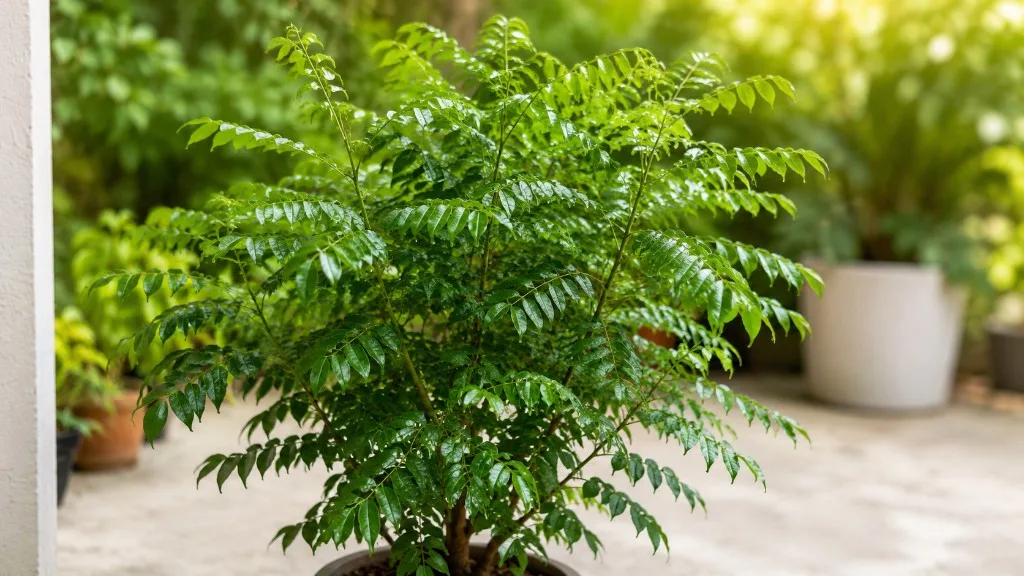
Each mature curry leaf is pinnately compound: a petiole attaches to the stem at a node, then expands into a rachis - the central midrib holding many small leaflets (pinnules). A single compound leaf typically carries 11 to 21 thin, glossy green leaflets, though counts vary with age and conditions.
The node is where pruning activates new growth. Cut 5 to 10 mm above a healthy node at a slight angle, high side toward the bud you want to keep. Cut mid-internode and you leave a stub that may die back. For harvest, your target is the pinnule, not the rachis - leave enough leaflets on each compound leaf that the branch keeps feeding itself.
Harvest vs Structural Pruning
Harvest answers: How do I get leaves for tonight without hurting tomorrow’s supply? Pinch or snip mature leaflets from lower compound leaves, rotate through branches, and leave reserves on each rachis.
Prune answers: How do I keep Curry Leaf Plant overview short, full, and branching from multiple points? Cut woody stems above outward-facing nodes, pinch soft tips, or remove crossing inward branches.
Many cooks cut whole sprigs every time they need leaves. That works as a deliberate combined harvest-and-shorten when you want regrowth below the cut - but as a daily habit it is slower and more stressful than selective leaflet picking. Save stem cuts for shaping days; pick leaflets for routine kitchen use.
What to Check Before You Cut
Walk the plant once before any session:
- Dead, yellow, or mushy stems - remove first; they contribute nothing and may harbor pests.
- Flower bud clusters at tips or leaf axils - note them for deadheading after cleanup.
- Leggy leaders with bare internodes and foliage only at the top - candidates for node cuts in warm weather.
- Bare rachis spikes left from over-picking - trim at the petiole base as cleanup, not as harvest.
- Recent stress - Curry Leaf Plant repotting guide within two weeks, drought wilt, or cold damage means lighter work only.
- Tool cleanliness - wipe bypass blades with rubbing alcohol if you have cut diseased plants recently.
Plan one session’s cuts before you start. You can always remove more wood next week; you cannot reattach a branch.
When to Prune Curry Leaf Plant
Warm-Season Structural Cuts
Schedule shaping, topping, and hard resets during active growth - typically late spring through early fall when temperatures are warm and light is strong. In frost-free regions where the plant grows outdoors year-round, USDA Zones 10–12 support cuts across much of the warm season. In temperate climates where the plant moves indoors for winter, time major cuts just before bringing it outside in spring or before moving it indoors if you need size control - not during the dark, cool indoor months.
Light maintenance - dead wood, one tip pinch on a leggy shoot, snipping a spent bare rachis - can happen whenever you see the problem. UC Master Gardeners note that curry leaf leaves may be harvested anytime for fresh use, which supports gentle daily picking through the growing season.
When Not to Prune
Hold off on hard structural cuts when:
- The plant is recently repotted and roots are still settling
- It is drought-stressed or waterlogged - foliage loss means the canopy is already under pressure
- It sits in dim, cool winter light indoors and cannot push new shoots quickly
- You already removed one-third of foliage within the past three weeks
Emergency removal of dead or diseased wood is the exception - take that off immediately regardless of season.
How to Harvest Curry Leaves Without Pruning Stems
Select deep green, fully expanded compound leaves lower on healthy branches. Young pale leaflets at tips are still building aroma compounds; let them mature first.
Hold the rachis steady and pinch each leaflet at its base, pulling gently sideways. If it does not release cleanly, snip with sharp scissors rather than tearing the rachis skin. Leave at least three to five leaflets on each compound leaf you touch unless you are also making a deliberate pruning cut lower on the stem.
Rotate through the canopy over the week - pick from one or two mature leaves per branch, then move on. A handful of leaflets daily from an established potted plant is sustainable during warm months. Stay under the one-third total foliage rule per session even when picking, not just when cutting wood.
Morning harvest captures leaflets when they are turgid; UC Master Gardeners recommend fresh use and note that leaves freeze well, while drying loses much flavor.
Step-by-Step: Structural Pruning for Bushier Growth
Work in order: cleanup → thin crossing wood → shorten leggy leaders → assess shape.
- Remove dead, damaged, or diseased stems to live tissue.
- Thin crossing or inward-facing branches so light reaches the interior without stripping the trunk bare.
- Shorten leggy leaders by cutting just above an outward-facing node at your target height.
- Step back and check for even foliage at multiple heights - not a flat top with bare legs.
- Collect debris, wipe tools, and place the plant in bright, stable light without jumping into hotter sun the same day.
Pinching Soft Tips on Young Plants
Pinching removes the soft growing tip before it hardens into stiff wood. On a young plant roughly 30 to 45 cm tall, pinch the main leader once to force low side shoots instead of a single trunk. Repeat through warm months whenever a branch adds 5 to 8 cm of bare extension and looks dominant over the rest.
Each pinch is a micro-prune: it redirects energy to lateral buds without the shock of removing large woody sections.
Node Cuts on Leggy Branches
When pinching is not enough - the stem is woody, the internode is long, or the branch overshoots your size limit - make a node cut. Find a node with a healthy bud or small side shoot facing outward. Cut 5 to 10 mm above at roughly 45 degrees, high side on the bud side so water sheds away.
For a branch with foliage only at the tip, cut back to a lower node with a viable bud. Going from 60 cm to 20 cm in one warm-season cut is acceptable if total foliage removal stays under one-third. If several branches need that treatment, stage the work over two to three weeks.
Never cut flush against the node or leave a long bare stub above it.
Remove Flower Buds When Growing for Leaves
Mature plants produce fragrant white flowers in terminal panicles, followed by bluish-black berry-like fruits. Flowering is normal, but it shifts resource allocation toward reproduction. Leaf growth slows, and new compound leaves may be smaller while buds swell and fruit set.
If leaves are your crop, pinch or snip bud clusters as soon as they appear - weekly checks during warm months take seconds. You do not need deep woody cuts; removing the bud head is enough.
Allow flowers on one branch only if you want seeds for propagation; deadhead the rest. Flowering sometimes signals root-bound stress or a seasonal shift when a patio plant returns indoors - deadhead first, then check pot size and light.
How Much Foliage You Can Safely Remove
The one-third rule is the ceiling for any single session combining pruning cuts and heavy harvest: do not remove more than one-third of total green foliage at once. Curry leaf depends on its leaves to photosynthesize and fuel regrowth. Strip half the canopy on a stressed winter windowsill plant and recovery may take months.
Daily leaflet picking usually stays well under one-third because individual pinnules are a small fraction of total leaf area. Trouble comes when daily harvest becomes repeated whole-branch removal or when you pick every leaflet from every compound leaf in one weekend batch for drying.
Young plants under one year: harvest lightly - a few leaflets at a time once multiple branches exist - and skip hard pruning. Established potted plants 60 to 120 cm: moderate daily picking plus seasonal shaping cuts work well. In-ground trees in frost-free climates have more canopy volume but still benefit from rotational picking rather than stripping one limb bare.
When resetting a leggy plant, stage hard pruning: cut back roughly one-third of the longest stems, wait three to four weeks for new shoots, then shorten the next set of leaders.
Tools and Sanitation
Daily harvest: clean fingers for mature leaflets; small sharp scissors for tight clusters or dry rachises.
Structural pruning: bypass pruning shears that slice cleanly through stems up to roughly 6 to 8 mm thick. Avoid anvil pruners on living wood - they crush tissue.
Wipe blades with 70% isopropyl alcohol before you start and between plants. Skip wound sealants; they trap moisture on many woody cuts. Dull scissors crush stems and invite dieback.
Shaping Potted vs In-Ground Plants
Container plants need pruning more often because root volume caps size. Target 60 to 120 cm with a rounded, multi-stemmed shrub - two to three light shaping prunes per growing season plus tip pinches, with daily leaflet harvest that does not remove structural wood. Keep the center moderately open so inner leaves receive light.
In-ground plants in frost-free climates can reach 6 to 15 feet without pruning; head back yearly to keep harvest within reach. Indoor overwintering plants may drop some leaves in autumn - trim only dead material in winter and save shaping for spring.
Recovery After Pruning and Heavy Harvest
Recovery speed depends on temperature, light, root health, and how much foliage you removed.
After a moderate structural prune in warm, bright conditions, expect bud break in two to four weeks and a fuller silhouette in six to eight weeks. Light daily leaflet harvest recovers faster because the rachis stays intact. Hard pruning or accidental over-stripping on a cool windowsill can take several months.
Hold off heavy fertilizer for two to three weeks after a hard cut. Keep watering even and light bright. If no buds appear after six warm weeks, scratch a stem for green cambium - brown dry wood below the cut may mean the branch was already declining.
Signs Your Pruning Routine Is Working
Healthy routines show up on the plant before the kitchen pot:
- New shoots emerging below recent cut points within two to four weeks in warm weather
- Multiple branching points low on the stem, not just one tuft at the tip
- Mature compound leaves forming behind the ones you pick from, without stripped bare branches
- Deep glossy green new growth; mass yellowing after a session points to over-removal or pre-existing stress
- Compact outline in the pot - slightly wider each season, not taller without filling in
Common Pruning and Harvest Mistakes
- Treating every harvest like a prune - cutting whole branches daily shocks the canopy; rotate leaflet picks instead.
- Never pruning - container plants stretch into leggy poles without tip pinches and node cuts.
- Ignoring flower buds - weeks of reduced leaf output while the plant fruits.
- Cutting mid-internode or leaving long stubs - dieback and ugly wood.
- Over-removing on young, repotted, or winter-stressed plants - double stress when foliage is already limited.
- Hard pruning indoors in winter - sticks with no response until spring light returns.
- Bare rachis spikes after over-picking - photosynthesize nothing; snip spent compound leaves at the petiole as cleanup.
Aftercare Once Cuts Are Made
Pruning redirects growth but does not replace fundamentals. Light drives regrowth - a pruned plant in six or more hours of direct sun refills its canopy far faster than one in a dim corner, and legginess often starts as a light problem pruning alone cannot fix. Watering should stay consistent after cuts; drought-to-flood swings push survival mode over branching. Fertilizer helps once new shoots appear, but wait two to three weeks after a hard prune before feeding heavily.
Cool overwintering rooms slow every recovery timeline - accept slower leaflet replacement indoors, or supplement light if year-round harvest volume matters.
Conclusion
Curry leaf plant pruning works best when you keep three jobs separate. Pick leaflets for the kitchen - gently, rotationally, leaving reserves on each compound leaf. Cut stems above nodes when you need bushier growth, lower branching, or a pot-friendly shape. Remove flower buds early if leaves, not berries, are the crop.
Match intensity to season: shape and reset in warm, bright months; harvest lightly indoors; save major cuts for when the plant can answer with new shoots in weeks, not months. Stay under the one-third foliage rule, use clean bypass tools, and watch for buds below cuts and fresh compound leaves behind your pick points - the signs that tomorrow’s harvest is still on the way.
When to use this page vs other Curry Leaf Plant guides
- Curry Leaf Plant overview - Start here for whole-plant context before deep-diving this topic.
- Curry Leaf Plant problems hub - Jump to symptom-specific fix guides when this care topic does not resolve the issue.
- Leggy Growth on Curry Leaf Plant - Escalate here when pruning adjustments are not enough.
- Slow Growth on Curry Leaf Plant - Escalate here when pruning adjustments are not enough.
- Brown Tips on Curry Leaf Plant - Escalate here when pruning adjustments are not enough.